
Report Feature
Software Asset Management Market Trends and Forecast
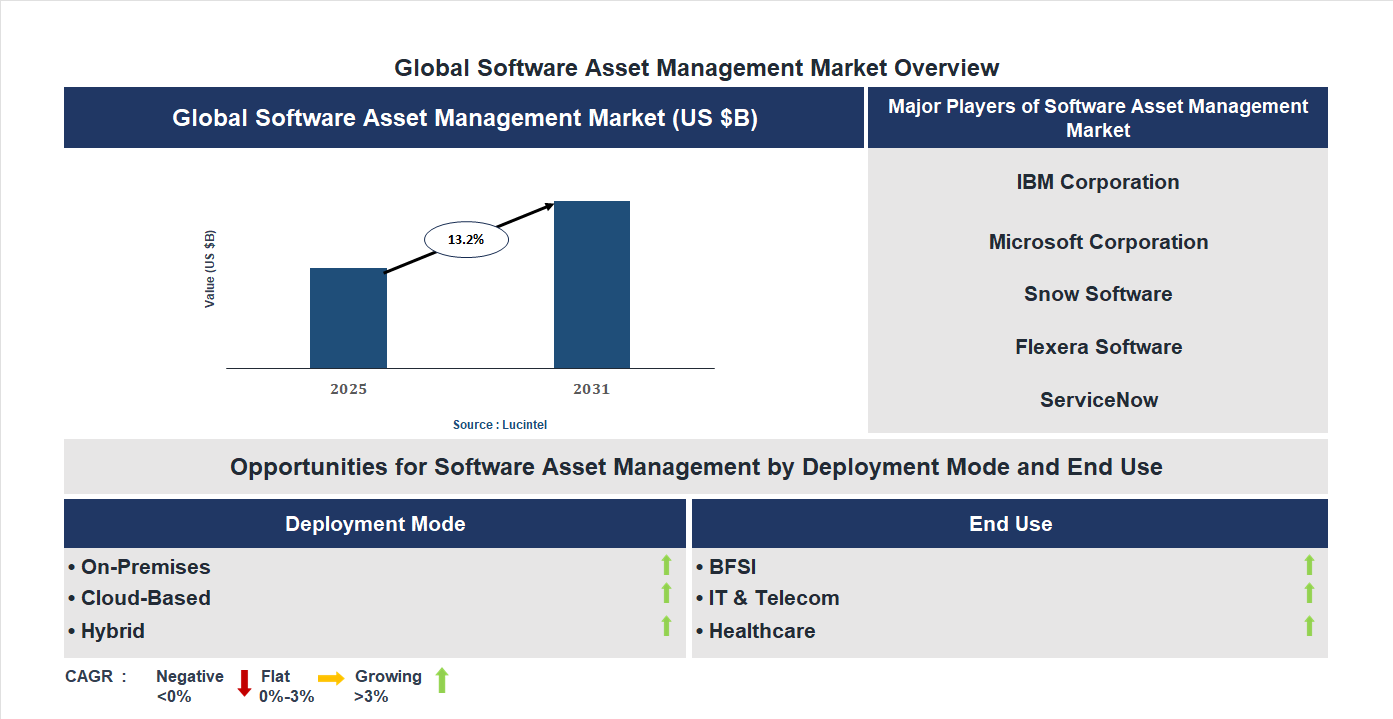
The future of the global software asset management market looks promising with opportunities in the BFSI, IT & telecom, and healthcare markets. The global software asset management market is expected to grow with a CAGR of 13.2% from 2025 to 2031. The major drivers for this market are the increasing need for cost-efficient software management, the rising adoption of cloud-based enterprise solutions, and the growing focus on compliance & security regulations.• Lucintel forecasts that, within the deployment mode category, cloud-based is expected to witness the highest growth over the forecast period.
• Within the end use category, BFSI is expected to witness the highest growth.
• In terms of region, APAC is expected to witness the highest growth over the forecast period. Gain valuable insights for your business decisions with our comprehensive 150+ page report. Sample figures with some insights are shown below.
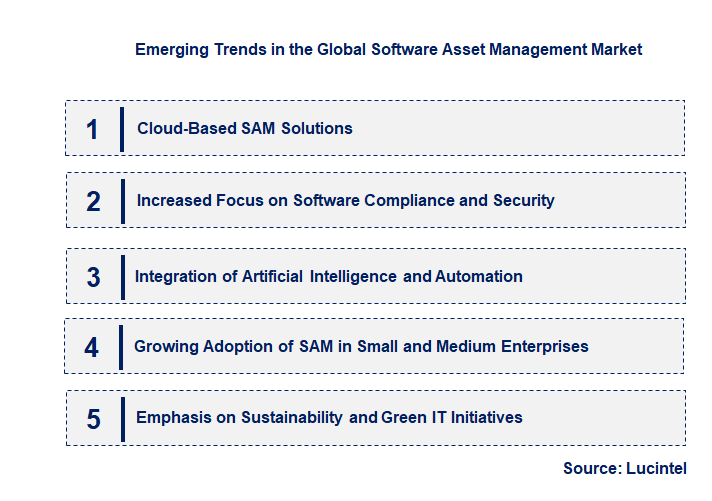
Emerging Trends in the Software Asset Management Market
The software asset management market is experiencing rapid evolution driven by technological advancements, increasing regulatory requirements, and shifting business needs. Organizations are seeking more efficient, compliant, and cost-effective ways to manage their software assets. As digital transformation accelerates, the market is witnessing innovative solutions that enhance visibility, control, and security of software assets. These emerging trends are reshaping how companies approach software management, emphasizing automation, integration, and sustainability. Staying ahead in this competitive landscape requires understanding these key developments, which are set to influence market growth, vendor strategies, and organizational practices significantly.• Cloud-Based SAM Solutions: The shift to cloud computing is transforming SAM by enabling scalable, flexible, and real-time management of software assets. Cloud-based solutions reduce infrastructure costs and improve accessibility, allowing organizations to monitor and optimize software usage across multiple locations seamlessly. They also facilitate rapid deployment and updates, ensuring compliance with licensing agreements. As cloud adoption grows, vendors are increasingly offering SaaS-based SAM tools, making software management more agile and integrated with other cloud services. This trend enhances operational efficiency and supports remote and hybrid work models.
• Increased Focus on Software Compliance and Security: With rising regulatory scrutiny and cyber threats, organizations are prioritizing compliance and security in their SAM strategies. Advanced tools now incorporate automated license tracking, audit readiness features, and vulnerability assessments. This helps prevent costly penalties and data breaches while ensuring adherence to licensing terms. The emphasis on security also drives integration of SAM with cybersecurity solutions, providing a holistic approach to software governance. As compliance standards become more stringent, companies are investing heavily in robust SAM systems to mitigate risks and maintain trust with stakeholders.
• Integration of Artificial Intelligence and Automation: AI and automation are revolutionizing SAM by enabling predictive analytics, intelligent license optimization, and automated workflows. These technologies reduce manual effort, minimize errors, and provide actionable insights for better decision-making. AI-driven tools can forecast software needs, detect unauthorized usage, and recommend cost-saving measures. Automation streamlines routine tasks such as license renewals and compliance reporting, freeing up resources for strategic initiatives. This integration enhances accuracy, efficiency, and agility in managing complex software environments, making SAM more proactive and responsive to organizational changes.
• Growing Adoption of Software Asset Management in Small and Medium Enterprises (SMEs): Traditionally focused on large enterprises, the SAM market is expanding into SMEs due to affordable, easy-to-deploy solutions. Cloud-based and SaaS offerings lower entry barriers, enabling smaller organizations to implement effective software management practices. This trend helps SMEs optimize software spend, ensure compliance, and improve operational efficiency. Vendors are tailoring solutions with simplified interfaces and scalable features to meet the unique needs of smaller businesses. As SMEs recognize the value of SAM, their adoption is expected to drive market growth and innovation.
• Emphasis on Sustainability and Green IT Initiatives: Environmental concerns are influencing SAM strategies, with a focus on reducing software waste and energy consumption. Organizations are adopting sustainable practices such as optimizing license utilization, decommissioning unused software, and leveraging energy-efficient data centers. SAM tools now incorporate features to track and report on software lifecycle impacts, supporting corporate sustainability goals. This trend aligns software management with broader green IT initiatives, promoting responsible resource use and cost savings. As sustainability becomes a priority, it is reshaping how companies approach software procurement, deployment, and disposal. In summary, these emerging trends are fundamentally reshaping the Software Asset Management market by fostering greater agility, security, compliance, and sustainability. They enable organizations to better navigate the complexities of modern software environments, optimize costs, and mitigate risks, ultimately driving market growth and innovation.
Recent Development in the Software Asset Management Market
The software asset management market has experienced significant growth driven by increasing digital transformation, rising cybersecurity concerns, and the need for cost optimization. Organizations are prioritizing efficient management of software assets to ensure compliance, reduce waste, and enhance operational efficiency. Technological advancements and evolving regulatory landscapes are also shaping the market dynamics. Recent developments reflect a shift towards more integrated, automated, and cloud-based solutions, enabling businesses to better manage their software portfolios. These trends are transforming how companies approach software governance, impacting market growth and competitive strategies.• Adoption of AI and Machine Learning: AI-driven SAM solutions are now capable of automating software discovery, license management, and compliance monitoring, reducing manual effort and errors. This enhances accuracy and efficiency, allowing organizations to proactively address compliance issues and optimize software usage, ultimately lowering costs and minimizing risks.
• Cloud-Based SAM Solutions: The shift to cloud computing has led to the rise of cloud-native SAM tools that offer scalability, flexibility, and real-time insights. These solutions facilitate remote management of software assets across distributed environments, supporting hybrid and multi-cloud strategies, and enabling organizations to adapt quickly to changing business needs.
• Increased Focus on Software Compliance and Security: With stricter regulations and rising cyber threats, companies are investing more in SAM to ensure license compliance and prevent software piracy. Enhanced security features integrated into SAM tools help detect vulnerabilities, unauthorized usage, and potential breaches, safeguarding organizational data and reputation.
• Strategic Partnerships and Acquisitions: Major players are forming alliances and acquiring smaller firms to expand their product portfolios and technological capabilities. These collaborations foster innovation, improve service offerings, and strengthen market positioning, providing comprehensive solutions that address diverse customer needs.
• Integration of IoT and Mobile Device Management: The proliferation of IoT devices and mobile platforms has prompted the integration of SAM with IoT and MDM solutions. This development enables organizations to manage a broader range of software assets across various devices and environments, ensuring compliance and optimizing usage in increasingly complex IT landscapes. In summary, these recent developments are significantly transforming the software asset management market by enhancing automation, security, and scalability. The adoption of AI, cloud solutions, and integrated management tools is enabling organizations to achieve better compliance, cost savings, and operational efficiency. Strategic collaborations are further accelerating innovation, positioning the market for sustained growth amid evolving technological and regulatory landscapes.
Strategic Growth Opportunities in the Software Asset Management Market
The software asset management market is experiencing rapid growth driven by increasing digital transformation, rising software compliance requirements, and the need for cost optimization across industries. As organizations seek to streamline their software assets and ensure regulatory adherence, the market presents numerous opportunities for expansion across various applications. Key growth areas include enterprise IT, healthcare, manufacturing, retail, and government sectors. These sectors are adopting advanced SAM solutions to improve operational efficiency, reduce risks, and achieve strategic business objectives. Understanding these opportunities is crucial for stakeholders aiming to capitalize on emerging trends and drive sustainable growth in the evolving SAM landscape.• Enterprise IT: Enhanced Asset Visibility and Cost Control : As enterprises expand their digital infrastructure, there is a growing demand for comprehensive asset management tools that provide real-time visibility into software usage, licensing, and compliance. This helps organizations optimize software investments, prevent overspending, and mitigate compliance risks, ultimately leading to improved operational efficiency and cost savings.
• Healthcare: Regulatory Compliance and Data Security : Healthcare providers require robust SAM solutions to manage complex software licenses and ensure compliance with strict regulations such as HIPAA. Effective SAM enhances data security, reduces legal liabilities, and supports seamless integration of healthcare applications, thereby improving patient care and operational reliability.
• Manufacturing: Streamlining Software Lifecycle Management : Manufacturing firms are adopting SAM to manage the entire software lifecycle, from procurement to decommissioning. This reduces software redundancies, minimizes licensing costs, and ensures that manufacturing operations remain uninterrupted, boosting productivity and reducing operational risks.
• Retail: Enhancing Customer Experience and Inventory Management : Retailers leverage SAM to optimize software used in point-of-sale systems, inventory management, and customer engagement platforms. Improved software utilization leads to better customer service, reduced downtime, and more efficient inventory control, driving sales growth and customer satisfaction.
• Government: Ensuring Security and Compliance in Public Sector : Governments are increasingly implementing SAM solutions to manage diverse software assets across multiple agencies. This ensures compliance with procurement policies, enhances cybersecurity, and promotes transparency, ultimately strengthening public sector governance and reducing fraud risks. In summary, these growth opportunities across key applications are significantly impacting the Software Asset Management market by driving innovation, improving operational efficiencies, and ensuring compliance. As organizations across sectors recognize the strategic value of SAM, the market is poised for sustained expansion, fostering technological advancements and delivering long-term benefits for stakeholders.
Software Asset Management Market Driver and Challenges
The software asset management market is influenced by a complex interplay of technological advancements, economic shifts, and regulatory frameworks. As organizations increasingly rely on software for their operations, the need for efficient management of software assets becomes critical. Rapid technological innovations such as cloud computing and automation are transforming SAM practices, while economic factors like cost optimization drive adoption. Additionally, evolving regulatory requirements around software licensing and compliance impose new challenges and opportunities. These drivers and challenges collectively shape the growth trajectory and strategic approaches within the SAM market, requiring stakeholders to adapt continuously to maintain competitiveness and compliance. The factors responsible for driving the software asset management market include:-• Technological Innovation: The rapid evolution of technology, especially cloud computing, automation, and AI, has significantly enhanced SAM capabilities. Cloud-based solutions enable real-time tracking and management of software assets across distributed environments, reducing manual efforts and errors. Automation tools streamline license compliance and optimize software usage, leading to cost savings. AI-driven analytics provide insights into usage patterns, helping organizations make informed decisions. These technological advancements make SAM more efficient, scalable, and accessible, encouraging widespread adoption across industries seeking to control software costs and ensure compliance.
• Cost Optimization and Efficiency: Organizations are under constant pressure to reduce IT expenses while maximizing software utilization. Effective SAM practices help identify unused or underutilized licenses, preventing unnecessary purchases and reducing waste. By optimizing license allocation, companies can avoid penalties associated with non-compliance and leverage volume licensing agreements more effectively. Cost savings from improved license management directly impact the bottom line, making SAM an essential component of IT financial management. As businesses seek to improve operational efficiency, the demand for sophisticated SAM solutions continues to grow.
• Increasing Regulatory and Compliance Requirements: Governments and industry bodies are imposing stricter regulations regarding software licensing, data security, and intellectual property rights. Organizations must ensure compliance to avoid hefty fines, legal actions, and reputational damage. SAM tools assist in tracking license entitlements, usage, and compliance status, simplifying audit processes. The complexity of licensing models and the proliferation of software vendors further necessitate robust management systems. As regulatory landscapes evolve, companies are compelled to adopt advanced SAM solutions to meet legal obligations and maintain trust with stakeholders.
• Growing Adoption of Cloud and SaaS Models: The shift towards cloud-based and Software-as-a-Service (SaaS) models has transformed software deployment and management. Cloud environments require dynamic and flexible SAM strategies to handle virtualized and on-demand resources. SaaS subscriptions often involve complex licensing terms, making management challenging without specialized tools. The need for real-time monitoring, cost control, and compliance in cloud and SaaS environments drives the adoption of dedicated SAM solutions. This trend expands the market scope, encouraging vendors to develop tailored offerings that address the unique needs of cloud and SaaS users. The challenges facing this software asset management market include:-
• Complexity of Licensing Models: Modern software licensing involves multiple models such as subscription, perpetual, usage-based, and hybrid licenses, each with distinct terms and conditions. Managing these diverse licensing schemes is complex and prone to errors, especially in large organizations with extensive software portfolios. Mismanagement can lead to over-licensing, resulting in unnecessary costs, or under-licensing, risking compliance violations. Keeping track of license entitlements, renewal dates, and usage metrics requires sophisticated tools and expertise. This complexity hampers the efficiency of SAM processes and necessitates ongoing staff training and system updates.
• Rapid Technological Changes: The fast pace of technological innovation, including the emergence of new platforms, tools, and deployment models, challenges existing SAM frameworks. Organizations must continuously update their management strategies to accommodate new software types, licensing terms, and deployment environments. Failure to adapt can lead to gaps in license compliance, security vulnerabilities, and increased operational costs. Keeping pace with technological change demands significant investment in training, system upgrades, and process reengineering, which can strain resources and delay implementation.
• Data Security and Privacy Concerns: As SAM involves extensive data collection and analysis of software usage, it raises concerns about data security and privacy. Sensitive information related to licensing agreements, usage patterns, and organizational assets must be protected against cyber threats and unauthorized access. Compliance with data protection regulations such as GDPR adds another layer of complexity. Mishandling of data can lead to legal penalties, loss of trust, and operational disruptions. Ensuring robust security measures and privacy protocols is essential but can be resource-intensive and challenging to implement effectively. In summary, the SAM market is driven by technological innovations, cost-saving imperatives, regulatory pressures, and the shift to cloud-based models. However, it faces challenges such as licensing complexity, rapid technological change, and data security concerns. These factors collectively influence market growth, requiring organizations to adopt advanced, flexible, and secure SAM solutions. Success in this environment depends on balancing innovation with compliance and security, ultimately shaping a dynamic and competitive landscape.
List of Software Asset Management Companies
Companies in the market compete on the basis of product quality offered. Major players in this market focus on expanding their manufacturing facilities, R&D investments, infrastructural development, and leverage integration opportunities across the value chain. With these strategies software asset management companies cater increasing demand, ensure competitive effectiveness, develop innovative products & technologies, reduce production costs, and expand their customer base. Some of the software asset management companies profiled in this report include-• IBM Corporation
• Microsoft Corporation
• Snow Software
• Flexera Software
• ServiceNow
Software Asset Management Market by Segment
The study includes a forecast for the global software asset management market by deployment mode, end use, and region.Software Asset Management Market by Deployment Mode [Value from 2019 to 2031]:
• On-Premises
• Cloud-Based
• Hybrid
Software Asset Management Market by End Use [Value from 2019 to 2031]:
• BFSI
• IT & Telecom
• Healthcare
Software Asset Management Market by Region [Value from 2019 to 2031]:
• North America
• Europe
• Asia Pacific
• The Rest of the World
Country Wise Outlook for the Software Asset Management Market
The software asset management market has experienced significant growth and transformation driven by increasing digitalization, regulatory compliance demands, and the need for cost optimization. As organizations worldwide seek to streamline software usage and reduce risks, key players are innovating with advanced tools and integrated solutions. The market's evolution is also influenced by emerging technologies such as artificial intelligence and cloud computing, which enhance SAM capabilities. Countries are adopting tailored strategies to address local regulatory environments and technological trends, leading to diverse developments across major economies. These changes reflect a broader shift towards smarter, more efficient software management practices globally.• United States: The US SAM market has seen rapid adoption of AI-powered tools for automated license management and compliance monitoring. Major tech firms are investing in cloud-based solutions to support remote work and hybrid environments. Regulatory pressures, such as GDPR and CCPA, are prompting companies to enhance data security and software governance. Additionally, mergers and acquisitions are consolidating market players, fostering innovation and expanding service portfolios. The US government is also emphasizing software asset transparency, driving public sector investments in advanced SAM solutions.
• China: China's SAM market is expanding with a focus on local compliance and digital transformation initiatives. Government policies encourage software localization and security, leading to increased demand for tailored asset management solutions. Chinese firms are adopting AI and big data analytics to optimize software usage and reduce waste. The rise of domestic software providers is challenging international vendors, fostering a competitive landscape. Cloud adoption is accelerating, with enterprises seeking scalable SAM tools to manage complex software ecosystems across diverse regions.
• Germany: In Germany, the SAM market is characterized by a strong emphasis on regulatory compliance and data privacy, aligned with GDPR standards. Companies are investing in integrated software management platforms that support sustainability and energy efficiency goals. The adoption of automation and AI-driven analytics is improving license optimization and cost control. The manufacturing and automotive sectors are key drivers, requiring precise software tracking for complex supply chains. Additionally, German organizations are increasingly partnering with local vendors to ensure compliance and data sovereignty.
• India: The Indian SAM market is witnessing rapid growth driven by digital transformation and government initiatives like Digital India. Enterprises are adopting cloud-based SAM solutions to manage expanding software portfolios efficiently. Cost optimization remains a priority, prompting organizations to leverage automation and analytics. The market is also seeing increased adoption of AI for license compliance and risk mitigation. Small and medium-sized enterprises are increasingly investing in affordable, scalable solutions to improve software governance, supported by a burgeoning local vendor ecosystem.
• Japan: Japan's SAM market is evolving with a focus on enterprise-wide software governance and security. Companies are integrating AI and IoT technologies to enhance license management and operational efficiency. The emphasis on cybersecurity and compliance with local regulations is prompting investments in advanced SAM tools. The manufacturing and technology sectors are leading adopters, seeking to streamline complex software environments. Additionally, Japanese firms are exploring sustainable practices, incorporating energy-efficient software management solutions to meet environmental goals.

Features of the Global Software Asset Management Market
Market Size Estimates: Software asset management market size estimation in terms of value ($B). Trend and Forecast Analysis: Market trends (2019 to 2024) and forecast (2025 to 2031) by various segments and regions. Segmentation Analysis: Software asset management market size by deployment mode, end use, and region in terms of value ($B). Regional Analysis: Software asset management market breakdown by North America, Europe, Asia Pacific, and Rest of the World. Growth Opportunities: Analysis of growth opportunities in different deployment mode, end uses, and regions for the software asset management market. Strategic Analysis: This includes M&A, new product development, and competitive landscape of the software asset management market. Analysis of competitive intensity of the industry based on Porter’s Five Forces model.
FAQ
Q1. What is the growth forecast for software asset management market? Answer: The global software asset management market is expected to grow with a CAGR of 13.2% from 2025 to 2031. Q2. What are the major drivers influencing the growth of the software asset management market? Answer: The major drivers for this market are the increasing need for cost-efficient software management, the rising adoption of cloud-based enterprise solutions, and the growing focus on compliance & security regulations. Q3. What are the major segments for software asset management market? Answer: The future of the software asset management market looks promising with opportunities in the BFSI, IT & telecom, and healthcare markets. Q4. Who are the key software asset management market companies? Answer: Some of the key software asset management companies are as follows:• IBM Corporation
• Microsoft Corporation
• Snow Software
• Flexera Software
• ServiceNow Q5. Which software asset management market segment will be the largest in future? Answer: Lucintel forecasts that, within the deployment mode category, cloud-based is expected to witness the highest growth over the forecast period. Q6. In software asset management market, which region is expected to be the largest in next 5 years? Answer: In terms of region, APAC is expected to witness the highest growth over the forecast period. Q7. Do we receive customization in this report? Answer: Yes, Lucintel provides 10% customization without any additional cost.
Table of Contents
List of Figures
List of Tables
Methodology
- In-depth interviews of the major players in this market
- Detailed secondary research from competitors’ financial statements and published data
- Extensive searches of published works, market, and database information pertaining to industry news, company press releases, and customer intentions
- A compilation of the experiences, judgments, and insights of Lucintel’s professionals, who have analyzed and tracked this market over the years.


Buy Now
Choose a license that fits your team. Instant PDF delivery.
Prices exclude taxes. Instant delivery. Custom licensing available on request.
Key Questions
- • What are some of the most promising, high-growth opportunities for the software asset management market by deployment mode (on-premises, cloud-based, and hybrid), end use (BFSI, IT & telecom, and healthcare), and region (North America, Europe, Asia Pacific, and the Rest of the World)?
- • Which segments will grow at a faster pace and why?
- • Which region will grow at a faster pace and why?
- • What are the key factors affecting market dynamics? What are the key challenges and business risks in this market?
- • What are the business risks and competitive threats in this market?
- • What are the emerging trends in this market and the reasons behind them?
- • What are some of the changing demands of customers in the market?
- • What are the new developments in the market? Which companies are leading these developments?
- • Who are the major players in this market? What strategic initiatives are key players pursuing for business growth?
- • What are some of the competing products in this market and how big of a threat do they pose for loss of market share by material or product substitution?
- • What M&A activity has occurred in the last 5 years and what has its impact been on the industry? For any questions related to Software Asset Management Market, Software Asset Management Market Size, Software Asset Management Market Growth, Software Asset Management Market Analysis, Software Asset Management Market Report, Software Asset Management Market Share, Software Asset Management Market Trends, Software Asset Management Market Forecast, Software Asset Management Companies, write Lucintel analyst at email: helpdesk@lucintel.com. We will be glad to get back to you soon.


