
Report Feature
Social Business Intelligence Market Trends and Forecast
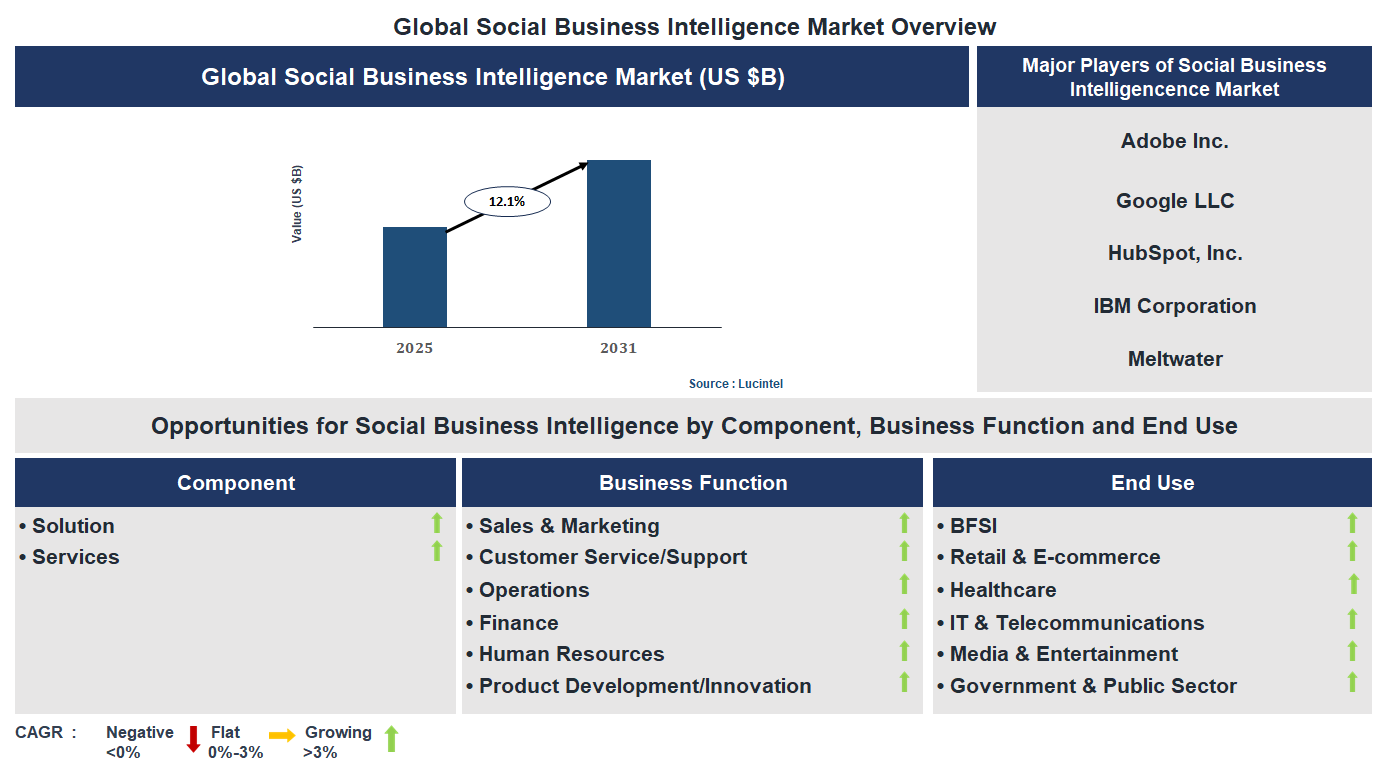
The future of the global social business intelligence market looks promising with opportunities in the BFSI, retail & E-commerce, healthcare, IT & telecommunication, media & entertainment, and government & public sector markets. The global social business intelligence market is expected to grow with a CAGR of 12.1% from 2025 to 2031. The major drivers for this market are the increasing need for data-driven decision making, the rising adoption of social media analytics, and the growing demand for real-time business insights.• Lucintel forecasts that, within the component category, solution is expected to witness higher growth over the forecast period.
• Within the end use category, BFSI is expected to witness the highest growth.
• In terms of region, North America is expected to witness the highest growth over the forecast period. Gain valuable insights for your business decisions with our comprehensive 150+ page report. Sample figures with some insights are shown below.
Emerging Trends in the Social Business Intelligence Market
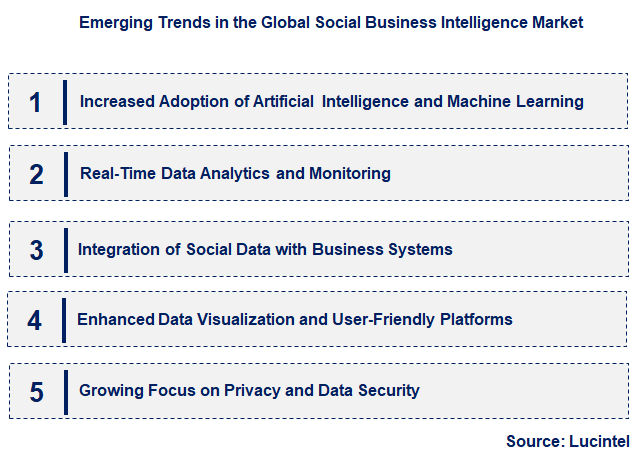
The social business intelligence market is experiencing rapid evolution driven by technological advancements and changing organizational needs. As companies seek deeper insights from social data, new tools and strategies are emerging to enhance decision-making, customer engagement, and competitive advantage. These developments are transforming how businesses analyze social interactions, measure brand sentiment, and predict market trends. The integration of AI, real-time analytics, and user-friendly platforms is making social business intelligence more accessible and impactful across industries. This dynamic landscape is reshaping the market, fostering innovation, and creating new opportunities for growth and competitive differentiation.• Increased Adoption of Artificial Intelligence and Machine Learning: AI and ML are revolutionizing social business intelligence by enabling automated data analysis, sentiment detection, and predictive analytics. These technologies allow businesses to process vast amounts of social data quickly and accurately, uncover hidden patterns, and forecast future trends. The impact is significant, as companies can respond proactively to customer needs, identify emerging issues, and personalize marketing strategies. AI-driven insights improve decision-making efficiency and accuracy, giving organizations a competitive edge in understanding social dynamics and consumer behavior.
• Real-Time Data Analytics and Monitoring: The demand for real-time insights is growing as organizations recognize the importance of immediate data analysis for timely decision-making. Advanced analytics platforms now offer live dashboards and instant alerts for social media activity, brand mentions, and customer feedback. This trend enhances responsiveness, allowing companies to address crises swiftly, capitalize on trending topics, and engage with audiences more effectively. Real-time analytics also support dynamic marketing campaigns and proactive reputation management, making social business intelligence more agile and impactful.
• Integration of Social Data with Business Systems: Companies are increasingly integrating social media data with existing enterprise systems such as CRM, ERP, and marketing automation tools. This integration provides a holistic view of customer interactions, preferences, and behaviors, enabling more personalized and targeted marketing efforts. It also facilitates cross-departmental collaboration and data-driven decision-making. The impact is a more unified approach to customer engagement, improved operational efficiency, and enhanced ability to measure social media ROI within broader business strategies.
• Enhanced Data Visualization and User-Friendly Platforms: The market is witnessing a shift towards intuitive, visually appealing dashboards and analytics tools that require minimal technical expertise. These platforms empower non-technical users to explore social data, generate reports, and derive insights independently. Improved visualization techniques help in better understanding complex data sets and communicating findings effectively. This trend democratizes social business intelligence, broadening its adoption across various organizational levels and fostering a data-driven culture.
• Growing Focus on Privacy and Data Security: As social data collection expands, concerns over user privacy and data security are intensifying. Regulations such as GDPR and CCPA influence how companies gather, store, and analyze social information. Market players are investing in secure data handling practices, anonymization techniques, and compliance tools to build trust and avoid legal repercussions. This focus ensures responsible data usage, enhances brand reputation, and aligns social intelligence practices with ethical standards, ultimately shaping the market’s future direction. In summary, these emerging trends are fundamentally reshaping the social business intelligence market by making insights more timely, accurate, integrated, accessible, and ethically managed. They enable organizations to leverage social data more effectively, fostering innovation and competitive advantage in an increasingly digital and social-driven landscape.
Recent Development in the Social Business Intelligence Market
The social business intelligence market has experienced rapid growth driven by the increasing need for organizations to harness social media data for strategic decision-making. As digital interactions expand, companies seek advanced tools to analyze social trends, customer sentiment, and competitive insights. Recent developments reflect technological innovations, evolving user demands, and the integration of AI and machine learning. These changes are transforming how businesses operate, compete, and engage with their audiences. Staying abreast of these developments is crucial for stakeholders aiming to leverage social data effectively and maintain a competitive edge in this dynamic landscape.• Adoption of AI and Machine Learning: The integration of AI and machine learning algorithms into social BI tools has enhanced data analysis capabilities. These technologies enable real-time sentiment analysis, predictive analytics, and automated insights, improving decision-making accuracy. This development allows businesses to respond swiftly to social trends, identify emerging opportunities, and mitigate risks more effectively, thereby increasing overall market competitiveness.
• Increased Focus on Data Privacy and Security: With rising concerns over data privacy, social BI providers are implementing stricter security measures and compliance protocols. Enhanced encryption, anonymization techniques, and adherence to regulations like GDPR have become standard. This focus builds user trust, ensures legal compliance, and encourages broader adoption of social BI solutions, ultimately expanding the market.
• Integration with Other Business Systems: Social BI tools are increasingly being integrated with CRM, ERP, and marketing automation platforms. This seamless connectivity allows for a holistic view of customer interactions and operational data, facilitating more comprehensive insights. Such integration improves workflow efficiency, enhances personalization strategies, and drives better business outcomes, fueling market growth.
• Emergence of Advanced Visualization and Reporting: New visualization tools and customizable dashboards have made social data more accessible and understandable. Interactive charts, real-time reporting, and intuitive interfaces enable non-technical users to interpret complex social insights easily. This democratization of data analysis broadens the user base and accelerates decision-making processes across organizations.
• Growth of Mobile and Cloud-Based Solutions: The shift towards mobile-friendly and cloud-based social BI platforms has increased accessibility and scalability. These solutions support remote work, facilitate collaboration, and reduce infrastructure costs. As organizations prioritize flexibility and agility, the market benefits from wider adoption of cloud-enabled social BI tools, fostering innovation and expansion. In summary, these developments are significantly impacting the social business intelligence market by enhancing analytical capabilities, ensuring data security, fostering integration, improving user accessibility, and promoting flexible deployment options. Collectively, they are driving market expansion, increasing adoption rates, and enabling businesses to derive more value from social data, positioning the market for sustained growth.
Strategic Growth Opportunities in the Social Business Intelligence Market
The social business intelligence market is experiencing rapid growth driven by increasing demand for data-driven decision-making and the proliferation of social media platforms. Organizations are leveraging social data to enhance customer engagement, improve operational efficiency, and gain competitive advantages. As digital transformation accelerates, key applications within this market are poised for significant expansion, creating new opportunities for vendors and users alike. These developments are shaping the future landscape of social business intelligence, making it essential for businesses to adapt and innovate to stay ahead in this dynamic environment.• Customer Engagement Enhancement: Utilizing social data to better understand customer needs and preferences, leading to personalized marketing strategies and improved customer satisfaction. This boosts brand loyalty and drives revenue growth.
• Competitive Analysis: Monitoring social media activities of competitors to identify strengths, weaknesses, and market trends. This enables companies to refine their strategies, anticipate market shifts, and maintain a competitive edge.
• Brand Reputation Management: Tracking social mentions and sentiment analysis to manage and improve brand perception. Proactive reputation management helps prevent crises and builds trust with consumers.
• Product Development Insights: Analyzing social feedback and discussions to identify unmet needs and emerging trends. This accelerates innovation and helps tailor products to market demands.
• Internal Business Optimization: Leveraging social data for internal decision-making, collaboration, and process improvements. This enhances operational efficiency and supports strategic planning. These growth opportunities are significantly impacting the social business intelligence market by fostering innovation, increasing adoption across industries, and enabling organizations to make more informed, agile decisions in a competitive digital landscape.
Social Business Intelligence Market Driver and Challenges
The social business intelligence market is influenced by a variety of technological, economic, and regulatory factors that shape its growth and development. Advances in data analytics, increasing adoption of social media platforms, and the need for real-time insights are key technological drivers. Economic factors such as rising investments in digital transformation and the growing importance of customer-centric strategies further propel the market. Regulatory considerations, including data privacy laws and compliance requirements, also impact market dynamics. Together, these factors create a complex environment that offers significant opportunities while presenting notable challenges for stakeholders aiming to leverage social business intelligence effectively. The factors responsible for driving the social business intelligence market include:-• Technological Innovation: The rapid evolution of data analytics tools and AI-driven algorithms enhances the ability to extract meaningful insights from social media data. These innovations enable businesses to monitor brand reputation, understand customer sentiment, and identify emerging trends in real time. As technology becomes more sophisticated and accessible, organizations across industries are increasingly integrating social BI solutions into their decision-making processes, leading to market expansion and increased competitiveness.
• Growing Social Media Usage: The exponential rise in social media platforms such as Facebook, Twitter, LinkedIn, and Instagram has created a vast pool of user-generated data. This data provides valuable insights into consumer behavior, preferences, and opinions. Companies leverage social BI tools to analyze this data for targeted marketing, customer engagement, and product development. The proliferation of social media usage directly correlates with increased demand for social business intelligence solutions, fueling market growth.
• Increasing Need for Data-Driven Decision Making: Businesses are recognizing the importance of making informed decisions based on comprehensive data analysis. Social BI offers real-time insights that help organizations respond swiftly to market changes, customer feedback, and competitive threats. This shift towards data-driven strategies enhances operational efficiency and customer satisfaction, thereby driving demand for advanced social BI platforms and services.
• Regulatory and Privacy Concerns: The implementation of data privacy laws such as GDPR and CCPA imposes strict guidelines on data collection, storage, and usage. These regulations influence how social BI tools are developed and deployed, requiring companies to ensure compliance to avoid penalties. While regulatory frameworks aim to protect consumer rights, they also pose challenges related to data accessibility and integration, impacting the growth trajectory of the social BI market. The challenges facing this social business intelligence market include:-
• Data Privacy and Security Issues: As social BI relies heavily on collecting and analyzing vast amounts of user data, concerns over privacy breaches and data security are prominent. Organizations must navigate complex legal landscapes and implement robust security measures to protect sensitive information. Failure to do so can result in legal penalties, loss of consumer trust, and reputational damage, which hinder market growth and adoption.
• Data Quality and Integration Challenges: Social media data is often unstructured, noisy, and inconsistent, making it difficult to extract accurate insights. Integrating data from multiple sources and ensuring its quality requires sophisticated tools and expertise. These challenges can lead to unreliable analytics, increased costs, and delays in deployment, thereby limiting the effectiveness and scalability of social BI solutions.
• Rapid Technological Changes: The fast-paced evolution of social media platforms and analytics technologies demands continuous updates and adaptations. Companies face difficulties in keeping up with new features, algorithms, and data formats, which can render existing tools obsolete quickly. This constant need for innovation increases operational costs and complicates long-term planning, posing a significant challenge to sustained market growth. In summary, the social business intelligence market is driven by technological advancements, increasing social media engagement, and the demand for data-driven decision-making. However, it faces challenges related to data privacy, quality, and rapid technological changes. These factors collectively influence the market’s trajectory, requiring stakeholders to innovate continuously while navigating regulatory and security concerns. Overall, the market’s growth potential remains significant, provided these challenges are effectively managed through strategic investments and compliance efforts.
List of Social Business Intelligence Companies
Companies in the market compete on the basis of product quality offered. Major players in this market focus on expanding their manufacturing facilities, R&D investments, infrastructural development, and leverage integration opportunities across the value chain. With these strategies social business intelligence companies cater increasing demand, ensure competitive effectiveness, develop innovative products & technologies, reduce production costs, and expand their customer base. Some of the social business intelligence companies profiled in this report include-• Adobe Inc.
• Google LLC
• HubSpot, Inc.
• IBM Corporation
• Meltwater
• Microsoft
• Oracle
• SAP SE
• Salesforce, Inc.
• Sprinklr Inc.
Social Business Intelligence Market by Segment
The study includes a forecast for the global social business intelligence market by component, business function, end use, and region.Social Business Intelligence Market by Component [Value from 2019 to 2031]:
• Solution
• Services
Social Business Intelligence Market by Business Function [Value from 2019 to 2031]:
• Sales & Marketing
• Customer Service/Support
• Operations
• Finance
• Human Resources
• Product Development/Innovation
Social Business Intelligence Market by End Use [Value from 2019 to 2031]:
• BFSI
• Retail & E-commerce
• Healthcare
• IT & Telecommunications
• Media & Entertainment
• Government & Public Sector
Social Business Intelligence Market by Region [Value from 2019 to 2031]:
• North America
• Europe
• Asia Pacific
• The Rest of the World
Country Wise Outlook for the Social Business Intelligence Market
The social business intelligence market has experienced rapid growth driven by increasing demand for data-driven decision-making, advancements in AI and analytics technologies, and the proliferation of social media platforms. Organizations worldwide are leveraging social data to enhance customer engagement, improve marketing strategies, and gain competitive advantages. The markets evolution reflects a shift towards more integrated, real-time analytics solutions that cater to diverse industry needs. As digital transformation accelerates globally, key players are innovating to offer more sophisticated tools, fostering a dynamic and competitive landscape across major economies.• United States: The US market has seen significant advancements with the integration of AI-powered analytics tools, enabling real-time social media monitoring and sentiment analysis. Major tech firms are investing heavily in developing comprehensive BI platforms that combine social data with traditional business metrics. The adoption of cloud-based solutions has increased, facilitating scalable and accessible analytics for enterprises of all sizes. Additionally, regulatory frameworks around data privacy are influencing how social data is collected and used, prompting innovations in anonymization and compliance features.
• China: Chinas social BI market is rapidly expanding, driven by the widespread use of social media platforms like WeChat and Weibo. Local companies are focusing on AI-driven insights tailored to the Chinese market, including sentiment analysis and consumer behavior prediction. Government initiatives to promote digital economy development are supporting the growth of domestic BI providers. Innovations include advanced social listening tools and integration with e-commerce platforms, enabling brands to optimize marketing strategies and customer engagement effectively.
• Germany: The German market emphasizes data privacy and security, aligning with strict EU regulations such as GDPR. Companies are adopting privacy-compliant social BI solutions that focus on secure data handling and anonymization. There is a strong focus on integrating social BI with existing enterprise systems to enhance operational efficiency. German firms are also investing in AI and machine learning to improve predictive analytics and automate insights, particularly in manufacturing, automotive, and retail sectors.
• India: The Indian social BI market is witnessing rapid growth due to increasing social media usage and digital adoption among businesses. Startups and large enterprises are leveraging social analytics to understand consumer preferences and improve marketing ROI. Cloud-based platforms are popular for their affordability and scalability. Innovations include localized sentiment analysis and regional language support, enabling businesses to tap into diverse markets and enhance customer engagement across various Indian languages and cultures.
• Japan: Japans market is characterized by a focus on integrating social BI with IoT and automation technologies. Companies are utilizing social data to enhance product development, customer service, and brand management. There is a growing emphasis on data privacy and security, aligning with national regulations. Japanese firms are also investing in AI-driven predictive analytics to anticipate market trends and consumer needs, particularly in sectors like electronics, automotive, and retail, fostering a more proactive approach to social business intelligence.

Features of the Global Social Business Intelligence Market
Market Size Estimates: Social business intelligence market size estimation in terms of value ($B). Trend and Forecast Analysis: Market trends (2019 to 2024) and forecast (2025 to 2031) by various segments and regions. Segmentation Analysis: Social business intelligence market size by component, business function, end use, and region in terms of value ($B). Regional Analysis: Social business intelligence market breakdown by North America, Europe, Asia Pacific, and Rest of the World. Growth Opportunities: Analysis of growth opportunities in different component, business function, end use, and regions for the social business intelligence market. Strategic Analysis: This includes M&A, new product development, and competitive landscape of the social business intelligence market. Analysis of competitive intensity of the industry based on Porter’s Five Forces model.
FAQ
Q1. What is the growth forecast for social business intelligence market? Answer: The global social business intelligence market is expected to grow with a CAGR of 12.1% from 2025 to 2031. Q2. What are the major drivers influencing the growth of the social business intelligence market? Answer: The major drivers for this market are the increasing need for data-driven decision making, the rising adoption of social media analytics, and the growing demand for real-time business insights. Q3. What are the major segments for social business intelligence market? Answer: The future of the social business intelligence market looks promising with opportunities in the BFSI, retail & E-commerce, healthcare, IT & telecommunication, media & entertainment, and government & public sector markets. Q4. Who are the key social business intelligence market companies? Answer: Some of the key social business intelligence companies are as follows:• Adobe Inc.
• Google LLC
• HubSpot, Inc.
• IBM Corporation
• Meltwater
• Microsoft
• Oracle
• SAP SE
• Salesforce, Inc.
• Sprinklr Inc. Q5. Which social business intelligence market segment will be the largest in future? Answer: Lucintel forecasts that, within the component category, solution is expected to witness higher growth over the forecast period. Q6. In social business intelligence market, which region is expected to be the largest in next 5 years? Answer: In terms of region, North America is expected to witness the highest growth over the forecast period. Q7. Do we receive customization in this report? Answer: Yes, Lucintel provides 10% customization without any additional cost.
Table of Contents
List of Figures
List of Tables
Methodology
- In-depth interviews of the major players in this market
- Detailed secondary research from competitors’ financial statements and published data
- Extensive searches of published works, market, and database information pertaining to industry news, company press releases, and customer intentions
- A compilation of the experiences, judgments, and insights of Lucintel’s professionals, who have analyzed and tracked this market over the years.


Key Questions
- • What are some of the most promising, high-growth opportunities for the social business intelligence market by component (solution and services), business function (sales & marketing, customer service/support, operations, finance, human resources, and product development/innovation), end use (BFSI, retail & E-commerce, healthcare, IT & telecommunications, media & entertainment, and government & public sector), and region (North America, Europe, Asia Pacific, and the Rest of the World)?
- • Which segments will grow at a faster pace and why?
- • Which region will grow at a faster pace and why?
- • What are the key factors affecting market dynamics? What are the key challenges and business risks in this market?
- • What are the business risks and competitive threats in this market?
- • What are the emerging trends in this market and the reasons behind them?
- • What are some of the changing demands of customers in the market?
- • What are the new developments in the market? Which companies are leading these developments?
- • Who are the major players in this market? What strategic initiatives are key players pursuing for business growth?
- • What are some of the competing products in this market and how big of a threat do they pose for loss of market share by material or product substitution?
- • What M&A activity has occurred in the last 5 years and what has its impact been on the industry? For any questions related to Social Business Intelligence Market, Social Business Intelligence Market Size, Social Business Intelligence Market Growth, Social Business Intelligence Market Analysis, Social Business Intelligence Market Report, Social Business Intelligence Market Share, Social Business Intelligence Market Trends, Social Business Intelligence Market Forecast, Social Business Intelligence Companies, write Lucintel analyst at email: helpdesk@lucintel.com. We will be glad to get back to you soon.


