
Report Feature
Snowboard Rental Market Trends and Forecast
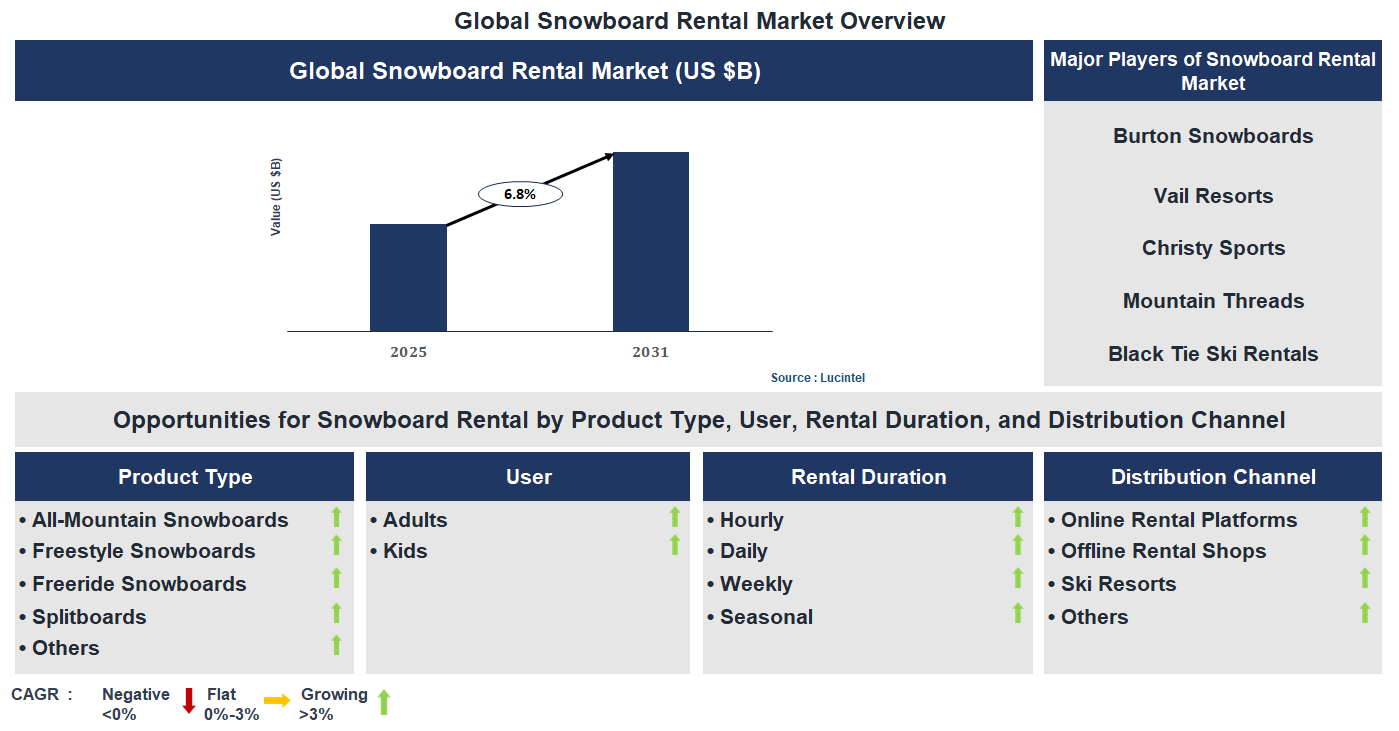
The future of the global snowboard rental market looks promising with opportunities in the online rental platform, offline rental shop, and ski resort markets. The global snowboard rental market is expected to grow with a CAGR of 6.8% from 2025 to 2031. The major drivers for this market are the increasing popularity of winter sports activities, the rising demand for cost-effective rentals, and the growing trend of outdoor adventure tourism.• Lucintel forecasts that, within the product type category, all-mountain snowboard is expected to witness the highest growth over the forecast period.
• Within the distribution channel category, online rental platform is expected to witness the highest growth.
• In terms of region, North America is expected to witness the highest growth over the forecast period. Gain valuable insights for your business decisions with our comprehensive 150+ page report. Sample figures with some insights are shown below.
Emerging Trends in the Snowboard Rental Market
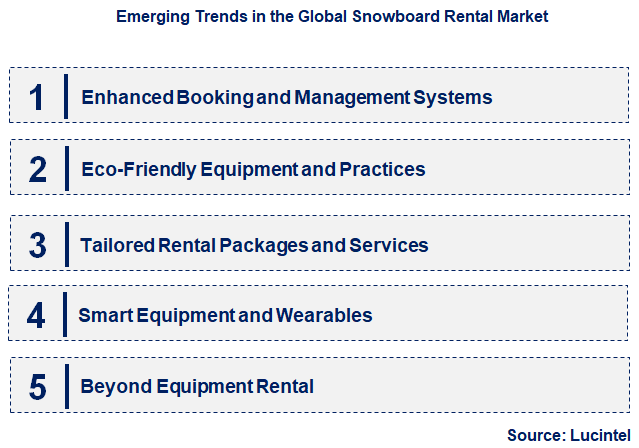
The snowboard rental market is experiencing a significant transformation driven by technological advancements, changing consumer preferences, and environmental considerations. As winter sports enthusiasts seek more convenient, sustainable, and personalized experiences, industry players are adapting rapidly. These emerging trends are reshaping how rentals are offered, managed, and experienced, leading to increased competition and innovation. Understanding these key developments is essential for stakeholders aiming to stay ahead in this dynamic market. The following five trends highlight the most impactful changes currently shaping the snowboard rental industry.• Enhanced Booking and Management Systems: The adoption of digital platforms allows customers to reserve and customize rentals online, streamlining the process. Advanced management software helps rental shops optimize inventory, track usage, and improve customer service. This integration reduces wait times, increases operational efficiency, and offers a seamless experience, attracting tech-savvy consumers. As a result, rental businesses can better meet customer expectations and expand their reach through mobile apps and online portals.
• Eco-Friendly Equipment and Practices: Growing environmental awareness is prompting rental companies to incorporate sustainable practices. This includes offering eco-friendly snowboards made from recycled or biodegradable materials and implementing energy-efficient operations. Additionally, shops are promoting responsible usage and recycling programs. These initiatives appeal to environmentally conscious consumers and help companies reduce their carbon footprint, aligning the market with global sustainability goals and enhancing brand reputation.
• Tailored Rental Packages and Services: Consumers increasingly seek personalized experiences, prompting rental providers to offer customized packages based on skill level, riding style, and preferences. This includes adjustable equipment, personalized fitting, and specialized accessories. Such tailored services improve customer satisfaction and loyalty, encouraging repeat business. Personalization also enables rental shops to differentiate themselves in a competitive market and cater to a broader demographic, from beginners to advanced riders.
• Smart Equipment and Wearables: The integration of smart technology into snowboarding equipment is revolutionizing the rental experience. Sensors embedded in boards and wearables provide real-time feedback on performance, technique, and safety. This data-driven approach enhances training, reduces injury risks, and appeals to tech enthusiasts. Smart equipment also facilitates remote diagnostics and maintenance, reducing downtime and costs for rental providers and offering a cutting-edge experience for users.
• Beyond Equipment Rental: The market is shifting towards providing comprehensive winter sports experiences rather than just equipment rental. This includes guided tours, skill clinics, and social events that foster community engagement. Rental shops are partnering with resorts to offer bundled packages that include lessons, accommodations, and activities. This trend enhances customer engagement, increases revenue streams, and positions rental providers as holistic service providers, elevating the overall winter sports experience. In summary, these trends are fundamentally reshaping the snowboard rental market by emphasizing digitalization, sustainability, personalization, technological innovation, and experiential offerings. They are driving increased customer satisfaction, operational efficiency, and market competitiveness, ensuring the industry remains vibrant and responsive to evolving consumer demands.
Recent Development in the Snowboard Rental Market
The snowboard rental market has experienced significant changes driven by technological advancements, shifting consumer preferences, and global economic factors. As winter sports continue to grow in popularity worldwide, rental companies are innovating to meet increasing demand while adapting to environmental concerns and digital transformation. These developments are shaping the competitive landscape, influencing customer experiences, and impacting revenue streams. Stakeholders are focusing on sustainability, digital integration, and expanding service offerings to stay ahead. The following are five key recent developments that are transforming the snowboard rental market and shaping its future trajectory.• Adoption of Digital Booking Platforms: The integration of online reservation systems has streamlined the rental process, allowing customers to book equipment in advance. This reduces wait times, enhances convenience, and improves inventory management for rental companies. As a result, customer satisfaction has increased, leading to higher retention rates and expanded market reach.
• Implementation of Eco-Friendly Practices: Rental companies are increasingly adopting sustainable practices, such as using eco-friendly materials for equipment and promoting recycling initiatives. These efforts appeal to environmentally conscious consumers and help reduce the industry's carbon footprint, aligning with global sustainability goals and attracting a broader customer base.
• Expansion of Equipment Customization Options: Companies now offer personalized snowboard fittings and customization services, including tailored bindings and boots. This enhances the customer experience by providing equipment that fits better and performs optimally, encouraging repeat rentals and positive word-of-mouth promotion.
• Integration of Wearable Technology: The use of wearable devices and sensors to monitor snowboard performance and safety has gained popularity. This innovation improves rider safety, provides valuable data for rental companies to optimize equipment, and appeals to tech-savvy consumers seeking enhanced experiences.
• Growth in Mobile Payment and Contactless Transactions: The adoption of mobile payment options and contactless transactions has accelerated, especially post-pandemic. This development ensures safer, faster, and more hygienic rental processes, boosting customer confidence and operational efficiency. In summary, these recent developments are significantly impacting the snowboard rental market by enhancing customer convenience, promoting sustainability, and integrating advanced technology. These changes are driving growth, improving operational efficiency, and positioning rental companies to better meet evolving consumer expectations in a competitive landscape.
Strategic Growth Opportunities in the Snowboard Rental Market
The snowboard rental market is experiencing significant growth driven by increasing participation in winter sports, rising tourism in snowboarding destinations, and the growing popularity of eco-friendly travel options. As consumers seek affordable and flexible options for snowboarding experiences, rental services are expanding their offerings and technological integration. Key applications such as resorts, travel agencies, retail outlets, online platforms, and corporate rentals are pivotal in shaping market dynamics. These developments present numerous opportunities for market players to innovate, enhance customer experience, and expand their reach. The following are five key growth opportunities across these applications that are expected to influence the market substantially.• Enhanced Customer Experience: Resorts are investing in advanced rental systems and personalized services, improving customer satisfaction and loyalty. This leads to increased rental volumes and higher revenue streams, attracting more visitors seeking seamless snowboarding experiences.
• Package Deal Integration: Travel agencies are incorporating snowboard rentals into comprehensive holiday packages, making snowboarding more accessible and convenient for tourists. This integration boosts rental demand and promotes winter tourism growth.
• Omni-channel Sales Strategies: Retailers are adopting online and offline sales channels, offering rental reservations and pick-up options. This approach broadens customer reach, increases rental transactions, and enhances brand visibility.
• Digital Booking and Management: Online rental platforms streamline booking processes, provide real-time availability, and offer flexible rental durations. This digital transformation improves user experience, increases rental frequency, and expands market penetration.
• B2B Partnerships and Events: Companies are leveraging snowboard rentals for corporate events, team-building activities, and promotional campaigns. This creates new revenue streams and positions snowboarding as a popular corporate activity. In summary, these growth opportunities are significantly impacting the snowboard rental market by driving innovation, expanding customer base, and increasing revenue streams across various applications. As market players capitalize on these trends, the industry is poised for sustained growth and increased competitiveness.
Snowboard Rental Market Driver and Challenges
The snowboard rental market is influenced by a variety of technological, economic, and regulatory factors that shape its growth and sustainability. Advances in rental technology, changing consumer preferences, economic fluctuations, and government policies all play crucial roles. These elements can either propel the market forward or pose significant hurdles. Understanding these drivers and challenges is essential for stakeholders to develop effective strategies, capitalize on opportunities, and mitigate risks. As the market evolves, staying attuned to these factors will be vital for maintaining competitiveness and ensuring long-term success in the dynamic snowboarding industry. The factors responsible for driving the snowboard rental market include:-• Technological Advancements: The integration of online booking platforms, mobile apps, and automated rental systems has streamlined the rental process, making it more convenient for customers. These innovations enhance user experience, reduce operational costs, and enable real-time inventory management. As technology continues to evolve, rental companies can offer personalized services, improve efficiency, and expand their reach to a broader customer base, thereby fueling market growth.
• Increasing Tourism in Snow Sports Destinations: The growing popularity of snowboarding as a leisure activity attracts tourists to winter resorts worldwide. The influx of tourists seeking affordable rental options boosts demand for snowboard rentals. Resorts are investing in modern rental fleets and marketing strategies to attract more visitors, which directly impacts the market positively. This trend is further supported by the rise in winter sports tourism, especially in regions with accessible snow-covered terrains.
• Rising Disposable Income and Changing Consumer Preferences: As disposable incomes increase globally, more consumers are willing to spend on recreational activities like snowboarding. Younger demographics and adventure seekers prefer renting equipment over purchasing, due to cost-effectiveness and convenience. This shift in consumer behavior encourages rental companies to expand their offerings and improve service quality, thereby driving market expansion.
• Environmental Concerns and Sustainability Initiatives: Growing awareness of environmental issues has led rental companies to adopt eco-friendly practices, such as using sustainable materials and promoting equipment sharing to reduce waste. These initiatives appeal to environmentally conscious consumers and can differentiate brands in a competitive market. Additionally, government incentives for sustainable tourism further support the adoption of green practices, positively impacting the market. The challenges facing this snowboard rental market include:-
• Seasonal and Weather Dependency: The snowboard rental market is highly dependent on winter weather conditions and seasonal tourism. Unpredictable weather patterns, such as warm winters or a lack of snowfall, can significantly reduce customer footfall and rental demand. This seasonal variability creates revenue fluctuations and operational challenges for rental providers, necessitating strategic planning and diversification to mitigate risks.
• High Competition and Price Wars: The market is characterized by intense competition among rental providers, resorts, and online platforms. Price wars and promotional offers can erode profit margins and lead to market saturation. Companies must continuously innovate and differentiate their services to maintain customer loyalty, which can be resource-intensive and challenging in a competitive landscape.
• Regulatory and Safety Standards: Compliance with safety regulations, licensing requirements, and environmental policies can pose operational hurdles. Ensuring equipment safety, staff training, and adherence to local laws require ongoing investment. Non-compliance can result in legal penalties, reputational damage, and increased operational costs, impacting overall market stability. In summary, the snowboard rental market is shaped by technological innovations, tourism trends, consumer spending habits, and sustainability efforts, which collectively drive growth. However, seasonal weather dependency, fierce competition, and regulatory challenges pose significant risks. Navigating these drivers and challenges requires strategic agility and innovation. The market's future will depend on how effectively companies adapt to technological changes, environmental concerns, and market dynamics, ensuring sustainable growth and resilience amid uncertainties.
List of Snowboard Rental Companies
Companies in the market compete on the basis of product quality offered. Major players in this market focus on expanding their manufacturing facilities, R&D investments, infrastructural development, and leverage integration opportunities across the value chain. With these strategies snowboard rental companies cater increasing demand, ensure competitive effectiveness, develop innovative products & technologies, reduce production costs, and expand their customer base. Some of the snowboard rental companies profiled in this report include-• Burton Snowboards
• Vail Resorts
• Christy Sports
• Mountain Threads
• Black Tie Ski Rentals
• Ski Butlers
• Powderhound
• Sports Basement
• REI Co-op
• Ski 'N See
Snowboard Rental Market by Segment
The study includes a forecast for the global snowboard rental market by product type, user, rental duration, distribution channel, and region.Snowboard Rental Market by Product Type [Value from 2019 to 2031]:
• All-Mountain Snowboards
• Freestyle Snowboards
• Freeride Snowboards
• Splitboards
• Others
Snowboard Rental Market by User [Value from 2019 to 2031]:
• Adults
• Kids
Snowboard Rental Market by Rental Duration [Value from 2019 to 2031]:
• Hourly
• Daily
• Weekly
• Seasonal
Snowboard Rental Market by Distribution Channel [Value from 2019 to 2031]:
• Online Rental Platforms
• Offline Rental Shops
• Ski Resorts
• Others
Snowboard Rental Market by Region [Value from 2019 to 2031]:
• North America
• Europe
• Asia Pacific
• The Rest of the World
Country Wise Outlook for the Snowboard Rental Market
The snowboard rental market has experienced significant shifts driven by technological advancements, changing consumer preferences, and global economic factors. As winter sports gain popularity worldwide, countries are innovating to enhance customer experience, improve operational efficiency, and adapt to environmental concerns. The United States, China, Germany, India, and Japan are leading these developments, each contributing uniquely to the evolving landscape. These countries are investing in digital platforms, expanding rental fleets, and adopting sustainable practices to meet increasing demand and environmental standards. The following summaries highlight the latest trends and key advancements in each nation's snowboard rental market.• United States: The US market has seen a surge in online booking platforms and mobile apps, making rentals more accessible and convenient. Major ski resorts are expanding their rental fleets with high-performance snowboards and integrating contactless payment systems. There is also a growing emphasis on eco-friendly equipment and sustainable practices, such as using recycled materials and energy-efficient operations. Additionally, rental shops are partnering with local tourism agencies to offer bundled packages, boosting overall customer engagement.
• China: China's snowboard rental market is rapidly expanding due to increased interest in winter sports, especially after hosting the Beijing Winter Olympics. The country is investing heavily in modernizing rental facilities and incorporating smart technology, such as AI-powered sizing and inventory management. E-commerce platforms are facilitating rental services, allowing customers to reserve equipment online. There is also a focus on developing affordable rental options to attract a broader demographic, including younger consumers and tourists.
• Germany: Germany's market is characterized by a focus on quality and sustainability. Rental providers are offering premium snowboards with advanced features and eco-friendly materials. Many resorts are adopting digital solutions for seamless rental experiences, including self-service kiosks and online reservations. The country is also promoting eco-conscious initiatives, such as solar-powered rental stations and recycling programs for used equipment. These efforts aim to enhance customer satisfaction while reducing environmental impact.
• India: The snowboard rental market in India is still emerging, but shows promising growth potential. Key developments include the establishment of dedicated winter sports resorts in the Himalayan regions and the introduction of affordable rental packages. Rental companies are leveraging social media and digital marketing to attract adventure enthusiasts and tourists. There is also an increasing focus on training and safety, with rental shops providing beginner-friendly equipment and instructional support to promote winter sports participation.
• Japan: Japan's snowboard rental market benefits from a well-established winter sports culture and advanced infrastructure. Rental shops are adopting innovative technologies such as RFID tagging for inventory management and real-time tracking. Many resorts are offering customizable rental packages and multi-day discounts to enhance customer loyalty. Sustainability initiatives, including the use of eco-friendly materials and energy-efficient operations, are gaining traction. Japan is also investing in multilingual services and digital platforms to cater to international tourists, further expanding the market.

Features of the Global Snowboard Rental Market
Market Size Estimates: Snowboard rental market size estimation in terms of value ($B). Trend and Forecast Analysis: Market trends (2019 to 2024) and forecast (2025 to 2031) by various segments and regions. Segmentation Analysis: Snowboard rental market size by various segments, such as by product type, user, rental duration, distribution channel, and region in terms of value ($B). Regional Analysis: Snowboard rental market breakdown by North America, Europe, Asia Pacific, and Rest of the World. Growth Opportunities: Analysis of growth opportunities in different product types, users, rental duration, distribution channels, and regions for the snowboard rental market. Strategic Analysis: This includes M&A, new product development, and competitive landscape of the snowboard rental market. Analysis of competitive intensity of the industry based on Porter’s Five Forces model.
FAQ
Q1. What is the growth forecast for snowboard rental market? Answer: The global snowboard rental market is expected to grow with a CAGR of 6.8% from 2025 to 2031. Q2. What are the major drivers influencing the growth of the snowboard rental market? Answer: The major drivers for this market are the increasing popularity of winter sports activities, the rising demand for cost-effective rentals, and the growing trend of outdoor adventure tourism. Q3. What are the major segments for snowboard rental market? Answer: The future of the snowboard rental market looks promising with opportunities in the online rental platform, offline rental shop, and ski resort markets. Q4. Who are the key snowboard rental market companies? Answer: Some of the key snowboard rental companies are as follows:• Burton Snowboards
• Vail Resorts
• Christy Sports
• Mountain Threads
• Black Tie Ski Rentals
• Ski Butlers
• Powderhound
• Sports Basement
• REI Co-op
• Ski 'N See Q5. Which snowboard rental market segment will be the largest in future? Answer: Lucintel forecasts that, within the product type category, all-mountain snowboard is expected to witness the highest growth over the forecast period. Q6. In snowboard rental market, which region is expected to be the largest in next 5 years? Answer: In terms of region, North America is expected to witness the highest growth over the forecast period. Q7. Do we receive customization in this report? Answer: Yes, Lucintel provides 10% customization without any additional cost.
Table of Contents
List of Figures
List of Tables
Methodology
- In-depth interviews of the major players in this market
- Detailed secondary research from competitors’ financial statements and published data
- Extensive searches of published works, market, and database information pertaining to industry news, company press releases, and customer intentions
- A compilation of the experiences, judgments, and insights of Lucintel’s professionals, who have analyzed and tracked this market over the years.


Buy Now
Choose a license that fits your team. Instant PDF delivery.
Prices exclude taxes. Instant delivery. Custom licensing available on request.
Key Questions
- • What are some of the most promising, high-growth opportunities for the snowboard rental market by product type (all-mountain snowboards, freestyle snowboards, freeride snowboards, splitboards, and others), user (adults and kids), rental duration (hourly, daily, weekly, and seasonal), distribution channel (online rental platforms, offline rental shops, ski resorts, and others), and region (North America, Europe, Asia Pacific, and the Rest of the World)?
- • Which segments will grow at a faster pace and why?
- • Which region will grow at a faster pace and why?
- • What are the key factors affecting market dynamics? What are the key challenges and business risks in this market?
- • What are the business risks and competitive threats in this market?
- • What are the emerging trends in this market and the reasons behind them?
- • What are some of the changing demands of customers in the market?
- • What are the new developments in the market? Which companies are leading these developments?
- • Who are the major players in this market? What strategic initiatives are key players pursuing for business growth?
- • What are some of the competing products in this market and how big of a threat do they pose for loss of market share by material or product substitution?
- • What M&A activity has occurred in the last 5 years and what has its impact been on the industry? For any questions related to Snowboard Rental Market, Snowboard Rental Market Size, Snowboard Rental Market Growth, Snowboard Rental Market Analysis, Snowboard Rental Market Report, Snowboard Rental Market Share, Snowboard Rental Market Trends, Snowboard Rental Market Forecast, Snowboard Rental Companies, write Lucintel analyst at email: helpdesk@lucintel.com. We will be glad to get back to you soon.


