
Market Report · July 29, 2026

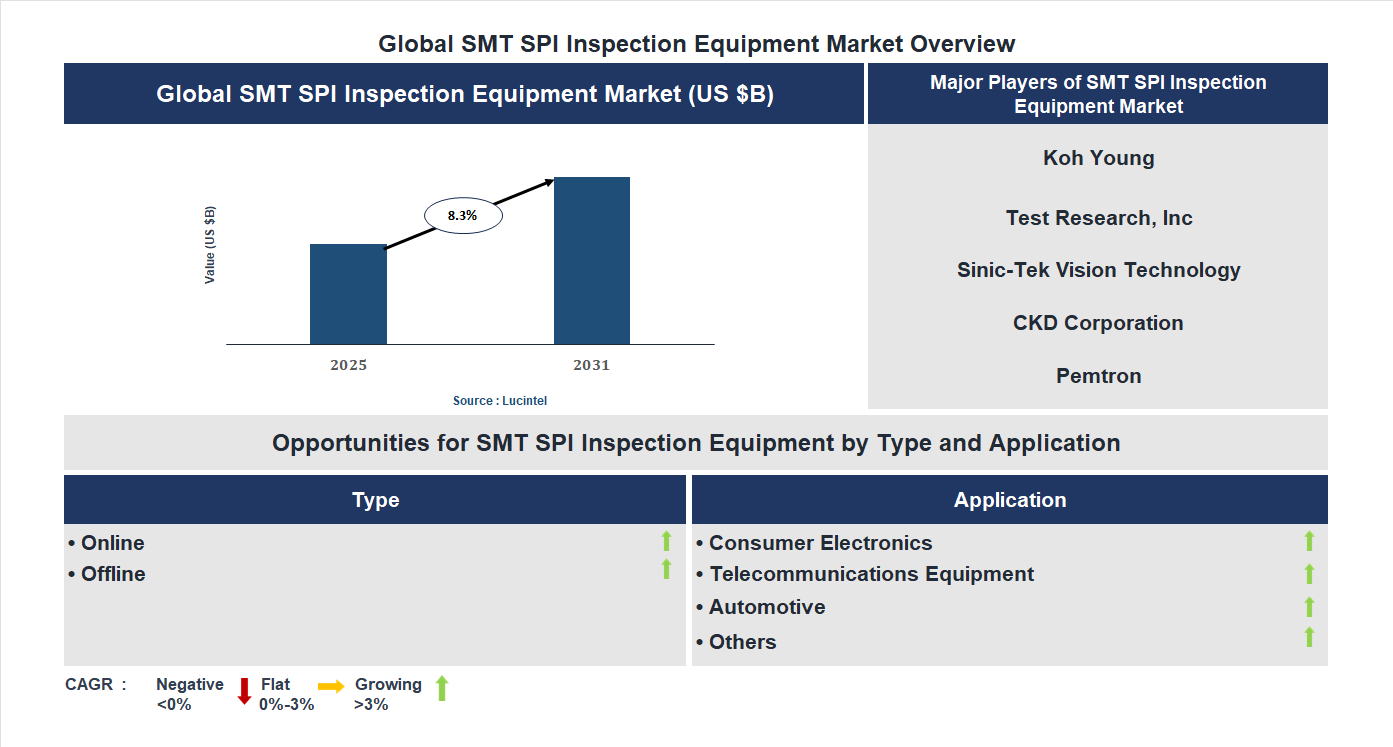
Key data points: The growth forecast = 8.3% annually for the next 7 years. Scroll below to get more insights. This market report covers trends, opportunities and forecasts in SMT SPI inspection equipment market to 2031 by type (online and offline), application (consumer electronics, telecommunications equipment, automotive, and others), and region (North America, Europe, Asia Pacific, and the Rest of the World)
We'll send your sample report shortly.
• Lucintel forecasts that, within the type category, online is expected to witness higher growth over the forecast period.
• Within the application category, automotive is expected to witness the highest growth.
• In terms of region, APAC is expected to witness the highest growth over the forecast period. Gain valuable insights for your business decisions with our comprehensive 150+ page report. Sample figures with some insights are shown below.
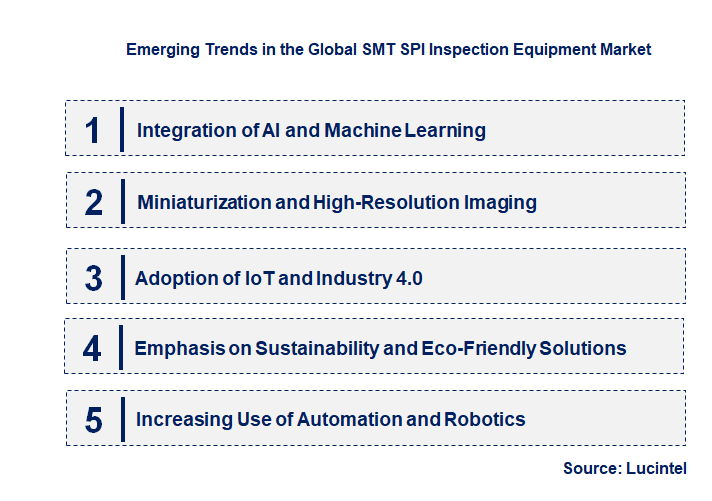
• Integration of AI and Machine Learning: The incorporation of AI and machine learning algorithms into SPI equipment enhances defect detection accuracy and speed. These technologies enable real-time analysis, predictive maintenance, and adaptive inspection processes, reducing false positives and improving overall quality. AI-driven systems can learn from data patterns, continuously improving their performance, which leads to higher efficiency and reduced operational costs. This trend is making inspection processes more intelligent, reliable, and capable of handling complex PCB designs, thus significantly impacting manufacturing quality standards.
• Miniaturization and High-Resolution Imaging: As electronic devices become smaller and more complex, SPI equipment is evolving to accommodate these changes through miniaturization and high-resolution imaging. Advanced imaging technologies such as 3D inspection and ultra-high-definition cameras allow for detailed analysis of tiny components and solder joints. This trend ensures that manufacturers can maintain high quality standards despite the increasing complexity of PCBs. It also reduces the risk of defects going unnoticed, thereby decreasing rework and scrap rates, and supporting the production of compact, high-performance electronics.
• Adoption of IoT and Industry 4.0: The integration of IoT connectivity and Industry 4.0 principles into SPI systems facilitates seamless data sharing, remote monitoring, and automation. These connected systems enable real-time process control, predictive maintenance, and data-driven decision-making, leading to enhanced operational efficiency. IoT-enabled inspection equipment can communicate with other manufacturing systems, providing comprehensive insights into production quality and bottlenecks. This interconnected approach is transforming traditional inspection processes into smart, autonomous systems, boosting productivity and reducing downtime across manufacturing facilities.
• Emphasis on Sustainability and Eco-Friendly Solutions: Growing environmental concerns are prompting the market to adopt sustainable inspection practices. Manufacturers are focusing on energy-efficient equipment, reducing waste, and utilizing eco-friendly materials in inspection systems. Innovations include low-power sensors and recyclable components, aligning with global sustainability goals. This trend not only helps companies meet regulatory standards but also appeals to environmentally conscious consumers. The shift towards sustainable solutions is driving innovation in equipment design and operational practices, ultimately contributing to a greener electronics manufacturing industry.
• Increasing Use of Automation and Robotics: Automation and robotics are becoming integral to SMT SPI inspection processes, offering higher throughput and consistency. Automated systems reduce human error, improve inspection speed, and enable 24/7 operation, which is vital for high-volume production. Robotic arms and automated handling systems facilitate precise positioning and inspection of components, especially in complex assemblies. This trend enhances overall manufacturing efficiency, reduces labor costs, and ensures uniform quality. As automation technology advances, the market is witnessing a shift towards fully autonomous inspection lines, significantly transforming traditional manual inspection methods. In summary, these emerging trends are collectively reshaping the SMT SPI inspection equipment market by making inspection processes smarter, more precise, and sustainable. They are driving increased efficiency, reducing costs, and ensuring higher quality standards, which are essential for meeting the demands of modern electronics manufacturing. As these trends continue to evolve, the market is poised for significant growth and innovation, ultimately supporting the development of more reliable and eco-friendly electronic products.
• Automation Integration: The adoption of automated inspection systems has increased, enabling continuous, high-speed quality checks without human intervention. This reduces labor costs and minimizes errors, leading to higher throughput and consistent product quality. Automated systems also facilitate real-time data collection, improving process control and traceability. As a result, manufacturers can respond swiftly to defects, enhancing overall efficiency and reducing time-to-market.
• AI and Machine Learning: Incorporation of artificial intelligence and machine learning algorithms has significantly improved defect detection accuracy. These technologies enable systems to learn from past inspections, identify subtle defects, and adapt to new inspection scenarios. The impact includes reduced false positives and negatives, increased reliability, and the ability to handle complex inspection tasks. This advancement enhances product quality and reduces rework costs, providing a competitive edge to early adopters.
• High-Resolution Imaging: The development of high-resolution cameras and sensors has enhanced the ability to detect minute defects on SMT components. These imaging systems provide detailed visual analysis, allowing for precise inspection of solder joints, component placement, and surface anomalies. The impact is a marked increase in inspection accuracy, leading to fewer defective products reaching the market and improved customer satisfaction.
• Integration with Manufacturing Execution Systems (MES): Recent developments focus on seamless integration of SPI equipment with MES platforms. This connectivity allows for real-time data sharing, process monitoring, and automated adjustments in manufacturing lines. The impact includes improved workflow efficiency, better quality control, and reduced downtime. It also facilitates comprehensive traceability, essential for compliance and quality audits.
• Portable and Compact Inspection Devices: The market has seen a rise in portable, compact SPI inspection tools suitable for on-site and in-line inspections. These devices offer flexibility, ease of use, and quick deployment in various manufacturing environments. Their impact includes increased inspection coverage, reduced equipment footprint, and enhanced adaptability for small or complex production lines, ultimately supporting lean manufacturing practices. In summary, these recent developments are transforming the SMT SPI inspection equipment market by enhancing inspection accuracy, efficiency, and integration capabilities. Automation, AI, high-resolution imaging, system integration, and portable devices are collectively driving higher quality standards, reducing costs, and enabling manufacturers to meet the growing demands of the electronics industry. These innovations are positioning the market for sustained growth and technological leadership.
• Consumer Electronics: Expanding demand for high-quality smartphones, tablets, and wearables drives the need for advanced SMT SPI inspection equipment. This ensures defect-free products, enhances customer satisfaction, and reduces returns, thereby boosting market growth.
• Automotive Industry: The increasing integration of electronic systems in vehicles necessitates precise inspection of complex circuit boards. SMT SPI equipment helps automotive manufacturers improve safety, reliability, and compliance with industry standards, fueling market expansion.
• Healthcare Devices: The rising production of medical devices such as diagnostic equipment and wearable health monitors requires stringent quality control. SMT SPI inspection ensures the integrity of intricate electronic components, supporting the growth of this application segment.
• Industrial Manufacturing: Automation and Industry 4.0 initiatives demand high-speed, accurate inspection solutions for large-scale production lines. SMT SPI equipment enhances efficiency, reduces waste, and ensures consistent quality, driving market opportunities.
• Telecommunications: The proliferation of 5G infrastructure and advanced communication devices increases the need for reliable electronic components. SMT SPI inspection supports the production of high-performance, defect-free components, contributing to market growth. In summary, these growth opportunities across diverse applications are significantly impacting the SMT SPI inspection equipment market by fostering innovation, improving product quality, and enabling manufacturers to meet stringent industry standards. This dynamic landscape promises sustained expansion and technological advancement in the coming years.
• Technological Innovation: The continuous development of advanced SPI systems with higher accuracy, faster processing speeds, and integrated AI capabilities is a major driver. These innovations enable manufacturers to detect defects more efficiently, reduce false positives, and improve overall product quality. As electronics become more complex, the demand for sophisticated inspection equipment increases, fostering market growth. Additionally, integration with other manufacturing systems enhances automation and productivity, making SPI equipment indispensable in modern SMT lines.
• Growing Electronics Manufacturing Sector: The expanding consumer electronics, automotive, aerospace, and healthcare industries are fueling demand for high-quality printed circuit boards (PCBs). As these sectors grow, so does the need for reliable inspection to ensure product integrity. The increasing adoption of miniaturized and complex components necessitates advanced inspection tools, boosting the market. Moreover, the rise of smart devices and IoT applications amplifies the volume of PCB production, further driving demand for efficient SPI inspection solutions.
• Stringent Quality and Regulatory Standards: Governments and industry bodies worldwide are implementing strict quality control and safety standards for electronic products. Compliance with these regulations requires thorough inspection processes, making SPI equipment essential. These standards push manufacturers to adopt more precise inspection technologies to meet certification requirements, thereby expanding the market. Additionally, quality assurance helps companies reduce warranty costs and improve brand reputation, incentivizing investment in advanced inspection systems.
• Cost Reduction and Efficiency Improvements: The need to optimize manufacturing processes and reduce operational costs is a significant market driver. Advanced SPI equipment offers faster inspection times, higher accuracy, and reduced rework, leading to cost savings. Automation features minimize manual intervention, decreasing labor costs and human error. As companies seek to enhance productivity and competitiveness, investing in efficient inspection solutions becomes a strategic priority, propelling market growth.
• Increasing Adoption of Automation and Industry 4.0: The shift towards automated manufacturing processes and Industry 4.0 initiatives is transforming the electronics industry. Smart inspection systems integrated with IoT and data analytics enable real-time monitoring and predictive maintenance. This integration improves process control, reduces downtime, and enhances product quality. The trend towards digitalization encourages manufacturers to upgrade their inspection equipment, fostering market expansion and innovation. The challenges facing this SMT SPI inspection equipment market include:
• High Initial Investment Costs: Advanced SMT SPI inspection equipment involves significant capital expenditure, which can be a barrier for small and medium-sized enterprises. The costs associated with purchasing, installing, and maintaining these systems are substantial, potentially limiting adoption. Companies may hesitate to invest without clear short-term ROI, especially in markets with fluctuating demand. This financial barrier can slow down the overall market growth and restrict technological diffusion across different regions.
• Rapid Technological Obsolescence: The fast-paced nature of technological advancements in electronics and inspection systems leads to frequent product updates and obsolescence. Companies must continuously invest in upgrading or replacing equipment to stay competitive, which increases operational costs. This rapid evolution can also create compatibility issues with existing systems, complicating integration and training. The risk of investing in outdated technology discourages some manufacturers from making long-term commitments.
• Stringent Regulatory and Certification Requirements: While regulations drive quality improvements, they also pose compliance challenges. Meeting diverse international standards requires significant effort and resources, including testing, documentation, and certification processes. Non-compliance can result in penalties, product recalls, or market restrictions. Navigating complex regulatory landscapes can delay product launches and increase costs, creating barriers for new entrants and complicating market expansion for existing players. In summary, the SMT SPI inspection equipment market is shaped by technological advancements, increasing demand from expanding electronics sectors, regulatory pressures, cost efficiency needs, and Industry 4.0 adoption. However, high costs, rapid obsolescence, and regulatory complexities pose significant challenges. These drivers collectively promote innovation and growth, while the challenges necessitate strategic planning and investment. Overall, the markets future depends on balancing technological progress with effective management of these hurdles, ensuring sustainable development and competitiveness.
• Koh Young
• Test Research, Inc
• Sinic-Tek Vision Technology
• CKD Corporation
• Pemtron
• Viscom AG
• Nordson Corporation
• Yamaha
• Mycronic
• SAKI Corporation
• Online
• Offline
• Consumer Electronics
• Telecommunications Equipment
• Automotive
• Others
• North America
• Europe
• Asia Pacific
• The Rest of the World
• United States: The US market has seen rapid adoption of AI-powered SPI systems, improving defect detection accuracy and process efficiency. Major companies are integrating IoT and cloud-based solutions for real-time monitoring and predictive maintenance. The focus on high-end electronics and aerospace applications has driven demand for advanced inspection equipment. Additionally, government initiatives supporting manufacturing innovation have fostered growth in this sector. The US also emphasizes sustainability, leading to the development of eco-friendly inspection technologies. Overall, the market is characterized by technological leadership and a strong emphasis on automation and data analytics.
• China: China remains the largest market for SMT SPI inspection equipment, driven by its massive electronics manufacturing industry. The country is investing heavily in automation and smart manufacturing to enhance quality control and reduce labor costs. Domestic companies are increasingly innovating, offering cost-effective solutions that compete with international brands. The government’s "Made in China 2025" initiative promotes advanced manufacturing, including inspection technologies. There is a growing focus on developing high-speed, high-precision inspection systems to meet the demands of 5G and IoT device production. The market is also witnessing increased adoption of AI and machine learning for defect detection.
• Germany: Germany’s market is characterized by a focus on precision engineering and high-quality standards, especially in automotive and industrial electronics sectors. Companies are adopting cutting-edge SPI inspection systems to ensure compliance with strict quality regulations. The emphasis on Industry 4.0 has led to the integration of smart sensors and automation in inspection processes. German firms are also investing in R&D to develop more energy-efficient and sustainable inspection solutions. Collaboration between industry and research institutions is fostering innovation. The market remains competitive, with a strong presence of global and local players emphasizing reliability and technological excellence.
• India: The Indian market is witnessing rapid growth due to expanding electronics manufacturing, driven by government initiatives like Make in India. Companies are increasingly adopting automated inspection systems to improve quality and reduce defects. The focus is on affordable yet efficient solutions suitable for small and medium-sized enterprises. There is a rising trend of local manufacturing of inspection equipment, supported by government incentives. The market is also benefiting from the growth of consumer electronics, telecom, and automotive sectors. As the industry matures, there is a push towards integrating AI and IoT for smarter inspection processes, aiming to boost export competitiveness.
• Japan: Japan’s market is renowned for its technological innovation and high standards in electronics manufacturing. Japanese companies are investing in advanced SPI inspection systems that offer high precision and speed, essential for their complex and miniaturized electronic components. The focus on quality assurance and defect reduction remains paramount. Japan is also exploring the integration of AI and robotics into inspection processes to enhance efficiency. The country’s emphasis on sustainable manufacturing practices is leading to the development of eco-friendly inspection technologies. Collaboration with global firms and continuous R&D efforts keep Japan at the forefront of the SMT SPI inspection equipment market.


• Koh Young
• Test Research, Inc
• Sinic-Tek Vision Technology
• CKD Corporation
• Pemtron
• Viscom AG
• Nordson Corporation
• Yamaha
• Mycronic
• SAKI Corporation Q5. Which SMT SPI inspection equipment market segment will be the largest in future? Answer: Lucintel forecasts that, within the type category, online is expected to witness higher growth over the forecast period. Q6. In SMT SPI inspection equipment market, which region is expected to be the largest in next 5 years? Answer: In terms of region, APAC is expected to witness the highest growth over the forecast period. Q7. Do we receive customization in this report? Answer: Yes, Lucintel provides 10% customization without any additional cost.


Choose a license that fits your team. Instant PDF delivery.
Prices exclude taxes. Instant delivery. Custom licensing available on request.
Market Report · July 29, 2026
Market Report · July 20, 2026
Market Report · July 20, 2026
Trusted partner for strategic intelligence and business growth


Receive a complimentary market analysis tailored to your industry. Our analysts will identify key growth opportunities and competitive dynamics specific to your business.

Market size, growth rate, and key trend analysis for your specific sector.

Top competitor positioning and market share analysis.

Strategic recommendations backed by data-driven insights.
Get curated market intelligence and competitive moves straight to your inbox.
By subscribing, you agree to receive our monthly insights. Unsubscribe anytime.
Receive a complimentary market analysis tailored to your industry. Our analysts will identify key growth opportunities and competitive dynamics specific to your business.
Market size, growth rate, and key trend analysis for your specific sector.
Top competitor positioning and market share analysis.
Strategic recommendations backed by data-driven insights.
Get curated market intelligence, emerging trends, and competitive moves straight to your inbox each month.
By subscribing, you agree to receive our monthly insights. Unsubscribe anytime.
We'll send your sample report shortly.