
Report Feature
Smart Toilet System Market Trends and Forecast
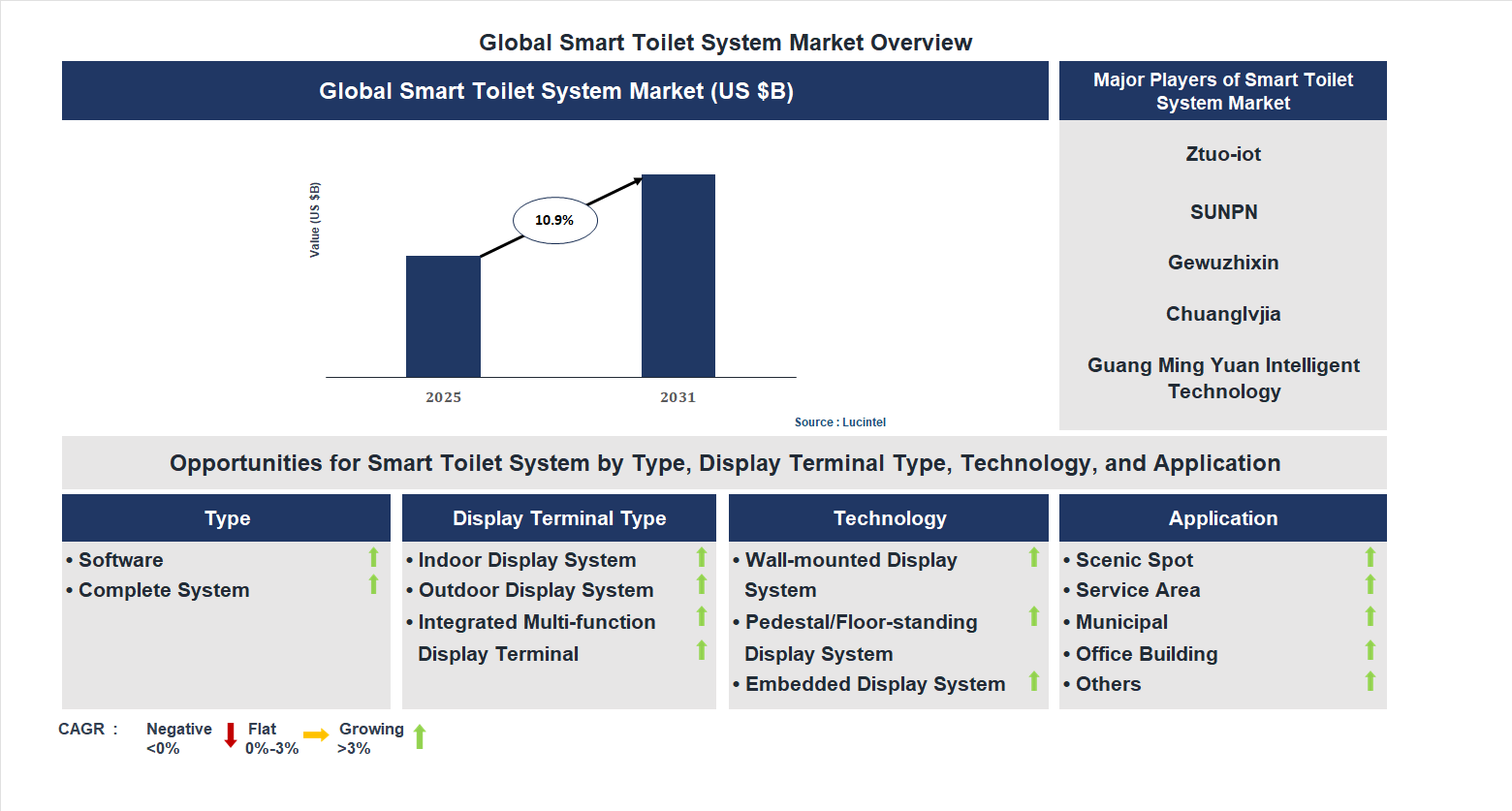
The future of the global smart toilet system market looks promising with opportunities in the scenic spot, service area, municipal, and office building markets. The global smart toilet system market is expected to grow with a CAGR of 10.9% from 2025 to 2031. The major drivers for this market are the increasing demand for smart home solutions, the rising awareness of hygiene technologies, and the growing adoption of automated bathroom fixtures.• Lucintel forecasts that, within the type category, complete system is expected to witness higher growth over the forecast period.
• Within the application category, municipal is expected to witness the highest growth.
• In terms of region, APAC is expected to witness the highest growth over the forecast period. Gain valuable insights for your business decisions with our comprehensive 150+ page report. Sample figures with some insights are shown below.
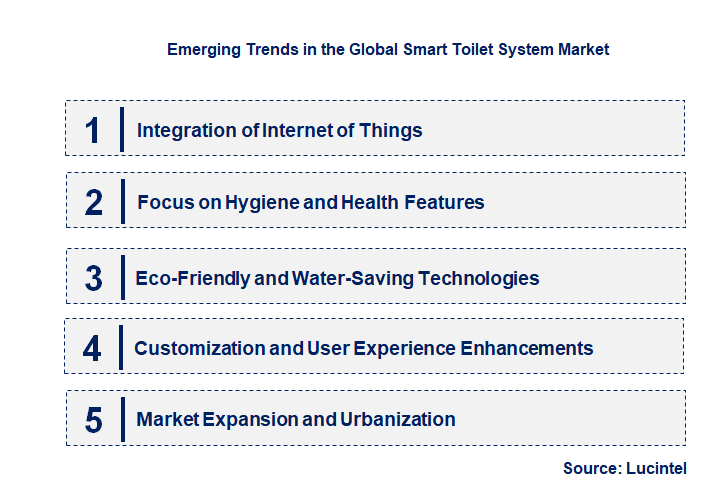
Emerging Trends in the Smart Toilet System Market
The smart toilet system market is experiencing rapid growth driven by technological advancements, increasing consumer demand for hygiene and convenience, and a shift towards smart home integration. As consumers seek more efficient, eco-friendly, and hygienic bathroom solutions, manufacturers are innovating with features like automated flushing, bidet functions, and IoT connectivity. These developments are transforming traditional bathroom fixtures into intelligent, connected devices that enhance user experience and sustainability. The market's evolution reflects broader trends in smart home technology and health-conscious consumer behavior, creating new opportunities and challenges for industry players. Understanding these key trends is essential for stakeholders aiming to capitalize on this dynamic market.• Integration of Internet of Things (IoT): The incorporation of IoT technology allows smart toilets to connect with other smart home devices, enabling remote control, usage monitoring, and maintenance alerts. This connectivity enhances user convenience and provides valuable data for manufacturers to improve product performance. IoT integration also supports personalized settings, energy efficiency, and predictive maintenance, reducing operational costs and increasing customer satisfaction. As IoT adoption accelerates, smart toilets are becoming more intelligent and user-centric, driving market growth and innovation.
• Focus on Hygiene and Health Features: Consumers increasingly prioritize hygiene and health in bathroom fixtures. Smart toilets now feature automatic flushing, touchless operation, UV sterilization, and bidet functions with adjustable settings. These features reduce contact points, minimizing germ transmission and promoting better hygiene. Additionally, health monitoring capabilities, such as analyzing waste for health insights, are emerging. This trend responds to heightened health awareness and the demand for safer, more hygienic bathroom solutions, significantly impacting product design and consumer preferences.
• Eco-Friendly and Water-Saving Technologies: Sustainability is a key driver in the market, leading to the development of water-efficient and eco-friendly smart toilets. Features like dual-flush systems, sensor-based water control, and biodegradable materials help reduce water consumption and environmental impact. Energy-efficient components, such as LED lighting and low-power electronics, further enhance sustainability. These innovations appeal to environmentally conscious consumers and comply with stricter regulations, positioning eco-friendly smart toilets as a preferred choice and fostering market expansion.
• Customization and User Experience Enhancements: Manufacturers are focusing on personalized user experiences through adjustable settings, heated seats, ambient lighting, and customizable spray functions. Smart toilets now offer user profiles that remember preferences, providing a tailored experience for each user. Enhanced comfort and convenience features improve customer satisfaction and differentiate products in a competitive market. This trend emphasizes user-centric design, making smart toilets more appealing to a broader demographic and encouraging adoption across various market segments.
• Market Expansion and Urbanization: Rapid urbanization and increasing disposable incomes are expanding the market geographically, especially in developing regions. Urban dwellers seek space-saving, efficient bathroom solutions, boosting demand for smart toilet systems. Infrastructure development and rising awareness about hygiene further accelerate adoption. This trend opens new opportunities for manufacturers to penetrate emerging markets, adapt products to local needs, and establish a global presence. The expansion also encourages innovation tailored to diverse consumer preferences and economic conditions, shaping the future landscape of the smart toilet system market. In summary, these trends are reshaping the smart toilet system market by fostering innovation, enhancing user experience, and emphasizing sustainability. The integration of IoT, focus on hygiene, eco-friendly technologies, customization, and market expansion are collectively driving growth and transforming traditional bathroom fixtures into intelligent, connected, and environmentally conscious solutions. This evolution is positioning the market for sustained development and increased consumer adoption worldwide.
Recent Development in the Smart Toilet System Market
The smart toilet system market is experiencing rapid growth driven by technological advancements, increasing consumer demand for hygiene, and the integration of IoT in home appliances. Innovations in design, functionality, and connectivity are transforming bathroom experiences worldwide. As urbanization accelerates and smart home adoption rises, the market presents significant opportunities for manufacturers and service providers. These developments are shaping a more connected, efficient, and hygienic future for bathroom solutions globally.• Technological Integration Enhances User Experience: The integration of IoT and AI in smart toilets allows for personalized settings, remote control, and maintenance alerts. This technological leap improves user convenience, hygiene, and water efficiency, making smart toilets more appealing to consumers. The ability to customize functions and monitor usage remotely enhances customer satisfaction and loyalty, driving market growth. As technology advances, the adoption of smart toilets is expected to become more widespread across residential and commercial sectors.
• Rising Demand for Hygienic and Contactless Solutions: The COVID-19 pandemic has heightened awareness around hygiene, boosting demand for contactless bathroom fixtures. Smart toilets equipped with touchless flush, automatic lid opening, and self-cleaning features are increasingly preferred. This trend is particularly prominent in public spaces, healthcare facilities, and upscale residences. The focus on hygiene and safety is expected to sustain growth in the market, encouraging manufacturers to innovate and expand their product offerings to meet consumer expectations.
• Eco-Friendly Features Drive Market Expansion: Consumers and regulators are emphasizing water conservation and energy efficiency. Smart toilets with dual-flush systems, water sensors, and energy-saving modes are gaining popularity. These eco-friendly features reduce utility bills and environmental impact, aligning with sustainability goals. The market benefits from increased adoption of such systems in green buildings and eco-conscious households, fostering innovation and competitive differentiation among manufacturers.
• Urbanization and Smart Home Integration Accelerate Adoption: Rapid urbanization and the proliferation of smart home ecosystems are fueling demand for integrated bathroom solutions. Smart toilets that connect seamlessly with home automation systems offer enhanced convenience and control. This integration supports energy management, remote operation, and data collection for maintenance. As urban dwellers seek modern, connected living spaces, the market is poised for substantial growth, with manufacturers focusing on compatibility and user-friendly interfaces.
• Regulatory Standards and Market Expansion in Emerging Economies: Governments are implementing stricter standards for water efficiency and sanitation, encouraging the adoption of smart toilet systems. Additionally, emerging economies present untapped markets with rising disposable incomes and urban infrastructure development. Market expansion is driven by these regulatory and economic factors, prompting companies to adapt products for diverse markets. This growth is expected to diversify the market landscape and accelerate global adoption of smart toilet technologies. The overall impact of these developments is a dynamic, expanding market characterized by innovation, increased consumer demand, and a sustainability focus. As technology advances and awareness grows, the smart toilet system market is set to become a significant segment within the broader smart home and sanitation industries, offering improved hygiene, efficiency, and connectivity worldwide.
Strategic Growth Opportunities in the Smart Toilet System Market
The smart toilet system market is experiencing rapid growth driven by technological advancements, increasing consumer demand for hygiene and convenience, and rising awareness of health and sanitation. Innovations in IoT connectivity, eco-friendly features, and user customization are expanding application scopes across residential, commercial, and healthcare sectors. Market players are focusing on integrating smart features to enhance user experience, reduce water consumption, and promote sustainability. This evolving landscape presents significant opportunities for growth, investment, and competitive differentiation in the coming years.• Integration of IoT and Connectivity Features: Smart toilet systems are increasingly incorporating IoT technology, enabling remote control, real-time diagnostics, and personalized user settings. This connectivity enhances convenience, hygiene, and maintenance efficiency, attracting tech-savvy consumers and commercial clients. IoT integration also facilitates data collection for health monitoring and usage patterns, opening avenues for health-related applications and predictive maintenance. As connectivity becomes more affordable and reliable, the adoption of IoT-enabled smart toilets is expected to accelerate across various markets.
• Growing Demand for Eco-Friendly and Water-Saving Solutions: Environmental concerns and water conservation initiatives are driving demand for eco-friendly smart toilets. Features such as dual-flush systems, waterless urinals, and automatic flushing reduce water consumption significantly. Manufacturers are developing sustainable materials and energy-efficient components to appeal to environmentally conscious consumers and regulatory standards. The push for sustainability in residential and commercial sectors is creating opportunities for innovative, water-saving smart toilet designs that align with global environmental goals.
• Expansion in Healthcare and Assisted Living Applications: The healthcare sector and assisted living facilities are adopting smart toilet systems to improve hygiene, monitor health, and support independent living. Features like automatic cleaning, health data sensors, and user-specific customization enhance patient comfort and safety. These systems can track vital signs, detect health anomalies, and facilitate remote health monitoring, making them valuable for elderly care and chronic disease management. Growing aging populations and healthcare modernization efforts are fueling demand for specialized smart toilet solutions in these sectors.
• Increasing Adoption in Commercial and Public Spaces: Commercial buildings, hotels, airports, and public restrooms are increasingly integrating smart toilet systems to improve hygiene standards, reduce maintenance costs, and enhance user experience. Automated features such as touchless flushing, seat warming, and self-cleaning mechanisms are becoming standard. These systems help in minimizing contact points, reducing the spread of germs, and optimizing sanitation processes. The focus on health safety and operational efficiency in public spaces is expected to drive widespread adoption of smart toilet technology.
• Customization and User Experience Enhancements: Consumer preferences for personalized hygiene and comfort are prompting manufacturers to develop customizable smart toilet features. Options include adjustable water temperature, pressure controls, heated seats, and personalized lighting. User-friendly interfaces and voice control capabilities are also gaining popularity. These enhancements improve overall user satisfaction, encourage adoption, and differentiate products in a competitive market. As consumer expectations evolve, the focus on tailored experiences will continue to be a key growth driver for smart toilet systems. These growth opportunities collectively are transforming the smart toilet system market into a highly innovative and sustainable sector. IoT integration, eco-friendly features, healthcare applications, public space adoption, and user customization are expanding market reach and driving technological advancements. As consumer awareness and regulatory standards increase, these opportunities will foster market expansion, competitive differentiation, and long-term growth, shaping the future landscape of smart sanitation solutions globally.
Smart Toilet System Market Driver and Challenges
The smart toilet system market is influenced by a variety of technological, economic, and regulatory factors that shape its growth trajectory. Innovations in hygiene technology, increasing consumer awareness about health and sanitation, and the rising adoption of smart home devices are key drivers. Additionally, government initiatives promoting sanitation and environmental sustainability further propel market expansion. However, the market also faces challenges such as high installation costs, regulatory hurdles, and concerns over data privacy. Understanding these drivers and challenges is essential for stakeholders to navigate the evolving landscape effectively and capitalize on emerging opportunities. The factors responsible for driving the smart toilet system market include:-• Technological Advancements: The continuous development of smart features such as automated flushing, bidet functions, and water-saving mechanisms enhances user experience and efficiency. These innovations attract consumers seeking modern, hygienic solutions, thereby expanding market reach. Moreover, integration with IoT and smart home ecosystems increases convenience and personalization, fueling demand. As technology becomes more affordable, adoption rates are expected to rise, making this a significant growth driver.
• Rising Health and Hygiene Awareness: Increasing awareness about personal hygiene and sanitation, especially post-pandemic, has led consumers to seek advanced toilet systems. Smart toilets offer features like self-cleaning, antibacterial surfaces, and health monitoring, which appeal to health-conscious consumers. This trend is particularly prominent in urban areas and developed regions, where consumers prioritize hygiene and wellness, thus driving market growth.
• Urbanization and Smart Home Adoption: Rapid urbanization has resulted in higher demand for modern, space-efficient, and technologically advanced bathroom fixtures. The proliferation of smart home systems encourages consumers to upgrade traditional toilets to smart variants. This integration enhances convenience, energy efficiency, and aesthetic appeal, making smart toilets a desirable feature in new residential and commercial constructions.
• Environmental Regulations and Sustainability Initiatives: Governments and regulatory bodies are increasingly emphasizing water conservation and eco-friendly practices. Smart toilets equipped with water-saving features and efficient flushing systems align with these policies. Such regulations incentivize manufacturers and consumers to adopt sustainable solutions, thereby boosting market growth while addressing environmental concerns. The challenges in the smart toilet system market are:
• High Installation and Maintenance Costs: The advanced features of smart toilets often come with a higher price tag compared to traditional models. Installation can be complex, requiring specialized services, which increases upfront costs. Additionally, maintenance and repairs may be costly due to the sophisticated technology involved, potentially limiting adoption among price-sensitive consumers and in developing regions.
• Regulatory and Standardization Barriers: The lack of uniform standards and regulations across different regions poses challenges for manufacturers. Compliance with varying safety, health, and data privacy regulations can delay product launches and increase costs. Uncertainty regarding future regulatory changes can also hinder investment and innovation in the market.
• Data Privacy and Security Concerns: Smart toilets often collect user data related to health and usage patterns, raising privacy issues. Consumers may be hesitant to adopt such systems due to fears of data breaches or misuse. Ensuring robust cybersecurity measures and transparent data policies is essential but can be challenging, impacting consumer trust and market penetration. In summary, the smart toilet system market is driven by technological innovations, health awareness, urbanization, and sustainability initiatives, which collectively foster growth. However, high costs, regulatory complexities, and privacy concerns present significant hurdles. Balancing these factors will be crucial for market players to capitalize on opportunities and address challenges effectively. Overall, the market's future depends on technological progress, regulatory clarity, and consumer trust, shaping a promising yet complex landscape.
List of Smart Toilet System Companies
Companies in the market compete on the basis of product quality offered. Major players in this market focus on expanding their manufacturing facilities, R&D investments, infrastructural development, and leverage integration opportunities across the value chain. With these strategies smart toilet system companies cater increasing demand, ensure competitive effectiveness, develop innovative products & technologies, reduce production costs, and expand their customer base. Some of the smart toilet system companies profiled in this report include-• Ztuo-iot
• SUNPN
• Gewuzhixin
• Chuanglvjia
• Guang Ming Yuan Intelligent Technology
• Tuwei Intelligent
• Zkturing
• Guangzhou Midterm Technology
• Daye Haoyun Environmental Protection
• Guangzhou Tongwei
Smart Toilet System Market by Segment
The study includes a forecast for the global smart toilet system market by type, display terminal type, installation method, application, and region.Smart Toilet System Market by Type [Value from 2019 to 2031]:
• Software
• Complete System
Smart Toilet System Market by Display Terminal Type [Value from 2019 to 2031]:
• Indoor Display System
• Outdoor Display System
• Integrated Multi-function Display Terminal
Smart Toilet System Market by Installation Method [Value from 2019 to 2031]:
• Wall-mounted Display System
• Pedestal/Floor-standing Display System
• Embedded Display System
Smart Toilet System Market by Application [Value from 2019 to 2031]:
• Scenic Spot
• Service Area
• Municipal
• Office Building
• Others
Smart Toilet System Market by Region [Value from 2019 to 2031]:
• North America
• Europe
• Asia Pacific
• The Rest of the World
Country Wise Outlook for the Smart Toilet System Market
The smart toilet system market has experienced significant growth driven by technological advancements, increasing consumer demand for hygiene and convenience, and rising awareness of health and sanitation. Countries are adopting innovative features such as touchless operation, water-saving technology, and integrated health monitoring. Regulatory standards and environmental concerns are also shaping product development. The market's evolution reflects a shift towards smarter, more sustainable bathroom solutions, with key players expanding their offerings globally. As urbanization accelerates and smart home integration becomes more prevalent, these developments are expected to continue influencing the market landscape across major economies.• United States: The US market has seen rapid adoption of smart toilet systems, driven by consumer interest in health tech and eco-friendly features. Major brands are integrating AI and IoT capabilities for personalized user experiences. Regulatory standards for water efficiency and sanitation are influencing product designs. Retailers and online platforms are expanding availability, and smart home integration is a key trend. The market is also witnessing increased investments in R&D to develop advanced features like health monitoring sensors and voice control. Overall, the US remains a leader in innovative smart toilet solutions, with a focus on sustainability and user convenience.
• China: China’s market for smart toilets is expanding quickly, fueled by urbanization and rising disposable incomes. Local manufacturers are offering affordable, feature-rich models with water-saving and self-cleaning functions. The government’s emphasis on sanitation infrastructure and health standards is promoting adoption. E-commerce platforms are playing a crucial role in distribution, making smart toilets accessible to a broader consumer base. Technological integration, such as app control and automatic lid functions, is gaining popularity. The market is also seeing collaborations between tech firms and sanitaryware companies to develop smarter, more efficient products tailored to Chinese consumers’ preferences.
• Germany: The German market emphasizes sustainability, hygiene, and high-quality engineering in smart toilet systems. Consumers prefer eco-friendly models with water efficiency and energy-saving features. Regulatory compliance with strict EU standards influences product development, ensuring safety and environmental impact reduction. Innovative designs incorporate touchless operation and advanced cleaning technologies. The market is characterized by a focus on durability and premium features, appealing to environmentally conscious and health-aware consumers. German companies are also investing in research to enhance user comfort and integrate smart home systems, positioning themselves as leaders in sustainable bathroom solutions.
• India: The Indian market for smart toilets is witnessing rapid growth due to increasing urbanization, rising middle-class income, and government initiatives promoting sanitation. Affordable models with essential features like water efficiency, self-cleaning, and easy installation are gaining popularity. E-commerce and organized retail channels are expanding access to smart toilet products. Local manufacturers are innovating to reduce costs while maintaining quality. The focus is on providing hygienic, water-saving solutions suitable for diverse Indian households. The market is also driven by awareness campaigns and government programs like Swachh Bharat Mission, which are encouraging the adoption of modern sanitation facilities, including smart toilets.
• Japan: Japan’s market is characterized by high technological integration, with consumers seeking advanced, hygienic, and space-efficient solutions. Smart toilets with features such as bidet functions, heated seats, and automatic lids are standard. The focus on health and hygiene, combined with the aging population's needs, drives innovation in user-friendly interfaces and accessibility features. Japanese manufacturers emphasize energy efficiency and eco-friendly designs, aligning with national sustainability goals. The market also sees integration with smart home systems and IoT connectivity for enhanced user experience. Continuous innovation and premium product offerings position Japan as a leader in high-end smart toilet technology.

Features of the Global Smart Toilet System Market
Market Size Estimates: Smart toilet system market size estimation in terms of value ($B). Trend and Forecast Analysis: Market trends (2019 to 2024) and forecast (2025 to 2031) by various segments and regions. Segmentation Analysis: Smart toilet system market size by various segments, such as by type, display terminal type, installation method, application, and region in terms of value ($B). Regional Analysis: Smart toilet system market breakdown by North America, Europe, Asia Pacific, and Rest of the World. Growth Opportunities: Analysis of growth opportunities in different types, display terminal types, installation methods, applications, and regions for the smart toilet system market. Strategic Analysis: This includes M&A, new product development, and competitive landscape of the smart toilet system market. Analysis of competitive intensity of the industry based on Porter’s Five Forces model.
FAQ
Q1. What is the growth forecast for smart toilet system market? Answer: The global smart toilet system market is expected to grow with a CAGR of 10.9% from 2025 to 2031. Q2. What are the major drivers influencing the growth of the smart toilet system market? Answer: The major drivers for this market are the increasing demand for smart home solutions, the rising awareness of hygiene technologies, and the growing adoption of automated bathroom fixtures. Q3. What are the major segments for smart toilet system market? Answer: The future of the smart toilet system market looks promising with opportunities in the scenic spot, service area, municipal, and office building markets. Q4. Who are the key smart toilet system market companies? Answer: Some of the key smart toilet system companies are as follows:• Ztuo-iot
• SUNPN
• Gewuzhixin
• Chuanglvjia
• Guang Ming Yuan Intelligent Technology
• Tuwei Intelligent
• Zkturing
• Guangzhou Midterm Technology
• Daye Haoyun Environmental Protection
• Guangzhou Tongwei Q5. Which smart toilet system market segment will be the largest in future? Answer: Lucintel forecasts that, within the type category, complete system is expected to witness higher growth over the forecast period. Q6. In smart toilet system market, which region is expected to be the largest in next 5 years? Answer: In terms of region, APAC is expected to witness the highest growth over the forecast period. Q7. Do we receive customization in this report? Answer: Yes, Lucintel provides 10% customization without any additional cost.
Table of Contents
List of Figures
List of Tables
Methodology
- In-depth interviews of the major players in this market
- Detailed secondary research from competitors’ financial statements and published data
- Extensive searches of published works, market, and database information pertaining to industry news, company press releases, and customer intentions
- A compilation of the experiences, judgments, and insights of Lucintel’s professionals, who have analyzed and tracked this market over the years.


Buy Now
Choose a license that fits your team. Instant PDF delivery.
Prices exclude taxes. Instant delivery. Custom licensing available on request.
Key Questions
- • What are some of the most promising, high-growth opportunities for the smart toilet system market by type (software and complete system), display terminal type (indoor display system, outdoor display system, and integrated multi-function display terminal), installation method (wall-mounted display system, pedestal/floor-standing display system, and embedded display system), application (scenic spot, service area, municipal, office building, and others), and region (North America, Europe, Asia Pacific, and the Rest of the World)?
- • Which segments will grow at a faster pace and why?
- • Which region will grow at a faster pace and why?
- • What are the key factors affecting market dynamics? What are the key challenges and business risks in this market?
- • What are the business risks and competitive threats in this market?
- • What are the emerging trends in this market and the reasons behind them?
- • What are some of the changing demands of customers in the market?
- • What are the new developments in the market? Which companies are leading these developments?
- • Who are the major players in this market? What strategic initiatives are key players pursuing for business growth?
- • What are some of the competing products in this market and how big of a threat do they pose for loss of market share by material or product substitution?
- • What M&A activity has occurred in the last 6 years and what has its impact been on the industry? For any questions related to Smart Toilet System Market, Smart Toilet System Market Size, Smart Toilet System Market Growth, Smart Toilet System Market Analysis, Smart Toilet System Market Report, Smart Toilet System Market Share, Smart Toilet System Market Trends, Smart Toilet System Market Forecast, Smart Toilet System Companies, write Lucintel analyst at email: helpdesk@lucintel.com. We will be glad to get back to you soon.


