
Smart Port Market Trends and Forecast
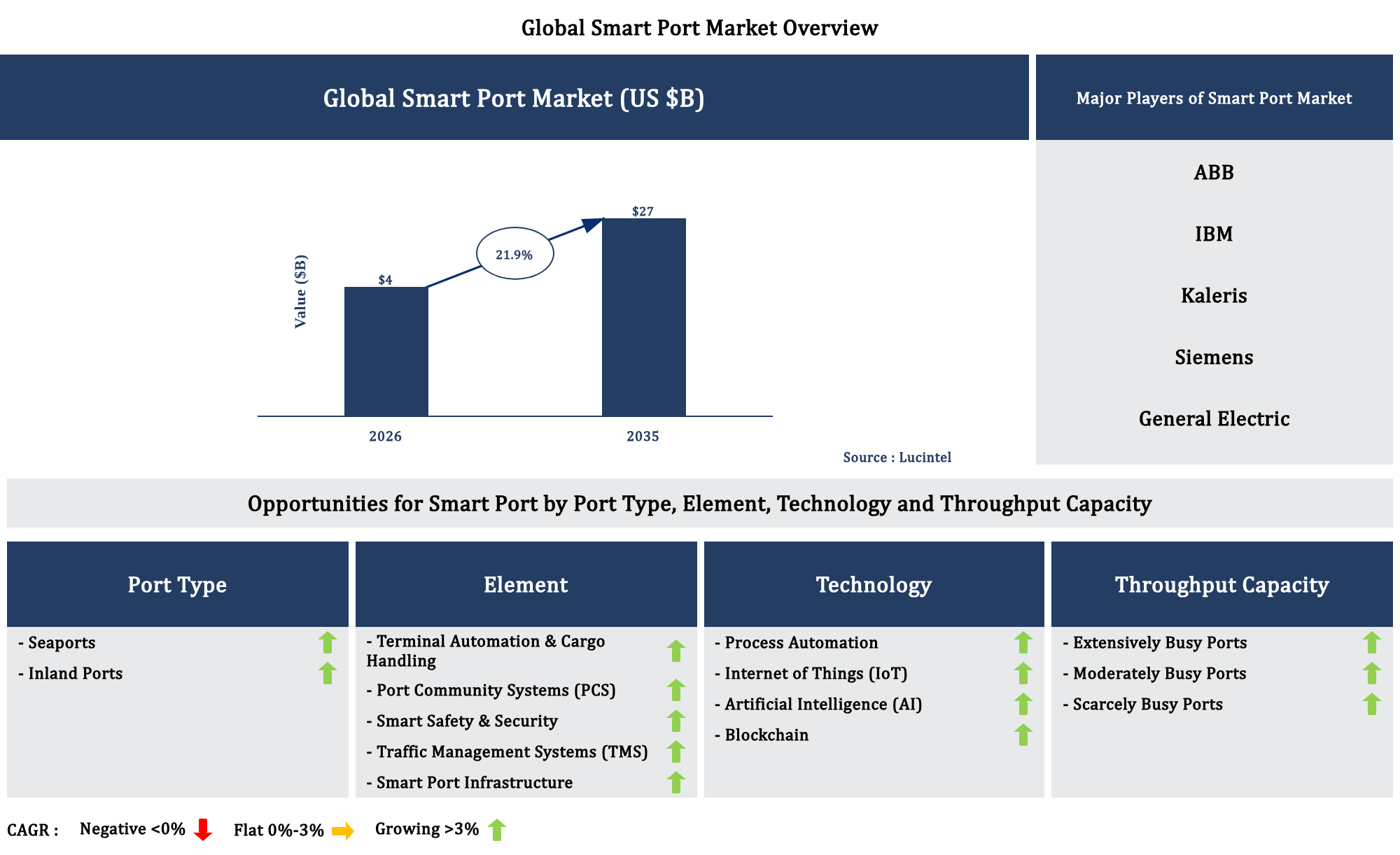
The future of the global smart port market looks promising with opportunities in the process automation, internet of things (IoT), artificial intelligence (AI), and blockchain markets. The global smart port market is expected to reach an estimated $27026 million by 2035 with a CAGR of 21.9% from 2026 to 2035. The major drivers for this market are the rising demand for automation reducing manual work & errors, the growing demand for focus on sustainability reducing emissions & energy use, and the increasing adoption of iot improving port connectivity & monitoring.
• Lucintel forecasts that, within the port type category, seaport is expected to witness higher growth over the forecast period.
• Within the technology category, internet of things (iot) is expected to witness the highest growth.
• In terms of region, APAC is expected to witness the highest growth over the forecast period.
Gain valuable insights for your business decisions with our comprehensive 150+ page report. Sample figures with some insights are shown below.
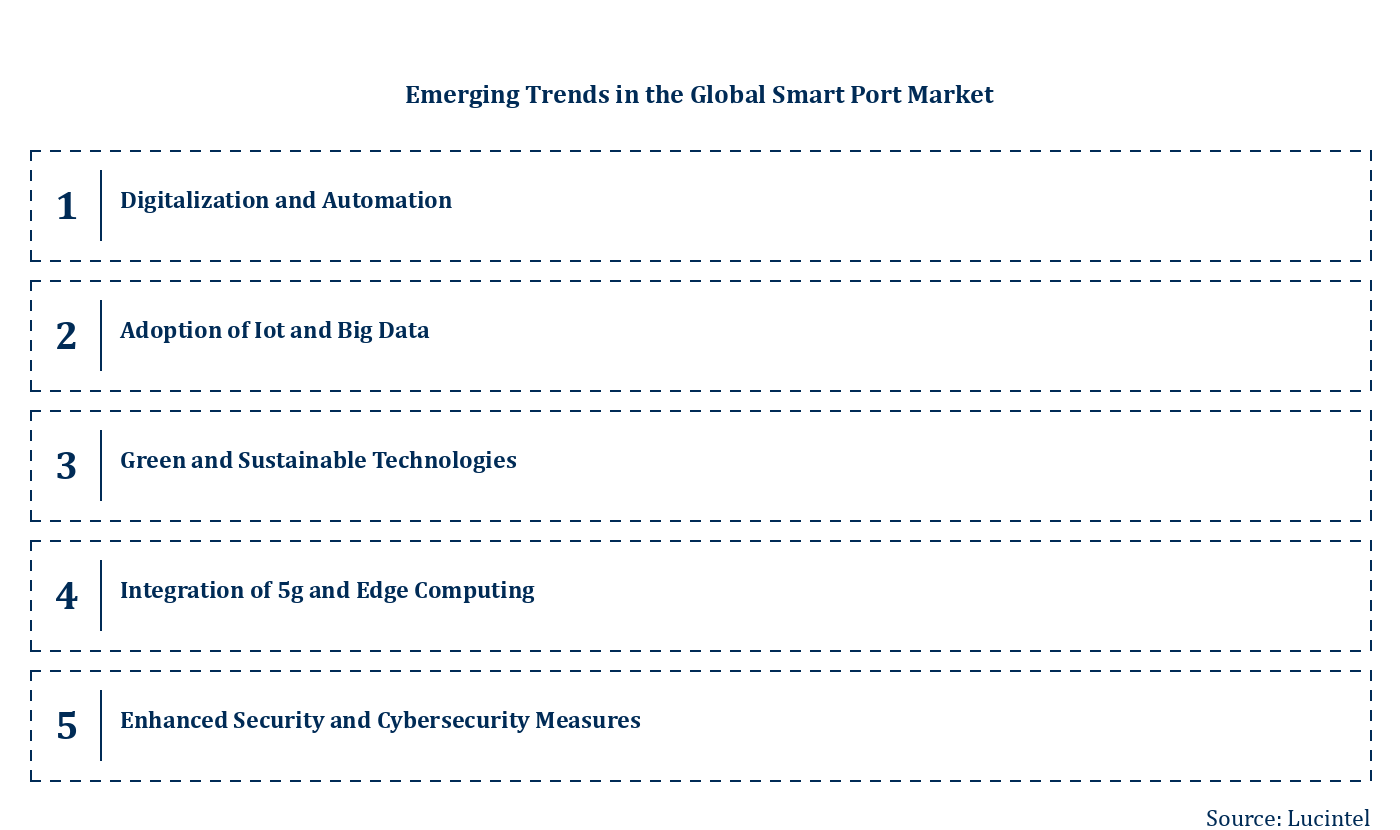
Emerging Trends in the Smart Port Market
The smart port market is experiencing rapid transformation driven by technological advancements, increasing global trade, and the need for sustainable and efficient logistics solutions. Ports are evolving from traditional hubs into intelligent, interconnected systems that leverage digital technologies to optimize operations, enhance security, and reduce environmental impact. These developments are reshaping the logistics landscape, creating new opportunities for stakeholders and fostering innovation. As the market continues to grow, understanding the key emerging trends is essential for industry players to stay competitive and capitalize on new efficiencies and capabilities.
• Digitalization and Automation: The integration of IoT, AI, and robotics is revolutionizing port operations by automating cargo handling, vessel management, and security processes. This reduces human error, increases efficiency, and lowers operational costs. Automated cranes, smart sensors, and real-time data analytics enable ports to operate more smoothly and respond swiftly to changing conditions, ultimately improving turnaround times and service quality.
• Adoption of IoT and Big Data: Ports are increasingly deploying IoT devices and sensors to collect vast amounts of data on cargo, equipment, and environmental conditions. Big data analytics help optimize logistics, predict maintenance needs, and enhance decision-making. This connectivity fosters a more transparent and efficient supply chain, reducing delays and improving resource allocation, which is crucial in a competitive global market.
• Green and Sustainable Technologies: Environmental concerns are prompting ports to adopt eco-friendly solutions such as electrification of equipment, renewable energy sources, and waste management systems. These initiatives aim to reduce carbon emissions, improve energy efficiency, and comply with stricter regulations. Sustainable practices not only benefit the environment but also enhance port reputation and operational resilience.
• Integration of 5G and Edge Computing: The deployment of 5G networks and edge computing enables faster, more reliable communication between devices and systems within ports. This connectivity supports real-time monitoring, autonomous vehicles, and remote operations, significantly enhancing operational agility. The low latency and high bandwidth of 5G are critical for managing complex port activities efficiently and safely.
• Enhanced Security and Cybersecurity Measures: As ports become more digitized, the risk of cyber threats increases. Ports are investing in advanced cybersecurity protocols, biometric access controls, and surveillance systems to safeguard critical infrastructure. Strengthening security measures ensures the integrity of operations, protects sensitive data, and maintains trust among stakeholders in an increasingly interconnected environment.
These emerging trends are transforming the smart port market into a highly efficient, sustainable, and secure ecosystem. Digitalization, automation, and advanced connectivity are driving operational excellence, while green initiatives and enhanced security measures are ensuring resilience and environmental responsibility. These developments are positioning ports to meet future demands and maintain competitiveness in a rapidly evolving global trade landscape.
Recent Development in the Smart Port Market
The smart port market is experiencing rapid growth driven by technological advancements, increasing global trade, and the need for efficient logistics. Ports are adopting digital solutions to enhance operational efficiency, security, and sustainability. Governments and private sectors are investing heavily in smart infrastructure to modernize maritime logistics. These developments are transforming traditional ports into intelligent hubs, creating new opportunities for stakeholders. The market‘s evolution is expected to significantly impact global trade dynamics, supply chain management, and environmental sustainability.
• Digital Infrastructure Enhancement: The integration of IoT, AI, and big data analytics is revolutionizing port operations. These technologies enable real-time tracking, predictive maintenance, and automated cargo handling, reducing delays and operational costs. Enhanced digital infrastructure improves port efficiency, safety, and security, attracting more international shipping lines. This transformation fosters a competitive edge for ports adopting smart solutions, ultimately boosting global trade capacity and reducing environmental impact through optimized resource utilization.
• Automation and Robotics Adoption: Ports are increasingly deploying autonomous vehicles, cranes, and robotic systems to streamline cargo handling. Automation reduces labor costs, minimizes human error, and accelerates turnaround times. These advancements lead to safer working environments and higher throughput capacities. The adoption of robotics is particularly impactful in congested or labor-scarce regions, enabling ports to operate 24/7 efficiently. This shift enhances overall port productivity and positions the market for future growth driven by technological innovation.
• Sustainable Port Operations: Emphasis on green technologies and eco-friendly practices is shaping the market. Ports are investing in renewable energy sources, electrification of equipment, and waste management systems. These initiatives reduce carbon emissions and environmental footprint, aligning with global sustainability goals. Sustainable operations attract environmentally conscious stakeholders and comply with stricter regulations. The focus on eco-friendly solutions enhances port reputation, operational efficiency, and long-term viability, making sustainability a key driver in market development.
• Enhanced Security Measures: Advanced surveillance systems, biometric access controls, and cybersecurity protocols are strengthening port security. These measures protect against cyber threats, terrorism, and illegal activities, ensuring smooth international trade flows. Improved security fosters trust among stakeholders and reduces insurance costs. As cyber threats evolve, ports are investing in resilient security infrastructure, which is crucial for maintaining operational integrity. Enhanced security measures are vital for safeguarding assets and ensuring compliance with international security standards.
• Integration of Blockchain Technology: Blockchain is being adopted for transparent, secure, and efficient documentation processes such as bills of lading and customs clearance. This technology reduces paperwork, minimizes fraud, and accelerates cargo processing. Blockchain enhances supply chain transparency and traceability, improving stakeholder collaboration. Its implementation leads to cost savings and reduced delays, making port operations more reliable. As blockchain adoption grows, it is expected to revolutionize port logistics, fostering greater trust and efficiency across global supply chains.
The overall impact of these developments is a more efficient, secure, and sustainable smart port market. These innovations are driving increased trade capacity, reducing operational costs, and promoting environmental responsibility. As ports modernize, they become more competitive and resilient, supporting global economic growth and supply chain resilience. The market‘s evolution is poised to reshape maritime logistics, creating new opportunities for stakeholders worldwide.
Strategic Growth Opportunities in the Smart Port Market
The smart port market is experiencing rapid growth driven by technological advancements, increasing maritime trade, and the need for efficient logistics management. Integration of IoT, AI, and automation is transforming port operations, enhancing safety, reducing costs, and improving environmental sustainability. As global trade expands, the adoption of smart port solutions offers significant opportunities for stakeholders to optimize workflows, increase competitiveness, and meet evolving regulatory standards. This dynamic landscape presents numerous avenues for strategic expansion and innovation.
• Enhanced Operational Efficiency Through Automation and IoT Integration: Smart ports leverage automation, IoT sensors, and data analytics to streamline cargo handling, vessel management, and resource allocation. These technologies reduce turnaround times, minimize human error, and optimize port throughput. The ability to monitor and control operations in real-time leads to cost savings and improved service quality, making ports more competitive and responsive to market demands.
• Adoption of AI and Machine Learning for Predictive Analytics: Implementing AI-driven predictive analytics enables ports to forecast equipment failures, optimize maintenance schedules, and anticipate congestion. This proactive approach minimizes downtime, enhances safety, and improves decision-making accuracy. As AI technology matures, its integration into port management systems will become essential for maintaining operational resilience and supporting complex logistical networks.
• Development of Green and Sustainable Port Solutions: Environmental regulations and sustainability goals are prompting ports to adopt eco-friendly technologies such as electric cranes, renewable energy sources, and waste management systems. Smart port solutions facilitate energy efficiency, reduce emissions, and promote sustainable practices. These initiatives not only comply with regulations but also enhance port reputation and attract environmentally conscious stakeholders.
• Expansion of Digital Twin Technology for Port Simulation and Planning: Digital twins create virtual replicas of port infrastructure, enabling detailed simulation of operations, planning, and scenario analysis. This technology helps optimize layout design, improve safety protocols, and evaluate the impact of new projects before implementation. As digital twin adoption grows, ports can achieve better resource utilization, reduce risks, and accelerate development timelines.
• Integration of Blockchain for Secure and Transparent Logistics Transactions: Blockchain technology ensures secure, transparent, and tamper-proof documentation of cargo movements, customs clearance, and payment processes. This enhances supply chain transparency, reduces fraud, and accelerates transaction times. As global trade becomes more complex, blockchain integration will be vital for streamlining port operations, increasing trust among stakeholders, and ensuring compliance with international standards.
The overall impact of these growth opportunities will significantly enhance port efficiency, sustainability, and competitiveness. Embracing innovative technologies will enable ports to meet rising global trade demands, improve safety standards, and reduce environmental footprints. Strategic investments in these areas will position ports as critical hubs in the evolving maritime logistics landscape, fostering long-term growth and resilience across the industry.
Smart Port Market Driver and Challenges
The smart port market is influenced by a variety of technological, economic, and regulatory factors that shape its growth and development. Advances in digitalization, automation, and IoT technologies are transforming port operations, making them more efficient and sustainable. Economic factors such as global trade dynamics and investment in infrastructure drive market expansion, while regulatory policies related to environmental standards and security influence operational practices. Additionally, geopolitical considerations and the push for smart city integrations further impact market trends. Navigating these complex drivers and challenges is essential for stakeholders aiming to capitalize on emerging opportunities and mitigate risks in this evolving landscape.
The factors responsible for driving the smart port market include:
• Technological Innovation: The rapid adoption of IoT, AI, and automation technologies enhances port efficiency, safety, and environmental sustainability. These innovations enable real-time data collection, predictive maintenance, and autonomous operations, reducing costs and turnaround times. As ports seek to modernize infrastructure, technological advancements serve as a key catalyst for market growth, attracting investments and fostering competitive advantages.
• Increasing Global Trade and Containerization: The surge in international trade, coupled with the expansion of container shipping, necessitates smarter port solutions to handle higher volumes efficiently. Ports are adopting digital systems to streamline cargo handling, customs clearance, and logistics management, which directly correlates with increased demand for smart port technologies. This trend supports economic growth and positions smart ports as critical nodes in global supply chains.
• Government Initiatives and Regulatory Support: Governments worldwide are implementing policies and funding programs to promote port modernization and sustainable practices. Regulations aimed at reducing carbon emissions and enhancing port security encourage the adoption of green technologies and integrated security systems. Such regulatory support accelerates market adoption and fosters innovation within the smart port ecosystem.
• Investment in Infrastructure and Public-Private Partnerships: Significant investments from governments and private entities are fueling the development of smart port infrastructure. Public-private partnerships facilitate the deployment of advanced technologies, including sensor networks and automated cranes, enabling ports to upgrade their facilities efficiently. These investments are vital for maintaining competitiveness and supporting long-term growth.
• Digital Transformation and Data Analytics: The integration of big data analytics and cloud computing allows ports to optimize operations, predict maintenance needs, and improve decision-making processes. Digital transformation initiatives enhance transparency, reduce delays, and improve customer satisfaction. As data-driven strategies become more prevalent, the market benefits from increased operational efficiency and innovation.
The challenges facing the smart port market include:
• High Capital and Operational Costs: Implementing smart port technologies requires substantial initial investments in infrastructure, hardware, and software. Ongoing operational costs for maintenance and upgrades can also be significant, posing financial challenges, especially for smaller ports. These costs may hinder rapid adoption and limit market expansion in certain regions.
• Cybersecurity Risks: As ports become more digitized and interconnected, they become vulnerable to cyber threats and attacks. Data breaches, system disruptions, and cyber espionage can compromise port operations, security, and safety. Ensuring robust cybersecurity measures is critical but can be complex and costly, representing a significant challenge for market stakeholders.
• Regulatory and Standardization Issues: The lack of uniform standards and regulations across different regions can impede the seamless deployment of smart port solutions. Variations in policies related to data privacy, security, and environmental compliance create complexities for international port operators. Harmonizing standards is essential but remains a significant hurdle, potentially delaying technological integration.
The smart port market is driven by technological advancements, increasing trade, supportive policies, infrastructure investments, and digital transformation. However, high costs, cybersecurity threats, and regulatory inconsistencies pose notable challenges. These factors collectively influence the pace and scope of market growth, requiring stakeholders to strategically navigate opportunities and risks. The overall impact is a dynamic landscape where innovation and regulation must be balanced to realize the full potential of smart port solutions.
List of Smart Port Companies
Companies in the market compete on the basis of product quality offered. Major players in this market focus on expanding their manufacturing facilities, R&D investments, infrastructural development, and leverage integration opportunities across the value chain. With these strategies smart port companies cater increasing demand, ensure competitive effectiveness, develop innovative products & technologies, reduce production costs, and expand their customer base. Some of the smart port companies profiled in this report include-
• ABB
• IBM
• Kaleris
• Siemens
• General Electric
• Cisco
• Trelleborg
• ZPMC
• Liebherr
• Accenture
Smart Port Market by Segment
The study includes a forecast for the global smart port market by port type, element , technology, throughput capacity , and region.
Smart Port Market by Port Type [Value from 2019 to 2035]:
• Seaports
• Inland Ports
Smart Port Market by Element [Value from 2019 to 2035]:
• Terminal Automation & Cargo Handling
• Port Community Systems (PCS)
• Smart Safety & Security
• Traffic Management Systems (TMS)
• Smart Port Infrastructure
Smart Port Market by Technology [Value from 2019 to 2035]:
• Process Automation
• Internet of Things (IoT)
• Artificial Intelligence (AI)
• Blockchain
Smart Port Market by Throughput Capacity [Value from 2019 to 2035]:
• Extensively Busy Ports
• Moderately Busy Ports
• Scarcely Busy Ports
Smart Port Market by Region [Value from 2019 to 2035]:
• North America
• Europe
• Asia Pacific
• The Rest of the World
Country Wise Outlook for the Smart Port Market
The smart port market has experienced significant growth driven by technological advancements, increasing global trade, and the need for efficient port operations. Countries are investing heavily in digital infrastructure, automation, and sustainable practices to enhance port efficiency, security, and environmental compliance. The market‘s evolution reflects a shift towards smarter, more connected port ecosystems that leverage IoT, AI, and big data analytics. These developments are crucial for reducing congestion, improving cargo handling, and supporting economic growth. As global trade dynamics evolve, countries are adopting innovative solutions to maintain competitiveness and meet future logistical demands.
• United States: The U.S. has seen substantial investments in smart port infrastructure, focusing on automation and digitalization. Major ports like Los Angeles and Savannah are deploying AI-driven cargo management systems and automated cranes to increase efficiency. The government promotes public-private partnerships to fund innovative projects, emphasizing sustainability and cybersecurity. The adoption of IoT sensors for real-time tracking and predictive maintenance is expanding, reducing delays and operational costs. The U.S. aims to strengthen its position as a leader in smart port technology through continuous innovation and infrastructure upgrades.
• China: China leads the global smart port market with extensive government backing and large-scale projects. Ports such as Shanghai and Shenzhen are implementing advanced automation, including autonomous vehicles and robotic cargo handling. The country emphasizes green port initiatives, integrating renewable energy sources and eco-friendly practices. China’s focus on digital transformation includes big data analytics and AI to optimize logistics and reduce congestion. The Belt and Road Initiative further accelerates smart port development, positioning China as a key global logistics hub. Continuous investments aim to enhance port capacity and operational efficiency.
• Germany: Germany’s smart port developments are centered around sustainability and technological integration. Ports like Hamburg are adopting IoT and AI to streamline operations and improve environmental performance. The country emphasizes energy-efficient solutions, including electrification of port equipment and renewable energy use. Germany’s focus on digital twin technology allows for better planning and simulation of port activities. Collaboration between industry and academia fosters innovation in automation and cybersecurity. The country aims to maintain its competitive edge by integrating smart solutions that balance efficiency with ecological responsibility.
• India: India is rapidly expanding its smart port infrastructure to support economic growth and regional connectivity. Ports such as Mumbai and Visakhapatnam are deploying automation, IoT, and data analytics to enhance cargo handling and reduce turnaround times. The government’s Sagarmala project aims to modernize ports and develop integrated logistics hubs. Focus areas include digitalization, green port initiatives, and capacity building. Investments are also directed toward improving port security and operational resilience. India’s strategic push towards smart ports aims to position it as a major player in global maritime trade.
• Japan: Japan’s smart port initiatives emphasize resilience, automation, and environmental sustainability. Ports like Yokohama and Kobe are adopting AI and robotics for cargo operations and security management. The country invests in smart infrastructure to withstand natural disasters, integrating IoT for real-time monitoring. Japan promotes eco-friendly port practices, including renewable energy and energy-efficient equipment. Collaboration with technology firms accelerates innovation in automation and data analytics. Japan’s focus on smart port development aims to enhance operational efficiency, safety, and sustainability in its maritime logistics sector.
Features of the Global Smart Port Market
Market Size Estimates: Smart port market size estimation in terms of value ($M).
Trend and Forecast Analysis: Market trends (2019 to 2025) and forecast (2026 to 2035) by various segments and regions.
Segmentation Analysis: Smart port market size by various segments, such as by port type, element , technology, throughput capacity , and region in terms of value ($M).
Regional Analysis: Smart port market breakdown by North America, Europe, Asia Pacific, and Rest of the World.
Growth Opportunities: Analysis of growth opportunities in different port type, element , technology, throughput capacity , and regions for the smart port market.
Strategic Analysis: This includes M&A, new product development, and competitive landscape of the smart port market.
Analysis of competitive intensity of the industry based on Porter’s Five Forces model.
FAQ
Q1. What is the smart port market size?
Answer: The global smart port market is expected to reach an estimated $27026 million by 2035.
Q2. What is the growth forecast for smart port market?
Answer: The global smart port market is expected to grow with a CAGR of 21.9% from 2026 to 2035.
Q3. What are the major drivers influencing the growth of the smart port market?
Answer: The major drivers for this market are the rising demand for automation reducing manual work & errors, the growing demand for focus on sustainability reducing emissions & energy use, and the increasing adoption of iot improving port connectivity & monitoring.
Q4. What are the major segments for smart port market?
Answer: The future of the smart port market looks promising with opportunities in the process automation, internet of things (IoT), artificial intelligence (AI), and blockchain markets.
Q5. Who are the key smart port market companies?
Answer: Some of the key smart port companies are as follows:
• ABB
• IBM
• Kaleris
• Siemens
• General Electric
• Cisco
• Trelleborg
• ZPMC
• Liebherr
• Accenture
Q6. Which smart port market segment will be the largest in future?
Answer: Lucintel forecasts that, within the port type category, seaport is expected to witness higher growth over the forecast period.
Q7. In smart port market, which region is expected to be the largest in next 8 years?
Answer: In terms of region, APAC is expected to witness the highest growth over the forecast period.
Q8. Do we receive customization in this report?
Answer: Yes, Lucintel provides 10% customization without any additional cost.
This report answers following 11 key questions:
Q.1. What are some of the most promising, high-growth opportunities for the smart port market by port type (seaports and inland ports), element (terminal automation & cargo handling, port community systems (PCS), smart safety & security, traffic management systems (TMS), and smart port infrastructure), technology (process automation, internet of things (IOT), artificial intelligence (AI), and blockchain), throughput capacity (extensively busy ports, moderately busy ports, and scarcely busy ports ), and region (North America, Europe, Asia Pacific, and the Rest of the World)?
Q.2. Which segments will grow at a faster pace and why?
Q.3. Which region will grow at a faster pace and why?
Q.4. What are the key factors affecting market dynamics? What are the key challenges and business risks in this market?
Q.5. What are the business risks and competitive threats in this market?
Q.6. What are the emerging trends in this market and the reasons behind them?
Q.7. What are some of the changing demands of customers in the market?
Q.8. What are the new developments in the market? Which companies are leading these developments?
Q.9. Who are the major players in this market? What strategic initiatives are key players pursuing for business growth?
Q.10. What are some of the competing products in this market and how big of a threat do they pose for loss of market share by material or product substitution?
Q.11. What M&A activity has occurred in the last 7 years and what has its impact been on the industry?
For any questions related to Smart Port Market, Smart Port Market Size, Smart Port Market Growth, Smart Port Market Analysis, Smart Port Market Report, Smart Port Market Share, Smart Port Market Trends, Smart Port Market Forecast, Smart Port Companies, write Lucintel analyst at email: helpdesk@lucintel.com. We will be glad to get back to you soon.
