
Report Feature
Smart Pneumatic Trends and Forecast
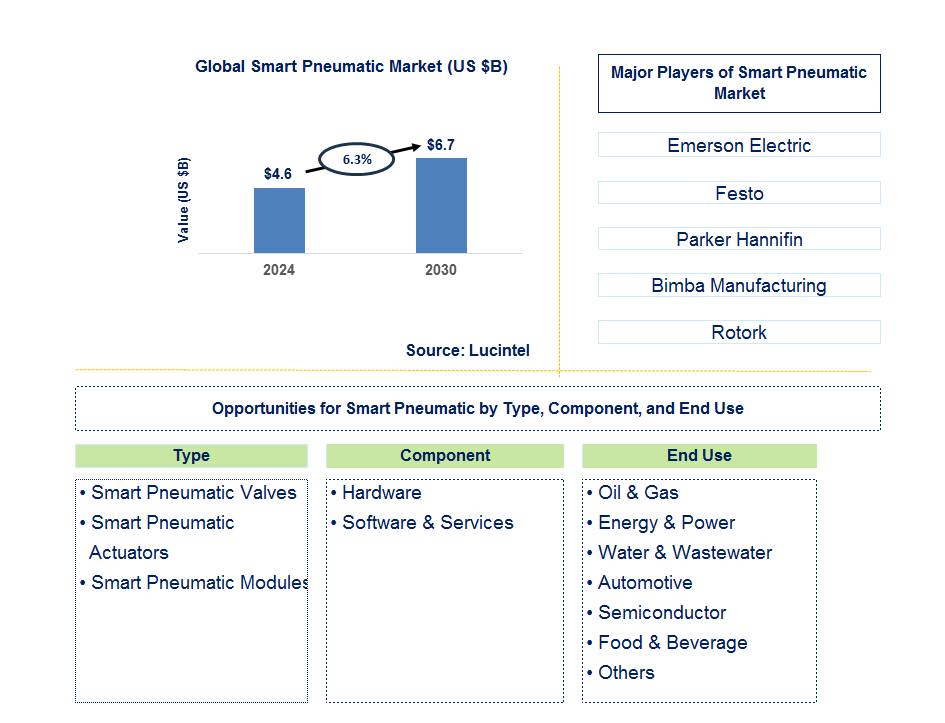
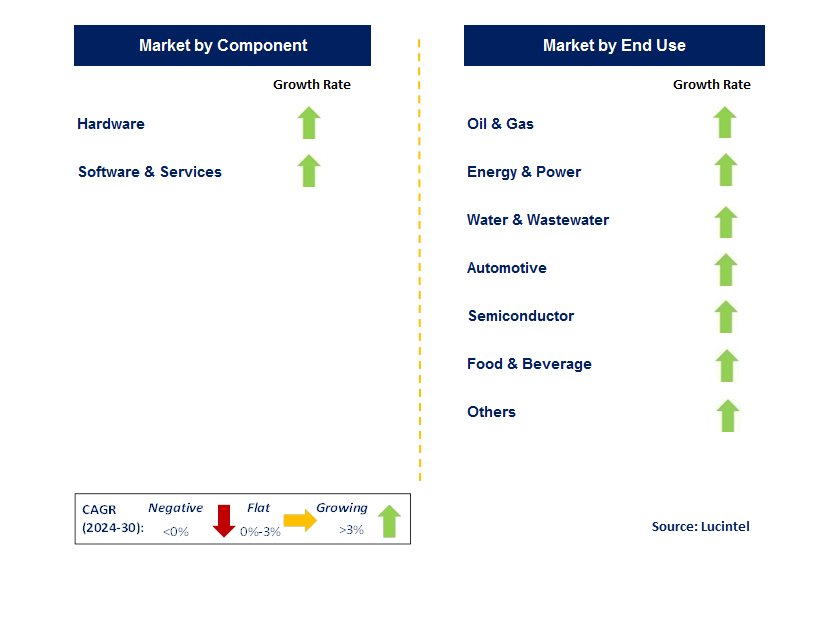
The future of the global smart pneumatic market looks promising with opportunities in the oil & gas, energy & power, water & wastewater, automotive, semiconductor, and food & beverage markets. The global smart pneumatic market is expected to reach an estimated $6.7 billion by 2030 with a CAGR of 6.3% from 2024 to 2030. The major drivers for this market are increasing demand for automation and digitization, growing adoption of the industrial internet of things (IIoT) across sectors, and stringent government regulations for safety and environmental protection.• Lucintel forecasts that, within the type category, software & services is expected to witness the higher growth over the forecast period because the smart pneumatic system's software is a crucial component, and it gathers, processes, and analyzes the raw data that hardware components extract.
• In terms of regions, APAC will remain the largest region over the forecast period due to the growing adoption of smart manufacturing across a number of industries, as well as, increasing emphasis on workplace regulations and the most efficient use of resources. Gain valuable insights for your business decisions with our comprehensive 150+ page report.
Emerging Trends in the Smart Pneumatic Market
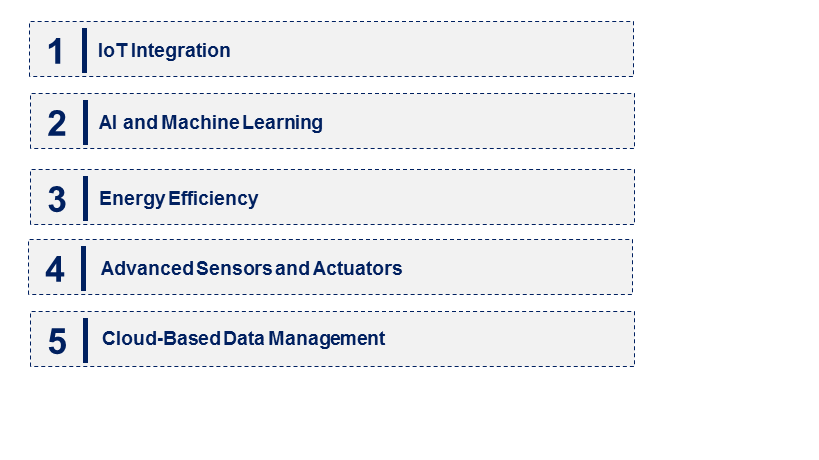
There are several emerging trends being witnessed within the Smart Pneumatic market that are changing its landscape through technology improvements and growing adoption within industry.• IoT Integration: Smart pneumatic systems’ real-time monitoring and data analytics capabilities are being improved by IoT integration, all for the purpose of enhancing operational efficiency and also predictive maintenance.
• AI and Machine Learning: Smarter automation solutions are achieved through AI and machine learning that is integrated into pneumatic control systems as well as reduced operational costs that come from predictive insights.
• Energy Efficiency: This supports sustainability while reducing power consumption and operating expenditure in energy-efficient smart pneumatic systems.
• Advanced Sensors and Actuators: The performance of smart pneumatic systems has been enhanced in complex industrial applications by innovations in sensors, actuators leading to increased precision and responsiveness.
• Cloud-Based Data Management: Cloud-based platforms have started to gain popularity in managing data from smart pneumatic systems as they also facilitate remote control or rather monitoring besides advanced analyses. Such trends lead to greater adoption through fostering technological progress, improving efficiency, expanding applications and creating more acceptance within the market which would then result in innovation.
Recent Developments in the Smart Pneumatic Market
Industrial Automation has been improved upon significantly due to some major new developments happening now with regards to technology advancements and uses within the Smart Pneumatics market.• Advanced Sensor Integration: The Intelligence of smart pneumatics is being improved by integration of advanced sensors that enhance precision and control for more accurate and reliable industrial processes.
• Enhanced Connectivity: Among others, the availability of better connectivity options such as wireless technology and the Internet of Things has facilitated exchange of data and monitoring in real-time.
• Energy-Efficient Designs: Energy efficient designs have targeted power use and incurred operation costs among other things to make them energy-saving in smart pneumatics
• AI-Driven Control Systems: AI driven controls support pneumatic operations via predictive maintenance as well as overall process improvement.
• Modular System Architectures: Modular smart pneumatic systems are aimed at making the system viable for a wide range of industrial applications which require great flexibility and scalability. These developments improve efficiency, accuracy, and connectedness in terms of technology used which facilitates increased adoption thus advancing contextualized industrial processes involving smart pneumatics.
Strategic Growth Opportunities for Smart Pneumatic Market
Across different application areas driven by technology innovations and increased automation demand there are Smart Pneumatics market strategic growth opportunities.• Manufacturing Automation: With smart pneumatics enabling more efficient processes and flexible Industry 4.0 initiatives there are manufacturing automation prospects.
• Automotive manufacturing: The global automotive industry is growing due to the use of smart pneumatic systems to increase automation and accuracy in assembly lines.
• Packaging: In packaging, smart pneumatics can assist with improving the speed, precision, and dependability of packing operations.
• Food & Drinks Processing Industry: Smart pneumatics are enabling the food and beverage industry to enhance cleanliness and productivity while processing or packaging their products.
• Robotics Integration: Incorporating robotics with intelligent pneumatics improves automation across numerous sectors through greater accuracy as well as enhanced operational capabilities. Consequently, these expansion opportunities have steered developments within the smart pneumatics market resulting in increased application and acceptance
Smart Pneumatic Market Driver and Challenges
Technological advancements, economic forces, regulatory aspects among others determine growth in the smart pneumatic market The factors responsible for driving the smart pneumatic market include: 1. Technological Advancements: Innovations on smart pneumatic technologies such as AI integration; IoT etc. contribute to enhancing automation and efficiency thus driving market expansion. 2. Rise of industrial automation: High demand for industrial automation across various sectors drives adoption of smart pneumatic systems. 3. Energy Efficiency Objectives: The urge for energy-saving techniques is pushing the growth and use of intelligent pneumatic systems that consume less power. 4. Reduced Costs: To cut down on costs, smart pneumatics are being used to improve efficiency at a lower cost thereby saving operational expenses. 5. Improved Connectivity: For instance, IoT and wireless technologies are among the connectivity options that enhance smart pneumatics capabilities and applications. Challenges in the smart pneumatic market are: 1. Costly Start-Ups: Exorbitant start-up capital required in sophisticated smart pneumatic systems could hinder their adoption especially by small businesses. 2. Integration Complexities: The integration of smart pneumatic systems with existing infrastructure can be complicated since it may require high level technological knowhow. 3. Compliance with Regulations: Development and deployment of smart pneumatic technology might face some problems due to adherence to regulatory standards and environmental requirements. These drivers and challenges affect the Smart Pneumatics market in terms of growth opportunities, technological enhancements, levels of acceptance therefore shaping industry development as a whole.List of Smart Pneumatic Companies
Companies in the market compete on the basis of product quality offered. Major players in this market focus on expanding their manufacturing facilities, R&D investments, infrastructural development, and leverage integration opportunities across the value chain. With these strategies smart pneumatic companies cater increasing demand, ensure competitive effectiveness, develop innovative products & technologies, reduce production costs, and expand their customer base. Some of the smart pneumatic companies profiled in this report include-• Emerson Electric
• Festo
• Parker Hannifin
• Bimba Manufacturing
• Rotork
• Metso
• Thomson Industries
Smart Pneumatic by Segment
The study includes a forecast for the global smart pneumatic market by type, component, end use, and region.Smart Pneumatic Market by Type [Analysis by Value from 2018 to 2030]:
• Smart Pneumatic Valves
• Smart Pneumatic Actuators
• Smart Pneumatic Modules
Smart Pneumatic Market by Component [Analysis by Value from 2018 to 2030]:
• Hardware
• Software & Services
Smart Pneumatic Market by End Use [Analysis by Value from 2018 to 2030]:
• Oil & Gas
• Energy & Power
• Water & Wastewater
• Automotive
• Semiconductor
• Food & Beverage
Smart Pneumatic Market by Region [Shipment Analysis by Value from 2018 to 2030]:
• North America
• Europe
• Asia Pacific
• The Rest of the World
Country Wise Outlook for the Smart Pneumatic Market
Smart pneumatics are a fast evolving market with advancements occurring in many countries due to technological innovations and rising industrial automation needs.• United States: The USA is developing smart pneumatic systems that incorporate improved sensors and IoT integration for better production efficiency as well as predictive maintenance in their manufacturing operations.
• China: China is broadening its smart pneumatic tech with AI and ML integration, aiding in industrial automation optimization while at the same time reducing operation costs.
• Germany: Germany is ahead when it comes to high-precision smart pneumatic solutions resulting from strong manufacturing industry as well as prioritizing Industry 4.0 technologies.
• India: India has experienced an increase in its smart pneumatics, majorly seen in automotive and manufacturing industries due to the increased investment on industrial automation and intelligence technologies.
• Japan: Japan remains a pioneer of smart pneumatics through miniaturized sensors’ developments and robotics, which have enhanced accuracy and effectiveness of high-tech manufacturing processes. 2. Emerging Trends in the Smart Pneumatic Market

Features of the Global Smart Pneumatic Market
Market Size Estimates: Smart pneumatic market size estimation in terms of value ($B). Trend and Forecast Analysis: Market trends (2018 to 2023) and forecast (2024 to 2030) by various segments and regions. Segmentation Analysis: Smart pneumatic market size by type, component, end use, and region in terms of value ($B). Regional Analysis: Smart pneumatic market breakdown by North America, Europe, Asia Pacific, and Rest of the World. Growth Opportunities: Analysis of growth opportunities in different type, component, end use, and regions for the smart pneumatic market. Strategic Analysis: This includes M&A, new product development, and competitive landscape of the smart pneumatic market. Analysis of competitive intensity of the industry based on Porter’s Five Forces model.If you are looking to expand your business in this or adjacent markets, then contact us. We have done hundreds of strategic consulting projects in market entry, opportunity screening, due diligence, supply chain analysis, M & A, and more.

FAQ
Q1. What is the smart pneumatic market size? Answer: The global smart pneumatic market is expected to reach an estimated $6.7 billion by 2030. Q2. What is the growth forecast for smart pneumatic market? Answer: The global smart pneumatic market is expected to grow with a CAGR of 6.3% from 2024 to 2030. Q3. What are the major drivers influencing the growth of the smart pneumatic market? Answer: The major drivers for this market are increasing demand for automation and digitization, growing adoption of the industrial internet of things (IIoT) across sectors, and stringent government regulations for safety and environmental protection. Q4. What are the major segments for smart pneumatic market? Answer: The future of the global smart pneumatic market looks promising with opportunities in the oil & gas, energy & power, water & wastewater, automotive, semiconductor, and food & beverage markets. Q5. Who are the key smart pneumatic market companies? Answer: Some of the key smart pneumatic companies are as follows:• Emerson Electric
• Festo
• Parker Hannifin
• Bimba Manufacturing
• Rotork
• Metso
• Thomson Industries Q6. Which smart pneumatic market segment will be the largest in future? Answer: Lucintel forecasts that software & services is expected to witness the higher growth over the forecast period because the smart pneumatic system's software is a crucial component, and it gathers, processes, and analyzes the raw data that hardware components extract. Q7. In smart pneumatic market, which region is expected to be the largest in next 5 years? Answer: APAC will remain the largest region over the forecast period due to the growing adoption of smart manufacturing across a number of industries, as well as, increasing emphasis on workplace regulations and the most efficient use of resources. Q.8 Do we receive customization in this report? Answer: Yes, Lucintel provides 10% customization without any additional cost.
Table of Contents
Methodology
- In-depth interviews of the major players in this market
- Detailed secondary research from competitors’ financial statements and published data
- Extensive searches of published works, market, and database information pertaining to industry news, company press releases, and customer intentions
- A compilation of the experiences, judgments, and insights of Lucintel’s professionals, who have analyzed and tracked this market over the years.


Buy Now
Choose a license that fits your team. Instant PDF delivery.
Prices exclude taxes. Instant delivery. Custom licensing available on request.
Key Questions
- • What are some of the most promising, high-growth opportunities for the smart pneumatic market by type (smart pneumatic valves, smart pneumatic actuators, and smart pneumatic modules), component (hardware and software & services), end use (oil & gas, energy & power, water & wastewater, automotive, semiconductor, food & beverage, and others), and region (North America, Europe, Asia Pacific, and the Rest of the World)?
- • Which segments will grow at a faster pace and why?
- • Which region will grow at a faster pace and why?
- • What are the key factors affecting market dynamics? What are the key challenges and business risks in this market?
- • What are the business risks and competitive threats in this market?
- • What are the emerging trends in this market and the reasons behind them?
- • What are some of the changing demands of customers in the market?
- • What are the new developments in the market? Which companies are leading these developments?
- • Who are the major players in this market? What strategic initiatives are key players pursuing for business growth?
- • What are some of the competing products in this market and how big of a threat do they pose for loss of market share by material or product substitution?
- • What M&A activity has occurred in the last 5 years and what has its impact been on the industry?


