
Market Report · July 16, 2026

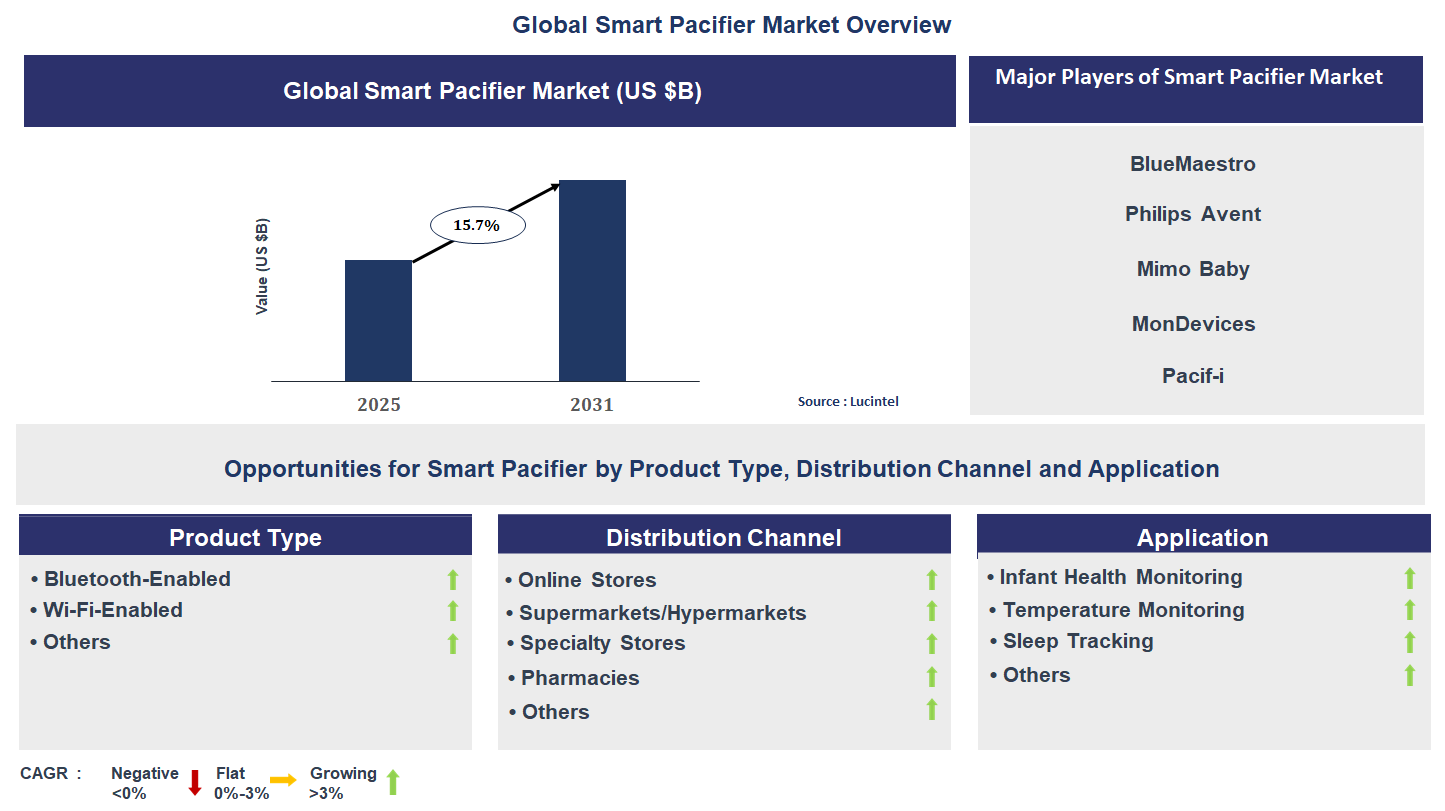
Key data points: The growth forecast = 15.7% annually for the next 7 years. Scroll below to get more insights. This market report covers trends, opportunities and forecasts in smart pacifier market to 2031 by product type (bluetooth-enabled, Wi-Fi-enabled, and others), distribution channel (online stores, supermarkets/hypermarkets, specialty stores, pharmacies, and others), application (infant health monitoring, temperature monitoring, sleep tracking, and others), and region (North America, Europe, Asia Pacific, and the Rest of the World)
We'll send your sample report shortly.
• Lucintel forecasts that, within the product type category, bluetooth-enabled is expected to witness higher growth over the forecast period.
• Within the distribution channel category, online store is expected to witness the highest growth.
• In terms of region, North America is expected to witness the highest growth over the forecast period. Gain valuable insights for your business decisions with our comprehensive 150+ page report. Sample figures with some insights are shown below.
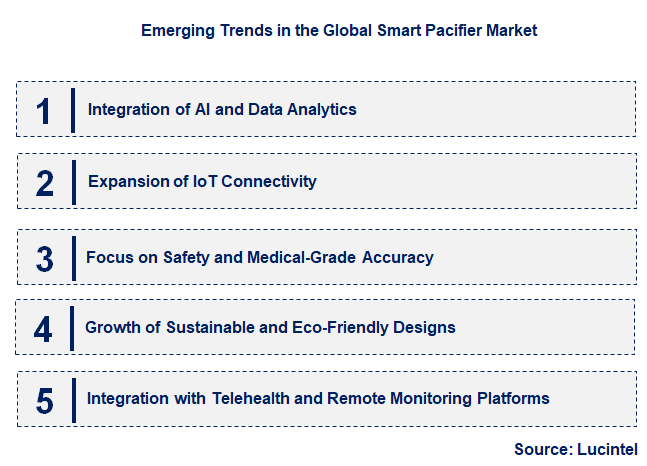
• Integration of AI and Data Analytics: Smart Pacifiers equipped with AI algorithms are enabling advanced data interpretation. Real-time analytics help detect patterns in temperature, hydration, and breathing, allowing early diagnosis of potential health issues. This trend is improving predictive healthcare capabilities and empowering parents with actionable insights.
• Expansion of IoT Connectivity: The integration of Smart Pacifiers into broader Internet of Things ecosystems allows seamless communication with smartphones, wearables, and healthcare systems. Parents can track infant vitals remotely, while physicians can access data for clinical evaluation, enhancing personalized care.
• Focus on Safety and Medical-Grade Accuracy: Manufacturers are prioritizing medical-grade sensors and non-toxic materials to meet safety standards. Compliance with healthcare regulations ensures reliable data accuracy, making Smart Pacifiers suitable for both consumer and clinical use.
• Growth of Sustainable and Eco-Friendly Designs: Eco-friendly materials and rechargeable batteries are being used to minimize waste and environmental impact. This trend aligns with consumer preference for sustainable baby care products without compromising functionality or hygiene.
• Integration with Telehealth and Remote Monitoring Platforms: Smart Pacifiers are increasingly connected to telehealth systems, allowing pediatricians to monitor infant health in real time. This innovation supports early intervention and reduces the need for hospital visits, particularly in rural or remote areas. The smart pacifier market is being reshaped by trends centered on innovation, connectivity, and safety. Integration of AI, IoT, and telehealth is enabling real-time infant monitoring, while sustainability and medical-grade standards are ensuring reliability. As manufacturers continue to merge healthcare expertise with smart technology, Smart Pacifiers are evolving from simple comfort tools into vital diagnostic devices, supporting proactive and data-driven childcare.
• Launch of AI-Integrated Smart Pacifiers: New models feature embedded sensors and algorithms that analyze temperature and hydration data to provide predictive health insights for infants.
• Development of Rechargeable and Sustainable Designs: Manufacturers are introducing rechargeable Smart Pacifiers to reduce waste and improve convenience for consumers.
• Collaborations Between Healthcare Institutions and Startups: Joint efforts are improving product validation, clinical accuracy, and integration into pediatric healthcare systems.
• Advancement in Mobile Application Integration: Enhanced apps now allow parents to monitor multiple health parameters simultaneously, providing real-time alerts and personalized recommendations.
• Expansion of Distribution Through Digital Platforms: The growing role of online retail and healthcare e-commerce platforms is making Smart Pacifiers accessible to a wider consumer base. Recent innovations in the smart pacifier market are focused on making infant health monitoring smarter, safer, and more convenient. AI integration, sustainability, and mobile connectivity are redefining consumer expectations. These developments are not only enhancing infant wellness management but also expanding the global market potential through digital transformation and strategic collaborations.
• Integration into Neonatal Intensive Care Units (NICUs): Smart Pacifiers are being integrated into hospital care systems to enable continuous monitoring of infant temperature and hydration, supporting early detection of health issues.
• Expansion in Home Healthcare Applications: Smart Pacifiers offer real-time infant health tracking for parents at home, reducing the need for frequent doctor visits.
• Collaboration with Telemedicine Platforms: Partnerships with telehealth providers enable remote diagnosis and improve access to healthcare professionals for parents in rural areas.
• Growth in Consumer Electronics Segment: Manufacturers are positioning Smart Pacifiers as part of the smart home ecosystem, enhancing convenience and real-time data sharing.
• Adoption in Preventive Healthcare Programs: Governments and health organizations are encouraging the use of smart monitoring devices to promote early disease detection and child wellness programs. Strategic growth opportunities in the smart pacifier market lie in expanding healthcare applications, integrating advanced technologies, and collaborating with digital health providers. As awareness and affordability increase, smart pacifiers are set to play a crucial role in preventive pediatric healthcare, bridging the gap between home care and clinical monitoring.
• BlueMaestro
• Philips Avent
• Mimo Baby
• MonDevices
• Pacif-i
• BabyPing
• iBaby Labs
• Sproutling
• Owlet Baby Care
• TempTraq
• Bluetooth-Enabled
• Wi-Fi-Enabled
• Others
• Online Stores
• Supermarkets/Hypermarkets
• Specialty Stores
• Pharmacies
• Others
• Infant Health Monitoring
• Temperature Monitoring
• Sleep Tracking
• Others
• North America
• Europe
• Asia Pacific
• The Rest of the World
• United States : The United States leads in smart pacifier innovation, driven by a strong ecosystem of health tech startups and consumer electronics companies. Recent developments focus on advanced sensor integration and AI-enabled analytics that provide accurate infant health data. Collaborations between pediatric health institutions and device manufacturers are accelerating regulatory approvals and market acceptance. Increased awareness among tech-savvy parents and the presence of well-developed e-commerce channels are boosting sales. In addition, government support for digital healthcare and FDA guidance on medical-grade wearables are fostering product innovation and adoption. The U.S. market remains a global benchmark for safety and functionality.
• China: China’s smart pacifier market is expanding rapidly, supported by the growing adoption of smart childcare products and increased investment in connected health technology. Domestic companies are introducing affordable yet feature-rich pacifiers with cloud connectivity and smartphone integration. Government policies promoting maternal and child health are encouraging innovation and consumer trust. The integration of artificial intelligence in product design enables real-time monitoring and predictive health insights. Additionally, the presence of a large infant population and rising disposable incomes are strengthening market demand. China is emerging as a key manufacturing and innovation hub for Smart Pacifiers in the Asia-Pacific region.
• Germany: Germany’s smart pacifier market is progressing through advancements in precision sensor technologies and compliance with stringent European Union safety standards. Local manufacturers emphasize medical-grade accuracy, sustainability, and user-friendly designs. Integration with telemedicine platforms enables healthcare professionals to remotely track infant health metrics. Collaborations between healthcare providers, universities, and technology firms are fostering product innovation and clinical validation. Growing parental interest in preventive healthcare and connected baby care solutions is increasing product adoption. Germany’s focus on quality assurance and research-based innovation continues to position it as a leader in Europe’s Smart Pacifier industry.
• India: India’s smart pacifier market is developing steadily as awareness of digital healthcare and infant wellness rises. Urban consumers, especially tech-oriented parents, are adopting connected baby care devices for real-time monitoring. Domestic startups and multinational companies are introducing affordable and portable pacifiers with Bluetooth connectivity and temperature-tracking features. Increased access to smartphones and digital health apps supports product integration. Government initiatives promoting maternal and child healthcare, along with the growing influence of e-commerce platforms, are driving sales. Although the market is in an early stage, India shows strong potential due to its large birth rate and evolving consumer behavior.
• Japan: Japan’s smart pacifier market is advancing through miniaturization, precision design, and high integration with healthcare networks. Japanese manufacturers focus on reliability, data accuracy, and ergonomic comfort for infants. The country’s aging population and emphasis on maternal healthcare innovation are encouraging adoption of connected baby care solutions. Partnerships between hospitals and technology companies enable real-time data sharing for early health diagnosis. Smart Pacifiers equipped with temperature and hydration sensors are increasingly being used in neonatal care units. Japan’s leadership in sensor technology and consumer electronics is solidifying its position as a major contributor to the global Smart Pacifier market.


• BlueMaestro
• Philips Avent
• Mimo Baby
• MonDevices
• Pacif-i
• BabyPing
• iBaby Labs
• Sproutling
• Owlet Baby Care
• TempTraq Q5. Which smart pacifier market segment will be the largest in future? Answer: Lucintel forecasts that, within the product type category, bluetooth-enabled is expected to witness higher growth over the forecast period. Q6. In smart pacifier market, which region is expected to be the largest in next 5 years? Answer: In terms of region, North America is expected to witness the highest growth over the forecast period. Q7. Do we receive customization in this report? Answer: Yes, Lucintel provides 10% customization without any additional cost.


Choose a license that fits your team. Instant PDF delivery.
Prices exclude taxes. Instant delivery. Custom licensing available on request.
Market Report · July 16, 2026
Market Report · July 15, 2026
Market Report · July 15, 2026
Trusted partner for strategic intelligence and business growth


Receive a complimentary market analysis tailored to your industry. Our analysts will identify key growth opportunities and competitive dynamics specific to your business.

Market size, growth rate, and key trend analysis for your specific sector.

Top competitor positioning and market share analysis.

Strategic recommendations backed by data-driven insights.
Get curated market intelligence and competitive moves straight to your inbox.
By subscribing, you agree to receive our monthly insights. Unsubscribe anytime.
Receive a complimentary market analysis tailored to your industry. Our analysts will identify key growth opportunities and competitive dynamics specific to your business.
Market size, growth rate, and key trend analysis for your specific sector.
Top competitor positioning and market share analysis.
Strategic recommendations backed by data-driven insights.
Get curated market intelligence, emerging trends, and competitive moves straight to your inbox each month.
By subscribing, you agree to receive our monthly insights. Unsubscribe anytime.
We'll send your sample report shortly.