
Report Feature
Smart Food Label Market Trends and Forecast
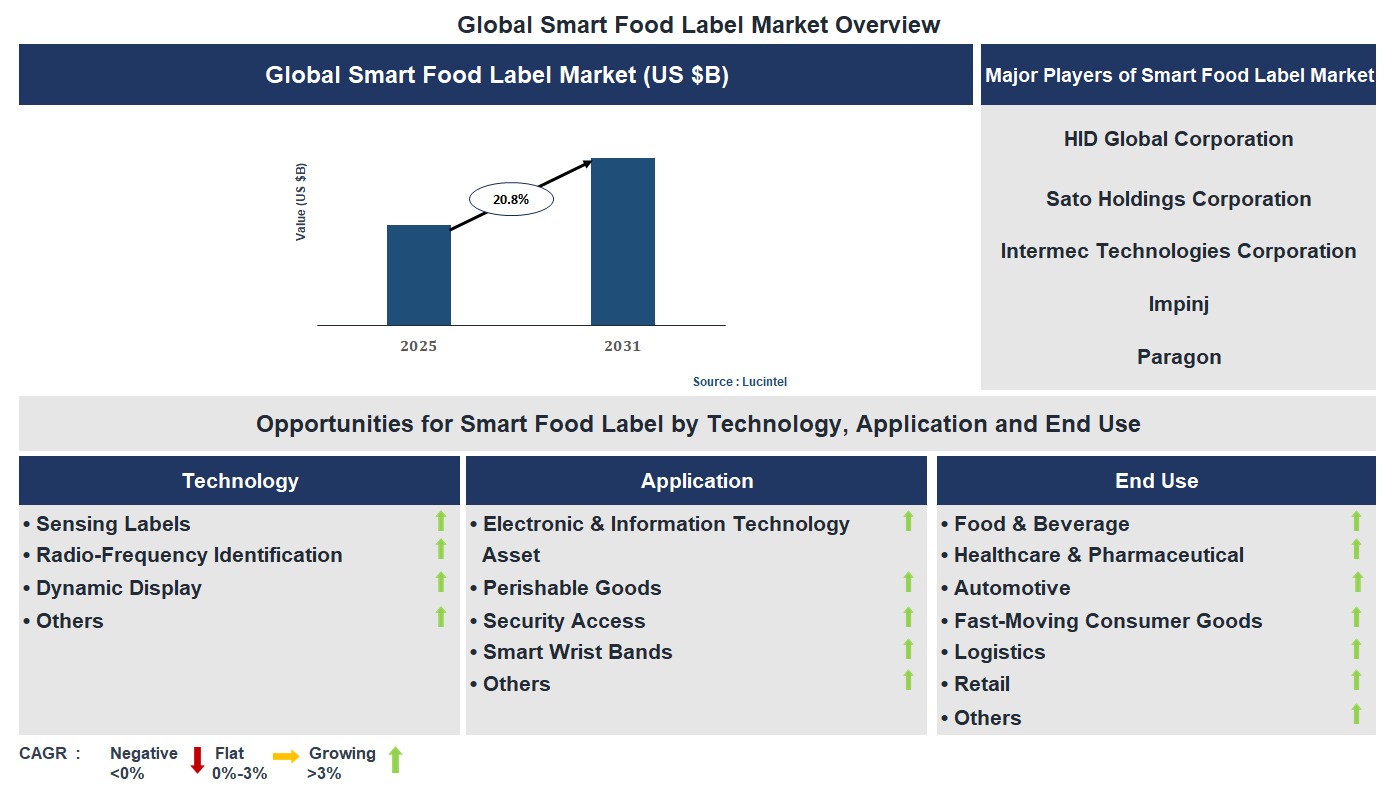
The future of the global smart food label market looks promising with opportunities in the food & beverage, healthcare & pharmaceutical, automotive, fast-moving consumer good, logistic, and retail markets. The global smart food label market is expected to grow with a CAGR of 20.8% from 2025 to 2031. The major drivers for this market are the increasing demand for real-time food monitoring, the rising focus on product safety compliance, and the growing use of intelligent packaging solutions.• Lucintel forecasts that, within the technology category, radio-frequency identification is expected to witness the highest growth over the forecast period.
• Within the end use category, healthcare & pharmaceutical is expected to witness the highest growth.
• In terms of region, North America is expected to witness the highest growth over the forecast period. Gain valuable insights for your business decisions with our comprehensive 150+ page report. Sample figures with some insights are shown below.
Emerging Trends in the Smart Food Label Market
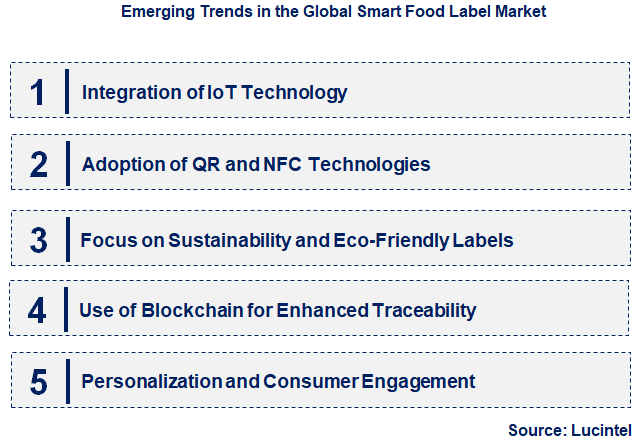
The smart food label market is experiencing rapid growth driven by technological advancements, increasing consumer demand for transparency, and the need for improved food safety. As consumers become more health-conscious and regulatory standards tighten, the adoption of innovative labeling solutions is transforming how food products are marketed and monitored. These developments are not only enhancing consumer trust but also streamlining supply chain management and regulatory compliance. The market is poised for significant expansion as companies leverage emerging technologies to meet evolving demands. The following key trends highlight the major shifts shaping this dynamic industry.• Integration of IoT Technology: The incorporation of Internet of Things (IoT) devices into food labels allows real-time tracking of product conditions. Sensors embedded in labels can monitor temperature, humidity, and freshness, providing consumers and manufacturers with instant data. This enhances food safety, reduces waste, and ensures quality control throughout the supply chain. IoT-enabled labels also facilitate better inventory management and traceability, fostering transparency and trust among stakeholders.
• Adoption of QR and NFC Technologies: Quick Response (QR) codes and Near Field Communication (NFC) tags are increasingly used in smart food labels. These technologies enable consumers to access detailed product information, including nutritional facts, origin, and expiration dates, via smartphones. This instant access promotes transparency, supports informed purchasing decisions, and complies with regulatory requirements. The ease of use and widespread smartphone adoption are driving the popularity of QR and NFC-based labels across various retail channels.
• Focus on Sustainability and Eco-Friendly Labels: The market is witnessing a shift towards sustainable labeling solutions that minimize environmental impact. Biodegradable, recyclable, and plant-based materials are being used to produce smart labels, aligning with consumer preferences for eco-conscious products. These labels often incorporate digital features that reduce paper waste and energy consumption. Sustainability initiatives not only appeal to environmentally aware consumers but also help companies meet regulatory standards and corporate social responsibility goals.
• Use of Blockchain for Enhanced Traceability: Blockchain technology is increasingly integrated into smart food labels to ensure tamper-proof traceability of products. This decentralized ledger records every transaction and movement of food items, providing transparent and immutable data. Blockchain enhances food safety by enabling quick identification of contamination sources and recalls. It also builds consumer confidence by offering verifiable product histories, thereby strengthening brand reputation and compliance with stringent food safety regulations.
• Personalization and Consumer Engagement: Emerging smart labels are designed to offer personalized experiences through interactive features. Augmented reality (AR) and augmented reality (AR) applications allow consumers to scan labels and access customized content, recipes, or health tips. This engagement fosters brand loyalty and enhances the shopping experience. Personalization also enables companies to target specific consumer segments with tailored marketing messages, thereby increasing product appeal and driving sales. In summary, these trends are fundamentally reshaping the smart food label market by enhancing transparency, safety, sustainability, and consumer engagement. The integration of advanced technologies is creating more intelligent, eco-friendly, and interactive labeling solutions that meet the evolving needs of consumers, regulators, and manufacturers. As these developments continue, the market is expected to see increased innovation, competitiveness, and growth, ultimately transforming the way food products are marketed, tracked, and consumed.
Recent Development in the Smart Food Label Market
The smart food label market is experiencing rapid growth driven by increasing consumer demand for transparency, technological advancements, and regulatory changes. As consumers become more health-conscious and seek detailed product information, companies are adopting innovative labeling solutions to meet these needs. The integration of IoT, AI, and blockchain technologies is transforming how food products are tracked, verified, and presented to consumers. Additionally, regulatory frameworks are evolving to mandate clearer labeling standards, further propelling market expansion. These developments are reshaping the landscape, making food labeling more intelligent, secure, and consumer-centric, ultimately influencing purchasing decisions and supply chain management.• Adoption of IoT-enabled Labels: IoT technology is enabling real-time tracking and data collection on food products, improving supply chain transparency and freshness verification. This development enhances consumer trust and reduces food fraud, leading to increased market adoption and higher product credibility.
• Integration of AI for Personalized Labels: Artificial Intelligence is being used to create personalized food labels that provide tailored nutritional information based on individual health profiles. This innovation improves consumer engagement and supports personalized nutrition, boosting market growth.
• Blockchain for Supply Chain Transparency: Blockchain technology ensures secure, immutable records of food origin and handling processes. This development increases transparency, reduces counterfeiting, and enhances consumer confidence, thereby expanding market opportunities.
• Regulatory Changes and Standards: Governments and regulatory bodies are implementing stricter labeling requirements for nutritional content, allergens, and origin. These regulations drive innovation in labeling solutions and ensure compliance, fostering market expansion.
• Consumer Engagement through Digital Platforms: Digital platforms and QR codes on labels allow consumers to access detailed product information instantly. This development enhances transparency, educates consumers, and influences purchasing decisions, fueling market growth. In summary, these key developments are making the smart food label market more innovative, transparent, and consumer-focused. The integration of advanced technologies and regulatory support is driving market expansion, improving supply chain integrity, and empowering consumers with detailed product information. This evolving landscape is set to redefine food labeling standards and boost industry growth.
Strategic Growth Opportunities in the Smart Food Label Market
The smart food label market is experiencing rapid growth driven by increasing consumer demand for transparency, food safety, and innovative packaging solutions. As technology advances, manufacturers are adopting smart labels to provide real-time information, enhance traceability, and improve supply chain efficiency. This evolution is transforming the food industry, creating new opportunities for differentiation and consumer engagement. Key applications such as fresh produce, packaged foods, dairy, beverages, and meat products are seeing significant innovations. These developments are not only improving product safety and quality but also enabling brands to build trust and loyalty. The following are five key growth opportunities across these applications.• Enhanced Traceability and Freshness Monitoring : Smart labels enable real-time tracking of freshness levels and origin, reducing waste and increasing consumer confidence in produce quality. This fosters trust and encourages purchase decisions, especially in organic and premium segments.
• Improved Shelf Life and Expiry Management : Smart labels provide accurate expiry dates and storage instructions, minimizing food waste and ensuring safety. This benefits retailers by reducing returns and enhances consumer satisfaction through reliable product information.
• Temperature and Quality Monitoring : Smart labels monitor temperature during transportation and storage, ensuring dairy products remain fresh and safe. This reduces spoilage, enhances brand reputation, and complies with safety regulations.
• Authenticity and Anti-counterfeiting Measures : Smart labels help verify product authenticity, preventing counterfeiting and ensuring consumer trust. This is particularly vital for premium and alcoholic beverages, protecting brand integrity.
• Supply Chain Transparency and Safety Assurance : Smart labels track the entire supply chain, providing transparency and ensuring meat safety standards. This reduces contamination risks and boosts consumer confidence in product safety. In summary, these growth opportunities are significantly impacting the smart food label market by enhancing product safety, reducing waste, and building consumer trust. They enable brands to differentiate themselves through innovation, improve supply chain efficiency, and meet increasing regulatory and consumer demands for transparency. As a result, the market is poised for sustained expansion driven by technological advancements and evolving consumer preferences.
Smart Food Label Market Driver and Challenges
The smart food label market is influenced by a variety of technological, economic, and regulatory factors that shape its growth and development. Advances in digital technology and data analytics are enabling more sophisticated labeling solutions, while increasing consumer demand for transparency and health information is driving market expansion. Economic factors such as rising food safety concerns and the need for supply chain efficiency further propel adoption. However, regulatory frameworks and standards vary across regions, posing challenges for market players. Balancing innovation with compliance, managing costs, and addressing consumer privacy concerns are critical considerations. Overall, these drivers and challenges collectively determine the trajectory of the Smart Food Label Market. The factors responsible for driving the smart food label market include:-• Technological Innovation: The rapid development of IoT, RFID, and blockchain technologies has revolutionized food labeling. These innovations enable real-time tracking, enhanced transparency, and detailed product information, which meet consumer demands for safety and authenticity. Companies investing in smart labels can improve supply chain management, reduce fraud, and enhance brand trust. As technology becomes more affordable and scalable, adoption accelerates across food producers and retailers, fostering market growth.
• Consumer Demand for Transparency: Modern consumers are increasingly health-conscious and seek detailed information about food products, including nutritional content, origin, and safety certifications. Smart labels facilitate this by providing accessible, real-time data via smartphones or other devices. This transparency builds consumer trust, influences purchasing decisions, and encourages brand loyalty. As awareness about food safety and sustainability grows, the demand for smart labeling solutions is expected to rise significantly.
• Regulatory and Compliance Pressures: Governments and regulatory bodies worldwide are implementing stricter food safety standards and labeling requirements. Smart labels help companies comply with these regulations by providing verifiable, tamper-proof information. They also assist in traceability during recalls or safety investigations, reducing legal and financial risks. The evolving regulatory landscape acts as a catalyst for market growth, prompting food industry stakeholders to adopt advanced labeling solutions.
• Rising Food Safety Concerns: Foodborne illnesses and contamination incidents have heightened awareness about food safety. Smart labels enable better traceability and monitoring throughout the supply chain, helping to prevent contamination and ensure product integrity. This proactive approach reduces recall costs and enhances consumer confidence. As safety concerns intensify, the adoption of smart labeling solutions becomes a strategic priority for food companies aiming to mitigate risks.
• Supply Chain Optimization: Efficient supply chain management is crucial for reducing costs and ensuring freshness. Smart labels provide real-time data on temperature, humidity, and location, enabling better inventory control and reducing waste. They facilitate seamless tracking from farm to table, improving transparency and accountability. As supply chains become more complex, the need for intelligent labeling solutions grows, driving market expansion and technological integration. The challenges facing smart food label market include:-
• High Implementation Costs: Integrating smart labels involves significant investment in technology, infrastructure, and training. Small and medium-sized enterprises may find these costs prohibitive, limiting widespread adoption. Additionally, ongoing maintenance and updates add to the financial burden. This cost barrier can slow market growth, especially in regions with limited resources or less regulatory pressure.
• Lack of Standardization: The absence of universal standards for smart labels creates compatibility issues across different systems and regions. Variations in technology, data formats, and regulatory requirements hinder interoperability and scalability. This fragmentation complicates adoption for global food companies and may lead to increased costs and inefficiencies, impeding the overall growth of the market.
• Consumer Privacy and Data Security Concerns: Smart labels often collect and transmit sensitive data related to product origin, supply chain, and consumer interactions. Ensuring data security and protecting consumer privacy is paramount, yet challenging. Breaches or misuse of data can erode trust and lead to legal repercussions. Addressing these concerns requires robust cybersecurity measures, which can be costly and complex, potentially restraining market expansion. In summary, the smart food label market is driven by technological advancements, consumer demand for transparency, regulatory pressures, safety concerns, and supply chain efficiencies. However, high costs, lack of standardization, and data security issues pose significant challenges. These factors collectively influence the pace and scope of market growth. While innovation and regulatory support foster expansion, addressing cost and security concerns is essential for sustainable development. Overall, the markets future hinges on balancing technological progress with effective management of these challenges to meet evolving industry and consumer needs.
List of Smart Food Label Companies
Companies in the market compete on the basis of product quality offered. Major players in this market focus on expanding their manufacturing facilities, R&D investments, infrastructural development, and leverage integration opportunities across the value chain. With these strategies smart food label companies cater increasing demand, ensure competitive effectiveness, develop innovative products & technologies, reduce production costs, and expand their customer base. Some of the smart food label companies profiled in this report include-• HID Global Corporation
• Sato Holdings Corporation
• Intermec Technologies Corporation
• Impinj
• Paragon
• Confidex
• Invengo Information Technology
• Lyngsoe Systems
• Alien Technology
• Xerafy
Smart Food Label Market by Segment
The study includes a forecast for the global smart food label market by technology, application, end use, and region.Smart Food Label Market by Technology [Value from 2019 to 2031]:
• Sensing Labels
• Radio-Frequency Identification
• Dynamic Display
• Others
Smart Food Label Market by Application [Value from 2019 to 2031]:
• Electronic & Information Technology Asset
• Perishable Goods
• Security Access
• Smart Wrist Bands
• Others
Smart Food Label Market by End Use [Value from 2019 to 2031]:
• Food & Beverage
• Healthcare & Pharmaceutical
• Automotive
• Fast-Moving Consumer Goods
• Logistics
• Retail
• Others
Smart Food Label Market by Region [Value from 2019 to 2031]:
• North America
• Europe
• Asia Pacific
• The Rest of the World
Country Wise Outlook for the Smart Food Label Market
The smart food label market has experienced significant growth driven by increasing consumer demand for transparency, technological advancements, and regulatory support worldwide. As consumers become more health-conscious and interested in sustainable practices, companies are adopting innovative labeling solutions to provide detailed product information. Governments are also encouraging the adoption of smart labels to improve food safety and traceability. This evolving landscape reflects a shift towards smarter, more informative packaging that enhances consumer trust and operational efficiency across various regions.• United States: The U.S. market has seen rapid adoption of smart food labels, driven by rising health awareness and stringent food safety regulations. Major food companies are integrating RFID and QR codes to provide real-time product information, including nutritional content and origin. Innovations in IoT technology are enabling better supply chain management and reducing food waste. Consumer demand for transparency and personalized nutrition data continues to propel market growth, with startups and tech giants investing heavily in R&D.
• China: China’s market is expanding due to government initiatives promoting food safety and traceability. The adoption of smart labels is facilitated by increasing e-commerce and online grocery shopping, which require reliable product information. Local companies are developing cost-effective solutions using NFC and QR codes to meet domestic demand. The focus is also on integrating AI and big data analytics to enhance supply chain transparency and combat food fraud, aligning with China’s broader digital transformation goals.
• Germany: Germany’s market is characterized by a strong emphasis on sustainability and regulatory compliance. Companies are adopting smart labels to meet EU standards for food traceability and safety. Innovations include biodegradable smart labels and integration with blockchain technology for enhanced transparency. The focus on organic and eco-friendly products is driving the development of environmentally sustainable labeling solutions. Consumer interest in detailed product origin and quality information remains high, supporting market expansion.
• India: The Indian market is witnessing rapid growth due to increasing awareness of food safety and government initiatives like the Food Safety and Standards Authority of India (FSSAI). Cost-effective smart labeling solutions such as QR codes and RFID are gaining popularity among local manufacturers. The rise of e-commerce and organized retail is fueling demand for transparent labeling. Startups are exploring innovative applications like smart packaging for perishable goods, aiming to reduce food wastage and improve supply chain efficiency.
• Japan: Japan’s market is driven by technological innovation and a focus on quality assurance. Companies are adopting advanced RFID and NFC technologies to provide detailed product information, including freshness and origin. The aging population’s demand for health-related data influences the development of smart labels with nutritional and allergen information. Regulatory support and consumer preference for high-quality, safe food products are fostering market growth, with a focus on integrating smart labels into premium and functional food segments.

Features of the Global Smart Food Label Market
Market Size Estimates: Smart food label market size estimation in terms of value ($B). Trend and Forecast Analysis: Market trends (2019 to 2024) and forecast (2025 to 2031) by various segments and regions. Segmentation Analysis: Smart food label market size by technology, application, end use, and region in terms of value ($B). Regional Analysis: Smart food label market breakdown by North America, Europe, Asia Pacific, and Rest of the World. Growth Opportunities: Analysis of growth opportunities in different technologies, applications, end uses, and regions for the smart food label market. Strategic Analysis: This includes M&A, new product development, and competitive landscape of the smart food label market. Analysis of competitive intensity of the industry based on Porter’s Five Forces model.
FAQ
Q1. What is the growth forecast for smart food label market? Answer: The global smart food label market is expected to grow with a CAGR of 20.8% from 2025 to 2031. Q2. What are the major drivers influencing the growth of the smart food label market? Answer: The major drivers for this market are the increasing demand for real-time food monitoring, the rising focus on product safety compliance, and the growing use of intelligent packaging solutions. Q3. What are the major segments for smart food label market? Answer: The future of the smart food label market looks promising with opportunities in the food & beverage, healthcare & pharmaceutical, automotive, fast-moving consumer good, logistic, and retail markets. Q4. Who are the key smart food label market companies? Answer: Some of the key smart food label companies are as follows:• HID Global Corporation
• Sato Holdings Corporation
• Intermec Technologies Corporation
• Impinj
• Paragon
• Confidex
• Invengo Information Technology
• Lyngsoe Systems
• Alien Technology
• Xerafy Q5. Which smart food label market segment will be the largest in future? Answer: Lucintel forecasts that, within the technology category, radio-frequency identification is expected to witness the highest growth over the forecast period. Q6. In smart food label market, which region is expected to be the largest in next 5 years? Answer: In terms of region, North America is expected to witness the highest growth over the forecast period. Q7. Do we receive customization in this report? Answer: Yes, Lucintel provides 10% customization without any additional cost.
Table of Contents
List of Figures
List of Tables
Methodology
- In-depth interviews of the major players in this market
- Detailed secondary research from competitors’ financial statements and published data
- Extensive searches of published works, market, and database information pertaining to industry news, company press releases, and customer intentions
- A compilation of the experiences, judgments, and insights of Lucintel’s professionals, who have analyzed and tracked this market over the years.


Buy Now
Choose a license that fits your team. Instant PDF delivery.
Prices exclude taxes. Instant delivery. Custom licensing available on request.
Key Questions
- • What are some of the most promising, high-growth opportunities for the smart food label market by technology (sensing labels, radio-frequency identification, dynamic display, and others), application (electronic & information technology asset, perishable goods, security access, smart wrist bands, and others), end use (food & beverage, healthcare & pharmaceutical, automotive, fast-moving consumer goods, logistics, retail, and others), and region (North America, Europe, Asia Pacific, and the Rest of the World)?
- • Which segments will grow at a faster pace and why?
- • Which region will grow at a faster pace and why?
- • What are the key factors affecting market dynamics? What are the key challenges and business risks in this market?
- • What are the business risks and competitive threats in this market?
- • What are the emerging trends in this market and the reasons behind them?
- • What are some of the changing demands of customers in the market?
- • What are the new developments in the market? Which companies are leading these developments?
- • Who are the major players in this market? What strategic initiatives are key players pursuing for business growth?
- • What are some of the competing products in this market and how big of a threat do they pose for loss of market share by material or product substitution?
- • What M&A activity has occurred in the last 5 years and what has its impact been on the industry? For any questions related to Smart Food Label Market, Smart Food Label Market Size, Smart Food Label Market Growth, Smart Food Label Market Analysis, Smart Food Label Market Report, Smart Food Label Market Share, Smart Food Label Market Trends, Smart Food Label Market Forecast, Smart Food Label Companies, write Lucintel analyst at email: helpdesk@lucintel.com. We will be glad to get back to you soon.


