
Report Feature
Skin Toner Market Trends and Forecast
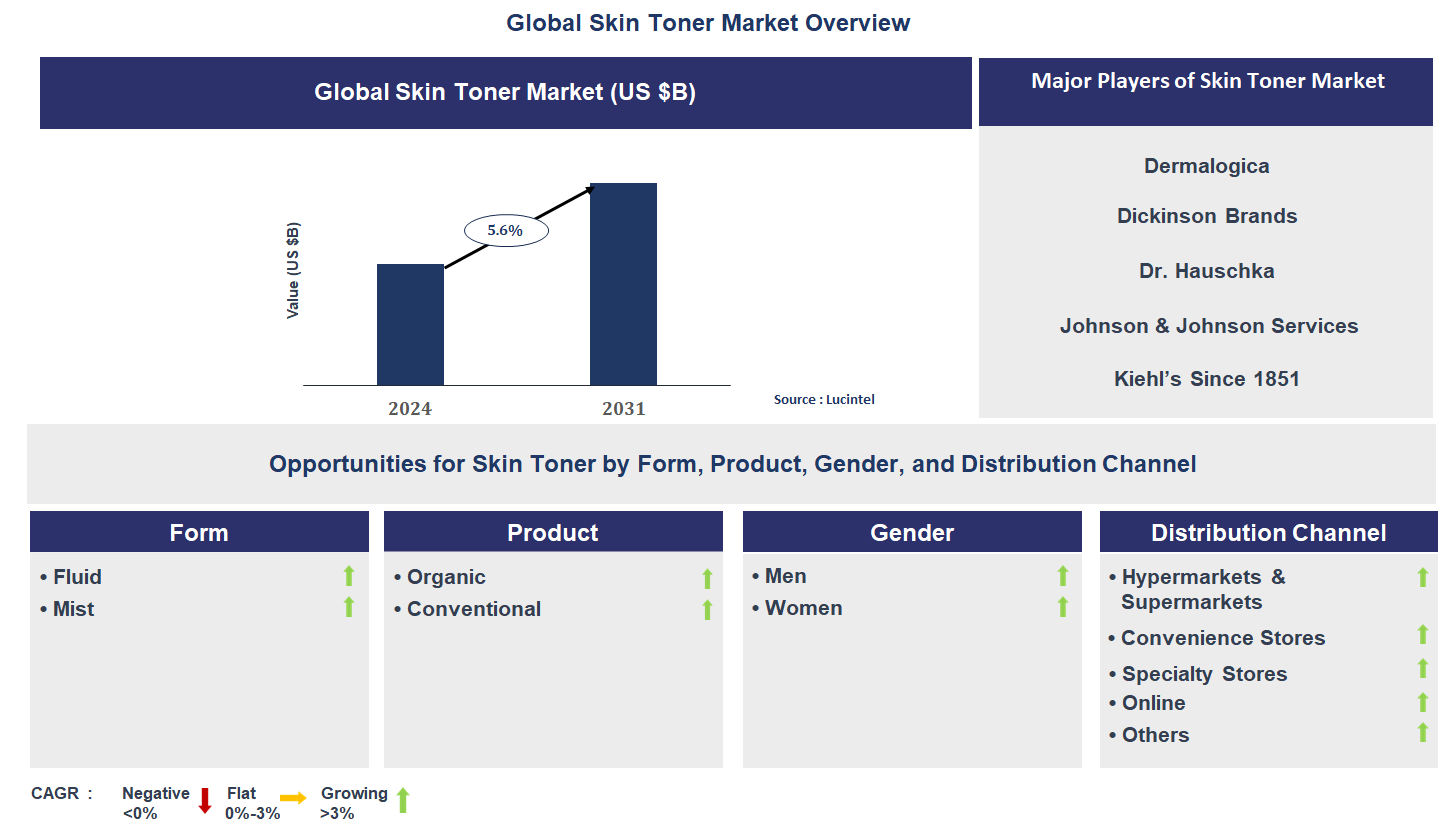
The future of the global skin toner market looks promising with opportunities in the hypermarket & supermarket, convenience store, specialty store, and online markets. The global skin toner market is expected to grow with a CAGR of 5.6% from 2025 to 2031. The major drivers for this market are the increasing focus on skincare routines, the rising demand for natural ingredients, and the growing awareness of skincare benefits.• Lucintel forecasts that, within the form category, fluid will remain a larger segment over the forecast period.
• Within the distribution channel category, hypermarket & supermarket will remain the largest segment.
• In terms of region, North America will remain the largest region over the forecast period. Gain valuable insights for your business decisions with our comprehensive 150+ page report. Sample figures with some insights are shown below.
Emerging Trends in the Skin Toner Market
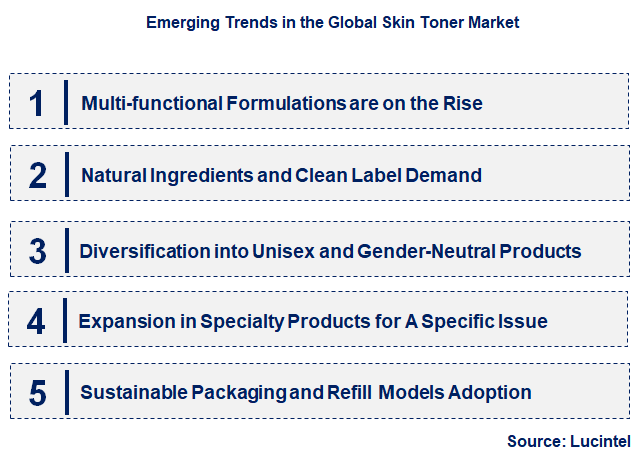
The market for skin toner is being redefined by a fresh list of upcoming trends that are redefining the landscape. These trends are an extension of a wider change in consumer attitudes, where products need to be not just functional but also responsive to personal health aspirations as well as ecological thinking. The market is becoming increasingly differentiated and specialized with greater emphasis on user experience and sustainable production. The following five trends are causing this shift.• Multi-functional Formulations are on the Rise: One important trend is the emergence of multi-functional toners that extend beyond simple cleansing. Companies are now producing products that provide multiple functions in one application, e.g., hydrating, exfoliating, and brightening. This trend comes in response to consumer preference for simple skincare routines and effective products. It is making it possible for new brands to enter the marketplace and is forcing traditional companies to re-formulate their product bases to address the needs of a health-conscious consumer base.
• Natural Ingredients and Clean Label Demand: The market is experiencing a significant shift towards clean label products that are produced using natural and organic ingredients. This is forcing manufacturers to phase out toxic chemicals such as parabens and synthetic fragrances and to incorporate ingredients that are ethically sourced. Consumers are also looking more closely at a brands ethics, and transparency has become an important consideration when making a purchase. This trend is driven by a growing consumer awareness of the health concerns posed by synthetic ingredients.
• Diversification into Unisex and Gender-Neutral Products: The industry is seeing a very strong trend in the direction of unisex and gender-neutral products. Brands are introducing formulations and fragrances that are attractive to many consumers. This is a reaction to a cultural shift in which personal care products are less gender-oriented. This movement is creating a large, underserved market segment that brands can enter and invest in, offering a new path to growth and differentiation.
• Expansion in Specialty Products for A Specific Issue: A speeding trend is the broad creation of specialized toners for varying skin types and issues. The marketplace is witnessing the demand increase for sensitive skin products and an emphasis on products for a single demographic, such as teenagers with acne skin. This is enabling companies to address specific customer segments and provide adapted solutions that prove superior to a generic, one-size-fits-all solution.
• Sustainable Packaging and Refill Models Adoption: There is a new wave towards eco-friendly and sustainable packaging. The industry is witnessing an increase in products that employ recyclable materials and refillable packaging. This trend is the immediate aftermath of increased consumer concern over plastic wastes environmental effect. This is not just attractive to a new generation of shoppers but is also giving rise to a new category of green products that can help a company stand out in a crowded market. These new trends are all together altering the skin toner industry by making it more reactive to contemporary consumer values. The emphasis on multi-functional products is meeting the demand for simplicity and efficiency, and the emphasis on sustainability is meeting the worlds challenges. The segmentation of customers and the new business models are widening the markets reach. The industrys future will be determined by how it meets these strong trends with innovation and changing.
Recent Development in the Skin Toner Market
The skin toner market has witnessed a string of swift and far-reaching changes in recent years, primarily a result of the worldwide trend toward wellness and natural living. These trends are shifting the market from a mere commodity to a more nuanced, consumer-influenced industry. The concern is not just in terms of basic cleansing but also in terms of therapeutic effectiveness, sustainability, and a more holistic approach to wellness. The next five important developments showcase the way the market is shifting.• Launch of Hydrating and Therapeutic Toners: One of the major developments is the mass launch of toners that are used to moisturize and calm the skin. As a response to the demand from consumers for milder products, manufacturers have substituted alcohol formulations with hyaluronic acid and glycerin-based versions. This trend is essentially revolutionizing the role of a toner from being a harsh astringent to being a moisturizing skincare step. This is also making it possible to have a wider range of products that target particular skin types.
• Formulation Advancements with Active Ingredients: There has been a significant advancement in the application of active ingredients in toners. Manufacturers are launching new products with innovative features such as AHAs and BHAs for delicate exfoliation and niacinamide for brightening. These innovations are increasing the efficacy of toners and are one of the major drivers to raise consumer satisfaction. These new products are a clear result of increased consumer consciousness and the need for products that achieve noticeable effects.
• E-commerce and Subscription Models Growth: One of the key developments is the emergence and popularity of the e-commerce and subscription model. This business model provides consumers with an easy means of buying a tremendous range of toners from the comfort of their homes. It gives a stable revenue stream to companies and enables them to establish a direct tie with consumers. It also facilitates new, niche brands entering the market and challenging established giants.
• Growth of Male Grooming and Gender-Neutral Lines: One major growth is in the growth of male grooming and gender-neutral product lines. The market is experiencing growth in toners that are specially designed for a male consumers lifestyle and skin requirements. This is a complete reaction to the male grooming market that is expanding. Companies are also creating products that are not specifically gendered, and with a focus on the universal, which is creating a large, untapped marketplace.
• Focus on Sustainable and Eco-Friendly Products: Another significant trend is the increased focus on sustainable and eco-friendly products. This ranges from recyclable packaging to sourcing ingredients that are ethically and environmentally sound. Brands now focus on promoting their sustainable efforts in their marketing. This trend is popular with a new generation of consumers who are environmentally friendly and is one of the most important drivers of ongoing product development within the industry. These developments are collectively shaping the skin toner market by nudging it towards a more specialized, therapeutic, and consumer-driven future. The move towards sustainable ingredients and the launch of new formulations are meeting health and environmental imperatives. The growth into new segments and emerging business models are opening new ground for market growth and brand differentiation.
Strategic Growth Opportunities in the Skin Toner Market
The skin toner market presents a range of strategic growth opportunities in leading applications, driven by a synergy of changing consumer values and a drive for increased specialization. To be successful, companies need to break away from the one-size-fits-all mentality and emphasize innovation and precision marketing. By recognizing and responding to specific needs in varying segments of the market, brands can build new revenue streams and develop a robust competitive advantage.• Servicing the Male Grooming Segment: One of the greatest opportunities for growth is reaching into the men’s grooming market. While a lot of skin toners are gender-neutral, there is an obvious opportunity to develop products designed specifically for male consumers. This involves the development of products with a masculine fragrance and an emphasis on formulations being non-greasy and long-lasting. This is a fast-growing segment and represents a consistent, high-value revenue stream.
• Creating a Premium, Multi-functional Line: A lot of growth potential exists in creating a premium line that deals with multi-functional benefits. This means combining high-performance actives such as vitamins and moisturizers into toner products. This approach is directed at the increasing number of consumers who are willing to spend extra on products offering enhanced skincare benefits. It also assists a brand in creating a solid reputation for innovation, which acts as a strong differentiator in a competitive marketplace.
• Riding E-commerce with Personalized Services: Direct-to-consumer and e-commerce models offer a significant growth opportunity. Brands can use these channels to provide personalized services, including quizzes that suggest products based on a user’s skin type and issues. A subscription method can also be used to offer a predictable and recurring revenue. This method not only offers convenience but also establishes a direct connection with the customer, generating increased brand loyalty and repeat buying.
• Breaking the Teenager and Acne-Prone Skin Segment: One of the major opportunities for growth is breaking the teenager and acne-prone skin segment. By providing a quality yet affordable product and by collaborating with dermatologists, brands are able to break into this market. The teenage population is social media-driven and is a primary influencer of new trends. By developing products that solve their particular problems, brands are able to get a committed and long-term customer base.
• Emerging Markets Expansion: A strategic growth strategy lies in expanding into emerging markets. With incomes on the rise and a rising new generation of consumers who increasingly demand healthy lifestyles, there will be an increasing demand for affordable, quality skin tones. By having a selection of well-crafted yet affordably priced products, companies can enter these markets and establish a sustained growth path. These strategic growth prospects are being collectively shaping the skin toner industry towards a future that is more specialized and consumer-centric. By concentration on niche uses and demographics, firms are extending the markets reach. The focus on multi-functional benefit and emerging business models is driving new segments of value-driven, premium products. The strategic entry into new markets also means that the industry will further develop and adapt to global consumers needs.
Skin Toner Market Driver and Challenges
The market for skin toner is influenced by a dynamic interaction of principal drivers and challenges that are impacting its growth and direction. The expansion of the markets is driven mostly by an increased worldwide consciousness about personal health and hygiene and a new set of consumers who prioritize self-care. However, the business also has major challenges, such as a premium product price point, lower consumer awareness in some markets, and risk of skin sensitivity. The factors responsible for driving the skin toner market include: 1. Increasing Consumer Health Awareness: A leading driver is the increasing consumer health awareness. Customers are more and more concerned about the possible health hazards from using traditional toners made of alcohol and synthetic ingredients. This has resulted in a significant trend toward organic and natural varieties. The preference for skin-friendly products that are chemical-free is one of the predominant drivers of market growth. This is a consumption pattern change that has turned skin toner into a daily staple for a much broader customer base. 2. Increasing Demand for Multi-functional Products: The increasing demand for multi-functional products is one of the key drivers in the market. People are looking for products that can deliver more than one benefit within a single use. This has prompted companies to create toners that not only balance the pH of a skin but also hydrate and exfoliate. This is a strong motivator that is adding value to products and is persuading consumers to utilize them as part of their daily skincare routine. 3. Influence of Social Media: The influence of social media is a major driver. These platforms are creating awareness about multi-step skincare routines and the importance of using a toner. Social media influencers and beauty bloggers are playing a key role in educating consumers about the benefits of different formulations. This has made the market more accessible to new brands. 4. K-Beauty and J-Beauty Trends: The K-Beauty and J-Beauty trends are a significant driver of growth. Both trends focus on a multi-step skincare routine with a toner frequently being a central product. This has driven higher adoption in Western markets where toners were once classed as a secondary product. This driver is especially important in markets where a streamlined, minimalist approach to skin care is the standard. 5. Urbanization and Environmental Issues: One of the major drivers is urbanization and the increasing awareness of the impact of pollution on the skin. This is generating a demand for toners with detoxifying and anti-pollution properties. This is a universal trend that is especially strong in highly populated regions. Demand for products that shield the skin from environmental aggressors is generating a new line of niche products. Challenges in the skin toner market are: 1. Premium Price Point: The industry is confronted with a huge threat posed by a higher price point. Specialized and premium skin toners usually employ natural, ethically produced ingredients that might cost more to manufacture compared to synthetic ingredients. They therefore become less affordable to budget-conscious consumers, especially in emerging economies. Brands challenge lies in achieving balance between quality and competitiveness. 2. Skin Sensitivity Concerns: One significant challenge is the risk of skin sensitivity. Irritation, redness, and allergic reactions can occur in some individuals due to common toner ingredients such as AHAs and BHAs. This is a significant turn-off for sensitive skin consumers, causing them to resist incorporating toners into their regimen. The challenge for brands is to create formulations that are effective yet gentle and tolerant. 3. Limited Consumer Awareness: A key challenge is limited consumer knowledge of the advantages of skin toners in certain markets. Most consumers view it as an extra product and do not realize the long-term advantages of regular use. This is a key stumbling block for brands and necessitates huge investments in large-scale educational campaigns to generate demand. The joint effect of these drivers and challenges is a market that is constantly evolving. The drivers, particularly the increased emphasis on health, aging population, and self-care, are compelling the industry towards innovation and diversification. Brands are reacting by producing high-technology, specialist, and sustainable products. Nevertheless, the challenges, more so market saturation and educating consumers, are compelling companies to be more strategic and responsible.List of Skin Toner Companies
Companies in the market compete on the basis of product quality offered. Major players in this market focus on expanding their manufacturing facilities, R&D investments, infrastructural development, and leverage integration opportunities across the value chain. With these strategies skin toner companies cater increasing demand, ensure competitive effectiveness, develop innovative products & technologies, reduce production costs, and expand their customer base. Some of the skin toner companies profiled in this report include-• Dermalogica
• Dickinson Brands
• Dr. Hauschka
• Johnson & Johnson Services
• Kiehl’s Since 1851
• Mario Badescu
• Milk Makeup
• PIXI - SJOVIK
• Thayers
• The Body Shop International Limited
Skin Toner Market by Segment
The study includes a forecast for the global skin toner market by form, product, gender, distribution channel, and region.Skin Toner Market by Form [Value from 2019 to 2031]:
• Fluid
• Mist
Skin Toner Market by Product [Value from 2019 to 2031]:
• Organic
• Conventional
Skin Toner Market by Gender [Value from 2019 to 2031]:
• Men
• Women
Skin Toner Market by Distribution Channel [Value from 2019 to 2031]:
• Hypermarkets & Supermarkets
• Convenience Stores
• Specialty Stores
• Online
• Others
Skin Toner Market by Region [Value from 2019 to 2031]:
• North America
• Europe
• Asia Pacific
• The Rest of the World
Country Wise Outlook for the Skin Toner Market
The international skin toner market has entered an era of accelerated change, stepping beyond its classic role as a one-dimensional astringent to that of a multi-tasking skincare essential. This is inspired by a greater sensitivity among consumers toward skin well-being and a shift worldwide toward a broader, multi-step beauty regimen. Current trends focus on product innovation, increased focus on natural ingredients, and product format diversification.• United States: In the United States, the market for skin toners is moving toward premium and niche products. One of the developments is the shift toward a clean beauty and wellness lifestyle. Consumers are now looking for products that are not just alcohol-free but also infused with active ingredients such as hyaluronic acid and niacinamide. There is also a growth in niche products for sensitive skin and a push for attractive, sustainable packaging. Direct-to-consumer products and online platforms are also becoming key players, offering a broad range of choices and enabling targeted marketing to an increasingly health-oriented consumer base.
• China: Chinas skin toner market is witnessing fast growth driven by a rapidly expanding middle class and increased emphasis on personal grooming. The market is registering an aggressive demand for products providing both therapeutic and cosmetic benefits. There is a penchant for herbal-based products and an emphasis on sophisticated formulations. Social media and e-commerce sites are the main drivers of growth, with companies using influencers to appeal to a large consumer base covering various geographies and demographics. Demand is increasing for premium, imported products.
• Germany: Demand for skin toners in the German market is driven by a strong product quality, effectiveness, and strict safety standards focus from consumers. Germany ranks among Europes largest markets, where theres a strong demand for skin-friendly and sustainable personal care products. It is also experiencing growth in packaging alternatives such as refills due to a robust consumer demand for the zero-waste movement. Innovation in Germany revolves around developing high-performance products that are clinically validated and effective, with a high emphasis placed on dermatological well-being and a minimal environment impact.
• India: Indias skin toner market is growing very fast, driven by increases in disposable incomes and higher awareness of personal care. Although the market remains dominated by low-cost products, there is a distinct trend towards premium, multi-benefit products. The market is experiencing an increase in demand for products infused with Ayurvedic ingredients. Expanded reach of products across traditional retail along with a rapidly expanding e-commerce sector is a major growth driver, enabling both domestic and foreign brands to touch diverse consumers.
• Japan: The Japanese market for skin toners is mature and is characterized by a high emphasis on cutting-edge technology and product excellence. Consumers in Japan expect products that are not only efficacious but also mild and luxurious. This has resulted in products with innovative features, including specialized products with non-greasy and quick-absorbing formulations. The market also is experiencing high demand for products that both tone and provide skincare benefits, a sign of cultural interest in all-around personal care and having a clean professional look.

Features of the Global Skin Toner Market
Market Size Estimates: Skin toner market size estimation in terms of value ($B). Trend and Forecast Analysis: Market trends (2019 to 2024) and forecast (2025 to 2031) by various segments and regions. Segmentation Analysis: Skin toner market size by various segments, such as by form, product, gender, distribution channel, and region in terms of value ($B). Regional Analysis: Skin toner market breakdown by North America, Europe, Asia Pacific, and Rest of the World. Growth Opportunities: Analysis of growth opportunities in different forms, products, gender, distribution channels, and regions for the skin toner market. Strategic Analysis: This includes M&A, new product development, and competitive landscape of the skin toner market. Analysis of competitive intensity of the industry based on Porter’s Five Forces model.
FAQ
Q1. What is the growth forecast for skin toner market? Answer: The global skin toner market is expected to grow with a CAGR of 5.6% from 2025 to 2031. Q2. What are the major drivers influencing the growth of the skin toner market? Answer: The major drivers for this market are the increasing focus on skincare routines, the rising demand for natural ingredients, and the growing awareness of skincare benefits. Q3. What are the major segments for skin toner market? Answer: The future of the skin toner market looks promising with opportunities in the hypermarket & supermarket, convenience store, specialty store, and online markets. Q4. Who are the key skin toner market companies? Answer: Some of the key skin toner companies are as follows:• Dermalogica
• Dickinson Brands
• Dr. Hauschka
• Johnson & Johnson Services
• Kiehl’s Since 1851
• Mario Badescu
• Milk Makeup
• PIXI - SJOVIK
• Thayers
• The Body Shop International Limited Q5. Which skin toner market segment will be the largest in future? Answer: Lucintel forecasts that, within the form category, fluid will remain a larger segment over the forecast period. Q6. In skin toner market, which region is expected to be the largest in next 5 years? Answer: In terms of region, North America will remain the largest region over the forecast period. Q7. Do we receive customization in this report? Answer: Yes, Lucintel provides 10% customization without any additional cost.
Table of Contents
List of Figures
List of Tables
Methodology
- In-depth interviews of the major players in this market
- Detailed secondary research from competitors’ financial statements and published data
- Extensive searches of published works, market, and database information pertaining to industry news, company press releases, and customer intentions
- A compilation of the experiences, judgments, and insights of Lucintel’s professionals, who have analyzed and tracked this market over the years.


Key Questions
- • What are some of the most promising, high-growth opportunities for the skin toner market by form (fluid and mist), product (organic and conventional), gender (men and women), distribution channel (hypermarkets & supermarkets, convenience stores, specialty stores, online, and others), and region (North America, Europe, Asia Pacific, and the Rest of the World)?
- • Which segments will grow at a faster pace and why?
- • Which region will grow at a faster pace and why?
- • What are the key factors affecting market dynamics? What are the key challenges and business risks in this market?
- • What are the business risks and competitive threats in this market?
- • What are the emerging trends in this market and the reasons behind them?
- • What are some of the changing demands of customers in the market?
- • What are the new developments in the market? Which companies are leading these developments?
- • Who are the major players in this market? What strategic initiatives are key players pursuing for business growth?
- • What are some of the competing products in this market and how big of a threat do they pose for loss of market share by material or product substitution?
- • What M&A activity has occurred in the last 5 years and what has its impact been on the industry? For any questions related to Skin Toner Market, Skin Toner Market Size, Skin Toner Market Growth, Skin Toner Market Analysis, Skin Toner Market Report, Skin Toner Market Share, Skin Toner Market Trends, Skin Toner Market Forecast, Skin Toner Companies, write Lucintel analyst at email: helpdesk@lucintel.com. We will be glad to get back to you soon.


