
Report Feature
Ski Gear & Equipment Market Trends and Forecast
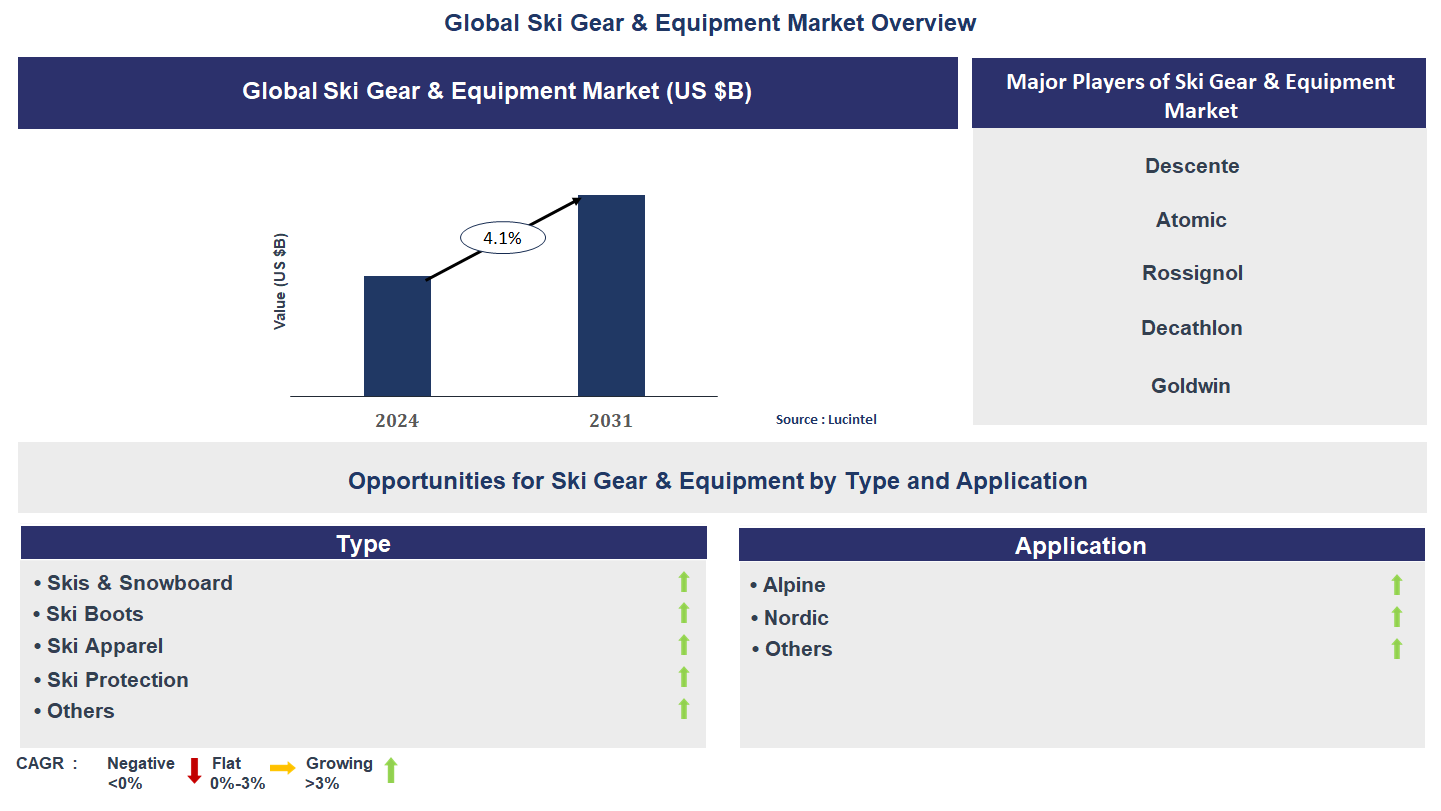
The future of the global ski gear & equipment market looks promising with opportunities in the alpine and nordic markets. The global ski gear & equipment market is expected to grow with a CAGR of 4.1% from 2025 to 2031. The major drivers for this market are the increasing popularity of winter sports, the rising disposable income of consumers, and the growing demand for advanced ski technology.• Lucintel forecasts that, within the type category, skis & snowboard is expected to witness the highest growth over the forecast period.
• Within the application category, alpine is expected to witness higher growth.
• In terms of region, APAC is expected to witness the highest growth over the forecast period. Gain valuable insights for your business decisions with our comprehensive 150+ page report. Sample figures with some insights are shown below.
Emerging Trends in the Ski Gear & Equipment Market
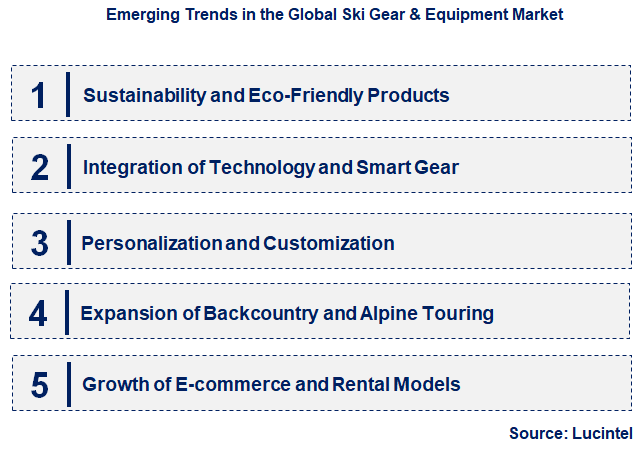
The ski gear & equipment market is being defined by some revolutionary trends based on changing consumer attitudes, technological innovation, and an increased awareness of environmental considerations. The sector is going beyond performance and safety to encompass sustainability, digital connectivity, and customized experiences. These are not standalone but are mutually interconnected, expressing a holistic transformation in the way that consumers engage with the sport.• Sustainability and Eco-Friendly Products: The skiing market, with its close affinity for the outdoors, is specifically demanding sustainable and eco-friendly products. This is driving brands to develop with nature-based materials like recycled plastic, bio-composites, and PFC-free water-repellents. Brands are employing the principles of the circular economy through repair services, buy-back schemes, and modular designs that facilitate component replacement.
• Integration of Technology and Smart Gear: Technology integration is no longer an option but an increasing expectation. Skiing gear is becoming "smarter" with sensors, GPS, and Bluetooth connectivity. Smart helmets with communications integrated, fall detection, and emergency notifications are becoming increasingly popular. Augmented reality overlays on goggles deliver real-time information on speed, altitude, and navigation. The trend improves safety, enhances the monitoring of performance, and provides a more engaged experience on the mountain that will attract a technology-oriented generation of skiers and snowboarders.
• Personalization and Customization: More and more skiers are looking for equipment that is customized for their individual needs and body types. Personalization, which was previously a specialized offering for expert skiers, is increasingly becoming mainstream. This encompasses custom-molded ski boots for enhanced comfort as well as performance, and skis and bindings that can be customized based on diverse skiing styles and preferences.
• Expansion of Backcountry and Alpine Touring: The need for distinct, less-crowded experiences is creating a huge surge in the popularity of backcountry skiing and alpine touring. This trend has established a niche sub-market for lightweight, efficient, and multi-talented equipment. Touring-specific bindings on skis, walk-mode boots that are light, and state-of-the-art safety gear such as transceivers and airbags are highly sought after.
• Growth of E-commerce and Rental Models: How consumers get access to ski equipment is evolving. Online marketplaces are opening up a broad range of brands and products to the world, making it possible for consumers to shop and research equipment from the convenience of home. Furthermore, new rental and subscription services are opening skiing up to novices and recreational skiers who are not willing or able to pay for high-end gear. All these trends are collectively transforming the ski gear & equipment market, spurring innovation and compelling brands to respond to evolving consumer demands. Attention is turning away from an exclusively product-based model towards an increasingly experience-based one, in which equipment is no longer merely a tool but part of a broader lifestyle.
Recent Development in the Ski Gear & Equipment Market
The ski gear & equipment industry has been influenced by a series of fundamental developments that are redefining product innovation, business models, and consumer interaction. These technologies are the result of a necessity for better performance, improved safety, and reacting to changing global needs and consumerism. The market is evolving at a very fast rate, with the manufacturer, retailer, and even the resort coming together to create an integrated and more convenient environment for winter sports.• Materials and Manufacturing Advances The industry is seeing a revolution in the field of materials science. Companies are employing new composites such as carbon fiber and lightweight metals to produce skis and snowboards that are lighter, stronger, and more responsive. For instance, certain brands are creating skis with built-in damping systems to dampen vibrations and enhance stability at high speeds. This innovation not only optimizes performance for professional athletes but also optimizes fun and reduced fatigue for recreational skiers.
• Digital and Smart Technology Integration The introduction of smart gear has dramatically changed the market. Helmets that have sensors built into them can sense a fall and send an automatic emergency notification with GPS location to pre-arranged contacts. Heads-up displays on goggles give real-time information on speed, trail maps, and even text messages. Ski boots are in the process of being designed with in-built heating systems that can be controlled through a smartphone app.
• Change Towards Eco-Friendly Production There is a shift, growing and substantial, towards sustainability in the industry. Brands are incorporating more recycled and bio based materials into their equipment and clothing, and most are cutting out toxic chemicals such as per and polyfluoroalkyl substances (PFCs) from their water proof treatments. This emphasis on sustainable production is being carried through the full supply chain, with companies adopting ethical sourcing and minimizing waste.
• Expansion in the Rental and Second-Hand Sectors The expense of new ski gear has spawned the growth of rental and second-hand markets. This is especially attractive to beginners and recreational skiers who are not prepared to make a large financial outlay. Creation of websites to rent and sell secondhand gear has made it easier and more convenient for people to use these alternatives. This movement reduces entry barriers to the sport and enables a greener, more circular economy in the industry by keeping gear in use longer and minimizing waste.
• Growth in Emerging Markets The market for ski gear is no longer limited to the older established markets such as North America and Europe. The popularity of the sport is increasing very fast in emerging markets like China and India. This trend is opening tremendous opportunity for local as well as international brands. The distinct requirements of these markets, e.g., the need for starter and low-cost gear, are influencing various product strategies. This expansion geography is a defining phenomenon, creating a diversified and globalized industry structure. These advancements are cumulatively influencing the ski equipment and apparel market through innovation, sustainability, and accessibility to more people. They are indicative of an industry reinventing itself with emerging technologies and consumer culture, guaranteeing its survival and development.
Strategic Growth Opportunities in the Ski Gear & Equipment Market
The ski gear & equipment market offers tremendous strategic growth prospects in numerous applications fueled by changing consumer habits and emerging technology frontiers. A segmented strategy to these application segments can open up vast expansion opportunities in the market, responding to the multifaceted needs of various skier segments. Such opportunities are not merely about product sales but about offering end-to-end solutions that improve the skiing experience across beginners, elite, and non-elite athletes and more.• Alpine Skiing Equipment This is the oldest and biggest segment of the market. The growth potential is in using technology to improve performance and safety. This would involve creating intelligent boots that can be adjusted to fit specific and provide feedback of real-time data, superior bindings that provide enhanced shock absorption and release, and skis with advanced materials to provide greater responsiveness.
• Backcountry and Alpine Touring Equipment The popularity of backcountry skiing is on the rise and thus presents a big growth prospect. Firms can ride this trend by creating and selling lightweight, functional, and long-lasting equipment. This involves the creation of skis and boots specifically for touring that provide an optimum balance of uphill performance and downhill performance and high-tech protective gear such as avalanche airbags, transceivers, and probes.
• Cross-Country Skiing Gear This category presents a high opportunity because of its accessibility and its benefits to one’s health. The emphasis in this case is on creating and marketing light, efficient, and comfortable gear for competition as well as recreational purposes. Boot design innovations towards improved fit and comfort, and the utilization of high-technology materials in skis and sticks towards enhanced glide and power transfer are important. Emphasis should be placed on the physical and mental well-being aspects of cross-country skiing to appeal to a new market of sport and outdoor enthusiasts.
• Protective Gear and Apparel Safety and fashion are major growth areas with emphasis on protective gear and clothing. There are opportunities in creating and manufacturing more advanced helmets with built-in safety functionalities such as MIPS technology for rotational impact protection, as well as goggles featuring photochromic lenses that adjust to changing light conditions. In apparel, opportunities reside in technical apparel that fuses performance, comfort, and style.
• Equipment Rental and Leasing Services The cost of equipment is another major barrier to entry. Strategic expansion can be realized by increasing and streamlining equipment rental and leasing services. This involves providing premium, current equipment, offering easy online booking and delivery, and leveraging technology for accurate, tailored fittings. For retailers and resorts, this is a revenue-generating opportunity as well as a way to attract new customers who may not yet be willing to purchase their own gear. It also feeds a circular economy and product longevity. These strategic opportunities are transforming the ski equipment and apparel market by catering to primary consumer demands, promoting innovation, and opening up a more inclusive and sustainable industry.
Ski Gear & Equipment Market Driver and Challenges
The ski gear & equipment market is driven by a multifaceted combination of key drivers and challenges that define its growth path. The industry is fast-paced, with technological, economic, and social influences all contributing. Recognizing these forces is key for stakeholders to be able to effectively navigate the market. Although several drivers are propelling growth, the industry must also battle sizable challenges that necessitate creative solutions. The factors responsible for driving the ski gear & equipment market include: 1. Growing Winter Sports Popularity The overall growth in winter sports participation worldwide is a key enabler. This is driven by increasing disposable incomes, urbanization, and heightened interest in outdoor and adventure pursuits, especially among the youth. Social media growth also contributes to this trend, as individuals post their skiing and snowboarding experiences, thereby motivating others to participate in the sports. As the number of people learning to ski increases, naturally the demand for equipment, clothing, and accessories rises, boosting market growth in each segment. 2. Technology Developments in Equipment Ongoing innovation in design and materials is one of the major drivers. Companies are regularly launching new technologies that enhance safety, performance, and comfort. Development of technologies such as lightweight materials such as carbon fiber, higher-performance binding systems, and "smart" helmets with built-in sensors and communications technology appeals to professional, as well as recreational, skiers. 3. Winter Tourism and Infrastructure Growth Large investments in ski resort infrastructure, especially in developing markets, are stimulating demand. The construction of new resorts, upgraded lifts, and new snowmaking equipment lengthens the ski season and makes the sport more convenient. In China, government-supported programs to build winter sports tourism are opening up a huge new consumer base. 4. Emphasis on Health and Well-being There is a world-wide drift towards active life and emphasis on health and well-being. Skiing, being an active sport, will find a fit in this context. As individuals look for more activities to keep fit and active in winters, they are looking towards skiing. This driver not only promotes participation but also drives the need for high-performance and comfortable equipment that caters to a health-aware consumer group, from novice to expert skiers. 5. Growth in E-commerce and Rental Platforms The rampant growth of online shopping has brought ski equipment within reach of the global consumer. E-commerce sites enable consumers to freely compare products and prices, expanding their options beyond in-shop local ski dealers. Furthermore, the growth of rental and subscription models reduces the economic entry barrier for new entrants, who are able to try out the sport without a hefty upfront expense. Challenges in the ski gear & equipment market are: 1. Excessive Cost of Equipment and Involvement The high expense of ski equipment and related costs such as lift tickets and travel can be a significant deterrent for most prospective participants. A complete package of good equipment can be very expensive, which can discourage new individuals from attempting the sport. This is especially the case in emerging markets, where lower disposable incomes make it challenging for the sport to reach a wider consumer base. 2. Climate Change and Environmental Issues Climate change and unstable weather patterns threaten the ski industry severely. Shorter, less predictable winters and less natural snowfall affect resort operations and discourage participation directly. Furthermore, the ecological impact of ski equipment manufacturing and resort operations is also a concern to consumers. 3. Seasonal and Weather Dependency The industry is naturally seasonal and weather-dependent. A light winter or absence of snow in a region can cause a substantial decrease in sales and visits to resorts. This uncertainty makes financial forecasting and inventory control challenging for manufacturers and retailers. The industry is working to mitigate it with new snowmaking technology, but this only partially offsets the risk and creates its own environmental and cost challenges. Whereas technological advancement and globalization are propelling the industry ahead, it will have to contend with concerns on the lines of affordability, sustainability of the environment, as well as volatile weather conditions. The success will hinge on the capacity of firms to innovate both in their products and in their business models to surmount such challenges and foster long-term, sustainable growth.List of Ski Gear & Equipment Companies
Companies in the market compete on the basis of product quality offered. Major players in this market focus on expanding their manufacturing facilities, R&D investments, infrastructural development, and leverage integration opportunities across the value chain. With these strategies ski gear & equipment companies cater increasing demand, ensure competitive effectiveness, develop innovative products & technologies, reduce production costs, and expand their customer base. Some of the ski gear & equipment companies profiled in this report include-• Descente
• Atomic
• Rossignol
• Decathlon
• Goldwin
• Head
• K2 Sports
• Burton
• Helly Hansen
• Fischer
Ski Gear & Equipment Market by Segment
The study includes a forecast for the global ski gear & equipment market by type, application, and region.Ski Gear & Equipment Market by Type [Value from 2019 to 2031]:
• Skis & Snowboard
• Ski Boots
• Ski Apparel
• Ski Protection
• Others
Ski Gear & Equipment Market by Application [Value from 2019 to 2031]:
• Alpine
• Nordic
• Others
Ski Gear & Equipment Market by Region [Value from 2019 to 2031]:
• North America
• Europe
• Asia Pacific
• The Rest of the World
Country Wise Outlook for the Ski Gear & Equipment Market
The global ski gear & equipment industry is witnessing a vibrant evolution, fueled by a combination of factors such as a proliferation in winter tourism, advances in technology, and an increased emphasis on sustainability. As snowboarding and skiing increase as recreational and adventure activities, particularly within emerging markets, demand for innovative, high-performance, and sustainable gear continues to rise. Producers are pushing back with innovative products, ranging from slimmed-down materials and intelligent wearables to personalized-fit solutions.• United States: The US ski apparel and equipment market maintains its leadership, fueled by a big and passionate consumer base. Recent trends are characterized by a heavy focus on technology and direct-to-consumer. Brands are adding smarts such as GPS, performance tracking, and augmented reality to helmets and goggles. The market is also experiencing an upsurge in the demand for alpine touring and backcountry equipment, fueled by an appetite for off-piste skiing.
• China: China is becoming a key growth catalyst in the market for ski equipment and equipment, driven by major government investment in winter sports facilities prior to and after major international events. The market is dominated by a high growth of new skiers, hence, great demand for beginner and mid-range equipment. Integration of technology, such as AI and IoT, is among the priorities, with the entry of local brands that have come up with smart helmets with fall detection and communications capabilities.
• Germany: Germany’s skiing equipment market is well developed and advanced, with a high emphasis on quality, durability, and technological sophistication. Developments are currently based on innovation in materials and the trend towards sustainability. German manufacturers have pioneered the production of carbon fiber skis that are lightweight and sustainable, as well as environmentally friendly, recycled or bio-based apparel. The market for specialist equipment for various disciplines, including cross-country and alpine skiing, is also very large.
• India: India’s ski gear & equipment market is young but very rapidly growing. Government policies to drive tourism in mountainous areas and the construction of new ski facilities are major drivers. Aspirational consumers in search of quality branded equipment dominate the market, which is typically bought through online channels. Although the professional equipment market is limited, there is increasing demand for mid-range and rental equipment as more individuals adopt winter sports as a recreational activity.
• Japan: Japan, with its rich ski culture and copious snowfall, has a well-developed ski equipment and apparel market. Recent trends are characterized by a combination of tradition and advanced high-tech innovation. The market addresses domestic skiers and an increasing number of ski tourists. Demand for high-performance, precision-finished gear is strong, especially for powder skiing. Japanese manufacturers are leading the innovation in new technology, while also placing great emphasis on a circular economy approach through strong second-hand and rental markets.

Features of the Global Ski Gear & Equipment Market
Market Size Estimates: Ski gear & equipment market size estimation in terms of value ($B). Trend and Forecast Analysis: Market trends (2019 to 2024) and forecast (2025 to 2031) by various segments and regions. Segmentation Analysis: Ski gear & equipment market size by type, application, and region in terms of value ($B). Regional Analysis: Ski gear & equipment market breakdown by North America, Europe, Asia Pacific, and Rest of the World. Growth Opportunities: Analysis of growth opportunities in different types, applications, and regions for the ski gear & equipment market. Strategic Analysis: This includes M&A, new product development, and competitive landscape of the ski gear & equipment market. Analysis of competitive intensity of the industry based on Porter’s Five Forces model.
FAQ
Q1. What is the growth forecast for ski gear & equipment market? Answer: The global ski gear & equipment market is expected to grow with a CAGR of 4.1% from 2025 to 2031. Q2. What are the major drivers influencing the growth of the ski gear & equipment market? Answer: The major drivers for this market are the increasing popularity of winter sports, the rising disposable income of consumers, and the growing demand for advanced ski technology. Q3. What are the major segments for ski gear & equipment market? Answer: The future of the ski gear & equipment market looks promising with opportunities in the alpine and nordic markets. Q4. Who are the key ski gear & equipment market companies? Answer: Some of the key ski gear & equipment companies are as follows:• Descente
• Atomic
• Rossignol
• Decathlon
• Goldwin
• Head
• K2 Sports
• Burton
• Helly Hansen
• Fischer Q5. Which ski gear & equipment market segment will be the largest in future? Answer: Lucintel forecasts that, within the type category, skis & snowboard is expected to witness the highest growth over the forecast period. Q6. In ski gear & equipment market, which region is expected to be the largest in next 5 years? Answer: In terms of region, APAC is expected to witness the highest growth over the forecast period. Q7. Do we receive customization in this report? Answer: Yes, Lucintel provides 10% customization without any additional cost.
Table of Contents
List of Figures
List of Tables
Methodology
- In-depth interviews of the major players in this market
- Detailed secondary research from competitors’ financial statements and published data
- Extensive searches of published works, market, and database information pertaining to industry news, company press releases, and customer intentions
- A compilation of the experiences, judgments, and insights of Lucintel’s professionals, who have analyzed and tracked this market over the years.


Buy Now
Choose a license that fits your team. Instant PDF delivery.
Prices exclude taxes. Instant delivery. Custom licensing available on request.
Key Questions
- • What are some of the most promising, high-growth opportunities for the ski gear & equipment market by type (skis & snowboard, ski boots, ski apparel, ski protection, and others), application (alpine, nordic, and others), and region (North America, Europe, Asia Pacific, and the Rest of the World)?
- • Which segments will grow at a faster pace and why?
- • Which region will grow at a faster pace and why?
- • What are the key factors affecting market dynamics? What are the key challenges and business risks in this market?
- • What are the business risks and competitive threats in this market?
- • What are the emerging trends in this market and the reasons behind them?
- • What are some of the changing demands of customers in the market?
- • What are the new developments in the market? Which companies are leading these developments?
- • Who are the major players in this market? What strategic initiatives are key players pursuing for business growth?
- • What are some of the competing products in this market and how big of a threat do they pose for loss of market share by material or product substitution?
- • What M&A activity has occurred in the last 5 years and what has its impact been on the industry? For any questions related to Ski Gear & Equipment Market, Ski Gear & Equipment Market Size, Ski Gear & Equipment Market Growth, Ski Gear & Equipment Market Analysis, Ski Gear & Equipment Market Report, Ski Gear & Equipment Market Share, Ski Gear & Equipment Market Trends, Ski Gear & Equipment Market Forecast, Ski Gear & Equipment Companies, write Lucintel analyst at email: helpdesk@lucintel.com. We will be glad to get back to you soon.


