
Market Report · July 31, 2026

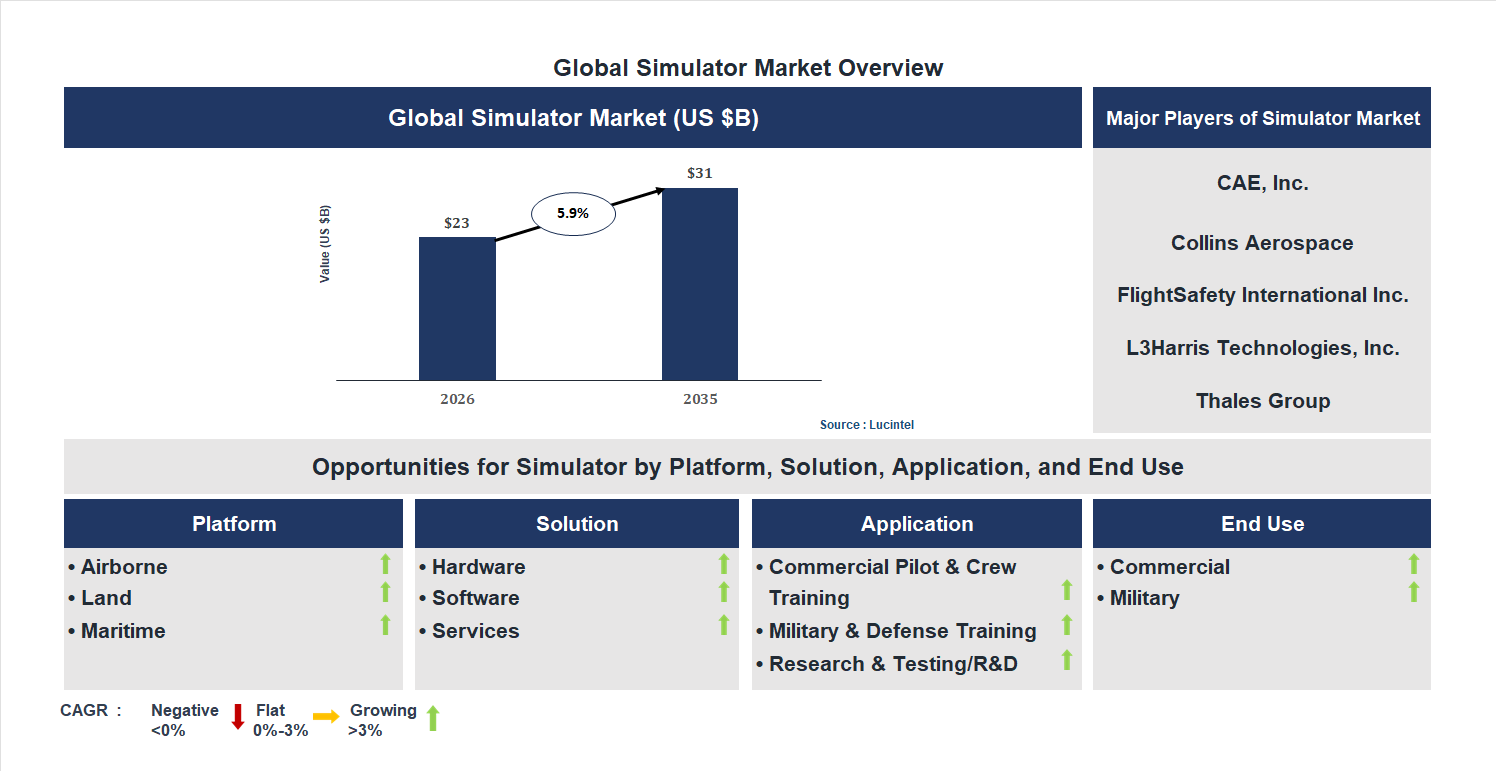
Key data points: The market size in 2035 = $31 billion, growth forecast = 5.9% annually for the next 8 years. Scroll below to get more insights. This market report covers trends, opportunities and forecasts in simulator market to 2035 by platform (airborne, land, and maritime), solution (hardware, software, and services), application (commercial pilot & crew training, military & defense training, and research & testing/R&D), end use (commercial and military), and region (North America, Europe, Asia Pacific, and the Rest of the World)
We'll send your sample report shortly.
• Lucintel forecasts that, within the platform category, airborne is expected to witness the highest growth over the forecast period.
• Within the end use category, military is expected to witness higher growth.
• In terms of region, APAC is expected to witness the highest growth over the forecast period. Gain valuable insights for your business decisions with our comprehensive 150+ page report. Sample figures with some insights are shown below.
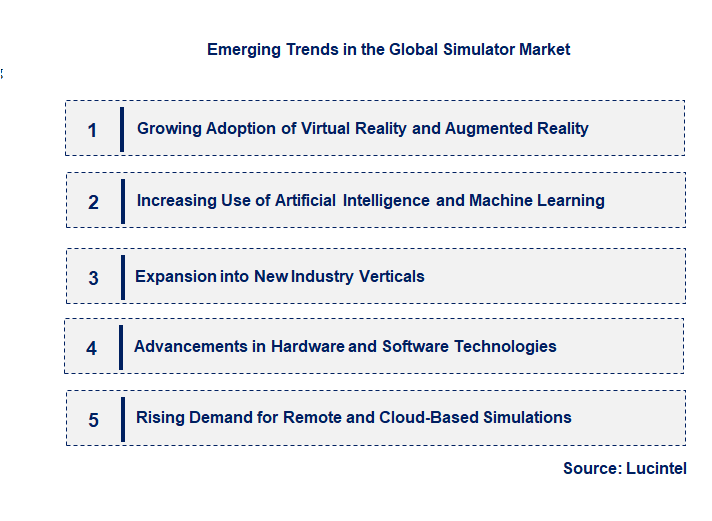
• Growing Adoption of Virtual Reality and Augmented Reality: The integration of VR and AR into simulators is revolutionizing user engagement by providing immersive experiences. These technologies enable realistic training scenarios in sectors like aviation, military, and healthcare, improving skill acquisition and safety. As VR and AR hardware become more affordable and accessible, their adoption is expanding rapidly, leading to more sophisticated and interactive simulation solutions. This trend enhances training effectiveness, reduces costs, and opens new avenues for entertainment and education, making simulators more appealing to a broader audience.
• Increasing Use of Artificial Intelligence and Machine Learning: AI and ML are transforming simulators by enabling adaptive learning environments and real-time feedback. These technologies facilitate personalized training programs, improve scenario realism, and automate complex data analysis. In sectors like automotive and healthcare, AI-driven simulators help in predictive modeling and decision-making, reducing risks and enhancing outcomes. The integration of AI also allows for continuous improvement of simulation scenarios based on user performance, making training more efficient and tailored. This trend is making simulators smarter, more responsive, and highly effective.
• Expansion into New Industry Verticals: Traditionally dominated by gaming and military training, the simulator market is now expanding into healthcare, education, real estate, and automotive sectors. Medical simulators are improving surgical training, while virtual property tours are transforming real estate marketing. Automotive simulators are used for driver training and vehicle testing, reducing costs and enhancing safety. This diversification is driven by the need for cost-effective, scalable, and safe training solutions across industries. As new verticals adopt simulation technology, market growth accelerates, and innovation opportunities multiply.
• Advancements in Hardware and Software Technologies: Innovations in hardware, such as haptic feedback devices, motion sensors, and high-resolution displays, are enhancing simulator realism. Concurrently, software improvements enable more complex, scalable, and customizable simulation environments. Cloud computing and edge processing are facilitating remote and distributed simulations, increasing accessibility. These technological advancements are reducing costs, improving performance, and enabling more detailed and accurate simulations. As hardware and software continue to evolve, the market is poised for more immersive, reliable, and versatile simulation solutions.
• Rising Demand for Remote and Cloud-Based Simulations: The shift towards remote work and online learning has accelerated the adoption of cloud-based simulation platforms. These solutions offer scalability, ease of access, and cost savings, making simulation training available anytime and anywhere. They are particularly valuable for global organizations seeking standardized training across multiple locations. Cloud simulations also enable real-time collaboration and data sharing, enhancing training outcomes. This trend is expanding the reach of simulators beyond traditional settings, fostering a more flexible and inclusive market environment that caters to diverse user needs. These emerging trends are significantly reshaping the simulator market by making simulations more immersive, intelligent, versatile, and accessible. The integration of advanced technologies like VR, AR, AI, and cloud computing is driving innovation, expanding industry applications, and improving training and entertainment experiences. As these developments continue, the market is expected to grow rapidly, offering new opportunities for providers and users alike.
• Growing Adoption of Virtual Reality Technologies: The integration of VR in simulators enhances realism and user engagement, leading to improved training outcomes. This trend is particularly impactful in aerospace, military, and healthcare sectors, where immersive experiences are critical. The increasing affordability of VR hardware and software is broadening accessibility, encouraging widespread adoption. As VR technology advances, simulators become more sophisticated, providing detailed scenarios that improve skill acquisition and decision-making, thus driving market growth.
• Expansion in Healthcare Simulation Applications: Healthcare simulators are revolutionizing medical training by providing realistic practice environments for surgeons, nurses, and emergency responders. These simulators improve patient safety, reduce training costs, and enhance clinical skills. The development of high-fidelity mannequins and virtual patient scenarios is expanding the scope of medical education. The rising demand for skilled healthcare professionals and technological innovations are propelling this segment, making healthcare simulation a key growth driver in the market.
• Increasing Use of Simulators in Aerospace and Defense: Aerospace and defense sectors are increasingly relying on simulators for pilot training, mission rehearsals, and maintenance procedures. These simulators reduce operational costs and risks associated with real-flight training. Advanced flight simulators with realistic graphics and motion systems are enhancing training effectiveness. Government investments and military modernization programs are further boosting demand. This segments growth is critical for the overall simulator market, offering substantial opportunities for technological innovation and market expansion.
• Rising Demand for Automotive and Driver Training Simulators: Automotive manufacturers and driving schools are adopting simulators for driver training, testing, and research. These simulators help improve driver safety, reduce accidents, and facilitate autonomous vehicle development. The integration of AI and machine learning enhances simulation accuracy and scenario diversity. The push for safer roads and autonomous vehicle testing is fueling this segments growth, making it a vital part of the broader simulator market landscape.
• Technological Innovations in Simulation Software and Hardware: Continuous advancements in simulation software, hardware, and integration techniques are improving simulator performance and user experience. Developments include haptic feedback, real-time data processing, and cloud-based simulation platforms. These innovations enable more complex and scalable simulations across industries. As technology becomes more accessible and cost-effective, the market benefits from increased adoption and new application possibilities, reinforcing the overall growth trajectory of the simulator industry. The overall impact of these developments is a robust expansion of the simulator market, driven by technological innovation and diverse industry applications. Enhanced realism, cost efficiency, and safety are attracting more users and investments, positioning the market for sustained growth. As these opportunities evolve, the market is expected to see increased adoption, new segments emerging, and a broader global footprint, shaping the future of simulation technology.
• Enhanced Training and Education Solutions: Simulator technology is revolutionizing training across sectors like healthcare, aviation, and military by providing realistic, risk-free environments. These simulators improve skill acquisition, reduce training costs, and enhance safety. For example, flight simulators for pilot training and surgical simulators for medical students are increasingly adopted. The demand for customized, high-fidelity simulators is rising, creating opportunities for companies to develop advanced training modules and expand into new educational markets.
• Growth in Automotive and Transportation Simulators: The automotive industry is leveraging simulators for vehicle design, testing, and driver training. Advanced driving simulators help improve safety features and autonomous vehicle development. Public transportation agencies use simulators for operator training, while ride-sharing companies explore virtual testing environments. The increasing focus on safety regulations and autonomous vehicle technology drives demand, opening avenues for innovation in immersive, real-time simulation solutions tailored to automotive needs.
• Expansion of Virtual and Augmented Reality in Simulation: The integration of VR and AR technologies enhances realism and user engagement in simulation applications. These immersive environments are used in military training, industrial maintenance, and entertainment sectors. The development of lightweight, affordable VR headsets and AR glasses broadens accessibility. Companies investing in these technologies can create more interactive, scalable simulation platforms, enabling remote collaboration, real-time data visualization, and enhanced user experiences across multiple industries.
• Adoption of Artificial Intelligence for Smarter Simulations: AI integration enables simulations to adapt dynamically to user actions, providing personalized training experiences. AI-driven analytics help identify skill gaps and optimize training programs. In sectors like healthcare, AI-powered simulators assist in diagnosing and treatment planning. The development of intelligent virtual agents and predictive modeling enhances simulation realism. This technological advancement offers market players opportunities to develop sophisticated, adaptive simulation solutions that improve outcomes and operational efficiency.
• Increasing Use of Simulators in Healthcare and Medical Fields: Medical simulators are vital for training surgeons, nurses, and emergency responders, reducing risks associated with real procedures. These simulators include virtual patients, laparoscopic trainers, and emergency response scenarios. The rising emphasis on patient safety and competency-based training fuels demand. Innovations such as haptic feedback and realistic anatomical models improve training effectiveness. The expanding healthcare sector and technological advancements create significant opportunities for developing specialized medical simulation products and expanding into emerging markets. The overall growth of the simulator market is driven by technological innovation, expanding application areas, and increasing adoption across industries. These opportunities are set to transform training, design, and operational processes, fostering a competitive landscape with significant potential for market expansion and technological breakthroughs.
• Technological Innovation: The continuous evolution of simulation technologies, such as virtual reality (VR), augmented reality (AR), and artificial intelligence (AI), significantly enhances the realism and effectiveness of simulators. These innovations enable more immersive training experiences, which are increasingly adopted across sectors like aviation, healthcare, and defense. As technology becomes more accessible and affordable, the adoption rate accelerates, expanding market opportunities. Moreover, advancements in hardware and software improve simulator performance, reliability, and user engagement, further fueling market growth and encouraging new applications.
• Increasing Demand for Cost-Effective Training Solutions: Organizations are seeking affordable and scalable training methods to reduce operational costs associated with traditional training. Simulators offer a safe, repeatable, and efficient way to train personnel without the risks and expenses of real-world training. Industries such as aviation, military, and healthcare are investing heavily in simulators to enhance skill development while minimizing costs. The ability to simulate complex scenarios and provide immediate feedback makes simulators an attractive alternative, driving market expansion as companies aim to optimize training budgets and improve safety standards.
• Growing Adoption in Emerging Markets: Emerging economies are witnessing rapid industrialization and urbanization, leading to increased investments in infrastructure, transportation, and defense. These developments create a rising demand for simulators to support training and operational needs. Governments and private sector players in regions like Asia-Pacific and Latin America are increasingly adopting simulation technology to bridge skill gaps and improve safety. This regional expansion offers significant growth opportunities for market players, as emerging markets often have less saturated markets and higher potential for technological adoption.
• Regulatory and Safety Standards: Stringent safety and regulatory standards across industries such as aviation, defense, and healthcare are driving the adoption of simulators. Compliance with these standards often requires extensive training, which simulators can provide efficiently. Regulatory bodies are mandating simulation-based training for certification and safety assurance, thereby increasing demand. This regulatory push ensures that organizations invest in high-quality simulators to meet compliance requirements, ultimately fostering innovation and market growth while emphasizing safety and standardization. The challenges facing the simulator market include:-
• High Development and Maintenance Costs: Developing advanced simulators involves significant investment in hardware, software, and content creation. These costs can be prohibitive for smaller organizations or emerging markets, limiting adoption. Additionally, ongoing maintenance, updates, and technical support add to the financial burden. The high costs can slow down market penetration and restrict the deployment of sophisticated simulation systems, especially in regions with budget constraints, thereby impacting overall market growth.
• Technological Complexity and Integration Issues: The integration of various simulation components, such as hardware, software, and data systems, presents technical challenges. Ensuring compatibility, real-time performance, and user-friendliness requires specialized expertise. Technological complexity can lead to delays in deployment, increased costs, and user resistance. Moreover, rapid technological changes necessitate frequent upgrades, complicating long-term maintenance and scalability, which can hinder widespread adoption and limit market expansion.
• Regulatory and Standardization Barriers: While regulations promote simulator adoption, inconsistent standards and certification processes across regions can pose challenges. Navigating complex regulatory environments increases time-to-market and costs for manufacturers. Lack of harmonized standards may lead to compatibility issues and restrict cross-border deployment. These barriers can slow innovation, increase compliance expenses, and create uncertainty for investors, ultimately impeding the growth trajectory of the simulator market. The simulator market is driven by technological advancements, cost-efficiency needs, regional growth, and regulatory support, which collectively foster expansion and innovation. However, high development costs, technological complexities, and regulatory barriers pose significant challenges that could hinder market growth. Balancing these drivers and challenges is crucial for stakeholders aiming to capitalize on emerging opportunities. Strategic investments in technology, standardization, and cost management will be essential to sustain growth and ensure the markets long-term success.
• CAE, Inc.
• Collins Aerospace
• FlightSafety International Inc.
• L3Harris Technologies, Inc.
• Thales Group
• Rheinmetall AG
• Kongsberg Gruppen ASA
• BAE Systems plc
• Lockheed Martin Corporation
• KNDS N.V.
• Airborne
• Land
• Maritime
• Hardware
• Software
• Services
• Commercial Pilot & Crew Training
• Military & Defense Training
• Research & Testing/R&D
• Commercial
• Military
• North America
• Europe
• Asia Pacific
• The Rest of the World
• United States: The US market has seen significant growth with major investments in virtual reality and AI-driven simulators. Leading tech companies are developing advanced training platforms for military, healthcare, and automotive sectors. The adoption of cloud-based simulators has increased, enabling remote training and collaboration. Additionally, government agencies are funding research to improve simulation realism and interactivity, fostering innovation. The US also hosts numerous startups focusing on niche simulator applications, contributing to a dynamic ecosystem that accelerates market expansion.
• China: China is rapidly expanding its simulator industry, driven by government initiatives to modernize its military and industrial sectors. The country has made substantial investments in virtual reality and augmented reality technologies, integrating them into training programs for aviation, manufacturing, and urban planning. Domestic companies are emerging as key players, offering cost-effective solutions tailored to local needs. The Chinese market emphasizes large-scale simulation centers and smart training systems, supported by policies promoting technological self-reliance and innovation, positioning China as a major global competitor.
• Germany: Germanys simulator market is characterized by high-quality engineering and a focus on automotive and aerospace applications. The country is leveraging its strong manufacturing base to develop realistic driving, flight, and industrial simulators. German firms are pioneering in integrating IoT and AI to enhance simulation accuracy and user experience. The government supports research collaborations between academia and industry, fostering innovation. The emphasis on safety, precision, and sustainability has driven the adoption of simulators in training, testing, and product development, making Germany a leader in high-end simulation solutions.
• India: India is witnessing rapid growth in the simulator market, fueled by increasing demand in defense, healthcare, and education sectors. The government’s focus on skill development and modernization of military training has spurred investments in virtual and augmented reality simulators. Local startups are developing affordable, portable solutions to address the needs of a diverse and expanding market. The integration of AI and machine learning is improving simulation realism and customization. Additionally, partnerships with international firms are facilitating technology transfer and capacity building, positioning India as a promising emerging market for simulation technologies.
• Japan: Japans simulator market is driven by advancements in robotics, automotive, and aerospace industries. The country emphasizes high-fidelity simulators for pilot training, vehicle testing, and industrial applications. Japanese firms are innovating with haptic feedback and immersive environments to improve training outcomes. The government promotes research in virtual reality and AI to enhance simulation capabilities, especially for disaster preparedness and urban planning. Collaboration between academia and industry is strong, fostering cutting-edge developments. Japan’s focus on quality and precision continues to position it as a key player in the global simulator market.


• CAE, Inc.
• Collins Aerospace
• FlightSafety International Inc.
• L3Harris Technologies, Inc.
• Thales Group
• Rheinmetall AG
• Kongsberg Gruppen ASA
• BAE Systems plc
• Lockheed Martin Corporation
• KNDS N.V. Q6. Which simulator market segment will be the largest in future? Answer: Lucintel forecasts that, within the platform category, airborne is expected to witness the highest growth over the forecast period. Q7. In simulator market, which region is expected to be the largest in next 8 years? Answer: In terms of region, APAC is expected to witness the highest growth over the forecast period. Q8. Do we receive customization in this report? Answer: Yes, Lucintel provides 10% customization without any additional cost.


Choose a license that fits your team. Instant PDF delivery.
Prices exclude taxes. Instant delivery. Custom licensing available on request.
Market Report · July 31, 2026
Market Report · July 31, 2026
Market Report · July 31, 2026
Trusted partner for strategic intelligence and business growth


Receive a complimentary market analysis tailored to your industry. Our analysts will identify key growth opportunities and competitive dynamics specific to your business.

Market size, growth rate, and key trend analysis for your specific sector.

Top competitor positioning and market share analysis.

Strategic recommendations backed by data-driven insights.
Get curated market intelligence and competitive moves straight to your inbox.
By subscribing, you agree to receive our monthly insights. Unsubscribe anytime.
Receive a complimentary market analysis tailored to your industry. Our analysts will identify key growth opportunities and competitive dynamics specific to your business.
Market size, growth rate, and key trend analysis for your specific sector.
Top competitor positioning and market share analysis.
Strategic recommendations backed by data-driven insights.
Get curated market intelligence, emerging trends, and competitive moves straight to your inbox each month.
By subscribing, you agree to receive our monthly insights. Unsubscribe anytime.
We'll send your sample report shortly.