
Market Report · July 24, 2026

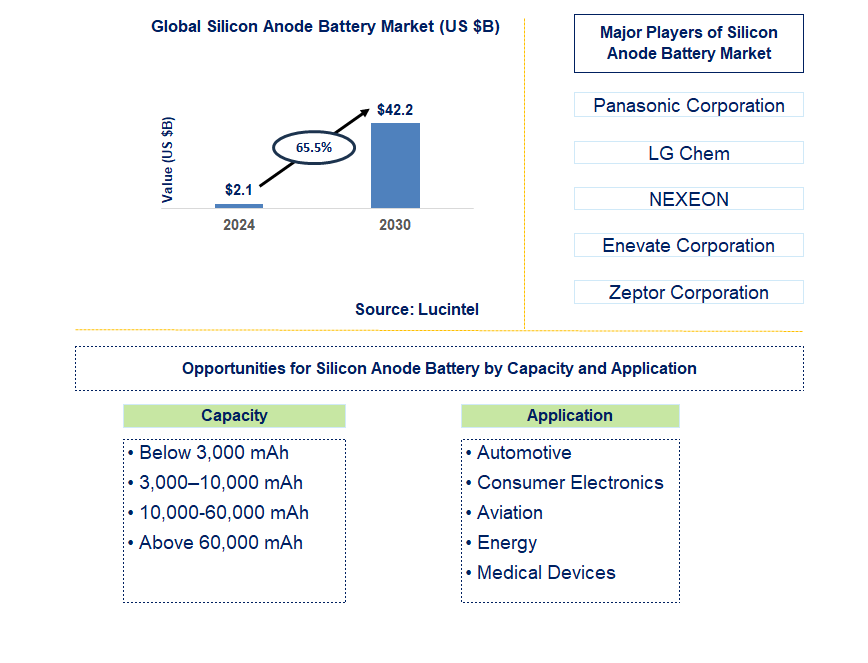
Key data points: The market size in 2031 = $69.9 billion, growth forecast = 65.5% annually for the next 7 years. Scroll below to get more insights. This market report covers trends, opportunities, and forecasts in the global silicon anode battery market to 2031 by capacity (below 3,000 mah, 3,000–10,000 mah, 10,000-60,000 mah, and above 60,000 mah), application (automotive, consumer electronics, aviation, energy, and medical devices), and region (North America, Europe, Asia Pacific, and the Rest of the World)
We'll send your sample report shortly.
• Lucintel forecasts that, within the capacity category, 3,000 mah to 10,000 mah will remain the largest segment over the forecast period because the batteries have unparalleled capabilities and a large capacity, as well as, it has steady cycling performance over more than 200 cycles and are reported to have better efficiency levels of up to 85–90%.
• In terms of regions, APAC is expected to witness the highest growth over the forecast period due to rising industries in the region such as automotive, consumer electronics, and renewable energy, as well as, significant government investment in R&D activities and high adoption rates among automotive manufacturers in the region. Gain valuable insights for your business decisions with our comprehensive 150+ page report.
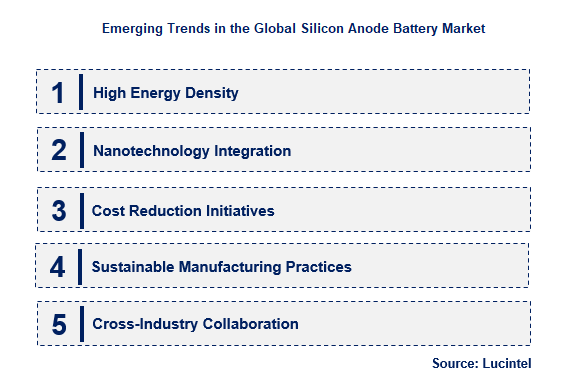
• High Energy Density: A key trend is the focus on increasing the energy density of the silicon anode battery. This allows for longer battery life and greater storage capacity, making these batteries more suitable for high-demand applications like electric vehicles and portable electronics.
• Nanotechnology Integration: The integration of nanotechnology in silicon anode battery is another emerging trend. By using nanoscale silicon particles, manufacturers can reduce the issue of silicon expansion, improving battery efficiency and durability, making these batteries more viable for commercial use.
• Cost Reduction Initiatives: Efforts to reduce the production costs of silicon anode battery are gaining momentum. This trend involves optimizing manufacturing processes and sourcing cheaper raw materials, making these advanced batteries more accessible and driving their adoption across a wider range of applications.
• Sustainable Manufacturing Practices: Sustainability is becoming a major trend in the production of silicon anode battery. Manufacturers are increasingly adopting eco-friendly practices, such as using renewable energy sources and recyclable materials, to minimize the environmental impact of battery production.
• Cross-Industry Collaboration: Collaboration between industries, particularly between battery manufacturers and automotive companies, is accelerating innovation. This trend is leading to the development of customized silicon anode battery that meet specific needs, such as higher energy efficiency for electric vehicles or longer life for consumer electronics. These emerging trends are reshaping the silicon anode battery market, driving innovation, and expanding the applications of this technology. As these trends continue to evolve, they will play a crucial role in the widespread adoption and commercialization of silicon anode battery.
• Improved Silicon-Carbon Composites: The development of silicon-carbon composites has significantly improved the performance of silicon anode batteries. These composites enhance the battery’s stability and capacity, allowing for better energy storage and a longer lifespan, which is crucial for applications like electric vehicles.
• Scalable Manufacturing Processes: Recent advancements in scalable manufacturing processes are making it easier to produce silicon anode batteries at a commercial scale. This development is reducing production costs and increasing the availability of these batteries for widespread use, particularly in consumer electronics and electric vehicles.
• Enhanced Cycling Stability: Innovations in battery design have led to enhanced cycling stability in silicon anode batteries. This means the batteries can be charged and discharged more times without significant degradation, making them more durable and reliable for long-term use in various applications.
• Integration with Renewable Energy Systems: Silicon anode batteries are increasingly being integrated into renewable energy systems, particularly for solar energy storage. This development is providing more efficient and reliable energy storage solutions, supporting the growth of renewable energy initiatives globally.
• Advanced Electrolytes: The development of advanced electrolytes that are compatible with silicon anode materials is another significant advancement. These electrolytes help to reduce the swelling and cracking issues associated with silicon anodes, improving the overall performance and lifespan of the batteries. These key developments are driving the evolution of silicon anode batteries, enhancing their performance, and making them more commercially viable. As these advancements continue, they will play a crucial role in expanding the applications of silicon anode batteries and shaping the future of energy storage.
• Electric Vehicles (EVs): The electric vehicle market presents a major growth opportunity for silicon anode batteries. These batteries offer higher energy density and a longer lifespan, making them ideal for EVs, where extended range and durability are critical. The adoption of silicon anode batteries in EVs is expected to drive significant market growth.
• Renewable Energy Storage: Silicon anode batteries are becoming increasingly important in renewable energy storage applications. Their ability to store large amounts of energy efficiently makes them ideal for solar and wind energy systems, where reliable and long-lasting energy storage is essential for maximizing energy output.
• Portable Electronics: The demand for longer battery life in portable electronics is driving the adoption of silicon anode batteries. These batteries can provide extended usage times for devices such as smartphones, laptops, and wearable technology, offering a competitive edge in the consumer electronics market.
• Aerospace and Defense: The aerospace and defense sectors are exploring silicon anode batteries for their high energy density and lightweight properties. These batteries can enhance the performance of unmanned aerial vehicles (UAVs) and other defense systems, offering strategic growth opportunities in these high-tech industries.
• Grid Storage Solutions: Silicon anode batteries are being considered for grid storage solutions due to their ability to provide stable and reliable energy storage. As the demand for grid storage increases, particularly with the integration of renewable energy, silicon anode batteries are expected to play a significant role in this sector. Strategic growth opportunities in the silicon anode battery market are expanding across key applications, driven by the need for advanced energy storage solutions. These opportunities are expected to fuel market growth and drive innovation in the development of silicon anode battery technologies.
• Demand for High Energy Density: The increasing demand for high energy density in batteries, particularly for electric vehicles and portable electronics, is a major driver for silicon anode batteries. These batteries offer superior energy storage capabilities, making them attractive for applications where extended battery life is essential.
• Growth of Electric Vehicles: The growth of the electric vehicle market is driving the demand for advanced battery technologies like silicon anode batteries. As automakers seek to improve the range and efficiency of EVs, the need for high-performance batteries is becoming more critical, boosting the adoption of silicon anode batteries.
• Technological Innovation: Continuous technological innovation in battery materials and manufacturing processes is propelling the silicon anode battery market forward. Advances in silicon-carbon composites, nanotechnology, and electrolyte formulations are enhancing battery performance, making these batteries more viable for commercial use.
• Renewable Energy Integration: The integration of silicon anode batteries into renewable energy systems is a significant driver for market growth. As the world shifts towards more sustainable energy sources, the need for efficient and reliable energy storage solutions is increasing, supporting the adoption of silicon anode batteries.
• Government Support and Incentives: Government support and incentives for advanced battery technologies are encouraging the development and adoption of silicon anode batteries. Policies aimed at promoting clean energy and reducing carbon emissions are driving investments in battery research and development, supporting market growth. Challenges in the silicon anode battery market are:
• Silicon Expansion Issues: One of the major challenges in silicon anode batteries is the issue of silicon expansion during charging cycles, which can lead to battery degradation. Overcoming this challenge is critical for improving the longevity and reliability of these batteries.
• High Production Costs: The production of silicon anode batteries is currently more expensive compared to traditional batteries. High production costs are a barrier to widespread adoption, particularly in cost-sensitive markets, necessitating innovations to reduce manufacturing expenses.
• Limited Commercial Availability: Despite the potential of silicon anode batteries, their commercial availability is still limited. The need for scalable production processes and the establishment of a robust supply chain are key challenges that must be addressed to increase market penetration. The silicon anode battery market is driven by the demand for advanced energy storage solutions and technological innovations. However, challenges such as silicon expansion issues and high production costs must be overcome to fully realize the potential of this technology. As these factors evolve, they will shape the future of the silicon anode battery market.
• Panasonic Corporation
• LG Chem
• NEXEON
• Enevate Corporation
• Zeptor Corporation
• XGSciences
• City of Irvine
• Amprius Technologies
• Solid Energy
• ActaCell
• Below 3,000 mAh
• 3,000–10,000 mAh
• 10,000-60,000 mAh
• Above 60,000 mAh
• Automotive
• Consumer Electronics
• Aviation
• Energy
• Medical Devices
• North America
• Europe
• Asia Pacific
• The Rest of the World
• United States: In the U.S., companies are focusing on scaling up production of silicon anode batteries to meet the growing demand for electric vehicles. Recent collaborations between battery manufacturers and automotive companies are accelerating the development of high-capacity, longer-lasting batteries, with significant investments in research and development.
• China: China is leading in silicon anode battery research, with numerous government-backed initiatives aimed at improving battery performance and reducing costs. The country is also focusing on building a robust supply chain for silicon materials, positioning itself as a global leader in advanced battery technology.
• Germany: Germany is integrating silicon anode batteries into its automotive industry, driven by the push for greener transportation solutions. German companies are collaborating with research institutions to enhance battery performance, focusing on improving energy density and extending the lifespan of batteries for electric vehicles.
• India: India is exploring the potential of silicon anode batteries to support its growing renewable energy sector. Recent developments include partnerships between Indian tech firms and global battery manufacturers to develop cost-effective, high-performance batteries that can be used in solar energy storage and electric vehicles.
• Japan: Japan is advancing silicon anode battery technology with a focus on miniaturization and improving battery life for consumer electronics. Japanese companies are investing in research to overcome the challenges of silicon expansion, aiming to create more durable and efficient batteries for various applications.


• Panasonic Corporation
• LG Chem
• NEXEON
• Enevate Corporation
• Zeptor Corporation
• XGSciences
• City of Irvine
• Amprius Technologies
• Solid Energy
• ActaCell Q6. Which silicon anode battery market segment will be the largest in future? Answer: Lucintel forecasts that 3,000 mah to 10,000 mah will remain the largest segment over the forecast period because the batteries have unparalleled capabilities and a large capacity, as well as, it has steady cycling performance over more than 200 cycles and are reported to have better efficiency levels of up to 85–90%. Q7. In silicon anode battery market, which region is expected to be the largest in next 5 years? Answer: APAC is expected to witness the highest growth over the forecast period due to rising industries in the region such as automotive, consumer electronics, and renewable energy, as well as, significant government investment in R&D activities and high adoption rates among automotive manufacturers in the region. Q.8 Do we receive customization in this report? Answer: Yes, Lucintel provides 10% customization without any additional cost.


Choose a license that fits your team. Instant PDF delivery.
Prices exclude taxes. Instant delivery. Custom licensing available on request.
Market Report · July 24, 2026
Market Report · July 20, 2026
Market Report · July 20, 2026
Trusted partner for strategic intelligence and business growth


Receive a complimentary market analysis tailored to your industry. Our analysts will identify key growth opportunities and competitive dynamics specific to your business.

Market size, growth rate, and key trend analysis for your specific sector.

Top competitor positioning and market share analysis.

Strategic recommendations backed by data-driven insights.
Get curated market intelligence and competitive moves straight to your inbox.
By subscribing, you agree to receive our monthly insights. Unsubscribe anytime.
Receive a complimentary market analysis tailored to your industry. Our analysts will identify key growth opportunities and competitive dynamics specific to your business.
Market size, growth rate, and key trend analysis for your specific sector.
Top competitor positioning and market share analysis.
Strategic recommendations backed by data-driven insights.
Get curated market intelligence, emerging trends, and competitive moves straight to your inbox each month.
By subscribing, you agree to receive our monthly insights. Unsubscribe anytime.
We'll send your sample report shortly.