
Close Lucintel Chat
Didn't Find What You're Looking for?
Call us at +1972 636 5056 or write at helpdesk@Lucintel.com
Ask an Expert Provide Custom Requirements Download Sample Report Search Available Reports
  • helpdesk@Lucintel.com
  • |
  • Call Lucintel +1 972 636 5056
  • |
  • Login
  • |
  • Register
  • |
  • Search
  • |
'
...

The Impact of COVID-19 is included in Shipping and Port Material Handling Equipment Market Report. Buy it today to get an advantage.

Request the impact of COVID-19 on your product or industry


Shipping and Port Material Handling Equipment Market Trends and Forecast

The future of the global shipping and port material handling equipment market looks promising with opportunities in the container handling, bulk handling, stacking, and general cargo markets. The global shipping and port material handling equipment market is expected to grow with a CAGR of 3.6% from 2025 to 2031. The major drivers for this market are the increasing demand for efficient logistics operations, the rising adoption of automation in ports, and the growing need for faster cargo handling.

• Lucintel forecasts that, within the equipment type category, crane is expected to witness higher growth over the forecast period.
• Within the application category, container handling is expected to witness the highest growth.
• In terms of region, APAC is expected to witness the highest growth over the forecast period.
Gain valuable insights for your business decisions with our comprehensive 150+ page report. Sample figures with some insights are shown below.
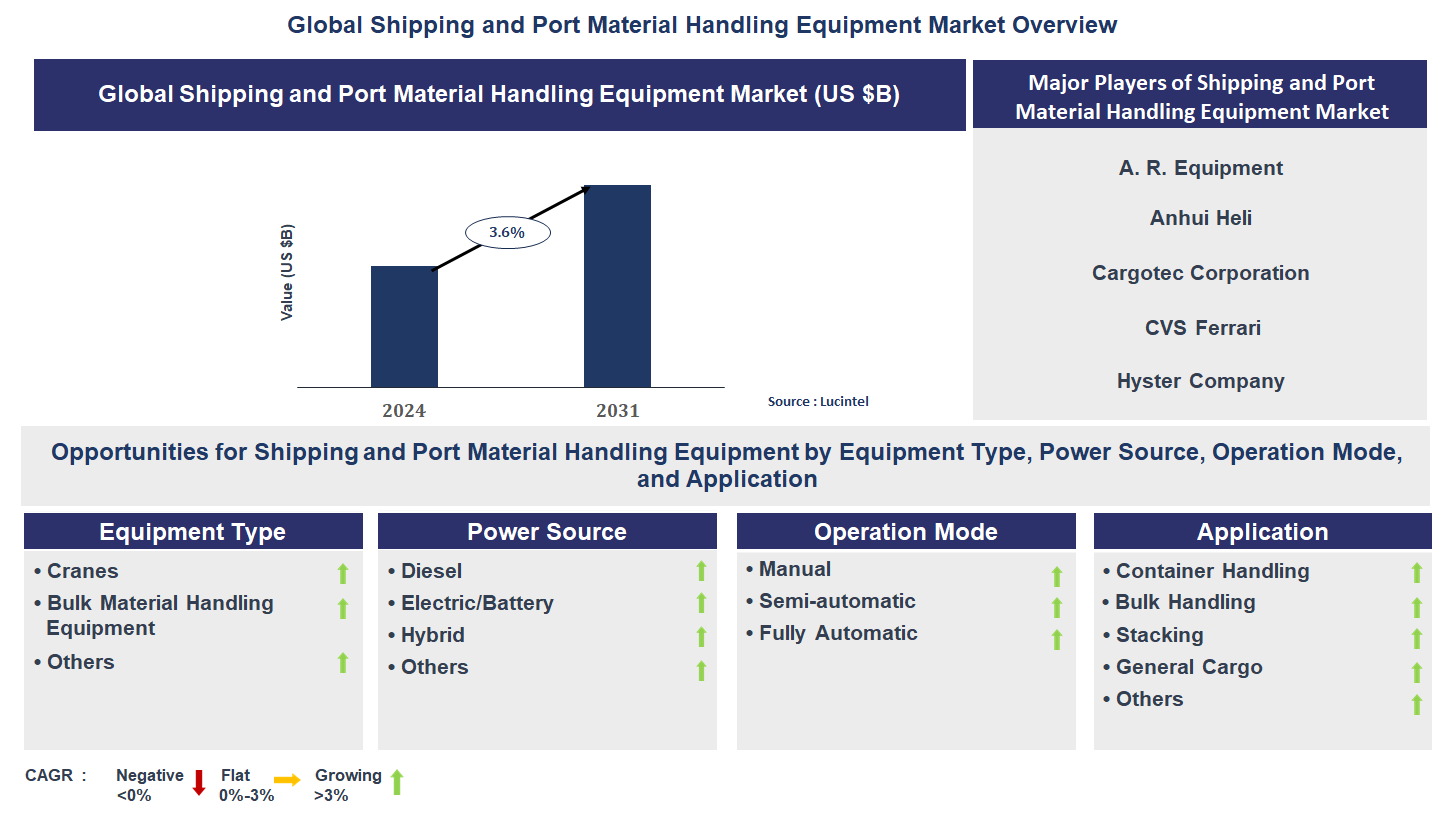
Shipping and Port Material Handling Equipment Market Trends and Forecast

Emerging Trends in the Shipping and Port Material Handling Equipment Market

The shipping and port material handling equipment industry is going through a period of quick evolution, as a number of significant trends are redefining the market. These trends are a direct reaction to some of the global challenges such as supply chain disruption, the need to drive down carbon emissions, and the need to drive greater operational efficiency. The sector is shifting from conventional, human-driven equipment to a future that is centered on technology, sustainability, and mechanization.
• Automation and Robotics: The most important trend is the growing use of automation and robotics in port operations. This involves the application of automated stacking cranes, automated guided vehicles (AGVs), and robotic handling systems. Such technologies enhance the efficiency of operations, minimize human mistakes, and increase safety by decreasing the level of manual intervention in dangerous working conditions. Automation enables 24/7 operations, which drastically enhances port throughput and decreases vessel turnaround times, critical to satisfying the requirements of global trade.
• Electrification and Decarbonization: As part of the international drive for a cleaner economy, there is a broad tendency towards electrifying port equipment. This includes replacing conventional diesel cranes, trucks, and other devices with electric or battery-powered ones. This move not only minimizes greenhouse gas emissions and air pollution within ports but also decreases operating costs because of lowered fuel and maintenance costs. Producers are heavily investing in creating long-lasting, high-performance batteries and quick-charging infrastructure to facilitate this trend.
• Smart Technology and IoT Integration: Ports are progressively becoming "smart ports" by incorporating smart technologies such as the Internet of Things (IoT), Artificial Intelligence (AI), and Big Data. This trend entails the integration of sensors into material handling equipment to provide real-time feedback on their condition, location, and performance. This information enables predictive maintenance, scheduling optimization, and greater security. Combined, these technologies provide a seamless, data-based environment that enhances operational transparency and enables more informed decision-making, resulting in a more efficient and responsive supply chain.
• Creation of High-Capacity and Modular Machinery: In order to accommodate the increasingly large container vessels, there is a very strong trend toward the creation of high-capacity and modular material handling equipment. These consist of bigger ship-to-shore cranes and straddle carriers which can accommodate mega-vessels. The modularity of the equipment means ports can readily increase and upgrade their capacity cost-effectively. It is important for ports to remain competitive and respond to the evolving nature of global maritime trade without enormous one-off investments.
• Development of Aftermarket and Services Segment: The market is also witnessing an increasing focus on the aftermarket and service segment. With the growing complexity and technological developments in port equipment, there is a rising need for high-tech maintenance, repair, and overhaul services. This pattern is opening up new revenue channels for manufacturers and service providers. It also involves the application of digital solutions for remote diagnostics and predictive maintenance in order to keep equipment running and reduce downtime, which is a top concern for port operators.
These trends are practically redefining the shipping and port material handling equipment industry by steering it towards an automated, green, and technologically merged future. The emphasis is on offering solutions that not only boost efficiency but also mitigate the environment and improve safety. The industry is becoming increasingly competitive with a robust focus on innovation that squarely targets the economic and environmental demands of shipping lines and port operators globally.
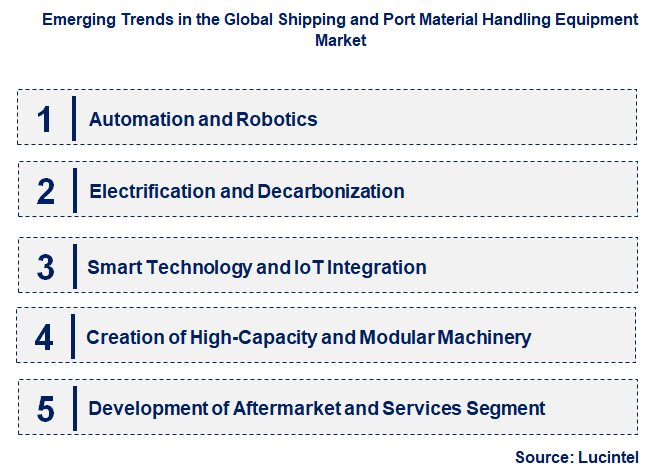
Emerging Trends in the Shipping and Port Material Handling Equipment Market

Recent Development in the Shipping and Port Material Handling Equipment Market

The international shipping and port material handling equipment industry is being swept by a tide of major developments powered by the twin drivers of efficiency and environmental responsibility. As world supply chains become ever more complex and volumes build, ports feel compelled to upgrade their functions. This has driven attention on new business models and technologies that facilitate quicker, safer, and more environmentally friendly cargo handling.
• Spread of Automated Terminals: Among the most important developments is the spread of the fully or semi-automated container terminal. These terminals employ automated stacking cranes, automated guided vehicles, and robotics to transfer containers from ships to the yard and on to trucks with minimal human touch. This innovation has a significant effect by greatly enhancing port throughput, lowering costs of operation, and enhancing safety. It supports 24/7 operations and enables ports to cope with the growing traffic in mega-ships.
• Growth in Electric and Hybrid Equipment: There is a strong trend towards replacing conventional diesel-powered equipment with electric and hybrid versions. Examples of such equipment include electric cranes, battery-powered yard trucks, and hybrid reach stackers. This growth is being spurred by stringent environmental regulations and corporate sustainability targets. The effect is a substantial reduction in noise pollution and greenhouse gas emissions at ports.
• Use of Advanced Telematics and Fleet Management: Contemporary material handling machinery now comes with advanced telematics and GPS. It enables port operators to monitor and control all their machinery in real time. This innovation offers useful information on equipment usage, fuel, and maintenance requirements. The effect is a better utilization of assets, less downtime through proactive maintenance, and streamlined operational flows within the port, which equates to cost savings and productivity improvements.
• Port Operations Digitalization: Ports are making significant investments in digitalizing port operations. This involves the integration of port operating systems, terminal management systems, and IoT sensors into a single, comprehensive data platform. This innovation facilitates seamless communication across all facets of the port, from ship arrival to container release. The result is a more efficient workflow, elimination of human errors, and making informed decisions based on data to enhance efficiency and security across the supply chain.
• Transition to More Oversized and Specialized Cranes: With the increasing size of container vessels, there is a definite move towards more oversized and specialized cranes. These are ship-to-shore cranes with dual hoists that can pick two containers simultaneously, greatly accelerating the unloading process. The effect of this innovation is reflected in a rise in the ability of a port to accommodate mega-vessels, as necessary for providing competitiveness in international trade. It also necessitates an overhaul of infrastructure at the ports in order to accommodate the new, heavier machinery.
These innovations are transforming the shipping and port material handling equipment market, propelling the industry toward a new generation of high-tech, efficient, and sustainable operations. The emphasis is on developing an integrated ecosystem of hardware and software solutions that can address the intricate needs of global trade today.

Strategic Growth Opportunities in the Shipping and Port Material Handling Equipment Market

The shipping and port material handling equipment market presents many strategic growth prospects in major applications based on the worldwide imperatives of efficiency, sustainability, and technology innovation. Both manufacturers and service providers can gain from these opportunities by creating specialized solutions based on the distinctive requirements of various types of port and terminals. Success is achieved by having a profound knowledge of the problems of the end-user, ranging from container handling to bulk cargo, and offering value-added products and services that meet their specific needs and enable them to optimize their operations and remain competitive in the international market.
• Container Handling: The container handling segment offers a significant opportunity for growth. The steady rise in global container trade and emergence of mega-ships are propelling the demand for high-capacity, automated, and smart equipment. Strategic opportunities include offering automated stacking cranes, rubber-tired gantry cranes, and automated guided vehicles. Manufacturers can target building integrated solutions that come with hardware coupled with software for real-time fleet management and operational optimization, which is extremely desired by contemporary container terminals.
• Bulk Material Handling: Another growth area is the bulk handling industry, which involves commodities such as coal, grain, and iron ore. This market calls for heavy-duty, high-volume, and specialty equipment to handle large quantities of material efficiently and with minimal environmental footprint. Strategic opportunities involve creating automated ship loaders and unloaders, stackers, and reclaimers that are energy efficient and have dust suppression systems. The emphasis in this case is on creating solutions that lower operating expenses and cope with increasingly stringent environmental laws.
• Ship Handling and Vessel Services: Outside the port yard, there is a major opportunity in ship handling equipment and services. These involve tugboats, mooring equipment, and passenger gangways. The strategic opportunity is to revolutionize with electric or hybrid tugboats and automated mooring technology with enhanced safety and lower emissions. The transition towards more sustainable vessel operations will drive a significant need for equipment that supports these sustainability objectives, presenting a direct avenue for development within this specialized but vital use.
• Warehousing and Logistics: The convergence of port operations with warehousing and logistics represents a frontier of opportunity. With e-commerce and fast-moving consumer goods generating demand for quick movement of goods, demand for effective equipment at port-side warehouses is increasing. Strategic opportunities include the provision of automated storage and retrieval systems, forklifts, and conveyor systems specifically developed for quick-turnaround, high-volume logistics. Companies can establish themselves as supply chain solution partners in developing end-to-end seamless solutions.
• Digital Maintenance and Aftermarket Services: With the increasing complexity of port equipment, the aftermarket for repair, maintenance, and overhaul services is a recurring and high-value growth potential. Suppliers can strategically invest in building up their service networks and creating digital maintenance platforms that leverage telematics and artificial intelligence to enable predictive maintenance. This not only offers a secure source of revenue but also develops good customer relationships and lowers the overall cost of ownership of a customer, which is one of the key decision-making factors for port operators.
These strategic opportunities for growth are transforming the shipping and port material handling equipment market by promoting specialization and innovation. The market’s future is in the delivery of customized, high-technology, and environmentally friendly solutions to a specific application, away from having one-size-fits-all solutions. Manufacturers can not only increase their market share by focusing on these high-growth areas but also be instrumental in facilitating the growth of contemporary global trade.

Shipping and Port Material Handling Equipment Market Driver and Challenges

The shipping and port material handling equipment market is a dynamic sector, driven by a mix of key drivers and compelling challenges. The drivers, which are predominantly favorable, are a function of global economic and technological developments that are driving the expansion of international trade. The drivers, however, are driven by new industry norms, economic volatilities, and the expense of innovation. The future of the market will depend on how well companies are able to leverage these drivers amidst overcoming the intrinsic complexities of the new global supply chain.
The factors responsible for driving the shipping and port material handling equipment market include:
1. Expansion in Worldwide Trade and Containerization: The main impetus for the market is the relentless expansion of worldwide trade activity and the relentless containerization of merchandise. With the growing integration of economies and increasing consumer demand, the amount of freight passing through ports goes up. This serves to directly increase the demand for new and advanced material handling equipment, ranging from large container cranes to terminal tractors, to deal with the increased throughput.
2. Technological Advancements and Automation: The push for greater efficiency and reduced labor costs is driving the adoption of automation and robotics. This includes the implementation of automated guided vehicles, automated stacking cranes, and remote-controlled machinery. These technological advancements are a major market driver, as they enable ports to operate 24/7, improve safety, and significantly increase throughput, giving them a competitive edge.
3. Sustainability and Green Ports: Increased environmental consciousness and stringent government policies on emissions are pushing ports towards adopting green solutions. This is a strong market driver, resulting in higher demand for electric, hybrid, and hydrogen solutions. Not only does this help ports decrease their carbon footprint, but it also reduces their operating costs in the long run with less fuel consumption and maintenance.
4. Port Modernization and Infrastructure Development: Governments and private investors globally are investing heavily in modernizing current ports and constructing new ones. This infrastructure development is a significant market driver since it necessitates the procurement of new, sophisticated material handling equipment to enable increased capacity and enhanced logistics. This is especially notable in developing economies that are heavily investing in their trade infrastructure.
5. Increasing Labor Costs and Safety Issues: With increasing labor costs and safety issues in the workplace, port operators are looking to reduce manual labor requirements in hazardous areas. This is a strong motivating force for automation and the use of remote-controlled machinery, which cuts down the number of personnel on the ground. Not only does automation enhance efficiency, but also it makes the working environment safer.
Challenges in the shipping and port material handling equipment market are:
1. High Upfront Costs: One of the biggest problems is the high upfront expense of buying and implementing advanced, automated material handling systems. This can be prohibitive for smaller ports or developing countries that might lack the capital to spend on a full system upgrade. This also encompasses the cost of educating the workers to run the new, sophisticated equipment.
2. Supply Chain Disruptions: The market is susceptible to global supply chain disruptions. Economic and geopolitical uncertainties have the potential to affect the supply and price of key inputs such as steel, microchips, and batteries. Disruptions can result in delays during production and higher production costs for manufacturers, which get passed on to port operators.
3. Issues of Integration and Interoperability: It can be difficult to implement new automated systems. There will be an assortment of old and new equipment in ports, and making all the systems talk to each other and integrate seamlessly is a big technical challenge. It involves a lot of software and IT infrastructure investment and can create delays and complexities in operations if not properly managed.
Overall, the shipping and port material handling equipment market is being powered by the underlying drivers of globalization and technological advancement. At the same time, however, it is also being confronted with huge challenges posed by the expensive nature of innovation and the intricacies of adapting new technology to old systems. The future of the market will lie in how ports and manufacturers are able to cooperate to offer sustainable, cost-effective, and integrated solutions addressing the drivers and challenges of the contemporary global supply chain.

List of Shipping and Port Material Handling Equipment Companies

Companies in the market compete on the basis of product quality offered. Major players in this market focus on expanding their manufacturing facilities, R&D investments, infrastructural development, and leverage integration opportunities across the value chain. With these strategies shipping and port material handling equipment companies cater increasing demand, ensure competitive effectiveness, develop innovative products & technologies, reduce production costs, and expand their customer base. Some of the shipping and port material handling equipment companies profiled in this report include-
• A. R. Equipment
• Anhui Heli
• Cargotec Corporation
• CVS Ferrari
• Hyster Company
• Jost’s Engineering Company
• Konecranes
• Liebherr Group
• Lonking Holdings Limited
• Mitsubishi Logisnext

Shipping and Port Material Handling Equipment Market by Segment

The study includes a forecast for the global shipping and port material handling equipment market by equipment type, power source, operation mode, application, and region.

Shipping and Port Material Handling Equipment Market by Equipment Type [Value from 2019 to 2031]:


• Cranes
• Bulk Material Handling Equipment
• Others

Shipping and Port Material Handling Equipment Market by Power Source [Value from 2019 to 2031]:


• Diesel
• Electric/Battery
• Hybrid
• Others

Shipping and Port Material Handling Equipment Market by Operation Mode [Value from 2019 to 2031]:


• Manual
• Semi-automatic
• Fully Automatic

Shipping and Port Material Handling Equipment Market by Application [Value from 2019 to 2031]:


• Container Handling
• Bulk Handling
• Stacking
• General Cargo
• Others

Shipping and Port Material Handling Equipment Market by Region [Value from 2019 to 2031]:


• North America
• Europe
• Asia Pacific
• The Rest of the World

Country Wise Outlook for the Shipping and Port Material Handling Equipment Market

The shipping and port material handling equipment market globally is experiencing a radical shift in its dynamics, propelled by demands for greater efficiency, sustainability, and automation. With global trade volumes increasing, ports face pressure to move more cargo within shorter times. This has triggered investment in high-tech equipment that is not only more efficient but also green. New technologies are centered on combining automation, electrification, and data analytics to develop smart port operations. This transformation is remodeling the market and producing new competitive forces between port operators and equipment makers globally.
• United States: In the United States, recent trends are dominated by the Infrastructure Investment and Jobs Act. This act has provided substantial investment in updating ports and transportation infrastructure, which has created massive demand for new and refurbished material handling equipment. There is a high priority on automation and smart logistics use to enhance port efficiency and minimize labor costs. Manufacturers are concentrating on delivering sophisticated cranes, autonomous guided vehicles, and other robotics.
• China: China is a world leader in the shipping and port material handling equipment industry, with activity fueled by its enormous Belt and Road Initiative and its efforts towards completely automated "smart ports." Its domestic manufacturers, like ZPMC, lead the way in the design and build of high-scale, automated container cranes and other heavy equipment. Recent innovations involve the embedding of 5G, AI, and IoT for real-time tracking and predictive maintenance. The government of China is investing heavily to increase port capacity and automate the operations to accommodate the growing amount of international trade, further cementing the nation’s leadership in this industry.
• Germany: The market for shipping and port material handling equipment in Germany is reflected in a very high regard for quality engineering and rigorous environmental compliance. The latest trends are focused on embedding Industry 4.0 principles, including smart sensors and data analytics, into the equipment for added performance and efficiency. German businesses excel at manufacturing energy-efficient and electric-driven equipment for facilitating green port initiatives. The focus is on creating robust, reliable, and technologically superior solutions for both container handling and bulk cargo operations, capitalizing on the nation’s reputation for precision manufacturing.
• India: India’s market is growing strongly with ambitious government initiatives to upgrade port facilities and enhance logistics efficiency. A major driver is India’s Sabarimala program, resulting in new investment in port expansions and the purchase of high-tech material handling equipment. Recent activity is centered on switching to semi-automatic and state-of-the-art diesel-electric equipment to meet increased cargo volumes. There is high demand for rugged, cost-saving equipment that is capable of handling various types of cargoes.
• Japan: Japan’s shipping and port material handling equipment market is influenced by a need for innovation and efficiency due to a declining workforce. The latest developments are prompted by the necessity to mechanize operations in order to offset labor shortages. Japanese businesses lead the way with robotics and automated guided vehicles for port logistics. Strong emphasis is placed on developing equipment with high reliability and long life along with low environmental impact.

Lucintel Analytics Dashboard

Features of the Global Shipping and Port Material Handling Equipment Market

Market Size Estimates: Shipping and port material handling equipment market size estimation in terms of value ($B).
Trend and Forecast Analysis: Market trends (2019 to 2024) and forecast (2025 to 2031) by various segments and regions.
Segmentation Analysis: Shipping and port material handling equipment market size by various segments, such as by equipment type, power source, operation mode, application, and region in terms of value ($B).
Regional Analysis: Shipping and port material handling equipment market breakdown by North America, Europe, Asia Pacific, and Rest of the World.
Growth Opportunities: Analysis of growth opportunities in different equipment types, power sources, operation modes, applications, and regions for the shipping and port material handling equipment market.
Strategic Analysis: This includes M&A, new product development, and competitive landscape of the shipping and port material handling equipment market.
Analysis of competitive intensity of the industry based on Porter’s Five Forces model.

Lucintel Consulting Services

FAQ

Q1. What is the growth forecast for shipping and port material handling equipment market?
Answer: The global shipping and port material handling equipment market is expected to grow with a CAGR of 3.6% from 2025 to 2031.
Q2. What are the major drivers influencing the growth of the shipping and port material handling equipment market?
Answer: The major drivers for this market are the increasing demand for efficient logistics operations, the rising adoption of automation in ports, and the growing need for faster cargo handling.
Q3. What are the major segments for shipping and port material handling equipment market?
Answer: The future of the shipping and port material handling equipment market looks promising with opportunities in the container handling, bulk handling, stacking, and general cargo markets.
Q4. Who are the key shipping and port material handling equipment market companies?
Answer: Some of the key shipping and port material handling equipment companies are as follows:
• A. R. Equipment
• Anhui Heli
• Cargotec Corporation
• CVS Ferrari
• Hyster Company
• Jost’s Engineering Company
• Konecranes
• Liebherr Group
• Lonking Holdings Limited
• Mitsubishi Logisnext
Q5. Which shipping and port material handling equipment market segment will be the largest in future?
Answer: Lucintel forecasts that, within the equipment type category, crane is expected to witness higher growth over the forecast period.
Q6. In shipping and port material handling equipment market, which region is expected to be the largest in next 5 years?
Answer: In terms of region, APAC is expected to witness the highest growth over the forecast period.
Q7. Do we receive customization in this report?
Answer: Yes, Lucintel provides 10% customization without any additional cost.

This report answers following 11 key questions:

Q.1. What are some of the most promising, high-growth opportunities for the shipping and port material handling equipment market by equipment type (cranes, bulk material handling equipment, and others), power source (diesel, electric/battery, hybrid, and others), operation mode (manual, semi-automatic, and fully automatic), application (container handling, bulk handling, stacking, general cargo, and others), and region (North America, Europe, Asia Pacific, and the Rest of the World)?
Q.2. Which segments will grow at a faster pace and why?
Q.3. Which region will grow at a faster pace and why?
Q.4. What are the key factors affecting market dynamics? What are the key challenges and business risks in this market?
Q.5. What are the business risks and competitive threats in this market?
Q.6. What are the emerging trends in this market and the reasons behind them?
Q.7. What are some of the changing demands of customers in the market?
Q.8. What are the new developments in the market? Which companies are leading these developments?
Q.9. Who are the major players in this market? What strategic initiatives are key players pursuing for business growth?
Q.10. What are some of the competing products in this market and how big of a threat do they pose for loss of market share by material or product substitution?
Q.11. What M&A activity has occurred in the last 5 years and what has its impact been on the industry?

For any questions related to Shipping and Port Material Handling Equipment Market, Shipping and Port Material Handling Equipment Market Size, Shipping and Port Material Handling Equipment Market Growth, Shipping and Port Material Handling Equipment Market Analysis, Shipping and Port Material Handling Equipment Market Report, Shipping and Port Material Handling Equipment Market Share, Shipping and Port Material Handling Equipment Market Trends, Shipping and Port Material Handling Equipment Market Forecast, Shipping and Port Material Handling Equipment Companies, write Lucintel analyst at email: helpdesk@lucintel.com. We will be glad to get back to you soon.
                                           Table of Contents

            1. Executive Summary

            2. Market Overview

                        2.1 Background and Classifications
                        2.2 Supply Chain

            3. Market Trends & Forecast Analysis

                        3.1 Macroeconomic Trends and Forecasts
                        3.2 Industry Drivers and Challenges
                        3.3 PESTLE Analysis
                        3.4 Patent Analysis
                        3.5 Regulatory Environment
                        3.6 Global Shipping and Port Material Handling Equipment Market Trends and Forecast

            4. Global Shipping and Port Material Handling Equipment Market by Equipment Type

                        4.1 Overview
                        4.2 Attractiveness Analysis by Equipment Type
                        4.3 Cranes : Trends and Forecast 2025 to 2031
                        4.4 Bulk Material Handling Equipment : Trends and Forecast 2025 to 2031
                        4.5 Others : Trends and Forecast 2025 to 2031

            5. Global Shipping and Port Material Handling Equipment Market by Power Source

                        5.1 Overview
                        5.2 Attractiveness Analysis by Power Source
                        5.3 Diesel : Trends and Forecast 2025 to 2031
                        5.4 Electric/Battery : Trends and Forecast 2025 to 2031
                        5.5 Hybrid : Trends and Forecast 2025 to 2031
                        5.6 Others : Trends and Forecast 2025 to 2031

            6. Global Shipping and Port Material Handling Equipment Market by Operation Mode

                        6.1 Overview
                        6.2 Attractiveness Analysis by Operation Mode
                        6.3 Manual : Trends and Forecast 2025 to 2031
                        6.4 Semi-automatic : Trends and Forecast 2025 to 2031
                        6.5 Fully Automatic : Trends and Forecast 2025 to 2031

            7. Global Shipping and Port Material Handling Equipment Market by Application

                        7.1 Overview
                        7.2 Attractiveness Analysis by Application
                        7.3 Container Handling : Trends and Forecast 2025 to 2031
                        7.4 Bulk Handling : Trends and Forecast 2025 to 2031
                        7.5 Stacking : Trends and Forecast 2025 to 2031
                        7.6 General Cargo : Trends and Forecast 2025 to 2031
                        7.7 Others : Trends and Forecast 2025 to 2031

            8. Regional Analysis

                        8.1 Overview
                        8.2 Global Shipping and Port Material Handling Equipment Market by Region

            9. North American Shipping and Port Material Handling Equipment Market

                        9.1 Overview
                        9.2 North American Shipping and Port Material Handling Equipment Market by Equipment Type
                        9.3 North American Shipping and Port Material Handling Equipment Market by Application
                        9.4 The United States Shipping and Port Material Handling Equipment Market
                        9.5 Canadian Shipping and Port Material Handling Equipment Market
                        9.6 Mexican Shipping and Port Material Handling Equipment Market

            10. European Shipping and Port Material Handling Equipment Market

                        10.1 Overview
                        10.2 European Shipping and Port Material Handling Equipment Market by Equipment Type
                        10.3 European Shipping and Port Material Handling Equipment Market by Application
                        10.4 German Shipping and Port Material Handling Equipment Market
                        10.5 French Shipping and Port Material Handling Equipment Market
                        10.6 Italian Shipping and Port Material Handling Equipment Market
                        10.7 Spanish Shipping and Port Material Handling Equipment Market
                        10.8 The United Kingdom Shipping and Port Material Handling Equipment Market

            11. APAC Shipping and Port Material Handling Equipment Market

                        11.1 Overview
                        11.2 APAC Shipping and Port Material Handling Equipment Market by Equipment Type
                        11.3 APAC Shipping and Port Material Handling Equipment Market by Application
                        11.4 Chinese Shipping and Port Material Handling Equipment Market
                        11.5 Indian Shipping and Port Material Handling Equipment Market
                        11.6 Japanese Shipping and Port Material Handling Equipment Market
                        11.7 South Korean Shipping and Port Material Handling Equipment Market
                        11.8 Indonesian Shipping and Port Material Handling Equipment Market

            12. ROW Shipping and Port Material Handling Equipment Market

                        12.1 Overview
                        12.2 ROW Shipping and Port Material Handling Equipment Market by Equipment Type
                        12.3 ROW Shipping and Port Material Handling Equipment Market by Application
                        12.4 Middle Eastern Shipping and Port Material Handling Equipment Market
                        12.5 South American Shipping and Port Material Handling Equipment Market
                        12.6 African Shipping and Port Material Handling Equipment Market

            13. Competitor Analysis

                        13.1 Product Portfolio Analysis
                        13.2 Operational Integration
                        13.3 Porter’s Five Forces Analysis
                                    • Competitive Rivalry
                                    • Bargaining Power of Buyers
                                    • Bargaining Power of Suppliers
                                    • Threat of Substitutes
                                    • Threat of New Entrants
                        13.4 Market Share Analysis

            14. Opportunities & Strategic Analysis

                        14.1 Value Chain Analysis
                        14.2 Growth Opportunity Analysis
                                    14.2.1 Growth Opportunity by Equipment Type
                                    14.2.2 Growth Opportunity by Power Source
                                    14.2.3 Growth Opportunity by Operation Mode
                                    14.2.4 Growth Opportunity by Application
                        14.3 Emerging Trends in the Global Shipping and Port Material Handling Equipment Market
                        14.4 Strategic Analysis
                                    14.4.1 New Product Development
                                    14.4.2 Certification and Licensing
                                    14.4.3 Mergers, Acquisitions, Agreements, Collaborations, and Joint Ventures

            15. Company Profiles of the Leading Players Across the Value Chain

                        15.1 Competitive Analysis
                        15.2 A. R. Equipment
                                    • Company Overview
                                    • Shipping and Port Material Handling Equipment Market Business Overview
                                    • New Product Development
                                    • Merger, Acquisition, and Collaboration
                                    • Certification and Licensing
                        15.3 Anhui Heli
                                    • Company Overview
                                    • Shipping and Port Material Handling Equipment Market Business Overview
                                    • New Product Development
                                    • Merger, Acquisition, and Collaboration
                                    • Certification and Licensing
                        15.4 Cargotec Corporation
                                    • Company Overview
                                    • Shipping and Port Material Handling Equipment Market Business Overview
                                    • New Product Development
                                    • Merger, Acquisition, and Collaboration
                                    • Certification and Licensing
                        15.5 CVS Ferrari
                                    • Company Overview
                                    • Shipping and Port Material Handling Equipment Market Business Overview
                                    • New Product Development
                                    • Merger, Acquisition, and Collaboration
                                    • Certification and Licensing
                        15.6 Hyster Company
                                    • Company Overview
                                    • Shipping and Port Material Handling Equipment Market Business Overview
                                    • New Product Development
                                    • Merger, Acquisition, and Collaboration
                                    • Certification and Licensing
                        15.7 JostÄX%$%Xs Engineering Company Overview
                                    • Company Overview
                                    • Shipping and Port Material Handling Equipment Market Business Overview
                                    • New Product Development
                                    • Merger, Acquisition, and Collaboration
                                    • Certification and Licensing
                        15.8 Konecranes
                                    • Company Overview
                                    • Shipping and Port Material Handling Equipment Market Business Overview
                                    • New Product Development
                                    • Merger, Acquisition, and Collaboration
                                    • Certification and Licensing
                        15.9 Liebherr Group
                                    • Company Overview
                                    • Shipping and Port Material Handling Equipment Market Business Overview
                                    • New Product Development
                                    • Merger, Acquisition, and Collaboration
                                    • Certification and Licensing
                        15.10 Lonking Holdings Limited
                                    • Company Overview
                                    • Shipping and Port Material Handling Equipment Market Business Overview
                                    • New Product Development
                                    • Merger, Acquisition, and Collaboration
                                    • Certification and Licensing
                        15.11 Mitsubishi Logisnext
                                    • Company Overview
                                    • Shipping and Port Material Handling Equipment Market Business Overview
                                    • New Product Development
                                    • Merger, Acquisition, and Collaboration
                                    • Certification and Licensing

            16. Appendix

                        16.1 List of Figures
                        16.2 List of Tables
                        16.3 Research Methodology
                        16.4 Disclaimer
                        16.5 Copyright
                        16.6 Abbreviations and Technical Units
                        16.7 About Us
                        16.8 Contact Us

                                               List of Figures


            Chapter 1

                        Figure 1.1: Trends and Forecast for the Global Shipping and Port Material Handling Equipment Market

            Chapter 2

                        Figure 2.1: Usage of Shipping and Port Material Handling Equipment Market
                        Figure 2.2: Classification of the Global Shipping and Port Material Handling Equipment Market
                        Figure 2.3: Supply Chain of the Global Shipping and Port Material Handling Equipment Market

            Chapter 3

                        Figure 3.1: Trends of the Global GDP Growth Rate
                        Figure 3.2: Trends of the Global Population Growth Rate
                        Figure 3.3: Trends of the Global Inflation Rate
                        Figure 3.4: Trends of the Global Unemployment Rate
                        Figure 3.5: Trends of the Regional GDP Growth Rate
                        Figure 3.6: Trends of the Regional Population Growth Rate
                        Figure 3.7: Trends of the Regional Inflation Rate
                        Figure 3.8: Trends of the Regional Unemployment Rate
                        Figure 3.9: Trends of Regional Per Capita Income
                        Figure 3.10: Forecast for the Global GDP Growth Rate
                        Figure 3.11: Forecast for the Global Population Growth Rate
                        Figure 3.12: Forecast for the Global Inflation Rate
                        Figure 3.13: Forecast for the Global Unemployment Rate
                        Figure 3.14: Forecast for the Regional GDP Growth Rate
                        Figure 3.15: Forecast for the Regional Population Growth Rate
                        Figure 3.16: Forecast for the Regional Inflation Rate
                        Figure 3.17: Forecast for the Regional Unemployment Rate
                        Figure 3.18: Forecast for Regional Per Capita Income
                        Figure 3.19: Driver and Challenges of the Shipping and Port Material Handling Equipment Market

            Chapter 4

                        Figure 4.1: Global Shipping and Port Material Handling Equipment Market by Equipment Type in 2019, 2024, and 2031
                        Figure 4.2: Trends of the Global Shipping and Port Material Handling Equipment Market ($B) by Equipment Type
                        Figure 4.3: Forecast for the Global Shipping and Port Material Handling Equipment Market ($B) by Equipment Type
                        Figure 4.4: Trends and Forecast for Cranes in the Global Shipping and Port Material Handling Equipment Market (2019-2031)
                        Figure 4.5: Trends and Forecast for Bulk Material Handling Equipment in the Global Shipping and Port Material Handling Equipment Market (2019-2031)
                        Figure 4.6: Trends and Forecast for Others in the Global Shipping and Port Material Handling Equipment Market (2019-2031)

            Chapter 5

                        Figure 5.1: Global Shipping and Port Material Handling Equipment Market by Power Source in 2019, 2024, and 2031
                        Figure 5.2: Trends of the Global Shipping and Port Material Handling Equipment Market ($B) by Power Source
                        Figure 5.3: Forecast for the Global Shipping and Port Material Handling Equipment Market ($B) by Power Source
                        Figure 5.4: Trends and Forecast for Diesel in the Global Shipping and Port Material Handling Equipment Market (2019-2031)
                        Figure 5.5: Trends and Forecast for Electric/Battery in the Global Shipping and Port Material Handling Equipment Market (2019-2031)
                        Figure 5.6: Trends and Forecast for Hybrid in the Global Shipping and Port Material Handling Equipment Market (2019-2031)
                        Figure 5.7: Trends and Forecast for Others in the Global Shipping and Port Material Handling Equipment Market (2019-2031)

            Chapter 6

                        Figure 6.1: Global Shipping and Port Material Handling Equipment Market by Operation Mode in 2019, 2024, and 2031
                        Figure 6.2: Trends of the Global Shipping and Port Material Handling Equipment Market ($B) by Operation Mode
                        Figure 6.3: Forecast for the Global Shipping and Port Material Handling Equipment Market ($B) by Operation Mode
                        Figure 6.4: Trends and Forecast for Manual in the Global Shipping and Port Material Handling Equipment Market (2019-2031)
                        Figure 6.5: Trends and Forecast for Semi-automatic in the Global Shipping and Port Material Handling Equipment Market (2019-2031)
                        Figure 6.6: Trends and Forecast for Fully Automatic in the Global Shipping and Port Material Handling Equipment Market (2019-2031)

            Chapter 7

                        Figure 7.1: Global Shipping and Port Material Handling Equipment Market by Application in 2019, 2024, and 2031
                        Figure 7.2: Trends of the Global Shipping and Port Material Handling Equipment Market ($B) by Application
                        Figure 7.3: Forecast for the Global Shipping and Port Material Handling Equipment Market ($B) by Application
                        Figure 7.4: Trends and Forecast for Container Handling in the Global Shipping and Port Material Handling Equipment Market (2019-2031)
                        Figure 7.5: Trends and Forecast for Bulk Handling in the Global Shipping and Port Material Handling Equipment Market (2019-2031)
                        Figure 7.6: Trends and Forecast for Stacking in the Global Shipping and Port Material Handling Equipment Market (2019-2031)
                        Figure 7.7: Trends and Forecast for General Cargo in the Global Shipping and Port Material Handling Equipment Market (2019-2031)
                        Figure 7.8: Trends and Forecast for Others in the Global Shipping and Port Material Handling Equipment Market (2019-2031)

            Chapter 8

                        Figure 8.1: Trends of the Global Shipping and Port Material Handling Equipment Market ($B) by Region (2019-2024)
                        Figure 8.2: Forecast for the Global Shipping and Port Material Handling Equipment Market ($B) by Region (2025-2031)

            Chapter 9

                        Figure 9.1: Trends and Forecast for the North American Shipping and Port Material Handling Equipment Market (2019-2031)
                        Figure 9.2: North American Shipping and Port Material Handling Equipment Market by Equipment Type in 2019, 2024, and 2031
                        Figure 9.3: Trends of the North American Shipping and Port Material Handling Equipment Market ($B) by Equipment Type (2019-2024)
                        Figure 9.4: Forecast for the North American Shipping and Port Material Handling Equipment Market ($B) by Equipment Type (2025-2031)
                        Figure 9.5: North American Shipping and Port Material Handling Equipment Market by Power Source in 2019, 2024, and 2031
                        Figure 9.6: Trends of the North American Shipping and Port Material Handling Equipment Market ($B) by Power Source (2019-2024)
                        Figure 9.7: Forecast for the North American Shipping and Port Material Handling Equipment Market ($B) by Power Source (2025-2031)
                        Figure 9.8: North American Shipping and Port Material Handling Equipment Market by Operation Mode in 2019, 2024, and 2031
                        Figure 9.9: Trends of the North American Shipping and Port Material Handling Equipment Market ($B) by Operation Mode (2019-2024)
                        Figure 9.10: Forecast for the North American Shipping and Port Material Handling Equipment Market ($B) by Operation Mode (2025-2031)
                        Figure 9.11: North American Shipping and Port Material Handling Equipment Market by Application in 2019, 2024, and 2031
                        Figure 9.12: Trends of the North American Shipping and Port Material Handling Equipment Market ($B) by Application (2019-2024)
                        Figure 9.13: Forecast for the North American Shipping and Port Material Handling Equipment Market ($B) by Application (2025-2031)
                        Figure 9.14: Trends and Forecast for the United States Shipping and Port Material Handling Equipment Market ($B) (2019-2031)
                        Figure 9.15: Trends and Forecast for the Mexican Shipping and Port Material Handling Equipment Market ($B) (2019-2031)
                        Figure 9.16: Trends and Forecast for the Canadian Shipping and Port Material Handling Equipment Market ($B) (2019-2031)

            Chapter 10

                        Figure 10.1: Trends and Forecast for the European Shipping and Port Material Handling Equipment Market (2019-2031)
                        Figure 10.2: European Shipping and Port Material Handling Equipment Market by Equipment Type in 2019, 2024, and 2031
                        Figure 10.3: Trends of the European Shipping and Port Material Handling Equipment Market ($B) by Equipment Type (2019-2024)
                        Figure 10.4: Forecast for the European Shipping and Port Material Handling Equipment Market ($B) by Equipment Type (2025-2031)
                        Figure 10.5: European Shipping and Port Material Handling Equipment Market by Power Source in 2019, 2024, and 2031
                        Figure 10.6: Trends of the European Shipping and Port Material Handling Equipment Market ($B) by Power Source (2019-2024)
                        Figure 10.7: Forecast for the European Shipping and Port Material Handling Equipment Market ($B) by Power Source (2025-2031)
                        Figure 10.8: European Shipping and Port Material Handling Equipment Market by Operation Mode in 2019, 2024, and 2031
                        Figure 10.9: Trends of the European Shipping and Port Material Handling Equipment Market ($B) by Operation Mode (2019-2024)
                        Figure 10.10: Forecast for the European Shipping and Port Material Handling Equipment Market ($B) by Operation Mode (2025-2031)
                        Figure 10.11: European Shipping and Port Material Handling Equipment Market by Application in 2019, 2024, and 2031
                        Figure 10.12: Trends of the European Shipping and Port Material Handling Equipment Market ($B) by Application (2019-2024)
                        Figure 10.13: Forecast for the European Shipping and Port Material Handling Equipment Market ($B) by Application (2025-2031)
                        Figure 10.14: Trends and Forecast for the German Shipping and Port Material Handling Equipment Market ($B) (2019-2031)
                        Figure 10.15: Trends and Forecast for the French Shipping and Port Material Handling Equipment Market ($B) (2019-2031)
                        Figure 10.16: Trends and Forecast for the Spanish Shipping and Port Material Handling Equipment Market ($B) (2019-2031)
                        Figure 10.17: Trends and Forecast for the Italian Shipping and Port Material Handling Equipment Market ($B) (2019-2031)
                        Figure 10.18: Trends and Forecast for the United Kingdom Shipping and Port Material Handling Equipment Market ($B) (2019-2031)

            Chapter 11

                        Figure 11.1: Trends and Forecast for the APAC Shipping and Port Material Handling Equipment Market (2019-2031)
                        Figure 11.2: APAC Shipping and Port Material Handling Equipment Market by Equipment Type in 2019, 2024, and 2031
                        Figure 11.3: Trends of the APAC Shipping and Port Material Handling Equipment Market ($B) by Equipment Type (2019-2024)
                        Figure 11.4: Forecast for the APAC Shipping and Port Material Handling Equipment Market ($B) by Equipment Type (2025-2031)
                        Figure 11.5: APAC Shipping and Port Material Handling Equipment Market by Power Source in 2019, 2024, and 2031
                        Figure 11.6: Trends of the APAC Shipping and Port Material Handling Equipment Market ($B) by Power Source (2019-2024)
                        Figure 11.7: Forecast for the APAC Shipping and Port Material Handling Equipment Market ($B) by Power Source (2025-2031)
                        Figure 11.8: APAC Shipping and Port Material Handling Equipment Market by Operation Mode in 2019, 2024, and 2031
                        Figure 11.9: Trends of the APAC Shipping and Port Material Handling Equipment Market ($B) by Operation Mode (2019-2024)
                        Figure 11.10: Forecast for the APAC Shipping and Port Material Handling Equipment Market ($B) by Operation Mode (2025-2031)
                        Figure 11.11: APAC Shipping and Port Material Handling Equipment Market by Application in 2019, 2024, and 2031
                        Figure 11.12: Trends of the APAC Shipping and Port Material Handling Equipment Market ($B) by Application (2019-2024)
                        Figure 11.13: Forecast for the APAC Shipping and Port Material Handling Equipment Market ($B) by Application (2025-2031)
                        Figure 11.14: Trends and Forecast for the Japanese Shipping and Port Material Handling Equipment Market ($B) (2019-2031)
                        Figure 11.15: Trends and Forecast for the Indian Shipping and Port Material Handling Equipment Market ($B) (2019-2031)
                        Figure 11.16: Trends and Forecast for the Chinese Shipping and Port Material Handling Equipment Market ($B) (2019-2031)
                        Figure 11.17: Trends and Forecast for the South Korean Shipping and Port Material Handling Equipment Market ($B) (2019-2031)
                        Figure 11.18: Trends and Forecast for the Indonesian Shipping and Port Material Handling Equipment Market ($B) (2019-2031)

            Chapter 12

                        Figure 12.1: Trends and Forecast for the ROW Shipping and Port Material Handling Equipment Market (2019-2031)
                        Figure 12.2: ROW Shipping and Port Material Handling Equipment Market by Equipment Type in 2019, 2024, and 2031
                        Figure 12.3: Trends of the ROW Shipping and Port Material Handling Equipment Market ($B) by Equipment Type (2019-2024)
                        Figure 12.4: Forecast for the ROW Shipping and Port Material Handling Equipment Market ($B) by Equipment Type (2025-2031)
                        Figure 12.5: ROW Shipping and Port Material Handling Equipment Market by Power Source in 2019, 2024, and 2031
                        Figure 12.6: Trends of the ROW Shipping and Port Material Handling Equipment Market ($B) by Power Source (2019-2024)
                        Figure 12.7: Forecast for the ROW Shipping and Port Material Handling Equipment Market ($B) by Power Source (2025-2031)
                        Figure 12.8: ROW Shipping and Port Material Handling Equipment Market by Operation Mode in 2019, 2024, and 2031
                        Figure 12.9: Trends of the ROW Shipping and Port Material Handling Equipment Market ($B) by Operation Mode (2019-2024)
                        Figure 12.10: Forecast for the ROW Shipping and Port Material Handling Equipment Market ($B) by Operation Mode (2025-2031)
                        Figure 12.11: ROW Shipping and Port Material Handling Equipment Market by Application in 2019, 2024, and 2031
                        Figure 12.12: Trends of the ROW Shipping and Port Material Handling Equipment Market ($B) by Application (2019-2024)
                        Figure 12.13: Forecast for the ROW Shipping and Port Material Handling Equipment Market ($B) by Application (2025-2031)
                        Figure 12.14: Trends and Forecast for the Middle Eastern Shipping and Port Material Handling Equipment Market ($B) (2019-2031)
                        Figure 12.15: Trends and Forecast for the South American Shipping and Port Material Handling Equipment Market ($B) (2019-2031)
                        Figure 12.16: Trends and Forecast for the African Shipping and Port Material Handling Equipment Market ($B) (2019-2031)

            Chapter 13

                        Figure 13.1: Porter’s Five Forces Analysis of the Global Shipping and Port Material Handling Equipment Market
                        Figure 13.2: Market Share (%) of Top Players in the Global Shipping and Port Material Handling Equipment Market (2024)

            Chapter 14

                        Figure 14.1: Growth Opportunities for the Global Shipping and Port Material Handling Equipment Market by Equipment Type
                        Figure 14.2: Growth Opportunities for the Global Shipping and Port Material Handling Equipment Market by Power Source
                        Figure 14.3: Growth Opportunities for the Global Shipping and Port Material Handling Equipment Market by Operation Mode
                        Figure 14.4: Growth Opportunities for the Global Shipping and Port Material Handling Equipment Market by Application
                        Figure 14.5: Growth Opportunities for the Global Shipping and Port Material Handling Equipment Market by Region
                        Figure 14.6: Emerging Trends in the Global Shipping and Port Material Handling Equipment Market

                                               List of Tables


            Chapter 1

                        Table 1.1: Growth Rate (%, 2023-2024) and CAGR (%, 2025-2031) of the Shipping and Port Material Handling Equipment Market by Equipment Type, Power Source, Operation Mode, and Application
                        Table 1.2: Attractiveness Analysis for the Shipping and Port Material Handling Equipment Market by Region
                        Table 1.3: Global Shipping and Port Material Handling Equipment Market Parameters and Attributes

            Chapter 3

                        Table 3.1: Trends of the Global Shipping and Port Material Handling Equipment Market (2019-2024)
                        Table 3.2: Forecast for the Global Shipping and Port Material Handling Equipment Market (2025-2031)

            Chapter 4

                        Table 4.1: Attractiveness Analysis for the Global Shipping and Port Material Handling Equipment Market by Equipment Type
                        Table 4.2: Market Size and CAGR of Various Equipment Type in the Global Shipping and Port Material Handling Equipment Market (2019-2024)
                        Table 4.3: Market Size and CAGR of Various Equipment Type in the Global Shipping and Port Material Handling Equipment Market (2025-2031)
                        Table 4.4: Trends of Cranes in the Global Shipping and Port Material Handling Equipment Market (2019-2024)
                        Table 4.5: Forecast for Cranes in the Global Shipping and Port Material Handling Equipment Market (2025-2031)
                        Table 4.6: Trends of Bulk Material Handling Equipment in the Global Shipping and Port Material Handling Equipment Market (2019-2024)
                        Table 4.7: Forecast for Bulk Material Handling Equipment in the Global Shipping and Port Material Handling Equipment Market (2025-2031)
                        Table 4.8: Trends of Others in the Global Shipping and Port Material Handling Equipment Market (2019-2024)
                        Table 4.9: Forecast for Others in the Global Shipping and Port Material Handling Equipment Market (2025-2031)

            Chapter 5

                        Table 5.1: Attractiveness Analysis for the Global Shipping and Port Material Handling Equipment Market by Power Source
                        Table 5.2: Market Size and CAGR of Various Power Source in the Global Shipping and Port Material Handling Equipment Market (2019-2024)
                        Table 5.3: Market Size and CAGR of Various Power Source in the Global Shipping and Port Material Handling Equipment Market (2025-2031)
                        Table 5.4: Trends of Diesel in the Global Shipping and Port Material Handling Equipment Market (2019-2024)
                        Table 5.5: Forecast for Diesel in the Global Shipping and Port Material Handling Equipment Market (2025-2031)
                        Table 5.6: Trends of Electric/Battery in the Global Shipping and Port Material Handling Equipment Market (2019-2024)
                        Table 5.7: Forecast for Electric/Battery in the Global Shipping and Port Material Handling Equipment Market (2025-2031)
                        Table 5.8: Trends of Hybrid in the Global Shipping and Port Material Handling Equipment Market (2019-2024)
                        Table 5.9: Forecast for Hybrid in the Global Shipping and Port Material Handling Equipment Market (2025-2031)
                        Table 5.10: Trends of Others in the Global Shipping and Port Material Handling Equipment Market (2019-2024)
                        Table 5.11: Forecast for Others in the Global Shipping and Port Material Handling Equipment Market (2025-2031)

            Chapter 6

                        Table 6.1: Attractiveness Analysis for the Global Shipping and Port Material Handling Equipment Market by Operation Mode
                        Table 6.2: Market Size and CAGR of Various Operation Mode in the Global Shipping and Port Material Handling Equipment Market (2019-2024)
                        Table 6.3: Market Size and CAGR of Various Operation Mode in the Global Shipping and Port Material Handling Equipment Market (2025-2031)
                        Table 6.4: Trends of Manual in the Global Shipping and Port Material Handling Equipment Market (2019-2024)
                        Table 6.5: Forecast for Manual in the Global Shipping and Port Material Handling Equipment Market (2025-2031)
                        Table 6.6: Trends of Semi-automatic in the Global Shipping and Port Material Handling Equipment Market (2019-2024)
                        Table 6.7: Forecast for Semi-automatic in the Global Shipping and Port Material Handling Equipment Market (2025-2031)
                        Table 6.8: Trends of Fully Automatic in the Global Shipping and Port Material Handling Equipment Market (2019-2024)
                        Table 6.9: Forecast for Fully Automatic in the Global Shipping and Port Material Handling Equipment Market (2025-2031)

            Chapter 7

                        Table 7.1: Attractiveness Analysis for the Global Shipping and Port Material Handling Equipment Market by Application
                        Table 7.2: Market Size and CAGR of Various Application in the Global Shipping and Port Material Handling Equipment Market (2019-2024)
                        Table 7.3: Market Size and CAGR of Various Application in the Global Shipping and Port Material Handling Equipment Market (2025-2031)
                        Table 7.4: Trends of Container Handling in the Global Shipping and Port Material Handling Equipment Market (2019-2024)
                        Table 7.5: Forecast for Container Handling in the Global Shipping and Port Material Handling Equipment Market (2025-2031)
                        Table 7.6: Trends of Bulk Handling in the Global Shipping and Port Material Handling Equipment Market (2019-2024)
                        Table 7.7: Forecast for Bulk Handling in the Global Shipping and Port Material Handling Equipment Market (2025-2031)
                        Table 7.8: Trends of Stacking in the Global Shipping and Port Material Handling Equipment Market (2019-2024)
                        Table 7.9: Forecast for Stacking in the Global Shipping and Port Material Handling Equipment Market (2025-2031)
                        Table 7.10: Trends of General Cargo in the Global Shipping and Port Material Handling Equipment Market (2019-2024)
                        Table 7.11: Forecast for General Cargo in the Global Shipping and Port Material Handling Equipment Market (2025-2031)
                        Table 7.12: Trends of Others in the Global Shipping and Port Material Handling Equipment Market (2019-2024)
                        Table 7.13: Forecast for Others in the Global Shipping and Port Material Handling Equipment Market (2025-2031)

            Chapter 8

                        Table 8.1: Market Size and CAGR of Various Regions in the Global Shipping and Port Material Handling Equipment Market (2019-2024)
                        Table 8.2: Market Size and CAGR of Various Regions in the Global Shipping and Port Material Handling Equipment Market (2025-2031)

            Chapter 9

                        Table 9.1: Trends of the North American Shipping and Port Material Handling Equipment Market (2019-2024)
                        Table 9.2: Forecast for the North American Shipping and Port Material Handling Equipment Market (2025-2031)
                        Table 9.3: Market Size and CAGR of Various Equipment Type in the North American Shipping and Port Material Handling Equipment Market (2019-2024)
                        Table 9.4: Market Size and CAGR of Various Equipment Type in the North American Shipping and Port Material Handling Equipment Market (2025-2031)
                        Table 9.5: Market Size and CAGR of Various Power Source in the North American Shipping and Port Material Handling Equipment Market (2019-2024)
                        Table 9.6: Market Size and CAGR of Various Power Source in the North American Shipping and Port Material Handling Equipment Market (2025-2031)
                        Table 9.7: Market Size and CAGR of Various Operation Mode in the North American Shipping and Port Material Handling Equipment Market (2019-2024)
                        Table 9.8: Market Size and CAGR of Various Operation Mode in the North American Shipping and Port Material Handling Equipment Market (2025-2031)
                        Table 9.9: Market Size and CAGR of Various Application in the North American Shipping and Port Material Handling Equipment Market (2019-2024)
                        Table 9.10: Market Size and CAGR of Various Application in the North American Shipping and Port Material Handling Equipment Market (2025-2031)
                        Table 9.11: Trends and Forecast for the United States Shipping and Port Material Handling Equipment Market (2019-2031)
                        Table 9.12: Trends and Forecast for the Mexican Shipping and Port Material Handling Equipment Market (2019-2031)
                        Table 9.13: Trends and Forecast for the Canadian Shipping and Port Material Handling Equipment Market (2019-2031)

            Chapter 10

                        Table 10.1: Trends of the European Shipping and Port Material Handling Equipment Market (2019-2024)
                        Table 10.2: Forecast for the European Shipping and Port Material Handling Equipment Market (2025-2031)
                        Table 10.3: Market Size and CAGR of Various Equipment Type in the European Shipping and Port Material Handling Equipment Market (2019-2024)
                        Table 10.4: Market Size and CAGR of Various Equipment Type in the European Shipping and Port Material Handling Equipment Market (2025-2031)
                        Table 10.5: Market Size and CAGR of Various Power Source in the European Shipping and Port Material Handling Equipment Market (2019-2024)
                        Table 10.6: Market Size and CAGR of Various Power Source in the European Shipping and Port Material Handling Equipment Market (2025-2031)
                        Table 10.7: Market Size and CAGR of Various Operation Mode in the European Shipping and Port Material Handling Equipment Market (2019-2024)
                        Table 10.8: Market Size and CAGR of Various Operation Mode in the European Shipping and Port Material Handling Equipment Market (2025-2031)
                        Table 10.9: Market Size and CAGR of Various Application in the European Shipping and Port Material Handling Equipment Market (2019-2024)
                        Table 10.10: Market Size and CAGR of Various Application in the European Shipping and Port Material Handling Equipment Market (2025-2031,)
                        Table 10.11: Trends and Forecast for the German Shipping and Port Material Handling Equipment Market (2019-2031)
                        Table 10.12: Trends and Forecast for the French Shipping and Port Material Handling Equipment Market (2019-2031)
                        Table 10.13: Trends and Forecast for the Spanish Shipping and Port Material Handling Equipment Market (2019-2031)
                        Table 10.14: Trends and Forecast for the Italian Shipping and Port Material Handling Equipment Market (2019-2031)
                        Table 10.15: Trends and Forecast for the United Kingdom Shipping and Port Material Handling Equipment Market (2019-2031)

            Chapter 11

                        Table 11.1: Trends of the APAC Shipping and Port Material Handling Equipment Market (2019-2024)
                        Table 11.2: Forecast for the APAC Shipping and Port Material Handling Equipment Market (2025-2031)
                        Table 11.3: Market Size and CAGR of Various Equipment Type in the APAC Shipping and Port Material Handling Equipment Market (2019-2024)
                        Table 11.4: Market Size and CAGR of Various Equipment Type in the APAC Shipping and Port Material Handling Equipment Market (2025-2031)
                        Table 11.5: Market Size and CAGR of Various Power Source in the APAC Shipping and Port Material Handling Equipment Market (2019-2024)
                        Table 11.6: Market Size and CAGR of Various Power Source in the APAC Shipping and Port Material Handling Equipment Market (2025-2031)
                        Table 11.7: Market Size and CAGR of Various Operation Mode in the APAC Shipping and Port Material Handling Equipment Market (2019-2024)
                        Table 11.8: Market Size and CAGR of Various Operation Mode in the APAC Shipping and Port Material Handling Equipment Market (2025-2031)
                        Table 11.9: Market Size and CAGR of Various Application in the APAC Shipping and Port Material Handling Equipment Market (2019-2024)
                        Table 11.10: Market Size and CAGR of Various Application in the APAC Shipping and Port Material Handling Equipment Market (2025-2031)
                        Table 11.11: Trends and Forecast for the Japanese Shipping and Port Material Handling Equipment Market (2019-2031)
                        Table 11.12: Trends and Forecast for the Indian Shipping and Port Material Handling Equipment Market (2019-2031)
                        Table 11.13: Trends and Forecast for the Chinese Shipping and Port Material Handling Equipment Market (2019-2031)
                        Table 11.14: Trends and Forecast for the South Korean Shipping and Port Material Handling Equipment Market (2019-2031)
                        Table 11.15: Trends and Forecast for the Indonesian Shipping and Port Material Handling Equipment Market (2019-2031)

            Chapter 12

                        Table 12.1: Trends of the ROW Shipping and Port Material Handling Equipment Market (2019-2024)
                        Table 12.2: Forecast for the ROW Shipping and Port Material Handling Equipment Market (2025-2031)
                        Table 12.3: Market Size and CAGR of Various Equipment Type in the ROW Shipping and Port Material Handling Equipment Market (2019-2024)
                        Table 12.4: Market Size and CAGR of Various Equipment Type in the ROW Shipping and Port Material Handling Equipment Market (2025-2031)
                        Table 12.5: Market Size and CAGR of Various Power Source in the ROW Shipping and Port Material Handling Equipment Market (2019-2024)
                        Table 12.6: Market Size and CAGR of Various Power Source in the ROW Shipping and Port Material Handling Equipment Market (2025-2031)
                        Table 12.7: Market Size and CAGR of Various Operation Mode in the ROW Shipping and Port Material Handling Equipment Market (2019-2024)
                        Table 12.8: Market Size and CAGR of Various Operation Mode in the ROW Shipping and Port Material Handling Equipment Market (2025-2031)
                        Table 12.9: Market Size and CAGR of Various Application in the ROW Shipping and Port Material Handling Equipment Market (2019-2024)
                        Table 12.10: Market Size and CAGR of Various Application in the ROW Shipping and Port Material Handling Equipment Market (2025-2031)
                        Table 12.11: Trends and Forecast for the Middle Eastern Shipping and Port Material Handling Equipment Market (2019-2031)
                        Table 12.12: Trends and Forecast for the South American Shipping and Port Material Handling Equipment Market (2019-2031)
                        Table 12.13: Trends and Forecast for the African Shipping and Port Material Handling Equipment Market (2019-2031)

            Chapter 13

                        Table 13.1: Product Mapping of Shipping and Port Material Handling Equipment Suppliers Based on Segments
                        Table 13.2: Operational Integration of Shipping and Port Material Handling Equipment Manufacturers
                        Table 13.3: Rankings of Suppliers Based on Shipping and Port Material Handling Equipment Revenue

            Chapter 14

                        Table 14.1: New Product Launches by Major Shipping and Port Material Handling Equipment Producers (2019-2024)
                        Table 14.2: Certification Acquired by Major Competitor in the Global Shipping and Port Material Handling Equipment Market

.

Buy full report or by chapter as follows

Limited Time Offer

Price by License Type:
[-] Hide Chapter Details
[Chapter Number] [Chapter Name] [Chapter Number Of Pages] [Chapter Price]
Title/Chapter Name Pages Price
Full Report: Shipping and Port Material Handling Equipment Market Report: Trends, Forecast and Competitive Analysis to 2031 Full Report $ 2,990
A 150 Page Report
Lucintel has been in the business of market research and management consulting since 2000 and has published over 1000 market intelligence reports in various markets / applications and served over 1,000 clients worldwide. This study is a culmination of four months of full-time effort performed by Lucintel's analyst team. The analysts used the following sources for the creation and completion of this valuable report:
  • In-depth interviews of the major players in this market
  • Detailed secondary research from competitors’ financial statements and published data 
  • Extensive searches of published works, market, and database information pertaining to industry news, company press releases, and customer intentions
  • A compilation of the experiences, judgments, and insights of Lucintel’s professionals, who have analyzed and tracked this market over the years.
Extensive research and interviews are conducted across the supply chain of this market to estimate market share, market size, trends, drivers, challenges, and forecasts. Below is a brief summary of the primary interviews that were conducted by job function for this report.
 
Thus, Lucintel compiles vast amounts of data from numerous sources, validates the integrity of that data, and performs a comprehensive analysis. Lucintel then organizes the data, its findings, and insights into a concise report designed to support the strategic decision-making process. The figure below is a graphical representation of Lucintel’s research process. 
 

Please sign in below to get report brochure - Shipping and Port Material Handling Equipment Market Report.

At Lucintel, we respect your privacy and maintain the confidentiality of information / data provided by you
(Please enter your corporate email. * These fields are mandatory )

Follow us on