
Market Report · July 22, 2026

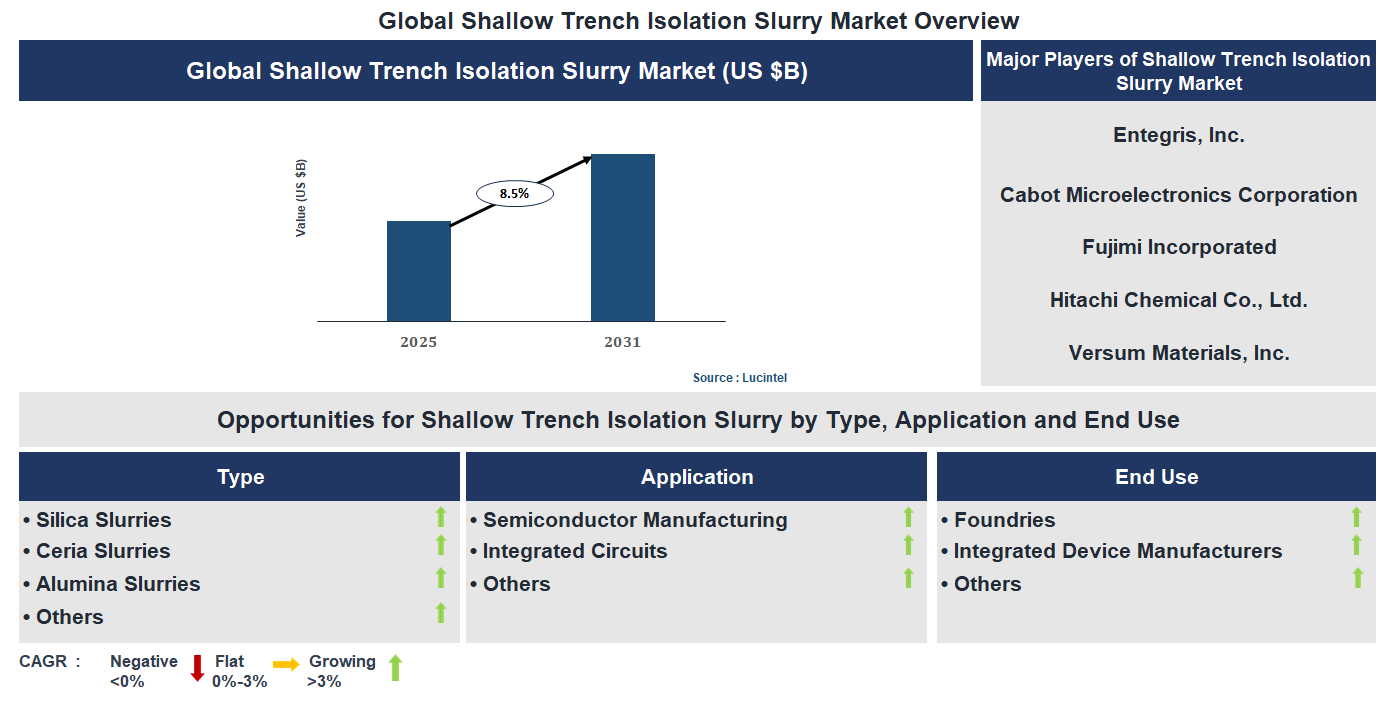
Key data points: The growth forecast = 8.5% annually for the next 6 years. Scroll below to get more insights. This market report covers trends, opportunities and forecasts in shallow trench isolation slurry market to 2031 by type (silica slurries, ceria slurries, alumina slurries, and others), application (semiconductor manufacturing, integrated circuits, and others), end use (foundries, integrated device manufacturers, and others), and region (North America, Europe, Asia Pacific, and the Rest of the World)
We'll send your sample report shortly.
• Lucintel forecasts that, within the type category, silica slurry is expected to witness the highest growth over the forecast period.
• Within the application category, semiconductor manufacturing is expected to witness higher growth.
• In terms of region, APAC is expected to witness the highest growth over the forecast period. Gain valuable insights for your business decisions with our comprehensive 150+ page report. Sample figures with some insights are shown below.
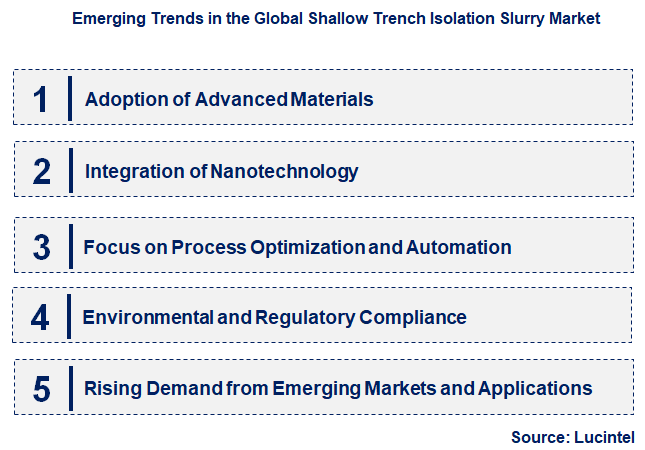
• Adoption of Advanced Materials: The market is shifting towards novel, high-performance slurry materials that offer better etch selectivity, reduced defectivity, and improved compatibility with smaller geometries. These materials enable more precise trench isolation, essential for next-generation chips, and help manufacturers meet stringent quality standards. The focus on eco-friendly and low-toxicity formulations is also gaining momentum, aligning with environmental regulations and sustainability goals.
• Integration of Nanotechnology: Nanotechnology is playing a pivotal role in enhancing slurry properties, such as improving uniformity, reducing particle size, and increasing stability. These advancements lead to more consistent trench filling, minimized voids, and enhanced electrical performance. The integration of nanomaterials also allows for tailored chemical interactions, resulting in more efficient removal of residues and better overall process control, which is critical for advanced semiconductor nodes.
• Focus on Process Optimization and Automation: The industry is increasingly adopting automation and process control technologies to improve yield, reduce variability, and lower costs. Real-time monitoring, AI-driven process adjustments, and precision dosing are becoming standard practices. These innovations help manufacturers achieve higher throughput, consistent quality, and faster time-to-market, especially important as device geometries shrink and process complexity increases.
• Environmental and Regulatory Compliance: Growing environmental concerns and stricter regulations are prompting the market to develop greener slurry formulations with reduced hazardous chemicals and waste. Companies are investing in sustainable manufacturing practices, recycling strategies, and eco-friendly materials to meet compliance standards. This trend not only minimizes environmental impact but also enhances brand reputation and aligns with global sustainability initiatives.
• Rising Demand from Emerging Markets and Applications: The expansion of semiconductor manufacturing in emerging markets and the growth of applications such as IoT, AI, and 5G are driving increased demand for STI slurries. These markets require high-performance, cost-effective solutions capable of supporting high-volume production. The diversification of end-use sectors is encouraging innovation and competition within the shallow trench isolation slurry market, fostering a dynamic environment for new product development. In summary, these emerging trends are fundamentally reshaping the shallow trench isolation slurry market by promoting technological innovation, sustainability, and process efficiency. They are enabling semiconductor manufacturers to meet the demands of increasingly complex devices, reduce environmental impact, and capitalize on new growth opportunities, thereby driving the market toward a more advanced and sustainable future.
• Technological Innovations in Slurry Formulations: The development of advanced STI slurries with enhanced chemical stability and etch selectivity is improving process precision. These innovations enable finer trench dimensions and reduce defect rates, leading to higher yields. Companies are focusing on environmentally friendly components to meet regulatory standards. This progress is expanding the application scope of STI slurries, making them suitable for next-generation semiconductor nodes. Overall, these innovations are driving efficiency and sustainability in semiconductor manufacturing.
• Adoption of Eco-Friendly and Low-Phosphorus Slurries: The industry is shifting towards environmentally sustainable slurry formulations with reduced phosphorus content. These eco-friendly slurries minimize hazardous waste and lower environmental impact, aligning with global sustainability goals. They also improve process safety and reduce disposal costs. As regulations tighten, manufacturers adopting green slurries gain competitive advantages. This shift is fostering innovation in slurry chemistry and expanding market opportunities for sustainable solutions, ultimately contributing to a greener semiconductor industry.
• Integration of Automation and Advanced Monitoring: Automation in slurry mixing, application, and monitoring is enhancing process control and consistency. Real-time sensors and AI-driven analytics enable precise adjustments, reducing defects and increasing throughput. This integration minimizes human error and improves yield rates, making manufacturing more cost-effective. The adoption of automation tools is accelerating, especially in high-volume fabs, and is expected to revolutionize STI slurry handling. These advancements are crucial for meeting the demands of advanced semiconductor nodes with complex geometries.
• Rising Demand from the Asia-Pacific Region: The Asia-Pacific region is witnessing significant growth due to expanding semiconductor manufacturing capacities and technological investments. Countries like China, South Korea, and Taiwan are adopting advanced STI slurry solutions to support their chip fabrication needs. This regional demand is driving market expansion, innovation, and local manufacturing. The growth also attracts global suppliers to establish regional R&D centers, fostering collaboration and technological transfer. Overall, this regional surge is a major growth driver for the global shallow trench isolation slurry market.
• Development of Cost-Effective and High-Performance Slurries: Market players are focusing on creating cost-efficient slurries that do not compromise performance. These formulations reduce material costs and process time, improving overall profitability for manufacturers. High-performance slurries enable finer trench etching and better defect control, essential for advanced nodes. The push for affordability combined with quality is expanding the market reach, especially for smaller semiconductor firms. This development ensures that cutting-edge STI solutions are accessible across various segments, fueling industry growth and technological progress. The overall impact of these developments is a more efficient, sustainable, and technologically advanced shallow trench isolation slurry market. These innovations are enabling semiconductor manufacturers to produce smaller, faster, and more reliable devices, thereby strengthening the global electronics supply chain and fostering continued industry growth.
• Innovation in High-Performance STI Slurries to Enhance Device Reliability: Developing advanced STI slurries that improve etch selectivity, reduce defectivity, and enhance the overall reliability of semiconductor devices is a key growth opportunity. These innovative solutions enable manufacturers to achieve finer geometries and better isolation, supporting the trend toward smaller, more powerful chips. Continuous R&D efforts are crucial to meet the stringent requirements of next-generation semiconductor nodes, fostering market expansion.
• Adoption of Environmentally Friendly and Sustainable Slurry Solutions: The industry is shifting toward eco-friendly STI slurries that minimize hazardous waste and reduce environmental impact. Developing biodegradable, low-toxicity, and energy-efficient slurry formulations aligns with global sustainability goals. This shift not only addresses regulatory pressures but also appeals to environmentally conscious customers, opening new market segments and driving growth through sustainable innovation.
• Integration of Advanced Materials and Nanotechnology in Slurry Formulations: Incorporating nanomaterials and novel compounds into STI slurries enhances their performance, such as improved etch control and defect reduction. Nanotechnology enables precise material removal and better process control, which is vital for advanced semiconductor nodes. This opportunity fosters competitive differentiation and supports the development of next-generation manufacturing processes.
• Expansion into Emerging Markets and Developing Economies: As semiconductor manufacturing infrastructure expands globally, emerging markets present significant growth potential for STI slurry suppliers. Localized production, tailored formulations, and strategic partnerships can facilitate market entry. Growing demand for consumer electronics and automotive chips in these regions further accelerates adoption, making emerging markets a vital avenue for market expansion and revenue growth.
• Collaboration with Semiconductor OEMs and Equipment Manufacturers: Strategic alliances with device manufacturers and equipment suppliers can accelerate innovation and adoption of new STI slurry technologies. Co-development initiatives enable tailored solutions that meet specific process requirements, reducing time-to-market. Such collaborations foster trust, enhance technological capabilities, and position companies as leaders in the evolving semiconductor fabrication ecosystem. The overall market outlook is positively influenced by these growth opportunities, promising increased innovation, sustainability, and global expansion. Companies that strategically leverage these avenues will strengthen their market position, meet the rising demands of advanced semiconductor manufacturing, and contribute to the ongoing evolution of the STI slurry landscape.
• Technological Advancements: The continuous evolution of semiconductor fabrication technology necessitates high-performance STI slurries. Innovations in slurry chemistry improve etch selectivity, reduce defectivity, and enable smaller device geometries, which are critical for advanced nodes. These technological improvements facilitate the development of more reliable and efficient isolation processes, thereby expanding market opportunities. As device miniaturization accelerates, the demand for sophisticated STI slurries that meet stringent specifications increases, fueling market growth.
• Increasing Semiconductor Production: The surge in demand for consumer electronics, data centers, and automotive electronics has led to increased semiconductor manufacturing activities worldwide. This growth directly boosts the need for effective isolation techniques like STI, which are essential for device performance and reliability. As production scales up, the requirement for high-quality STI slurries also rises, driving market expansion. The expanding semiconductor industry acts as a primary catalyst for the shallow trench isolation slurry market.
• Rising Focus on Miniaturization: The push towards smaller, more powerful electronic devices demands advanced fabrication techniques capable of supporting device miniaturization. STI slurries play a vital role in achieving the necessary isolation with minimal feature sizes. This trend compels manufacturers to develop and adopt specialized slurries that can handle finer trenches and complex geometries, thereby propelling market growth. The miniaturization trend ensures sustained demand for innovative STI slurry solutions.
• Regulatory and Environmental Standards: Increasing regulatory scrutiny concerning environmental safety, waste disposal, and chemical usage influences the market. Manufacturers are compelled to develop eco-friendly and less hazardous slurry formulations to comply with stringent standards. This regulatory environment encourages innovation in slurry chemistry and process optimization, which can both challenge and drive market growth. Companies investing in sustainable solutions are better positioned to capitalize on emerging opportunities. The challenges facing this shallow trench isolation slurry market include:
• Stringent Environmental Regulations: The implementation of strict environmental policies regarding chemical waste disposal and emissions poses significant hurdles. Manufacturers must invest in eco-friendly slurry formulations and waste management systems, which can increase production costs and complicate compliance. Failure to meet these standards may result in penalties or market restrictions, impacting profitability and growth prospects.
• Technological Complexity: Developing STI slurries that meet the demanding specifications of advanced semiconductor nodes involves complex chemistry and process control. Achieving consistent performance across different manufacturing setups is challenging, requiring significant R&D investment. This complexity can slow down innovation cycles and increase time-to-market for new slurry formulations, hindering overall market growth.
• Supply Chain Disruptions: The global supply chain for raw materials used in slurry production is vulnerable to disruptions caused by geopolitical tensions, pandemics, or logistical issues. Such disruptions can lead to shortages, increased costs, and delays in product delivery. These factors adversely affect manufacturers' ability to meet customer demands and can dampen market expansion efforts. In summary, the shallow trench isolation slurry market is driven by technological innovations, increasing semiconductor production, and miniaturization trends, which collectively foster growth. However, regulatory pressures, technological complexities, and supply chain issues present notable challenges. The interplay of these factors shapes the market's trajectory, requiring stakeholders to innovate continuously and adapt to evolving standards. Overall, the market's future depends on balancing technological progress with sustainable and resilient practices to sustain growth amid challenges.
• Entegris, Inc.
• Cabot Microelectronics Corporation
• Fujimi Incorporated
• Hitachi Chemical Co., Ltd.
• Versum Materials, Inc.
• Dow Chemical Company
• BASF SE
• Saint-Gobain Ceramics & Plastics, Inc.
• JSR Corporation
• Ebara Corporation
• Silica Slurries
• Ceria Slurries
• Alumina Slurries
• Others
• Semiconductor Manufacturing
• Integrated Circuits
• Others
• Foundries
• Integrated Device Manufacturers
• Others
• North America
• Europe
• Asia Pacific
• The Rest of the World
• United States: The US market is witnessing increased R&D investments in STI slurry formulations to support the growth of advanced logic and memory chips. Leading semiconductor companies are collaborating with material suppliers to develop eco-friendly and high-performance slurries. The adoption of automation and AI-driven manufacturing processes is also enhancing production efficiency and quality control. Government initiatives aimed at strengthening domestic semiconductor manufacturing are further fueling market growth.
• China: China is rapidly expanding its semiconductor manufacturing capacity, with a focus on developing indigenous STI slurry solutions to reduce reliance on imports. Major investments are being made in research institutes and local suppliers to innovate high-purity, cost-effective slurries. The government’s "Made in China 2025" initiative is encouraging domestic companies to advance their technological capabilities, resulting in increased product development and regional market expansion.
• Germany: Germany's market is characterized by a focus on high-precision STI slurry formulations tailored for advanced European semiconductor fabs. The emphasis on sustainability and environmental regulations is driving the development of eco-friendly slurry products. German companies are also investing in process optimization and quality assurance to meet stringent industry standards, supporting the region’s reputation for high-quality semiconductor manufacturing.
• India: India is emerging as a key player in the shallow trench isolation slurry market, driven by government policies promoting semiconductor manufacturing and electronics exports. Local firms are investing in research collaborations to develop innovative slurry formulations suitable for smaller nodes. The increasing demand for consumer electronics and automotive semiconductors is boosting regional market growth, with a focus on cost-effective and reliable solutions.
• Japan: Japan continues to lead in advanced materials and process technologies for STI slurries. The country’s focus on innovation and quality has resulted in the development of high-performance, low-defect slurries for cutting-edge semiconductor nodes. Japanese firms are also exploring sustainable materials and environmentally friendly processes, aligning with global trends toward greener manufacturing practices. The strong presence of multinational corporations further supports Japan’s leadership in this market segment.


• Entegris, Inc.
• Cabot Microelectronics Corporation
• Fujimi Incorporated
• Hitachi Chemical Co., Ltd.
• Versum Materials, Inc.
• Dow Chemical Company
• BASF SE
• Saint-Gobain Ceramics & Plastics, Inc.
• JSR Corporation
• Ebara Corporation Q5. Which shallow trench isolation slurry market segment will be the largest in future? Answer: Lucintel forecasts that, within the type category, silica slurry is expected to witness the highest growth over the forecast period. Q6. In shallow trench isolation slurry market, which region is expected to be the largest in next 5 years? Answer: In terms of region, APAC is expected to witness the highest growth over the forecast period. Q7. Do we receive customization in this report? Answer: Yes, Lucintel provides 10% customization without any additional cost.


Choose a license that fits your team. Instant PDF delivery.
Prices exclude taxes. Instant delivery. Custom licensing available on request.
Market Report · July 22, 2026
Market Report · July 22, 2026
Market Report · July 22, 2026
Trusted partner for strategic intelligence and business growth


Receive a complimentary market analysis tailored to your industry. Our analysts will identify key growth opportunities and competitive dynamics specific to your business.

Market size, growth rate, and key trend analysis for your specific sector.

Top competitor positioning and market share analysis.

Strategic recommendations backed by data-driven insights.
Get curated market intelligence and competitive moves straight to your inbox.
By subscribing, you agree to receive our monthly insights. Unsubscribe anytime.
Receive a complimentary market analysis tailored to your industry. Our analysts will identify key growth opportunities and competitive dynamics specific to your business.
Market size, growth rate, and key trend analysis for your specific sector.
Top competitor positioning and market share analysis.
Strategic recommendations backed by data-driven insights.
Get curated market intelligence, emerging trends, and competitive moves straight to your inbox each month.
By subscribing, you agree to receive our monthly insights. Unsubscribe anytime.
We'll send your sample report shortly.