
Report Feature
Semiconductor Wafer Cleaning Market Trends and Forecast
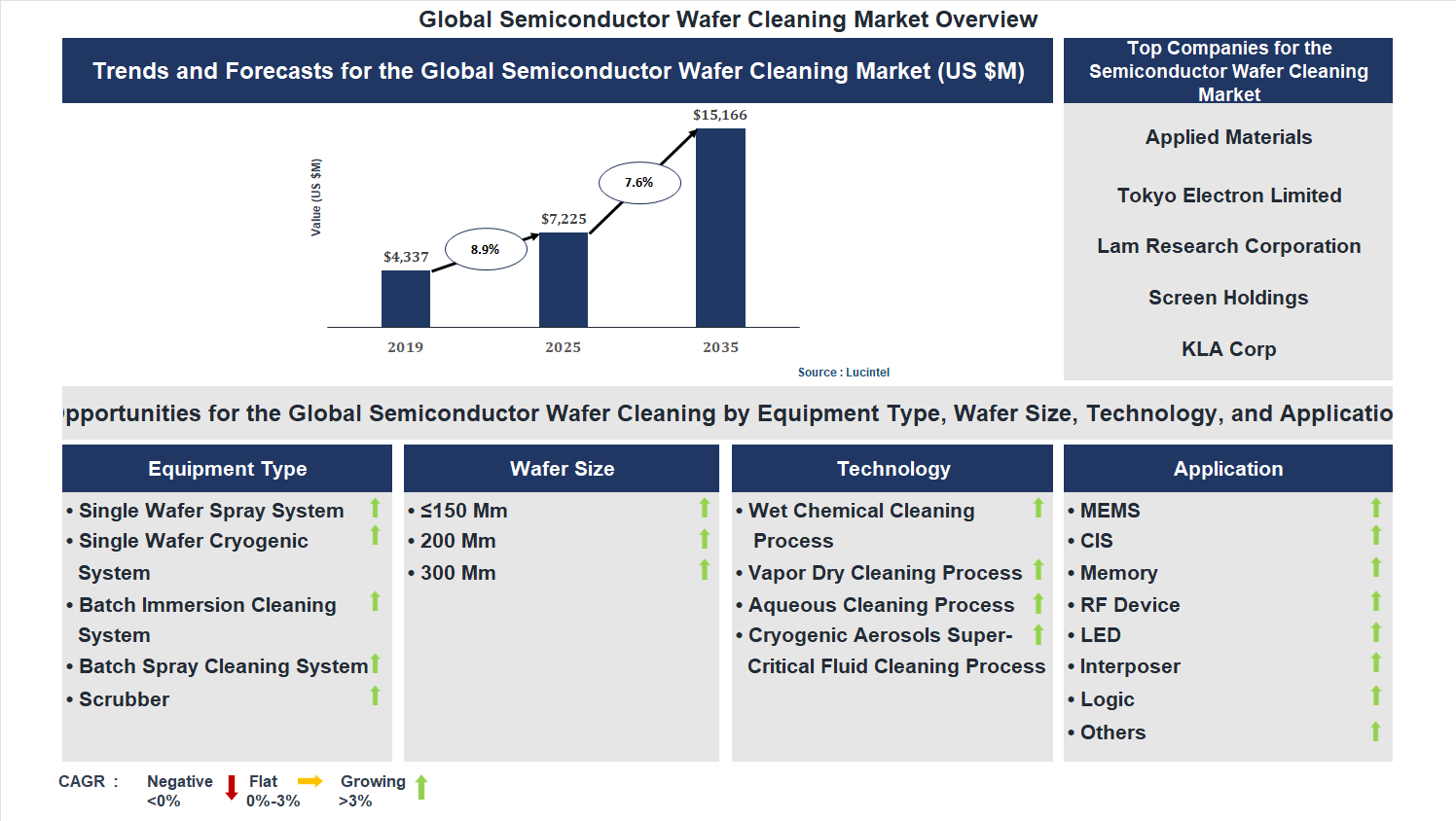
The future of the global semiconductor wafer cleaning market looks promising with opportunities in the MEMS, CIS, memory, RF device, LED, interposer, and logic markets. The global semiconductor wafer cleaning market is expected to reach an estimated $15166 million by 2035 with a CAGR of 7.6% from 2026 to 2035. The major drivers for this market are the increasing adoption of ai & high performance computing chips, the growing demand for consumer electronics & automotive sectors, and the rising demand for investments in semiconductor manufacturing facilities.• Lucintel forecasts that, within the equipment type category, single wafer spray system is expected to witness the highest growth over the forecast period.
• Within the application category, memory is expected to witness the highest growth.
• In terms of region, APAC is expected to witness the highest growth over the forecast period. Gain valuable insights for your business decisions with our comprehensive 150+ page report. Sample figures with some insights are shown below.
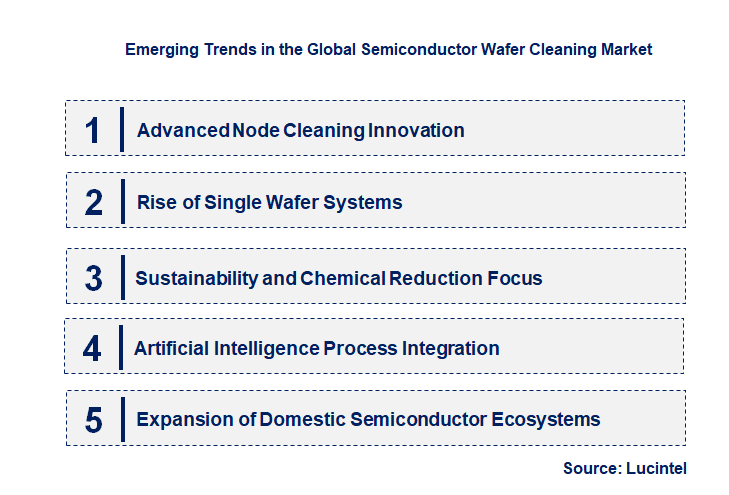
Emerging Trends in the Semiconductor Wafer Cleaning Market
The semiconductor wafer cleaning market is undergoing significant transformation driven by rapid scaling of semiconductor technologies, increasing demand for high-performance computing chips, and the expansion of advanced fabrication facilities worldwide. As chip geometries shrink and production complexity increases, wafer cleaning has become one of the most critical steps in semiconductor manufacturing, directly influencing yield, performance, and reliability. The emergence of AI, 5G, electric vehicles, and IoT devices is further intensifying the need for ultra-clean wafer surfaces and defect-free processing. At the same time, geopolitical shifts and national semiconductor strategies are accelerating investment in domestic manufacturing ecosystems. These combined forces are shaping new technological and operational trends across the global wafer cleaning market.• Advanced Node Cleaning Innovation: Advanced Node Cleaning Innovation : The shift toward sub-7nm, 5nm, and emerging 3nm semiconductor nodes is driving major innovation in wafer cleaning technologies. As transistor densities increase, even atomic-level contamination can affect chip performance, making ultra-precise cleaning essential. Manufacturers are developing next-generation single-wafer cleaning systems, advanced mega sonic cleaning, and plasma-based dry cleaning techniques to minimize particle contamination without damaging delicate structures. These innovations are improving yield rates and enabling more reliable production of AI processors, high-performance computing chips, and advanced mobile semiconductors. The trend is also pushing equipment makers to integrate real-time monitoring and AI-based process control to ensure higher precision and consistency in cleaning performance.
• Rise of Single Wafer Systems: Rise Of Single Wafer Systems : The industry is increasingly shifting from batch cleaning processes to single-wafer cleaning systems due to higher precision requirements and process control advantages. Single-wafer tools allow manufacturers to clean each wafer individually, reducing contamination risks and improving uniformity across advanced nodes. This trend is especially important for EUV lithography processes where defect control is extremely critical. Equipment providers are focusing on improving throughput and reducing chemical consumption in single-wafer systems. Additionally, integration of automation and robotics is enhancing efficiency in wafer handling. This transition is significantly improving yield optimization and is becoming a standard requirement in advanced semiconductor fabs worldwide.
• Sustainability and Chemical Reduction Focus: Sustainability And Chemical Reduction Focus : Environmental sustainability is becoming a key trend in the wafer cleaning market, with manufacturers focusing on reducing chemical usage, wastewater generation, and energy consumption. Semiconductor fabs are adopting eco-friendly cleaning chemistries and closed-loop recycling systems to minimize environmental impact. Equipment makers are designing low-consumption cleaning systems that use less ultra-pure water while maintaining high cleaning efficiency. Regulatory pressures, especially in regions like Europe and parts of Asia, are accelerating this shift. Sustainability-driven innovation is also improving operational cost efficiency for fabs. As a result, green manufacturing practices are becoming a competitive differentiator in semiconductor wafer cleaning technologies.
• Artificial Intelligence Process Integration: Artificial Intelligence Process Integration : The integration of artificial intelligence and machine learning into wafer cleaning processes is emerging as a major trend. AI-driven systems are being used to monitor contamination levels, optimize cleaning cycles, and predict equipment maintenance requirements. This helps improve yield consistency and reduce downtime in high-volume semiconductor manufacturing. Predictive analytics allows fabs to identify process deviations early and adjust cleaning parameters in real time. Equipment manufacturers are embedding smart sensors and data analytics platforms into cleaning systems to enable adaptive process control. This trend is significantly enhancing operational efficiency and enabling more precise control over complex semiconductor manufacturing environments.
• Expansion of Domestic Semiconductor Ecosystems: Expansion Of Domestic Semiconductor Ecosystems : Governments worldwide are heavily investing in domestic semiconductor ecosystems, which is driving localized growth in wafer cleaning equipment demand. Countries such as the United States, China, India, and members of the European Union are promoting local fabrication facilities to reduce dependency on global supply chains. This is leading to increased installation of advanced wafer cleaning systems in new fabs. Local equipment manufacturing capabilities are also being strengthened through partnerships and incentives. The semiconductor wafer cleaning market are collectively reshaping the industry toward higher precision, sustainability, automation, and localization. Technological advancements are enabling ultra-clean processes required for advanced nodes, while AI and single-wafer systems are improving yield and efficiency. At the same time, sustainability initiatives are reducing environmental impact, and geopolitical strategies are encouraging domestic ecosystem development. Together, these trends are creating a more competitive, innovation-driven, and regionally diversified market structure, positioning wafer cleaning as a critical enabler of next-generation semiconductor manufacturing.
Recent Developments in the Semiconductor Wafer Cleaning Market
The semiconductor wafer cleaning market is witnessing strong recent developments driven by rapid advancements in semiconductor manufacturing technologies and increasing global demand for high-performance chips. As devices shrink to advanced nanometer scales, the need for ultra-precise wafer cleaning has become essential to maintain yield and performance. Governments and private companies are heavily investing in new fabrication facilities, while equipment manufacturers are innovating to meet stringent contamination control requirements. The rise of AI, electric vehicles, 5G infrastructure, and advanced computing is further accelerating demand for next-generation wafer cleaning solutions across global semiconductor production ecosystems.• Expansion of Advanced Fabrication Facilities: Expansion Of Advanced Fabrication Facilities : Recent years have seen significant expansion of advanced semiconductor fabrication plants across the United States, China, Europe, and Asia, driving strong demand for wafer cleaning equipment. These new fabs are designed for sub-7nm and 5nm production nodes, requiring extremely precise contamination control. Equipment suppliers are benefiting from increased orders for single-wafer and plasma-based cleaning systems. Government incentives and private investments are accelerating construction timelines, further boosting market growth. This expansion is strengthening the global semiconductor supply chain and increasing competition among equipment manufacturers to deliver high-performance cleaning solutions for next-generation chip production environments.
• Growth in EUV Lithography Adoption: Growth In EUV Lithography Adoption : The increasing adoption of extreme ultraviolet lithography in semiconductor manufacturing is creating strong demand for advanced wafer cleaning technologies. EUV processes are highly sensitive to particle contamination, making ultra-clean wafer surfaces essential. Recent developments include improved dry cleaning and mega sonic cleaning systems designed to support EUV-compatible processes. Equipment manufacturers are integrating advanced filtration and real-time monitoring technologies to enhance precision. This trend is particularly strong in leading-edge fabs producing AI and high-performance computing chips. As EUV adoption expands globally, wafer cleaning systems are becoming more sophisticated and tightly integrated with lithography workflows.
• Rising Demand for AI Chip Production: Rising Demand For AI Chip Production : The rapid growth of artificial intelligence applications has significantly increased demand for high-performance semiconductor chips, directly impacting wafer cleaning requirements. AI chips require extremely complex architectures, where even minor contamination can affect performance and reliability. Recent developments include enhanced single-wafer cleaning systems optimized for advanced logic and memory chips used in AI accelerators. Manufacturers are also integrating AI-driven process control into cleaning systems to improve accuracy and yield. This surge in AI chip production is pushing fabs to adopt more advanced cleaning technologies, ensuring defect-free wafers and supporting high-volume manufacturing efficiency.
• Development of Domestic Semiconductor Ecosystems: Development Of Domestic Semiconductor Ecosystems : Countries such as the United States, China, India, and members of the European Union are heavily investing in domestic semiconductor ecosystems. Recent developments include government-backed programs, subsidies, and strategic partnerships aimed at reducing reliance on foreign chip supply chains. This has led to increased establishment of local wafer fabrication plants, directly boosting demand for wafer cleaning equipment. Equipment suppliers are forming collaborations with regional manufacturers to expand market presence. These developments are reshaping global supply chains, encouraging technology localization, and increasing competition in wafer cleaning technology development across multiple regions worldwide.
• Advancements in Sustainable Cleaning Technologies: Advancements In Sustainable Cleaning Technologies : Sustainability has become a major focus in semiconductor wafer cleaning, leading to recent innovations in eco-friendly processes. Manufacturers are developing low-chemical, water-efficient, and energy-saving cleaning systems to meet environmental regulations and reduce operational costs. Recent advancements include closed-loop chemical recycling systems and reduced ultra-pure water consumption technologies. Equipment providers are also designing systems that minimize waste generation while maintaining high cleaning efficiency. These improvements are being widely adopted in new fabs, especially in regions with strict environmental standards. This shift toward sustainability is enhancing operational efficiency and supporting long-term environmental goals in semiconductor manufacturing. These recent developments are significantly transforming the semiconductor wafer cleaning market by driving technological advancement, increasing production efficiency, and enabling support for next-generation chip manufacturing. Expansion of advanced fabs and EUV adoption are strengthening demand for highly precise cleaning systems, while AI chip growth is accelerating innovation in process control. At the same time, domestic semiconductor ecosystem development is reshaping global supply chains, and sustainability-focused innovations are improving environmental performance. Collectively, these developments are creating a more competitive, technology-driven, and regionally diversified wafer cleaning market with strong long-term growth potential.
Strategic Growth Opportunities in the Semiconductor Wafer Cleaning Market
The semiconductor wafer cleaning market is expanding steadily as advanced semiconductor applications continue to grow across industries such as artificial intelligence, automotive electronics, telecommunications, and consumer devices. Wafer cleaning plays a critical role in ensuring defect-free chip production, especially as semiconductor nodes continue to shrink and process complexity increases. Rising investments in fabrication facilities, government-backed semiconductor initiatives, and increasing demand for high-performance chips are collectively creating strong opportunities across key applications. As a result, wafer cleaning technologies are becoming more advanced, precise, and essential for maintaining yield and reliability in next-generation semiconductor manufacturing environments.• Advanced Logic Chip Manufacturing Drives Growth Opportunity: Advanced Logic Chip Manufacturing Drives Growth Opportunity : Advanced logic chip manufacturing represents a major growth opportunity for wafer cleaning systems due to increasing demand for high-performance processors used in AI, data centers, and advanced computing. As logic chips move toward sub-5nm and beyond, contamination control becomes extremely critical. Wafer cleaning technologies such as single-wafer and plasma-based systems are being widely adopted to ensure defect-free production. Equipment manufacturers are focusing on improving precision, throughput, and automation. This application is driving continuous innovation in cleaning chemistries and process control technologies, enabling semiconductor fabs to achieve higher yields and improved operational efficiency in advanced node production environments.
• Memory Chip Production Expansion Creates Strong Demand: Memory Chip Production Expansion Creates Strong Demand : The expansion of DRAM and NAND flash memory production is creating significant demand for advanced wafer cleaning solutions. Memory chips require extremely uniform and contamination-free surfaces to ensure data integrity and performance stability. Recent investments in new memory fabs, particularly in Asia, are driving adoption of high-throughput wet and dry cleaning systems. Manufacturers are also integrating advanced defect detection technologies into cleaning processes to improve yield. As memory densities increase, wafer cleaning becomes more critical, making it a key enabler for next-generation storage solutions used in smartphones, servers, and cloud computing infrastructure worldwide.
• Power Semiconductor Applications Accelerate Adoption: Power Semiconductor Applications Accelerate Adoption : The growing use of power semiconductors in electric vehicles, renewable energy systems, and industrial automation is driving increased demand for wafer cleaning technologies. Power devices such as IGBTs and MOSFETs require high reliability and defect-free surfaces to handle high voltage and current conditions. Recent developments include specialized cleaning processes designed for wide-bandgap materials like silicon carbide and gallium nitride. These materials require unique cleaning chemistries and precision handling. Equipment manufacturers are developing tailored solutions to improve surface quality and reduce contamination, supporting the rapid expansion of power electronics applications in global energy transition and mobility sectors.
• Advanced Packaging and Heterogeneous Integration Growth: Advanced Packaging And Heterogeneous Integration Growth : Advanced packaging technologies, including 3D ICs and chaplet-based architectures, are creating new growth opportunities for wafer cleaning systems. These packaging methods require ultra-clean wafer surfaces to ensure proper bonding, alignment, and interconnect reliability. Recent developments include precision cleaning systems designed for backside wafer processing and through-silicon vias. As heterogeneous integration becomes more common in AI and high-performance computing applications, demand for advanced cleaning solutions is increasing. Equipment suppliers are focusing on improving contamination control at multiple stages of packaging, enabling higher yield and better performance in complex semiconductor device architectures.
• Photonics and Sensor Device Expansion Drives Demand: Photonics And Sensor Device Expansion Drives Demand : The expansion of photonics and sensor device manufacturing is creating strong opportunities for wafer cleaning technologies. Applications such as autonomous vehicles, medical imaging, and optical communication require highly sensitive and precision-engineered semiconductor components. Wafer cleaning plays a crucial role in ensuring optical clarity and performance reliability. Recent developments include specialized cleaning processes for compound semiconductors used in photonics devices. Manufacturers are investing in advanced cleaning tools that minimize surface defects and improve device performance. As demand for sensing and optical technologies continues to rise, wafer cleaning systems are becoming increasingly important for enabling high-quality production. These strategic growth opportunities across key semiconductor applications are significantly strengthening the wafer cleaning market by expanding its role in advanced chip manufacturing. Growth in logic and memory chips, along with rising adoption in power electronics, advanced packaging, and photonics, is driving continuous innovation in cleaning technologies. As semiconductor devices become more complex and performance-driven, wafer cleaning is emerging as a critical enabler of yield improvement and reliability. Collectively, these opportunities are fostering technological advancement, increasing equipment demand, and supporting long-term market expansion across global semiconductor manufacturing ecosystems.
Semiconductor Wafer Cleaning Market Driver and Challenges
The semiconductor wafer cleaning market is shaped by a combination of technological advancements, economic investments, and regulatory influences across global semiconductor manufacturing ecosystems. As chip designs become more complex and node sizes continue to shrink, wafer cleaning has emerged as a critical process ensuring defect-free production and high yield rates. Economic factors such as rising demand for advanced electronics and government-backed semiconductor programs are accelerating market expansion. At the same time, regulatory pressures related to environmental sustainability and chemical usage are influencing equipment design. Together, these technological, economic, and regulatory factors are defining the competitive landscape and driving innovation in wafer cleaning solutions worldwide. The factors responsible for driving the semiconductor wafer cleaning market include:-• Increasing Demand for Advanced Semiconductor Devices: Increasing Demand For Advanced Semiconductor Devices: The rapid growth in demand for advanced semiconductor devices used in artificial intelligence, 5G infrastructure, automotive electronics, and high-performance computing is a major driver of the wafer cleaning market. As semiconductor architectures become more complex, even microscopic contamination can severely impact performance and yield. This has led to increased reliance on highly precise wafer cleaning systems, including single-wafer and plasma-based technologies. Manufacturers are investing heavily in advanced cleaning solutions to support sub-7nm and emerging 3nm nodes. This demand surge is pushing innovation in process control, automation, and contamination detection, strengthening the role of wafer cleaning in semiconductor manufacturing.
• Expansion of Semiconductor Fabrication Facilities: Expansion Of Semiconductor Fabrication Facilities: The global expansion of semiconductor fabrication plants is significantly driving the wafer cleaning market. Governments and private companies are investing in new fabs across the United States, China, Europe, and Asia to strengthen supply chain resilience and reduce dependency on imports. These new facilities require advanced wafer cleaning equipment to maintain high production yield and quality standards. The adoption of cutting-edge manufacturing technologies, including EUV lithography, further increases the need for ultra-clean wafer surfaces. As fab construction accelerates, equipment suppliers are experiencing growing demand for high-precision cleaning systems, making fabrication expansion a key growth engine for the market.
• Advancements in Semiconductor Manufacturing Technologies: Advancements In Semiconductor Manufacturing Technologies: Continuous innovation in semiconductor manufacturing technologies is driving the need for more sophisticated wafer cleaning solutions. As processes evolve toward smaller nodes and 3D architectures, contamination control becomes increasingly challenging. Advanced techniques such as mega sonic cleaning, dry plasma cleaning, and chemical-free cleaning systems are being developed to address these challenges. Integration of automation, robotics, and AI-based monitoring systems is improving process accuracy and efficiency. These technological advancements are enabling fabs to achieve higher yield rates and better device performance. As a result, wafer cleaning technologies are evolving rapidly to match the complexity of modern semiconductor production processes.
• Rising Investments in Semiconductor Industry: Rising Investments In Semiconductor Industry: Significant investments from governments and private enterprises are fueling growth in the semiconductor wafer cleaning market. Initiatives such as national semiconductor missions and subsidy programs are encouraging the establishment of new fabrication facilities and strengthening domestic semiconductor ecosystems. These investments are particularly strong in regions such as the United States, China, India, and Europe. Increased funding is also supporting research and development of next-generation wafer cleaning technologies. As investment levels rise, equipment manufacturers are benefiting from higher demand for advanced cleaning systems, which is accelerating innovation and expanding the global market footprint. The challenges facing this semiconductor wafer cleaning market include:
• High Cost of Advanced Cleaning Equipment: High Cost Of Advanced Cleaning Equipment: One of the major challenges in the wafer cleaning market is the high cost associated with advanced cleaning systems. Technologies such as single-wafer and plasma-based cleaning equipment require significant capital investment, making them less accessible for smaller semiconductor manufacturers. Additionally, maintenance and operational costs are also high due to the need for ultra-pure chemicals and specialized consumables. These cost barriers can slow down adoption, especially in emerging markets. While large semiconductor fabs can absorb these expenses, smaller players may face financial constraints, limiting widespread deployment of advanced wafer cleaning technologies across the industry.
• Complexity in Process Integration: Complexity In Process Integration: Integrating wafer cleaning processes into highly advanced semiconductor manufacturing workflows is becoming increasingly complex. As chip designs evolve toward multi-layered and 3D architectures, ensuring compatibility between cleaning systems and other fabrication steps is challenging. Even minor process deviations can lead to yield loss or device failure. Manufacturers must continuously fine-tune cleaning parameters to match specific materials and process conditions. This complexity increases development time and operational difficulty for semiconductor fabs. Equipment suppliers must invest heavily in customization and process optimization, making integration a significant technical challenge for the industry.
• Environmental and Regulatory Compliance Pressure: Environmental And Regulatory Compliance Pressure: The semiconductor wafer cleaning market faces growing pressure from environmental regulations related to chemical usage, wastewater disposal, and energy consumption. Governments in regions such as Europe and Asia are enforcing stricter sustainability standards, requiring fabs to adopt eco-friendly cleaning processes. Compliance with these regulations often increases operational complexity and costs. Manufacturers must invest in sustainable technologies such as chemical recycling systems and low-water consumption cleaning methods. While these solutions improve environmental performance, they also require significant technological upgrades. This regulatory pressure is forcing companies to balance performance efficiency with sustainability requirements, creating a key challenge for market participants. The semiconductor wafer cleaning market is strongly influenced by a combination of powerful growth drivers and significant operational challenges. Rising demand for advanced semiconductor devices, rapid expansion of fabrication facilities, and continuous technological innovation are driving strong market growth. At the same time, increasing investments are accelerating the adoption of advanced cleaning systems across global semiconductor ecosystems. However, high equipment costs, integration complexity, and stringent environmental regulations are limiting factors that must be addressed. Overall, these drivers and challenges are collectively shaping a highly dynamic, innovation-driven, and competitive market landscape with strong long-term growth potential.
List of Semiconductor Wafer Cleaning Companies
Companies in the market compete on the basis of product quality offered. Major players in this market focus on expanding their manufacturing facilities, R&D investments, infrastructural development, and leverage integration opportunities across the value chain. With these strategies semiconductor wafer cleaning companies cater increasing demand, ensure competitive effectiveness, develop innovative products & technologies, reduce production costs, and expand their customer base. Some of the semiconductor wafer cleaning companies profiled in this report include-• Applied Materials
• Tokyo Electron Limited
• Lam Research Corporation
• Screen Holdings
• KLA Corp
Semiconductor Wafer Cleaning Market by Segment
The study includes a forecast for the global semiconductor wafer cleaning market by equipment type, wafer size, technology, application, and region.Semiconductor Wafer Cleaning Market by Equipment Type [Value from 2019 to 2035]:
• Single Wafer Spray System
• Single Wafer Cryogenic System
• Batch Immersion Cleaning System
• Batch Spray Cleaning System
• Scrubber
Semiconductor Wafer Cleaning Market by Wafer Size [Value from 2019 to 2035]:
• ≤150 Mm
• 200 Mm
• 300 Mm
Semiconductor Wafer Cleaning Market by Technology [Value from 2019 to 2035]:
• Wet Chemical Cleaning Process
• Vapor Dry Cleaning Process
• Aqueous Cleaning Process
• Cryogenic Aerosols Super-Critical Fluid Cleaning Process
Semiconductor Wafer Cleaning Market by Application [Value from 2019 to 2035]:
• MEMS
• CIS
• Memory
• RF Device
• LED
• Interposer
• Logic
• Others
Semiconductor Wafer Cleaning Market by Region [Value from 2019 to 2035]:
• North America
• Europe
• Asia Pacific
• The Rest of the World
Country Wise Outlook for the Semiconductor Wafer Cleaning Market
The semiconductor wafer cleaning market is experiencing rapid evolution driven by the ongoing miniaturization of semiconductor nodes, rising demand for advanced chips used in AI, 5G, automotive electronics, and high-performance computing, as well as increasing fabrication complexity. Wafer cleaning has become a critical step in semiconductor manufacturing because even microscopic contamination can significantly reduce chip yield and reliability. Across major semiconductor-producing nations, developments are being shaped by national semiconductor self-sufficiency policies, expansion of fabrication facilities, and strong investments in advanced cleaning technologies such as wet, dry, plasma, and hybrid cleaning systems. These trends are also intensifying competition among global equipment manufacturers and encouraging localization of supply chains.• United States: United States, recent developments in the semiconductor wafer cleaning market are strongly influenced by large-scale investments in domestic chip manufacturing under initiatives like the CHIPS-focused industrial expansion. Major players such as Lam Research and Applied Materials are advancing next-generation single-wafer and plasma-based cleaning systems designed for sub-7nm and EUV lithography processes. Growth in AI chip demand and advanced packaging has increased the need for ultra-precise contamination control solutions. Additionally, collaboration between U.S. chipmakers and research institutes is accelerating innovation in dry cleaning and hybrid cleaning technologies. However, geopolitical restrictions on equipment exports to China are also reshaping supply chain strategies and encouraging onshore production capabilities.
• China: China, the wafer cleaning market is expanding rapidly due to strong government-backed semiconductor self-sufficiency programs and massive investment in new fabrication plants. Domestic companies such as NAURA Technology and King semi are increasingly developing competitive cleaning equipment, reducing dependence on foreign suppliers. China’s push for advanced-node and mature-node production has significantly increased demand for high-throughput wet cleaning systems. Recent policy measures encouraging the use of domestically produced semiconductor tools in fabs are accelerating local adoption. At the same time, foreign equipment providers continue to operate in China but face regulatory and geopolitical constraints, which is further strengthening the domestic equipment ecosystem and innovation capabilities.
• Germany: Germany, developments in semiconductor wafer cleaning are closely tied to Europe’s broader semiconductor sovereignty strategy, including initiatives like the European Chips Act. Germany’s strong automotive and industrial electronics sector is driving demand for highly reliable semiconductor components, which in turn increases the need for precision wafer cleaning technologies. Equipment suppliers such as AP&S and other European engineering firms are focusing on advanced wet chemical cleaning systems tailored for specialty semiconductors and power devices. Expansion of semiconductor manufacturing facilities in Germany, supported by global players, is further boosting adoption of contamination-free wafer processing technologies. Sustainability regulations are also pushing innovation in chemical-efficient and environmentally friendly cleaning processes.
• India: India, the semiconductor wafer cleaning market is in an early but rapidly developing stage, supported by the government’s India Semiconductor Mission and large-scale investment approvals for new fabs and packaging units. Recent developments include the establishment of semiconductor manufacturing projects focused on both chip fabrication and advanced packaging, which are expected to generate future demand for wafer cleaning systems. Global equipment suppliers are beginning to engage with Indian projects as the country builds its semiconductor ecosystem. While domestic manufacturing capabilities remain limited, India is focusing on attracting foreign investment and technology partnerships, which will play a key role in introducing advanced cleaning technologies into upcoming fabs.
• Japan: Japan, the semiconductor wafer cleaning market is highly advanced, supported by the country’s strong position in semiconductor equipment manufacturing. Leading companies such as SCREEN Semiconductor Solutions and Tokyo Electron are continuously innovating in single-wafer cleaning systems with higher precision, faster cycle times, and reduced chemical usage. Japan is particularly strong in specialty semiconductors used in automotive, sensors, and industrial applications, which require extremely high cleaning accuracy. Recent developments also include investments in next-generation cleaning technologies compatible with sub-5nm manufacturing and advanced packaging. Japan’s well-established semiconductor ecosystem and strong export orientation continue to make it a global leader in wafer cleaning equipment innovation.

Features of the Global Semiconductor Wafer Cleaning Market
Market Size Estimates: Semiconductor wafer cleaning market size estimation in terms of value ($M). Trend and Forecast Analysis: Market trends (2019 to 2025) and forecast (2026 to 2035) by various segments and regions. Segmentation Analysis: Semiconductor wafer cleaning market size by various segments, such as by equipment type, wafer size, technology, application, and region in terms of value ($M). Regional Analysis: Semiconductor wafer cleaning market breakdown by North America, Europe, Asia Pacific, and Rest of the World. Growth Opportunities: Analysis of growth opportunities in different equipment type, wafer size, technology, application, and regions for the semiconductor wafer cleaning market. Strategic Analysis: This includes M&A, new product development, and competitive landscape of the semiconductor wafer cleaning market. Analysis of competitive intensity of the industry based on Porter’s Five Forces model.
FAQ
Q1. What is the semiconductor wafer cleaning market size? Answer: The global semiconductor wafer cleaning market is expected to reach an estimated $15166 million by 2035. Q2. What is the growth forecast for semiconductor wafer cleaning market? Answer: The global semiconductor wafer cleaning market is expected to grow with a CAGR of 7.6% from 2026 to 2035. Q3. What are the major drivers influencing the growth of the semiconductor wafer cleaning market? Answer: The major drivers for this market are the increasing adoption of ai & high performance computing chips, the growing demand for consumer electronics & automotive sectors, and the rising demand for investments in semiconductor manufacturing facilities. Q4. What are the major segments for semiconductor wafer cleaning market? Answer: The future of the semiconductor wafer cleaning market looks promising with opportunities in the MEMS, CIS, memory, RF device, LED, interposer, and logic markets. Q5. Who are the key semiconductor wafer cleaning market companies? Answer: Some of the key semiconductor wafer cleaning companies are as follows:• Applied Materials
• Tokyo Electron Limited
• Lam Research Corporation
• Screen Holdings
• KLA Corp Q6. Which semiconductor wafer cleaning market segment will be the largest in future? Answer: Lucintel forecasts that, within the equipment type category, single wafer spray system is expected to witness the highest growth over the forecast period. Q7. In semiconductor wafer cleaning market, which region is expected to be the largest in next 8 years? Answer: In terms of region, APAC is expected to witness the highest growth over the forecast period. Q8. Do we receive customization in this report? Answer: Yes, Lucintel provides 10% customization without any additional cost.
Table of Contents
List of Figures
List of Tables
Methodology
- In-depth interviews of the major players in this market
- Detailed secondary research from competitors’ financial statements and published data
- Extensive searches of published works, market, and database information pertaining to industry news, company press releases, and customer intentions
- A compilation of the experiences, judgments, and insights of Lucintel’s professionals, who have analyzed and tracked this market over the years.


Buy Now
Choose a license that fits your team. Instant PDF delivery.
Prices exclude taxes. Instant delivery. Custom licensing available on request.
Key Questions
- • What are some of the most promising, high-growth opportunities for the semiconductor wafer cleaning market by equipment type (single wafer spray system, single wafer cryogenic system, batch immersion cleaning system, batch spray cleaning system, and scrubber), wafer size (≤150 mm, 200 mm, and 300 mm), technology (wet chemical cleaning process, vapor dry cleaning process, aqueous cleaning process, and cryogenic aerosols super-critical fluid cleaning process), application (MEMS, CIS, memory, RF device, LED, interposer, logic, and others), and region (North America, Europe, Asia Pacific, and the Rest of the World)?
- • Which segments will grow at a faster pace and why?
- • Which region will grow at a faster pace and why?
- • What are the key factors affecting market dynamics? What are the key challenges and business risks in this market?
- • What are the business risks and competitive threats in this market?
- • What are the emerging trends in this market and the reasons behind them?
- • What are some of the changing demands of customers in the market?
- • What are the new developments in the market? Which companies are leading these developments?
- • Who are the major players in this market? What strategic initiatives are key players pursuing for business growth?
- • What are some of the competing products in this market and how big of a threat do they pose for loss of market share by material or product substitution?
- • What M&A activity has occurred in the last 5 years and what has its impact been on the industry? For any questions related to Semiconductor Wafer Cleaning Market, Semiconductor Wafer Cleaning Market Size, Semiconductor Wafer Cleaning Market Growth, Semiconductor Wafer Cleaning Market Analysis, Semiconductor Wafer Cleaning Market Report, Semiconductor Wafer Cleaning Market Share, Semiconductor Wafer Cleaning Market Trends, Semiconductor Wafer Cleaning Market Forecast, Semiconductor Wafer Cleaning Companies, write Lucintel analyst at email: helpdesk@lucintel.com. We will be glad to get back to you soon.


