
Report Feature
Semiconductor Tester Market Trends and Forecast
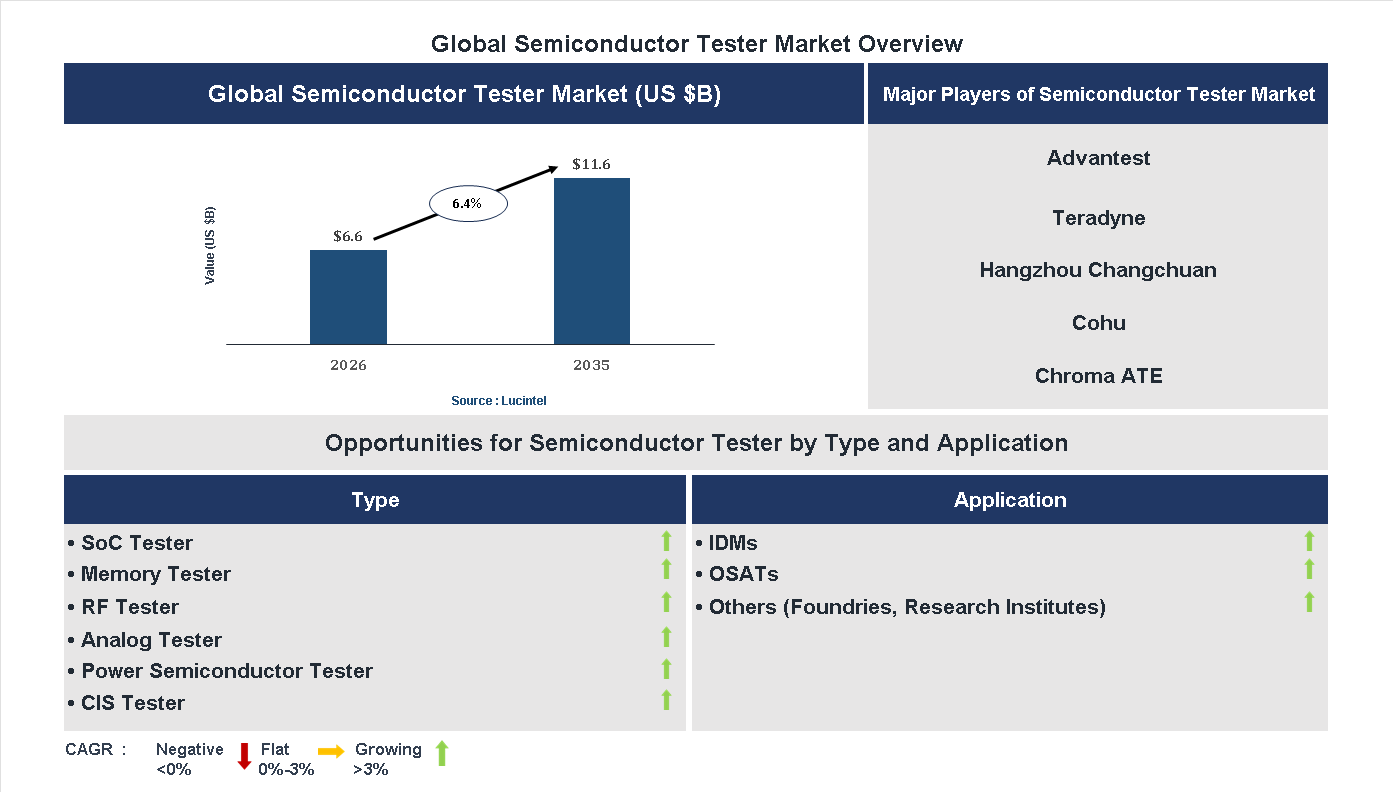
The future of the global semiconductor tester market looks promising with opportunities in the IDM and OSAT markets. The global semiconductor tester market is expected to reach an estimated $11.6 billion by 2035 with a CAGR of 6.4% from 2026 to 2035. The major drivers for this market are the rising demand for advanced semiconductor devices, the growing automotive electronics testing needs, and the increase in government investments in semiconductor fab.• Lucintel forecasts that, within the type category, SoC tester is expected to witness the highest growth over the forecast period.
• Within the application category, OSAT is expected to witness the highest growth.
• In terms of region, APAC is expected to witness the highest growth over the forecast period. Gain valuable insights for your business decisions with our comprehensive 150+ page report. Sample figures with some insights are shown below.
Emerging Trends in the Semiconductor Tester Market
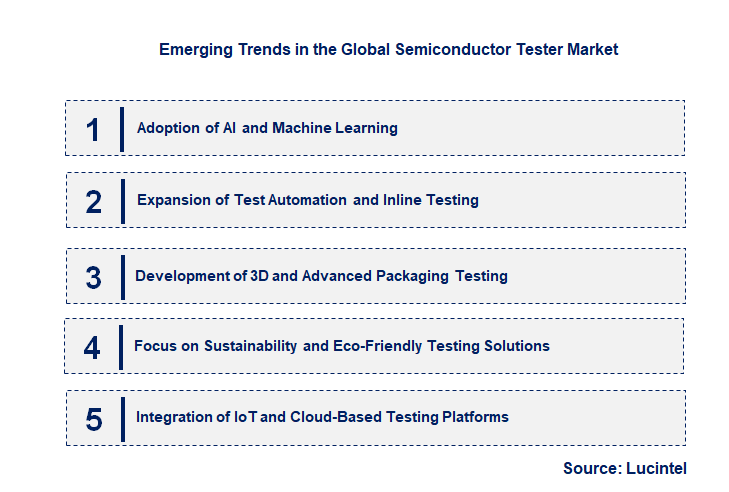
The semiconductor tester market is experiencing rapid evolution driven by technological advancements, increasing demand for electronic devices, and the need for higher testing efficiency. As the industry adapts to these changes, several emerging trends are shaping its future landscape. These trends reflect innovations in testing technologies, integration of AI, and a focus on sustainability, all aimed at enhancing performance, reducing costs, and meeting stringent quality standards. Understanding these key developments is essential for stakeholders to stay competitive and leverage new opportunities in this dynamic market environment.• Adoption of AI and Machine Learning: The integration of AI and machine learning algorithms into semiconductor testing processes is revolutionizing defect detection and predictive maintenance. These technologies enable faster, more accurate analysis of test data, reducing false positives and improving yield rates. AI-driven automation enhances decision-making, minimizes human error, and accelerates time-to-market for new chips. As AI becomes more sophisticated, its role in optimizing testing workflows will expand, leading to smarter, more adaptive testing solutions that can handle complex semiconductor architectures efficiently.
• Expansion of Test Automation and Inline Testing: Increasing automation in testing processes is a key trend, driven by the need for higher throughput and consistency. Inline testing, integrated directly into manufacturing lines, allows real-time defect detection and immediate process adjustments, reducing waste and rework. Automated test equipment (ATE) is becoming more versatile, supporting a wider range of device types and process nodes. This trend enhances production efficiency, shortens cycle times, and ensures higher quality standards, which are critical in high-volume semiconductor manufacturing environments.
• Development of 3D and Advanced Packaging Testing: As 3D ICs and advanced packaging techniques gain prominence, testing solutions are evolving to address their unique challenges. These include complex interconnects and stacked dies, requiring specialized test methods. Innovations in probe design, test access mechanisms, and non-destructive testing are emerging to ensure the reliable performance of 3D structures. This trend is vital for supporting the next generation of high-performance, miniaturized devices, and it opens new avenues for testing providers to develop tailored solutions for complex semiconductor architectures.
• Focus on Sustainability and Eco-Friendly Testing Solutions: Environmental concerns and regulatory pressures are prompting the industry to adopt greener testing practices. This includes developing energy-efficient testing equipment, reducing hazardous materials, and optimizing resource consumption. Companies are also exploring recyclable and biodegradable materials for test fixtures and consumables. Emphasizing sustainability not only aligns with global environmental goals but also reduces operational costs and enhances corporate responsibility. This trend is shaping the market by encouraging innovation in eco-friendly testing technologies and practices.
• Integration of IoT and Cloud-Based Testing Platforms: The adoption of IoT and cloud technologies is transforming semiconductor testing by enabling remote monitoring, data analytics, and centralized management. Cloud-based platforms facilitate real-time data sharing across global manufacturing sites, improving collaboration and decision-making. IoT sensors provide continuous insights into testing conditions, equipment health, and process performance. This connectivity enhances flexibility, scalability, and traceability in testing operations, supporting Industry 4.0 initiatives. As a result, the market is moving toward more integrated, intelligent testing ecosystems that improve efficiency and reduce downtime. These emerging trends are significantly reshaping the semiconductor tester market by fostering greater automation, intelligence, and sustainability. They enable manufacturers to achieve higher quality, faster production cycles, and more adaptable testing solutions. As these developments continue to evolve, the market will become more innovative, efficient, and aligned with the demands of next-generation semiconductor devices, ensuring sustained growth and competitiveness.
Recent Development in the Semiconductor Tester Market
The semiconductor tester market is experiencing rapid evolution driven by technological advancements, increasing demand for high-performance electronics, and the need for more efficient testing solutions. These developments are shaping the future landscape, offering new opportunities for manufacturers and stakeholders. As the industry adapts to these changes, market dynamics are shifting, creating a more competitive and innovative environment. The following key developments highlight the current trajectory and potential growth areas within this vital sector.• Advancements in AI-Driven Testing: Integration of artificial intelligence in semiconductor testing enhances accuracy and speed, reducing time-to-market for new chips. AI algorithms enable predictive maintenance and fault detection, minimizing downtime and costs. This innovation improves overall efficiency, allowing companies to deliver higher-quality products faster. The impact is significant, as it boosts competitiveness and supports the development of complex, high-performance semiconductors, meeting increasing industry demands.
• Expansion of 5G and IoT Testing Capabilities: The rollout of 5G networks and IoT devices drives the need for specialized testing solutions. Semiconductor testers are now equipped to handle the complexity of 5G chips and IoT sensors, ensuring reliability and performance. This expansion opens new revenue streams for testing companies and accelerates the deployment of next-generation communication devices. It also ensures that devices meet stringent standards, fostering consumer confidence and technological adoption.
• Growth in Automotive Semiconductor Testing: The rise of electric and autonomous vehicles increases demand for robust semiconductor testing. Testers are now designed to evaluate chips used in safety, navigation, and power management systems. This development ensures vehicle safety and compliance with regulatory standards. It also supports innovation in automotive electronics, enabling faster development cycles and reducing failure risks, ultimately boosting market confidence and consumer safety.
• Development of Compact, High-Throughput Testers: Miniaturization and increased throughput are key trends, allowing testing of smaller chips with higher efficiency. These compact testers reduce operational costs and space requirements, making them ideal for high-volume manufacturing. They enable faster testing cycles, improving productivity and reducing time-to-market. This development is crucial for keeping pace with the rapid production demands of advanced semiconductor devices, supporting industry growth and technological progress.
• Implementation of Sustainable Testing Solutions: Focus on eco-friendly and energy-efficient testing methods is gaining momentum. Companies are adopting greener technologies to reduce carbon footprints and operational costs. Sustainable testers incorporate energy-saving features and recyclable materials, aligning with global environmental standards. This shift not only benefits the environment but also enhances corporate responsibility and brand reputation. It positions the industry as forward-thinking and adaptable to future regulatory changes, fostering long-term market stability. The overall impact of these developments is a more innovative, efficient, and sustainable semiconductor tester market. They enable faster product development, higher quality standards, and expanded testing capabilities, which collectively drive industry growth. As these trends continue, the market is poised for significant expansion, attracting new investments and fostering technological breakthroughs that will shape the future of semiconductor manufacturing and testing.
Strategic Growth Opportunities in the Semiconductor Tester Market
The semiconductor tester market is experiencing rapid expansion driven by advancements in technology, increasing demand for electronic devices, and the need for higher testing accuracy. As semiconductor devices become more complex, the need for innovative testing solutions grows, creating significant opportunities for market players. Strategic investments and technological innovations are essential to capitalize on these growth prospects, ensuring improved performance, reduced testing time, and cost efficiency. This dynamic environment offers numerous avenues for growth across various applications and regions.• Increasing Adoption of AI and Automation in Testing Processes: The integration of AI and automation technologies into semiconductor testing enhances accuracy, reduces testing time, and lowers costs. Automated systems enable real-time data analysis, predictive maintenance, and improved fault detection, which are critical as device complexity increases. This trend offers significant growth opportunities for companies investing in intelligent testing solutions, catering to the rising demand for faster, more reliable testing in high-volume manufacturing environments.
• Growing Demand for Testing in IoT and 5G Applications: The proliferation of IoT devices and the rollout of 5G networks require advanced semiconductor testing to ensure device reliability and performance. These applications demand miniaturized, energy-efficient, and high-speed components, which necessitate specialized testing solutions. Market players focusing on developing tailored testing platforms for IoT and 5G will benefit from expanding opportunities driven by these emerging technologies.
• Expansion of Testing Solutions for Advanced Semiconductor Nodes: As semiconductor manufacturing advances to smaller nodes (7nm, 5nm, and below), testing becomes more complex and critical. The need for highly precise, scalable, and cost-effective testing equipment grows with the complexity of these nodes. Companies investing in next-generation testing technologies will gain a competitive edge, addressing the challenges of testing at advanced nodes and supporting the ongoing trend of device miniaturization.
• Rising Demand for Testing in Automotive and Aerospace Sectors: The automotive industry’s shift towards electric and autonomous vehicles, along with aerospace innovations, increases the need for rigorous semiconductor testing. These sectors require highly reliable, durable, and high-performance components tested under extreme conditions. Market growth is driven by the need for specialized testing solutions that meet stringent safety and quality standards, opening new avenues for industry players.
• Increasing Focus on Environmental Sustainability and Cost Reduction: Semiconductor manufacturers are seeking eco-friendly and cost-efficient testing solutions to reduce their carbon footprint and operational expenses. Innovations in energy-efficient testing equipment, recyclable materials, and process optimization are gaining importance. Companies that develop sustainable testing technologies will find significant growth opportunities, aligning with global environmental goals and the industry’s push for greener manufacturing practices. These growth opportunities are poised to significantly influence the semiconductor tester market by fostering innovation, expanding application scope, and addressing emerging industry needs. Embracing these trends will enable market players to enhance their competitiveness, meet evolving customer demands, and sustain long-term growth in a rapidly advancing technological landscape.
Semiconductor Tester Market Driver and Challenges
The semiconductor tester market is influenced by a complex interplay of technological advancements, economic conditions, and regulatory frameworks. Rapid innovation in semiconductor devices demands more sophisticated testing solutions to ensure quality and performance. Economic factors such as global supply chain dynamics and investment trends significantly impact market growth. Additionally, regulatory standards related to safety, environmental concerns, and industry compliance shape the development and deployment of testing technologies. These drivers and challenges collectively determine the markets trajectory, influencing manufacturers, suppliers, and end-users. Understanding these factors is essential for stakeholders to navigate the evolving landscape and capitalize on emerging opportunities while addressing potential obstacles. The factors responsible for driving the semiconductor tester market include:• Technological Innovation: The continuous evolution of semiconductor devices, including smaller geometries and complex architectures, necessitates advanced testing solutions. Innovations such as AI-driven testing algorithms and high-speed testing capabilities enhance accuracy and efficiency, enabling manufacturers to meet stringent quality standards. This technological progression fuels market growth by expanding the scope and capabilities of testing equipment, reducing time-to-market, and supporting the development of next-generation semiconductors.
• Increasing Demand for Consumer Electronics: The proliferation of smartphones, tablets, wearables, and IoT devices drives the need for reliable semiconductor testing. As consumer electronics become more sophisticated, the demand for high-performance, energy-efficient chips increases, requiring comprehensive testing solutions to ensure product reliability. This surge in demand directly boosts the market for semiconductor testers, as manufacturers seek to maintain quality and competitive advantage in a rapidly expanding industry.
• Growing Adoption of 5G Technology: The rollout of 5G networks necessitates advanced semiconductor components capable of supporting high data rates and low latency. Testing these complex chips requires specialized equipment capable of handling high-frequency signals and intricate architectures. The adoption of 5G technology accelerates the need for innovative testing solutions, thereby expanding the market and encouraging investments in cutting-edge testing technologies.
• Expansion in Automotive Electronics: The automotive industry’s shift towards electric vehicles, autonomous driving, and connected car systems increases the complexity and volume of semiconductor components. These components require rigorous testing to ensure safety, reliability, and compliance with industry standards. The growing integration of semiconductors in automotive applications propels demand for specialized testers, fostering market growth and technological advancements.
• Rising Investment in Semiconductor Manufacturing: Governments and private entities worldwide are investing heavily in semiconductor fabrication facilities to meet global demand. This investment includes upgrading existing manufacturing lines and establishing new fabs, which require state-of-the-art testing equipment. Increased capital expenditure in manufacturing infrastructure directly stimulates demand for advanced semiconductor testers, supporting market expansion and innovation. The challenges facing this Market include:
• Rapid Technological Obsolescence: The fast-paced nature of semiconductor technology leads to frequent updates and innovations, rendering existing testing equipment obsolete quickly. Manufacturers face the challenge of continuously investing in new testing solutions to keep pace with technological advancements, which can be costly and time-consuming. This rapid obsolescence creates a cycle of frequent upgrades, impacting profitability and operational efficiency.
• High Capital Investment and Cost of Testing Equipment: Semiconductor testers are complex and expensive, requiring significant capital expenditure for procurement, maintenance, and upgrades. Smaller players or emerging markets may find it difficult to afford such investments, limiting market penetration. The high costs also pose challenges for manufacturers in balancing quality assurance with cost efficiency, especially during economic downturns.
• Stringent Regulatory and Industry Standards: Evolving safety, environmental, and industry-specific standards impose additional testing requirements. Compliance with these regulations demands sophisticated testing procedures and documentation, increasing operational complexity and costs. Non-compliance can lead to penalties, product recalls, and reputational damage, making regulatory adherence a critical but challenging aspect for market participants. The semiconductor tester market is driven by rapid technological innovation, increasing demand from consumer electronics, the adoption of 5G, automotive industry growth, and substantial investments in manufacturing infrastructure. However, it faces challenges such as rapid obsolescence, high costs, and stringent regulatory requirements. These factors collectively shape the markets evolution, requiring stakeholders to innovate continuously and adapt strategically. While growth opportunities are significant, addressing these challenges is crucial for sustained success in this dynamic industry landscape.
List of Semiconductor Tester Companies
Companies in the market compete on the basis of product quality offered. Major players in this market focus on expanding their manufacturing facilities, R&D investments, infrastructural development, and leverage integration opportunities across the value chain. With these strategies semiconductor tester companies cater increasing demand, ensure competitive effectiveness, develop innovative products & technologies, reduce production costs, and expand their customer base. Some of the semiconductor tester companies profiled in this report include-• Advantest
• Teradyne
• Hangzhou Changchuan
• Cohu
• Chroma ATE
• YC Corporation
• Beijing Huafeng
• PowerTECH
• UNITEST
• TESEC Corporation
Semiconductor Tester Market by Segment
The study includes a forecast for the global semiconductor tester market by type, application, and region.Semiconductor Tester Market by Type [Value from 2019 to 2035]:
• SoC Tester
• Memory Tester
• RF Tester
• Analog Tester
• Power Semiconductor Tester
• CIS Tester
Semiconductor Tester Market by Application [Value from 2019 to 2035]:
• IDMs
• OSATs
• Others (Foundries, Research Institutes)
Semiconductor Tester Market by Region [Value from 2019 to 2035]:
• North America
• Europe
• Asia Pacific
• The Rest of the World
Country Wise Outlook for the Semiconductor Tester Market
The semiconductor tester market is experiencing rapid growth driven by technological advancements, increasing demand for electronic devices, and the expansion of the semiconductor industry worldwide. Innovations in testing technologies, automation, and integration with AI are shaping the future landscape. Countries are investing heavily to enhance their testing capabilities to meet the rising complexity of semiconductor devices. This global race for technological supremacy is fostering collaborations, mergers, and new product launches. The markets evolution reflects broader trends in digital transformation, IoT, and 5G deployment, making it a critical sector for economic growth and technological innovation.• United States: The US market is leading with significant investments in AI-driven testing solutions and automation. Major players like Teradyne and Advantest are expanding their product portfolios to include more sophisticated testing systems. The focus is on developing high-speed, high-precision testers to support advanced chip architectures such as 3D ICs and Finest. Additionally, US companies are collaborating with AI startups to integrate machine learning into testing processes, improving efficiency and defect detection. Government initiatives aim to bolster domestic semiconductor manufacturing, further fueling market growth.
• China: China is rapidly advancing its semiconductor testing capabilities through substantial government funding and strategic partnerships. The country is focusing on developing indigenous testing equipment to reduce reliance on foreign technology. Chinese firms are investing in automation and AI integration to enhance testing accuracy and throughput. The market is also witnessing increased adoption of 5G and AI chips, driving demand for specialized testers. Local companies are expanding their R&D efforts to compete globally, with a focus on cost-effective solutions tailored for domestic and emerging markets.
• Germany: Germanys semiconductor tester market is characterized by a strong emphasis on precision engineering and quality. Leading firms like Advantest and Teradyne are establishing R&D centers to develop innovative testing solutions for automotive, industrial, and consumer electronics sectors. The country is also focusing on sustainable and energy-efficient testing technologies to meet environmental standards. Collaborations between industry and academia are fostering advancements in testing methodologies, especially for complex semiconductor devices. Germanys strategic position within the EU supports its role as a hub for high-quality testing equipment and technological innovation.
• India: India is witnessing rapid growth in the semiconductor testing sector driven by government initiatives like the Make in India program. The focus is on developing local testing infrastructure and reducing dependency on imports. Indian companies are investing in automation and AI-enabled testing solutions to improve efficiency and reduce costs. The increasing adoption of IoT and 5G technologies is boosting demand for specialized testers. The government’s push for semiconductor manufacturing and R&D is attracting global players to set up testing facilities, fostering a burgeoning ecosystem for semiconductor testing in the country.
• Japan: Japan remains a key player in the semiconductor testing market, emphasizing high-precision and reliability. Companies like Advantest and Tokyo Electron are innovating in areas such as 5G, automotive electronics, and AI chips. Japan is investing in next-generation testing technologies, including advanced automation and miniaturization techniques. The country’s focus on quality standards and long-term R&D collaborations with global firms sustains its competitive edge. Additionally, Japan is exploring sustainable testing solutions to align with environmental goals, reinforcing its position as a leader in high-end semiconductor testing equipment.

Features of the Global Semiconductor Tester Market
Market Size Estimates: Semiconductor tester market size estimation in terms of value ($B). Trend and Forecast Analysis: Market trends (2019 to 2025) and forecast (2026 to 2035) by various segments and regions. Segmentation Analysis: Semiconductor tester market size by type, application, and region in terms of value ($B). Regional Analysis: Semiconductor tester market breakdown by North America, Europe, Asia Pacific, and Rest of the World. Growth Opportunities: Analysis of growth opportunities in different types, applications, and regions for the semiconductor tester market. Strategic Analysis: This includes M&A, new product development, and competitive landscape of the semiconductor tester market. Analysis of competitive intensity of the industry based on Porter’s Five Forces model.
FAQ
Q1. What is the semiconductor tester market size? Answer: The global semiconductor tester market is expected to reach an estimated $11.6 billion by 2035. Q2. What is the growth forecast for semiconductor tester market? Answer: The global semiconductor tester market is expected to grow with a CAGR of 6.4% from 2026 to 2035. Q3. What are the major drivers influencing the growth of the semiconductor tester market? Answer: The major drivers for this market are the rising demand for advanced semiconductor devices, the growing automotive electronics testing needs, and the increase in government investments in semiconductor fab. Q4. What are the major segments for semiconductor tester market? Answer: The future of the semiconductor tester market looks promising with opportunities in the IDM and OSAT markets. Q5. Who are the key semiconductor tester market companies? Answer: Some of the key semiconductor tester companies are as follows:• Advantest
• Teradyne
• Hangzhou Changchuan
• Cohu
• Chroma ATE
• YC Corporation
• Beijing Huafeng
• PowerTECH
• UNITEST
• TESEC Corporation Q6. Which semiconductor tester market segment will be the largest in future? Answer: Lucintel forecasts that, within the type category, SoC tester is expected to witness the highest growth over the forecast period. Q7. In semiconductor tester market, which region is expected to be the largest in next 5 years? Answer: In terms of region, APAC is expected to witness the highest growth over the forecast period. Q8. Do we receive customization in this report? Answer: Yes, Lucintel provides 10% customization without any additional cost.
Table of Contents
List of Figures
List of Tables
Methodology
- In-depth interviews of the major players in this market
- Detailed secondary research from competitors’ financial statements and published data
- Extensive searches of published works, market, and database information pertaining to industry news, company press releases, and customer intentions
- A compilation of the experiences, judgments, and insights of Lucintel’s professionals, who have analyzed and tracked this market over the years.


Buy Now
Choose a license that fits your team. Instant PDF delivery.
Prices exclude taxes. Instant delivery. Custom licensing available on request.
Key Questions
- • What are some of the most promising, high-growth opportunities for the semiconductor tester market by type (SoC tester, memory tester, RF tester, analog tester, power semiconductor tester, and CIS tester), application (IDMs, OSATs, and others (foundries, research institutes)), and region (North America, Europe, Asia Pacific, and the Rest of the World)?
- • Which segments will grow at a faster pace and why?
- • Which region will grow at a faster pace and why?
- • What are the key factors affecting market dynamics? What are the key challenges and business risks in this market?
- • What are the business risks and competitive threats in this market?
- • What are the emerging trends in this market and the reasons behind them?
- • What are some of the changing demands of customers in the market?
- • What are the new developments in the market? Which companies are leading these developments?
- • Who are the major players in this market? What strategic initiatives are key players pursuing for business growth?
- • What are some of the competing products in this market and how big of a threat do they pose for loss of market share by material or product substitution?
- • What M&A activity has occurred in the last 7 years and what has its impact been on the industry? For any questions related to Semiconductor Tester Market, Semiconductor Tester Market Size, Semiconductor Tester Market Growth, Semiconductor Tester Market Analysis, Semiconductor Tester Market Report, Semiconductor Tester Market Share, Semiconductor Tester Market Trends, Semiconductor Tester Market Forecast, Semiconductor Tester Companies, write Lucintel analyst at email: helpdesk@lucintel.com. We will be glad to get back to you soon.


