
Market Report · July 24, 2026

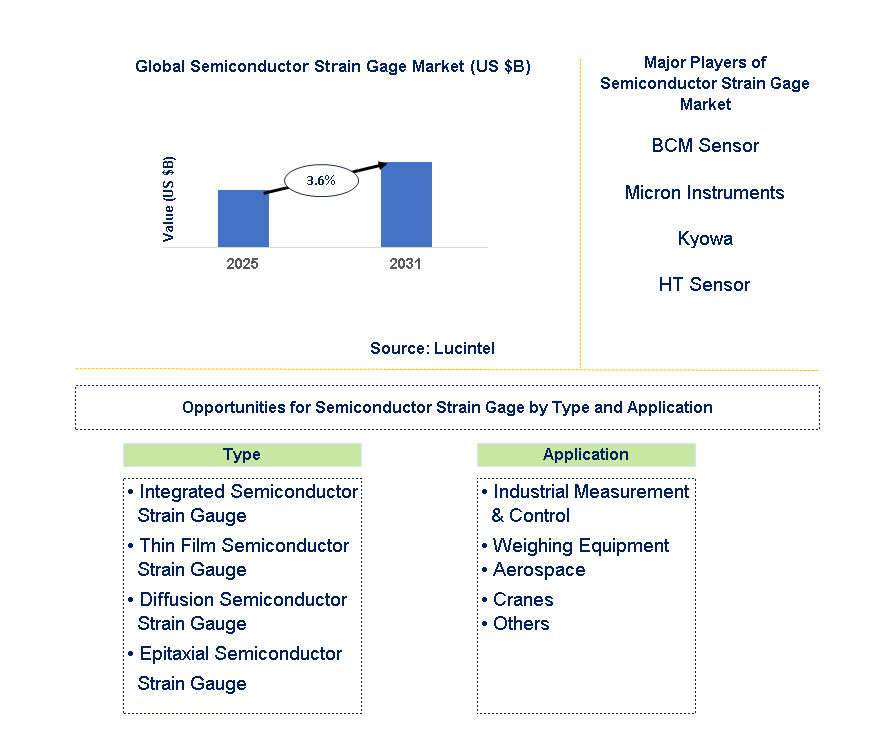
Key data points: The growth forecast = 3.6% annually for the next 7 years. Scroll below to get more insights. This market report covers Trends, opportunities and forecasts in semiconductor strain gage market to 2031 by type (integrated semiconductor strain gauge, thin film semiconductor strain gauge, diffusion semiconductor strain gauge, and epitaxial semiconductor strain gauge), application (industrial measurement & control, weighing equipment, aerospace, cranes, and others), and region (North America, Europe, Asia Pacific, and the Rest of the World)
We'll send your sample report shortly.
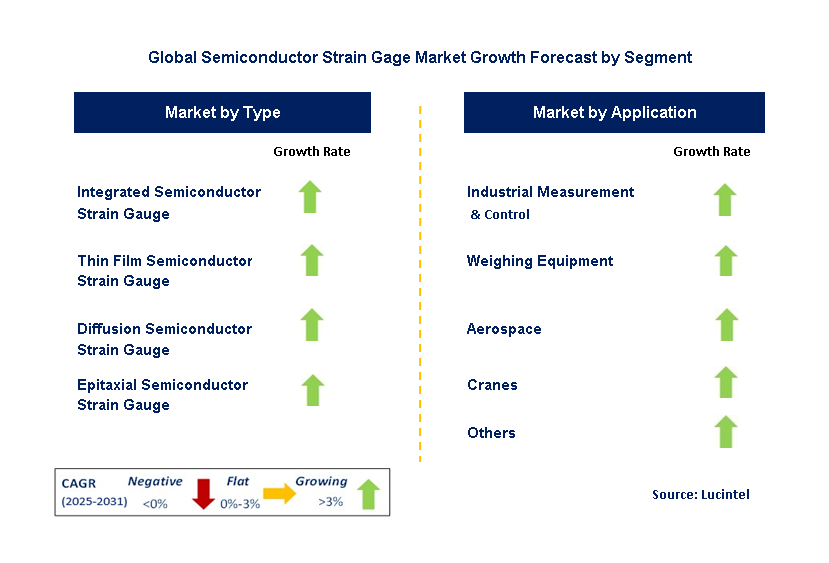
• Lucintel forecasts that, within the type category, integrated semiconductor strain gauge is expected to witness the highest growth over the forecast period.
• Within the application category, aerospace is expected to witness the highest growth due to rising demand for precise and reliable strain gages.
• In terms of region, North America is expected to witness the highest growth over the forecast period.
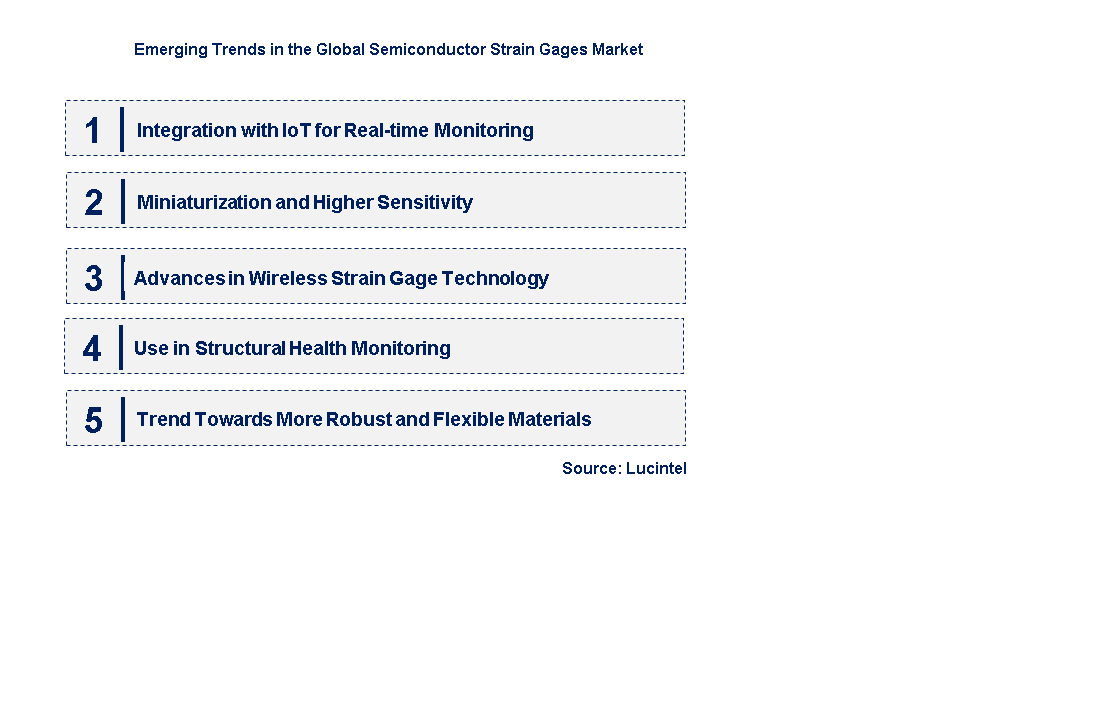
• Integration with IoT for Real-time Monitoring: Strain gages are increasingly being integrated into IoT-based systems, allowing for real-time monitoring of stress and strain on materials. This integration enables industries to track performance, detect early signs of failure, and improve preventive maintenance strategies. With the rise of Industry 4.0, this trend is expected to enhance the adoption of semiconductor strain gages in smart factories and automated systems.
• Miniaturization and Higher Sensitivity: Modular semiconductor strain gages are becoming smaller and more sensitive because of the advanced microelectronics and fabrication technologies. Miniaturization allows the use of sensors in more compact and constrained environments, such as wearable devices and embedded systems. The ability to work into smaller and more sophisticated applications will become increasingly important as demand increases for more accurate and efficient sensors.
• Advances in Wireless Strain Gage Technology: Wireless technology is becoming more prominent in the strain gage market, allowing for easier installation and remote monitoring. Wireless strain gages eliminate the need for wired connections, reducing installation time and costs. These advancements are particularly useful in applications where sensors need to be placed in hard-to-reach locations, such as in aerospace and construction monitoring.
• Use in Structural Health Monitoring: In the area of structural health monitoring, there is an increasing trend toward the use of semiconductor strain gages. The sensors are being used increasingly in bridges, buildings, and other critical infrastructures to measure stress and strain over time. With the rising need for infrastructure maintenance worldwide, this trend has led to an increase in the demand for semiconductor strain gages to improve the safety and durability of structures.
• Trend Towards More Robust and Flexible Materials: The semiconductor strain gages are being developed using more robust and flexible materials to be able to withstand harsher environments. This trend is particularly relevant for industries such as aerospace and automotive, where components are subject to extreme temperatures and mechanical stresses. The shift towards using these advanced materials is driving the development of more reliable and longer-lasting strain gages. This concludes that the semiconductor strain gage market is highly being transformed by integration with IoT, miniaturization, wireless technology, structural health monitoring, and development of more durable materials. These developments increase the scope and demand for semiconductor strain gauges in several industries, creating new openings for growth.
• Advances in Microfabrication Technologies: Advances in microfabrication technologies enable the fabrication of semiconductor strain gages with much higher precision and smaller form factors. These new advances allow for strain gages to be applied in more places, such as wearables and miniaturized systems, but improve their sensitivity and accuracy as well.
• Development of Self-Powered Strain Gages: Recent developments in energy harvesting technologies have led to the creation of self-powered strain gages that do not require an external power source. These gages can operate independently, which makes them ideal for remote or hard-to-reach applications, such as monitoring the structural integrity of buildings, bridges, and aerospace components.
• Improved Wireless Communication: Modern strain gages with improved wireless communication capabilities make possible the monitoring of objects or even people over thousands of kilometers by sending information, without wires and using little to no energy, thanks to micro-transmitters attached to them.
• Higher Durability for Harsh Environments: Semiconductor strain gages are being designed with improved durability to withstand extreme environmental conditions, such as high temperatures, humidity, and chemical exposure. This development is crucial for industries like aerospace and automotive, where strain gages need to perform reliably under challenging conditions.
• Artificial Intelligence Integration for Data Analysis: The semiconductor strain gage market is incorporating artificial intelligence (AI) and machine learning (ML) for more complex data analysis and predictive maintenance. AI algorithms can analyze strain data to predict equipment failure or wear, providing industries with valuable insights on how to optimize their operations. Recent developments in microfabrication, self-powered strain gages, wireless communication, durability improvements, and AI integration are widening the scope and applications of semiconductor strain gages. These new developments are making strain gages more efficient, reliable, and versatile across industries, which drives the market forward.
• Automobile Testing and Diagnostic Applications: Growth prospects for the semiconductor strain gage are good in the automotive sector, which has automobile testing and diagnostics. The strain gages measure the stress and strain on vehicle components to enhance performance, durability, and safety of the vehicle. Demand for performance automobiles will, therefore, further increase the automobile industry's need for semiconductor strain gages in the market.
• Structural Health Monitoring for Infrastructure: The demand for semiconductor strain gages in structural health monitoring (SHM) is growing as countries invest in the maintenance and safety of infrastructure. Strain gages are increasingly used to monitor bridges, roads, and buildings, helping detect early signs of damage and ensuring the safety of critical structures.
• Aerospace and Defense Applications: Key aerospace and defense applications will provide a thrust in the growth of semiconductor-based strain gages. Aerospace and defense sensors measure the performance of core components in aircraft, spacecraft, and military equipment. As aerospace and defense grow and continue to innovate, the need for high-precision and reliable measurement of strain will augment semiconductor-based strain gages demand.
• Energy and Power Industry: The energy and power sector, especially oil and gas, renewable energy, and power plants, is another growing market for semiconductor strain gages. They are used to monitor the stress and strain on critical infrastructure such as pipelines, turbines, and power generation equipment to ensure that they are working at their optimal performance and safety.
• Wearable Devices and Health Monitoring: An increase in the demand for wearable devices, specifically in the health and fitness arena, offers ample growth opportunities in semiconductor strain gauges. For instance, it is used within wearable devices that measure strain applied to the human body, which helps monitor postures and follows movement. All these applications play a vital role in health monitoring. The growth opportunities in the semiconductor strain gage market are being driven by the increasing adoption of strain gages in automotive testing, structural health monitoring, aerospace and defense, energy industries, and wearable devices. These opportunities are shaping the future of the semiconductor strain gage market, providing new avenues for growth and innovation.
• BCM Sensor
• Micron Instruments
• Kyowa
• HT Sensor
• Integrated Semiconductor Strain Gauge
• Thin Film Semiconductor Strain Gauge
• Diffusion Semiconductor Strain Gauge
• Epitaxial Semiconductor Strain Gauge
• Industrial Measurement & Control
• Weighing Equipment
• Aerospace
• Cranes
• Others
• North America
• Europe
• Asia Pacific
• The Rest of the World
• United States: In the United States, the semiconductor strain gage market is witnessing substantial growth, driven by the demand for high-precision measurement tools in various sectors like aerospace, automotive, and structural health monitoring. U.S. companies are focusing on developing more accurate and durable strain gages, with advancements in microfabrication technologies enabling improved performance. Another related application area where semiconductor strain gages are increasingly being integrated in IoT-based systems for real-time monitoring of data is gathering importance. Overall, a strong emphasis on industrial automation along with the requirement of sophisticated sensors in critical applications is driving the industry forward.
• China: The market for semiconductor strain gages in China is rapidly growing owing to the rapid growth of manufacturing and industrial sectors in the country. Semiconductor strain gages are increasingly being used for monitoring structural integrity and mechanical systems. Chinese manufacturers are investing in research and development to improve the sensitivity and versatility of strain gages, while also working to reduce production costs. The growing emphasis on high-precision testing and quality control across various industries, including automotive and electronics, is expected to fuel further demand for semiconductor strain gages in the Chinese market.
• Germany: Germany is one of the leading markets for semiconductor strain gages in Europe, with a strong focus on precision engineering, automotive, and industrial applications. German manufacturers are actively working on innovations to enhance the accuracy and reliability of semiconductor strain gages, especially in sectors that require high-performance materials testing. The automotive industry, in particular, is adopting strain gages for various applications, including vehicle dynamics and safety testing. Strong governmental support by the German government towards technological development and sustainability is also encouraging the growth of the semiconductor strain gage market.
• India: India's semiconductor strain gage market is still at its infancy stage but is highly promising because of the increasing manufacturing and industrial base of the country. Indian companies are studying the applications of semiconductor strain gages for structural health monitoring, testing in the automobile industry, and other high precision applications. With an increasing focus on infrastructure development and manufacturing, the demand for accurate and efficient sensors like strain gages is expected to increase. India's push toward smart cities and industrial automation is another significant growth area for the semiconductor strain gage market in the coming years.
• Japan: Japan is one of the leading players in the semiconductor strain gage market, with advancements in high-tech industries such as electronics, robotics, and automotive. Japanese producers are also experts in precision instrumentation, and there is an ongoing drive for better, more sophisticated, and reliable semiconductor strain gages. Automotive testing, wherein vehicle stress and durability are measured, is seeing increasing adoption in the Japanese market. Due to the strong thrust of innovation and automation in the country, together with its pursuit of quality, Japan remains an important player in the global market for semiconductor strain gages.


• BCM Sensor
• Micron Instruments
• Kyowa
• HT Sensor Q5. Which semiconductor strain gage market segment will be the largest in future? Answer: Lucintel forecasts that, within the type category, integrated semiconductor strain gauge is expected to witness the highest growth over the forecast period. Q6. In semiconductor strain gage market, which region is expected to be the largest in next 5 years? Answer: In terms of region, North America is expected to witness the highest growth over the forecast period. Q7. Do we receive customization in this report? Answer: Yes, Lucintel provides 10% customization without any additional cost.


Choose a license that fits your team. Instant PDF delivery.
Prices exclude taxes. Instant delivery. Custom licensing available on request.
Market Report · July 24, 2026
Market Report · July 20, 2026
Market Report · July 20, 2026
Trusted partner for strategic intelligence and business growth


Receive a complimentary market analysis tailored to your industry. Our analysts will identify key growth opportunities and competitive dynamics specific to your business.

Market size, growth rate, and key trend analysis for your specific sector.

Top competitor positioning and market share analysis.

Strategic recommendations backed by data-driven insights.
Get curated market intelligence and competitive moves straight to your inbox.
By subscribing, you agree to receive our monthly insights. Unsubscribe anytime.
Receive a complimentary market analysis tailored to your industry. Our analysts will identify key growth opportunities and competitive dynamics specific to your business.
Market size, growth rate, and key trend analysis for your specific sector.
Top competitor positioning and market share analysis.
Strategic recommendations backed by data-driven insights.
Get curated market intelligence, emerging trends, and competitive moves straight to your inbox each month.
By subscribing, you agree to receive our monthly insights. Unsubscribe anytime.
We'll send your sample report shortly.