
Report Feature
Semiconductor Plating Chemical Market Trends and Forecast
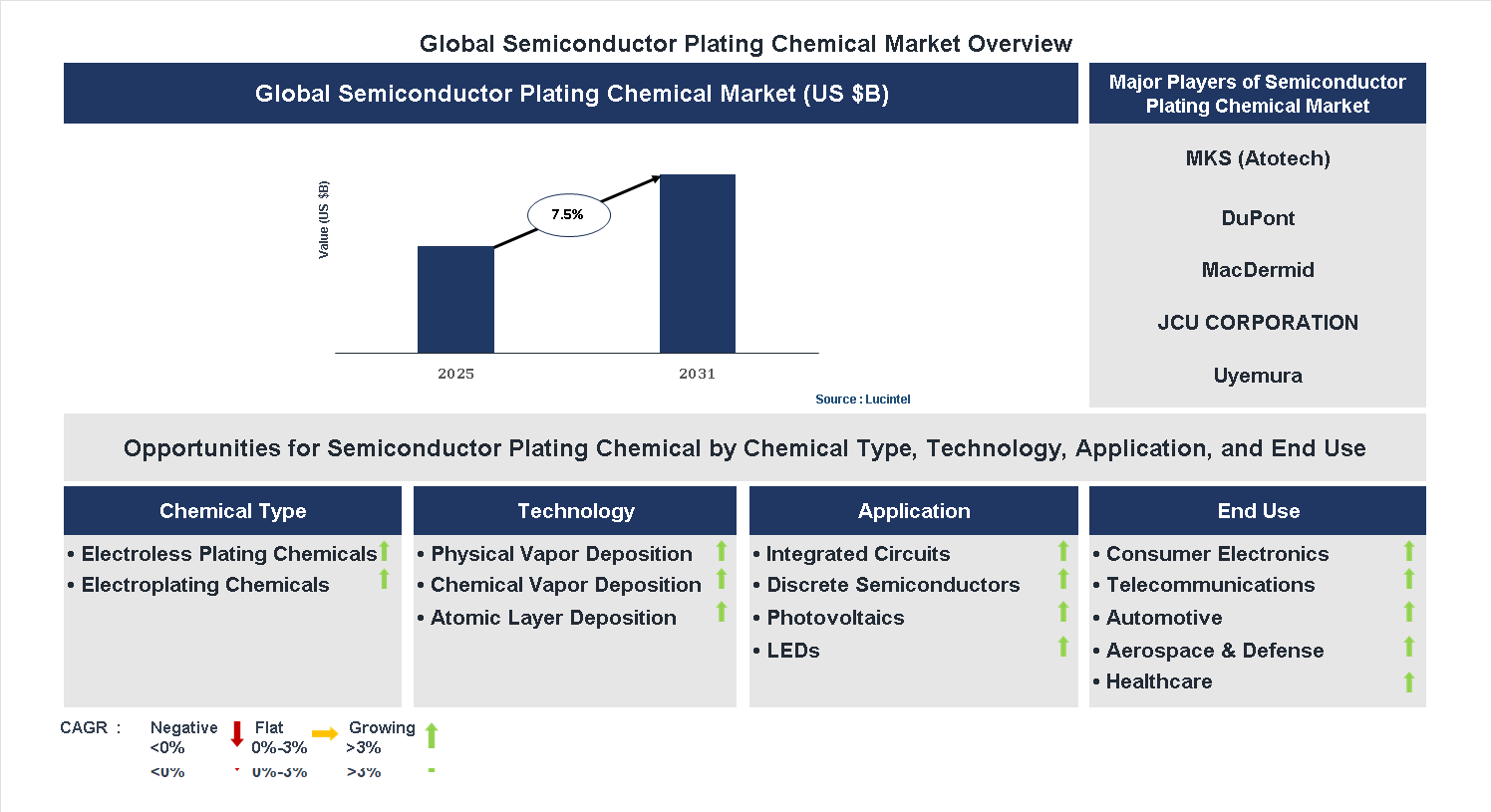
The future of the global semiconductor plating chemical market looks promising with opportunities in the consumer electronics, telecommunication, automotive, aerospace & defense, and healthcare markets. The global semiconductor plating chemical market is expected to grow with a CAGR of 7.5% from 2025 to 2031. The major drivers for this market are the increasing demand for advanced semiconductor packaging, the rising adoption of high performance chips, and the growing use in automotive & electronics industries.• Lucintel forecasts that, within the chemical type category, electroplating chemical is expected to witness higher growth over the forecast period.
• Within the end use category, automotive is expected to witness the highest growth.
• In terms of region, APAC is expected to witness the highest growth over the forecast period. Gain valuable insights for your business decisions with our comprehensive 150+ page report. Sample figures with some insights are shown below.
Emerging Trends in the Semiconductor Plating Chemical Market
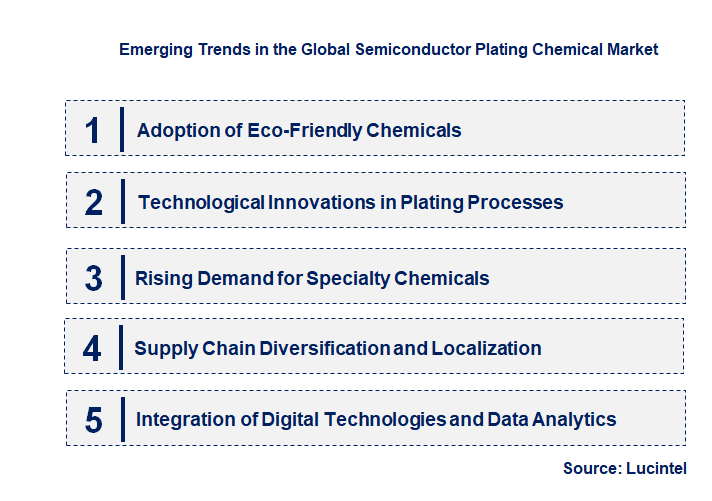
The semiconductor plating chemical market is experiencing rapid evolution driven by technological advancements, increasing demand for miniaturized devices, and a focus on sustainability. As the electronics industry pushes towards higher performance and smaller form factors, the need for specialized chemicals in plating processes has surged. Innovations in material science, environmental regulations, and supply chain dynamics are also shaping this market. These developments are not only enhancing product quality and process efficiency but are also influencing global competitiveness. Understanding these emerging trends is crucial for stakeholders aiming to capitalize on new opportunities and navigate the challenges in this dynamic sector.• Adoption of Eco-Friendly Chemicals: Growing environmental concerns and stricter regulations are prompting manufacturers to develop and adopt environmentally friendly plating chemicals. These eco-friendly alternatives reduce hazardous waste and energy consumption, aligning with sustainability goals. This shift enhances brand reputation and compliance, while also appealing to eco-conscious consumers. The market is witnessing increased R&D investments in biodegradable and non-toxic chemicals, which are expected to become industry standards. Overall, eco-friendly chemicals are transforming the supply chain and operational practices within the semiconductor plating industry.
• Technological Innovations in Plating Processes: Advances in plating technology, such as pulse plating and automation, are improving process precision and efficiency. These innovations enable finer line widths and better uniformity, essential for advanced semiconductor devices. Automation reduces human error and increases throughput, lowering production costs. The integration of AI and IoT in plating equipment allows real-time monitoring and predictive maintenance, minimizing downtime. These technological strides are driving higher quality outputs and supporting the development of next-generation semiconductors, thus reshaping manufacturing paradigms and competitive dynamics in the market.
• Rising Demand for Specialty Chemicals: The increasing complexity of semiconductor devices necessitates specialized plating chemicals tailored for specific applications like copper, gold, and tin plating. These chemicals offer enhanced conductivity, corrosion resistance, and adhesion properties. The demand is driven by the proliferation of 5G, IoT, and AI devices requiring high-performance components. Manufacturers are investing in R&D to develop customized solutions that meet stringent industry standards. This trend is leading to a more segmented market with a focus on high-value, application-specific chemicals, thereby boosting innovation and profitability for chemical suppliers.
• Supply Chain Diversification and Localization: Geopolitical tensions and global disruptions have highlighted the need for diversified and localized supply chains. Companies are increasingly sourcing chemicals from multiple regions to mitigate risks associated with dependency on a single source. Local manufacturing facilities are being established to ensure supply continuity and reduce lead times. This trend enhances resilience against geopolitical and logistical challenges, while also complying with regional regulations. Supply chain diversification is fostering competitive pricing and innovation, ultimately stabilizing the market and enabling faster response to customer needs.
• Integration of Digital Technologies and Data Analytics: Digital transformation is playing a pivotal role in optimizing plating chemical processes. Data analytics and machine learning enable predictive insights into chemical performance and process parameters, leading to improved quality control. Digital platforms facilitate better inventory management and supply chain coordination. These technologies support sustainable practices by minimizing waste and energy use. The adoption of digital tools is empowering manufacturers to achieve higher efficiency, reduce costs, and accelerate innovation cycles. This integration is fundamentally reshaping operational strategies and competitive positioning within the semiconductor plating chemical market. In summary, these emerging trends—eco-friendly chemicals, technological innovations, specialty chemical demand, supply chain diversification, and digital integration—are collectively transforming the semiconductor plating chemical market. They are driving sustainability, enhancing process capabilities, and fostering resilience, which ultimately leads to a more innovative, efficient, and competitive industry landscape.
Recent Development in the Semiconductor Plating Chemical Market
The semiconductor plating chemical market is experiencing rapid evolution driven by technological advancements, increasing demand for miniaturized electronic devices, and stringent environmental regulations. As the electronics industry continues to expand, the need for high-quality, efficient, and sustainable plating chemicals has become critical. Innovations in chemical formulations, automation, and eco-friendly processes are shaping the future of this market. These developments are not only enhancing product performance but also addressing regulatory compliance and environmental concerns. The following key developments highlight the current trajectory and transformative changes within the semiconductor plating chemical market.• Technological Innovation: Development of advanced plating chemicals has improved deposit quality and process efficiency, leading to higher precision in semiconductor manufacturing. This innovation reduces defects and enhances device performance, thereby boosting market competitiveness and enabling the production of smaller, more powerful chips.
• Eco-Friendly Chemicals: Increasing focus on sustainability has driven the adoption of environmentally friendly plating chemicals. These chemicals reduce hazardous waste and emissions, aligning with global environmental regulations and appealing to eco-conscious manufacturers, which enhances market growth and corporate responsibility.
• Automation and Process Optimization: Integration of automation technologies in plating processes has increased throughput and consistency. Automated systems minimize human error, improve safety, and reduce operational costs, making the manufacturing process more efficient and scalable for high-volume production.
• Rising Demand for Miniaturization: The growing need for compact electronic devices has propelled demand for precise and uniform plating chemicals. This trend supports the development of specialized chemicals that enable finer features and thinner coatings, expanding the market scope and application range.
• Regulatory Compliance and Standards: Stricter regulations regarding chemical usage and waste management have prompted companies to innovate compliant formulations. Meeting these standards ensures market access and reduces legal risks, fostering a more sustainable and responsible industry environment. In summary, these developments are significantly impacting the semiconductor plating chemical market by enhancing product quality, promoting sustainability, increasing efficiency, and ensuring regulatory compliance. As a result, the market is poised for continued growth, driven by technological advancements and evolving industry standards.
Strategic Growth Opportunities in the Semiconductor Plating Chemical Market
The semiconductor plating chemical market is experiencing rapid evolution driven by technological advancements, increasing demand for miniaturization, and the need for higher performance in electronic devices. As the industry shifts towards more sophisticated applications, companies are exploring strategic growth opportunities to capture market share and enhance innovation. These opportunities span various applications, including integrated circuits, memory devices, sensors, power devices, and optoelectronics. By focusing on these key areas, stakeholders can leverage emerging trends to accelerate growth, improve product quality, and meet the rising demands of the global electronics industry.• Integrated Circuits: Expanding applications in advanced microprocessors and logic chips drive demand for specialized plating chemicals, enhancing circuit performance and miniaturization. This growth boosts market revenue and encourages innovation in chemical formulations tailored for high-density circuitry.
• Memory Devices: The increasing need for faster, more reliable memory solutions fuels growth in plating chemicals designed for DRAM and NAND flash memory production. This opportunity supports the development of high-performance, durable memory components, strengthening market competitiveness.
• Sensors: Growing adoption of sensors in IoT, automotive, and healthcare sectors creates demand for precise, high-quality plating chemicals. These chemicals improve sensor durability and sensitivity, opening new avenues for market expansion in emerging tech applications.
• Power Devices: The rise of electric vehicles and renewable energy systems necessitates advanced plating chemicals for power semiconductor devices. This growth enhances device efficiency and reliability, positioning the market to capitalize on the green energy transition.
• Optoelectronics: Increasing use of optoelectronic components in displays, lighting, and communication devices drives demand for specialized plating chemicals. These chemicals enable high-quality, efficient optoelectronic components, fostering innovation and market growth. In summary, these key growth opportunities are significantly impacting the semiconductor plating chemical market by fostering innovation, expanding application scopes, and meeting the evolving needs of the electronics industry. As these sectors grow, the market is poised for sustained expansion, driven by technological advancements and increasing global demand for high-performance electronic components.
Semiconductor Plating Chemical Market Driver and Challenges
The semiconductor plating chemical market is influenced by a variety of technological, economic, and regulatory factors. Rapid advancements in semiconductor manufacturing technology demand high-quality plating chemicals to ensure device performance and reliability. Economic factors such as global supply chain dynamics and fluctuating raw material costs impact market stability. Regulatory frameworks aimed at environmental safety and chemical handling also shape market practices and innovation. Additionally, increasing demand for consumer electronics, automotive electronics, and data centers drives growth, while challenges related to sustainability and compliance pose hurdles. Understanding these drivers and challenges is essential for stakeholders to navigate the evolving landscape effectively. The factors responsible for driving the semiconductor plating chemical market include:-• Technological Innovation: The continuous evolution of semiconductor manufacturing processes necessitates advanced plating chemicals that meet stringent quality and performance standards. Innovations such as 3D packaging and miniaturization require specialized chemicals to achieve precise, uniform coatings. This drives R&D investments and adoption of new formulations, ensuring manufacturers stay competitive. The demand for high-purity, environmentally friendly chemicals also pushes innovation, fostering sustainable practices. As technology advances, the market benefits from improved process efficiencies, reduced defects, and enhanced device performance, fueling overall growth.
• Growing Semiconductor Demand: The surge in demand for semiconductors across various sectors like consumer electronics, automotive, and data centers significantly propels the market. The proliferation of IoT devices, 5G infrastructure, and electric vehicles increases the need for high-quality plating chemicals to produce reliable, high-performance chips. This expanding demand encourages manufacturers to increase production capacity and diversify chemical offerings. The trend towards miniaturization and complex chip architectures further amplifies the need for specialized plating solutions, making this a key growth driver for the market.
• Environmental Regulations and Sustainability: Stricter environmental regulations worldwide compel companies to develop eco-friendly plating chemicals that reduce hazardous waste and emissions. Governments are imposing limits on the use of toxic substances, prompting industry players to innovate greener formulations. This shift not only ensures compliance but also enhances brand reputation and market competitiveness. The push for sustainability encourages the adoption of water-based, biodegradable, and low-toxicity chemicals, which can lead to cost savings and reduced environmental impact. Consequently, regulatory pressures are a catalyst for innovation and market transformation.
• Supply Chain Optimization: The global semiconductor industry faces supply chain disruptions due to geopolitical tensions, pandemics, and logistical challenges. To mitigate risks, companies are focusing on local sourcing, inventory management, and diversified supplier networks for plating chemicals. This ensures a consistent supply and reduces dependency on single sources, maintaining production continuity. Supply chain resilience also enables quicker adaptation to market fluctuations and technological changes, supporting sustained growth. Investments in supply chain infrastructure and strategic partnerships are critical to overcoming these challenges and maintaining market stability.
• Investment in R&D and Innovation: Continuous research and development efforts are vital for creating advanced plating chemicals that meet evolving industry standards. Companies investing in R&D can develop formulations that offer better adhesion, corrosion resistance, and environmental compliance. Innovation also enables the creation of chemicals compatible with emerging manufacturing techniques like 3D stacking and wafer-level packaging. These advancements help manufacturers improve process efficiency, reduce defects, and lower costs. The focus on R&D fosters a competitive edge, accelerates product development cycles, and opens new market opportunities, driving overall industry growth. The challenges facing this semiconductor plating chemical market include:-
• Stringent Regulatory Compliance: The increasing stringency of environmental and safety regulations poses significant challenges for chemical manufacturers. Compliance requires substantial investment in R&D to develop safer, eco-friendly alternatives, which can be costly and time-consuming. Non-compliance risks legal penalties, product recalls, and damage to brand reputation. Navigating diverse regulations across regions complicates market entry and expansion strategies. Additionally, the need for continuous monitoring and reporting adds operational burdens. Balancing innovation with regulatory adherence remains a critical challenge for sustaining growth and competitiveness in the market.
• Raw Material Price Volatility: Fluctuations in the prices of raw materials such as acids, metals, and solvents directly impact production costs. Price volatility can result from geopolitical tensions, supply-demand imbalances, or environmental policies affecting resource extraction. These uncertainties make it difficult for manufacturers to forecast expenses, set competitive pricing, and maintain profit margins. To mitigate risks, companies may need to diversify suppliers or stockpile materials, which can increase inventory costs. Managing raw material costs effectively is essential to ensure market stability and profitability amid fluctuating economic conditions.
• Environmental and Waste Management Concerns: The use of hazardous chemicals in plating processes raises environmental and waste disposal issues. Proper treatment and disposal of chemical waste are costly and subject to strict regulations. Failure to manage waste responsibly can lead to environmental contamination, legal penalties, and reputational damage. Additionally, pressure to reduce chemical usage and emissions necessitates ongoing investment in cleaner technologies. Balancing operational efficiency with environmental responsibility remains a complex challenge, requiring continuous innovation and compliance efforts to sustain market growth while minimizing ecological impact. In summary, the semiconductor plating chemical market is shaped by rapid technological advancements, increasing demand, regulatory pressures, supply chain dynamics, and ongoing innovation. While these drivers foster growth and competitiveness, challenges such as regulatory compliance, raw material volatility, and environmental concerns require strategic management. The interplay of these factors influences market stability, innovation trajectories, and sustainability efforts. Overall, the markets future depends on how effectively industry players adapt to technological changes, regulatory landscapes, and environmental responsibilities, ensuring sustainable growth and technological leadership.
List of Semiconductor Plating Chemical Companies
Companies in the market compete on the basis of product quality offered. Major players in this market focus on expanding their manufacturing facilities, R&D investments, infrastructural development, and leverage integration opportunities across the value chain. With these strategies semiconductor plating chemical companies cater increasing demand, ensure competitive effectiveness, develop innovative products & technologies, reduce production costs, and expand their customer base. Some of the semiconductor plating chemical companies profiled in this report include-• MKS (Atotech)
• DuPont
• MacDermid
• JCU CORPORATION
• Uyemura
• Jetchem International
• Guanghua Technology
• Feikai material
• ATMI
• Moses Lake Industries
Semiconductor Plating Chemical Market by Segment
The study includes a forecast for the global semiconductor plating chemical market by chemical type, technology, application, end use, and region.Semiconductor Plating Chemical Market by Chemical Type [Value from 2019 to 2031]:
• Electroless Plating Chemicals
• Electroplating Chemicals
Semiconductor Plating Chemical Market by Technology [Value from 2019 to 2031]:
• Physical Vapor Deposition
• Chemical Vapor Deposition
• Atomic Layer Deposition
Semiconductor Plating Chemical Market by Application [Value from 2019 to 2031]:
• Integrated Circuits
• Discrete Semiconductors
• Photovoltaics
• LEDs
Semiconductor Plating Chemical Market by End Use [Value from 2019 to 2031]:
• Consumer Electronics
• Telecommunications
• Automotive
• Aerospace & Defense
• Healthcare
Semiconductor Plating Chemical Market by Region [Value from 2019 to 2031]:
• North America
• Europe
• Asia Pacific
• The Rest of the World
Country Wise Outlook for the Semiconductor Plating Chemical Market
The semiconductor plating chemical market is experiencing rapid growth driven by technological advancements, increasing demand for semiconductors across various industries, and evolving manufacturing processes. As global electronics and automotive sectors expand, countries are investing heavily in research, innovation, and infrastructure to stay competitive. This dynamic landscape reflects shifts in supply chains, regulatory standards, and sustainability initiatives, influencing market strategies worldwide. The following summaries highlight recent developments in the United States, China, Germany, India, and Japan, emphasizing key advancements and strategic movements shaping the future of this vital industry.• United States: The US market has seen significant R&D investments, with major players focusing on developing eco-friendly plating chemicals and improving process efficiency. Government initiatives promote innovation, and collaborations between industry and academia are accelerating technological breakthroughs. The adoption of automation and AI-driven quality control systems is enhancing manufacturing precision and reducing waste. Additionally, US companies are expanding their production capacities to meet rising domestic and international demand, positioning themselves as leaders in sustainable semiconductor solutions.
• China: China continues to expand its semiconductor manufacturing capabilities, with substantial government backing through initiatives like the "Made in China 2025" plan. The focus is on developing indigenous chemical formulations to reduce reliance on imports and enhance supply chain security. Recent advancements include the development of high-purity plating chemicals tailored for advanced chip fabrication. Chinese firms are also investing in environmentally sustainable processes, aiming to meet stricter global standards while increasing production efficiency and capacity to serve both domestic and global markets.
• Germany: Germany remains a key player in the European semiconductor supply chain, emphasizing high-quality and innovative chemical solutions. Recent developments include the introduction of advanced plating chemicals that improve yield and reduce environmental impact. German companies are also investing in sustainable manufacturing practices, aligning with EU regulations on chemical safety and environmental protection. Collaborations with research institutions are fostering innovations in chemical formulations, and there is a growing focus on developing chemicals suitable for next-generation semiconductor devices, ensuring Germany’s competitive edge in the industry.
• India: India is rapidly emerging as a significant market for semiconductor chemicals, driven by government initiatives like "Make in India" and increased foreign direct investment. Recent developments include the establishment of local manufacturing facilities for plating chemicals and the development of cost-effective, high-performance formulations. The country is also focusing on building a skilled workforce and research capabilities to support domestic semiconductor fabrication. Efforts are underway to develop environmentally sustainable chemicals, aligning with global standards, and to create a self-reliant supply chain that reduces dependency on imports.
• Japan: Japan continues to innovate in semiconductor plating chemicals, emphasizing high purity and process stability. Recent advancements include the development of chemicals that enable finer line widths and higher device performance. Japanese firms are investing in eco-friendly formulations to meet global environmental standards and reduce hazardous waste. The country is also strengthening collaborations with international semiconductor manufacturers to co-develop advanced chemical solutions. Japan’s focus remains on maintaining technological leadership through continuous R&D, ensuring the production of high-quality chemicals that support the evolution of next-generation semiconductor devices.

Features of the Global Semiconductor Plating Chemical Market
Market Size Estimates: Semiconductor plating chemical market size estimation in terms of value ($B). Trend and Forecast Analysis: Market trends (2019 to 2024) and forecast (2025 to 2031) by various segments and regions. Segmentation Analysis: Semiconductor plating chemical market size by various segments, such as by chemical type, technology, application, end use, and region in terms of value ($B). Regional Analysis: Semiconductor plating chemical market breakdown by North America, Europe, Asia Pacific, and Rest of the World. Growth Opportunities: Analysis of growth opportunities in different chemical types, technologies, applications, end uses, and regions for the semiconductor plating chemical market. Strategic Analysis: This includes M&A, new product development, and competitive landscape of the semiconductor plating chemical market. Analysis of competitive intensity of the industry based on Porter’s Five Forces model.
FAQ
Q1. What is the growth forecast for semiconductor plating chemical market? Answer: The global semiconductor plating chemical market is expected to grow with a CAGR of 7.5% from 2025 to 2031. Q2. What are the major drivers influencing the growth of the semiconductor plating chemical market? Answer: The major drivers for this market are the increasing demand for advanced semiconductor packaging, the rising adoption of high performance chips, and the growing use in automotive & electronics industries. Q3. What are the major segments for semiconductor plating chemical market? Answer: The future of the semiconductor plating chemical market looks promising with opportunities in the consumer electronics, telecommunication, automotive, aerospace & defense, and healthcare markets. Q4. Who are the key semiconductor plating chemical market companies? Answer: Some of the key semiconductor plating chemical companies are as follows:• MKS (Atotech)
• DuPont
• MacDermid
• JCU CORPORATION
• Uyemura
• Jetchem International
• Guanghua Technology
• Feikai material
• ATMI
• Moses Lake Industries Q5. Which semiconductor plating chemical market segment will be the largest in future? Answer: Lucintel forecasts that, within the chemical type category, electroplating chemical is expected to witness higher growth over the forecast period. Q6. In semiconductor plating chemical market, which region is expected to be the largest in next 5 years? Answer: In terms of region, APAC is expected to witness the highest growth over the forecast period. Q7. Do we receive customization in this report? Answer: Yes, Lucintel provides 10% customization without any additional cost.
Table of Contents
List of Figures
List of Tables
Methodology
- In-depth interviews of the major players in this market
- Detailed secondary research from competitors’ financial statements and published data
- Extensive searches of published works, market, and database information pertaining to industry news, company press releases, and customer intentions
- A compilation of the experiences, judgments, and insights of Lucintel’s professionals, who have analyzed and tracked this market over the years.


Buy Now
Choose a license that fits your team. Instant PDF delivery.
Prices exclude taxes. Instant delivery. Custom licensing available on request.
Key Questions
- • What are some of the most promising, high-growth opportunities for the semiconductor plating chemical market by chemical type (electroless plating chemicals and electroplating chemicals), technology (physical vapor deposition, chemical vapor deposition, and atomic layer deposition), application (integrated circuits, discrete semiconductors, photovoltaics, and LEDs), end use (consumer electronics, telecommunications, automotive, aerospace & defense, and healthcare), and region (North America, Europe, Asia Pacific, and the Rest of the World)?
- • Which segments will grow at a faster pace and why?
- • Which region will grow at a faster pace and why?
- • What are the key factors affecting market dynamics? What are the key challenges and business risks in this market?
- • What are the business risks and competitive threats in this market?
- • What are the emerging trends in this market and the reasons behind them?
- • What are some of the changing demands of customers in the market?
- • What are the new developments in the market? Which companies are leading these developments?
- • Who are the major players in this market? What strategic initiatives are key players pursuing for business growth?
- • What are some of the competing products in this market and how big of a threat do they pose for loss of market share by material or product substitution?
- • What M&A activity has occurred in the last 5 years and what has its impact been on the industry? For any questions related to Semiconductor Plating Chemical Market, Semiconductor Plating Chemical Market Size, Semiconductor Plating Chemical Market Growth, Semiconductor Plating Chemical Market Analysis, Semiconductor Plating Chemical Market Report, Semiconductor Plating Chemical Market Share, Semiconductor Plating Chemical Market Trends, Semiconductor Plating Chemical Market Forecast, Semiconductor Plating Chemical Companies, write Lucintel analyst at email: helpdesk@lucintel.com. We will be glad to get back to you soon.


