
Market Report · July 24, 2026

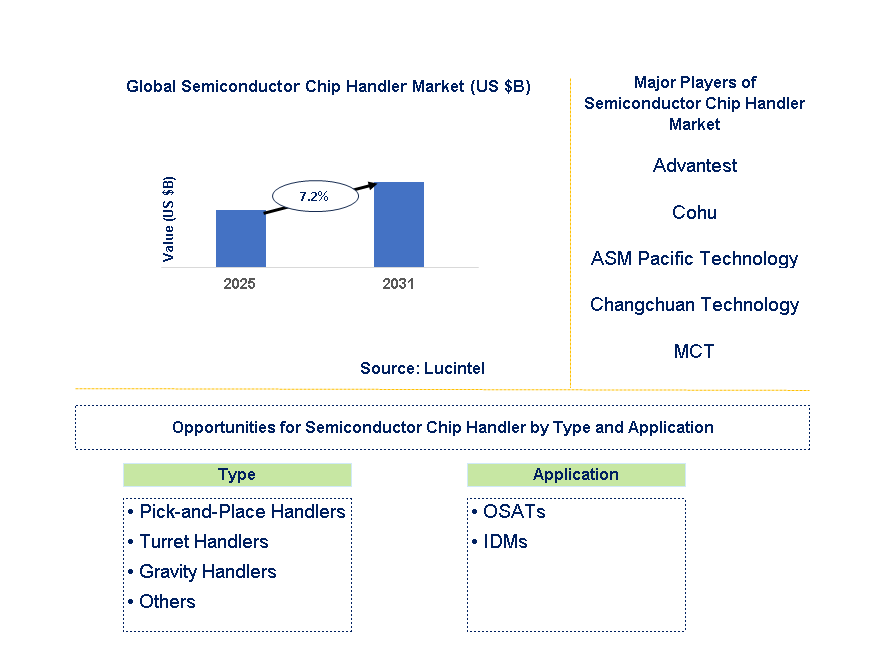
Key data points: The growth forecast = 7.2% annually for the next 7 years. Scroll below to get more insights. This market report covers Trends, opportunities and forecasts in semiconductor chip handler market to 2031 by type (pick-and-place handlers, turret handlers, gravity handlers, and others), application (OSATs and IDMs), and region (North America, Europe, Asia Pacific, and the Rest of the World)
We'll send your sample report shortly.
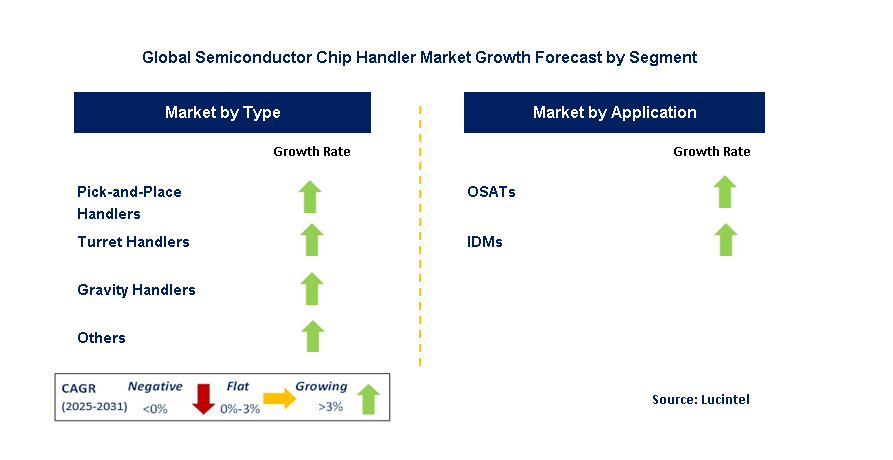
• Lucintel forecasts that, within the type category, pick-and-place handler is expected to witness the highest growth over the forecast period due to increasing use in semiconductor manufacturing.
• Within the application category, IDM is expected to witness higher growth due to its good control over the entire semiconductor manufacturing process.
• In terms of region, APAC is expected to witness the highest growth over the forecast period due to growing demand for advanced chip handling solutions.
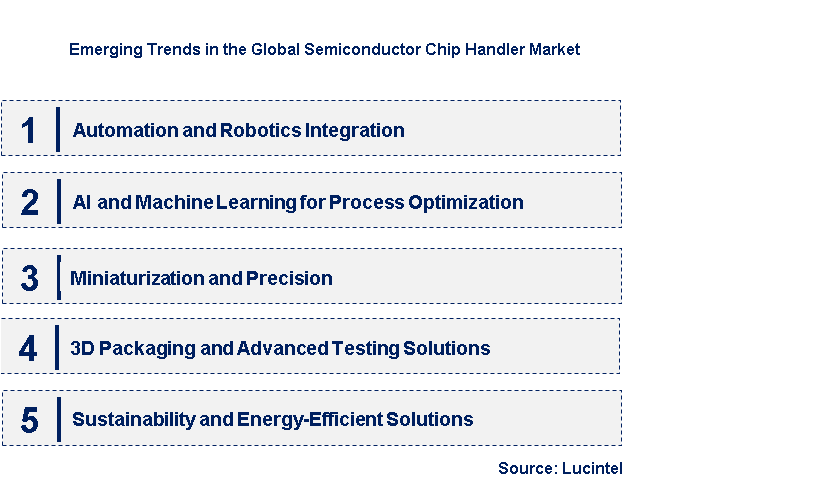
• Automation and Robotics Integration: With the integration of automation and robotics in semiconductor chip handling, an important trend comes into play. Robotic systems help increase speed and accuracy levels in chip-handling processes by reducing human involvement. These can handle fragile chips with ease while reducing the possibilities of damage through transportation and testing. The rise of robotic systems also allows for faster production cycles and more efficient use of labor, thus enabling semiconductor manufacturers to scale their operations and reduce costs.
• AI and Machine Learning for Process Optimization: AI and machine learning technologies are increasingly being incorporated into chip handler systems to improve efficiency and accuracy. AI algorithms analyze data collected during chip handling processes to identify patterns, predict failures, and optimize testing and packaging stages. This use of AI minimizes errors, enhances throughput, and predicts maintenance needs, thereby reducing downtime. Using machine learning, chip handlers can continually improve their operations, thus achieving better overall performance in semiconductor manufacturing.
• Miniaturization and Precision: With the increase in the size of semiconductors, precision in handling chips has also increased. Advances in miniaturization have led to the development of chip handling systems that can manage smaller chips with greater accuracy. These systems feature enhanced precision capabilities, such as high-resolution vision systems and fine-tuned robotic arms, to ensure the correct handling of microchips without causing damage. The trend toward miniaturization is crucial to the demands of new technologies, like IoT and 5G.
• 3D Packaging and Advanced Testing Solutions: The growing demand for more advanced semiconductor packaging, such as 3D packaging, will require more complex chip handler systems. These have to be precise in handling multi-layered chips while ensuring that the layers are properly aligned in testing and packaging. This trend is especially applicable in the area of mobile devices, where miniaturization and high performance are the prime needs. Advanced testing solutions integrated with chip handlers are becoming indispensable for the quality and reliability of chips, especially in high-performance applications.
• Sustainability and Energy-Efficient Solutions: As the world focuses on sustainability, the need for energy-efficient and eco-friendly chip handling systems is becoming a major requirement for semiconductor manufacturers. It has become more frequent to find chip handling equipment incorporating low-energy components and sustainable manufacturing processes. Companies are also keen on minimizing waste, using recyclable materials, and optimizing power consumption. Sustainability initiatives in the semiconductor industry will not only minimize operational costs but also support worldwide efforts to minimize the industry's environmental impact. The trends in automation, AI integration, miniaturization, advanced packaging, and sustainability are transforming the semiconductor chip handler market. The innovations are improving efficiency, accuracy, and sustainability in chip handling processes, allowing semiconductor manufacturers to meet rising demand for high-performance chips. With these developments, their roles will become more critical in the semiconductor industry's future.
• New Advancements in Robotic Chip Handlers: New advancements in robotics have really impacted the growth of the market for the semiconductor chip handler. Robotic systems can now process semiconductor chips with more accuracy, speed, and efficiency. Chip robots use advanced vision systems and AI algorithms for precise positioning and minimize damage during the processing. Robotic systems enable manufacturers to achieve a higher throughput and to automate some of the labor-intensive tasks that translate into better productivity.
• AI Integration for Predictive Maintenance: AI-based predictive maintenance is now a core feature of contemporary semiconductor chip handler systems. Through machine learning algorithms, such systems can predict possible failures and schedule maintenance ahead of time before such failures occur. This reduces unplanned downtime by a considerable margin and ensures that chip handling processes are always operating at maximum efficiency. Predictive maintenance also saves on operational costs by preventing unnecessary repairs and extending the lifespan of equipment.
• Trends towards Totally Automated Systems: The semiconductor industry is switching to totally automated chip handling systems capable of handling the whole production chain in minimal direct human interference. These systems integrate multiple processes such as testing, sorting, and packaging into one flow without separation. Full automation, therefore, reduces labor costs, increases production rates, and improves the consistency of semiconductor products. This development is of great advantage for manufacturers who seek to expand operations and meet surging demand.
• Miniaturization of Chip Handler Machines: With the persistent trend towards reduced and more sophisticated semiconductors, the chip handler machines are also miniaturized to be more accurate. The smaller chip handlers manage chips with better accuracy, particularly in applications demanding high-density components. The smaller machines are also more versatile to accommodate various chip sizes and configurations, giving manufacturers more flexibility in their production processes. This development is helping manufacturers meet the demand for high-performance, compact chips used in advanced electronics.
• Sustainability and Eco-Friendly Design: With sustainability becoming a priority for industries around the world, semiconductor chip handler manufacturers are focusing on creating energy-efficient and eco-friendly systems. Many of the latest chip handler systems are energy-efficient, waste minimal, and recyclable. Most manufacturers also employ green technologies and optimize processes to minimize the environmental implications of production. Though operating costs have been reduced, these sustainability efforts also reflect aligned global initiatives for environmentally responsible manufacturing. Current developments, including the integration of robotics, AI, and automation, along with miniaturized chip handling systems, are significantly altering the shape of the semiconductor chip handler market. It is bringing in efficiency, making more economical products, and improving the sustainability aspects of the production of semiconductors. Therefore, all these features become essential for the increasing demand for high-performance semiconductors.
• Automotive Industry Applications: The need for advanced semiconductors in the automotive industry continues to increase due to electric vehicles (EVs) and autonomous systems. As a result, a significant growth opportunity for chip handlers is presented because of the complexity of these chips, which demand precise handling. Chips specifically designed for automotive applications will play a crucial role in ensuring that chips used in such critical systems as infotainment, safety, and battery management are of quality and reliability standards.
• Consumer Electronics Market: The increasing demand for consumer electronics like handphones, wearables, and gaming devices is highly driving the requirement for chip handling efficiently. Chip handlers designed for consumer electronics applications must be fast, precise, and able to handle a large volume of chips. Manufacturers are looking for solutions that can help improve production rates while cutting costs, resulting in a significant opportunity for innovation through chip handlers in this market.
• IoT and Smart Devices: The growing IoT market is leading to the requirement for smaller yet more powerful semiconductors. Chip handlers that can manage small, high-performance chips of IoT devices, such as smart home products, sensors, and wearables, are in huge demand. Here lies the opportunity in the development of chip handling systems that have higher precision, flexibility, and speed to adapt to the variety of IoT chip sizes and needs.
• Telecommunications and 5G Infrastructure: As 5G technology rolls out across the globe, the telecommunications industry will be an ever-growing opportunity for semiconductor chip handlers. High-performance chips are used in 5G infrastructure such as base stations and network equipment, and this demand is on the rise. Chip handlers capable of managing these complex chips with a focus on speed and reliability will play a key role in ensuring the success of 5G deployments.
• Artificial Intelligence and Machine Learning: The demand for special semiconductors is increasing with the rise in the application of AI and machine learning. Ensuring the proper functioning of these advanced chips within AI systems is becoming of utmost importance with chip handlers that can manage and test these chips. The growing adoption of AI in healthcare, finance, and manufacturing significantly bodes well for chip handler systems that are tailored to the specific needs of AI and machine learning chip requirements. The semiconductor chip handler market is in a prime position to grow further in the market across different applications, including automotive, consumer electronics, IoT, telecommunications, and AI. In these key areas, manufacturers will be able to capitalize on growing demand for high-performance chips while further advancing chip handling technologies in response to emerging industry needs.
• Advantest
• Cohu
• ASM Pacific Technology
• Changchuan Technology
• MCT
• Boston Semi Equipment
• Exis Tech
• Hon Precision
• Chroma
• SRM Integration
• Pick-and-Place Handlers
• Turret Handlers
• Gravity Handlers
• Others
• OSATs
• IDMs
• North America
• Europe
• Asia Pacific
• The Rest of the World
• United States: The United States is a major hub for the semiconductor chip handler market, with leading companies investing heavily in automation and advanced packaging solutions. There is a growing demand for faster and more efficient chip testing and handling systems, mainly due to the increasing demand for high-performance chips in AI, 5G, and automotive sectors. The innovations in robotic systems and machine learning algorithms have allowed U.S.-based companies to produce highly precise and flexible chip handler systems. In addition, the U.S. semiconductor industry is reaping the benefits of significant government investments aimed at improving domestic manufacturing capabilities.
• China: The semiconductor chip handler market in China experienced tremendous growth as the country continues to make high investments in semiconductor production. The demand for high-tech electronic products and a shift towards local chip manufacturing have catalyzed high expectations for advanced chip handling solutions. Chinese manufacturers are focusing on improving automation, precision, and speed in their systems of chip handling in order to be globally competitive. With China's focus on self-reliance in semiconductor production, local companies are also innovating in new technologies to reduce dependence on foreign suppliers, making it a key player in the global semiconductor chip handler market.
• Germany: Germany's semiconductor chip handler market is highly influenced by the country's strong automotive and industrial sectors. The increasing demand for semiconductors in electric vehicles, smart manufacturing, and automation has increased the demand for efficient chip handling systems. German companies are focusing on developing high-precision chip handler machines, integrating automation and AI technologies. Apart from that, a high focus of Germany on industrial automation and Industry 4.0 is accelerating the adoption of smart manufacturing systems in semiconductor chip handling, where manufacturers can have more efficient production with minimal human error.
• India: The growth of the semiconductor industry in India is also boosting the market for semiconductor chip handlers. As the demand for smartphones, consumer electronics, and automotive chips rises, Indian manufacturers are opting for more automation and cost-efficient chip handling systems. The government's push for a "Made in India" semiconductor manufacturing initiative has only accelerated investment in advanced chip handling solutions. Indian companies are focusing on affordable and scalable chip handler systems tailored to local manufacturing requirements so as to compete with global players in this emerging market.
• Japan: Among the leading semiconductor chip handler markets, Japan is attributed to its strong electronics and robotics industries. The Japanese reputation for quality precision machinery applies equally well to semiconductor chip handling systems. As a result of an increased demand for semiconductors in automotive electronics, robotics, and IoT applications, Japan upgraded innovations of chip handler systems based on speed, reliability, and miniaturization. The country has long experience in automation technology, which allows its manufacturers to produce high-throughput systems for handling chips efficiently.


• Advantest
• Cohu
• ASM Pacific Technology
• Changchuan Technology
• MCT
• Boston Semi Equipment
• Exis Tech
• Hon Precision
• Chroma
• SRM Integration Q5. Which semiconductor chip handler market segment will be the largest in future? Answer: Lucintel forecasts that, within the type category, pick-and-place handler is expected to witness the highest growth over the forecast period due to increasing use in semiconductor manufacturing. Q6. In semiconductor chip handler market, which region is expected to be the largest in next 5 years? Answer: In terms of region, APAC is expected to witness the highest growth over the forecast period due to growing demand for advanced chip handling solutions. Q7. Do we receive customization in this report? Answer: Yes, Lucintel provides 10% customization without any additional cost.


Choose a license that fits your team. Instant PDF delivery.
Prices exclude taxes. Instant delivery. Custom licensing available on request.
Market Report · July 24, 2026
Market Report · July 20, 2026
Market Report · July 20, 2026
Trusted partner for strategic intelligence and business growth


Receive a complimentary market analysis tailored to your industry. Our analysts will identify key growth opportunities and competitive dynamics specific to your business.

Market size, growth rate, and key trend analysis for your specific sector.

Top competitor positioning and market share analysis.

Strategic recommendations backed by data-driven insights.
Get curated market intelligence and competitive moves straight to your inbox.
By subscribing, you agree to receive our monthly insights. Unsubscribe anytime.
Receive a complimentary market analysis tailored to your industry. Our analysts will identify key growth opportunities and competitive dynamics specific to your business.
Market size, growth rate, and key trend analysis for your specific sector.
Top competitor positioning and market share analysis.
Strategic recommendations backed by data-driven insights.
Get curated market intelligence, emerging trends, and competitive moves straight to your inbox each month.
By subscribing, you agree to receive our monthly insights. Unsubscribe anytime.
We'll send your sample report shortly.