
Report Feature
Semiconductor Chemical Market Trends and Forecast
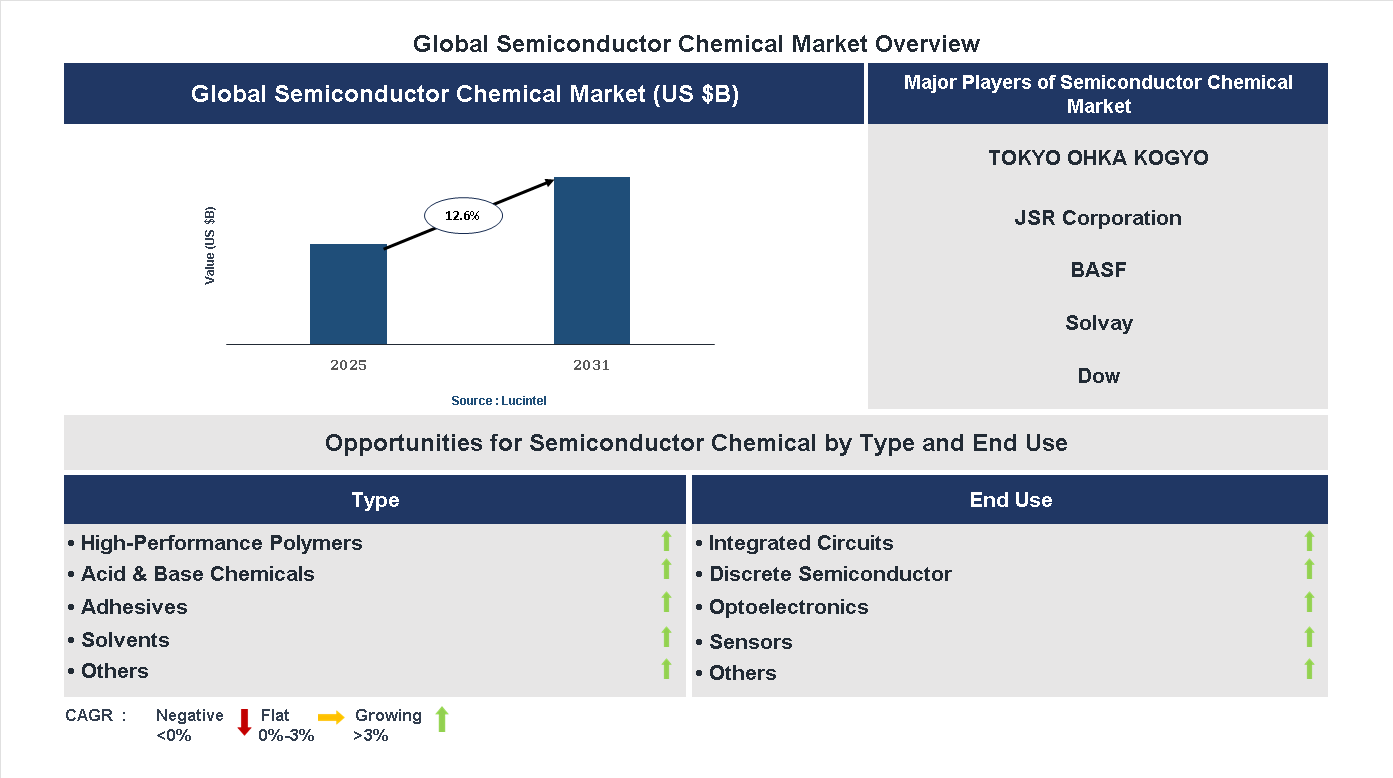
The future of the global semiconductor chemical market looks promising with opportunities in the integrated circuit, discrete semiconductor, optoelectronics, and sensor markets. The global semiconductor chemical market is expected to grow with a CAGR of 12.6% from 2025 to 2031. The major drivers for this market are the increasing demand for advanced semiconductor materials, the rising production of integrated circuit chips, and the growing adoption of electronic manufacturing processes.• Lucintel forecasts that, within the type category, high-performance polymer is expected to witness the highest growth over the forecast period.
• Within the end use category, integrated circuit is expected to witness the highest growth.
• In terms of region, APAC is expected to witness the highest growth over the forecast period. Gain valuable insights for your business decisions with our comprehensive 150+ page report. Sample figures with some insights are shown below.
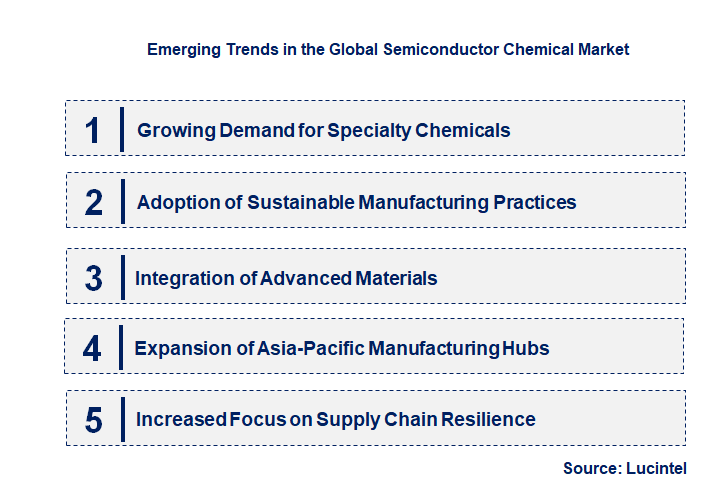
Emerging Trends in the Semiconductor Chemical Market
The semiconductor chemical market is experiencing rapid evolution driven by technological advancements, increasing demand for electronic devices, and a push towards more sustainable manufacturing practices. As the industry adapts to these changes, several emerging trends are shaping its future trajectory. These trends influence supply chains, innovation, and environmental considerations, ultimately impacting global electronics manufacturing and consumption. Companies are investing heavily in R&D, adopting new materials, and optimizing processes to stay competitive. Understanding these key trends is essential for stakeholders aiming to navigate the dynamic landscape of semiconductor chemicals effectively.• Growing demand for specialty chemicals: The market is witnessing increased demand for high-purity and specialty chemicals essential for advanced semiconductor manufacturing. These chemicals improve device performance and yield, driving innovation in chip design. As semiconductor devices become more complex, the need for specialized chemicals that meet stringent purity and performance standards is rising. This trend encourages chemical manufacturers to develop tailored solutions, fostering a competitive edge. It also prompts investments in R&D to create chemicals compatible with next-generation fabrication processes, ultimately supporting the industry’s push toward smaller, faster, and more efficient chips.
• Adoption of sustainable manufacturing practices: Environmental concerns and regulatory pressures are prompting companies to adopt greener chemical production methods. This includes reducing hazardous waste, lowering carbon emissions, and utilizing eco-friendly raw materials. Sustainable practices not only help companies comply with regulations but also appeal to environmentally conscious consumers and investors. Innovations such as recycling chemicals, developing biodegradable alternatives, and optimizing process efficiency are gaining traction. This shift toward sustainability is reshaping supply chains and operational strategies, encouraging industry players to balance technological advancement with environmental responsibility, thus fostering a more sustainable semiconductor ecosystem.
• Integration of advanced materials: The industry is increasingly incorporating novel materials like graphene, nanomaterials, and alternative dielectrics to enhance semiconductor performance. These materials enable faster, smaller, and more energy-efficient chips, meeting the demands of emerging applications such as AI, IoT, and 5G. The integration of advanced materials requires new chemical formulations and processing techniques, pushing the boundaries of traditional manufacturing. This trend accelerates innovation, opens new market segments, and compels chemical suppliers to develop specialized compounds compatible with cutting-edge fabrication technologies, ultimately transforming the landscape of semiconductor production.
• Expansion of Asia-Pacific manufacturing hubs: The Asia-Pacific region continues to dominate semiconductor chemical production and consumption due to lower costs, skilled labor, and supportive government policies. Countries like China, South Korea, and Taiwan are investing heavily in expanding their manufacturing capacities. This regional growth influences global supply chains, reduces lead times, and enhances market responsiveness. The concentration of manufacturing hubs also fosters regional innovation clusters, attracting investments and talent. As the region’s influence grows, it reshapes global market dynamics, making Asia-Pacific a critical center for semiconductor chemical development and distribution.
• Increased focus on supply chain resilience: Recent disruptions have highlighted the need for a more resilient supply chain for semiconductor chemicals. Companies are diversifying suppliers, investing in local production facilities, and building strategic inventories to mitigate risks. This trend aims to reduce dependency on single sources and improve responsiveness to market fluctuations. Strengthening supply chain resilience ensures consistent supply for semiconductor manufacturing, which is vital given the industry’s high demand and complex logistics. This shift encourages collaboration among industry players and governments, fostering a more robust and adaptable supply network capable of supporting future technological growth. In summary, these emerging trends are fundamentally reshaping the semiconductor chemical market by fostering innovation, promoting sustainability, expanding regional manufacturing capabilities, and enhancing supply chain resilience. Together, they are driving the industry toward a more advanced, environmentally responsible, and globally integrated future, ensuring it remains responsive to technological and market demands.
Recent Development in the Semiconductor Chemical Market
The semiconductor chemical market is experiencing rapid evolution driven by technological advancements, increasing demand for electronic devices, and shifts toward sustainable manufacturing practices. As the electronics industry expands, the need for specialized chemicals that enhance chip performance and manufacturing efficiency grows. Innovations in material science, environmental regulations, and supply chain dynamics are shaping the market landscape. Companies are investing heavily in R&D to develop eco-friendly and high-performance chemicals. These developments are crucial for maintaining competitiveness and meeting global demand. The following key developments highlight the current trajectory and future prospects of the Semiconductor Chemical Market.• Adoption of Eco-Friendly Chemicals: Increasing regulatory pressure and environmental awareness are prompting manufacturers to develop and adopt greener chemicals. These eco-friendly alternatives reduce hazardous waste and emissions, aligning with sustainability goals. This shift not only minimizes environmental impact but also enhances brand reputation and compliance, leading to a broader acceptance across the industry. The adoption of sustainable chemicals is expected to drive innovation and create new market opportunities.
• Expansion of Capacity in Asia-Pacific: The Asia-Pacific region continues to dominate the semiconductor industry, prompting significant capacity expansion for chemical manufacturing. Investments in new plants and modernization of existing facilities aim to meet rising demand. This expansion enhances supply chain resilience and reduces lead times, ensuring a steady supply of critical chemicals. It also attracts global semiconductor companies to establish regional operations, boosting local economies and fostering technological growth.
• Development of High-Purity Chemicals: The demand for high-purity chemicals is surging due to the miniaturization of semiconductor devices and the need for precision manufacturing. Innovations in purification technologies have enabled the production of chemicals with extremely low impurity levels, essential for advanced chip fabrication. This development improves device performance, yields, and reliability, giving manufacturers a competitive edge. The focus on purity standards is expected to intensify as device complexity increases.
• Integration of Automation and Digital Technologies: Automation and digitalization are transforming chemical manufacturing processes, improving efficiency, quality control, and safety. Smart sensors, AI-driven analytics, and automated systems enable real-time monitoring and predictive maintenance. This integration reduces operational costs and minimizes errors, leading to higher productivity. It also facilitates compliance with stringent safety and environmental regulations, positioning companies for future industry standards and innovations.
• Strategic Mergers and Acquisitions: The market has seen a rise in mergers and acquisitions aimed at consolidating expertise, expanding product portfolios, and entering new markets. These strategic moves help companies leverage synergies, accelerate innovation, and strengthen supply chains. M&A activity also enables access to advanced technologies and customer bases, fostering competitive advantages. Such consolidation is expected to continue, shaping the market structure and driving overall growth. In summary, these developments are significantly impacting the Semiconductor Chemical Market by fostering innovation, enhancing supply chain resilience, and promoting sustainability. The focus on eco-friendly chemicals, capacity expansion, high-purity standards, automation, and strategic collaborations is driving growth and competitiveness. As these trends evolve, the market is poised for continued expansion, technological advancement, and increased sustainability, aligning with the broader growth of the semiconductor industry globally.
Strategic Growth Opportunities in the Semiconductor Chemical Market
The semiconductor chemical market is experiencing rapid evolution driven by technological advancements, increasing demand for electronic devices, and the need for higher performance and miniaturization. As the industry shifts towards more sophisticated applications, key growth opportunities are emerging across various sectors. These opportunities are shaping the future landscape of semiconductor manufacturing, offering potential for innovation, efficiency, and market expansion. Companies that capitalize on these trends can gain competitive advantages and meet the rising global demand for advanced semiconductor solutions. Understanding these growth avenues is essential for stakeholders aiming to navigate and capitalize on the dynamic market environment.• Expansion in the Consumer Electronics Sector: The surge in demand for smartphones, tablets, and wearables is driving the need for advanced semiconductor chemicals. These chemicals enable the production of smaller, more powerful, and energy-efficient devices, fueling growth in this application segment.
• Growth in Automotive Electronics: The increasing integration of semiconductors in electric vehicles and autonomous driving systems presents significant opportunities. Specialized chemicals are essential for manufacturing high-performance chips that meet automotive safety and reliability standards.
• Advancements in Data Centers and Cloud Computing: The expansion of data centers requires high-quality semiconductor chemicals for manufacturing advanced processors and memory devices. This growth supports the digital transformation and the increasing reliance on cloud infrastructure.
• Development in IoT and Smart Devices: The proliferation of Internet of Things devices necessitates innovative chemical solutions for semiconductor fabrication. These chemicals facilitate the production of smaller, more efficient chips suitable for interconnected devices.
• Expansion in 5G Infrastructure: The rollout of 5G networks demands specialized chemicals for manufacturing high-frequency, high-performance semiconductors. This development is critical for enabling faster data transmission and new technological applications. In summary, these growth opportunities are significantly impacting the semiconductor chemical market by driving innovation, expanding application scopes, and increasing demand across multiple sectors. They are fostering market growth, encouraging technological advancements, and positioning the industry for sustained future development.
Semiconductor Chemical Market Driver and Challenges
The semiconductor chemical market is influenced by a complex interplay of technological advancements, economic conditions, and regulatory frameworks. Rapid innovation in semiconductor manufacturing drives demand for specialized chemicals, while global economic shifts impact investment and production capacities. Regulatory policies concerning environmental safety and chemical handling also shape market dynamics. Additionally, supply chain disruptions and geopolitical tensions pose significant challenges. Understanding these drivers and challenges is essential for stakeholders to navigate the evolving landscape, capitalize on growth opportunities, and mitigate risks effectively. The factors responsible for driving the semiconductor chemical market include:• Technological Innovation: The continuous evolution of semiconductor manufacturing processes necessitates advanced chemicals, such as photoresists, etchants, and cleaning agents. As device complexity increases, the demand for high-purity, specialized chemicals grows, fueling market expansion. Innovations like 3D ICs and smaller node sizes require new chemical formulations, creating a robust demand pipeline. This technological progression ensures the market remains dynamic, with suppliers investing heavily in R&D to meet emerging needs, thus driving growth and competitiveness.
• Growing Electronics Industry: The surge in consumer electronics, IoT devices, and automotive electronics significantly boosts demand for semiconductors. As these sectors expand, the need for high-quality chemicals to produce reliable, high-performance chips intensifies. The proliferation of smart devices and connected systems accelerates semiconductor production, directly impacting chemical consumption. This trend supports sustained market growth, with chemical manufacturers aligning their offerings to meet the increasing quality and purity standards demanded by electronics manufacturers.
• Environmental Regulations and Sustainability Initiatives: Stricter environmental policies worldwide compel chemical manufacturers to develop eco-friendly and sustainable solutions. Regulations on hazardous chemicals and waste management influence the formulation and handling of semiconductor chemicals. Companies are investing in greener alternatives and recycling technologies to comply with these standards, which can increase costs but also open new market segments. This regulatory landscape encourages innovation and responsible manufacturing practices, shaping the market toward sustainable growth.
• Supply Chain Optimization and Localization: The COVID-19 pandemic highlighted vulnerabilities in global supply chains, prompting a shift toward regional sourcing and manufacturing. Semiconductor chemical suppliers are establishing local production facilities to reduce dependency on distant suppliers, ensuring supply stability. This localization enhances supply chain resilience, reduces lead times, and mitigates geopolitical risks. As a result, market players are restructuring their operations, which influences pricing, availability, and overall market dynamics.
• Increasing Investment in R&D: Major industry players and governments are investing heavily in research and development to advance semiconductor technologies. This focus on innovation drives the creation of new chemical formulations tailored for next-generation chips. R&D investments also facilitate process improvements, cost reductions, and environmental compliance. The resulting technological breakthroughs enable manufacturers to produce smaller, faster, and more efficient semiconductors, further propelling market growth and competitiveness. The challenges facing the semiconductor chemical market include:
• Stringent Regulatory Compliance: Navigating complex environmental and safety regulations poses significant hurdles for chemical manufacturers. Compliance requires substantial investment in safety protocols, waste management, and eco-friendly alternatives, which can increase operational costs. Non-compliance risks legal penalties and reputational damage, making regulatory adherence a critical challenge. As regulations evolve rapidly, companies must continuously adapt their processes, potentially delaying product launches and increasing R&D expenses, thereby impacting overall market growth.
• Supply Chain Disruptions: The semiconductor chemical industry is highly dependent on a global supply chain for raw materials and distribution channels. Disruptions caused by geopolitical tensions, trade restrictions, or pandemics can lead to shortages, delays, and increased costs. These disruptions threaten the timely delivery of chemicals, affecting semiconductor manufacturing schedules and profitability. Companies must develop resilient supply networks and diversify sourcing strategies to mitigate these risks, which can be resource-intensive and complex.
• High Capital and R&D Costs: Developing new chemicals and manufacturing processes requires substantial capital investment. The high costs associated with R&D, specialized equipment, and compliance can be prohibitive, especially for smaller players. This financial barrier limits market entry and innovation, potentially stifling competition. Additionally, the long development cycles and uncertain returns on investment pose risks, challenging companies to balance innovation with financial sustainability in a competitive environment. In summary, the Semiconductor Chemical Market is shaped by rapid technological advancements, expanding electronics demand, and evolving regulatory standards. While these drivers foster growth and innovation, challenges such as regulatory compliance, supply chain vulnerabilities, and high R&D costs pose significant hurdles. The market’s future depends on how effectively stakeholders can leverage technological opportunities while managing these risks. Strategic investments in sustainable practices, supply chain resilience, and innovation will be crucial for sustained growth and competitiveness in this dynamic industry.
List of Semiconductor Chemical Companies
Companies in the market compete on the basis of product quality offered. Major players in this market focus on expanding their manufacturing facilities, R&D investments, infrastructural development, and leverage integration opportunities across the value chain. With these strategies semiconductor chemical companies cater increasing demand, ensure competitive effectiveness, develop innovative products & technologies, reduce production costs, and expand their customer base. Some of the semiconductor chemical companies profiled in this report include-• TOKYO OHKA KOGYO
• JSR Corporation
• BASF
• Solvay
• Dow
• Taiwan Semiconductor Manufacturing Company Limited
• Eastman Chemical Company
• FUJIFILM
• Honeywell International
• VWR International
Semiconductor Chemical Market by Segment
The study includes a forecast for the global semiconductor chemical market by type, end use, and region.Semiconductor Chemical Market by Type [Value from 2019 to 2031]:
• High-Performance Polymers
• Acid & Base Chemicals
• Adhesives
• Solvents
• Others
Semiconductor Chemical Market by End Use [Value from 2019 to 2031]:
• Integrated Circuits
• Discrete Semiconductor
• Optoelectronics
• Sensors
• Others
Semiconductor Chemical Market by Region [Value from 2019 to 2031]:
• North America
• Europe
• Asia Pacific
• The Rest of the World
Country Wise Outlook for the Semiconductor Chemical Market
The semiconductor chemical market is experiencing rapid growth driven by technological advancements, increased demand for electronic devices, and expanding applications in industries such as automotive, telecommunications, and consumer electronics. Countries are investing heavily in research, development, and manufacturing capabilities to stay competitive in this dynamic landscape. Recent developments reflect shifts towards sustainable practices, supply chain diversification, and innovation in chemical formulations to meet the evolving needs of the semiconductor industry. These changes are shaping the global market, influencing pricing, availability, and technological progress across key regions.• United States: The US has seen significant investments in semiconductor manufacturing, with initiatives like the CHIPS Act promoting domestic production. Companies are innovating in chemical processes to improve yield and reduce environmental impact. There is also a focus on developing advanced materials for next-generation chips, alongside increased collaboration between industry and academia to foster innovation.
• China: China is rapidly expanding its semiconductor chemical production capacity to reduce reliance on imports. Government policies support local industry growth, emphasizing sustainable and high-performance chemicals. Chinese firms are investing in R&D to develop specialized chemicals for advanced semiconductor fabrication, aiming to become a global leader in the sector.
• Germany: Germany continues to strengthen its position in the semiconductor chemical market through technological innovation and sustainable practices. The country is focusing on high-purity chemicals essential for advanced chip manufacturing. German companies are also investing in automation and eco-friendly processes to enhance efficiency and reduce environmental impact.
• India: India is emerging as a key player in the semiconductor chemical supply chain, driven by government initiatives like the Make in India program. The focus is on developing local manufacturing capabilities and sourcing high-quality chemicals. Investments are also being made in research to develop cost-effective and environmentally sustainable chemical solutions for semiconductor fabrication.
• Japan: Japan maintains its leadership in high-purity chemicals and advanced materials for semiconductors. The country is investing in R&D to develop next-generation chemicals that support smaller, more powerful chips. Japanese firms are also emphasizing sustainable production methods and strengthening global supply chain resilience to meet increasing demand.

Features of the Global Semiconductor Chemical Market
Market Size Estimates: Semiconductor chemical market size estimation in terms of value ($B). Trend and Forecast Analysis: Market trends (2019 to 2024) and forecast (2025 to 2031) by various segments and regions. Segmentation Analysis: Semiconductor chemical market size by type, end use, and region in terms of value ($B). Regional Analysis: Semiconductor chemical market breakdown by North America, Europe, Asia Pacific, and Rest of the World. Growth Opportunities: Analysis of growth opportunities in different types, end uses, and regions for the semiconductor chemical market. Strategic Analysis: This includes M&A, new product development, and competitive landscape of the semiconductor chemical market. Analysis of competitive intensity of the industry based on Porter’s Five Forces model.
FAQ
Q1. What is the growth forecast for semiconductor chemical market? Answer: The global semiconductor chemical market is expected to grow with a CAGR of 12.6% from 2025 to 2031. Q2. What are the major drivers influencing the growth of the semiconductor chemical market? Answer: The major drivers for this market are the increasing demand for advanced semiconductor materials, the rising production of integrated circuit chips, and the growing adoption of electronic manufacturing processes. Q3. What are the major segments for semiconductor chemical market? Answer: The future of the semiconductor chemical market looks promising with opportunities in the integrated circuit, discrete semiconductor, optoelectronics, and sensor markets. Q4. Who are the key semiconductor chemical market companies? Answer: Some of the key semiconductor chemical companies are as follows:• TOKYO OHKA KOGYO
• JSR Corporation
• BASF
• Solvay
• Dow
• Taiwan Semiconductor Manufacturing Company Limited
• Eastman Chemical Company
• FUJIFILM
• Honeywell International
• VWR International Q5. Which semiconductor chemical market segment will be the largest in future? Answer: Lucintel forecasts that, within the type category, high-performance polymer is expected to witness the highest growth over the forecast period. Q6. In semiconductor chemical market, which region is expected to be the largest in next 5 years? Answer: In terms of region, APAC is expected to witness the highest growth over the forecast period. Q7. Do we receive customization in this report? Answer: Yes, Lucintel provides 10% customization without any additional cost.
Table of Contents
List of Figures
List of Tables
Methodology
- In-depth interviews of the major players in this market
- Detailed secondary research from competitors’ financial statements and published data
- Extensive searches of published works, market, and database information pertaining to industry news, company press releases, and customer intentions
- A compilation of the experiences, judgments, and insights of Lucintel’s professionals, who have analyzed and tracked this market over the years.


Buy Now
Choose a license that fits your team. Instant PDF delivery.
Prices exclude taxes. Instant delivery. Custom licensing available on request.
Key Questions
- • What are some of the most promising, high-growth opportunities for the semiconductor chemical market by type (high-performance polymers, acid & base chemicals, adhesives, solvents, and others), end use (integrated circuits, discrete semiconductor, optoelectronics, sensors, and others), and region (North America, Europe, Asia Pacific, and the Rest of the World)?
- • Which segments will grow at a faster pace and why?
- • Which region will grow at a faster pace and why?
- • What are the key factors affecting market dynamics? What are the key challenges and business risks in this market?
- • What are the business risks and competitive threats in this market?
- • What are the emerging trends in this market and the reasons behind them?
- • What are some of the changing demands of customers in the market?
- • What are the new developments in the market? Which companies are leading these developments?
- • Who are the major players in this market? What strategic initiatives are key players pursuing for business growth?
- • What are some of the competing products in this market and how big of a threat do they pose for loss of market share by material or product substitution?
- • What M&A activity has occurred in the last 5 years and what has its impact been on the industry? For any questions related to Semiconductor Chemical Market, Semiconductor Chemical Market Size, Semiconductor Chemical Market Growth, Semiconductor Chemical Market Analysis, Semiconductor Chemical Market Report, Semiconductor Chemical Market Share, Semiconductor Chemical Market Trends, Semiconductor Chemical Market Forecast, Semiconductor Chemical Companies, write Lucintel analyst at email: helpdesk@lucintel.com. We will be glad to get back to you soon.


