
Market Report · July 24, 2026

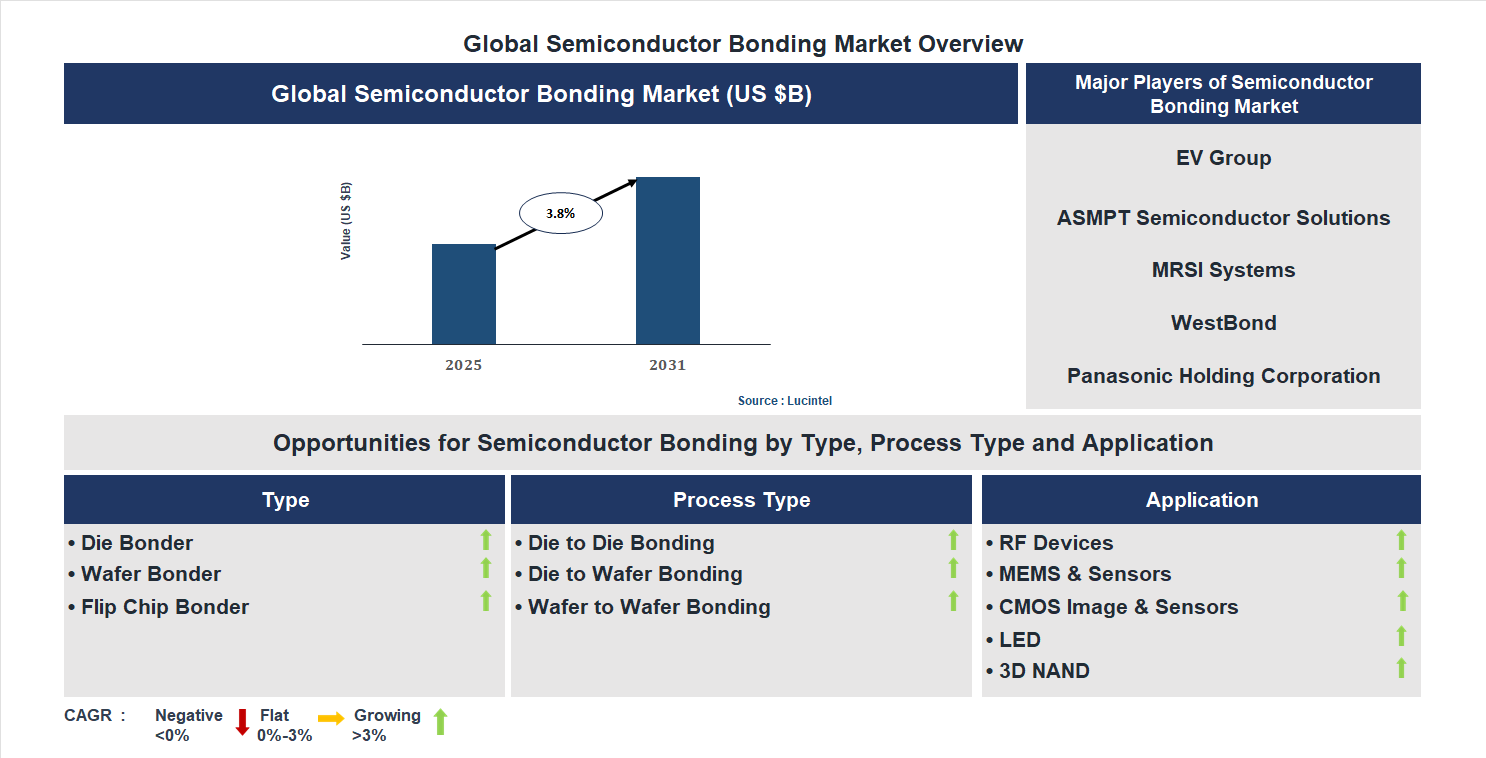
Key data points: The growth forecast = 3.8% annually for the next 7 years. Scroll below to get more insights. This market report covers trends, opportunities and forecasts in semiconductor bonding market to 2031 by type (die bonder, wafer bonder, and flip chip bonder), process type (die to die bonding, die to wafer bonding, and wafer to wafer bonding), application (RF devices, MEMS & sensors, CMOS image & sensors, LED, and 3D NAND), and region (North America, Europe, Asia Pacific, and the Rest of the World)
We'll send your sample report shortly.
• Lucintel forecasts that, within the type category, die bonder is expected to witness the highest growth over the forecast period.
• Within the application category, CMOS image & sensor is expected to witness the highest growth.
• In terms of region, APAC is expected to witness the highest growth over the forecast period. Gain valuable insights for your business decisions with our comprehensive 150+ page report. Sample figures with some insights are shown below.
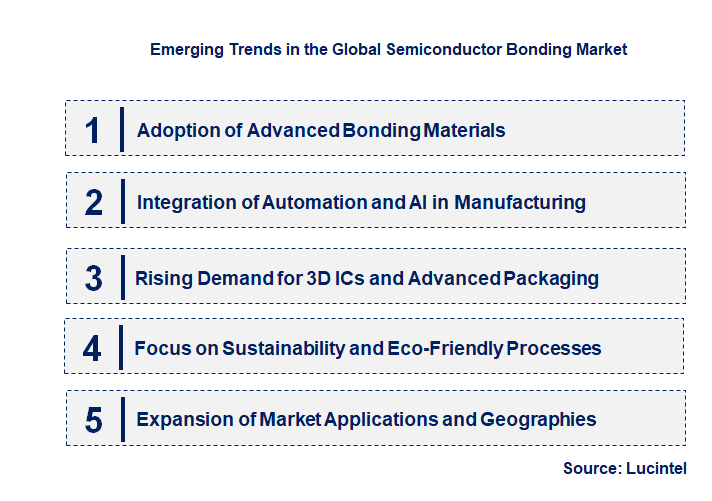
• Adoption of Advanced Bonding Materials: The market is witnessing a shift towards innovative bonding materials such as thermocompression, anisotropic conductive adhesives, and low-temperature solders. These materials offer improved electrical conductivity, thermal management, and mechanical stability, enabling the production of smaller, more efficient devices. Their adoption reduces manufacturing complexity and costs while enhancing device reliability. As demand for high-performance semiconductors grows, these advanced materials are becoming critical in achieving the desired miniaturization and durability, thus driving market growth and opening new opportunities for manufacturers.
• Integration of Automation and AI in Manufacturing: Automation and artificial intelligence are transforming semiconductor bonding processes by increasing precision, reducing errors, and enhancing throughput. Automated systems enable consistent quality control and faster production cycles, which are vital in meeting the high-volume demands of modern electronics. AI-driven analytics optimize process parameters, predict equipment failures, and improve yield rates. This integration results in cost savings, higher efficiency, and improved product quality, making manufacturing more sustainable and competitive. As these technologies mature, they are expected to become standard practices across the industry, further accelerating innovation.
• Rising Demand for 3D ICs and Advanced Packaging: The growth of 3D integrated circuits and advanced packaging solutions is a significant trend shaping the market. These technologies enable stacking of multiple semiconductor layers, leading to higher performance and reduced form factors. Bonding techniques such as wafer-to-wafer and die-to-wafer bonding are crucial for these applications. The demand is driven by the need for faster data processing, lower power consumption, and compact device designs in smartphones, data centers, and automotive electronics. This trend is pushing the development of specialized bonding methods and materials tailored for 3D integration, thereby expanding market opportunities.
• Focus on Sustainability and Eco-Friendly Processes: Environmental concerns and regulatory pressures are prompting the industry to adopt greener bonding processes. This includes the development of lead-free solders, low-temperature bonding techniques, and recyclable materials. These eco-friendly approaches reduce hazardous waste, lower energy consumption, and minimize the carbon footprint of manufacturing operations. Companies investing in sustainable practices are gaining competitive advantages and meeting consumer expectations for environmentally responsible products. The shift towards sustainability is expected to influence material selection, process design, and overall market dynamics, fostering innovation in eco-conscious bonding solutions.
• Expansion of Market Applications and Geographies: The semiconductor bonding market is expanding beyond traditional consumer electronics into sectors like automotive, healthcare, and industrial automation. The increasing adoption of electric vehicles and IoT devices is fueling demand for reliable, high-performance bonding solutions. Geographically, emerging markets in Asia-Pacific and Latin America are experiencing rapid growth due to expanding electronics manufacturing hubs and technological adoption. This diversification broadens the market scope, encourages regional innovation, and creates new revenue streams. As applications diversify and markets globalize, the industry is poised for sustained growth and increased competitiveness. In summary, these emerging trends are fundamentally reshaping the semiconductor bonding market by fostering innovation, improving efficiency, and expanding application horizons. They are driving the industry towards more sustainable, high-performance, and cost-effective solutions, ensuring its continued evolution in a competitive global landscape.
• Technological Innovations in Bonding Techniques: New methods like direct bonding and hybrid bonding are improving electrical performance and thermal management, leading to more reliable semiconductor devices and expanding application possibilities.
• Adoption of Advanced Materials: The integration of novel materials such as graphene and low-temperature solders enhances bonding strength and reduces manufacturing costs, boosting overall market competitiveness.
• Growing Demand in Automotive and Healthcare Sectors: Increased use of semiconductor bonding in electric vehicles and medical devices is driving market expansion, emphasizing the need for durable and high-performance bonding solutions.
• Sustainability and Eco-friendly Solutions: Market players are focusing on developing environmentally friendly bonding materials and processes, aligning with global sustainability goals and regulatory standards.
• Supply Chain Optimization and Geopolitical Influences: Disruptions and trade tensions are prompting companies to diversify supply sources and innovate supply chain strategies, impacting market stability and growth trajectories. These developments are collectively transforming the semiconductor bonding market by enhancing product performance, reducing costs, and expanding application areas, thereby fostering a more resilient and innovative industry landscape.
• Consumer Electronics: Growing demand for compact, high-performance devices : The proliferation of smartphones, tablets, and wearables necessitates advanced bonding solutions that enable miniaturization and improved device reliability, driving innovation in bonding materials and techniques.
• Automotive Industry: Increasing adoption of electric vehicles and advanced driver-assistance systems : The need for durable, high-temperature resistant bonds in automotive electronics and power modules is expanding, prompting development of specialized bonding solutions to withstand harsh conditions.
• Healthcare Devices: Rising use of medical imaging and diagnostic equipment : Precise, reliable bonding is essential for sensitive medical devices, creating opportunities for bonding solutions that offer high precision, biocompatibility, and long-term stability.
• Industrial Automation: Expansion of robotics and IoT-enabled machinery : The demand for robust, high-strength bonds in industrial equipment and sensors is increasing, encouraging the development of bonding materials that can endure extreme environments and mechanical stress.
• Emerging Technologies: Growth in 3D ICs and advanced packaging : The shift towards 3D integrated circuits and complex packaging solutions requires innovative bonding techniques that enable high-density interconnections, fostering new research and development efforts. In summary, these growth opportunities are significantly impacting the semiconductor bonding market by driving innovation, expanding application scopes, and enhancing product performance. As industries evolve, the demand for specialized, reliable bonding solutions is expected to accelerate market growth, fostering competitive advantages and technological advancements across sectors.
• Technological Innovation: The continuous evolution of semiconductor devices necessitates advanced bonding techniques such as wafer-level, flip-chip, and hybrid bonding. These innovations improve device performance, miniaturization, and thermal management, fueling market growth. As consumer electronics, automotive, and industrial sectors demand higher efficiency, the need for cutting-edge bonding solutions becomes critical. Companies investing in R&D to develop novel bonding materials and processes are further propelling the market forward, ensuring compatibility with next-generation semiconductor architectures.
• Rising Demand for Consumer Electronics: The proliferation of smartphones, tablets, wearables, and IoT devices has significantly increased the need for compact, high-performance semiconductors. Bonding techniques are essential for stacking multiple chips and integrating complex circuitry within limited spaces. This surge in consumer electronics production, driven by technological trends and consumer preferences, directly boosts demand for advanced bonding solutions, creating new opportunities for manufacturers and suppliers in the market.
• Growth in Automotive Electronics: The automotive industry is increasingly integrating semiconductors for applications such as ADAS, electric vehicles, and autonomous driving systems. These applications require reliable, high-speed, and thermally efficient bonding methods to ensure safety and performance. The expansion of electric vehicle production and smart automotive systems is a major driver, prompting innovations in bonding materials that can withstand harsh environments and high temperatures, thus expanding the market scope.
• Expansion of 5G Infrastructure: The deployment of 5G networks necessitates advanced semiconductor components with enhanced bonding techniques to support high-frequency and high-speed data transmission. The demand for miniaturized, high-performance chips in base stations, smartphones, and data centers is fueling the need for innovative bonding solutions. This technological shift is encouraging manufacturers to develop specialized bonding processes that meet the stringent requirements of 5G infrastructure, thereby driving market growth. The challenges facing this semiconductor bonding market include:-
• Supply Chain Disruptions: The semiconductor industry is highly dependent on a global supply chain for raw materials, equipment, and components. Disruptions caused by geopolitical tensions, pandemics, or trade restrictions can lead to shortages, delays, and increased costs. These issues hinder production schedules and limit market expansion, forcing companies to seek alternative sources or innovate supply chain management, which can be costly and time-consuming.
• Environmental and Regulatory Constraints: Increasing environmental concerns and stricter regulations regarding hazardous materials used in bonding processes pose significant challenges. Compliance with environmental standards such as RoHS and REACH requires the adoption of eco-friendly materials and processes, which may involve substantial R&D investments. Navigating these regulatory landscapes can slow down product development and increase operational costs, impacting overall market competitiveness.
• Technological Complexity and Cost: Developing advanced bonding techniques involves high R&D costs and technical complexity. Smaller players may struggle to keep pace with rapid technological changes, leading to market consolidation. Additionally, the high costs associated with new equipment and materials can limit adoption, especially among emerging markets. This complexity can also result in longer development cycles and increased risk, potentially stifling innovation and market growth. In summary, the semiconductor bonding market is shaped by rapid technological advancements, increasing demand across various sectors, and evolving regulatory standards. While these drivers present significant growth opportunities, challenges such as supply chain disruptions, environmental constraints, and technological complexities pose risks that could hinder progress. Overall, the markets future depends on how effectively stakeholders navigate these factors, balancing innovation with sustainability and resilience to sustain long-term growth.
• EV Group
• ASMPT Semiconductor Solutions
• MRSI Systems
• WestBond
• Panasonic Holding Corporation
• Palomar Technologies
• Dr. Tresky
• BE Semiconductor Industries
• Fasford Technology
• Kulicke and Soffa Industries
• Die Bonder
• Wafer Bonder
• Flip Chip Bonder
• Die to Die Bonding
• Die to Wafer Bonding
• Wafer to Wafer Bonding
• RF Devices
• MEMS & Sensors
• CMOS Image & Sensors
• LED
• 3D NAND
• North America
• Europe
• Asia Pacific
• The Rest of the World
• United States: The US market is witnessing significant advancements in wafer-level bonding and 3D integration technologies. Leading companies are investing in R&D to develop more reliable and scalable bonding solutions, driven by the growth of AI, IoT, and 5G applications. The government’s CHIPS Act aims to bolster domestic semiconductor manufacturing, encouraging innovation and reducing reliance on foreign suppliers. Additionally, US startups are pioneering novel bonding materials and techniques, contributing to increased market competitiveness and technological leadership.
• China: China is rapidly expanding its semiconductor bonding capabilities through substantial government funding and strategic initiatives. The focus is on developing indigenous technologies to reduce dependence on foreign imports amid ongoing trade tensions. Chinese firms are investing in advanced bonding processes such as hybrid bonding and copper-to-copper bonding, aiming to enhance device performance and miniaturization. The country is also establishing new fabrication plants and research centers to foster innovation and increase domestic production capacity.
• Germany: Germany remains a key player in the European semiconductor market, emphasizing high-precision bonding techniques for automotive and industrial applications. The country is advancing in the development of ultra-fine pitch bonding and wafer-level packaging, supported by strong collaborations between industry and academia. Germany’s focus on sustainability and energy efficiency is driving innovations in low-temperature bonding processes. The government and private sector are jointly investing in research to maintain technological leadership and meet the growing demand for reliable, high-performance semiconductor components.
• India: India is emerging as a significant hub for semiconductor assembly and testing, with a focus on developing local supply chains. The government’s initiatives, such as the Production Linked Incentive scheme, aim to attract investments in semiconductor manufacturing and bonding technology. Indian companies are adopting advanced bonding techniques like flip-chip and wire bonding to improve device performance. The country is also investing in skill development and infrastructure to support the growth of the semiconductor ecosystem, positioning itself as a future manufacturing and innovation center.
• Japan: Japan continues to innovate in semiconductor bonding, particularly in the areas of fine-pitch and high-reliability bonding solutions. The country’s industry leaders are focusing on improving bonding materials and processes to meet the demands of next-generation electronics, including 5G and autonomous vehicles. Japan’s emphasis on quality and durability is driving research into new bonding materials that can withstand extreme conditions. Additionally, collaborations between Japanese firms and global technology companies are fostering the development of cutting-edge bonding technologies to maintain Japan’s competitive edge in the global market.


• EV Group
• ASMPT Semiconductor Solutions
• MRSI Systems
• WestBond
• Panasonic Holding Corporation
• Palomar Technologies
• Dr. Tresky
• BE Semiconductor Industries
• Fasford Technology
• Kulicke and Soffa Industries Q5. Which semiconductor bonding market segment will be the largest in future? Answer: Lucintel forecasts that, within the type category, die bonder is expected to witness the highest growth over the forecast period. Q6. In semiconductor bonding market, which region is expected to be the largest in next 5 years? Answer: In terms of region, APAC is expected to witness the highest growth over the forecast period. Q7. Do we receive customization in this report? Answer: Yes, Lucintel provides 10% customization without any additional cost.


Choose a license that fits your team. Instant PDF delivery.
Prices exclude taxes. Instant delivery. Custom licensing available on request.
Market Report · July 24, 2026
Market Report · July 20, 2026
Market Report · July 20, 2026
Trusted partner for strategic intelligence and business growth


Receive a complimentary market analysis tailored to your industry. Our analysts will identify key growth opportunities and competitive dynamics specific to your business.

Market size, growth rate, and key trend analysis for your specific sector.

Top competitor positioning and market share analysis.

Strategic recommendations backed by data-driven insights.
Get curated market intelligence and competitive moves straight to your inbox.
By subscribing, you agree to receive our monthly insights. Unsubscribe anytime.
Receive a complimentary market analysis tailored to your industry. Our analysts will identify key growth opportunities and competitive dynamics specific to your business.
Market size, growth rate, and key trend analysis for your specific sector.
Top competitor positioning and market share analysis.
Strategic recommendations backed by data-driven insights.
Get curated market intelligence, emerging trends, and competitive moves straight to your inbox each month.
By subscribing, you agree to receive our monthly insights. Unsubscribe anytime.
We'll send your sample report shortly.