
Security Service Market Trends and Forecast
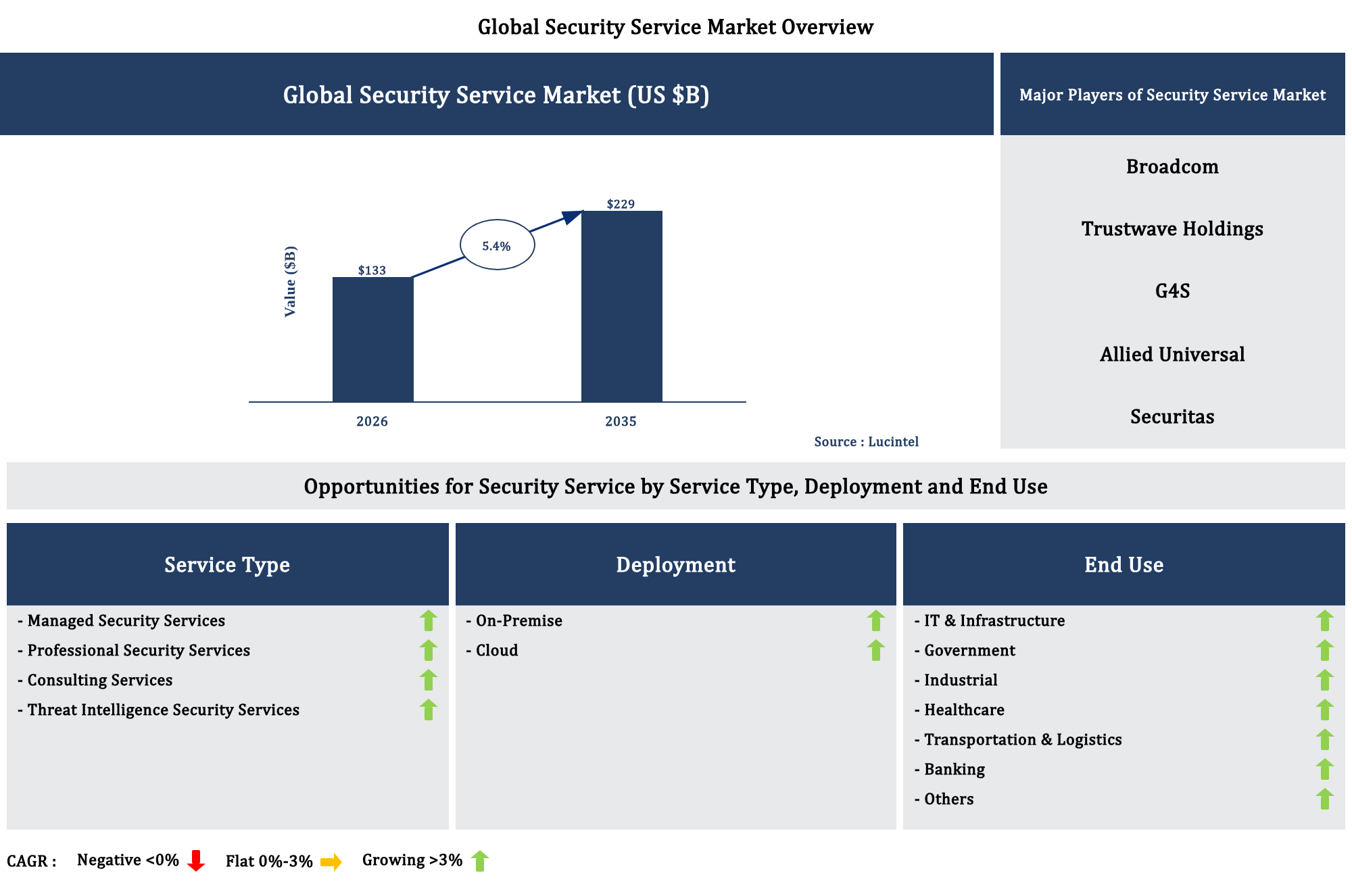
The future of the global security service market looks promising with opportunities in the IT & infrastructure, government, industrial, healthcare, transportation & logistic, and banking markets. The global security service market is expected to reach an estimated $229 billion by 2035 with a CAGR of 5.4% from 2026 to 2035. The major drivers for this market are the increasing need for security services, the growing use of cctv & monitoring systems, and the rising demand for terrorism threats boosting security.
• Lucintel forecasts that, within the service type category, managed security service is expected to witness the highest growth over the forecast period.
• Within the end use category, IT & infrastructure is expected to witness the highest growth.
• In terms of region, APAC is expected to witness the highest growth over the forecast period.
Gain valuable insights for your business decisions with our comprehensive 150+ page report. Sample figures with some insights are shown below.
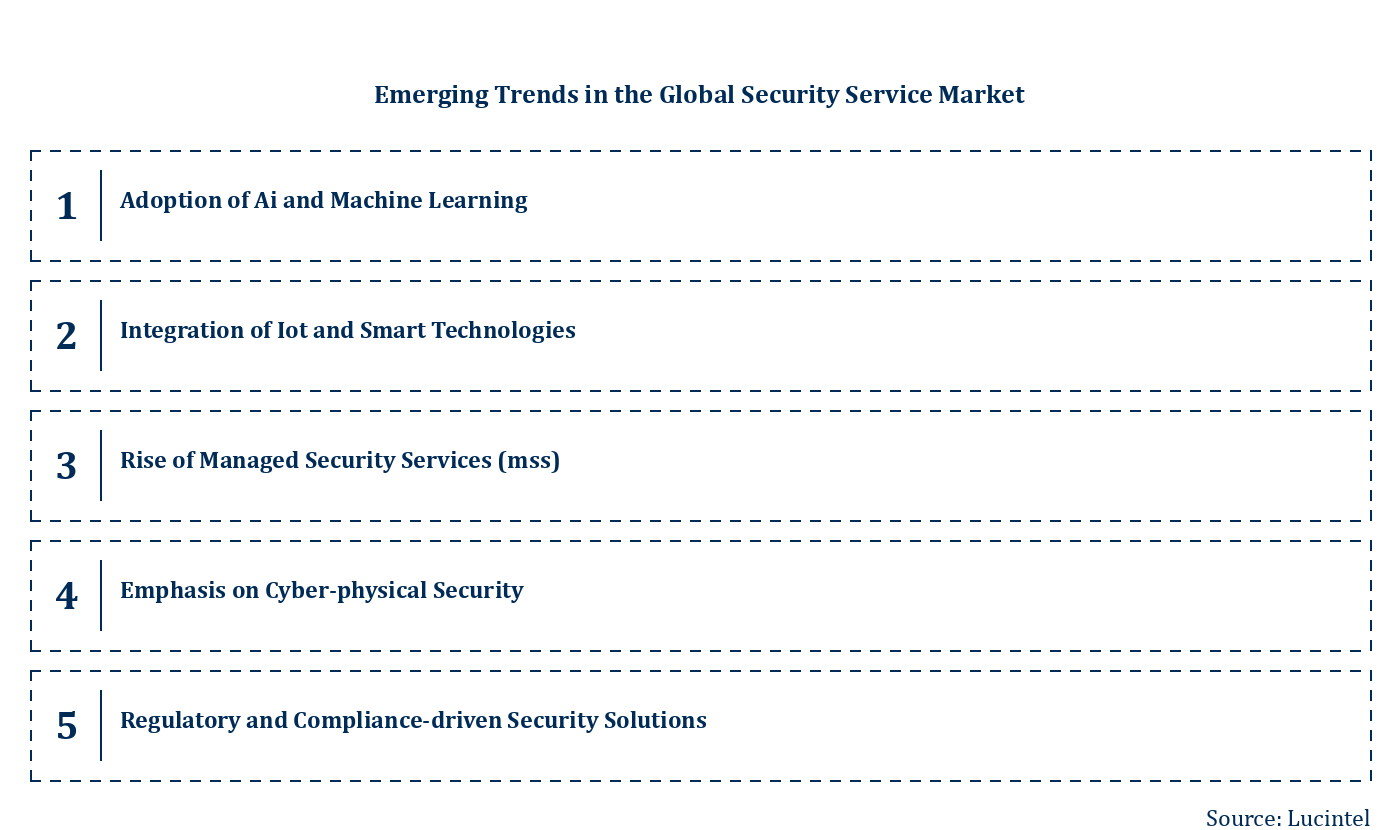
Emerging Trends in the Security Service Market
The security service market is experiencing rapid transformation driven by technological advancements, evolving threats, and changing customer expectations. As digital and physical security needs become more complex, providers are adopting innovative solutions to stay competitive. These developments are reshaping how security services are delivered, emphasizing automation, integration, and personalized offerings. The market is also witnessing increased regulatory pressures and a focus on proactive security measures. These trends collectively influence market dynamics, creating new opportunities and challenges for providers and consumers alike. Understanding these emerging trends is crucial for stakeholders aiming to navigate the future landscape effectively.
• Adoption of AI and Machine Learning: Enhances threat detection and response capabilities by enabling real-time analysis of vast data sets, reducing false alarms, and improving accuracy. AI-driven security systems can predict potential breaches and automate responses, increasing efficiency and reducing reliance on human intervention. This trend is transforming traditional security models into smarter, more adaptive solutions, leading to faster incident management and improved safety outcomes.
• Integration of IoT and Smart Technologies: Connects various security devices and systems for seamless communication and centralized control. IoT-enabled security solutions allow for real-time monitoring, remote management, and data sharing across multiple platforms, improving overall security posture. This integration facilitates proactive threat detection, enhances situational awareness, and enables customized security protocols, making security services more responsive and efficient.
• Rise of Managed Security Services (MSS): Outsourcing security functions to specialized providers is gaining popularity due to cost efficiency and access to advanced technologies. MSS providers offer comprehensive solutions, including monitoring, incident response, and compliance management, allowing organizations to focus on core activities. This trend is driven by increasing security complexity and the need for 24/7 vigilance, making managed services a preferred choice for many enterprises.
• Emphasis on Cyber-Physical Security: As physical and digital security converge, there is a growing focus on protecting both realms simultaneously. This includes securing IoT devices, critical infrastructure, and data centers against cyber threats that could impact physical assets. The integration of cybersecurity with physical security measures enhances overall resilience and reduces vulnerabilities, especially in sectors like manufacturing, transportation, and energy.
• Regulatory and Compliance-driven Security Solutions: Increasing regulatory requirements are pushing organizations to adopt security measures that ensure compliance with standards such as GDPR, HIPAA, and others. Providers are developing solutions that facilitate compliance reporting, data protection, and audit readiness. This trend emphasizes the importance of legal adherence and risk mitigation, influencing product development and service offerings in the security market.
These emerging trends are fundamentally reshaping the security service market by fostering smarter, more integrated, and proactive security solutions. They are enabling organizations to better anticipate threats, respond swiftly, and comply with evolving regulations, ultimately leading to a more resilient and efficient security landscape.
Recent Developments in the Security Service Market
The security service market is experiencing rapid evolution driven by technological advancements, increasing security concerns, and the need for integrated solutions. Businesses and governments are investing heavily in innovative security measures to protect assets, data, and personnel. These developments are reshaping the industry landscape, creating new opportunities for providers and stakeholders. As the market adapts to emerging threats and digital transformation, understanding key growth areas is essential for strategic planning and investment.
• Growing Adoption of AI and Machine Learning: AI and machine learning are revolutionizing security services by enabling real-time threat detection, automated responses, and predictive analytics. These technologies improve accuracy, reduce response times, and enhance overall security posture. Organizations benefit from proactive threat management, minimizing potential damages. The integration of AI-driven solutions is expected to significantly boost market growth, attract investments, and foster innovation in security services, making them more efficient and scalable.
• Expansion of Cloud-Based Security Solutions: Cloud security services are gaining popularity due to their flexibility, cost-effectiveness, and ease of deployment. They allow organizations to monitor and manage security remotely, ensuring continuous protection across distributed networks. Cloud solutions also facilitate rapid updates and integration with other digital tools. As cyber threats evolve, the demand for scalable, cloud-based security services is increasing, driving market expansion and enabling businesses to adopt more comprehensive security strategies.
• Increasing Demand for Physical Security Services: Physical security remains vital amid rising concerns over theft, vandalism, and terrorism. The market is witnessing growth in surveillance systems, access control, and security personnel services. Technological integration, such as biometric access and smart surveillance, enhances effectiveness. Governments and private sectors are investing heavily to upgrade security infrastructure, which boosts market revenue. The focus on comprehensive security solutions that combine physical and cyber security is creating new opportunities for service providers.
• Rising Importance of Cybersecurity Services: As digital transformation accelerates, cyber threats become more sophisticated and frequent. The demand for cybersecurity services, including threat intelligence, incident response, and vulnerability assessments, is surging. Organizations seek to protect sensitive data and maintain regulatory compliance. The market is witnessing increased investments in cybersecurity solutions, fostering innovation and specialization. This trend underscores the critical role of cybersecurity in overall security strategies, significantly impacting market growth and competitiveness.
• Integration of IoT and Smart Security Systems: IoT-enabled security devices and smart systems are transforming security management by providing real-time monitoring and automation. Connected sensors, cameras, and alarms enhance situational awareness and enable quick responses. The integration of IoT with existing security infrastructure offers comprehensive, scalable solutions for various sectors. This technological convergence is driving market growth, creating new revenue streams, and encouraging innovation. It also presents challenges related to data privacy and system interoperability, which are being actively addressed.
These developments are significantly transforming the security service market by enhancing efficiency, scalability, and responsiveness. The integration of advanced technologies like AI, IoT, and cloud solutions is creating more comprehensive and proactive security strategies. As demand for both cyber and physical security grows, the market is poised for sustained expansion. These innovations are attracting investments, fostering competition, and enabling providers to deliver more tailored, effective security solutions across diverse sectors.
Strategic Growth Opportunities in the Security Service Market
The security service market is experiencing rapid expansion driven by increasing safety concerns, technological advancements, and evolving threat landscapes. Organizations across sectors are investing heavily in comprehensive security solutions to protect assets, data, and personnel. The integration of innovative technologies such as AI, IoT, and cloud-based systems is creating new opportunities for service providers. As threats become more sophisticated, the demand for customized, scalable, and proactive security services continues to grow, shaping the future landscape of the industry.
• Growing Adoption of AI and Machine Learning for Predictive Security: The integration of AI and machine learning enhances threat detection and response capabilities, enabling security services to proactively identify vulnerabilities and respond swiftly to incidents. These technologies facilitate real-time analysis of vast data streams, reducing false positives and improving accuracy. As organizations seek smarter security solutions, providers investing in AI-driven systems will gain a competitive edge, driving market growth and enabling more efficient, adaptive security strategies.
• Expansion of IoT-Enabled Security Solutions for Smarter Environments: The proliferation of IoT devices creates new security challenges and opportunities. IoT-enabled security solutions offer real-time monitoring, remote management, and automation for smart buildings, industrial facilities, and urban infrastructure. These solutions improve operational efficiency and safety while reducing manual oversight. As IoT adoption accelerates, demand for integrated security services that can manage complex, interconnected systems will surge, fostering innovation and market expansion.
• Increasing Demand for Cybersecurity Services in Critical Infrastructure: Critical infrastructure sectors such as energy, transportation, and healthcare face escalating cyber threats. Security service providers are increasingly offering specialized cybersecurity solutions to safeguard these vital assets. The need for continuous monitoring, threat intelligence, and incident response is driving growth in this segment. Governments and private entities are investing heavily to protect against cyberattacks, creating significant opportunities for security firms to develop tailored, resilient cybersecurity strategies.
• Rising Importance of Integrated Security Solutions for Comprehensive Protection: Organizations are shifting towards integrated security systems that combine physical security, cybersecurity, and surveillance into unified platforms. This holistic approach enhances situational awareness and streamlines management. Vendors offering scalable, interoperable solutions are positioned to capitalize on this trend. The demand for seamless, end-to-end security services is expected to grow as organizations seek to simplify operations and improve overall security posture through integrated technologies.
• Increasing Focus on Remote and Cloud-Based Security Services: The shift towards remote work and cloud computing has heightened the need for remote security management and cloud-based solutions. These services offer flexibility, scalability, and cost-efficiency, enabling organizations to monitor and control security remotely. Cloud security services also facilitate rapid deployment and updates, reducing downtime. As digital transformation accelerates, the market for remote and cloud-based security solutions will expand, providing new avenues for service providers to innovate and meet evolving client needs.
These growth opportunities are poised to significantly influence the security service market by fostering innovation, expanding service offerings, and addressing emerging threats. The integration of advanced technologies and the increasing complexity of security environments will drive sustained market growth. Providers that adapt to these trends and develop comprehensive, scalable solutions will be well-positioned to capitalize on future demand, shaping a more secure and resilient landscape.
Security Service Market Driver and Challenges
The security service market is influenced by a complex interplay of technological advancements, economic shifts, and regulatory frameworks. As digital transformation accelerates, the demand for sophisticated security solutions grows, driven by increasing cyber threats and physical security concerns. Economic factors such as rising investments in security infrastructure and the need to protect assets further propel market growth. Simultaneously, evolving regulations around data privacy and security standards shape service offerings and compliance requirements. These drivers and challenges collectively determine the trajectory of the security service market, impacting stakeholders from service providers to end-users. Understanding these factors is essential for strategic planning and sustainable growth in this dynamic industry.
The factors responsible for driving the security service market include:
• Technological Innovation: The rapid development of advanced security technologies such as AI, IoT, and biometric systems enhances threat detection and response capabilities. These innovations enable providers to offer more efficient, real-time security solutions, increasing market competitiveness. As organizations seek smarter security measures, the adoption of cutting-edge tech becomes a key growth driver, fostering market expansion and service diversification.
• Increasing Cybersecurity Threats: The surge in cyberattacks, data breaches, and hacking incidents compels organizations across sectors to invest heavily in security services. The rising frequency and sophistication of cyber threats create a persistent demand for comprehensive security solutions, including monitoring, threat intelligence, and incident response, thereby fueling market growth.
• Growing Adoption of Managed Security Services: Businesses prefer outsourcing security functions to specialized providers to reduce costs and access expert knowledge. Managed security services offer scalable, 24/7 monitoring and rapid incident management, making them attractive to small and large enterprises alike. This trend significantly expands the market by broadening the customer base and service scope.
• Regulatory and Compliance Pressures: Increasing regulations related to data privacy, financial security, and industry-specific standards compel organizations to enhance their security measures. Compliance requirements drive demand for specialized security services that help companies meet legal obligations, thereby supporting market growth and service innovation.
The challenges in the security service market are:
• Rapidly Evolving Threat Landscape: The constantly changing nature of cyber and physical threats makes it difficult for security providers to stay ahead. Attackers develop new tactics and tools, requiring continuous updates to security solutions. This dynamic environment increases operational costs and complicates the development of comprehensive, future-proof security strategies.
• High Implementation and Maintenance Costs: Advanced security systems and services often involve significant initial investments and ongoing expenses. Small and medium-sized enterprises may find these costs prohibitive, limiting market penetration. Additionally, maintaining sophisticated security infrastructure demands specialized skills, adding to the financial and operational burden.
• Regulatory Complexity and Compliance Challenges: Navigating diverse and evolving regulatory frameworks across regions can be complex and resource-intensive. Non-compliance risks penalties and reputational damage, prompting organizations to invest heavily in compliance-related security measures. This complexity can slow down market growth and create barriers for new entrants.
The security service market is driven by technological advancements, increasing cyber threats, managed service adoption, and regulatory pressures. However, it faces challenges such as a rapidly evolving threat landscape, high costs, and regulatory complexities. These factors collectively shape the market‘s growth trajectory, requiring stakeholders to innovate continuously and adapt to changing conditions. Strategic responses to these drivers and challenges will determine the market‘s future stability and expansion potential.
List of Security Service Companies
Companies in the market compete on the basis of product quality offered. Major players in this market focus on expanding their manufacturing facilities, R&D investments, infrastructural development, and leverage integration opportunities across the value chain. With these strategies security service companies cater increasing demand, ensure competitive effectiveness, develop innovative products & technologies, reduce production costs, and expand their customer base. Some of the security service companies profiled in this report include-
• Broadcom
• Trustwave Holdings
• G4S
• Allied Universal
• Securitas
• Unity Resource
• Constellis
• DSS Securitech
• Fortra LLC7
• IBM
Security Service Market by Segment
The study includes a forecast for the global security service market by service type, deployment, end use, and region.
Security Service Market by Service Type [Value from 2019 to 2035]:
• Managed Security Services
• Professional Security Services
• Consulting Services
• Threat Intelligence Security Services
Security Service Market by Deployment [Value from 2019 to 2035]:
• On-Premise
• Cloud
Security Service Market by End Use [Value from 2019 to 2035]:
• IT & Infrastructure
• Government
• Industrial
• Healthcare
• Transportation & Logistics
• Banking
• Others
Security Service Market by Region [Value from 2019 to 2035]:
• North America
• Europe
• Asia Pacific
• The Rest of the World
Country Wise Outlook for the Security Service Market
The security service market has experienced rapid growth and transformation driven by technological advancements, increasing security concerns, and evolving regulatory landscapes across the globe. Countries are investing heavily in innovative solutions such as AI, IoT, and cloud-based security systems to enhance safety and operational efficiency. The market‘s expansion is also influenced by rising cyber threats, terrorism, and the need for integrated security solutions. Each country’s unique geopolitical and economic factors shape their security strategies, leading to diverse developments. These trends reflect a global shift towards smarter, more adaptive security services that address both physical and cyber vulnerabilities.
• United States: The US security service market has seen significant growth with a focus on integrating AI and IoT technologies for enhanced surveillance and threat detection. Major investments are directed toward cybersecurity solutions to combat rising cyberattacks. Private security firms are expanding their offerings to include advanced analytics and remote monitoring. Government agencies are also adopting more sophisticated security protocols, including biometric access controls and drone surveillance. The market is driven by increasing concerns over terrorism, cybercrime, and infrastructure protection, with a strong emphasis on innovation and public-private partnerships.
• China: China’s security service market is rapidly expanding, fueled by government initiatives to strengthen national security and social stability. The country is investing heavily in AI-powered surveillance systems, facial recognition, and big data analytics. Smart city projects are integrating security solutions to monitor urban environments efficiently. The private sector is also adopting advanced security technologies to protect assets and data. Cybersecurity remains a priority, with strict regulations and government-led initiatives to combat cyber threats. Overall, China’s market is characterized by rapid technological adoption and a focus on comprehensive, integrated security networks.
• Germany: Germany’s security service market emphasizes cybersecurity, critical infrastructure protection, and compliance with strict data privacy laws such as GDPR. The country is investing in innovative security solutions like biometric authentication and AI-driven threat detection. Public-private collaborations are strengthening, especially in protecting transportation, energy, and financial sectors. Germany is also focusing on developing resilient security systems to counter cyberattacks and terrorism. The market is characterized by a cautious approach to technology adoption, prioritizing data security and privacy while integrating advanced security measures to safeguard national interests.
• India: India’s security service market is experiencing rapid growth driven by increasing urbanization, cyber threats, and terrorism concerns. The government is investing in smart city projects, IoT-enabled surveillance, and integrated security systems. Cybersecurity is gaining prominence due to rising digital adoption and cyberattacks targeting financial and government institutions. The private security sector is expanding, offering advanced solutions like AI-based monitoring and biometric access controls. Additionally, India is focusing on border security and counter-terrorism measures. The market’s growth is supported by government initiatives and a rising demand for comprehensive security solutions across sectors.
• Japan: Japan’s security service market is evolving with a focus on cybersecurity, disaster prevention, and aging population challenges. The country is adopting AI, robotics, and IoT for enhanced security and emergency response. Cybersecurity remains a top priority, especially for protecting critical infrastructure and financial systems. Japan is also investing in disaster preparedness and response systems, integrating security solutions with smart city initiatives. The private sector is adopting innovative technologies to address demographic challenges, including security for elderly populations. Overall, Japan’s market is characterized by technological innovation, a focus on resilience, and a proactive approach to emerging security threats.
Features of the Global Security Service Market
Market Size Estimates: Security service market size estimation in terms of value ($B).
Trend and Forecast Analysis: Market trends (2019 to 2025) and forecast (2026 to 2035) by various segments and regions.
Segmentation Analysis: Security service market size by service type, deployment, end use, and region in terms of value ($B).
Regional Analysis: Security service market breakdown by North America, Europe, Asia Pacific, and Rest of the World.
Growth Opportunities: Analysis of growth opportunities in different service type, deployment, end use, and regions for the security service market.
Strategic Analysis: This includes M&A, new product development, and competitive landscape of the security service market.
Analysis of competitive intensity of the industry based on Porter’s Five Forces model.
FAQ
Q1. What is the security service market size?
Answer: The global security service market is expected to reach an estimated $229 billion by 2035.
Q2. What is the growth forecast for security service market?
Answer: The global security service market is expected to grow with a CAGR of 5.4% from 2026 to 2035.
Q3. What are the major drivers influencing the growth of the security service market?
Answer: The major drivers for this market are the increasing need for security services, the growing use of cctv & monitoring systems, and the rising demand for terrorism threats boosting security.
Q4. What are the major segments for security service market?
Answer: The future of the security service market looks promising with opportunities in the IT & infrastructure, government, industrial, healthcare, transportation & logistic, and banking markets.
Q5. Who are the key security service market companies?
Answer: Some of the key security service companies are as follows:
• Broadcom
• Trustwave Holdings
• G4S
• Allied Universal
• Securitas
• Unity Resource
• Constellis
• DSS Securitech
• Fortra LLC7
• IBM
Q6. Which security service market segment will be the largest in future?
Answer: Lucintel forecasts that, within the service type category, managed security service is expected to witness the highest growth over the forecast period.
Q7. In security service market, which region is expected to be the largest in next 8 years?
Answer: In terms of region, APAC is expected to witness the highest growth over the forecast period.
Q8. Do we receive customization in this report?
Answer: Yes, Lucintel provides 10% customization without any additional cost.
This report answers following 11 key questions:
Q.1. What are some of the most promising, high-growth opportunities for the security service market by service type (managed security services, professional security services, consulting services, and threat intelligence security services), deployment (on-premise and cloud), end use (IT & infrastructure, government, industrial, healthcare, transportation & logistics, banking, and others), and region (North America, Europe, Asia Pacific, and the Rest of the World)?
Q.2. Which segments will grow at a faster pace and why?
Q.3. Which region will grow at a faster pace and why?
Q.4. What are the key factors affecting market dynamics? What are the key challenges and business risks in this market?
Q.5. What are the business risks and competitive threats in this market?
Q.6. What are the emerging trends in this market and the reasons behind them?
Q.7. What are some of the changing demands of customers in the market?
Q.8. What are the new developments in the market? Which companies are leading these developments?
Q.9. Who are the major players in this market? What strategic initiatives are key players pursuing for business growth?
Q.10. What are some of the competing products in this market and how big of a threat do they pose for loss of market share by material or product substitution?
Q.11. What M&A activity has occurred in the last 5 years and what has its impact been on the industry?
For any questions related to Security Service Market, Security Service Market Size, Security Service Market Growth, Security Service Market Analysis, Security Service Market Report, Security Service Market Share, Security Service Market Trends, Security Service Market Forecast, Security Service Companies, write Lucintel analyst at email: helpdesk@lucintel.com. We will be glad to get back to you soon.