
Report Feature
Secure Web Gateway Market Trends and Forecast
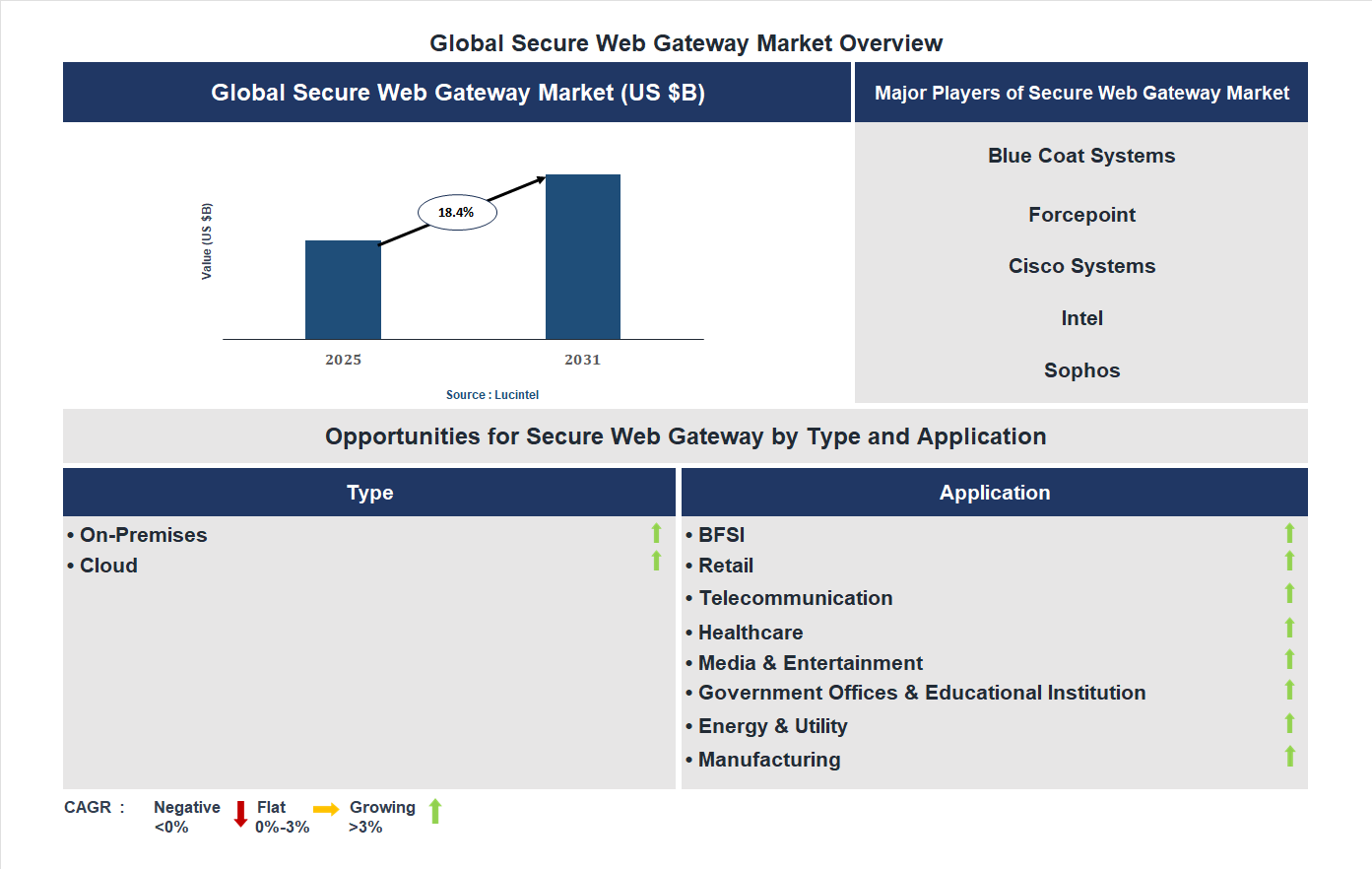
The future of the global secure web gateway market looks promising with opportunities in the BFSI, retail, telecommunication, healthcare, media & entertainment, government offices & educational institution, energy & utility, and manufacturing markets. The global secure web gateway market is expected to grow with a CAGR of 18.4% from 2025 to 2031. The major drivers for this market are the increasing demand for real-time threat protection, the rising need for secure remote access, and the growing adoption of cloud-based web security.• Lucintel forecasts that, within the type category, cloud is expected to witness higher growth over the forecast period.
• Within the application category, BFSI is expected to witness the highest growth.
• In terms of region, APAC is expected to witness the highest growth over the forecast period. Gain valuable insights for your business decisions with our comprehensive 150+ page report. Sample figures with some insights are shown below.
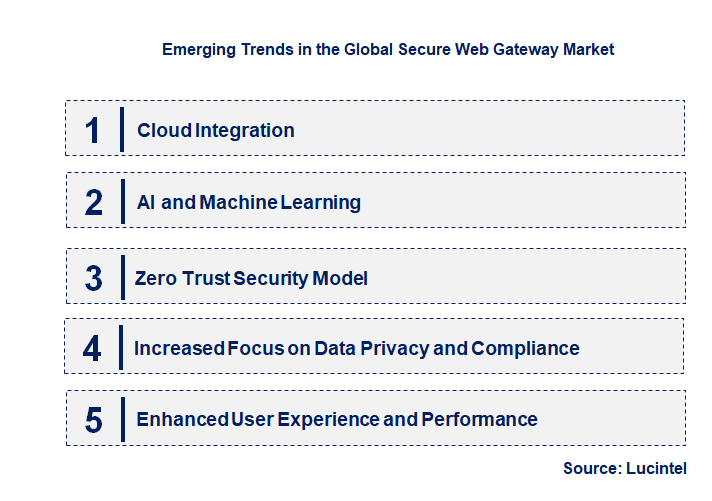
Emerging Trends in the Secure Web Gateway Market
The secure web gateway market is experiencing rapid evolution driven by increasing cyber threats, remote work trends, and the need for enhanced security measures. Organizations are prioritizing comprehensive solutions to safeguard their digital assets while ensuring compliance with regulatory standards. Technological advancements and changing user behaviors are fueling innovation within this space, leading to the emergence of new strategies and tools. These developments are transforming how businesses approach web security, emphasizing agility, scalability, and proactive threat mitigation. As the market continues to grow, understanding these key trends is essential for stakeholders aiming to stay ahead in a competitive landscape.• Cloud Integration: The integration of SWGs with cloud platforms is gaining prominence. As organizations adopt multi-cloud and hybrid cloud environments, SWGs are evolving to provide seamless security across various cloud services. This trend enhances flexibility, reduces latency, and simplifies management by enabling centralized security policies. Cloud integration also supports remote and mobile workforce security, ensuring consistent protection regardless of location. Consequently, vendors are developing cloud-native SWG solutions that are scalable, easy to deploy, and capable of handling complex cloud architectures, thereby expanding the market’s reach and effectiveness.
• AI and Machine Learning: The incorporation of AI and machine learning into SWGs is revolutionizing threat detection and response. These technologies enable real-time analysis of vast data sets to identify anomalies, malicious activities, and zero-day threats more accurately. AI-driven SWGs can adapt to evolving attack patterns, reducing false positives and enhancing security precision. This trend improves overall threat mitigation efficiency, minimizes manual intervention, and accelerates incident response times. As AI and machine learning become more sophisticated, they are set to become integral components of next-generation SWGs, significantly boosting their capabilities and market competitiveness.
• Zero Trust Security Model: The adoption of the Zero Trust security framework is influencing SWG deployment strategies. Zero Trust emphasizes strict identity verification and continuous monitoring, regardless of user location or device. SWGs are being tailored to support Zero Trust principles by enforcing granular access controls, inspecting encrypted traffic, and integrating with identity management systems. This approach reduces the attack surface and enhances security posture, especially in remote work scenarios. The shift towards Zero Trust is prompting vendors to innovate their SWG offerings, making them more adaptable and aligned with modern security paradigms.
• Increased Focus on Data Privacy and Compliance: As data privacy regulations such as GDPR, CCPA, and others tighten, organizations are prioritizing compliance within their web security strategies. SWGs are evolving to include features like data loss prevention (DLP), content filtering, and detailed audit logs to meet regulatory requirements. This trend ensures that organizations can monitor and control data flow effectively, reducing legal and financial risks. Vendors are also offering customizable policies and reporting tools to facilitate compliance management. The emphasis on privacy and regulation-driven security is shaping product development and market growth.
• Enhanced User Experience and Performance: Market players are focusing on improving user experience without compromising security. Innovations include faster browsing speeds, reduced false positives, and intuitive interfaces. Techniques such as SSL inspection optimization and cloud-based deployment are reducing latency and enhancing performance. This trend is critical as user satisfaction directly impacts adoption rates and operational efficiency. By balancing security with usability, vendors are enabling organizations to implement robust SWG solutions that do not hinder productivity, thereby broadening market appeal and driving growth. In summary, these emerging trends—cloud integration, AI and machine learning, Zero Trust adoption, compliance focus, and user experience improvements—are collectively reshaping the Secure Web Gateway market. They are fostering more agile, intelligent, and user-centric security solutions that meet the evolving needs of modern organizations. As these developments continue, the market is poised for significant growth, driven by innovation and a proactive approach to web security challenges.
Recent Development in the Secure Web Gateway Market
The secure web gateway market has experienced significant growth driven by increasing cybersecurity threats, remote work trends, and the need for robust web security solutions. As organizations prioritize protecting their digital assets, the market has seen rapid technological advancements and strategic partnerships. These developments are shaping the future landscape of web security, making it more efficient, scalable, and user-friendly. The following key developments highlight the current trajectory of the SWG Market, reflecting its evolving nature and expanding adoption across various industries.• Adoption of Cloud-Based SWGs: Content: Cloud-based SWGs are gaining popularity due to their scalability, cost-effectiveness, and ease of deployment. They enable organizations to implement security policies without extensive infrastructure investments, supporting remote and hybrid work models. This shift enhances flexibility and allows real-time threat detection, significantly reducing security gaps and improving overall web security posture.
• Integration of AI and Machine Learning: Content: AI and machine learning are increasingly integrated into SWG solutions to enhance threat detection and response capabilities. These technologies enable proactive identification of sophisticated threats, reduce false positives, and automate security processes. The integration improves accuracy and efficiency, allowing organizations to respond swiftly to emerging cyber threats and minimize potential damages.
• Rising Demand for Zero Trust Security: Content: The Zero Trust security model is becoming a core component of SWG offerings, emphasizing strict access controls and continuous verification. This approach minimizes insider threats and lateral movement within networks. The increasing adoption of Zero Trust principles is driving innovation in SWG solutions, making them more robust and aligned with modern security requirements.
• Strategic Partnerships and Collaborations: Content: Major vendors are forming alliances with technology providers, cloud service providers, and cybersecurity firms to enhance SWG capabilities. These collaborations facilitate the integration of advanced features, expand market reach, and improve customer support. Such partnerships accelerate innovation and help meet the diverse needs of organizations across sectors.
• Regulatory Compliance and Data Privacy: Content: Stringent data privacy laws and compliance standards are influencing SWG development. Vendors are incorporating features to ensure adherence to regulations like GDPR, CCPA, and others. This focus on compliance not only helps organizations avoid penalties but also builds customer trust, driving market growth and adoption of secure web gateway solutions. The recent developments in the secure web gateway market are significantly impacting its growth trajectory by making solutions more scalable, intelligent, and compliant. The integration of advanced technologies and strategic collaborations is fostering innovation, while the emphasis on zero trust and compliance is increasing adoption across industries. Overall, these trends are positioning the SWG Market for sustained expansion and enhanced cybersecurity resilience.
Strategic Growth Opportunities in the Secure Web Gateway Market
The secure web gateway market is experiencing rapid growth driven by increasing cybersecurity threats, evolving regulatory requirements, and the need for enhanced web security solutions. As organizations seek to protect their digital assets and ensure safe internet usage, key applications within this market are presenting significant growth opportunities. These opportunities are shaping the future landscape of cybersecurity, enabling businesses to adopt more robust, scalable, and intelligent SWG solutions. By focusing on specific application areas, vendors can capitalize on emerging trends and address critical security challenges faced by various industries.• Enterprise Security Enhancement: The rising frequency of cyberattacks prompts organizations to adopt advanced SWG solutions to safeguard sensitive data and ensure compliance. This growth opportunity enhances overall enterprise security posture, reduces risk exposure, and fosters trust among stakeholders.
• Cloud Security Integration: As cloud adoption accelerates, integrating SWG with cloud platforms becomes essential. This opportunity allows organizations to secure remote and distributed workforces, ensuring seamless, secure access to cloud applications and data, thereby boosting operational efficiency.
• Remote Workforce Protection: The surge in remote working arrangements necessitates robust SWG solutions to monitor and control web traffic outside traditional corporate networks. This application improves security for remote employees, reduces vulnerabilities, and supports flexible work policies.
• Industry-Specific Solutions: Tailoring SWG offerings for sectors like healthcare, finance, and government enhances compliance with industry regulations and addresses unique security challenges. This targeted approach increases market penetration and customer trust within specialized markets.
• Threat Detection and Response: Incorporating advanced threat detection capabilities into SWG solutions enables real-time identification and mitigation of cyber threats. This growth area improves overall security resilience, minimizes potential damages, and supports proactive cybersecurity strategies. In summary, these key growth opportunities are significantly impacting the Secure Web Gateway market by driving innovation, expanding application scope, and enabling organizations to better defend against evolving cyber threats. As these opportunities mature, they will foster increased adoption, market competitiveness, and overall cybersecurity maturity across industries.
Secure Web Gateway Market Driver and Challenges
The secure web gateway market is influenced by a variety of technological, economic, and regulatory factors that shape its growth and development. Rapid advancements in cybersecurity technologies, increasing adoption of cloud services, and evolving regulatory standards are key drivers. Simultaneously, economic fluctuations and the complexity of implementing comprehensive security measures pose significant challenges. As organizations seek to protect their digital assets amidst a dynamic threat landscape, understanding these drivers and challenges is essential for strategic planning and market positioning. The interplay of these factors determines the pace and direction of market expansion, influencing stakeholders across industries. The factors responsible for driving the secure web gateway market include:-• Technological Innovation: The continuous development of advanced security solutions, such as AI-powered threat detection and cloud-based SWGs, enhances protection capabilities. These innovations enable organizations to efficiently monitor and control web traffic, reduce false positives, and respond swiftly to emerging threats. As cyber threats become more sophisticated, the demand for cutting-edge SWG technologies increases, fueling market growth. Additionally, integration with other security tools like SIEM and endpoint security creates a comprehensive security ecosystem, further boosting adoption.
• Rising Cybersecurity Threats: The increasing frequency and complexity of cyberattacks, including malware, phishing, and data breaches, drive organizations to adopt robust web security solutions. SWGs serve as a critical line of defense by filtering malicious content and preventing access to harmful sites. The growing awareness of cyber risks, coupled with regulatory pressures to safeguard sensitive data, compels enterprises to invest heavily in secure web gateways, thereby expanding the market.
• Cloud Adoption and Digital Transformation: The shift towards cloud computing and digital business models necessitates flexible and scalable security solutions. SWGs that support cloud environments enable organizations to enforce security policies across distributed networks and remote workforces. This trend accelerates market growth as companies seek seamless, cloud-compatible security solutions that facilitate digital transformation without compromising security.
• Regulatory Compliance and Data Privacy: Stringent data protection laws such as GDPR, HIPAA, and CCPA require organizations to implement effective web security measures. SWGs help ensure compliance by monitoring and controlling web access, preventing data leaks, and maintaining audit trails. The increasing regulatory landscape compels organizations to upgrade their security infrastructure, thereby propelling market expansion.
• Growing Remote Workforce: The proliferation of remote work arrangements has expanded the attack surface for cyber threats. Organizations need to secure web access for remote employees, making SWGs essential for enforcing security policies outside traditional corporate networks. This trend has led to increased demand for cloud-based, scalable SWG solutions that support remote and mobile users, significantly impacting market growth. The challenges facing this secure web gateway market include:-
• Complexity of Implementation: Deploying and managing SWGs can be complex, requiring specialized expertise and significant resources. Organizations often face difficulties integrating SWGs with existing security infrastructure and ensuring compatibility across diverse IT environments. This complexity can lead to delays, increased costs, and potential security gaps if not properly managed, hindering widespread adoption.
• Evolving Threat Landscape: Cyber threats are continuously evolving, with attackers developing new techniques to bypass security measures. Keeping SWGs updated and effective against emerging threats demands ongoing investment and expertise. Failure to adapt quickly can render security solutions obsolete, exposing organizations to risks and challenging market players to innovate rapidly.
• Privacy and Data Security Concerns: While SWGs monitor web traffic to prevent threats, they also raise concerns about user privacy and data security. Organizations must balance security enforcement with respecting user privacy, especially in regulated industries. Mismanagement or overreach can lead to legal issues and loss of user trust, posing a significant challenge for market growth. In summary, the Secure Web Gateway Market is driven by technological advancements, increasing cyber threats, cloud adoption, regulatory requirements, and remote work trends. However, challenges such as implementation complexity, evolving threats, and privacy concerns must be addressed to sustain growth. The interplay of these factors influences market dynamics, requiring stakeholders to innovate and adapt continuously. Overall, the markets future depends on balancing robust security solutions with ease of deployment and privacy considerations, ensuring resilient and compliant web security environments.
List of Secure Web Gateway Companies
Companies in the market compete on the basis of product quality offered. Major players in this market focus on expanding their manufacturing facilities, R&D investments, infrastructural development, and leverage integration opportunities across the value chain. With these strategies secure web gateway companies cater increasing demand, ensure competitive effectiveness, develop innovative products & technologies, reduce production costs, and expand their customer base. Some of the secure web gateway companies profiled in this report include-• Blue Coat Systems
• Forcepoint
• Cisco Systems
• Intel
• Sophos
• Clearswift
• Trend Micro
• Zscaler
• Trustwave
• Barracuda Networks
Secure Web Gateway Market by Segment
The study includes a forecast for the global secure web gateway market by type, application, and region.Secure Web Gateway Market by Type [Value from 2019 to 2031]:
• On-Premises
• Cloud
Secure Web Gateway Market by Application [Value from 2019 to 2031]:
• BFSI
• Retail
• Telecommunication
• Healthcare
• Media & Entertainment
• Government Offices & Educational Institution
• Energy & Utility
• Manufacturing
Secure Web Gateway Market by Region [Value from 2019 to 2031]:
• North America
• Europe
• Asia Pacific
• The Rest of the World
Country Wise Outlook for the Secure Web Gateway Market
The secure web gateway market has experienced rapid growth driven by increasing cybersecurity threats, remote work trends, and the need for enhanced data protection. Organizations worldwide are investing in advanced security solutions to safeguard their networks and ensure compliance with evolving regulations. Technological innovations, such as AI and cloud integration, are shaping the market landscape, while regional policies influence adoption rates. The United States, China, Germany, India, and Japan are key players, each demonstrating unique developments aligned with their digital infrastructure and security priorities. These countries are pivotal in driving global SWG market growth through strategic investments and technological advancements.• United States: The US market has seen significant adoption of AI-powered SWGs, enhancing threat detection and response capabilities. Major vendors are integrating cloud-based solutions to support remote workforces, with increased focus on data privacy and compliance standards like GDPR and CCPA. The government is also investing in cybersecurity infrastructure, boosting market growth. Enterprises are prioritizing zero-trust security models, leading to innovative SWG deployments. The US remains a leader in technological innovation, with startups and established firms collaborating to develop next-generation security solutions.
• China: China’s SWG market is rapidly expanding, driven by government initiatives to strengthen cybersecurity and data sovereignty. Local vendors are gaining prominence by offering cost-effective, scalable solutions tailored to domestic enterprises. The government’s emphasis on cybersecurity laws encourages organizations to adopt advanced SWG solutions to meet regulatory requirements. Cloud security integration is a key trend, with a focus on protecting critical infrastructure. Additionally, partnerships between Chinese tech giants and international firms are fostering innovation, although regulatory restrictions influence market dynamics.
• Germany: Germany’s market emphasizes compliance with strict data protection regulations, such as GDPR. Enterprises are adopting SWGs to ensure secure web access while maintaining privacy standards. The focus is on integrating SWGs with existing security frameworks and enhancing threat intelligence capabilities. The German government promotes cybersecurity awareness and invests in infrastructure resilience. Industry-specific solutions are gaining traction, especially in manufacturing and automotive sectors. Overall, the market is characterized by a cautious but steady adoption of advanced SWG technologies aligned with European data privacy norms.
• India: India’s SWG market is witnessing rapid growth due to increasing cyber threats and a burgeoning digital economy. The government’s Digital India initiative encourages organizations to adopt secure web gateways to protect sensitive data. Local vendors are expanding their offerings, often providing cost-effective, scalable solutions suitable for small and medium enterprises. Cloud-based SWGs are gaining popularity, supporting remote work and digital transformation. The market is also driven by rising awareness of cybersecurity threats and regulatory compliance needs. Strategic partnerships and government-led initiatives are further accelerating market penetration across various sectors.
• Japan: Japan’s SWG market is characterized by a focus on advanced threat detection and integration with existing security systems. The country’s emphasis on cybersecurity resilience in critical infrastructure drives demand for sophisticated SWG solutions. Japanese firms are investing in AI and machine learning to enhance threat prevention capabilities. The government promotes cybersecurity standards and collaborates with international agencies to improve security frameworks. Market growth is also supported by increasing remote work and digital transformation initiatives. Japanese companies are adopting hybrid security models, combining on-premises and cloud solutions, to address diverse organizational needs effectively.

Features of the Global Secure Web Gateway Market
Market Size Estimates: Secure web gateway market size estimation in terms of value ($B). Trend and Forecast Analysis: Market trends (2019 to 2024) and forecast (2025 to 2031) by various segments and regions. Segmentation Analysis: Secure web gateway market size by type, application, and region in terms of value ($B). Regional Analysis: Secure web gateway market breakdown by North America, Europe, Asia Pacific, and Rest of the World. Growth Opportunities: Analysis of growth opportunities in different types, applications, and regions for the secure web gateway market. Strategic Analysis: This includes M&A, new product development, and competitive landscape of the secure web gateway market. Analysis of competitive intensity of the industry based on Porter’s Five Forces model.
FAQ
Q1. What is the growth forecast for secure web gateway market? Answer: The global secure web gateway market is expected to grow with a CAGR of 18.4% from 2025 to 2031. Q2. What are the major drivers influencing the growth of the secure web gateway market? Answer: The major drivers for this market are the increasing demand for real-time threat protection, the rising need for secure remote access, and the growing adoption of cloud-based web security. Q3. What are the major segments for secure web gateway market? Answer: The future of the secure web gateway market looks promising with opportunities in the BFSI, retail, telecommunication, healthcare, media & entertainment, government offices & educational institution, energy & utility, and manufacturing markets. Q4. Who are the key secure web gateway market companies? Answer: Some of the key secure web gateway companies are as follows:• Blue Coat Systems
• Forcepoint
• Cisco Systems
• Intel
• Sophos
• Clearswift
• Trend Micro
• Zscaler
• Trustwave
• Barracuda Networks Q5. Which secure web gateway market segment will be the largest in future? Answer: Lucintel forecasts that, within the type category, cloud is expected to witness higher growth over the forecast period. Q6. In secure web gateway market, which region is expected to be the largest in next 5 years? Answer: In terms of region, APAC is expected to witness the highest growth over the forecast period. Q7. Do we receive customization in this report? Answer: Yes, Lucintel provides 10% customization without any additional cost.
Table of Contents
List of Figures
List of Tables
Methodology
- In-depth interviews of the major players in this market
- Detailed secondary research from competitors’ financial statements and published data
- Extensive searches of published works, market, and database information pertaining to industry news, company press releases, and customer intentions
- A compilation of the experiences, judgments, and insights of Lucintel’s professionals, who have analyzed and tracked this market over the years.


Buy Now
Choose a license that fits your team. Instant PDF delivery.
Prices exclude taxes. Instant delivery. Custom licensing available on request.
Key Questions
- • What are some of the most promising, high-growth opportunities for the secure web gateway market by type (on-premises and cloud), application (BFSI, retail, telecommunication, healthcare, media & entertainment, government offices & educational institution, energy & utility, and manufacturing), and region (North America, Europe, Asia Pacific, and the Rest of the World)?
- • Which segments will grow at a faster pace and why?
- • Which region will grow at a faster pace and why?
- • What are the key factors affecting market dynamics? What are the key challenges and business risks in this market?
- • What are the business risks and competitive threats in this market?
- • What are the emerging trends in this market and the reasons behind them?
- • What are some of the changing demands of customers in the market?
- • What are the new developments in the market? Which companies are leading these developments?
- • Who are the major players in this market? What strategic initiatives are key players pursuing for business growth?
- • What are some of the competing products in this market and how big of a threat do they pose for loss of market share by material or product substitution?
- • What M&A activity has occurred in the last 5 years and what has its impact been on the industry? For any questions related to Secure Web Gateway Market, Secure Web Gateway Market Size, Secure Web Gateway Market Growth, Secure Web Gateway Market Analysis, Secure Web Gateway Market Report, Secure Web Gateway Market Share, Secure Web Gateway Market Trends, Secure Web Gateway Market Forecast, Secure Web Gateway Companies, write Lucintel analyst at email: helpdesk@lucintel.com. We will be glad to get back to you soon.


