
Report Feature
Scramjet Engine Market Trends and Forecast
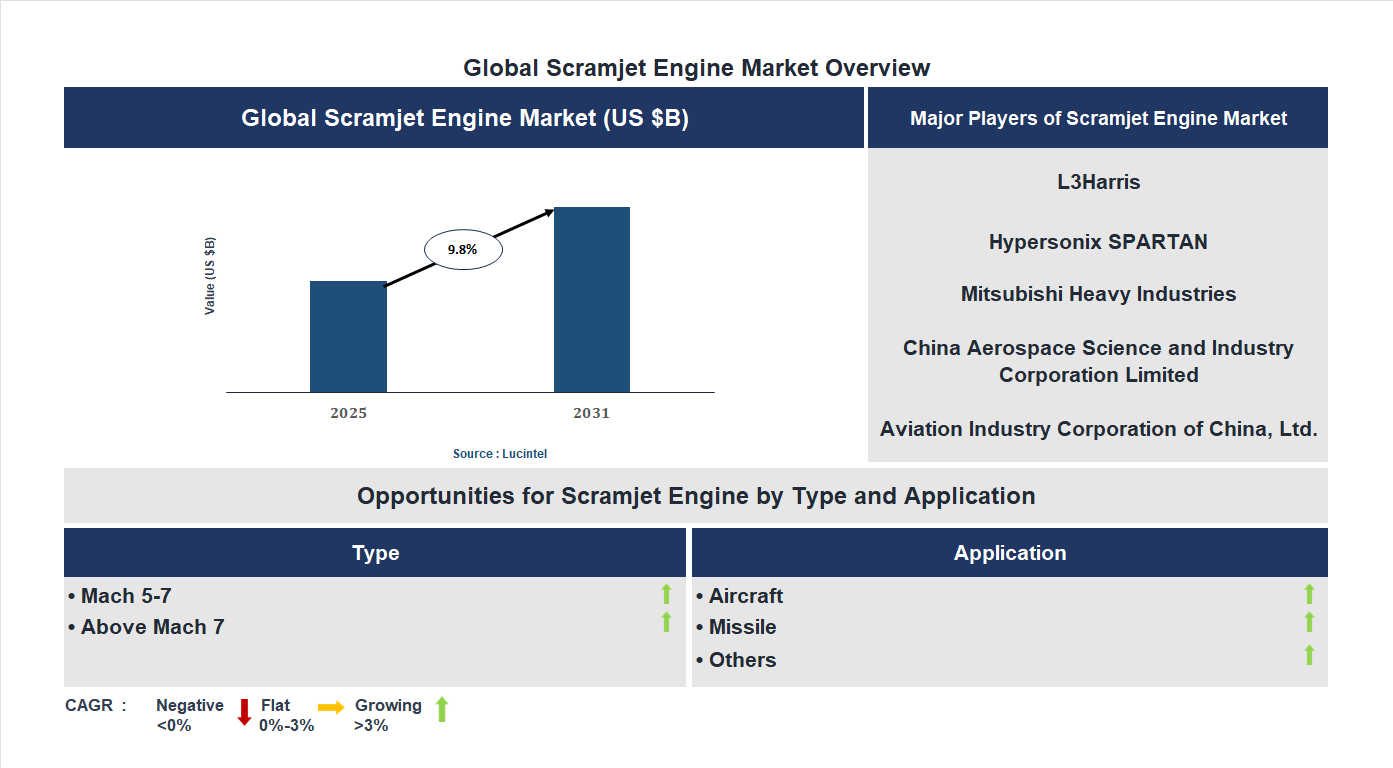
The future of the global scramjet engine market looks promising with opportunities in the aircraft and missile markets. The global scramjet engine market is expected to grow with a CAGR of 9.8% from 2025 to 2031. The major drivers for this market are the increasing investments in hypersonic aerospace technology, the rising defense & military propulsion requirements, and the growing demand for high speed air travel research.• Lucintel forecasts that, within the type category, mach 5-7 is expected to witness higher growth over the forecast period.
• Within the application category, missile is expected to witness higher growth.
• In terms of region, APAC is expected to witness the highest growth over the forecast period. Gain valuable insights for your business decisions with our comprehensive 150+ page report. Sample figures with some insights are shown below.
Emerging Trends in the Scramjet Engine Market
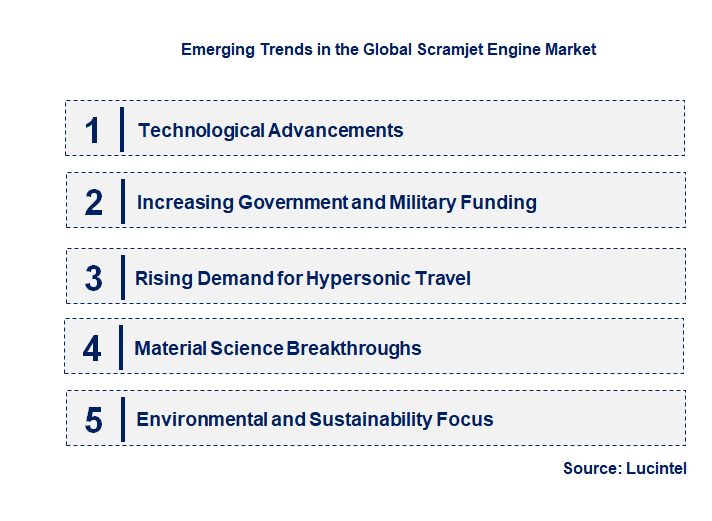
The scramjet engine market is experiencing rapid evolution driven by advancements in aerospace technology, increasing demand for high-speed travel, and the pursuit of more efficient propulsion systems. As the aerospace industry pushes the boundaries of speed and efficiency, innovative engine designs like scramjets are gaining prominence. These engines promise to revolutionize space access, military applications, and commercial travel by enabling hypersonic speeds. The markets growth is also fueled by government investments, technological breakthroughs, and the need for sustainable propulsion solutions. Understanding the key emerging trends provides insight into how this market is poised to transform future aerospace capabilities and redefine transportation paradigms.• Technological Advancements: Development of more efficient scramjet designs has led to higher operational speeds and better fuel efficiency. Researchers are focusing on materials that withstand extreme temperatures and pressures, enabling engines to operate reliably at hypersonic speeds. These innovations are expanding the practical applications of scramjets, making them more viable for space launch systems and military use. The impact is significant, as improved technology reduces costs and enhances performance, accelerating market adoption and opening new avenues for commercial and defense sectors.
• Increasing Government and Military Funding: Governments worldwide are investing heavily in hypersonic research to maintain strategic superiority. Military agencies are exploring scramjets for missile technology and rapid response systems, while space agencies aim to develop reusable launch vehicles. This funding accelerates research, prototype development, and testing, leading to faster commercialization. The increased financial support not only boosts technological progress but also fosters collaborations between academia, industry, and government, creating a robust ecosystem that propels the market forward.
• Rising Demand for Hypersonic Travel: The commercial sector is exploring scramjets for ultra-fast travel, reducing transcontinental flight times significantly. Airlines and private companies see hypersonic travel as a way to revolutionize transportation, catering to business travelers and premium markets. This demand drives innovation in engine design, materials, and safety systems, ultimately making hypersonic commercial flights feasible. The trend is reshaping market dynamics by creating new opportunities for aerospace companies and prompting regulatory frameworks to adapt to this emerging technology.
• Material Science Breakthroughs: The development of advanced materials capable of withstanding extreme heat and stress is critical for scramjet operation. Innovations in ceramics, composites, and heat-resistant alloys are enabling engines to operate at higher Mach numbers without degradation. These materials improve engine durability, safety, and performance, reducing maintenance costs and increasing lifespan. The impact is profound, as material science breakthroughs directly influence the feasibility and scalability of scramjet technology, fostering broader market acceptance and deployment.
• Environmental and Sustainability Focus: The push for greener propulsion systems is influencing scramjet development. Researchers are exploring alternative fuels and designs that minimize emissions and environmental impact. Sustainable scramjet engines could leverage hydrogen or biofuels, aligning with global efforts to reduce carbon footprints. This trend encourages innovation in eco-friendly propulsion, making scramjets more attractive for future aerospace applications. The market is thus evolving towards sustainable solutions, which are essential for regulatory approval, public acceptance, and long-term viability of hypersonic technologies. In summary, these emerging trends are collectively transforming the scramjet engine market by enhancing technological capabilities, increasing investment, expanding application scope, and emphasizing sustainability. They are paving the way for faster, more efficient, and environmentally conscious hypersonic travel and space access, fundamentally reshaping the future landscape of aerospace propulsion systems.
Recent Development in the Scramjet Engine Market
The scramjet engine market is experiencing rapid growth driven by advancements in aerospace technology, increasing demand for high-speed travel, and military applications. As the quest for faster, more efficient propulsion systems intensifies, key developments are shaping the future of this innovative sector. These developments are not only enhancing the performance and feasibility of scramjet engines but also expanding their applications across commercial, defense, and space exploration domains. The markets evolution reflects a convergence of technological breakthroughs, strategic investments, and regulatory support, positioning scramjet engines as a pivotal component in next-generation aerospace propulsion systems.• Technological Breakthroughs in Materials: New high-temperature, lightweight materials have been developed, enabling scramjet engines to operate efficiently at higher speeds and temperatures. This advancement improves engine durability and performance, reducing maintenance costs and increasing operational lifespan. The enhanced materials also allow for more compact engine designs, facilitating integration into various aircraft and missile platforms. Overall, this development significantly boosts the viability of scramjet technology for practical applications.
• Increased Government and Military Funding: Governments and defense agencies worldwide are investing heavily in scramjet research and development. Funding initiatives aim to develop hypersonic weapons, space launch systems, and high-speed aircraft. This financial support accelerates technological progress, shortens development timelines, and fosters innovation within the industry. The increased funding underscores the strategic importance of scramjet engines in national security and space exploration efforts.
• Successful Test Flights and Demonstrations: Recent successful test flights of scramjet-powered vehicles have demonstrated their capability to reach hypersonic speeds reliably. These tests validate theoretical models and provide critical data for refining engine designs. The successful demonstrations boost confidence among stakeholders and attract further investment. They also pave the way for commercial and military deployment, marking a significant milestone in the market’s development.
• Integration with Space Launch Systems: Companies are exploring the integration of scramjet engines into reusable space launch vehicles. This approach promises to reduce launch costs and increase payload capacity by enabling air-breathing propulsion during the initial phase of ascent. The development of scramjet-powered space launch systems could revolutionize space access, making it more economical and sustainable. This integration is a key step toward commercializing hypersonic space transportation.
• Rising Commercial Interest and Private Sector Participation: Private aerospace firms are increasingly investing in scramjet technology, driven by the potential for high-speed commercial travel and space tourism. Companies are developing prototypes and conducting test flights to demonstrate feasibility. This rising interest fosters competition, innovation, and diversification within the market. The involvement of the private sector accelerates technological advancements and broadens the application scope of scramjet engines. In summary, these developments are propelling the scramjet engine market toward a new era of hypersonic travel and space exploration. Technological innovations, strategic investments, successful testing, and increased private sector participation are collectively enhancing the performance, affordability, and applicability of scramjet engines. As a result, the market is poised for significant growth, transforming aerospace propulsion and opening new frontiers in high-speed transportation and space access.
Strategic Growth Opportunities in the Scramjet Engine Market
The scramjet engine market is experiencing rapid development driven by advancements in aerospace technology, increasing demand for high-speed travel, and military applications. As the aerospace industry pushes the boundaries of speed and efficiency, scramjet engines are emerging as a critical component for hypersonic vehicles. These engines offer the potential for faster, more efficient travel and military capabilities, creating significant growth opportunities across various applications. Key growth areas include defense, commercial aviation, space exploration, research and development, and government projects. Understanding these opportunities helps stakeholders capitalize on emerging trends and technological innovations shaping the future of hypersonic propulsion.• Defense Applications: Enhanced military capabilities drive growth : Scramjet engines enable hypersonic missile and aircraft development, providing strategic advantages in speed and maneuverability, thus attracting significant government investment and R&D efforts.
• Commercial Aviation: Faster travel options emerge : The pursuit of hypersonic commercial flights benefits from scramjet technology, promising reduced travel times and opening new markets for high-speed passenger transportation.
• Space Exploration: Cost-effective launch systems : Scramjets facilitate reusable and efficient launch vehicles, lowering costs and increasing access to space, which attracts space agencies and private companies alike.
• Research and Development: Innovation accelerates : Continuous R&D efforts improve scramjet performance, leading to breakthroughs in materials, design, and fuel efficiency, which further expand market potential.
• Government and Military Projects: Strategic investments increase : Governments worldwide are funding hypersonic research, fostering collaborations and accelerating the deployment of scramjet-powered systems for defense and space missions. In summary, these growth opportunities are significantly impacting the scramjet engine market by driving technological innovation, expanding application scope, and attracting substantial investments. As these opportunities mature, they are poised to revolutionize high-speed travel, defense systems, and space exploration, positioning the market for sustained growth and strategic importance in the aerospace sector.
Scramjet Engine Market Driver and Challenges
The scramjet engine market is influenced by a variety of technological, economic, and regulatory factors that shape its growth trajectory. Advances in aerospace technology, increasing demand for high-speed transportation, and government investments in space exploration are key drivers. Conversely, challenges such as technological complexity, high development costs, and regulatory hurdles pose significant obstacles. The interplay of these factors determines the pace and direction of market expansion, impacting stakeholders from aerospace manufacturers to government agencies. Understanding these drivers and challenges is essential for strategic planning and investment in this innovative sector. The factors responsible for driving the scramjet engine market include:• Technological Advancements: The continuous development of high-speed propulsion systems has propelled the market forward. Innovations in materials, aerodynamics, and combustion processes have improved scramjet efficiency and operational capabilities. These advancements enable faster, more fuel-efficient hypersonic travel and space launch systems, attracting investments from aerospace companies and governments. As technology matures, the potential for commercial and military applications expands, fostering market growth.
• Increasing Space Exploration Activities: Governments and private entities are investing heavily in space missions, satellite deployment, and lunar and Mars exploration. Scramjet engines offer a promising solution for reusable launch vehicles and rapid space access, reducing costs and increasing mission frequency. This surge in space exploration initiatives directly boosts demand for scramjet technology, positioning it as a critical component in future aerospace endeavors.
• Rising Demand for Hypersonic Travel: The pursuit of ultra-fast transportation options is driving interest in scramjet engines. Military applications such as hypersonic missiles and civilian high-speed air travel are key areas of focus. The ability of scramjets to operate efficiently at hypersonic speeds makes them attractive for next-generation transportation systems, encouraging research and development investments and expanding market prospects.
• Government Funding and Policy Support: Many governments recognize the strategic importance of hypersonic and space technologies. Increased funding for research, development, and testing programs, along with supportive policies and international collaborations, facilitate market growth. Regulatory frameworks that promote innovation while ensuring safety are crucial for accelerating commercial deployment of scramjet engines. The challenges in the scramjet engine market are:
• Technological Complexity: Developing reliable, efficient scramjet engines involves overcoming significant technical hurdles. High-temperature materials, precise manufacturing, and complex airflow management are required, making R&D costly and time-consuming. The unproven nature of some concepts adds risk, potentially delaying commercialization and increasing investment uncertainty.
• High Development and Testing Costs: The costs associated with designing, building, and testing scramjet engines are substantial. Extensive experimental facilities and flight testing are necessary to validate performance, which require significant financial resources. These high costs can limit participation to well-funded organizations, slowing overall market growth and innovation.
• Regulatory and Safety Challenges: The novel nature of scramjet technology raises regulatory concerns related to safety, environmental impact, and airspace management. Establishing international standards and obtaining approvals for testing and deployment can be complex and lengthy. Regulatory uncertainties may hinder commercial adoption and delay market expansion. In summary, the scramjet engine market is driven by technological innovation, increasing space exploration, hypersonic travel demand, and supportive government policies. However, it faces challenges such as technological complexity, high costs, and regulatory hurdles. These factors collectively influence the pace of market development, requiring strategic investments and collaborative efforts to realize the full potential of scramjet technology. The markets future depends on overcoming these obstacles while leveraging technological and policy advancements to unlock new aerospace frontiers.
List of Scramjet Engine Companies
Companies in the market compete on the basis of product quality offered. Major players in this market focus on expanding their manufacturing facilities, R&D investments, infrastructural development, and leverage integration opportunities across the value chain. With these strategies scramjet engine companies cater increasing demand, ensure competitive effectiveness, develop innovative products & technologies, reduce production costs, and expand their customer base. Some of the scramjet engine companies profiled in this report include-• L3Harris
• Hypersonix SPARTAN
• Mitsubishi Heavy Industries
• China Aerospace Science and Industry Corporation Limited
• Aviation Industry Corporation of China, Ltd.
• China Aerospace Science and Technology Group
• GE Aerospace
Scramjet Engine Market by Segment
The study includes a forecast for the global scramjet engine market by type, application, and region.Scramjet Engine Market by Type [Value from 2019 to 2031]:
• Mach 5-7
• Above Mach 7
Scramjet Engine Market by Application [Value from 2019 to 2031]:
• Aircraft
• Missile
• Others
Scramjet Engine Market by Region [Value from 2019 to 2031]:
• North America
• Europe
• Asia Pacific
• The Rest of the World
Country Wise Outlook for the Scramjet Engine Market
The scramjet engine market is experiencing rapid advancements driven by increasing demand for high-speed transportation, military applications, and space exploration. Innovations in materials, design efficiency, and propulsion technology are propelling the industry forward. Governments and private companies are investing heavily to develop more reliable, cost-effective scramjet engines capable of reaching hypersonic speeds. These developments are shaping the future of aerospace and defense sectors globally, with strategic implications for national security and commercial space travel. As the market evolves, key players are focusing on research, testing, and commercialization to stay competitive in this cutting-edge field.• United States: The US leads in scramjet technology development, with significant investments from NASA and DARPA. Recent advancements include successful flight tests of hypersonic vehicles, demonstrating improved engine efficiency and durability. Private companies like Lockheed Martin and Boeing are also actively involved in developing next-generation scramjets for military and space applications. The US government continues to prioritize research funding to accelerate commercialization and operational deployment of hypersonic systems.
• China: China has made notable progress in scramjet research, focusing on military and space exploration applications. Recent developments include successful ground tests of hypersonic engines and plans for integrating scramjets into future missile systems. The Chinese government is investing heavily in aerospace innovation, aiming to achieve technological independence and enhance strategic capabilities. Collaborations between research institutes and industry are driving rapid advancements, positioning China as a key player in the global market.
• Germany: Germany is advancing scramjet technology primarily through collaborations within the European aerospace sector. Recent projects involve testing new materials and engine designs to improve performance and thermal resistance. German research institutions are also exploring applications in commercial space travel and high-speed aircraft. The focus remains on developing sustainable, efficient engines that can operate reliably under extreme conditions, contributing to Europes broader ambitions in hypersonic research.
• India: India has made significant strides in scramjet development, with ISRO and DRDO leading efforts to create indigenous hypersonic propulsion systems. Recent milestones include successful ground tests of scramjet engines and plans for integrating these into future space launch vehicles and defense systems. The Indian government emphasizes self-reliance in aerospace technology, with ongoing investments to enhance capabilities in hypersonic research and development, aiming to establish India as a competitive player in the global market.
• Japan: Japan is focusing on advancing scramjet technology for both space and defense applications. Recent developments include experimental testing of high-speed propulsion systems and collaborations with international aerospace agencies. Japanese research centers are working on improving engine efficiency, thermal management, and materials to support long-duration hypersonic flights. The country aims to leverage these innovations for space exploration missions and advanced military systems, contributing to its strategic technological independence.

Features of the Global Scramjet Engine Market
Market Size Estimates: Scramjet engine market size estimation in terms of value ($B). Trend and Forecast Analysis: Market trends (2019 to 2024) and forecast (2025 to 2031) by various segments and regions. Segmentation Analysis: Scramjet engine market size by type, application, and region in terms of value ($B). Regional Analysis: Scramjet engine market breakdown by North America, Europe, Asia Pacific, and Rest of the World. Growth Opportunities: Analysis of growth opportunities in different types, applications, and regions for the scramjet engine market. Strategic Analysis: This includes M&A, new product development, and competitive landscape of the scramjet engine market. Analysis of competitive intensity of the industry based on Porter’s Five Forces model.
FAQ
Q1. What is the growth forecast for scramjet engine market? Answer: The global scramjet engine market is expected to grow with a CAGR of 9.8% from 2025 to 2031. Q2. What are the major drivers influencing the growth of the scramjet engine market? Answer: The major drivers for this market are the increasing investments in hypersonic aerospace technology, the rising defense & military propulsion requirements, and the growing demand for high speed air travel research. Q3. What are the major segments for scramjet engine market? Answer: The future of the scramjet engine market looks promising with opportunities in the aircraft and missile markets. Q4. Who are the key scramjet engine market companies? Answer: Some of the key scramjet engine companies are as follows:• L3Harris
• Hypersonix SPARTAN
• Mitsubishi Heavy Industries
• China Aerospace Science and Industry Corporation Limited
• Aviation Industry Corporation of China, Ltd.
• China Aerospace Science and Technology Group
• GE Aerospace Q5. Which scramjet engine market segment will be the largest in future? Answer: Lucintel forecasts that, within the type category, mach 5-7 is expected to witness higher growth over the forecast period. Q6. In scramjet engine market, which region is expected to be the largest in next 5 years? Answer: In terms of region, APAC is expected to witness the highest growth over the forecast period. Q7. Do we receive customization in this report? Answer: Yes, Lucintel provides 10% customization without any additional cost.
Table of Contents
List of Figures
List of Tables
Methodology
- In-depth interviews of the major players in this market
- Detailed secondary research from competitors’ financial statements and published data
- Extensive searches of published works, market, and database information pertaining to industry news, company press releases, and customer intentions
- A compilation of the experiences, judgments, and insights of Lucintel’s professionals, who have analyzed and tracked this market over the years.


Buy Now
Choose a license that fits your team. Instant PDF delivery.
Prices exclude taxes. Instant delivery. Custom licensing available on request.
Key Questions
- • What are some of the most promising, high-growth opportunities for the scramjet engine market by type (mach 5-7 and above mach 7), application (aircraft, missile, and others), and region (North America, Europe, Asia Pacific, and the Rest of the World)?
- • Which segments will grow at a faster pace and why?
- • Which region will grow at a faster pace and why?
- • What are the key factors affecting market dynamics? What are the key challenges and business risks in this market?
- • What are the business risks and competitive threats in this market?
- • What are the emerging trends in this market and the reasons behind them?
- • What are some of the changing demands of customers in the market?
- • What are the new developments in the market? Which companies are leading these developments?
- • Who are the major players in this market? What strategic initiatives are key players pursuing for business growth?
- • What are some of the competing products in this market and how big of a threat do they pose for loss of market share by material or product substitution?
- • What M&A activity has occurred in the last 5 years and what has its impact been on the industry? For any questions related to Scramjet Engine Market, Scramjet Engine Market Size, Scramjet Engine Market Growth, Scramjet Engine Market Analysis, Scramjet Engine Market Report, Scramjet Engine Market Share, Scramjet Engine Market Trends, Scramjet Engine Market Forecast, Scramjet Engine Companies, write Lucintel analyst at email: helpdesk@lucintel.com. We will be glad to get back to you soon.


