
Report Feature
Scented Candle Market Trends and Forecast
The future of the global scented candle market looks promising with opportunities in the supermarket & hypermarket, convenience store, and online markets. The global scented candle market is expected to grow with a CAGR of 4.1% from 2025 to 2031. The major drivers for this market are the increasing popularity of home fragrance products, the rising demand for wellness & relaxation items, and the growing trend of personalized scented candles.• Lucintel forecasts that, within the wax type category, paraffin wax is expected to witness the highest growth over the forecast period.
• Within the distribution channel category, supermarket & hypermarket is expected to witness the highest growth.
• In terms of region, North America is expected to witness the highest growth over the forecast period. Gain valuable insights for your business decisions with our comprehensive 150+ page report. Sample figures with some insights are shown below.
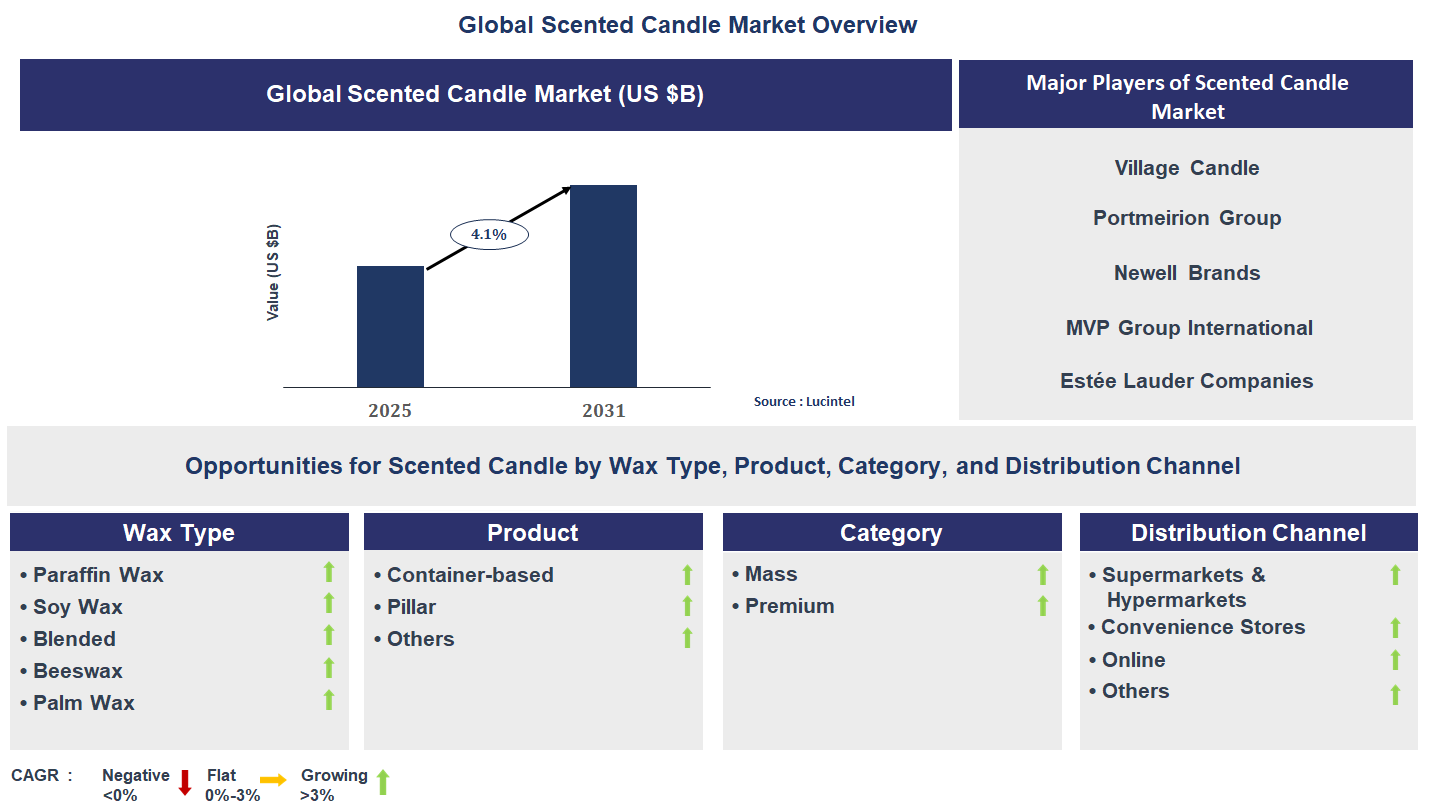
Emerging Trends in the Scented Candle Market
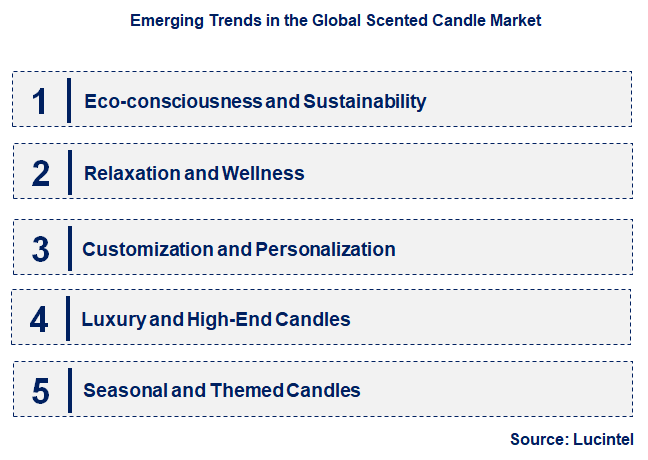
The market for scented candle is also drastically changing due to many consumer demands and lifestyle changes. The new trends suggest going towards more personal, eco-friendly, and wellness-driven products.• Eco-consciousness and Sustainability: With consumers increasingly being environmentally conscious, there is a definite move towards candles produced with natural, sustainable ingredients such as coconut wax, beeswax, and soy wax. Eco-friendly packaging and processes of production are also becoming the norm, as consumers look for brands that care about the planet. This trend is especially evident in developed economies such as Europe and the U.S., where consumers pay a premium to purchase sustainable products.
• Relaxation and Wellness: Most consumers have shifted their attention to scented candles for their perceived therapeutic nature. Essential oil candles, like lavender and eucalyptus, are notably in demand because they have a calming and stress-relieving effect. With wellness trends remaining on top, scented candles are being sold as a component of self-care rituals. The trend is observed in the U.S., Japan, and Germany, where mental and physical wellness are being prioritized more.
• Customization and Personalization: People are looking more for candles that suit their lifestyle, personality, or particular requirements. This has created a boom for customized-scented candles, where individuals can select the fragrance, color, and pattern. Several companies are also providing customized candles for special events, including weddings and birthdays, further providing for the need for differentiated, customized products. The trend is much sought after in Western countries, where individuality and personalization are appreciated.
• Luxury and High-End Candles: Premium, luxury fragrant candles are in increased demand across markets such as the U.S. and Germany. People are choosing high-quality, handmade products with rare or advanced fragrance. Luxury candles are coming in beautiful packaging and are being marketed as status symbols or friendly gifts. This category is growing as consumers want indulgent experiences to beautify their home environment.
• Seasonal and Themed Candles: There has been a huge demand for seasonal and themed candles as consumers look for scents to match the changing seasons or special occasions such as holidays and festivals. Limited collection series, e.g., Christmas or autumn-themed candles, are especially in vogue. The trend is prevalent where there is a strong tradition of gifts, e.g., the U.S., Germany, and Japan, where candles are often bought as part of holidays or as gift items for family and friends. These trends are transforming the scented candle market by stimulating demand for more sustainable, customized, and wellness-focused products, as well as improving the luxury status and holiday gift status of candles.
Recent Development in the Scented Candle Market
Recent trends within the scented candle industry have been influenced by changing consumer trends towards luxury, wellness, and sustainability. With the market expanding internationally, companies are adapting by launching new products, improving their sustainability practices, and exploring new trends such as customization and luxury. These trends are indicative of evolving consumer lifestyles and technological advancements within the sector.• Production Sustainability Efforts: Amid increasing environmental issues, several scented candle producers have adopted sustainable production efforts. This involves eco-friendly raw materials such as soy wax, beeswax, and recyclable glass for packaging. Companies are also shifting towards biodegradable packaging materials and minimizing carbon prints in production, due to consumers demand for more environmentally friendly products. The change has become a competitive advantage for companies in markets such as the U.S., Europe, and Japan.
• Premium Offerings Expansion: With the rising demand for luxury goods, numerous companies are launching premium scented candles with unusual or intricate fragrances. Luxury brands emphasize artisanal quality and handcrafted designs, providing distinctive blends of scents and high-end packaging. This movement towards premium candles is significant in markets such as the U.S. and Germany, where consumers are more and more considering candles as luxury home decor or gifts.
• Growth of E-commerce: The e-commerce market for scented candles has grown tremendously, with customers buying candles from online channels such as Amazon and niche online stores. This is fueled by convenience, the possibilities to browse a great selection of products, and the popularity of candle subscription boxes. Online channels have also enabled more consumer-to-consumer brands to succeed, especially in North America and Europe.
• Customized and Personal Candles: There has been increased demand for customized scented candles, where consumers are looking for distinctive products that are a perfect fit to their individual preferences. Most companies now have customization services where customers can choose their preferred fragrance, color, and packaging. This trend has especially picked up in countries such as the U.S. and India, where customized gifts and experiences are much preferred.
• Production Technology Advancements: Manufacturing technology developments, like 3D printing and robotized manufacturing lines, are making candle production more efficient and economical. With these technologies, manufacturers can provide more diverse designs and aromas at a reduced price. Consequently, scalability in production has increased, covering big brands and small makers alike. These trends suggest that the market for scented candles is changing to accommodate contemporary consumers demand for luxury, green living, and bespoke products, as well as to react to new trends such as wellness and e-commerce.
Strategic Growth Opportunities in the Scented Candle Market
There are various strategic growth prospects for the scented candle market, particularly with the trends of wellness, sustainability, and personalization in consumer preferences. These trends are being leveraged by manufacturers to grow their market share, providing products that address various customer needs in the residential, wellness, and luxury segments. Knowledge of key growth areas will assist firms in positioning themselves for future success in the competitive market.• Environmentally Friendly Products: The demand for environmentally friendly candles produced using sustainable materials such as soy wax, beeswax, and coconut wax is increasing. Consumers are becoming more conscious of the environment, and firms can differentiate themselves by providing environmentally friendly candles with low environmental footprints. This prospect best suits markets in countries like the U.S. and Europe, which hold sustainability as a key consumer issue.
• Scented Aromatherapy Candles: The wellness and self-care movement offers a huge growth potential for essential oil-infused scented candles. Those that support relaxation, stress reduction, and sleep enhancement are in demand. As consumers increasingly focus on aromatherapy, businesses can formulate candles with specific benefits, taking advantage of the rising demand for items that complement mental and physical health.
• Luxury and High-End Candles: Luxury scented candles remain an expanding market as consumers demand high-end home accessories. Brands offering unique fragrances, sophisticated packaging, and handcrafted quality can appeal to this high-end market. Luxury candles are frequently a status symbol or a sign of consideration, reflecting an enormous potential for expansion by luxury-targeting companies.
• Themed and Seasonal Candles: Seasonal candles that are specifically tied to special events or holidays, like Christmas, Valentines Day, or Diwali, are becoming increasingly popular. Consumers are willing to buy candles that coincide with these events or periods of the year. This presents companies with the potential to introduce special products that draw consumers into peak sales periods.
• Personalization and Customization Trend: Providing consumers with the option to personalize candles is a key growth area. Personalized candles, such as distinct fragrances, hues, and packaging, enable consumers to make one-of-a-kind products either for themselves or as gifts. The trend is particularly attractive to younger, millennial consumers who highly regard individuality and expression. These development prospects are propelling the future of the scented candle industry by servicing changing consumer needs for sustainability, well-being, luxury, and personalization. Businesses that take advantage of these forces will be positioned to thrive in this competitive market.
Scented Candle Market Driver and Challenges
The scented candle market is influenced by several drivers and challenges that are influenced by economic, technological, and regulatory factors. Although drivers like wellness trends, increasing disposable incomes, and customer interest in eco-friendly products are driving market growth, challenges such as increasing raw material prices and growing competition are obstacles. Knowledge of these drivers and challenges is important for companies to understand the changing market environment. The factors responsible for driving the scented candle market include: 1. More Emphasis on Wellness: With consumers putting a high value on mental well-being and calmness, the market for scented candles as wellness products has grown exponentially. Stress-relief benefits and aromatherapy are major selling features for candles, particularly those infused with essential oils. This increasing trend towards wellness is fueling market growth in countries such as North America, Europe, and Asia. 2. Increasing Disposable Incomes: In countries such as China and India, growing disposable incomes are fueling demand for premium and luxury scented candles. There is willingness among consumers to pay a premium for home decor and wellness products, opening up opportunities for high-end brands that provide exclusive fragrances and superior quality materials. 3. Sustainability Trends: Increasing concern over the environment is making consumers look for environmentally friendly scented candles that are made from natural resources and sustainable processes. This is one of the key drivers, particularly in those markets where sustainability is a top consumer issue, for instance, Europe and North America. 4. Technological Innovation in Manufacturing: Manufacturing technology innovations, including automated manufacturing and 3D printing, are enabling firms to simplify manufacturing and supply distinctive designs at affordable prices. Such technological advancements are promoting efficiency and cost reduction in the scented candle industry. 5. Shift to Home Fragrances: Growing demand for home fragrances as part of an overall home decor pattern is contributing to the growth of the scented candle market. A bigger shift is being seen, where consumers are willing to spend on scented candles to beautify their homes, driving demand in the different regions. Challenges in the scented candle market are: 1. Raw Material Price Volatility: Prices of such raw materials as essential oils, waxes, and others that are applied in candle manufacturing may be volatile, and therefore their costs have a direct impact on manufacturing. It becomes challenging for the manufacturers, particularly those dependent on premium or organic products. 2. Supply Chain Disruptions: International supply chain disruptions, such as material shortages and shipping postponements, can affect the timely manufacturing and distribution of scented candles. It complicates the market, especially for seasonal goods that depend on timely distribution. 3. Fierce Competition: The scented candle industry is extremely competitive, with a number of tiny and huge brands fighting for market share. With the intense competition and proliferation of e-commerce platforms, new companies find it difficult to emerge and existing brands find it difficult to retain leadership in the market. The market for scented candles is fueled by demand for wellness, sustainability, and quality products, as well as technology development in production. Nevertheless, instability in market conditions still emerges due to raw material price fluctuations and disruptions to supply chains. In order to remain competitive, producers have to innovate against such challenges with emphasis on sustainability, customization, and wellness products.List of Scented Candle Companies
Companies in the market compete on the basis of product quality offered. Major players in this market focus on expanding their manufacturing facilities, R&D investments, infrastructural development, and leverage integration opportunities across the value chain. With these strategies scented candle companies cater increasing demand, ensure competitive effectiveness, develop innovative products & technologies, reduce production costs, and expand their customer base. Some of the scented candle companies profiled in this report include-• Village Candle
• Portmeirion Group
• Newell Brands
• MVP Group International
• Estée Lauder Companies
• Diptyque Paris
• Lalique Group
• L Brands
• NEST New York
• Thymes
Scented Candle Market by Segment
The study includes a forecast for the global scented candle market by wax type, product, category, distribution channel, and region.Scented Candle Market by Wax Type [Value from 2019 to 2031]:
• Paraffin Wax
• Soy Wax
• Blended
• Beeswax
• Palm Wax
Scented Candle Market by Product [Value from 2019 to 2031]:
• Container-based
• Pillar
• Others
Scented Candle Market by Category [Value from 2019 to 2031]:
• Mass
• Premium
Scented Candle Market by Distribution Channel [Value from 2019 to 2031]:
• Supermarkets & Hypermarkets
• Convenience Stores
• Online
• Others
Scented Candle Market by Region [Value from 2019 to 2031]:
• North America
• Europe
• Asia Pacific
• The Rest of the World
Country Wise Outlook for the Scented Candle Market
The market for scented candle has experienced significant growth over the past few years, fueled by evolving consumer lifestyles, heightened awareness of well-being benefits, and growing demand for home fragrances. Specifically, markets in the United States, China, Germany, India, and Japan have experienced distinct trends in consumer preferences and product innovation. From the expanding focus on sustainability to luxury and personalization, these trends are influencing the production, marketing, and consumption of scented candles around the world.• United States: In the United States, the market for scented candles is fueled by growing consumer interest in wellness and self-care. Candles are no longer viewed as merely home decor, but also as devices for relaxation, meditation, and stress reduction. With demand on the rise, manufacturers in the U.S. are focusing heavily on natural, sustainable ingredients, such as soy wax and essential oils. The proliferation of luxury candle brands and sustainable packaging has created a more premium-focused market. Online shopping has boomed, with buyers seeking distinctive, artisanal fragrances that reflect personal taste and environmental concerns.
• China: Scented candles are gaining traction in China as a part of the general trend towards enhancing home life and living conditions. Historic Chinese fragrances like sandalwood and jasmine are being blended with Western perfumes to produce a mixture of cross-cultural inspiration. As disposable incomes rise and there is increasing interest in well-being, Chinese consumers are now turning to scented candles for their medicinal benefits. Local firms are also looking toward sustainable manufacturing practices and packaging to capture the demand for environmentally friendly products.
• Germany: Germanys scented candle market is driven by the nations emphasis on sustainability and manufacturing standards. German consumers are increasingly concerned with natural, organic, and vegan candles. The drive towards minimalism and going green is creating a trend towards soy-based wax and reusable or recycled containers. Most German brands are making their products premium, with luxury fragrances and handcrafted craftsmanship. Germany is also seeing a rise in gifting candles, particularly over the holiday season, that is driving both domestic and international demand for upscale, nicely curated scented candles.
• India: The scented candle industry in India is seeing tremendous growth with growing incomes, urbanization, and shifts in cultural attitudes. Incense and oils have traditionally been the favorites, but increasingly there is a move toward the use of scented candles as a newer and more visually appealing means of adding to the home environment. Florals, vanilla, and common Indian spices such as sandalwood are favored scents. The market is increasing, especially in urban settings where people are becoming more open to spending money on luxury candles as a decorative home addition.
• Japan: Japanese people prefer subtle and minimalist fragrances in their scented candles that echo the nations cultural ideals of simplicity and peace. Japanese consumers mostly opt for soft-scented products such as green tea, cherry blossom, and hinoki wood. There is also a growing need for candles that induce relaxation and mindfulness, corresponding to Japans historical tradition of Zen and wellness. The market is centered on high-end, handmade products, with a focus on quality craftsmanship and natural ingredients. The trend towards gifting and seasonal candles is also fueling growth.

Features of the Global Scented Candle Market
Market Size Estimates: Scented candle market size estimation in terms of value ($B). Trend and Forecast Analysis: Market trends (2019 to 2024) and forecast (2025 to 2031) by various segments and regions. Segmentation Analysis: Scented candle market size by various segments, such as by wax type, product, category, distribution channel, and region in terms of value ($B). Regional Analysis: Scented candle market breakdown by North America, Europe, Asia Pacific, and Rest of the World. Growth Opportunities: Analysis of growth opportunities in different wax types, products, category, distribution channels, and regions for the scented candle market. Strategic Analysis: This includes M&A, new product development, and competitive landscape of the scented candle market. Analysis of competitive intensity of the industry based on Porter’s Five Forces model.
FAQ
Q1. What is the growth forecast for scented candle market? Answer: The global scented candle market is expected to grow with a CAGR of 4.1% from 2025 to 2031. Q2. What are the major drivers influencing the growth of the scented candle market? Answer: The major drivers for this market are the increasing popularity of home fragrance products, the rising demand for wellness & relaxation items, and the growing trend of personalized scented candles. Q3. What are the major segments for scented candle market? Answer: The future of the scented candle market looks promising with opportunities in the supermarket & hypermarket, convenience store, and online markets. Q4. Who are the key scented candle market companies? Answer: Some of the key scented candle companies are as follows:• Village Candle
• Portmeirion Group
• Newell Brands
• MVP Group International
• Estée Lauder Companies
• Diptyque Paris
• Lalique Group
• L Brands
• NEST New York
• Thymes Q5. Which scented candle market segment will be the largest in future? Answer: Lucintel forecasts that, within the wax type category, paraffin wax is expected to witness the highest growth over the forecast period. Q6. In scented candle market, which region is expected to be the largest in next 5 years? Answer: In terms of region, North America is expected to witness the highest growth over the forecast period. Q7. Do we receive customization in this report? Answer: Yes, Lucintel provides 10% customization without any additional cost.
Table of Contents
List of Figures
List of Tables
Methodology
- In-depth interviews of the major players in this market
- Detailed secondary research from competitors’ financial statements and published data
- Extensive searches of published works, market, and database information pertaining to industry news, company press releases, and customer intentions
- A compilation of the experiences, judgments, and insights of Lucintel’s professionals, who have analyzed and tracked this market over the years.


Buy Now
Choose a license that fits your team. Instant PDF delivery.
Prices exclude taxes. Instant delivery. Custom licensing available on request.
Key Questions
- • What are some of the most promising, high-growth opportunities for the scented candle market by wax type (paraffin wax, soy wax, blended, beeswax, and palm wax), product (container-based, pillar, and others), category (mass and premium), distribution channel (supermarkets & hypermarkets, convenience stores, online, and others), and region (North America, Europe, Asia Pacific, and the Rest of the World)?
- • Which segments will grow at a faster pace and why?
- • Which region will grow at a faster pace and why?
- • What are the key factors affecting market dynamics? What are the key challenges and business risks in this market?
- • What are the business risks and competitive threats in this market?
- • What are the emerging trends in this market and the reasons behind them?
- • What are some of the changing demands of customers in the market?
- • What are the new developments in the market? Which companies are leading these developments?
- • Who are the major players in this market? What strategic initiatives are key players pursuing for business growth?
- • What are some of the competing products in this market and how big of a threat do they pose for loss of market share by material or product substitution?
- • What M&A activity has occurred in the last 5 years and what has its impact been on the industry? For any questions related to Scented Candle Market, Scented Candle Market Size, Scented Candle Market Growth, Scented Candle Market Analysis, Scented Candle Market Report, Scented Candle Market Share, Scented Candle Market Trends, Scented Candle Market Forecast, Scented Candle Companies, write Lucintel analyst at email: helpdesk@lucintel.com. We will be glad to get back to you soon.


