
Market Report · July 31, 2026

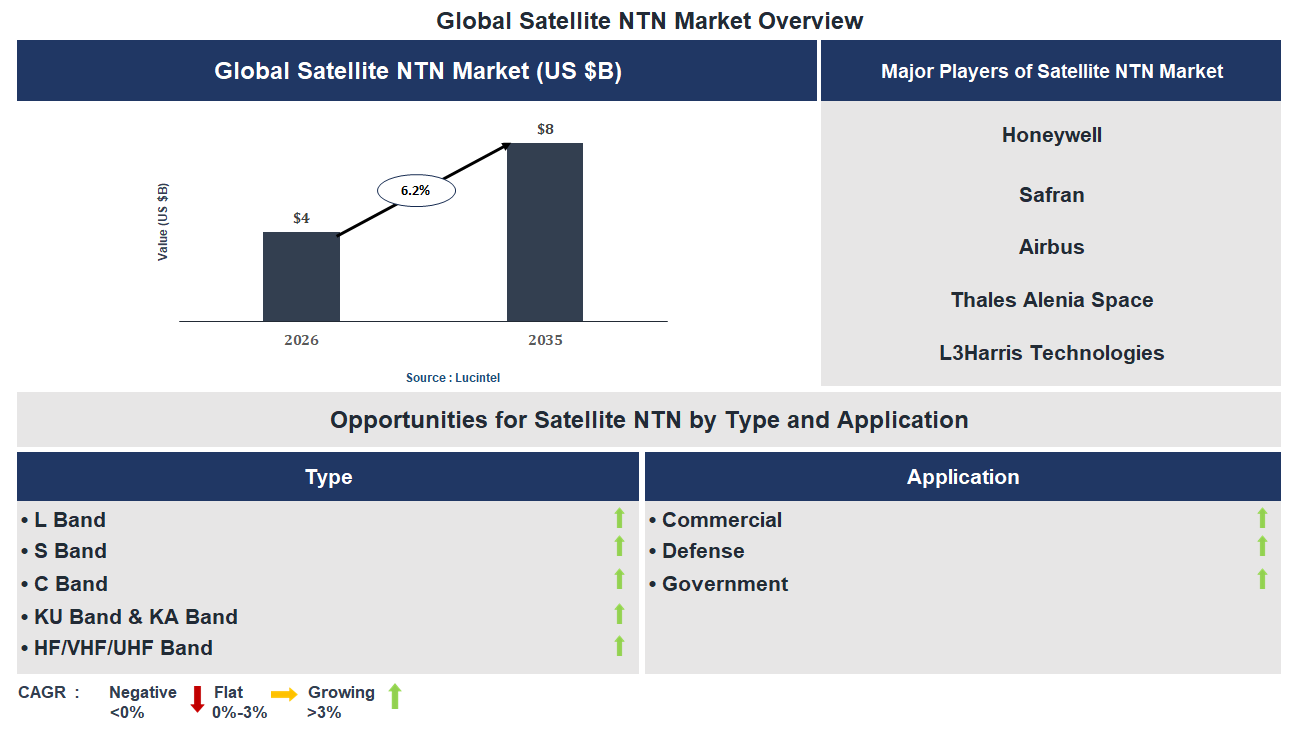
Key data points: The market size in 2035 = $8 billion, growth forecast = 6.2% annually for the next 8 years. Scroll below to get more insights. This market report covers trends, opportunities and forecasts in satellite NTN market to 2035 by type (L band, S band, C band, KU band & KA band, and HF/VHF/UHF band), application (commercial, defense, and government), and region (North America, Europe, Asia Pacific, and the Rest of the World)
We'll send your sample report shortly.
• Lucintel forecasts that, within the type category, KU band & KA band is expected to witness the highest growth over the forecast period.
• Within the application category, commercial is expected to witness the highest growth.
• In terms of region, APAC is expected to witness the highest growth over the forecast period. Gain valuable insights for your business decisions with our comprehensive 150+ page report. Sample figures with some insights are shown below.
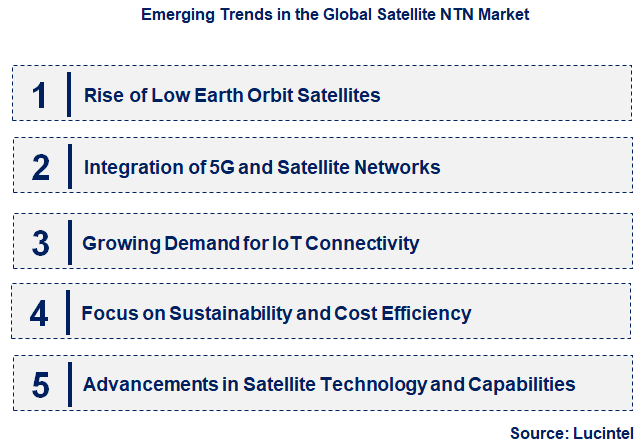
• Rise of Low Earth Orbit Satellites: The deployment of LEO satellites is revolutionizing satellite communication by offering lower latency and higher bandwidth. Companies like SpaceX and OneWeb are launching constellations of LEO satellites to provide global internet coverage, especially in remote areas. This trend reduces dependency on traditional geostationary satellites, making satellite internet more competitive with terrestrial broadband. The increased deployment of LEO satellites is also driving down costs and improving service quality, thus expanding market accessibility and adoption.
• Integration of 5G and Satellite Networks: The convergence of 5G technology with satellite networks is creating new opportunities for seamless connectivity across urban and rural areas. Satellite NTN is being integrated into 5G infrastructure to extend coverage, especially in hard-to-reach locations. This integration enhances network resilience, reduces latency, and supports high-speed data transfer, which is crucial for applications like autonomous vehicles, smart cities, and industrial IoT. The synergy between 5G and satellite NTN is expected to accelerate digital transformation and foster innovative service offerings.
• Growing Demand for IoT Connectivity: The proliferation of IoT devices across industries such as agriculture, transportation, and healthcare is fueling demand for reliable, global connectivity solutions. Satellite NTN provides the coverage needed for remote sensors, tracking devices, and autonomous systems that operate outside terrestrial networks. This trend is enabling real-time data collection and analysis in previously inaccessible regions, improving operational efficiency and decision-making. As IoT adoption accelerates, satellite networks are becoming essential for ensuring continuous, secure, and scalable connectivity.
• Focus on Sustainability and Cost Efficiency: Market players are increasingly prioritizing sustainable satellite solutions, including the development of reusable launch vehicles and eco-friendly satellite components. Cost efficiency is also a key driver, with innovations reducing launch and operational costs. These efforts make satellite NTN more accessible to a broader range of customers and applications. Sustainable practices not only minimize environmental impact but also enhance the long-term viability of satellite networks, encouraging investment and innovation in the sector.
• Advancements in Satellite Technology and Capabilities: Continuous technological innovations are enhancing satellite performance, including higher throughput, improved power efficiency, and advanced payloads like high-resolution imaging and real-time data processing. These advancements enable more sophisticated applications such as Earth observation, disaster management, and secure military communications. Enhanced satellite capabilities are expanding the scope of services offered by NTN providers, making satellite networks more versatile and integral to global communication infrastructure. These emerging trends are reshaping the Satellite NTN Market by making satellite communication more accessible, efficient, and integrated with terrestrial networks. They are driving innovation, expanding coverage, and enabling new applications that were previously unattainable, thus positioning satellite NTN as a critical component of the future global connectivity landscape.
• Growing Demand for Global Connectivity: The Satellite NTN Market is expanding as the need for reliable, high-speed internet in remote and underserved areas increases. Governments and private companies are investing in satellite infrastructure to bridge the digital divide, providing connectivity where traditional networks are unavailable. This growth enhances access to education, healthcare, and economic opportunities, fostering social and economic development. The markets expansion is driven by the rising demand for seamless communication across borders and challenging terrains.
• Advancements in Satellite Technology: Innovations in satellite design, such as low Earth orbit (LEO) constellations, are significantly improving latency, bandwidth, and coverage. These technological advancements enable real-time data transmission and support high-demand applications like streaming and IoT. The improved efficiency and reduced costs of satellite manufacturing are making satellite NTN more accessible to various industries. This progress is accelerating market growth and expanding the scope of satellite-based services globally.
• Increasing Adoption of IoT and M2M Communications: The proliferation of IoT devices and machine-to-machine (M2M) communication is fueling demand for satellite NTN solutions. These networks provide reliable connectivity for sensors, autonomous vehicles, and industrial equipment in remote locations. The ability to support massive device deployments enhances operational efficiency and data collection. As IoT applications grow across sectors like agriculture, transportation, and energy, satellite NTN becomes essential for ensuring uninterrupted connectivity, thereby expanding market opportunities.
• Rising Investments and Strategic Partnerships: Major telecom operators, satellite manufacturers, and technology firms are investing heavily in satellite NTN infrastructure. Strategic alliances are forming to develop integrated solutions that combine terrestrial and non-terrestrial networks. These collaborations aim to improve coverage, reduce costs, and accelerate deployment timelines. Increased funding and partnerships are driving innovation, expanding market reach, and fostering competitive advantages, ultimately contributing to the rapid growth of the satellite NTN market.
• Regulatory Developments and Spectrum Allocation: Governments and international bodies are updating regulations and spectrum policies to facilitate satellite NTN deployment. Clear guidelines and spectrum allocations are essential for avoiding interference and ensuring efficient operation. Regulatory support accelerates market entry for new players and encourages investment. As policies evolve to accommodate satellite networks, the market benefits from increased confidence, streamlined licensing processes, and expanded operational capabilities, further propelling growth. The recent developments in satellite NTN, including technological innovations, increased investments, and regulatory support, are significantly transforming the market. These opportunities are enabling broader coverage, improved connectivity, and new applications across industries. As a result, the market is poised for substantial growth, fostering global digital inclusion and creating new revenue streams for stakeholders. The evolving landscape promises a more connected, efficient, and inclusive future for satellite-based communication services worldwide.
• Expanding Coverage in Remote and Rural Areas: Satellite NTN offers unparalleled reach to underserved regions lacking terrestrial infrastructure. By providing reliable internet and communication services, it bridges connectivity gaps, enabling economic growth, education, and healthcare improvements. The increasing demand for universal connectivity drives investments in satellite networks, making remote areas accessible and fostering digital inclusion. This opportunity is crucial for governments and private companies aiming to achieve global connectivity goals efficiently and cost-effectively.
• Advancements in Satellite Technology Enable Higher Data Speeds: Innovations such as high-throughput satellites (HTS) and low Earth orbit (LEO) constellations significantly enhance data transmission capabilities. These technological improvements allow for faster, more reliable internet services comparable to terrestrial networks. As consumer and enterprise demand for bandwidth grows, satellite NTN providers can capitalize on these advancements to deliver premium services, support data-intensive applications, and expand their market share in the competitive satellite communication landscape.
• Growing Demand for IoT and M2M Connectivity in Various Sectors: The proliferation of Internet of Things (IoT) devices and machine-to-machine (M2M) communication requires robust, global connectivity solutions. Satellite NTN offers a viable platform for connecting remote sensors, autonomous vehicles, maritime vessels, and industrial equipment across challenging environments. This creates opportunities for satellite providers to serve diverse sectors such as agriculture, transportation, defense, and energy, enabling real-time data exchange, operational efficiency, and enhanced safety measures.
• Increasing Adoption of Satellite-Based 5G Backhaul Solutions: As 5G networks expand, satellite NTN can serve as a complementary backhaul solution, especially in areas where fiber deployment is impractical or costly. This integration supports seamless connectivity, reduces latency, and enhances network resilience. The deployment of satellite-based 5G backhaul is particularly advantageous for rural, mountainous, or island regions, enabling telecom operators to extend high-speed services and meet the growing demand for mobile broadband, thus opening new revenue streams.
• Rising Investment in Satellite Constellations for Global Connectivity: Major industry players and governments are investing heavily in deploying large-scale satellite constellations, such as LEO networks, to provide ubiquitous internet coverage. These initiatives aim to deliver low-latency, high-capacity connectivity worldwide, including in disaster zones and conflict areas. The expansion of satellite constellations fosters competition, innovation, and cost reductions, accelerating market growth and enabling new applications like real-time remote monitoring, global broadcasting, and emergency response services. These growth opportunities are poised to significantly influence the Satellite NTN market by expanding coverage, enhancing technological capabilities, and enabling new applications. As investments and innovations continue, the market is set to become more competitive, inclusive, and technologically advanced, ultimately transforming global connectivity and bridging digital divides across diverse regions.
• Technological Advancements: The continuous development of satellite technology, including miniaturization, higher bandwidth capabilities, and improved launch methods, has significantly enhanced the feasibility and performance of NTN solutions. These innovations enable broader coverage, lower latency, and increased reliability, making satellite networks more attractive for various applications such as remote areas, maritime, and aviation. The rapid pace of technological progress also reduces costs over time, encouraging adoption among service providers and end-users. As technology evolves, the market is poised for accelerated growth, driven by improved service quality and expanded coverage options.
• Growing Demand for Global Connectivity: The increasing need for seamless, high-speed internet access across urban and rural areas worldwide is a major market driver. Satellite NTN offers a solution to bridge connectivity gaps in remote, underserved, or difficult-to-reach regions where traditional terrestrial networks are impractical or cost-prohibitive. The proliferation of IoT devices, smart cities, and digital services further amplifies demand for reliable, ubiquitous connectivity. Governments and private enterprises are investing heavily in satellite networks to support economic development, disaster management, and military applications, fueling market expansion.
• Regulatory Support and Policy Frameworks: Governments and international organizations are recognizing the strategic importance of satellite NTN and are implementing policies to facilitate its deployment. Spectrum allocation, licensing procedures, and international cooperation initiatives are being streamlined to promote market growth. Regulatory support reduces barriers to entry for new players and encourages investment in satellite infrastructure. Additionally, initiatives aimed at bridging the digital divide and promoting rural connectivity are providing favorable policy environments, which in turn stimulate market development and innovation.
• Rising Investment and Strategic Partnerships: Increased funding from private investors, venture capitalists, and government agencies is fueling satellite NTN development. Strategic collaborations between satellite manufacturers, telecom operators, and technology firms are accelerating deployment and innovation. These partnerships facilitate resource sharing, technological integration, and market expansion. The influx of capital and strategic alliances also enable companies to undertake large-scale projects, improve service offerings, and accelerate time-to-market, thereby strengthening the overall market ecosystem and fostering competitive growth.
• Expansion of Use Cases and Applications: The diversification of satellite NTN applications across sectors such as defense, maritime, aviation, and disaster management is a key driver. The ability to provide reliable connectivity in remote or mobile environments opens new revenue streams and market segments. Emerging use cases like autonomous vehicles, remote healthcare, and smart agriculture are further expanding the market scope. This broad applicability encourages continuous innovation and investment, ensuring the market remains dynamic and responsive to evolving technological and societal needs. The challenges facing the satellite NTN market include:
• High Deployment and Operational Costs: Establishing satellite NTN infrastructure involves substantial capital expenditure, including satellite manufacturing, launch costs, and ground station setup. Operational expenses such as maintenance, spectrum licensing, and regulatory compliance add to the financial burden. These high costs can limit market entry for smaller players and slow down deployment, especially in regions with limited funding or regulatory support. Cost management and technological efficiencies are critical to making satellite NTN commercially viable and competitive against terrestrial networks.
• Regulatory and Spectrum Challenges: Navigating complex regulatory environments and securing spectrum licenses pose significant hurdles. International coordination is required for spectrum allocation, which can be time-consuming and subject to geopolitical considerations. Regulatory uncertainties regarding satellite operations, orbital slots, and frequency usage can delay projects and increase costs. Compliance with varying national and international regulations complicates deployment strategies, potentially hindering rapid market expansion and technological innovation.
• Technological Complexities and Risks: Developing reliable, scalable, and secure satellite NTN systems involves overcoming significant technological challenges. Ensuring interoperability between satellite and terrestrial networks, managing latency, and maintaining system security are complex tasks. Additionally, risks related to satellite failure, space debris, and cyber threats can impact service continuity and market confidence. Addressing these technological hurdles requires ongoing research, substantial investment, and robust risk management strategies, which can slow down market growth and innovation. The satellite NTN market is driven by technological progress, increasing global connectivity needs, supportive regulatory frameworks, strategic investments, and expanding application areas. However, high costs, regulatory complexities, and technological challenges present notable barriers. The interplay of these factors will shape the market’s trajectory, demanding innovative solutions and collaborative efforts to realize its full potential. Overall, the market’s growth prospects remain promising, provided stakeholders effectively navigate these drivers and challenges.
• Honeywell
• Safran
• Airbus
• Thales Alenia Space
• L3Harris Technologies
• Teledyne Technologies
• Smiths Interconnect
• Analog Devices
• Qorvo
• Mercury Systems
• L Band
• S Band
• C Band
• KU Band & KA Band
• HF/VHF/UHF Band
• Commercial
• Defense
• Government
• North America
• Europe
• Asia Pacific
• The Rest of the World
• United States: The US has seen significant investments in satellite NTN technology, with major companies like SpaceX and OneWeb expanding their satellite constellations. The Federal Communications Commission (FCC) has approved several new satellite licenses, fostering increased competition and innovation. The deployment of 5G-compatible satellite networks is underway, aiming to provide seamless connectivity in rural and urban areas. Additionally, government initiatives focus on integrating satellite NTN with terrestrial networks to improve national security and emergency response capabilities.
• China: China is rapidly advancing its satellite NTN capabilities through state-backed projects such as the BeiDou satellite system and the China Satellite Network Group. The country has launched multiple high-throughput satellites to enhance coverage and data transmission speeds. China’s focus is on developing autonomous satellite networks to support its Belt and Road Initiative, expanding connectivity in Asia and Africa. The government also emphasizes integrating satellite NTN with 5G infrastructure to boost digital economy growth and reduce reliance on foreign technology.
• Germany: Germany is actively investing in satellite NTN research and development, primarily through collaborations between industry and academia. The European Space Agency (ESA) and German aerospace firms are working on next-generation satellite constellations to improve broadband access across Europe. Germany is also exploring the use of satellite NTN for secure military communications and disaster management. Recent initiatives include launching new low Earth orbit (LEO) satellites and fostering public-private partnerships to accelerate deployment.
• India: India is making notable progress in satellite NTN deployment, driven by government initiatives like the National Digital Communications Policy. The Indian Space Research Organization (ISRO) has launched multiple communication satellites to expand rural connectivity. The country is also exploring private sector participation to develop affordable satellite-based internet services. Efforts are underway to integrate satellite NTN with terrestrial networks to bridge the digital divide and support smart city projects, especially in remote regions.
• Japan: Japan is focusing on enhancing its satellite NTN infrastructure through collaborations with global tech firms and space agencies. The country has launched advanced communication satellites to improve connectivity in the Asia-Pacific region. Japan emphasizes the development of resilient satellite networks for disaster response and maritime communications. Recent advancements include deploying high-capacity satellites and exploring hybrid networks combining satellite and terrestrial systems to ensure reliable, high-speed internet access in remote and disaster-prone areas.


• Honeywell
• Safran
• Airbus
• Thales Alenia Space
• L3Harris Technologies
• Teledyne Technologies
• Smiths Interconnect
• Analog Devices
• Qorvo
• Mercury Systems Q6. Which satellite NTN market segment will be the largest in future? Answer: Lucintel forecasts that, within the type category, KU band & KA band is expected to witness the highest growth over the forecast period. Q7. In satellite NTN market, which region is expected to be the largest in next 8 years? Answer: In terms of region, APAC is expected to witness the highest growth over the forecast period. Q8. Do we receive customization in this report? Answer: Yes, Lucintel provides 10% customization without any additional cost.


Choose a license that fits your team. Instant PDF delivery.
Prices exclude taxes. Instant delivery. Custom licensing available on request.
Market Report · July 31, 2026
Market Report · July 31, 2026
Market Report · July 31, 2026
Trusted partner for strategic intelligence and business growth


Receive a complimentary market analysis tailored to your industry. Our analysts will identify key growth opportunities and competitive dynamics specific to your business.

Market size, growth rate, and key trend analysis for your specific sector.

Top competitor positioning and market share analysis.

Strategic recommendations backed by data-driven insights.
Get curated market intelligence and competitive moves straight to your inbox.
By subscribing, you agree to receive our monthly insights. Unsubscribe anytime.
Receive a complimentary market analysis tailored to your industry. Our analysts will identify key growth opportunities and competitive dynamics specific to your business.
Market size, growth rate, and key trend analysis for your specific sector.
Top competitor positioning and market share analysis.
Strategic recommendations backed by data-driven insights.
Get curated market intelligence, emerging trends, and competitive moves straight to your inbox each month.
By subscribing, you agree to receive our monthly insights. Unsubscribe anytime.
We'll send your sample report shortly.