
Report Feature
Satellite Navigation System Market Trends and Forecast
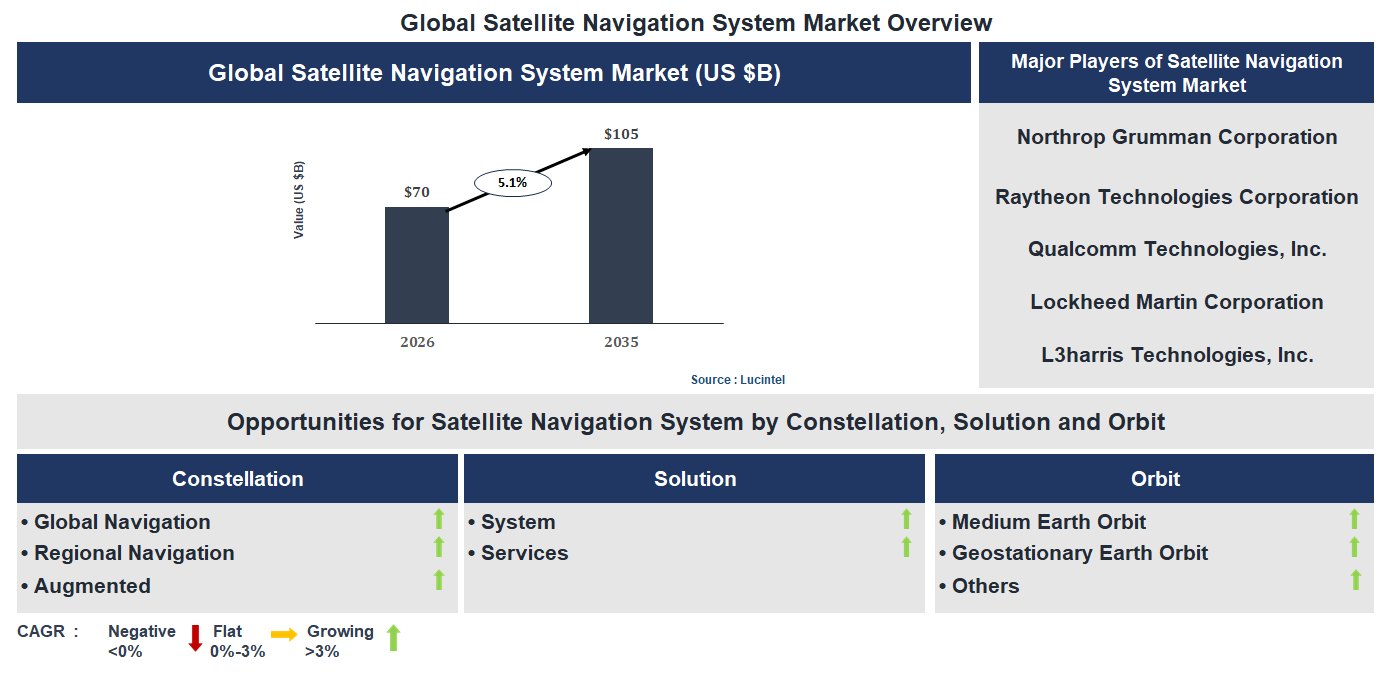
The future of the global satellite navigation system market looks promising with opportunities in the medium earth orbit and geostationary earth orbit markets. The global satellite navigation system market is expected to reach an estimated $105 billion by 2035 with a CAGR of 5.1% from 2026 to 2035. The major drivers for this market are the increasing demand for accurate positioning services, the rising adoption of satellite navigation technologies, and the growing integration with advanced communication systems.• Lucintel forecasts that, within the constellation category, global navigation is expected to witness the highest growth over the forecast period.
• Within the orbit category, medium earth orbit is expected to witness higher growth.
• In terms of region, APAC is expected to witness the highest growth over the forecast period. Gain valuable insights for your business decisions with our comprehensive 150+ page report. Sample figures with some insights are shown below.
Emerging Trends in the Satellite Navigation System Market
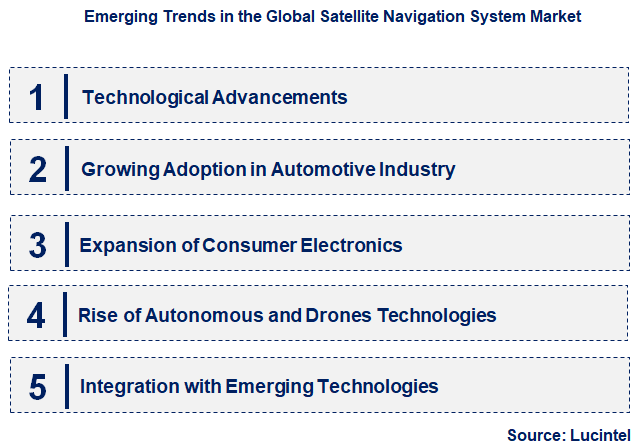
The satellite navigation system market is experiencing rapid growth driven by technological advancements, increasing adoption across various industries, and the rising demand for precise location-based services. As the digital landscape evolves, innovations in satellite technology, integration with emerging technologies, and expanding applications are transforming this market. These developments are not only enhancing the accuracy and reliability of navigation systems but also broadening their use cases in sectors such as automotive, aviation, defense, and consumer electronics. Understanding these key trends is essential for stakeholders aiming to capitalize on the markets potential and navigate the competitive landscape effectively.• Technological Advancements: The integration of next-generation satellites and improved signal processing techniques are significantly enhancing system accuracy and reliability. Innovations such as multi-constellation support (GPS, GLONASS, Galileo, BeiDou) enable seamless global coverage and redundancy, reducing signal disruptions. These advancements are enabling applications requiring high precision, like autonomous vehicles and drone navigation. As technology continues to evolve, the market will see more sophisticated, resilient, and cost-effective navigation solutions, driving further adoption across industries.
• Growing Adoption in Automotive Industry: The automotive sector is increasingly integrating satellite navigation systems for enhanced driver assistance, real-time traffic updates, and autonomous driving capabilities. The rise of connected and smart vehicles relies heavily on accurate navigation data, prompting automakers to invest heavily in advanced GPS solutions. This trend is expanding the market, especially with the push toward electric and autonomous vehicles, which depend on precise location data for safety and efficiency. As vehicle connectivity becomes standard, satellite navigation systems are becoming indispensable, fueling market growth.
• Expansion of Consumer Electronics: The proliferation of smartphones, wearables, and IoT devices is boosting demand for compact, high-precision navigation modules. Consumers increasingly rely on location-based services for navigation, fitness tracking, and augmented reality applications. The integration of satellite navigation into everyday devices has made location data more accessible and accurate, fostering new service models and business opportunities. This trend is expected to continue as consumer electronics become more sophisticated, with enhanced features that leverage satellite positioning for improved user experiences.
• Rise of Autonomous and Drones Technologies: Autonomous vehicles, drones, and robotics depend heavily on satellite navigation for precise positioning and navigation. The development of high-accuracy GNSS (Global Navigation Satellite System) solutions is critical for these applications to operate safely and efficiently. The market is witnessing increased investments in multi-frequency and multi-constellation systems to meet the stringent accuracy and reliability requirements of autonomous systems. This trend is transforming industries by enabling new applications in delivery, agriculture, surveillance, and transportation, thereby expanding the market scope.
• Integration with Emerging Technologies: Satellite navigation systems are increasingly being integrated with AI, IoT, and 5G networks to enable smarter, more connected solutions. This integration facilitates real-time data sharing, predictive analytics, and enhanced user experiences across various sectors. For example, in smart cities, integrated navigation supports traffic management and emergency response. In agriculture, it improves precision farming. The convergence of these technologies is creating new opportunities for innovative applications, making satellite navigation systems more versatile and essential in the digital economy. These trends are collectively reshaping the satellite navigation system market by enhancing technological capabilities, expanding application areas, and fostering innovation. The market is moving toward more integrated, accurate, and reliable solutions that support a wide array of industries and consumer needs. As these developments continue, the market is poised for sustained growth, driven by technological progress and increasing global reliance on precise positioning data.
Recent Development in the Satellite Navigation System Market
The satellite navigation system market is experiencing rapid growth driven by technological advancements, increasing demand for precise location data, and expanding applications across various industries. Innovations in satellite technology and integration with emerging digital platforms are creating new opportunities. Governments and private sectors are investing heavily to enhance navigation accuracy and reliability. This evolving landscape is reshaping transportation, logistics, and consumer services, making satellite navigation systems more accessible and essential for daily operations worldwide.• Growing Adoption in Automotive Industry: The integration of satellite navigation systems in vehicles is expanding rapidly, driven by consumer demand for enhanced safety and convenience. Automakers are increasingly incorporating advanced GPS features, which improve route planning, traffic management, and autonomous driving capabilities. This growth enhances user experience and reduces travel time, boosting market revenue. The automotive sectors focus on smart, connected vehicles is a significant driver, making satellite navigation systems indispensable for modern transportation solutions.
• Expansion of IoT and Smart City Projects: Satellite navigation systems are vital for the development of IoT and smart city initiatives. They enable efficient traffic management, asset tracking, and public safety systems. Governments and private entities are investing in infrastructure that leverages satellite data to optimize urban mobility and resource allocation. This integration enhances operational efficiency, reduces congestion, and improves quality of life. The proliferation of connected devices and urban automation underscores the importance of reliable satellite navigation, fueling market growth.
• Increasing Use in Agriculture and Precision Farming: Satellite navigation is transforming agriculture through precision farming techniques. Farmers utilize GPS-guided machinery for planting, fertilizing, and harvesting, which increases productivity and reduces resource wastage. The technology supports soil mapping and crop monitoring, leading to better decision-making. As the agriculture sector adopts sustainable practices, demand for accurate navigation systems rises. This trend is expanding market opportunities, especially in developing regions seeking to modernize farming practices and improve yields.
• Advancements in Satellite Technology and Constellations: Innovations in satellite technology, including the deployment of new constellations like Starlink and Galileo, are enhancing coverage and accuracy. These advancements enable real-time, high-precision positioning globally, even in remote areas. Improved satellite infrastructure reduces signal disruptions and enhances system reliability. This progress supports diverse applications, from military to commercial sectors, and fosters competition and innovation within the market. The continuous evolution of satellite technology is a key driver of market expansion and service quality.
• Rising Demand for Location-Based Services (LBS): The proliferation of smartphones and connected devices has spurred demand for LBS applications, such as navigation apps, ride-hailing, and delivery services. These services rely heavily on satellite navigation for real-time positioning and route optimization. The growth of e-commerce and on-demand services further amplifies this demand. Businesses leverage LBS for targeted marketing and operational efficiency, fueling market expansion. The increasing reliance on digital services underscores the critical role of satellite navigation systems in everyday life and commerce. These developments are significantly transforming the satellite navigation system market by enhancing accuracy, expanding application areas, and fostering technological innovation. The integration with IoT, smart city projects, and advancements in satellite technology are creating new revenue streams and improving service reliability. As industries increasingly depend on precise location data, the market is poised for sustained growth, driving competitiveness and technological progress across sectors worldwide.
Strategic Growth Opportunities in the Satellite Navigation System Market
The satellite navigation system market is experiencing rapid expansion driven by technological advancements, increasing demand for precise location data, and integration into various industries such as automotive, aviation, and logistics. Growing adoption of connected devices and smart infrastructure further fuels market growth. Opportunities for innovation and strategic partnerships are emerging as key players seek to enhance accuracy, reliability, and user experience. This dynamic environment presents significant potential for market players to capitalize on evolving applications and expanding customer bases worldwide.• Expansion into Autonomous Vehicles: Satellite navigation systems are critical for autonomous vehicle operation, providing precise real-time positioning essential for safety and efficiency. As the automotive industry shifts toward self-driving technology, demand for advanced navigation solutions increases. Companies investing in high-accuracy, low-latency systems can capture significant market share. Integration with AI and sensor data enhances vehicle autonomy, creating new revenue streams and competitive advantages in the evolving mobility landscape.
• Growth in Maritime and Aviation Navigation: The maritime and aviation sectors require reliable, high-precision navigation for safety and operational efficiency. Satellite navigation systems tailored for these industries offer improved accuracy, anti-jamming features, and global coverage. As global trade expands and air traffic increases, demand for specialized solutions grows. Developing resilient, multi-constellation systems can address industry-specific challenges, opening new markets and strengthening existing applications in these critical sectors.
• Integration with IoT and Smart Infrastructure: The proliferation of IoT devices and smart infrastructure necessitates advanced navigation solutions for asset tracking, logistics, and urban planning. Satellite navigation systems integrated with IoT enable real-time monitoring and data collection, optimizing operations across industries. This integration supports smart city initiatives, supply chain management, and environmental monitoring, creating opportunities for vendors to develop comprehensive, scalable solutions that enhance connectivity and operational efficiency.
• Adoption of High-Precision and Augmented Reality Applications: Increasing demand for high-precision navigation in fields like surveying, agriculture, and augmented reality (AR) drives innovation. Enhanced accuracy and real-time data processing enable AR applications to overlay digital information onto physical environments effectively. Companies investing in multi-frequency, multi-constellation systems can meet these needs, opening avenues for new applications in entertainment, defense, and precision farming, thereby expanding market reach and technological leadership.
• Development of Cost-Effective and Miniaturized Systems: The demand for affordable, compact satellite navigation modules is rising across consumer electronics, wearables, and IoT devices. Miniaturization and cost reduction enable broader adoption in emerging markets and new device categories. Innovations in chip design and manufacturing processes allow for scalable production, making advanced navigation accessible to a wider audience. This trend supports market growth by expanding application scope and fostering innovation in low-cost, high-performance navigation solutions. These strategic growth opportunities are poised to significantly influence the satellite navigation system market by fostering innovation, expanding application domains, and enhancing system capabilities. Embracing these avenues will enable market players to strengthen their competitive position, meet evolving customer demands, and capitalize on emerging industry needs. Overall, these opportunities will drive sustained growth, technological advancement, and increased market penetration across diverse sectors worldwide.
Satellite Navigation System Market Driver and Challenges
The satellite navigation system market is influenced by a complex interplay of technological advancements, economic shifts, and regulatory frameworks. Rapid innovations in satellite technology, increasing demand for precise location-based services, and expanding applications across various industries are key drivers. Conversely, challenges such as regulatory hurdles, high deployment costs, and technological limitations pose significant obstacles. Understanding these factors is essential for stakeholders aiming to capitalize on growth opportunities while navigating potential risks. The evolving landscape requires continuous adaptation to technological trends and regulatory changes to sustain competitive advantage and foster market expansion. The factors responsible for driving the satellite navigation system market include:-• Technological Innovation: The rapid development of satellite and receiver technology enhances accuracy, reliability, and user experience. Advances such as multi-constellation systems (GPS, GLONASS, Galileo) improve coverage and precision, enabling applications in autonomous vehicles, aviation, and maritime navigation. These innovations reduce latency and improve signal robustness, fostering increased adoption across sectors. As technology continues to evolve, the market benefits from improved performance and new use cases, driving growth and competitiveness.
• Growing Demand for Location-Based Services: The proliferation of smartphones, IoT devices, and connected vehicles has significantly increased the need for accurate positioning data. Industries such as retail, healthcare, logistics, and agriculture rely heavily on satellite navigation for operational efficiency and customer engagement. The expansion of smart city initiatives and autonomous systems further amplifies this demand. As consumers and businesses increasingly depend on real-time location data, the market experiences sustained growth driven by diverse application needs.
• Expansion in Automotive and Transportation Sectors: The automotive industry is rapidly integrating satellite navigation systems for navigation, safety, and autonomous driving features. The rise of connected vehicles and ride-sharing services depends on reliable navigation solutions. Additionally, logistics and freight management benefit from real-time tracking and route optimization. This sectors growth directly correlates with increased satellite navigation system deployment, fostering innovation and market expansion as transportation becomes more intelligent and efficient.
• Regulatory and Standardization Developments: Governments and international bodies are establishing regulations and standards to ensure the safety, security, and interoperability of satellite navigation systems. These frameworks facilitate cross-border compatibility and foster trust among users and service providers. Regulatory support encourages investment and innovation while addressing concerns related to signal interference and security threats. As standards evolve, they create a more stable environment for market players to develop and deploy advanced navigation solutions.
• Investment in Satellite Infrastructure: Significant investments by governments and private entities in satellite constellations and ground infrastructure enhance system coverage and resilience. Initiatives like the deployment of new satellite constellations improve global coverage, especially in remote and underserved areas. These investments reduce signal disruptions and increase system reliability, enabling broader adoption across industries. Enhanced infrastructure also supports emerging applications such as drone navigation and precision agriculture, further fueling market growth. The challenges facing the satellite navigation system market include:-
• Regulatory and Geopolitical Constraints: The satellite navigation market faces complex regulatory environments and geopolitical tensions that can hinder deployment and operation. International disputes over satellite spectrum rights, security concerns, and compliance requirements create barriers for market expansion. Additionally, differing national standards can complicate interoperability and global integration efforts. These constraints may delay project timelines, increase costs, and limit access to certain markets, impacting overall growth prospects.
• High Deployment and Maintenance Costs: Establishing and maintaining satellite navigation infrastructure involves substantial capital expenditure. Launching satellites, developing ground stations, and ensuring system upgrades require significant financial resources. Small and emerging players may find these costs prohibitive, limiting market competition and innovation. Moreover, ongoing maintenance and technological upgrades add to operational expenses, challenging profitability and scalability, especially in developing regions.
• Technological Limitations and Signal Interference: Despite advancements, satellite navigation systems still face issues such as signal blockage, multipath errors, and interference from natural and artificial sources. Urban canyons, dense foliage, and atmospheric conditions can degrade signal quality, affecting accuracy and reliability. Interference from jamming and spoofing poses security risks, potentially disrupting critical applications. Overcoming these technical challenges requires continuous innovation, which can be resource-intensive and may slow down widespread adoption. The satellite navigation system market is shaped by rapid technological progress, increasing demand for precise location data, and supportive regulatory frameworks. However, challenges such as high costs, regulatory complexities, and technical limitations must be addressed to sustain growth. The interplay of these drivers and challenges determines the market’s trajectory, with opportunities for innovation and expansion balanced by the need for strategic navigation through regulatory and technical hurdles. Overall, the market is poised for significant growth, provided stakeholders effectively manage these factors.
List of Satellite Navigation System Companies
Companies in the market compete on the basis of product quality offered. Major players in this market focus on expanding their manufacturing facilities, R&D investments, infrastructural development, and leverage integration opportunities across the value chain. With these strategies satellite navigation system companies cater increasing demand, ensure competitive effectiveness, develop innovative products & technologies, reduce production costs, and expand their customer base. Some of the satellite navigation system companies profiled in this report include-• Northrop Grumman Corporation
• Raytheon Technologies Corporation
• Qualcomm Technologies, Inc.
• Lockheed Martin Corporation
• L3harris Technologies, Inc.
• Cobham Limited
• Topcon Corporation
• Hemisphere GNSS, Inc.
• Furuno Electric Co., Ltd.
• Texas Instruments Incorporated
Satellite Navigation System Market by Segment
The study includes a forecast for the global satellite navigation system market by constellation, solution, orbit, and region.Satellite Navigation System Market by Constellation [Value from 2019 to 2035]:
• Global Navigation
• Regional Navigation
• Augmented
Satellite Navigation System Market by Solution [Value from 2019 to 2035]:
• System
• Services
Satellite Navigation System Market by Orbit [Value from 2019 to 2035]:
• Medium Earth Orbit
• Geostationary Earth Orbit
• Others
Satellite Navigation System Market by Region [Value from 2019 to 2035]:
• North America
• Europe
• Asia Pacific
• The Rest of the World
Country Wise Outlook for the Satellite Navigation System Market
The satellite navigation system market has experienced rapid growth driven by technological advancements, increasing demand for precise positioning, and expanding applications across various sectors such as transportation, agriculture, and defense. Countries are investing heavily in developing and deploying advanced satellite navigation infrastructure to enhance accuracy, reliability, and coverage. The evolving landscape is marked by innovations in satellite technology, integration with emerging technologies like IoT and AI, and strategic collaborations among key players. These developments reflect a global push toward more efficient, secure, and versatile navigation solutions, shaping the future of the satellite navigation industry across major economies.• United States: The US market has seen significant advancements with the modernization of GPS infrastructure, including the deployment of new satellites to improve accuracy and resilience. The government has increased investments in next-generation navigation systems, integrating AI and IoT for enhanced applications in autonomous vehicles and military operations. Private sector players are expanding their offerings, focusing on high-precision services and commercial applications. Additionally, collaborations between tech giants and defense agencies are driving innovation, ensuring the US maintains its leadership in satellite navigation technology.
• China: China has made substantial progress with its BeiDou Navigation Satellite System, achieving global coverage and offering services comparable to GPS. The country is investing heavily in expanding satellite constellations and improving signal accuracy for civilian and military use. Chinese companies are integrating BeiDou into various sectors, including transportation, agriculture, and smart cities, to boost efficiency. The government’s strategic focus on self-reliance and technological independence is fueling rapid development and deployment of advanced satellite navigation solutions, positioning China as a key global player.
• Germany: Germany is focusing on enhancing the European Galileo system, aiming to provide highly accurate and reliable navigation services across Europe. Recent developments include the launch of new Galileo satellites to improve system robustness and signal precision. Germany is also investing in research to integrate Galileo with other satellite systems for seamless global coverage. The country emphasizes security and privacy, ensuring that Galileo remains a trusted platform for government and commercial applications. Collaborations within the European Union are strengthening the system’s capabilities and expanding its use in critical infrastructure.
• India: India has made notable strides with its Navi system, which now offers regional coverage with improved accuracy and reliability. The government is working on expanding the constellation and enhancing signal strength to support applications in transportation, disaster management, and agriculture. India is also exploring integration of Navi with other global navigation systems to improve coverage and precision. The focus remains on self-reliance, reducing dependence on foreign systems, and fostering innovation through public-private partnerships. These efforts aim to position India as a significant player in the satellite navigation domain.
• Japan: Japan continues to develop its Quasi-Zenith Satellite System (QZSS), which complements GPS by providing high-precision positioning in urban and mountainous regions. Recent advancements include launching additional satellites to improve coverage and signal accuracy. Japan is also investing in research to enhance system resilience against interference and jamming. The government promotes integration of QZSS with other global navigation systems to support applications in disaster management, transportation, and autonomous vehicles. Japan’s focus on technological innovation and system reliability underscores its commitment to maintaining a competitive edge in satellite navigation technology.

Features of the Global Satellite Navigation System Market
Market Size Estimates: Satellite navigation system market size estimation in terms of value ($B). Trend and Forecast Analysis: Market trends (2019 to 2025) and forecast (2026 to 2035) by various segments and regions. Segmentation Analysis: Satellite navigation system market size by constellation, solution, orbit, and region in terms of value ($B). Regional Analysis: Satellite navigation system market breakdown by North America, Europe, Asia Pacific, and Rest of the World. Growth Opportunities: Analysis of growth opportunities in different constellation, solutions, orbit, and regions for the satellite navigation system market. Strategic Analysis: This includes M&A, new product development, and competitive landscape of the satellite navigation system market. Analysis of competitive intensity of the industry based on Porter’s Five Forces model.
FAQ
Q1. What is the satellite navigation system market size? Answer: The global satellite navigation system market is expected to reach an estimated $105 billion by 2035. Q2. What is the growth forecast for satellite navigation system market? Answer: The global satellite navigation system market is expected to grow with a CAGR of 5.1% from 2026 to 2035. Q3. What are the major drivers influencing the growth of the satellite navigation system market? Answer: The major drivers for this market are the increasing demand for accurate positioning services, the rising adoption of satellite navigation technologies, and the growing integration with advanced communication systems. Q4. What are the major segments for satellite navigation system market? Answer: The future of the satellite navigation system market looks promising with opportunities in the medium earth orbit and geostationary earth orbit markets. Q5. Who are the key satellite navigation system market companies? Answer: Some of the key satellite navigation system companies are as follows:• Northrop Grumman Corporation
• Raytheon Technologies Corporation
• Qualcomm Technologies, Inc.
• Lockheed Martin Corporation
• L3harris Technologies, Inc.
• Cobham Limited
• Topcon Corporation
• Hemisphere GNSS, Inc.
• Furuno Electric Co., Ltd.
• Texas Instruments Incorporated Q6. Which satellite navigation system market segment will be the largest in future? Answer: Lucintel forecasts that, within the constellation category, global navigation is expected to witness the highest growth over the forecast period. Q7. In satellite navigation system market, which region is expected to be the largest in next 8 years? Answer: In terms of region, APAC is expected to witness the highest growth over the forecast period. Q8. Do we receive customization in this report? Answer: Yes, Lucintel provides 10% customization without any additional cost.
Table of Contents
List of Figures
List of Tables
Methodology
- In-depth interviews of the major players in this market
- Detailed secondary research from competitors’ financial statements and published data
- Extensive searches of published works, market, and database information pertaining to industry news, company press releases, and customer intentions
- A compilation of the experiences, judgments, and insights of Lucintel’s professionals, who have analyzed and tracked this market over the years.


Buy Now
Choose a license that fits your team. Instant PDF delivery.
Prices exclude taxes. Instant delivery. Custom licensing available on request.
Key Questions
- • What are some of the most promising, high-growth opportunities for the satellite navigation system market by constellation (global navigation, regional navigation, and augmented), solution (system and services), orbit (medium earth orbit, geostationary earth orbit, and others), and region (North America, Europe, Asia Pacific, and the Rest of the World)?
- • Which segments will grow at a faster pace and why?
- • Which region will grow at a faster pace and why?
- • What are the key factors affecting market dynamics? What are the key challenges and business risks in this market?
- • What are the business risks and competitive threats in this market?
- • What are the emerging trends in this market and the reasons behind them?
- • What are some of the changing demands of customers in the market?
- • What are the new developments in the market? Which companies are leading these developments?
- • Who are the major players in this market? What strategic initiatives are key players pursuing for business growth?
- • What are some of the competing products in this market and how big of a threat do they pose for loss of market share by material or product substitution?
- • What M&A activity has occurred in the last 5 years and what has its impact been on the industry? For any questions related to Satellite Navigation System Market, Satellite Navigation System Market Size, Satellite Navigation System Market Growth, Satellite Navigation System Market Analysis, Satellite Navigation System Market Report, Satellite Navigation System Market Share, Satellite Navigation System Market Trends, Satellite Navigation System Market Forecast, Satellite Navigation System Companies, write Lucintel analyst at email: helpdesk@lucintel.com. We will be glad to get back to you soon.


