
Report Feature
Satellite Market Trends and Forecast
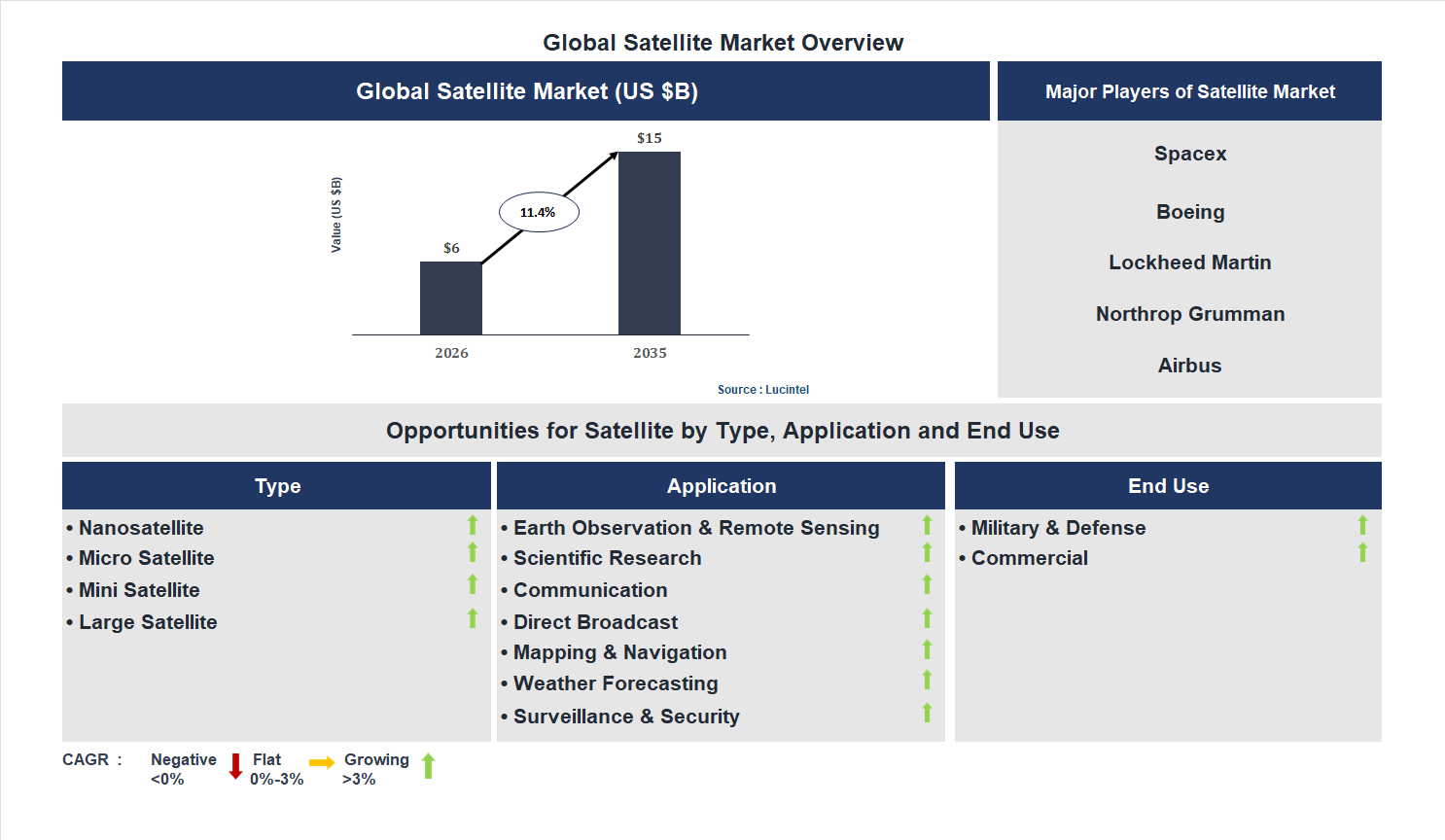
The future of the global satellite market looks promising with opportunities in the military & defense and commercial markets. The global satellite market is expected to reach an estimated $15 billion by 2035 with a CAGR of 11.4% from 2026 to 2035. The major drivers for this market are the increasing demand for satellite internet connectivity, the rising investments in space technology infrastructure, and the growing need for earth observation data services.• Lucintel forecasts that, within the type category, large satellite is expected to witness the highest growth over the forecast period.
• Within the end use category, military & defense is expected to witness higher growth.
• In terms of region, APAC is expected to witness the highest growth over the forecast period. Gain valuable insights for your business decisions with our comprehensive 150+ page report. Sample figures with some insights are shown below.
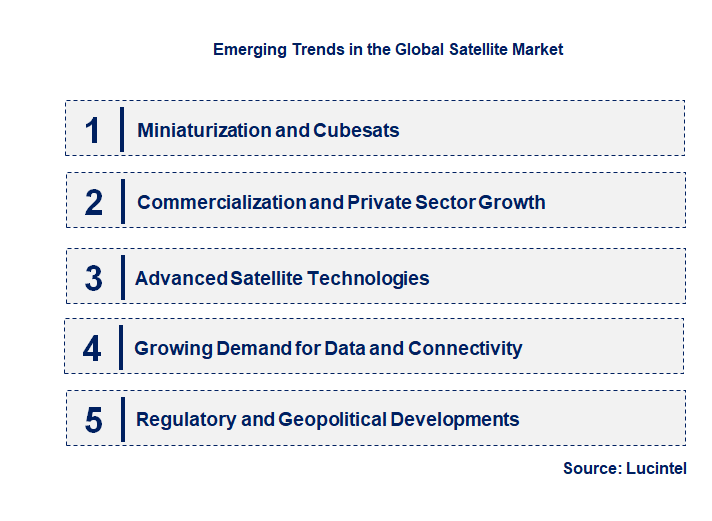
Emerging Trends in the Satellite Market
The satellite market is experiencing rapid evolution driven by technological advancements, increasing demand for data, and geopolitical shifts. As satellite technology becomes more sophisticated and accessible, new opportunities and challenges are emerging across various sectors. These developments are reshaping how industries operate, governments strategize, and consumers access information. The markets future is poised for significant growth, driven by innovations in satellite design, deployment, and applications. Understanding these trends is crucial for stakeholders aiming to capitalize on emerging opportunities and navigate potential risks in this dynamic landscape.• Miniaturization and CubeSats: The trend toward smaller, cost-effective satellites like CubeSats is transforming deployment strategies. These miniaturized satellites reduce launch costs and enable rapid, frequent launches, making space more accessible for universities, startups, and research institutions. They facilitate specialized missions such as Earth observation, communications, and scientific experiments. The proliferation of CubeSats is democratizing space access, fostering innovation, and expanding the satellite ecosystem, ultimately leading to more diverse and competitive market offerings.
• Commercialization and Private Sector Growth: The increasing involvement of private companies in satellite manufacturing, launch services, and data analytics is reshaping the market landscape. Companies like SpaceX, OneWeb, and Amazon are investing heavily in satellite constellations for broadband and IoT connectivity. This shift reduces reliance on government agencies and accelerates deployment timelines. The commercialization trend is driving down costs, increasing competition, and expanding satellite applications into new sectors such as logistics, agriculture, and urban planning, thereby broadening market scope and revenue streams.
• Advanced Satellite Technologies: Innovations in propulsion, power systems, and materials are enhancing satellite performance and lifespan. Electric propulsion enables efficient orbit adjustments, while high-capacity batteries support longer missions. New materials improve durability against space debris and radiation. These technological advancements lead to more reliable, longer-lasting satellites with enhanced capabilities, supporting complex missions like deep-space exploration and high-resolution Earth imaging. The improved performance and durability are critical for meeting the growing demand for data and global connectivity.
• Growing Demand for Data and Connectivity: The surge in data consumption driven by IoT, 5G, and smart city initiatives is fueling satellite deployment for broadband and data services. Satellites provide essential connectivity in remote and underserved areas, bridging digital divides. The demand for high-speed, reliable internet access is prompting investments in large-scale satellite constellations. This trend is expanding the market beyond traditional applications, creating new revenue streams and fostering digital inclusion. It also encourages the development of integrated terrestrial and satellite networks for seamless global connectivity.
• Regulatory and Geopolitical Developments: Evolving regulations and geopolitical considerations are influencing satellite deployment and spectrum management. Governments are implementing policies to regulate satellite constellations, orbital slots, and spectrum allocation to prevent congestion and interference. Geopolitical tensions impact satellite access and collaboration, affecting international partnerships and market stability. These regulatory and political factors necessitate strategic planning for satellite operators and manufacturers, shaping the future landscape of satellite deployment, ownership, and operational protocols. These emerging trends are collectively transforming the satellite market into a more innovative, competitive, and accessible industry. Miniaturization and CubeSats democratize space access, while increased private sector involvement accelerates deployment and reduces costs. Technological advancements improve satellite performance, supporting diverse applications. Growing data and connectivity demands expand market opportunities, especially in underserved regions. Meanwhile, regulatory and geopolitical developments require strategic navigation to ensure sustainable growth. Overall, these trends are fostering a more dynamic, resilient, and expansive satellite ecosystem, poised to meet the evolving needs of global industries and societies.
Recent Development in the Satellite Market
The satellite market is experiencing rapid growth driven by technological advancements, increased demand for global connectivity, and expanding applications across various sectors. Innovations in satellite design, miniaturization, and launch capabilities are opening new opportunities for commercial, governmental, and scientific uses. As the industry evolves, key developments are shaping the future landscape, offering enhanced coverage, improved data transmission, and cost-effective solutions. These trends are transforming how industries operate and how nations strategize their space initiatives, creating a dynamic and competitive market environment.• Growing Demand for Global Connectivity: The increasing need for reliable internet and communication services worldwide is driving satellite deployment. Low Earth Orbit (LEO) satellite constellations, such as Starlink, are expanding coverage to remote and underserved areas, reducing digital divides. This growth is fostering new business models, boosting revenue streams, and encouraging investments in satellite infrastructure. The market benefits from enhanced data speeds, lower latency, and broader access, making satellite connectivity a critical component of modern communication networks.
• Advancements in Satellite Technology: Innovations in miniaturization, propulsion, and power systems are making satellites more efficient and affordable. Small satellites and CubeSats are gaining popularity for scientific research, Earth observation, and commercial applications. These technological improvements enable faster deployment, lower costs, and increased mission flexibility. As a result, more players can participate in satellite launches, fostering competition and expanding the market scope. Enhanced capabilities also improve data accuracy and operational lifespan, benefiting various industries.
• Expansion of Commercial Satellite Launch Services: The rise of private launch providers like SpaceX and Rocket Lab is transforming satellite deployment economics. Reusable launch vehicles and cost-effective missions are reducing launch costs significantly. This development allows smaller companies and startups to access space, accelerating innovation and market entry. The increased launch frequency and reduced costs are enabling larger satellite constellations and more diverse applications, including IoT, navigation, and Earth monitoring, thus broadening the market’s reach and potential.
• Increasing Use of Satellite Data Analytics: The proliferation of satellite data is fueling growth in analytics services across sectors such as agriculture, defense, and urban planning. Advanced data processing and AI integration enable real-time insights, predictive analytics, and decision-making support. This trend enhances operational efficiency, resource management, and strategic planning. As data volumes grow, demand for sophisticated analytics tools rises, creating new revenue streams and expanding the satellite market’s value chain, ultimately making satellite data more accessible and actionable.
• Growing Focus on Space Sustainability and Regulations: Increasing satellite deployments raise concerns about space debris and orbital congestion. Governments and industry stakeholders are developing regulations and debris mitigation strategies to ensure sustainable space operations. Initiatives include end-of-life satellite disposal, debris tracking, and international cooperation. These efforts promote responsible growth, reduce collision risks, and foster investor confidence. The emphasis on sustainability is shaping market practices, encouraging innovation in debris removal technologies, and ensuring long-term viability of satellite services. The recent developments in satellite technology, launch services, data analytics, connectivity, and sustainability are significantly transforming the market. These advancements are enabling broader access, reducing costs, and improving operational efficiency, which attract new entrants and foster innovation. As the industry continues to evolve, these trends will drive increased investment, expand application areas, and promote sustainable practices, ultimately shaping a resilient and competitive satellite market landscape with vast growth potential.
Strategic Growth Opportunities in the Satellite Market
The satellite market is experiencing rapid growth driven by technological advancements, increasing demand for global connectivity, and expanding applications across various sectors. Emerging markets and innovative satellite solutions are creating new opportunities for industry players. Strategic investments and collaborations are further accelerating market expansion. As satellite technology becomes more cost-effective and versatile, the potential for growth across commercial, defense, and scientific applications continues to rise, shaping the future landscape of global satellite deployment and services.• Increasing Demand for Global Connectivity: The rising need for reliable internet access in remote and underserved areas is fueling satellite deployment. Low Earth Orbit (LEO) satellite constellations like Starlink and OneWeb are expanding coverage, improving bandwidth, and reducing latency. This growth benefits sectors such as telecommunications, rural development, and disaster management, creating significant opportunities for satellite service providers and manufacturers to capture new markets and enhance global connectivity infrastructure.
• Advancements in Satellite Technology and Miniaturization: Innovations in miniaturization and propulsion systems are enabling smaller, more efficient satellites. CubeSats and small satellites are reducing launch costs and increasing deployment flexibility. These technological advancements open opportunities for universities, startups, and established companies to develop specialized applications like Earth observation, scientific research, and IoT connectivity, thereby broadening the market scope and encouraging more frequent satellite launches.
• Growing Adoption of Commercial Satellite Services: The commercial sector is increasingly utilizing satellite services for navigation, broadcasting, and data transmission. The rise of satellite-based IoT solutions and remote sensing applications is creating new revenue streams. Companies are investing in high-throughput satellites (HTS) and broadband services to meet rising demand. This trend is fostering partnerships and innovations, expanding the commercial satellite market, and driving revenue growth across multiple industries.
• Expansion of Defense and Security Satellite Applications: Governments and military agencies are investing heavily in secure communication, surveillance, and reconnaissance satellites. The need for real-time intelligence and national security is boosting defense satellite procurement. Innovations in anti-jamming, encryption, and persistent surveillance are creating opportunities for defense contractors. This segments growth is expected to continue, driven by geopolitical tensions and the need for advanced security infrastructure.
• Increasing Focus on Space Sustainability and Satellite Servicing: As satellite constellations grow, space debris management and satellite servicing are gaining importance. Technologies for debris removal, satellite refueling, and end-of-life deorbiting are emerging. Companies and agencies are investing in sustainable practices to ensure long-term space operations. This focus on space sustainability presents opportunities for innovative solutions, regulatory frameworks, and new business models in satellite servicing and debris mitigation. The satellite markets growth is propelled by technological innovations, expanding applications, and increasing demand for connectivity and security. Opportunities across commercial, defense, and scientific sectors are fostering a dynamic environment for industry expansion. Emphasizing sustainability and advanced satellite solutions will be crucial for long-term success. Overall, these growth opportunities are set to significantly shape the future landscape of the satellite industry, driving innovation, investment, and global connectivity.
Satellite Market Driver and Challenges
The satellite market is influenced by a complex interplay of technological advancements, economic shifts, and regulatory frameworks. Rapid innovations in satellite technology, increasing demand for global connectivity, and expanding applications across sectors such as defense, telecommunications, and earth observation are key drivers. Conversely, challenges such as high deployment costs, regulatory hurdles, and space debris management pose significant obstacles. Understanding these factors is essential for stakeholders to navigate the evolving landscape, capitalize on opportunities, and mitigate risks effectively. The dynamic nature of this market requires continuous adaptation to technological progress and policy changes, shaping its growth trajectory and competitive landscape. The factors responsible for driving the satellite market include:-• Technological Innovation: The rapid development of miniaturized, cost-effective satellite components and launch systems has significantly lowered entry barriers. Advances in propulsion, materials, and data processing enable more sophisticated and versatile satellites, expanding their applications. These innovations facilitate faster deployment, improved performance, and reduced costs, attracting new players and increasing market competition. As technology continues to evolve, the market is poised for sustained growth driven by enhanced capabilities and new use cases, including IoT connectivity, remote sensing, and space exploration.
• Growing Demand for Global Connectivity: The increasing need for reliable, high-speed internet access in remote and underserved regions is a major driver. Satellite constellations like Starlink and OneWeb aim to provide global coverage, bridging the digital divide. This demand is fueled by the proliferation of connected devices, remote work, and digital transformation initiatives. Governments and private companies are investing heavily in satellite-based communication infrastructure, which is expected to boost market expansion. The ability to deliver broadband services in challenging terrains and during natural disasters further amplifies this demand, making it a critical growth factor.
• Expansion of Earth Observation and Data Analytics: The rising importance of satellite-based earth observation for environmental monitoring, disaster management, agriculture, and urban planning is a key driver. Enhanced imaging technologies and data analytics enable real-time insights, supporting decision-making processes across various sectors. Governments and private entities are increasingly relying on satellite data for climate change studies, resource management, and security. This expanding application spectrum drives demand for specialized satellites, fostering innovation and market growth in the remote sensing segment.
• Increasing Defense and Security Applications: Military and security agencies worldwide are investing in advanced satellite systems for surveillance, reconnaissance, navigation, and secure communications. The strategic importance of space assets in national security has led to increased government funding and international collaborations. The development of resilient, anti-jamming, and anti-satellite technologies further enhances the capabilities of defense satellites. This sectors growth directly impacts the overall market, encouraging technological advancements and expanding the satellite ecosystem to meet evolving security needs. The challenges facing the satellite market include:-
• High Deployment and Maintenance Costs: Building, launching, and maintaining satellites require substantial financial investment. The costs associated with manufacturing advanced satellite systems, securing launch services, and ensuring operational longevity are significant barriers for new entrants and smaller players. These expenses can limit market entry and slow down innovation. Additionally, ongoing maintenance and replacement costs add to the financial burden, impacting profitability and market stability. As satellite technology becomes more complex, managing costs remains a critical challenge for sustainable growth.
• Regulatory and Spectrum Allocation Challenges: The satellite industry faces complex regulatory environments across different countries, including licensing, spectrum management, and orbital slot allocations. These regulations can delay project timelines and increase compliance costs. International coordination is necessary to prevent interference and ensure fair spectrum distribution, but differing national policies often create hurdles. Navigating these regulatory frameworks requires significant expertise and resources, potentially hindering market expansion and technological deployment, especially for emerging players seeking global reach.
• Space Debris and Sustainability Concerns: The increasing number of satellites contributes to space debris, posing collision risks and operational hazards. Managing space traffic and ensuring sustainable use of orbital slots are critical issues. Regulatory bodies and industry stakeholders are working on guidelines, but enforcement remains challenging. Space debris not only threatens satellite longevity but also raises environmental and safety concerns, potentially leading to stricter regulations and operational limitations. Addressing these sustainability issues is vital for the long-term viability of the satellite industry. The satellite market is driven by technological innovation, rising demand for global connectivity, expanding earth observation applications, and strategic defense needs. However, high costs, regulatory complexities, and space debris management pose significant challenges. These factors collectively shape the markets growth trajectory, requiring stakeholders to innovate, collaborate, and adapt to ensure sustainable development. The interplay of drivers and challenges will determine the pace and nature of future market expansion, influencing investment, policy, and technological strategies across the industry.
List of Satellite Companies
Companies in the market compete on the basis of product quality offered. Major players in this market focus on expanding their manufacturing facilities, R&D investments, infrastructural development, and leverage integration opportunities across the value chain. With these strategies satellite companies cater increasing demand, ensure competitive effectiveness, develop innovative products & technologies, reduce production costs, and expand their customer base. Some of the satellite companies profiled in this report include-• Spacex
• Boeing
• Lockheed Martin
• Northrop Grumman
• Airbus
• Thales Alenia Space
• Ses S.A.
• Intelsat
• Oneweb
• Maxar Technologies
Satellite Market by Segment
The study includes a forecast for the global satellite market by type, application, end use, and region.Satellite Market by Type [Value from 2019 to 2035]:
• Nanosatellite
• Micro Satellite
• Mini Satellite
• Large Satellite
Satellite Market by Application [Value from 2019 to 2035]:
• Earth Observation & Remote Sensing
• Scientific Research
• Communication
• Direct Broadcast
• Mapping & Navigation
• Weather Forecasting
• Surveillance & Security
Satellite Market by End Use [Value from 2019 to 2035]:
• Military & Defense
• Commercial
Satellite Market by Region [Value from 2019 to 2035]:
• North America
• Europe
• Asia Pacific
• The Rest of the World
Country Wise Outlook for the Satellite Market
The satellite market has experienced rapid growth driven by technological advancements, increased demand for communication, navigation, and Earth observation services, and expanding commercial and governmental applications. The United States, China, Germany, India, and Japan are key players, each contributing unique developments to this dynamic sector. These countries are investing heavily in satellite technology, launching innovative projects, and fostering international collaborations to enhance their capabilities and market share. The evolving regulatory landscape and the push for more sustainable and cost-effective satellite solutions are also shaping recent trends. Below is a country-specific overview of recent developments in the satellite market.• United States: The US has seen significant advancements with private companies like SpaceX and Blue Origin launching reusable rockets, reducing launch costs. NASAs Artemis program aims to return humans to the Moon, boosting satellite technology for lunar exploration. The US government is also investing in small satellite constellations for global internet coverage, such as SpaceXs Starlink. Additionally, there is increased focus on satellite cybersecurity and data analytics to support national security and commercial interests.
• China: China has accelerated its satellite deployment with the BeiDou navigation system reaching global coverage, competing with GPS. The country launched the Tiangong space station, which includes advanced Earth observation and communication satellites. China is also developing high-resolution imaging satellites for environmental monitoring and urban planning. The government encourages commercial satellite startups, fostering innovation in satellite manufacturing and launch services, and aims to become a global leader in satellite technology by 2030.
• Germany: Germany continues to advance its satellite capabilities through collaborations with the European Space Agency (ESA). The country has launched new Earth observation satellites focused on climate monitoring, disaster management, and agricultural planning. Germany is also investing in satellite-based navigation and communication systems to support transportation and industry. The development of small satellite platforms and innovative propulsion systems highlights its commitment to sustainable and efficient satellite solutions.
• India: India has made notable progress with its Indian Space Research Organisation (ISRO) launching a series of communication, navigation, and Earth observation satellites. The Gaganyaan human spaceflight mission is expected to enhance satellite technology for crewed missions. India is also focusing on cost-effective satellite manufacturing and launch services, with the PSLV and GSLV rockets playing key roles. The country aims to expand its satellite constellation for better rural connectivity, disaster management, and agricultural monitoring.
• Japan: Japan remains a leader in satellite technology with advanced Earth observation and weather satellites supporting disaster prediction and climate research. The country is investing in small satellite technology and commercial space ventures, including satellite servicing and in-orbit manufacturing. Japans collaboration with international partners enhances its capabilities in space situational awareness and security. The government emphasizes sustainable satellite operations and the development of next-generation propulsion and communication systems to maintain its competitive edge.

Features of the Global Satellite Market
Market Size Estimates: Satellite market size estimation in terms of value ($B). Trend and Forecast Analysis: Market trends (2019 to 2025) and forecast (2026 to 2035) by various segments and regions. Segmentation Analysis: Satellite market size by type, application, end use, and region in terms of value ($B). Regional Analysis: Satellite market breakdown by North America, Europe, Asia Pacific, and Rest of the World. Growth Opportunities: Analysis of growth opportunities in different types, applications, end uses, and regions for the satellite market. Strategic Analysis: This includes M&A, new product development, and competitive landscape of the satellite market. Analysis of competitive intensity of the industry based on Porter’s Five Forces model.
FAQ
Q1. What is the satellite market size? Answer: The global satellite market is expected to reach an estimated $15 billion by 2035. Q2. What is the growth forecast for satellite market? Answer: The global satellite market is expected to grow with a CAGR of 11.4% from 2026 to 2035. Q3. What are the major drivers influencing the growth of the satellite market? Answer: The major drivers for this market are the increasing demand for satellite internet connectivity, the rising investments in space technology infrastructure, and the growing need for earth observation data services. Q4. What are the major segments for satellite market? Answer: The future of the satellite market looks promising with opportunities in the military & defense and commercial markets. Q5. Who are the key satellite market companies? Answer: Some of the key satellite companies are as follows:• Spacex
• Boeing
• Lockheed Martin
• Northrop Grumman
• Airbus
• Thales Alenia Space
• Ses S.A.
• Intelsat
• Oneweb
• Maxar Technologies Q6. Which satellite market segment will be the largest in future? Answer: Lucintel forecasts that, within the type category, large satellite is expected to witness the highest growth over the forecast period. Q7. In satellite market, which region is expected to be the largest in next 8 years? Answer: In terms of region, APAC is expected to witness the highest growth over the forecast period. Q8. Do we receive customization in this report? Answer: Yes, Lucintel provides 10% customization without any additional cost.
Table of Contents
List of Figures
List of Tables
Methodology
- In-depth interviews of the major players in this market
- Detailed secondary research from competitors’ financial statements and published data
- Extensive searches of published works, market, and database information pertaining to industry news, company press releases, and customer intentions
- A compilation of the experiences, judgments, and insights of Lucintel’s professionals, who have analyzed and tracked this market over the years.


Buy Now
Choose a license that fits your team. Instant PDF delivery.
Prices exclude taxes. Instant delivery. Custom licensing available on request.
Key Questions
- • What are some of the most promising, high-growth opportunities for the satellite market by type (nanosatellite, micro satellite, mini satellite, and large satellite), application (earth observation & remote sensing, scientific research, communication, direct broadcast, mapping & navigation, weather forecasting, and surveillance & security), end use (military & defense and commercial), and region (North America, Europe, Asia Pacific, and the Rest of the World)?
- • Which segments will grow at a faster pace and why?
- • Which region will grow at a faster pace and why?
- • What are the key factors affecting market dynamics? What are the key challenges and business risks in this market?
- • What are the business risks and competitive threats in this market?
- • What are the emerging trends in this market and the reasons behind them?
- • What are some of the changing demands of customers in the market?
- • What are the new developments in the market? Which companies are leading these developments?
- • Who are the major players in this market? What strategic initiatives are key players pursuing for business growth?
- • What are some of the competing products in this market and how big of a threat do they pose for loss of market share by material or product substitution?
- • What M&A activity has occurred in the last 5 years and what has its impact been on the industry? For any questions related to Satellite Market, Satellite Market Size, Satellite Market Growth, Satellite Market Analysis, Satellite Market Report, Satellite Market Share, Satellite Market Trends, Satellite Market Forecast, Satellite Companies, write Lucintel analyst at email: helpdesk@lucintel.com. We will be glad to get back to you soon.


