
Market Report · July 31, 2026

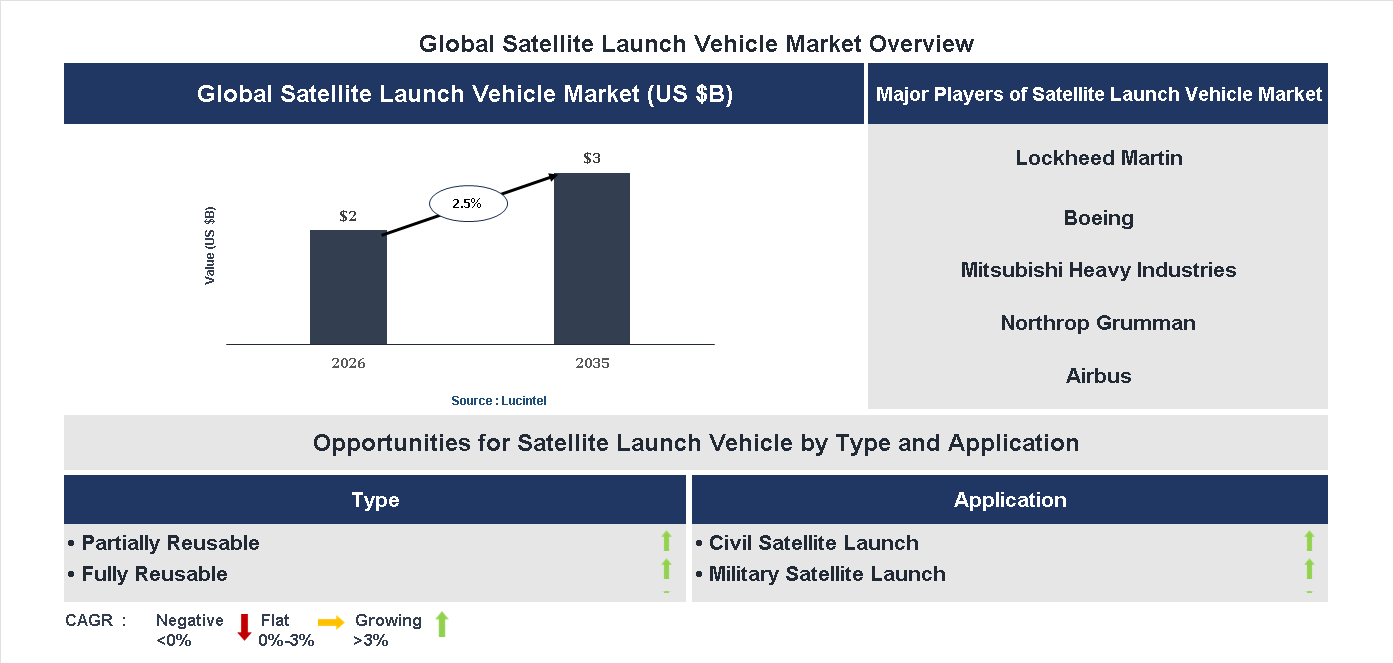
Key data points: The market size in 2035 = $3 billion, growth forecast = 2.5% annually for the next 8 years. Scroll below to get more insights. This market report covers trends, opportunities and forecasts in satellite launch vehicle market to 2035 by type (partially reusable and fully reusable), application (civil satellite launch and military satellite launch), and region (North America, Europe, Asia Pacific, and the Rest of the World)
We'll send your sample report shortly.
• Lucintel forecasts that, within the type category, fully reusable is expected to witness higher growth over the forecast period.
• Within the application category, civil satellite launch is expected to witness higher growth.
• In terms of region, APAC is expected to witness the highest growth over the forecast period. Gain valuable insights for your business decisions with our comprehensive 150+ page report. Sample figures with some insights are shown below.
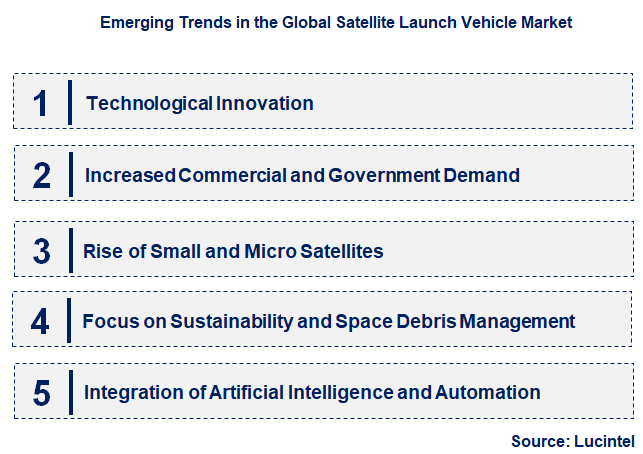
• Technological Innovation: Advancements in reusable launch vehicles are revolutionizing the market by significantly reducing launch costs. Companies like SpaceX and Blue Origin are pioneering reusable technology, enabling more frequent and affordable launches. This innovation enhances market accessibility, encourages new entrants, and accelerates satellite deployment timelines. The reduction in costs also makes space more accessible for smaller organizations and countries, broadening the market base and fostering competitive dynamics.
• Increased Commercial and Government Demand: The rising need for satellite-based services such as broadband, Earth observation, and navigation is driving market growth. Governments are investing heavily in space programs for defense, scientific research, and infrastructure development, while private companies seek to capitalize on commercial opportunities. This surge in demand is leading to more frequent launches, diversified satellite constellations, and increased collaboration between public and private sectors, thereby expanding the market scope and revenue streams.
• Rise of Small and Micro Satellites: The miniaturization of satellite technology has led to a boom in small and micro satellites, which are cheaper and quicker to develop and launch. These satellites are ideal for niche applications like IoT, environmental monitoring, and disaster management. The trend is prompting launch service providers to develop dedicated small satellite launch vehicles, creating a new segment within the market. This shift enhances market flexibility, reduces barriers to entry, and fosters innovation in satellite applications.
• Focus on Sustainability and Space Debris Management: Growing concerns over space debris are prompting industry stakeholders to adopt sustainable practices. Innovations in debris mitigation, such as end-of-life satellite deorbiting and debris removal technologies, are gaining traction. Regulatory frameworks are also evolving to enforce responsible launch practices. These efforts aim to ensure long-term sustainability of space activities, minimize environmental impact, and maintain orbital safety, which are critical for the continued growth of the satellite launch market.
• Integration of Artificial Intelligence and Automation: AI and automation are transforming launch operations by improving mission planning, vehicle monitoring, and anomaly detection. These technologies enhance reliability, reduce human error, and optimize launch schedules. Automated systems enable faster decision-making and real-time adjustments, increasing overall efficiency. The integration of AI also facilitates predictive maintenance and data analysis, leading to cost savings and improved safety standards. This trend is set to make launch services more reliable, scalable, and accessible, further fueling market expansion. These emerging trends are collectively reshaping the satellite launch vehicle market by making launches more affordable, sustainable, and technologically advanced. They are expanding market opportunities, fostering innovation, and ensuring the sectors resilience in a competitive global landscape. As these developments continue, the market is poised for sustained growth and increased diversification, ultimately supporting the broader expansion of space-based applications and services.
• Technological Advancements in Launch Vehicles: Innovation in propulsion systems and reusable rockets is reducing costs and increasing launch frequency, making satellite deployment more accessible. These improvements are enabling faster, more reliable launches, which attract more customers and expand market reach. The reduced costs and increased efficiency are fostering a more competitive environment, encouraging new entrants, and accelerating satellite deployment timelines. This evolution is crucial for meeting the growing demand for satellite-based services worldwide.
• Rising Demand for Satellite Services: The increasing need for broadband, Earth observation, and communication services is driving satellite launches. Governments and private companies are investing heavily to enhance connectivity, especially in remote areas. This demand is fueling the development of specialized launch vehicles capable of deploying large constellations of small satellites. The market expansion is also supporting innovations in satellite technology, which further boosts the demand for dedicated launch solutions, creating a positive feedback loop for growth.
• Growth of Small Satellite Deployments: The proliferation of small satellites, or CubeSats, is transforming the launch landscape by requiring dedicated, cost-effective launch options. This trend is opening new markets for launch service providers, especially in research, defense, and commercial sectors. The ability to deploy multiple small satellites simultaneously is reducing costs and increasing deployment frequency. This shift is encouraging the development of dedicated small satellite launch vehicles, which are expected to significantly impact market dynamics.
• Increased Government and Commercial Investments: Governments worldwide are prioritizing space programs, leading to increased funding for satellite launches. Private companies are also investing heavily in launch infrastructure and services to capitalize on market opportunities. These investments are accelerating technological development and expanding launch capacity. The influx of capital is fostering innovation, reducing costs, and enabling more frequent launches, which collectively drive market growth and diversification.
• Emergence of Reusable Launch Vehicles: The adoption of reusable rockets is revolutionizing the launch industry by drastically reducing costs and turnaround times. Companies like SpaceX and Blue Origin are leading this trend, making satellite launches more economical and accessible. Reusability is enabling more frequent launches, supporting the deployment of larger satellite constellations, and attracting new customers. This development is fundamentally transforming the market, fostering competition, and expanding the scope of satellite applications. These developments are collectively transforming the satellite launch vehicle market by making launches more affordable, reliable, and accessible. The technological innovations, increased investments, and growing demand for satellite services are driving rapid industry expansion. As a result, the market is becoming more competitive, diverse, and capable of supporting a broader range of applications, ultimately enhancing global connectivity and satellite-based services.
• Growing Demand for Commercial Satellite Launch Services: The increasing need for commercial satellite deployment, including broadband, broadcasting, and IoT applications, is driving market growth. Companies are investing in more reliable, cost-effective launch vehicles to meet customer demands for faster deployment and higher payload capacities. This trend is supported by rising satellite constellations and the expansion of global connectivity initiatives, creating substantial opportunities for launch service providers to capture new business and expand their market share.
• Advancements in Reusable Launch Vehicle Technologies: Innovations in reusable rocket technology are transforming the satellite launch industry by significantly reducing costs and turnaround times. Companies like SpaceX and Blue Origin are pioneering reusable systems, making launches more economical and accessible. These advancements enable frequent launches, increase market competitiveness, and open avenues for smaller satellite deployments, thereby expanding the overall market size and encouraging new entrants to develop cost-efficient launch solutions.
• Expansion of Small Satellite Launch Capabilities: The proliferation of small satellites, driven by the demand for cost-effective, rapid deployment of nanosatellites and CubeSats, is creating a niche market for dedicated small satellite launch vehicles. Specialized launch services tailored for small payloads are emerging, offering flexible scheduling and lower costs. This growth supports the expanding small satellite ecosystem, including scientific research, Earth observation, and communication networks, providing lucrative opportunities for launch providers to diversify their offerings.
• Strategic Collaborations and Partnerships for Market Penetration: Collaborations between launch service providers, satellite manufacturers, and government agencies are crucial for market expansion. Strategic alliances facilitate technology sharing, joint missions, and access to new customer bases. These partnerships help mitigate risks, enhance technological capabilities, and accelerate market entry, especially in emerging regions. Such collaborations are vital for establishing a competitive edge and fostering innovation within the satellite launch vehicle industry.
• Increasing Government and Defense Sector Investments: Governments and defense agencies are investing heavily in satellite technology for surveillance, navigation, and communication purposes. This increased funding supports the development of dedicated launch vehicles and national space programs. Public-private partnerships are also emerging to develop cost-effective launch solutions for defense applications. These investments are expected to sustain long-term growth, stimulate technological advancements, and expand the market scope for satellite launch vehicles globally. The overall impact of these opportunities is set to significantly accelerate market growth, foster innovation, and diversify service offerings. As technological and strategic developments continue, the satellite launch vehicle market will become more competitive, accessible, and capable of supporting a broader range of applications. This evolution will ultimately enable more countries and organizations to participate in space activities, shaping a more dynamic and resilient industry landscape.
• Technological Innovation: The continuous development of more efficient, reliable, and cost-effective launch vehicles is a primary driver. Advances in reusable rocket technology, such as those pioneered by private companies, significantly reduce launch costs and increase frequency. These innovations enable more satellite deployments, catering to growing demand from telecommunications, Earth observation, and defense sectors. As technology progresses, the market benefits from increased reliability and reduced risk, encouraging more customers to opt for satellite launches, thus fueling overall growth.
• Rising Satellite Deployment Demand: The exponential increase in satellite applications across various industries is a major growth driver. From global internet coverage via satellite constellations to advanced Earth monitoring systems, the demand for satellite services is surging. Governments and private companies are investing heavily to expand their satellite fleets, which necessitates a robust launch infrastructure. This rising demand directly correlates with increased launch vehicle orders, stimulating market expansion and encouraging innovation in launch capabilities.
• Economic Factors and Cost Reduction: The decreasing costs associated with satellite launches are pivotal in driving market growth. Innovations such as reusable rockets and streamlined manufacturing processes have significantly lowered launch expenses. This cost reduction makes satellite deployment more accessible to smaller firms and emerging markets, broadening the customer base. Additionally, increased competition among launch service providers fosters price wars, further reducing costs and encouraging more frequent launches, thereby expanding the market.
• Government and Private Sector Investments: Increased funding from government agencies and private enterprises is a key driver. Governments worldwide are investing in space programs for strategic, scientific, and commercial purposes. Simultaneously, private companies like SpaceX, Blue Origin, and others are investing heavily in launch vehicle development to capitalize on commercial satellite demand. These investments accelerate technological progress, expand launch capacity, and create a more competitive environment, all of which contribute to market growth.
• Regulatory Environment and International Cooperation: Evolving regulatory frameworks and international agreements facilitate satellite launches by providing clearer guidelines and reducing bureaucratic hurdles. Streamlined licensing processes and international cooperation agreements enable faster deployment of satellite constellations. Moreover, regulatory support for reusable launch vehicles and commercial space activities encourages innovation and investment, further propelling the market forward. The challenges facing the satellite launch vehicle market include:-
• Stringent Regulatory and Licensing Procedures: The satellite launch industry faces complex regulatory requirements that can delay or increase the cost of launches. Governments impose strict safety, environmental, and frequency spectrum regulations, which require extensive approval processes. Navigating these regulations can be time-consuming and costly, potentially hindering rapid deployment and increasing overall project costs. As regulations evolve, companies must continuously adapt, which can create uncertainty and impact market growth.
• High Development and Operational Costs: Developing reliable launch vehicles involves significant capital investment, advanced technology, and extensive testing. These high costs pose barriers for new entrants and can strain existing players, especially during economic downturns. Operational expenses, including maintenance, insurance, and launch site fees, further add to the financial burden. These costs can limit the frequency of launches and slow down market expansion, particularly for smaller companies or emerging markets.
• Geopolitical and International Tensions: Political conflicts and international disputes can restrict access to launch sites, technology transfer, and international cooperation. Sanctions and export controls may limit the ability of certain countries or companies to participate fully in the market. Additionally, geopolitical tensions can lead to launch bans or restrictions, disrupting supply chains and delaying projects. These factors introduce uncertainty and risk, potentially dampening investment and innovation in the satellite launch vehicle sector. The satellite launch vehicle market is driven by technological innovations, increasing satellite deployment needs, cost reductions, and supportive investments. However, regulatory complexities, high costs, and geopolitical issues pose significant challenges. These factors collectively shape a dynamic environment where growth opportunities are substantial but require strategic navigation. The markets future will depend on how effectively stakeholders can leverage technological advancements while mitigating regulatory and geopolitical risks, ensuring sustainable expansion and innovation.
• Lockheed Martin
• Boeing
• Mitsubishi Heavy Industries
• Northrop Grumman
• Airbus
• Bellatrix Aerospace
• Bigelow Aerospace
• Masten Space Systems
• Space Exploration Technologies
• Virgin Galactic
• Partially Reusable
• Fully Reusable
• Civil Satellite Launch
• Military Satellite Launch
• North America
• Europe
• Asia Pacific
• The Rest of the World
• United States: The US continues to lead with advancements in reusable launch technology, exemplified by SpaceXs Starship and Falcon series, significantly reducing launch costs. NASAs Artemis program aims to return humans to the Moon, boosting launch vehicle development. Private companies are increasingly involved, fostering innovation and competition. The US government also invests in small satellite launchers to support rapid deployment and research missions, maintaining its dominant position in the global market.
• China: China has rapidly expanded its satellite launch capabilities, with the Long March series achieving notable milestones. The country is focusing on developing domestically produced, cost-effective launch vehicles to support its space station and satellite constellation ambitions. Recent launches have demonstrated increased reliability and payload capacity, positioning China as a major player. The government emphasizes self-reliance and strategic autonomy in space, with ongoing investments in new launch technologies and international collaborations.
• Germany: Germany is advancing its launch vehicle technology through partnerships within the European Space Agency and private sector initiatives. The focus is on developing small and medium-sized launchers to serve regional and scientific needs. Germany also contributes to the Ariane and Vega programs, emphasizing reliability and environmental sustainability. The country is exploring innovative propulsion systems and reusable technologies to enhance competitiveness and reduce costs in the European market.
• India: India’s ISRO has made significant progress with the GSLV and PSLV series, achieving cost-effective launches for domestic and international clients. The country is working on the Gagan Yaan crewed mission, which will require advanced launch capabilities. India is also developing small satellite launchers to cater to the growing demand for affordable, rapid deployment options. The government’s focus on self-reliance and expanding its space industry has led to increased investments and international partnerships.
• Japan: Japan continues to innovate with its H-IIA and H-IIB launch vehicles, emphasizing reliability and precision. The country is investing in next-generation launchers to support its space exploration and satellite deployment goals. Japan’s space agency, JAXA, collaborates internationally on lunar and asteroid missions, which influence launch vehicle development. The focus remains on enhancing payload capacity, environmental sustainability, and integrating cutting-edge technologies to maintain Japan’s competitive edge in the global market.


• Lockheed Martin
• Boeing
• Mitsubishi Heavy Industries
• Northrop Grumman
• Airbus
• Bellatrix Aerospace
• Bigelow Aerospace
• Masten Space Systems
• Space Exploration Technologies
• Virgin Galactic Q6. Which satellite launch vehicle market segment will be the largest in future? Answer: Lucintel forecasts that, within the type category, fully reusable is expected to witness higher growth over the forecast period. Q7. In satellite launch vehicle market, which region is expected to be the largest in next 8 years? Answer: In terms of region, APAC is expected to witness the highest growth over the forecast period. Q8. Do we receive customization in this report? Answer: Yes, Lucintel provides 10% customization without any additional cost.


Choose a license that fits your team. Instant PDF delivery.
Prices exclude taxes. Instant delivery. Custom licensing available on request.
Market Report · July 31, 2026
Market Report · July 31, 2026
Market Report · July 31, 2026
Trusted partner for strategic intelligence and business growth


Receive a complimentary market analysis tailored to your industry. Our analysts will identify key growth opportunities and competitive dynamics specific to your business.

Market size, growth rate, and key trend analysis for your specific sector.

Top competitor positioning and market share analysis.

Strategic recommendations backed by data-driven insights.
Get curated market intelligence and competitive moves straight to your inbox.
By subscribing, you agree to receive our monthly insights. Unsubscribe anytime.
Receive a complimentary market analysis tailored to your industry. Our analysts will identify key growth opportunities and competitive dynamics specific to your business.
Market size, growth rate, and key trend analysis for your specific sector.
Top competitor positioning and market share analysis.
Strategic recommendations backed by data-driven insights.
Get curated market intelligence, emerging trends, and competitive moves straight to your inbox each month.
By subscribing, you agree to receive our monthly insights. Unsubscribe anytime.
We'll send your sample report shortly.