
Report Feature
Sanitary Napkin Market Trends and Forecast
The future of the global sanitary napkin market looks promising with opportunities in the hypermarket, supermarket, convenience store, and online sale markets. The global sanitary napkin market is expected to grow with a CAGR of 4.1% from 2025 to 2031. The major drivers for this market are the increasing awareness about menstrual hygiene, the rising focus on womens health, and the growing demand for eco-friendly products.• Lucintel forecasts that, within the type category, daily use is expected to witness higher growth over the forecast period.
• Within the application category, online sale is expected to witness the highest growth.
• In terms of region, APAC is expected to witness the highest growth over the forecast period. Gain valuable insights for your business decisions with our comprehensive 150+ page report. Sample figures with some insights are shown below.
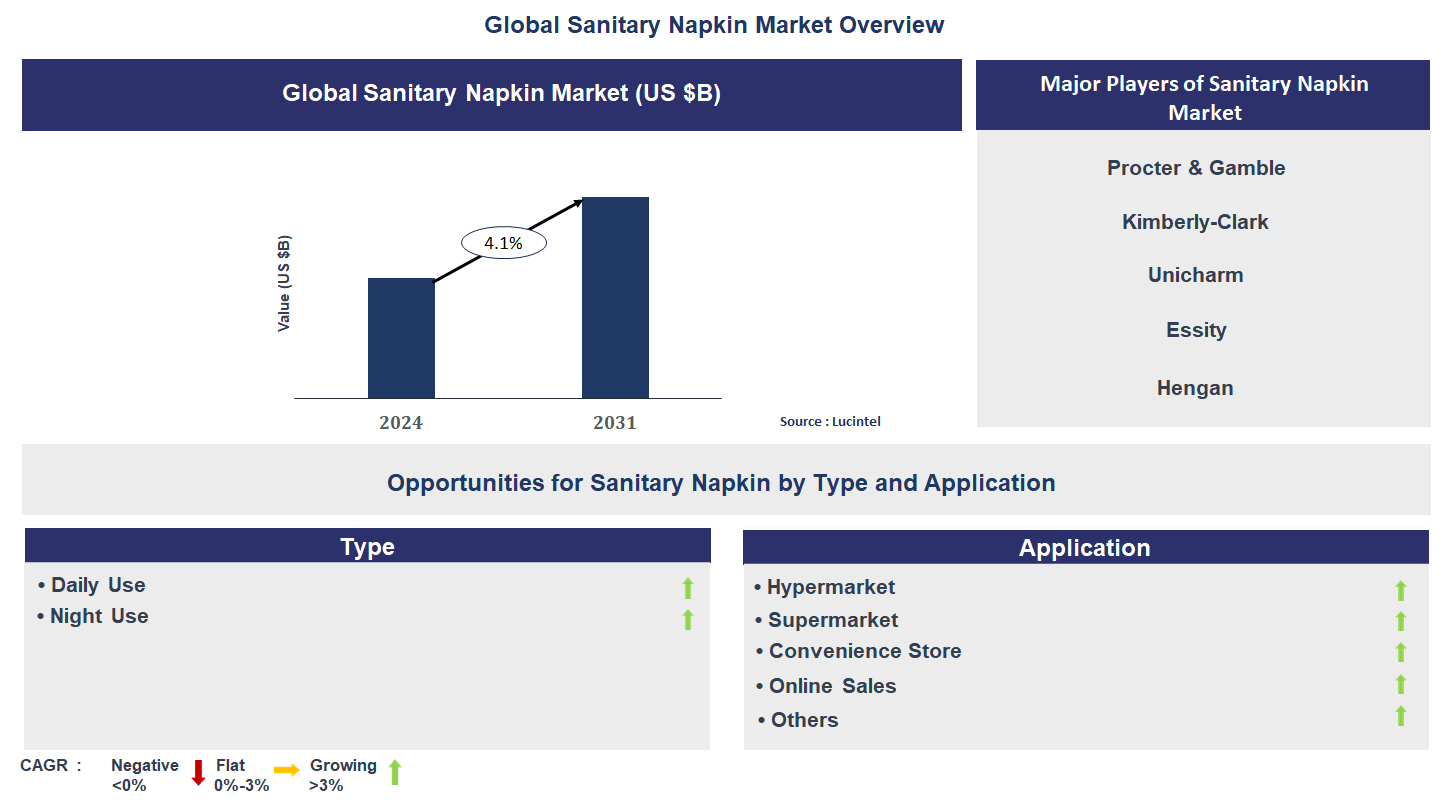
Emerging Trends in the Sanitary Napkin Market
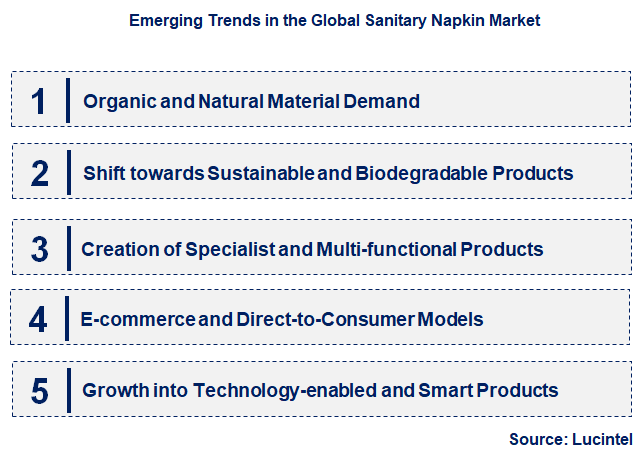
The sanitary napkin market is being redefined by a new wave of emerging trends that are remapping its landscape. These trends are part of an overall change in consumer values, where the product must not only be functional but also fit personal health objectives and an environmental awareness. The business is transitioning out of a basic, utilitarian product to greater specialization, sustainability, and consumer-based business models.• Organic and Natural Material Demand: One of the key trends is the increased demand for sanitary napkins produced using organic and natural materials. This has brought on a boom in demand for chemical-free synthetic-free pads and chlorine-free dyes. Consequently, companies are adopting ingredients such as bamboo fiber and organic cotton. This trend is enabling new, mission-based brands to emerge and is pushing established firms to re-formulate their products to accommodate the needs of a health-aware consumer base.
• Shift towards Sustainable and Biodegradable Products: The market is witnessing a strong shift towards sustainable and biodegradable products due to increasing environmental awareness. This is pushing manufacturers to adopt packaging that is ethically sourced, recyclable, or refillable. Consumers are increasingly judging a brands ecological behavior, so sustainability is becoming a central consideration in their purchasing choices. It is not only led by consumer demand but also by increasing government regulations on plastic waste.
• Creation of Specialist and Multi-functional Products: A growing trend is the universal creation of specialist and multi-functional products for various skin types and issues. The market is experiencing an increase in products used for sensitive skin and targeting products used for a particular group, e.g., athletes. This trend is also shifting towards products that are multi-benefit in one application, e.g., a pad that also benefits the skin to soothe and moisturize.
• E-commerce and Direct-to-Consumer Models: The industry is observing a robust trend of expansion in e-commerce and direct-to-consumer business models. This business model provides consumers with an easy means of buying a large range of goods in the comfort of their homes. It offers companies a regular revenue stream and enables them to establish a direct relationship with consumers. It also facilitates easier entry into the market of new brands to compete with long-standing giants, potentially creating increased consumer choice.
• Growth into Technology-enabled and Smart Products: There is a new trend in specialized, technology-enabled products. Although nascent, it includes the creation of smart pads with sensors to monitor several health parameters, including menstrual flow and temperature. This indicates the growing importance of technology in personal care and is building a new, highly specialized part of the market with a high growth rate. These new trends are cumulatively altering the sanitary napkin industry in such a manner that it is becoming increasingly consumer-value-driven and need-responsive. The emphasis on multi-benefit products and on adopting new technologies is building a new market segment of high-end, value-oriented products. The growth of new business models and the increase in the aesthetic and skincare categories are driving new market opportunities for growth and revenue expansion. The industrys future will depend on its capacity to innovate and respond to these potent trends.
Recent Development in the Sanitary Napkin Market
The market for sanitary napkin has seen a succession of fast and significant changes in the last few years, primarily based on increased consumer interest in health and wellness. These changes are shifting the market from a straightforward, problem-based category to an integrated, consumer-driven industry. The emphasis is now on sustainability, therapeutic performance, and a more complete strategy for health.• Introduction of Chemical-free and Organic Products: One of the main developments is the mass introduction of chemical-free and organic sanitary napkins. Owing to the demand for natural ingredients, companies are substituting synthetic chemicals with natural substitutes and are incorporating ingredients that are mild on the skin. This trend is essentially transforming product content and a companys public image, setting a new benchmark for ethical and health-oriented manufacture.
• Evolution of Absorbency and Comfort Technology: There has been significant evolution in absorbency and comfort technology. Firms are launching new products with innovative features such as super-absorbent polymers with the ability to manage heavy flow yet stay ultra-thin. The market is also witnessing growth in pads with a breathable and skin-friendly top sheet, which reduces irritation and discomfort. These innovations are enhancing the performance of sanitary napkins and are playing a major role in enhancing consumer satisfaction.
• Development of E-commerce and Subscription Models: One of the major developments is the growth and extensive adoption of the e-commerce and subscription model. This business model presents customers with an easy method of acquiring a vast range of sanitary napkins from home. It provides a stable source of revenue for companies and enables them to establish a direct customer relationship. It also facilitates it easier for new, niche brands to penetrate the market and compete with established giants.
• Menstrual Hygiene Awareness Campaigns Expansion: One of the most significant developments is the extension of menstrual hygiene awareness campaigns. Both governments and NGOs are striving to make people aware of the significance of menstrual health and hygiene. This is shattering social taboos and is boosting the use of sanitary napkins, especially in developing and rural regions. This growth is not merely propelling market growth but is also positively influencing society.
• Focus on Sustainable and Green Products: Another significant trend is the increasing focus on sustainable and green products. This encompasses using recyclable packaging and sourcing ingredients that are environmentally and ethically conscious. Brands now feature their eco-friendliness in their marketing. This trend is attractive to a new generation of green consumers and is a main force behind ongoing product development in the sector. These recent trends are all influencing the sanitary napkin market by driving it towards a future that is more specialized, therapeutic, and consumer-oriented. The move towards sustainable ingredients and the launch of new formulations are meeting both health and environmental demands. The move into new segments and the emergence of new business models are opening up new possibilities for market growth and brand differentiation.
Strategic Growth Opportunities in the Sanitary Napkin Market
The sanitary napkin industry presents a range of strategic growth opportunities in major applications, fueled by a convergence of shifting consumer values and the trend towards more specialization. To take advantage of these opportunities, businesses need to transcend a one-size-fits-all strategy and emphasize innovation and niche marketing. Through the recognition of and response to particular needs within various market segments, brands are able to develop new revenue channels and build a solid competitive position.• Serving the Niche Consumer Market: One of the biggest growth prospects is serving the niche consumer market. This involves creating products for unique groups, such as teenagers, individuals with a specific skin sensitivity, or individuals with heavy flow. By targeting a particular market, brands can create a loyal consumer base and differentiate themselves from generalist competitors. This provides the opportunity for higher profit margins and a powerful brand image.
• Leverage the Organic and Eco-friendly Segment: There is huge growth potential in the organic and eco-friendly segment. This involves creating products made with natural materials such as organic cotton or bamboo fiber and without toxic chemicals. Brands can also make strategic use of sustainable packaging. The segment has a high-value customer base that will pay premium prices for products that are aligned to personal values and environmental awareness.
• Rural and Underserved Markets Expansion: One of the biggest growth opportunities is to expand into rural and underserved markets. Though the disposable incomes in these markets might be lower, they form a huge, untapped consumer base. By providing an affordable but quality product and by aligning with local communities and organizations, brands can capture market share in such markets and create a long-term growth path.
• Taking Advantage of E-commerce with Customized Services: Direct-to-consumer and e-commerce models are a significant growth potential. By having a direct-to-consumer service, brands can minimize the costs of distribution and establish a direct connection with the customer. A subscription-based model provides a consistent and recurring revenue stream. The data that comes from online sales can also be utilized by firms to know consumers habits and tastes better, which can shape future product development and marketing campaigns.
• Penetrating the Female Athlete and Active Lifestyle Segment: There is a strategic opportunity for growth in penetrating the female athlete and active lifestyle segment. This involves creating products that are designed specifically to be functional and comfortable during physical activity. These products can have high-end absorbency, a focus on breathability, and a non-slip footprint. This is a fast-growing segment that has a high-value customer base. These strategic opportunities for growth are all affecting the market for sanitary napkins in driving it toward a more specialized, consumer-oriented future. By concentrating on niche populations and targeting particular applications, firms are broadening the markets scope. The focus on sustainability and new business models is giving rise to new segments of value-driven premium products. The strategic expansion into new markets also guarantees that the industry will grow and evolve in response to world consumer needs.
Sanitary Napkin Market Driver and Challenges
Sanitary napkin market is influenced by a multifaceted interaction of major drivers and challenges affecting its growth and trajectory. The growth of the market is driven mainly by increased global consciousness regarding personal health and hygiene, along with a fresh generation of consumers with a strong emphasis on self-care. Nonetheless, the industry also has some major challenges, such as a deficit in consumer awareness in certain markets, the premium product being more expensive, and ongoing cultural taboos. The factors responsible for driving the sanitary napkin market include: 1. Increasing Consumer Health Consciousness: One major driver is the increasing consumer health consciousness. The consumers are becoming more and more aware of the health hazards posed by using traditional pads that use synthetic materials and chemicals. This has resulted in widespread changes towards natural and organic options. The need for products that are safe for the skin and free of toxic chemicals is one of the major drivers of growth in the market. This is a change in behavior that has turned sanitary napkins into a daily essential for much broader consumer segments. 2. Rising Demand for Sustainable Products: The rising demand for sustainable products is a major driver of the market. Consumers are increasingly demanding that brands use ethically sourced ingredients and eco-friendly packaging. This has led to the widespread adoption of recyclable and biodegradable packaging. This is a big trend in the personal care market, and sanitary napkin brands that practice transparency are gaining a competitive advantage and are winning over an eco-aware new generation of consumers. 3. Government Campaigns and Initiatives: Government campaigns and initiatives for menstrual hygiene are one of the key drivers in the market, especially in developing economies. The efforts focus on raising awareness and making sanitary napkins available to every woman. It is a strong driver that is also dismantling social stigmas and driving adoption higher, which is also fueling market growth in a big way. 4. Increasing Disposable Incomes: The increasing disposable incomes, especially in emerging economies, are a key driver of the market. As the middle class increases, consumers have sufficient funds to spend on personal care products. This enables them to upgrade from basic hygienic products to more specific and luxury sanitary napkins. This driver is specifically strong in countries such as China and India, where economic growth is building a huge new consumer base. 5. Development of E-commerce and Social Media: The development of e-commerce and social media is a significant growth driver of the market. These mediums are facilitating the reach of brands to large numbers of people and enabling consumers to find a variety of products. Social media bloggers and influencers are also significantly contributing to informing consumers about the advantages of various sanitary napkins. This has also opened up the market to new brands. Challenges in the sanitary napkin market are: 1. Cultural Taboos and Stigma: One of the biggest challenges for the market is the stigma and cultural taboos attached to menstruation in certain areas. This discourages open conversation about menstrual hygiene and limits availability of correct products. This is a big hurdle for brands and forces them to invest in large educational campaigns to generate demand and alter consumer behavior. 2. Affordability and Accessibility: Affordability and accessibility of sanitary napkins are the key challenge, particularly in low-income populations. For most women, pads can be a luxury item and too expensive, and this is a considerable deterrent to usage. The issue for the brands is to create a product that is effective yet affordable to a large segment of consumers. 3. Alternative Products Competition: The market is being seriously threatened by alternative products. Menstrual cups and cloth pads that are reusable are increasing in demand, especially among environmentally aware consumers. Although these products form a minor segment of the market, they are an emerging threat to conventional sanitary napkin makers. The combined effect of these drivers and challenges is a market in constant flux. The motorists, particularly the increasing emphasis on health, sustainability, and self-care, are pressurizing the business to innovate and diversify. Companies are reacting by developing high-tech, niche, and organic offerings. Nevertheless, the obstacles, especially cultural resistance and intense competition, are compelling firms to be more strategic and accountable.List of Sanitary Napkin Companies
Companies in the market compete on the basis of product quality offered. Major players in this market focus on expanding their manufacturing facilities, R&D investments, infrastructural development, and leverage integration opportunities across the value chain. With these strategies sanitary napkin companies cater increasing demand, ensure competitive effectiveness, develop innovative products & technologies, reduce production costs, and expand their customer base. Some of the sanitary napkin companies profiled in this report include-• Procter & Gamble
• Kimberly-Clark
• Unicharm
• Essity
• Hengan
• Kenvue
• Kao Corporation
• Kingdom Healthcare
• Edgewell Personal Care
• Baiya Corporation
Sanitary Napkin Market by Segment
The study includes a forecast for the global sanitary napkin market by type, application, and region.Sanitary Napkin Market by Type [Value from 2019 to 2031]:
• Daily Use
• Night Use
Sanitary Napkin Market by Application [Value from 2019 to 2031]:
• Hypermarket
• Supermarket
• Convenience Store
• Online Sales
• Others
Sanitary Napkin Market by Region [Value from 2019 to 2031]:
• North America
• Europe
• Asia Pacific
• The Rest of the World
Country Wise Outlook for the Sanitary Napkin Market
The international sanitary napkin industry is entering an era of tremendous change fueled by shifting consumer needs, increasing environmental awareness, and speedy technological progress. This change is taking the industry away from emphasis on mere absorbency and comfort to a broader approach encompassing sustainability, stealthiness, and skin-friendliness. As awareness of menstrual hygiene grows in once underserved areas, the market is taking on social and economic importance. Every major nation has distinctive market features that illustrate its consumer, economic conditions, and cultural beliefs regarding menstrual health.• United States: In the United States, the market for sanitary napkins is turning toward emphasis on premium and specialty products. Though basic pads are still a standard, there is increasing demand for products with additional benefits, including organic components, anti-leak technology, and emphasis on skin-friendly formulation. There is also an increase in special products for various purposes, including ultra-thin and overnight pads. Direct-to-consumer companies and online retailers are taking center stage, offering numerous choices and enabling the targeted promotion of products to an increasingly health-aware consumer base.
• China: Chinas sanitary napkin market is growing rapidly, driven by a growing middle class and increased concern for individual health. The market is witnessing a high demand for products that provide therapeutic as well as aesthetic solutions, like herbal extract-infused pads and odor-controlling pads. Social media and e-commerce websites are the major growth drivers, with companies using influencers to tap into a large consumer base. The market is also experiencing an increase in demand for luxury, imported products.
• Germany: The sanitary napkin market in Germany is defined by a strong consumer focus on product quality as well as environmental and ecological considerations. Germany is one of the prominent markets in Europe with a great preference for skin-friendly and green personal care products. The market is also witnessing increasing demand for sustainable packaging solutions such as refills due to high consumer demand for the zero-waste trend.
• India: Indias sanitary napkin market is growing exponentially, driven by increasing disposable income and awareness of personal hygiene. Demand is also experiencing a robust growth through initiatives and campaigns by the government promoting menstrual hygiene. Although the market remains dominated by low-priced products, there is a definite movement towards premium and multi-purpose products. The market is observing a surge in demand for products with Ayurvedic ingredients infused into them.
• Japan: The mature Japanese sanitary napkin market is characterized by its emphasis on sophisticated technology and precision. Japanese consumers prefer products that not only work but are also gentle and luxurious. This has resulted in the creation of products with distinctive attributes, such as mens specialist skincare and technologically advanced grooming appliances. The market for items that offer anti-aging solutions for a professional, older population also exists. Japanese companies lead the way with innovative products that deliver a top-shelf, spa-like experience.

Features of the Global Sanitary Napkin Market
Market Size Estimates: Sanitary napkin market size estimation in terms of value ($B). Trend and Forecast Analysis: Market trends (2019 to 2024) and forecast (2025 to 2031) by various segments and regions. Segmentation Analysis: Sanitary napkin market size by type, application, and region in terms of value ($B). Regional Analysis: Sanitary napkin market breakdown by North America, Europe, Asia Pacific, and Rest of the World. Growth Opportunities: Analysis of growth opportunities in different types, applications, and regions for the sanitary napkin market. Strategic Analysis: This includes M&A, new product development, and competitive landscape of the sanitary napkin market. Analysis of competitive intensity of the industry based on Porter’s Five Forces model.
FAQ
Q1. What is the growth forecast for sanitary napkin market? Answer: The global sanitary napkin market is expected to grow with a CAGR of 4.1% from 2025 to 2031. Q2. What are the major drivers influencing the growth of the sanitary napkin market? Answer: The major drivers for this market are the increasing awareness about menstrual hygiene, the rising focus on womens health, and the growing demand for eco-friendly products. Q3. What are the major segments for sanitary napkin market? Answer: The future of the sanitary napkin market looks promising with opportunities in the hypermarket, supermarket, convenience store, and online sale markets. Q4. Who are the key sanitary napkin market companies? Answer: Some of the key sanitary napkin companies are as follows:• Procter & Gamble
• Kimberly-Clark
• Unicharm
• Essity
• Hengan
• Kenvue
• Kao Corporation
• Kingdom Healthcare
• Edgewell Personal Care
• Baiya Corporation Q5. Which sanitary napkin market segment will be the largest in future? Answer: Lucintel forecasts that, within the type category, daily use is expected to witness higher growth over the forecast period. Q6. In sanitary napkin market, which region is expected to be the largest in next 5 years? Answer: In terms of region, APAC is expected to witness the highest growth over the forecast period. Q7. Do we receive customization in this report? Answer: Yes, Lucintel provides 10% customization without any additional cost.
Table of Contents
List of Figures
List of Tables
Methodology
- In-depth interviews of the major players in this market
- Detailed secondary research from competitors’ financial statements and published data
- Extensive searches of published works, market, and database information pertaining to industry news, company press releases, and customer intentions
- A compilation of the experiences, judgments, and insights of Lucintel’s professionals, who have analyzed and tracked this market over the years.


Buy Now
Choose a license that fits your team. Instant PDF delivery.
Prices exclude taxes. Instant delivery. Custom licensing available on request.
Key Questions
- • What are some of the most promising, high-growth opportunities for the sanitary napkin market by type (daily use and night use), application (hypermarket, supermarket, convenience store, online sales, and others), and region (North America, Europe, Asia Pacific, and the Rest of the World)?
- • Which segments will grow at a faster pace and why?
- • Which region will grow at a faster pace and why?
- • What are the key factors affecting market dynamics? What are the key challenges and business risks in this market?
- • What are the business risks and competitive threats in this market?
- • What are the emerging trends in this market and the reasons behind them?
- • What are some of the changing demands of customers in the market?
- • What are the new developments in the market? Which companies are leading these developments?
- • Who are the major players in this market? What strategic initiatives are key players pursuing for business growth?
- • What are some of the competing products in this market and how big of a threat do they pose for loss of market share by material or product substitution?
- • What M&A activity has occurred in the last 5 years and what has its impact been on the industry? For any questions related to Sanitary Napkin Market, Sanitary Napkin Market Size, Sanitary Napkin Market Growth, Sanitary Napkin Market Analysis, Sanitary Napkin Market Report, Sanitary Napkin Market Share, Sanitary Napkin Market Trends, Sanitary Napkin Market Forecast, Sanitary Napkin Companies, write Lucintel analyst at email: helpdesk@lucintel.com. We will be glad to get back to you soon.


