
Report Feature
Rug and Carpet Market Trends and Forecast
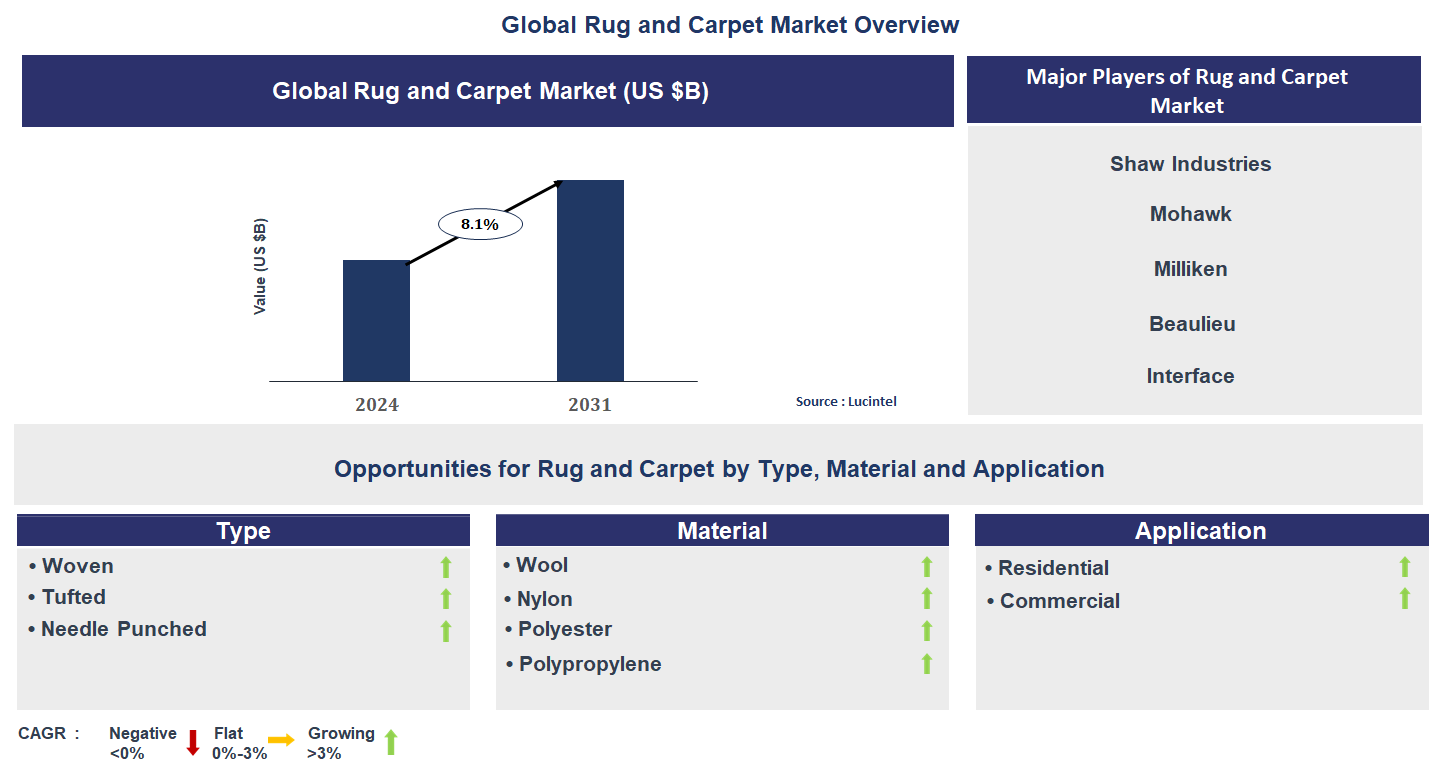
The future of the global rug and carpet market looks promising with opportunities in the residential and commercial markets. The global rug and carpet market is expected to grow with a CAGR of 8.1% from 2025 to 2031. The major drivers for this market are the increasing demand for home decor products, the rising preference for sustainable materials, and the growing trend of luxury home interiors.• Lucintel forecasts that, within the type category, woven is expected to witness the highest growth over the forecast period.
• Within the application category, residential is expected to witness higher growth.
• In terms of region, APAC is expected to witness the highest growth over the forecast period. Gain valuable insights for your business decisions with our comprehensive 150+ page report. Sample figures with some insights are shown below.
Emerging Trends in the Rug and Carpet Market
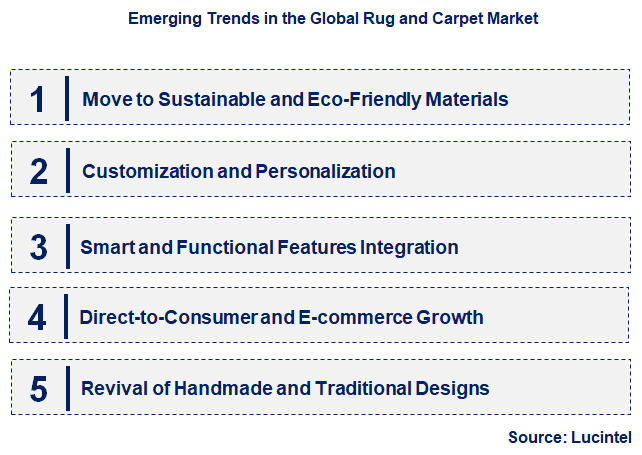
The rug and carpet industry is being transformed by some new trends that signify greater insight into aesthetics, sustainability, and contemporary consumer preferences. The era of plain, one-size-fits-all products is gone. Consumers today are looking for high-end, sustainable, and tailored products that also answer to larger issues of environmental responsibility and self-expression. All of these trends are affecting product design through to distribution, producing a more specialized and consumer-driven industry that is concerned with art as well as environmentally responsible production.• Move to Sustainable and Eco-Friendly Materials: One of the key trends is the increasing popularity of rugs and carpets constructed from sustainable and eco-friendly materials. This is fueled by greater consumer knowledge about environmental concerns and a perception that the non-biodegradable products used in conventional production are not right. The effect is a market shift where the sustainability credentials of the brands are being touted as a major marketing point.
• Customization and Personalization: One of the predominant trends is the industrys shift away from mass products toward customized rugs that provide a personal touch. There is increasing demand for products that can be customized to a specific customers needs in terms of size, color, pattern, and material. This is driven by improvements in digital printing and manufacturing technology. This trend is opening up a new category of highly personalized home decor.
• Smart and Functional Features Integration: One of the key trends is increasing interest in rugs and carpets with functional and smart features. The reason behind this is a need for products that provide more than merely visual appeal. Companies are now introducing rugs with functional qualities such as anti-microbial finishes, sound absorption, and stain repellency. The effect is one in which technology and functionality become prime differentiators in the marketplace.
• Direct-to-Consumer and E-commerce Growth: One trend fueled by the growth of e-commerce is the application of direct-to-consumer (D2C) models. Brands are more and more using social media and digital platforms to sell their products and to connect with consumers directly. This enables them to circumvent conventional retail channels and to have control over their brand message. The effect is a more accessible and competitive market. This trend is most favored by smaller, innovative brands that are able to establish a direct connection with their base of customers using personalized content and targeted advertising.
• Revival of Handmade and Traditional Designs: A trend resulting from a need for authenticity is the revival of traditional and handmade designs. Consumers are looking more and more for the craftsmanship and cultural heritage of handmade and hand-knotted and hand-woven rugs. The trend is developing a new market segment that demands both artistry and cultural heritage. The result is a marketplace in which brands are concentrating on the development of a harmonious and enjoyable user experience. This serves to minimize product loss and keep the rugs fresh and functional for extended periods. These new trends are essentially transforming the rug and carpet industry by making it more consumer-focused, specialized, and ethically aware. The emphasis on sustainability and multi-functionality is setting the bar higher for product performance and value. Concurrently, the shift towards being more multi-purpose and direct-to-consumer is balancing the industry with the sensibilities of contemporary consumers. In turn, these trends are taking the market towards a future where rug and carpet use is more considered, holistic, and accountable within an individual care routine.
Recent Development in the Rug and Carpet Market
The rug and carpet market is now being shaped by several of the most significant recent trends that are affecting its competitive environment and growth. These trends are not discrete phenomena but are interrelated and represent a more general alteration in values and technological sophistication among consumers. The market is becoming increasingly advanced, led by scientific progress, emphasis on safety and efficacy, and alternative means of reaching consumers.• Introduction of Sustainable and Recycled Materials: One of the most significant developments is the wide-scale launch of sustainable and recycled materials. Companies are shifting away from the conventional non-woven materials to develop solutions that have a reduced impact on the environment. This development meets an existing requirement for eco-friendly products. The effect is a more diversified market that serves more environmentally aware customers, thus enhancing customer satisfaction and loyalty.
• Greater Supply of Personalized and Customizable Products: One of the most significant developments is the widespread availability of customizable and personalized rugs. Fueled by customer preference for personalized and customized home décor, such products are designed to serve more than just a floor covering function. They can be designed to meet certain sizes, color combinations, and patterns. The effect is a profound growth in the markets "premium" tier. This trend is compelling traditional brands to reinvent their products to compete and is establishing a new marketplace for high-value, differentiated products.
• Move to E-commerce and Direct-to-Consumer Channels: The move to e-commerce and direct-to-consumer (D2C) channels is a major trend. Brands are now using e-commerce platforms and their websites to reach more people without the limitations of old retail. The effect is that there is a very competitive environment with more choices for consumers. This trend also enables brands to own the brand message, connect directly with customers, and receive valuable feedback to shape future product offerings.
• Expansion of the Commercial Market: One emerging trend is increasing popularity of carpets and rugs in the commercial market. The reason behind this trend is growing awareness among companies regarding the need to make the workplace comfortable as well as visually appealing for workers and customers alike. The result is an enormous boost to market accessibility and a new set of consumers. This strategy also assists brands in drawing new customers who are seeking a lower-cost entry into the personal care market.
• Advances in Weaving and Tufting Technology: The market is witnessing a significant advancement in weaving and tufting technology. Brands are launching new technologies that enable more complex designs, bright colors, and strong materials. This evolution is a direct reaction to consumers demanding better quality and longer-lasting goods. The effect is a lower-risk and more user-friendly experience. It also gives consumers a substantial marketing point who care about how long their rug will last and how well it will look. These recent trends are all having a cumulative effect on the rug and carpet industry, driving it towards a more specialized, ethical, consumer-driven model. The emphasis on sustainability and multi-functionalities is adding to product effectiveness and worth. At the same time, the move towards online sales and the emergence of niche segments is updating the markets distribution and availability norms, paving its way for future growth and pertinence to the next generation of consumers.
Strategic Growth Opportunities in the Rug and Carpet Market
The rug and carpet industry offers various strategic growth prospects in its major applications. With the change in consumer inclinations and an increasing emphasis on aesthetics and sustainability, business entities can capitalize on these possibilities to innovate and gain new market shares. These possibilities extend beyond conventional product offerings and involve innovation in marketing, distribution, and product specialization. Discovery and leverage e of these strategic growth opportunities will be essential for firms looking to find long-term success in this dynamic market.• Residential Sector Opportunity: There is a tremendous opportunity for growth in the residential product line. As increasing numbers of individuals are investing in home remodeling and home decorating, there is an increasing demand for high-quality, long-lasting, and good-looking rugs and carpets. This can be leveraged by companies, however, by creating niche products for various rooms, like soft, plush rugs for bedrooms and strong, stain-proof ones for the living room. This allows brands to charge a premium, establish themselves as a high-quality product, and attract an audience that values the style and comfort of their own home.
• E-commerce and Direct-to-Consumer Channel Opportunity: Growth in e-commerce provides a significant growth opportunity. By building a robust online platform and utilizing direct-to-consumer (D2C) models, companies can cut out retail intermediaries and access more consumers. This provides companies with the opportunity to dictate their brand story, connect one-on-one with consumers through social media and content marketing, and provide personalized product suggestions.
• Commercial and Hospitality Business Opportunity: The commercial and hospitality sector presents a significant opportunity for expansion. With businesses in industries such as hotels, offices, and retail outlets trying to make the environment more welcoming and comfortable, there is increasing need for premium quality, long-lasting, and fashionable rugs and carpets. Firms may distinguish themselves by concentrating on products that are specifically designed to meet the specific needs of a specific environment. This approach not only addresses an increasing market segment but also creates a favorable company image and sets up long-term business alliances.
• Potential in Eco-Friendly and Sustainable Products: One of the main growth opportunities is based on creating products that are eco-friendly. As people become increasingly ecologically aware, the demand for rugs and carpets produced from sustainable and recycled materials is on the increase. Companies can develop formulations and advertising campaigns that are specifically designed to meet the specific requirements of those looking for an easy and effective solution.
• Luxury and Designer Segment Opportunity: There is an opportunity in the luxury and designer segments in the market. With increasing numbers of consumers looking for unique, high-quality, and exclusive home decor, demand is growing for handcrafted, custom-designed, and artistic rugs. Firms can create platforms for the interaction of designers and artists for creating new collections, or they can put money in traditional weaving processes to produce a single, unique piece. Such strategic growth opportunities are well set to propel the rug and carpet industry into the future. Focusing on the residential and commercial spaces, and using direct-to-consumer channels, businesses can widen their reach and establish new avenues of revenue. The growth of sustainable and luxury offerings also reflects contemporary consumer values, and the potential for customization suggests a future wherein not only is the market bigger but also more innovative and bespoke to the distinct needs of every individual.
Rug and Carpet Market Driver and Challenges
The rug and carpet industry is driven by a dynamic mix of significant drivers and challenges, which are dictating its direction. The key drivers are primarily centered on changing consumer lifestyles, a heightened focus on aesthetics, and a rising interest in sustainable products. However, the market also faces significant hurdles, including intense competition, the threat of alternative flooring options, and a lack of clear regulatory standards. Understanding these factors is essential for any company or organization looking to succeed in this evolving market. The factors responsible for driving the rug and carpet market include: 1. Urbanization and Real Estate Development: One of the main drivers is the speedy rate of urban development and, along with it, real estate and construction growth. With increasing populations and investments in new housing, apartments, and office spaces, there is a mounting demand for interior design and flooring solutions. This driver is supported by increasing disposable incomes and lifestyle shifts, which are turning house furnishing into an imperative for an increasing number of individuals. 2. Rising Emphasis on Home Decoration and Looks: One of the key drivers is rising consumer interest in home décor and interior looks. Rugs and carpets are now not just perceived as useful floor coverings but are also seen as integral parts of a rooms décor, bringing color, texture, and a look. This trend is being driven by the popularity of social media websites and home design shows, which are encouraging consumers to make investments in quality home furniture. 3. Manufacturing Technology Improvements: The rug and carpet industry is spurred on by ongoing improvements in manufacturing technology. The invention of new equipment and weaving methods has enabled the manufacture of more resilient, stain-resistant, and visually appealing products at reduced cost. The technology has not only enhanced the user experience but has also addressed historic issues regarding maintenance and durability. 4. Increased Demand for Eco-Friendly and Natural Products: The market is compelled by a developing trend of consumers towards eco-friendly and natural products. Consumers are becoming increasingly environmentally conscious, which translates to a demand for products that leave a lower carbon footprint. This trend is resulting in a higher demand for carpets and rugs produced from products such as wool, jute, and recycled materials. This driver also affects the growth of new production processes that are more environmentally friendly. 5. Growth in the Commercial and Hospitality Sectors: A final driver is the increasing demand for rugs and carpets from the commercial and hospitality sectors. As businesses in these sectors focus on creating a more inviting and comfortable atmosphere, there is a need for high-quality, durable, and aesthetically pleasing flooring solutions. This driver is opening up a new, high-value segment for the market and is prompting brands to create and offer products that address the particular needs and desires of this segment. Challenges in the rug and carpet market are: 1. High Competition and Market Saturation: One of the major challenges is the high competition and market saturation across numerous regions. The market is filled with a diverse array of brands, ranging from multinational companies to local artisans. The high competition hinders new brands from establishing themselves and makes it challenging for existing brands to hold on to their market share. The challenge necessitates that brands heavily invest in marketing, product development, and brand establishment in order to carve out their niche. 2. Danger of Substitute Flooring: The market is threatened by increasing usage of substitute flooring. Hardwood, laminate, and luxury vinyl tile (LVT) are increasingly being used in residential and commercial applications because they are resistant to water and easy to maintain, and they are durable. This trend is very prevalent in areas that have a clean, minimalist style, and it is compelling the rug and carpet market to come up with new things and to emphasize the individual advantages of their products, including comfort and noise absorption. 3. Raw Material Price Volatility: The industry is plagued by the price volatility of raw materials like wool, cotton, and synthetic fibers. Price variations can affect a companys profitability and competitive pricing. This issue is making manufacturers take greater care in managing their supply chains and investing in emerging technologies that will help to minimize the cost of production and to offset the effects of price variations. The rug and carpet industry is driven by powerful drivers such as growing incomes, an emphasis on aesthetics, and technological advancements. These drivers are building a supportive climate to grow and expand. The future of the market also hangs in the balance based on its response to major challenges. The high competition, the threat of substitute flooring, and the volatility of raw material prices are major challenges that need to be addressed. The capacity of firms to innovate responsibly, provide product efficiency, and establish consumer trust will be vital for the long-term sustainability and success of the market.List of Rug and Carpet Companies
Companies in the market compete on the basis of product quality offered. Major players in this market focus on expanding their manufacturing facilities, R&D investments, infrastructural development, and leverage integration opportunities across the value chain. With these strategies rug and carpet companies cater increasing demand, ensure competitive effectiveness, develop innovative products & technologies, reduce production costs, and expand their customer base. Some of the rug and carpet companies profiled in this report include-• Shaw Industries
• Mohawk
• Milliken
• Beaulieu
• Interface
• Tarkett
• Dixie Group
• Oriental Weavers
• Balta
• Brintons
Rug and Carpet Market by Segment
The study includes a forecast for the global rug and carpet market by type, material, application, and region.Rug and Carpet Market by Type [Value from 2019 to 2031]:
• Woven
• Tufted
• Needle Punched
Rug and Carpet Market by Material [Value from 2019 to 2031]:
• Wool
• Nylon
• Polyester
• Polypropylene
Rug and Carpet Market by Application [Value from 2019 to 2031]:
• Residential
• Commercial
Rug and Carpet Market by Region [Value from 2019 to 2031]:
• North America
• Europe
• Asia Pacific
• The Rest of the World
Country Wise Outlook for the Rug and Carpet Market
The rug and carpet industry is undergoing a deep revolution, fueled by changes in consumer taste, technological innovation, and an increasing focus on sustainability. Consumers are looking beyond mere functionality, treating carpets and rugs as integral aspects of interior design and self-expression. This has resulted in a heightened demand for products that not only look good but also are sustainable, long-lasting, and customized. The market is also being transformed by increasing e-commerce, which is making it more accessible and offering more choices to consumers across the globe.• United States: In the United States, the rug and carpet market is mature and very diversified, supported by a robust consumer base both for old and new products. A newer trend is the increasing call for sustainable and environmentally friendly choices, such as rugs constructed from recyclable materials and natural fibers. Product launches with added value such as anti-microbial and stain resistance are also being witnessed to cater to the demands of contemporary, fast-paced homes. Growth is driven as well by the impact of interior design trends and a robust residential market.
• China: Chinas rug and carpet market is witnessing strong growth, driven by urbanization, growing middle class, and increased focus on home interior decoration. The most significant trend is emerging demand for high-quality, mass-produced as well as high-end, designer rugs. While local producers are concentrating on affordability and scale of production, foreign brands are also growing their penetration with high-quality, hand-knotted, and aesthetically crafted products.
• Germany: There is a strong focus on product sustainability, durability, and quality in the German rug and carpet market. The recent trend has been for stronger demand of eco-friendly and natural fiber rugs with high environmental standards. German customers are very discerning and like products with clear material origin and a long-term focus on safety and the environment. The market also has a definite preference for products with underfloor heating suitability and sound-absorbing capability, indicating an interest in both functionality and comfort.
• India: Indias rug and carpet industry is in a period of high growth, fueled by an increasing middle class and enhanced interest in traditional craftsmanship. One of the key developments is the development of domestic brands that are launching more affordable products for the domestic market, as well as also concentrating on exporting high-end, hand-knotted rugs. Concurrently, international brands are stretching their presence, frequently by means of e-commerce sites, to satisfy the increasing requirement for an increasing variety of styles.
• Japan: Japans rug and carpet market is very advanced and fueled by a culture of fastidious attention to detail coupled with an appetite for high-quality minimalist products. Current trends involve minimalist design and lightweight, low-care materials that provide maximum convenience without compromise on aesthetics. The market also prefers products that are clean and easy to maintain, coupled with anti-allergen qualities, and a theme that enhances health and well-being.

Features of the Global Rug and Carpet Market
Market Size Estimates: Rug and carpet market size estimation in terms of value ($B). Trend and Forecast Analysis: Market trends (2019 to 2024) and forecast (2025 to 2031) by various segments and regions. Segmentation Analysis: Rug and carpet market size by type, material, application, and region in terms of value ($B). Regional Analysis: Rug and carpet market breakdown by North America, Europe, Asia Pacific, and Rest of the World. Growth Opportunities: Analysis of growth opportunities in different types, materials, applications, and regions for the rug and carpet market. Strategic Analysis: This includes M&A, new product development, and competitive landscape of the rug and carpet market. Analysis of competitive intensity of the industry based on Porter’s Five Forces model.
FAQ
Q1. What is the growth forecast for rug and carpet market? Answer: The global rug and carpet market is expected to grow with a CAGR of 8.1% from 2025 to 2031. Q2. What are the major drivers influencing the growth of the rug and carpet market? Answer: The major drivers for this market are the increasing demand for home decor products, the rising preference for sustainable materials, and the growing trend of luxury home interiors. Q3. What are the major segments for rug and carpet market? Answer: The future of the rug and carpet market looks promising with opportunities in the residential and commercial markets. Q4. Who are the key rug and carpet market companies? Answer: Some of the key rug and carpet companies are as follows:• Shaw Industries
• Mohawk
• Milliken
• Beaulieu
• Interface
• Tarkett
• Dixie Group
• Oriental Weavers
• Balta
• Brintons Q5. Which rug and carpet market segment will be the largest in future? Answer: Lucintel forecasts that, within the type category, woven is expected to witness the highest growth over the forecast period. Q6. In rug and carpet market, which region is expected to be the largest in next 5 years? Answer: In terms of region, APAC is expected to witness the highest growth over the forecast period. Q7. Do we receive customization in this report? Answer: Yes, Lucintel provides 10% customization without any additional cost.
Table of Contents
List of Figures
List of Tables
Methodology
- In-depth interviews of the major players in this market
- Detailed secondary research from competitors’ financial statements and published data
- Extensive searches of published works, market, and database information pertaining to industry news, company press releases, and customer intentions
- A compilation of the experiences, judgments, and insights of Lucintel’s professionals, who have analyzed and tracked this market over the years.


Buy Now
Choose a license that fits your team. Instant PDF delivery.
Prices exclude taxes. Instant delivery. Custom licensing available on request.
Key Questions
- • What are some of the most promising, high-growth opportunities for the rug and carpet market by type (woven, tufted, and needle punched), material (wool, nylon, polyester, and polypropylene), application (residential and commercial), and region (North America, Europe, Asia Pacific, and the Rest of the World)?
- • Which segments will grow at a faster pace and why?
- • Which region will grow at a faster pace and why?
- • What are the key factors affecting market dynamics? What are the key challenges and business risks in this market?
- • What are the business risks and competitive threats in this market?
- • What are the emerging trends in this market and the reasons behind them?
- • What are some of the changing demands of customers in the market?
- • What are the new developments in the market? Which companies are leading these developments?
- • Who are the major players in this market? What strategic initiatives are key players pursuing for business growth?
- • What are some of the competing products in this market and how big of a threat do they pose for loss of market share by material or product substitution?
- • What M&A activity has occurred in the last 5 years and what has its impact been on the industry? For any questions related to Rug and Carpet Market, Rug and Carpet Market Size, Rug and Carpet Market Growth, Rug and Carpet Market Analysis, Rug and Carpet Market Report, Rug and Carpet Market Share, Rug and Carpet Market Trends, Rug and Carpet Market Forecast, Rug and Carpet Companies, write Lucintel analyst at email: helpdesk@lucintel.com. We will be glad to get back to you soon.


