
Report Feature
RPA Platform Training Market Trends and Forecast
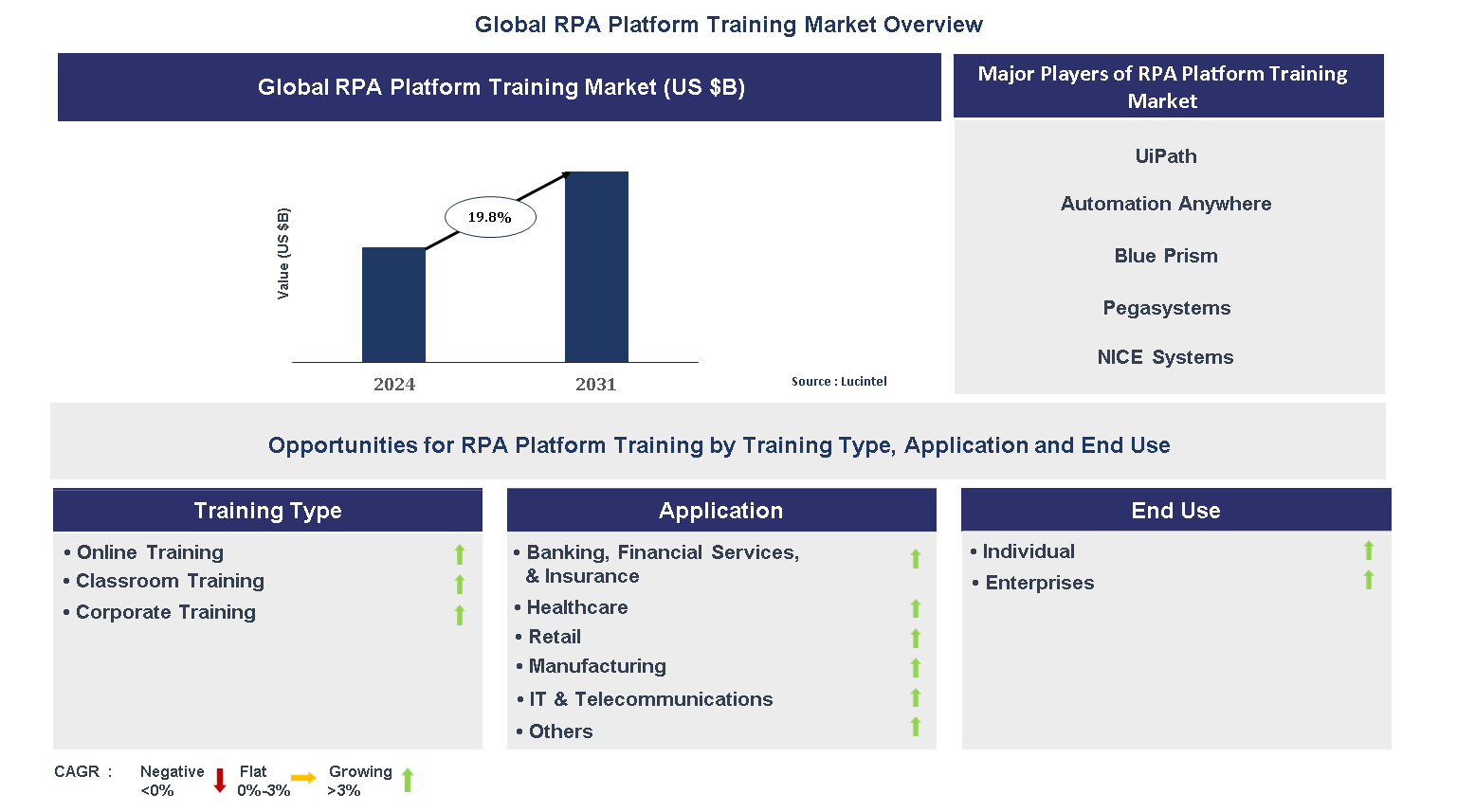
The future of the global RPA platform training market looks promising with opportunities in the banking, financial services, & insurance, healthcare, retail, manufacturing, and it & telecommunication markets. The global RPA platform training market is expected to grow with a CAGR of 19.8% from 2025 to 2031. The major drivers for this market are the increasing demand for process automation skills, the rising adoption of robotic process automation, and the growing need for operational efficiency training.• Lucintel forecasts that, within the training type category, online training is expected to witness the highest growth over the forecast period.
• Within the application category, banking, financial services, & insurance is expected to witness the highest growth.
• In terms of region, North America is expected to witness the highest growth over the forecast period. Gain valuable insights for your business decisions with our comprehensive 150+ page report. Sample figures with some insights are shown below.
Emerging Trends in the RPA Platform Training Market
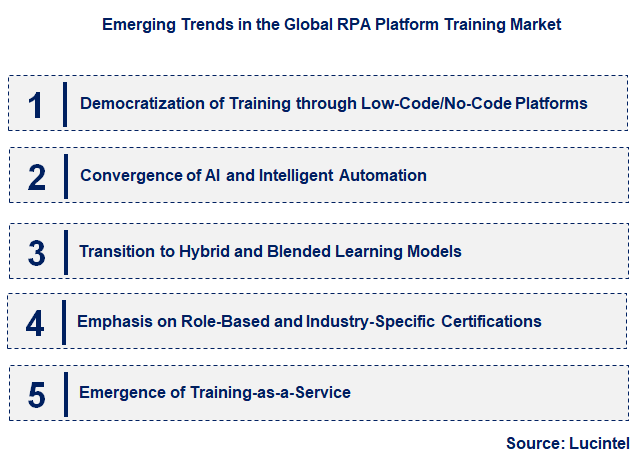
The RPA platform training market is making a dramatic change, brought about by the growing sophistication of automation and the need for a more comprehensive, scalable model of skill acquisition. The classical model of investing in a small team of IT experts is being transformed by a more democratized style where more employees across the organization, not just technical ones, have the power to become automation champions. These nascent trends are not merely about what is learned but also how it is being learned, and they are transforming the training ecosystem and the work of the future.• Democratization of Training through Low-Code/No-Code Platforms: The advent of low-code/no-code RPA platforms has given rise to the largest training trend for "citizen developers." They represent a new generation of business users with no technical background who are able to create simplistic automation solutions through the use of drag-and-drop interfaces. Training modules are now specifically designed for this group, emphasizing process analysis and business logic as opposed to coding.
• Convergence of AI and Intelligent Automation: RPA is shifting from mere, rule-based automation to intelligent automation based on AI and ML for dealing with unstructured data and making decisions. The market for training is reacting by bringing in modules on AI technology such as natural language processing and computer vision. The result is a more value-driven workforce that can develop more advanced bots that can automate intricate, end-to-end business processes, including invoice processing and customer support.
• Transition to Hybrid and Blended Learning Models: The pandemic hastened the transition from classroom-based training to online learning. The new trend is a hybrid model that incorporates on-demand digital content coupled with virtual or in-person workshops and hands-on lab work. The effect is a more accessible and flexible training experience that can scale across the globe. It enables them to study at their convenience yet remain connected to expert trainers and hands-on practice, which is imperative for mastering intricate automation skills.
• Emphasis on Role-Based and Industry-Specific Certifications: With increasing maturity of RPA adoption, the need for generic training is being overcome by a requirement for special-purpose, role-based, and industry-specific certifications. For instance, a financial analyst would look for finance automation-specific training while an IT administrator would look for both orchestration and governance. The result is a more focused and effective learning pathway that equips individuals with the precise skills necessary to excel in their jobs, thus increasing their value to their companies.
• Emergence of Training-as-a-Service: Organizations are shifting away from a single-event training model to one of constant learning, typically in a service format. This phenomenon is called Training-as-a-Service, where there is constant access to refreshed content, new modules, and certifier refreshers, usually a subscription. The effect is that it maintains the skills of the workforce abreast with the fast-changing nature of RPA platforms. This guarantees that companies possess an ever-great reservoir of competent resources and are able to rapidly change in response to new innovations and business requirements. These trends are fundamentally transforming the RPA platform training space by making it more inclusive, smarter, and responsive. They are promoting a culture of continuous learning and enabling a broader segment of employees to engage with the automation process.
Recent Development in the RPA Platform Training Market
The RPA platform training market is a hub of recent trends fueled by the sector’s fast-paced technological changes and the intensifying demand for a qualified workforce. These trends are not incremental developments but are actually reshaping the manner in which RPA skills are gained and sustained. The emphasis is no longer on teaching users to construct a bot but on delivering broad, role-specific learning that prepares experts to work through the entire automation cycle, from process discovery to governance.• Introduction of Vendor-Specific Academies and Certifications: One of the major developments is the increase in official training academies by large RPA vendors like UiPath Academy and Automation Anywhere University. These sites provide free or low-cost online tutorials and official certifications that are industry-approved. The effect is that this has formalized RPA skills and offered a formal career path for potential automation professionals. It also makes it a point to keep the training material up-to-date with the most recent platform capabilities and best practices.
• Greater Emphasis on Low-Code/No-Code Training: Democratization of automation has propelled a significant evolution in training for low-code/no-code platforms. This has made RPA development accessible to non-technical business users, commonly known as "citizen developers." The training focuses on recognizing automation potential and developing bots through visual interfaces. The effect is a huge boost in the volume of individuals capable of automating their work, thus accelerating and universalizing adoption of RPA within a company.
• Incorporation of Process Mining into Training: Another notable improvement is the incorporation of process mining tools into RPA training. Process mining assists users in detecting and analyzing business processes so as to determine the most promising prospects for automation. It now educates users on how to use the tools to develop a successful automation strategy prior to having to build a bot. The result is a more ROI-focused and strategic approach to automation, with projects prioritizing areas that will bring the greatest value to the business.
• Growth of Cloud-Based Training Labs: The migration to cloud-based RPA platforms has created a growth opportunity for cloud-based training labs and virtual labs. This enables learners to practice bot creation and bot management in an interactive, safe environment with no local software installs required. The result is an easier and more scalable training option that can be distributed to learners globally. It makes the learning process easier and allows for a more realistic and interactive experience.
• Launch of AI and ML Modules: The transition from RPA to intelligent automation has resulted in a fresh development: the launch of modules on AI and ML as part of RPA training. This instructs users on how to integrate cognitive services, including natural language processing and optical character recognition, into their bots. The effect is that it is producing a new generation of trained professionals who can construct complex automation solutions that deal with unstructured data, which is one of the primary needs of contemporary enterprise automation. These innovations are all collectively shaping the RPA platform training market to be more affordable, niche, and future-forward. The market is transforming to address the demands of a new generation of digital change, where automation is not a specialized skill but a core competency for companies and their workers.
Strategic Growth Opportunities in the RPA Platform Training Market
The RPA platform training market presents a number of strategic growth opportunities in key applications, fueled by the increasing adoption of automation and the necessity for specialized expertise. Training providers and manufacturers can take advantage of these opportunities by creating focused solutions that meet the specific needs of various industries and types of users. The secret of success is in having in-depth knowledge of the market, from the precise requirements of big companies to the developing needs of small and medium enterprises, and delivering value-added training that can assist them in reaching their goals in automation.• Enterprise-Wide Automation and COE Training: With the shift of big companies from pilot initiatives to enterprise-wide deployment, there lies a tremendous growth opportunity in enterprise-wide deployment training and Centers of Excellence. Strategic opportunities are extending customized in-house training programs that are centered around governance, security, and scalability. The effect is that these programs enable businesses to develop a strong in-house capacity for running their automation projects, for sustainable success and increased ROI on their RPA deployments.
• Industry-Specific Training: Industry-specific knowledge is a key area of growth. For instance, a bank would require training on reconciliation bots, while a healthcare provider would require training on patient data management. Strategic possibilities involve creating pre-packaged learning modules and certifications for sectors such as BFSI, healthcare, and manufacturing. The effect is that this facilitates a more effective and efficient learning process by concentrating on the relevant business processes and compliance needs of a specific sector.
• Citizen Developer and Business Analyst Training: The advent of low-code/no-code platforms has created a vast opportunity for growth in training for citizen developers. This is not an audience that wants to dive deep into coding but a simple means of automating their everyday work. Strategic opportunities lie in providing streamlined, visually-focused training programs and user-friendly certification programs for business analysts and other non-technical employees. The effect is that it enables organizations to establish a culture of automation from the ground level, with solutions designed by the individuals who are closest to the business process.
• Global and Regional Partnerships: A huge growth potential exists in partnerships between global RPA vendors and regional training providers. This enables localization of training content and presentation of courses in local languages, which is essential for market extension. Strategic opportunities involve co-creating training content and setting up certified training partners in new and emerging countries. The effect is that this aids in crossing geographical as well as linguistic boundaries, speeding up the global uptake of RPA technology.
• MRO and Post-Implementation Support Training: With the increasing number of bots being deployed, there is an equal need for maintenance, repair, and post-implementation support. A strategic opportunity for growth is training experts for the MRO (Maintenance, Repair, and Operations) of RPA bots. This involves training in both orchestration, monitoring, and troubleshooting. The effect is that this guarantees the long-term stability and health of an organization’s automation processes, optimizing the return on their initial investment and avoiding bot failures that would hamper business operations. These growth opportunities of a strategic nature are reforming the RPA platform training market by promoting specialization, localization, and emphasis on long-term value. The market is transforming from a transactional model to a one-of-a-kind partnership, where training is viewed as a perpetual investment in the digital transformation process of a company.
RPA Platform Training Market Driver and Challenges
The RPA platform training industry is a fast-moving market, driven by a mix of key drivers and impactful challenges. The drivers owe mostly to international economic and technology trends that are propelling the uptake of automation. The challenges, however, originate from the exorbitant implementation cost, the intricateness of the technology, and the fast-moving pace of change in the market. The future of the market will depend on how well firms and training providers are able to leverage such drivers while navigating the inbuilt complexity of the contemporary workforce and technology environment. The factors responsible for driving the RPA platform training market include: 1. Fast Digital Transformation: The international drive for digital transformation is the biggest driver. As businesses need to enhance efficiency and decrease operational expenses, they are turning more towards RPA to mechanize repetitive work, opening a gigantic market for a trained workforce. It is a basic adjustment in business tactic that is driving the demand straightaway. 2. Increasing Need for Automation: There is a growing need for automation in all sectors, ranging from finance to healthcare. This is due to the imperative to enhance precision, boost productivity, and enable human employees to concentrate on more strategic, value-added activities. This universal demand is generating an enormous market for RPA training. 3. Low-Code/No-Code Platforms: Low-code/no-code platforms are one of the biggest drivers since they bring RPA technology within reach for a broader group of users beyond IT professionals. The trend has greatly increased the size of the potential market for training since it enables business users without technical backgrounds to become "citizen developers" capable of creating their own automation. 4. Alignment of AI and Machine Learning: The transition of RPA to smart automation, with the inclusion of AI and ML, is a strong enabler. These next-generation bots are capable of operating complex, unstructured data, leading to the requirement for sophisticated training on cognitive services. This is fueling higher-value training prospects and propelling the market forward. 5. Reskilling and Upskilling Requirement: With the increasing trend of automation, the demand has grown for businesses to upskill and reskill their current employees in order to co-exist with the bots as well as to lead automation projects. This is one of the key drivers of the training industry, with businesses investing in employees so that they can stay effective in the automated environment. Challenges in the RPA platform training market are: 1. Exorbitant Training and Certification Cost: The expense of good-quality RPA platform training and formal certification can prove to be a major hindrance, particularly for small and medium enterprises and individuals. The high cost may restrict access to the necessary expertise, leading to a talent gap and slowing the adoption of RPA technology at large scale. 2. Rapidly Evolving Technology: The RPA market is evolving at a breakneck pace, with new platform features and technologies being released constantly. This presents a major challenge for training providers, who must continuously update their curriculum. Learners also face the challenge of keeping their skills current, which can make a one-time training approach ineffective. 3. Lack of Skilled Trainers and Experts: In spite of the surging need for RPA expertise, there is a deficit of skilled professionals trained to train. This is one of the biggest bottlenecks for the market since a shortage of expert trainers can inhibit the quality and scalability of training initiatives to achieve the demands of an expanding market. Finally, the global RPA platform training market is being driven by the intrinsic demand for automation and digitalization everywhere in the world. Yet at the same time, it is also confronted with major challenges such as the prohibitively expensive cost of training, the breakneck speed of technological advancement, and the lack of capable trainers. Its capacity to keep pace with these challenges by providing more accessible, more affordable, and constantly revised training will be essential to its long-term success and to its contribution to the future of work.List of RPA Platform Training Companies
Companies in the market compete on the basis of product quality offered. Major players in this market focus on expanding their manufacturing facilities, R&D investments, infrastructural development, and leverage integration opportunities across the value chain. With these strategies RPA platform training companies cater increasing demand, ensure competitive effectiveness, develop innovative products & technologies, reduce production costs, and expand their customer base. Some of the RPA platform training companies profiled in this report include-• UiPath
• Automation Anywhere
• Blue Prism
• Pegasystems
• NICE Systems
• Kofax
• WorkFusion
• EdgeVerve Systems
• AntWorks
• HelpSystems
RPA Platform Training Market by Segment
The study includes a forecast for the global RPA platform training market by training type, application, end use, and region.RPA Platform Training Market by Training Type [Value from 2019 to 2031]:
• Online Training
• Classroom Training
• Corporate Training
RPA Platform Training Market by Application [Value from 2019 to 2031]:
• Banking, Financial Services, & Insurance
• Healthcare
• Retail
• Manufacturing
• IT & Telecommunications
• Others
RPA Platform Training Market by End Use [Value from 2019 to 2031]:
• Individual
• Enterprises
RPA Platform Training Market by Region [Value from 2019 to 2031]:
• North America
• Europe
• Asia Pacific
• The Rest of the World
Country Wise Outlook for the RPA Platform Training Market
The RPA platform training market is an important and fast-growing sector of the larger automation industry. As global organizations adopt digital transformation, there is a growing demand for competent professionals with the capability to develop, deploy, and maintain RPA solutions. The market is characterized by the transformation from basic, rule-based automation to sophisticated, smart automation that includes artificial intelligence (AI) and machine learning (ML). This has necessitated the need for specialized training, bringing forth tremendous advancements in the manner and content being taught in various nations.• United States: In the United States, the market for RPA platform training is established and is powered by big companies and cloud providers. Current developments are aimed at upskilling and reskilling workers to manage sophisticated automation, especially with the convergence of AI and ML. Large players such as UiPath and Automation Anywhere have widened their training portfolio with specialized certifications in intelligent automation and low-code/no-code systems.
• China: China’s RPA platform training market is growing exponentially, driven by the nation’s ambitious plans for digital transformation and automation. Latest developments focus on establishing a strong domestic talent pool to accommodate the fast deployment of RPA. There is considerable government as well as private sector pressure on setting up training centers and online academies that offer certification programs.
• Germany: Germany’s RPA platform training market is dominated by a theme of industrial automation and engineering superiority. Latest trends are linked with the "Industry 4.0" program, with training solutions for manufacturing and logistics industries. The market is witnessing an uptrend of hybrid training models that marry online learning with practical, in-class workshops to drive a thorough appreciation of intricate automation procedures. There is heavy focus on IT professional training for handling and ruling large-scale automation rollouts, with security and compliance guarantees.
• India: India’s RPA training market for the platform is a hotbed of activity, fueled by the nation’s enormous IT services industry and huge pool of tech-educated manpower. The latest initiatives are focused on bringing RPA training within reach of a wider population, with numerous institutions and startups providing low-cost online training and bootcamps. The market is also experiencing an increase in collaborations between training providers and large RPA vendors, serving to bridge the skills gap and offer formal certifications.
• Japan: Japan’s RPA platform training market is being transformed by the demographic issues facing the country, including a declining workforce. Latest trends are aimed at employing RPA to automate staffing shortages and increase operational productivity. Training programs are structured to enable businesses to shift from labor-intensive, repetitive processes to automated processes. Low-code/no-code training is emphasized heavily to enable more employees to develop automation solutions. The market is witnessing increased alliances between Japanese businesses and RPA vendors to create custom support and training.

Features of the Global RPA Platform Training Market
Market Size Estimates: RPA platform training market size estimation in terms of value ($B). Trend and Forecast Analysis: Market trends (2019 to 2024) and forecast (2025 to 2031) by various segments and regions. Segmentation Analysis: RPA platform training market size by training type, application, end use, and region in terms of value ($B). Regional Analysis: RPA platform training market breakdown by North America, Europe, Asia Pacific, and Rest of the World. Growth Opportunities: Analysis of growth opportunities in different training types, applications, end uses, and regions for the RPA platform training market. Strategic Analysis: This includes M&A, new product development, and competitive landscape of the RPA platform training market. Analysis of competitive intensity of the industry based on Porter’s Five Forces model.
FAQ
Q1. What is the growth forecast for RPA platform training market? Answer: The global RPA platform training market is expected to grow with a CAGR of 19.8% from 2025 to 2031. Q2. What are the major drivers influencing the growth of the RPA platform training market? Answer: The major drivers for this market are the increasing demand for process automation skills, the rising adoption of robotic process automation, and the growing need for operational efficiency training. Q3. What are the major segments for RPA platform training market? Answer: The future of the RPA platform training market looks promising with opportunities in the banking, financial services, & insurance, healthcare, retail, manufacturing, and it & telecommunication markets. Q4. Who are the key RPA platform training market companies? Answer: Some of the key rpa platform training companies are as follows:• UiPath
• Automation Anywhere
• Blue Prism
• Pegasystems
• NICE Systems
• Kofax
• WorkFusion
• EdgeVerve Systems
• AntWorks
• HelpSystems Q5. Which RPA platform training market segment will be the largest in future? Answer: Lucintel forecasts that, within the training type category, online training is expected to witness the highest growth over the forecast period. Q6. In RPA platform training market, which region is expected to be the largest in next 5 years? Answer: In terms of region, North America is expected to witness the highest growth over the forecast period. Q7. Do we receive customization in this report? Answer: Yes, Lucintel provides 10% customization without any additional cost.
Table of Contents
List of Figures
List of Tables
Methodology
- In-depth interviews of the major players in this market
- Detailed secondary research from competitors’ financial statements and published data
- Extensive searches of published works, market, and database information pertaining to industry news, company press releases, and customer intentions
- A compilation of the experiences, judgments, and insights of Lucintel’s professionals, who have analyzed and tracked this market over the years.


Buy Now
Choose a license that fits your team. Instant PDF delivery.
Prices exclude taxes. Instant delivery. Custom licensing available on request.
Key Questions
- • What are some of the most promising, high-growth opportunities for the RPA platform training market by training type (online training, classroom training, and corporate training), application (banking, financial services, & insurance, healthcare, retail, manufacturing, IT & telecommunications, and others), end use (individual and enterprises), and region (North America, Europe, Asia Pacific, and the Rest of the World)?
- • Which segments will grow at a faster pace and why?
- • Which region will grow at a faster pace and why?
- • What are the key factors affecting market dynamics? What are the key challenges and business risks in this market?
- • What are the business risks and competitive threats in this market?
- • What are the emerging trends in this market and the reasons behind them?
- • What are some of the changing demands of customers in the market?
- • What are the new developments in the market? Which companies are leading these developments?
- • Who are the major players in this market? What strategic initiatives are key players pursuing for business growth?
- • What are some of the competing products in this market and how big of a threat do they pose for loss of market share by material or product substitution?
- • What M&A activity has occurred in the last 5 years and what has its impact been on the industry? For any questions related to RPA Platform Training Market, RPA Platform Training Market Size, RPA Platform Training Market Growth, RPA Platform Training Market Analysis, RPA Platform Training Market Report, RPA Platform Training Market Share, RPA Platform Training Market Trends, RPA Platform Training Market Forecast, RPA Platform Training Companies, write Lucintel analyst at email: helpdesk@lucintel.com. We will be glad to get back to you soon.


