
Market Report · July 24, 2026

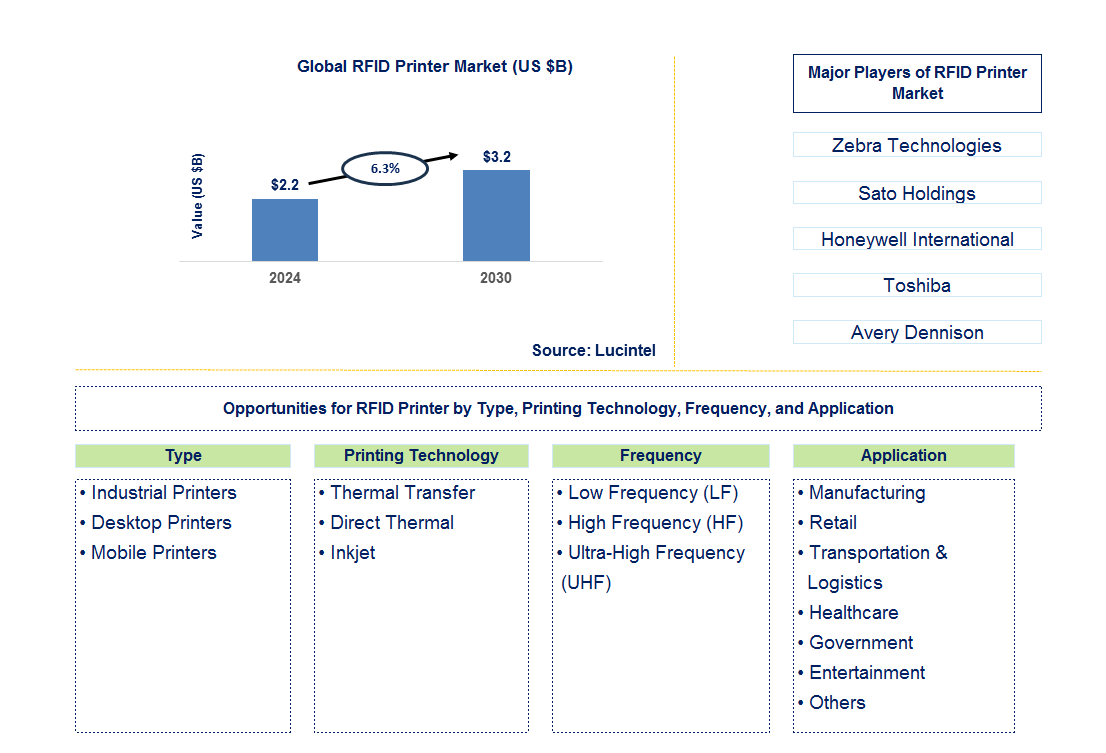
Key data points: The market size in 2030 = $3.2 billion, growth forecast = 6.3% annually next 6 years. Scroll below to get more insights. This market report covers trends, opportunities, and forecast in the global rfid printer market to 2030 by type (industrial printers, desktop printers, and mobile printer), printing technology (thermal transfer, direct thermal, and inkjet), frequency (low frequency (LF), high frequency (HF), and ultra-high frequency (UHF)), application (manufacturing, retail, transportation & logistics, healthcare, government, entertainment, and others), and region (North America, Europe, Asia Pacific, and the Rest of the World)
We'll send your sample report shortly.
• United States: In the United States, the market for RFID printers is undergoing substantial advancements, more so regarding the addition of the IoT. Companies like Zebra Technologies and Brady Corporation are releasing next-generation RFID printers that include the capabilities of real-time tracking and reporting. The retail and logistics industries are taking the lead in the changes because of the growing need for better inventory management and efficiency of operations. Additionally, manufacturers are looking for ways to integrate environmentally friendly features into the RFID printing technology to respond to sustainability trends. Government policies also promote the implementation of primary tracking management solutions using RFID systems thus enhancing the application of RFID printers in different industries.
• China: China's RFID printer market continues to flourish, owing to a strong governmental support for implementing efforts towards intelligent manufacturing and efficient supply chain management. Technological advancement has enabled local players to come up with affordable RFID printers that address demand from retail, medical and transportation industries. The rise in online shopping has also boosted the usage of RFID printers to improve inventory records and speed up the quicker processes., Small and medium enterprises craves for authority to print out both paper and rfid labels which has increasingly triggered companies to incorporate label printer manufacturers companies like TSC Auto ID Technology who has expanded its product base to incorporate multifaceted printers that will make RFID labels faster.
• Germany: Germany’s RFID printer market has been analyzing a notable growth from automotive, manufacturing and logistics industries. German labeled manufacturers look for robust and high quality RFID printing solutions due to tough industrial applications. Companies like Printronix and SATO are adding mobile convenience as well as online capabilities among others to the printers for flexible operations. The focus on Industry 4.0 is also prompting the developments of the RFID printers as the manufacturers looking to integrate easily into automated manufacturing processes. There is also the need for environmentally sound materials to be used in the manufacture of RFID labels and tags due to changing times.
• India: India’s RFID printer market is steadily growing due to the increased activity in the retail sector as well as the implementation of automated inventory management systems. Local companies are coming up with cheap RFID printing solutions which target the small and medium enterprises. Likewise, supportive government policies aimed at embracing digitization and smart manufacturing are also promoting the use of RFID technology in India. Such companies as UPM Reflate are broadening their scope of activities in India marketing effective RFID printing technologies. In addition, the growing internet penetration and expansion of logistics business are increasing the demand for RFID printers which offers good prospects for manufacturers.
• Japan: Japan’s RFID printer market is progressing with the advent of advanced technologies in the fields of retail, health care and logistics. Companies such as Toshiba and Canon are active in developing high end performance RFID printers with more accurate and faster tag production. The rising adoption of automation in warehouses is increasing the need for RFID printing solutions that ease the inventory management activities. In addition, appropriate policies and practices in Japan aimed at nurturing creativity and environmental awareness enables enterprises to come up with low power consumption RFID printers and green label materials, advent technology for RFID will be adopted on a high level.
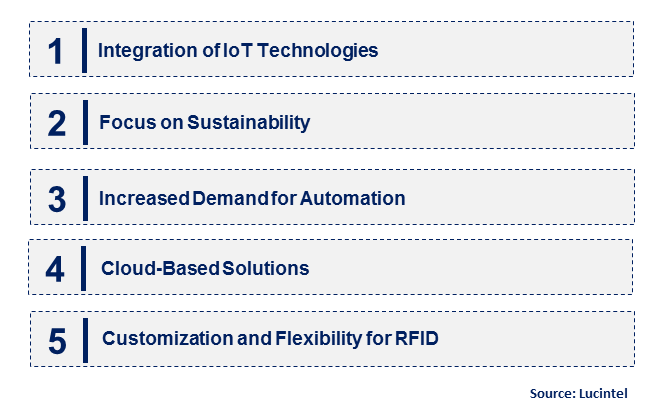
• Integration of IoT Technologies: As the feature of IoT Technology into RFID Printers is necessary for aggressive data collection that helps businesses to enhance inventory management and operational processes. Understanding how IoT works and using it in RFID printers improves data collection and analysis processes. This means that business operations are better with the help of this integration since inventory and assets can be tracked more easily.
• Focus on Sustainability: As more emphasis is placed on sustainability, manufacturers are looking for ways to provide RFID printing solutions that are less harmful to the surroundings. This incorporates the recycling of raw materials and the less energy consuming printing processes targeted at both businesses and consumers who are conscious about the impact on the environment.
• Increased Demand for Automation: Another factor making the demand for RFID printers high is the increasing demand towards automation of the overall supply chain and inventory management systems. To eliminate or reduce the amount of human errors made, automated systems were created to assist in processes. This would lead to high adoption levels of the technology as the processes will be simple.
• Cloud-Based Solutions: The market for RFID printers is also affected by the trend of cloud computing. Making use of mounting cloud based RFID set up enhance the business as it promotes effective and accurate management of information within the business in real time when it is needed.
• Customization and Flexibility for RFID Printing: Businesses are looking for tailor made solutions that provide specific operational competencies within the context of RFID Printing and further provide them with the ability to alter their offerings rapidly. This has stemmed from innovation in the development and usage of printers to enhance the readiness of businesses to shift with the variability of the market. All of these enhance the enhancement of the efficiency of the processes related to the use of the items, support green objectives and apply new concepts which results in a more composite and responsive sector.
• Roll Out of High-Speed Printers: Developers are coming up with high-speed RFID printers that can manufacture a large number of tags in a considerably little period. This is very essential for retail and logistics business that require fast turnover of stocks.
• Improved Mobile Printing Solutions: There is increasing adoption of mobile RFID printing solutions, which enable users to print refed labels from handheld devices. This improvement is boosting work productivity, especially in the field.
• Conception of Hybrid Printers: A new hybrid printer that allows one to print using both RFID as well as conventional labels is assisting enterprise to shift over to the RFID system without a heavy financial burden at first.
• Improvement of Integration with Other Software Solutions: RFID printers now support additional software applications that offer monitoring and analytical features for tracking goods, eventually improving the management of a company’s resources.
• Design with the User in Mind & Provide Easy Development to Operate: Simplifying the function of RFID printers has become a core business of manufacturers, taking into consideration the needs of new users for improved productivity. These changes are altering the game of RFID printers by bringing in speed, flexibility, and usability, consequently expanding the footprint of RFID Inlay printers to more sectors.
• Retail Inventory Management: An upsurge in the retail sector’s move towards the use of RFID technology for inventory control and hence the potential for the development of RFID printers that are able to tag and track merchandise better thus increasing stock control and decrease stock loss.
• Healthcare Asset Tracking: With the usage of RFID printers for asset management in the healthcare sector, medication tracking and patient identification, there arises the need for more efficient, and accurate RFID solutions that improve operational and patient safety.
• Logistics and Supply Chain Optimization: With the drive by logistic companies to enhance their supply chain, through the use of RFID printers it becomes possible to trace the shipment and the stock in real time, thus there is a growing demand for a combination of printing solutions that enhance clarity and control.
• Manufacturing Process Automation: RFID technology is being heightened in the manufacturing sector for process automation and quality assurance systems, thereby creating a market for R.W. management systems through the use of RFID printers to help in the quick attachment of tags on various parts and components during the entire manufacturing process.
• E-commerce Fulfillment Solutions: Due to the escalating demand for e-commerce, there is an increasing need for effective fulfillment processes. In this regard, RFID printers are useful in inventory management and order fulfillment hence presenting tremendous growth opportunities. These applications showcase the various prospects available in the entire RFID printer market that provides pathways for the manufacturers to adapt to the changing trends of different industries and also onboard growth into the market.
• Zebra Technologies
• Sato Holdings
• Honeywell International
• Toshiba
• Avery Dennison
• Seiko Epson
• Dascom
• Printronix Auto ID
• ID Technology
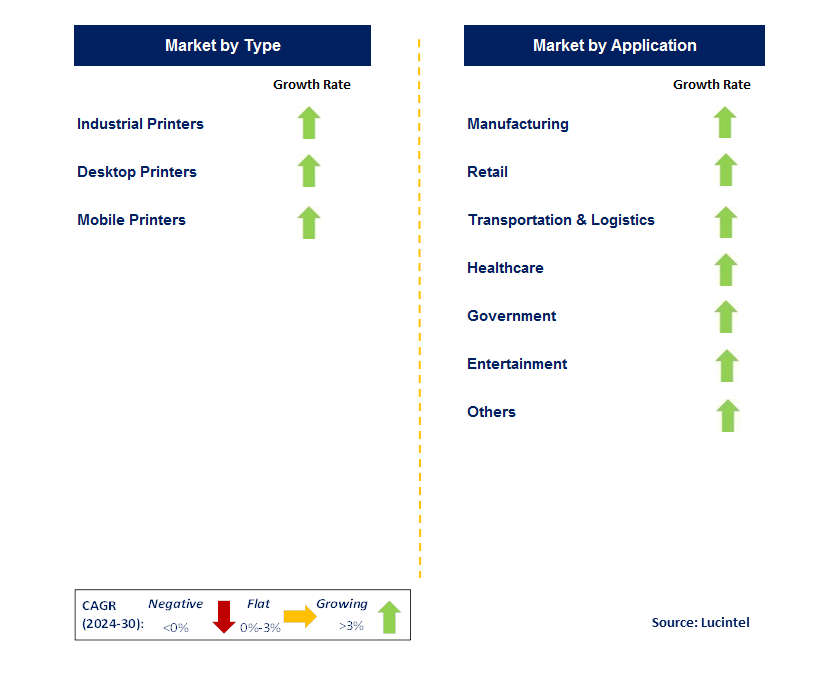
• Industrial Printers
• Desktop Printers
• Mobile Printers
• Thermal Transfer
• Direct Thermal
• Inkjet
• Low Frequency (LF)
• High Frequency (HF)
• Ultra-High Frequency (UHF)
• Manufacturing
• Retail
• Transportation & Logistics
• Healthcare
• Government
• Entertainment
• Others
• North America
• Europe
• Asia Pacific
• The Rest of the World


• Zebra Technologies
• Sato Holdings
• Honeywell International
• Toshiba
• Avery Dennison
• Seiko Epson
• Dascom
• Printronix Auto ID
• ID Technology Q6. Which RFID printer market segment will be the largest in future? Answer: Lucintel forecasts that industrial will remain the largest segment due to increasing use of this printer for smart labels and tags in the manufacturing industry. Q7. In RFID printer market, which region is expected to be the largest in next 6 years? Answer: North America will remain the largest region due to expanding number of smart factories, existence of major manufacturing hubs, and presence of key players in the region. Q.8 Do we receive customization in this report? Answer: Yes, Lucintel provides 10% customization without any additional cost.


Choose a license that fits your team. Instant PDF delivery.
Prices exclude taxes. Instant delivery. Custom licensing available on request.
Market Report · July 24, 2026
Market Report · July 20, 2026
Market Report · July 20, 2026
Trusted partner for strategic intelligence and business growth


Receive a complimentary market analysis tailored to your industry. Our analysts will identify key growth opportunities and competitive dynamics specific to your business.

Market size, growth rate, and key trend analysis for your specific sector.

Top competitor positioning and market share analysis.

Strategic recommendations backed by data-driven insights.
Get curated market intelligence and competitive moves straight to your inbox.
By subscribing, you agree to receive our monthly insights. Unsubscribe anytime.
Receive a complimentary market analysis tailored to your industry. Our analysts will identify key growth opportunities and competitive dynamics specific to your business.
Market size, growth rate, and key trend analysis for your specific sector.
Top competitor positioning and market share analysis.
Strategic recommendations backed by data-driven insights.
Get curated market intelligence, emerging trends, and competitive moves straight to your inbox each month.
By subscribing, you agree to receive our monthly insights. Unsubscribe anytime.
We'll send your sample report shortly.