
Market Report · July 24, 2026

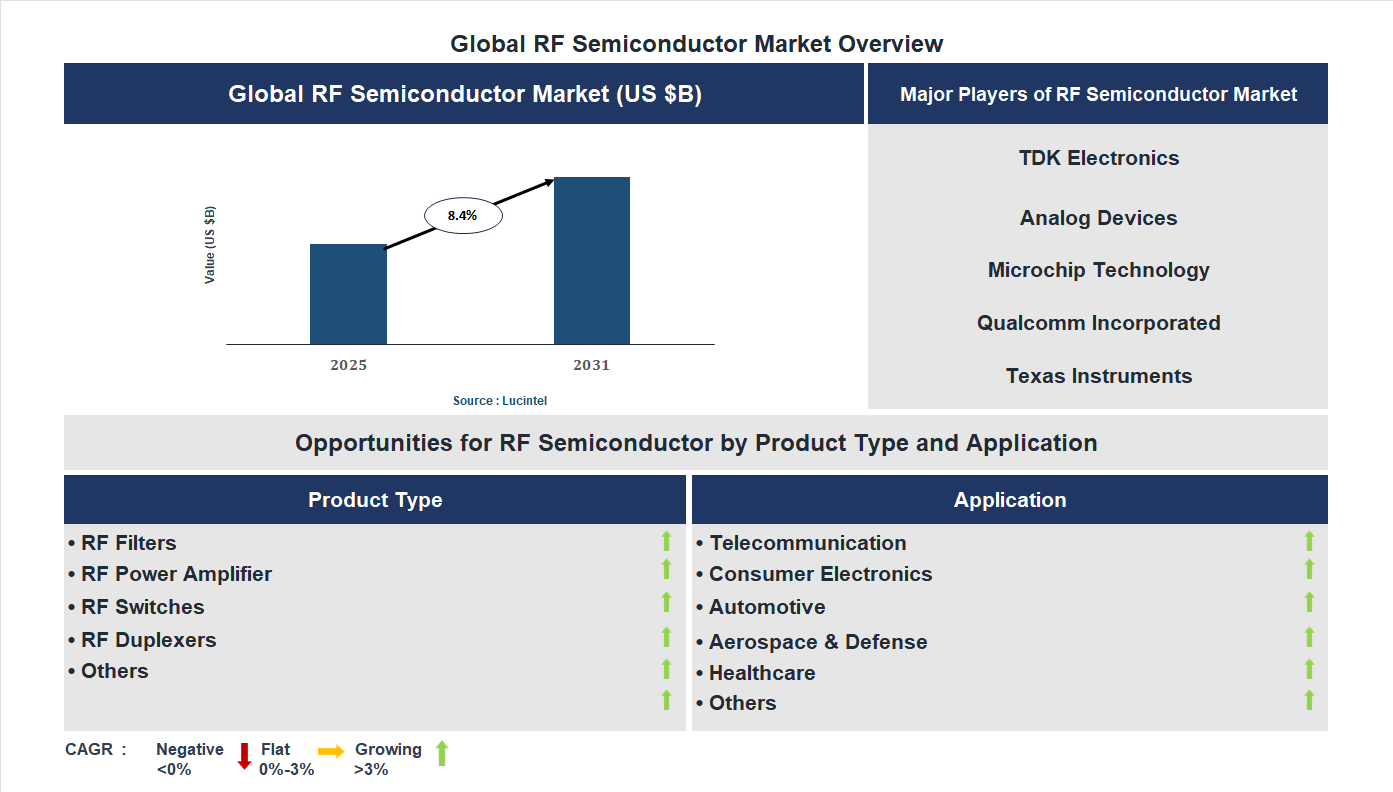
Key data points: The growth forecast = 8.4% annually for the next 7 years. Scroll below to get more insights. This market report covers trends, opportunities and forecasts in RF semiconductor market to 2031 by product type (RF filters, RF power amplifier, RF switches, RF duplexers, and others), application (telecommunication, consumer electronics, automotive, aerospace & defense, healthcare, and others), and region (North America, Europe, Asia Pacific, and the Rest of the World)
We'll send your sample report shortly.
• Lucintel forecasts that, within the product type category, RF filter is expected to witness the highest growth over the forecast period.
• Within the application category, automotive is expected to witness the highest growth.
• In terms of region, APAC is expected to witness the highest growth over the forecast period. Gain valuable insights for your business decisions with our comprehensive 150+ page report. Sample figures with some insights are shown below.
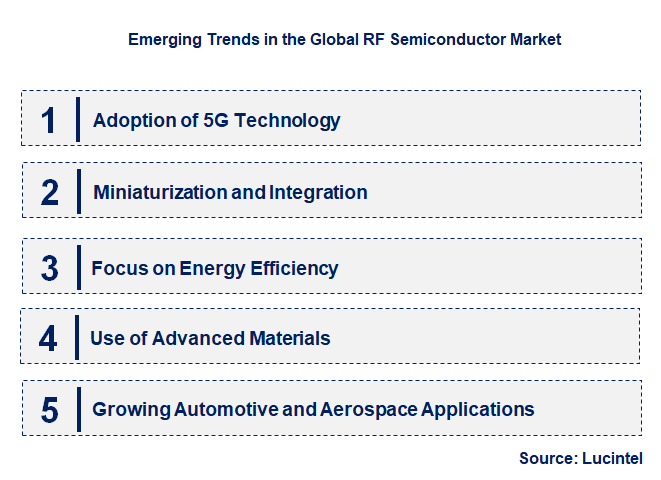
• Adoption of 5G Technology: The rollout of 5G networks is a major driver for RF semiconductor demand. 5G requires high-frequency, high-performance RF components capable of supporting faster data rates and lower latency. This trend pushes manufacturers to innovate with advanced materials and designs to meet the stringent specifications of 5G infrastructure and devices. The impact is significant, as it accelerates the development of new RF chips, boosts market growth, and encourages investments in R&D to enhance performance and efficiency.
• Miniaturization and Integration: There is a growing emphasis on reducing the size of RF components while increasing their functionality. This trend is driven by the demand for compact devices in smartphones, wearables, and IoT gadgets. Integrated RF front-end modules combine multiple functions into a single chip, reducing space and power consumption. The impact includes improved device performance, longer battery life, and the ability to embed RF capabilities into smaller form factors, thus expanding market applications and enabling innovative product designs.
• Focus on Energy Efficiency: As wireless devices become more pervasive, energy efficiency in RF semiconductors is increasingly critical. Manufacturers are developing low-power RF chips to extend battery life and reduce energy consumption in large-scale deployments like smart cities and industrial IoT. This trend enhances device sustainability and operational cost savings. The impact is a shift towards greener, more sustainable RF solutions, which are essential for meeting regulatory standards and consumer expectations for eco-friendly technology.
• Use of Advanced Materials: The integration of new materials such as Gallium Nitride (GaN) and Silicon Carbide (SiC) is transforming RF semiconductor performance. These materials offer higher power density, better thermal management, and improved frequency capabilities. Their adoption enables RF components to operate efficiently at higher frequencies and power levels, essential for 5G and radar applications. The impact includes enhanced device performance, increased reliability, and the opening of new markets that demand high-power RF solutions.
• Growing Automotive and Aerospace Applications: The increasing use of RF semiconductors in automotive radar, autonomous vehicles, and aerospace systems is a notable trend. These applications require high-frequency, high-reliability components capable of operating under extreme conditions. The impact is a surge in demand for specialized RF chips, fostering innovation in rugged, high-performance semiconductors. This trend broadens the market scope beyond traditional telecom and consumer electronics, positioning RF semiconductors as critical components in next-generation transportation and defense systems. In summary, these emerging trends are fundamentally reshaping the RF semiconductor market by driving technological innovation, expanding application areas, and emphasizing sustainability and miniaturization. They are fostering a more dynamic, competitive landscape that is poised for significant growth as new technologies and industries continue to evolve.
• Adoption of 5G Technology: The deployment of 5G networks has significantly increased demand for RF semiconductors, especially in base stations and mobile devices. This development has driven manufacturers to innovate faster, resulting in higher performance chips that support faster data rates and lower latency. The market has seen a surge in investments to meet the growing infrastructure needs, boosting overall growth and competitiveness.
• Advancements in Manufacturing Processes: New fabrication techniques, such as silicon-germanium and gallium nitride (GaN) technologies, have improved RF semiconductor performance. These innovations enable higher power efficiency, better thermal management, and miniaturization, which are critical for modern wireless devices. The impact is a more robust product portfolio, allowing companies to cater to diverse applications from consumer electronics to aerospace.
• Strategic Mergers and Acquisitions: Major industry players are engaging in mergers and acquisitions to strengthen their market position and expand technological capabilities. These strategic moves facilitate access to advanced R&D, diversify product offerings, and accelerate time-to-market. The consolidation trend enhances competitiveness and fosters innovation within the RF semiconductor ecosystem.
• Integration of AI and Machine Learning: Incorporating AI into design and manufacturing processes has optimized RF semiconductor development. AI-driven simulations and predictive analytics reduce time and costs, while improving product quality. This integration accelerates innovation cycles and enables the creation of smarter, more adaptable RF components, impacting overall market agility.
• Supply Chain Resilience and Geopolitical Factors: Recent disruptions have highlighted the need for resilient supply chains. Companies are diversifying sourcing strategies and investing in local manufacturing to mitigate risks. These efforts ensure steady supply and reduce dependency on specific regions, stabilizing market growth amid geopolitical uncertainties. In summary, these developments are transforming the RF semiconductor market by enhancing technological capabilities, fostering innovation, and improving supply chain resilience. The market is becoming more competitive and dynamic, with increased opportunities for growth driven by 5G expansion, technological advancements, and strategic industry collaborations.
• 5G Infrastructure Development: Accelerated deployment of 5G networks is driving demand for advanced RF semiconductors, enabling faster data transmission and improved connectivity. This growth enhances network performance and supports new applications like smart cities and autonomous vehicles.
• IoT Expansion: The proliferation of IoT devices requires compact, energy-efficient RF components. This opportunity boosts market growth by enabling smarter homes, industrial automation, and wearable technology, fostering connectivity and data exchange.
• Automotive Radar Systems: Increasing adoption of radar sensors in autonomous vehicles and advanced driver-assistance systems (ADAS) is expanding RF semiconductor applications. This enhances vehicle safety, navigation, and driver experience, fueling market growth.
• Defense and Aerospace Applications: Growing defense budgets and technological advancements are increasing demand for RF semiconductors in radar, communication, and surveillance systems. This sector offers high-value opportunities for innovation and growth.
• Miniaturization and Integration: The trend toward smaller, integrated RF solutions is driven by consumer electronics and portable devices. This reduces size and power consumption, enabling new product designs and expanding market reach. In summary, these growth opportunities are significantly impacting the RF semiconductor market by driving innovation, expanding application areas, and increasing demand. They are fostering a competitive environment that encourages technological advancements and market diversification, ultimately fueling sustained growth and industry evolution.
• Technological Innovation: Rapid advancements in RF semiconductor technology enable higher performance, energy efficiency, and miniaturization, which are essential for modern wireless devices. The development of new materials and fabrication techniques enhances device capabilities, supporting the growth of 5G, IoT, and wearable technologies. These innovations attract investments and foster competitive advantages for manufacturers, fueling market expansion.
• Growing 5G Deployment: The global rollout of 5G networks significantly increases demand for RF semiconductors, as these components are critical for base stations, smartphones, and IoT devices. The need for high-frequency, high-performance chips to support faster data rates and lower latency drives manufacturers to innovate and expand production capacities, creating a robust growth trajectory.
• Rising Consumer Electronics Demand: The surge in demand for smartphones, tablets, and connected devices directly impacts RF semiconductor sales. Consumers’ increasing reliance on wireless communication and smart devices necessitates advanced RF components, prompting manufacturers to scale up production and invest in R&D to meet evolving needs.
• Expansion of IoT Ecosystem: The proliferation of IoT devices across industries such as healthcare, automotive, and smart homes relies heavily on RF semiconductors for connectivity. This expanding ecosystem creates a sustained demand for RF components, encouraging innovation and strategic partnerships to develop tailored solutions for diverse applications. The challenges in the RF semiconductor market are:
• Supply Chain Disruptions: The industry faces significant supply chain challenges due to geopolitical tensions, shortages of raw materials, and disruptions caused by global events like the COVID-19 pandemic. These issues lead to delays in manufacturing, increased costs, and difficulty in meeting market demand, which can hamper growth and profitability.
• Regulatory and Spectrum Allocation Issues: Regulatory frameworks governing spectrum allocation and export controls vary across regions, creating barriers for market expansion. Compliance with evolving standards and restrictions can increase operational costs and limit access to certain markets, impacting overall competitiveness.
• Technological Complexity and High R&D Costs: Developing advanced RF semiconductors involves complex manufacturing processes and substantial R&D investments. The high costs and technical challenges associated with innovation can slow down product development cycles and limit entry for smaller players, affecting market dynamics. In summary, the RF semiconductor market is driven by rapid technological advancements, expanding 5G infrastructure, increasing consumer electronics demand, and the growth of IoT applications. However, it faces challenges such as supply chain disruptions, regulatory hurdles, and high R&D costs. These factors collectively shape the market’s trajectory, requiring stakeholders to adapt strategically. While opportunities for growth are substantial, addressing the challenges effectively will be crucial for sustained success in this competitive landscape. The market’s future will depend on how well companies innovate within regulatory constraints and manage supply chain risks to meet the rising global demand for wireless connectivity solutions.
• TDK Electronics
• Analog Devices
• Microchip Technology
• Qualcomm Incorporated
• Texas Instruments
• MACOM Technology
• Teledyne Technologies
• Qorvo
• Toshiba Electronic Devices & Storage Corporation
• NXP Semiconductors
• RF Filters
• RF Power Amplifier
• RF Switches
• RF Duplexers
• Others
• Telecommunication
• Consumer Electronics
• Automotive
• Aerospace & Defense
• Healthcare
• Others
• North America
• Europe
• Asia Pacific
• The Rest of the World
• United States: The US leads in RF semiconductor innovation with major companies like Qualcomm and Skyworks investing heavily in 5G technology. The government promotes research through initiatives like DARPA, fostering advanced chip development. US firms are expanding manufacturing capabilities and collaborating with startups to accelerate product deployment, ensuring technological leadership in the global market.
• China: China is rapidly advancing in RF semiconductor production, aiming for self-sufficiency amid trade tensions. Companies like Huawei and SMIC are investing in domestic R&D to develop 5G-compatible RF chips. The government supports this growth through policies and funding, focusing on reducing reliance on foreign technology and boosting local industry competitiveness.
• Germany: Germany emphasizes high-quality RF components for automotive and industrial applications. Leading firms such as Infineon Technologies are innovating in RF solutions for connected vehicles and automation. The country benefits from strong research institutions and collaborations within the European Union, fostering sustainable growth and technological excellence in RF semiconductor manufacturing.
• India: India is emerging as a key player in RF semiconductor design and manufacturing, driven by government initiatives like Make in India. Local startups and established firms are investing in R&D to develop cost-effective RF chips for mobile devices and IoT applications. The focus is on building a robust supply chain and attracting foreign investment to boost domestic production.
• Japan: Japan maintains a significant presence in RF semiconductor technology, with companies like Sony and Renesas leading innovation. The country focuses on high-performance RF components for consumer electronics and automotive sectors. Japan’s advanced research infrastructure and strategic partnerships help sustain its competitive edge in the global RF semiconductor market.


• TDK Electronics
• Analog Devices
• Microchip Technology
• Qualcomm Incorporated
• Texas Instruments
• MACOM Technology
• Teledyne Technologies
• Qorvo
• Toshiba Electronic Devices & Storage Corporation
• NXP Semiconductors Q5. Which RF semiconductor market segment will be the largest in future? Answer: Lucintel forecasts that, within the product type category, RF filter is expected to witness the highest growth over the forecast period. Q6. In RF semiconductor market, which region is expected to be the largest in next 5 years? Answer: In terms of region, APAC is expected to witness the highest growth over the forecast period. Q7. Do we receive customization in this report? Answer: Yes, Lucintel provides 10% customization without any additional cost.


Choose a license that fits your team. Instant PDF delivery.
Prices exclude taxes. Instant delivery. Custom licensing available on request.
Market Report · July 24, 2026
Market Report · July 20, 2026
Market Report · July 20, 2026
Trusted partner for strategic intelligence and business growth


Receive a complimentary market analysis tailored to your industry. Our analysts will identify key growth opportunities and competitive dynamics specific to your business.

Market size, growth rate, and key trend analysis for your specific sector.

Top competitor positioning and market share analysis.

Strategic recommendations backed by data-driven insights.
Get curated market intelligence and competitive moves straight to your inbox.
By subscribing, you agree to receive our monthly insights. Unsubscribe anytime.
Receive a complimentary market analysis tailored to your industry. Our analysts will identify key growth opportunities and competitive dynamics specific to your business.
Market size, growth rate, and key trend analysis for your specific sector.
Top competitor positioning and market share analysis.
Strategic recommendations backed by data-driven insights.
Get curated market intelligence, emerging trends, and competitive moves straight to your inbox each month.
By subscribing, you agree to receive our monthly insights. Unsubscribe anytime.
We'll send your sample report shortly.