
Report Feature
Reusable Tumbler Market Trends and Forecast
The future of the global reusable tumbler market looks promising with opportunities in the supermarket, convenience store, and online store markets. The global reusable tumbler market is expected to grow with a CAGR of 5.7% from 2025 to 2031. The major drivers for this market are the increasing environmental concerns over single-use plastics, the rising consumer demand for sustainable products, and the growing trend of personalization & customization in drinkware.• Lucintel forecasts that, within the type category, stainless is expected to witness the highest growth over the forecast period.
• Within the application category, supermarket is expected to witness the highest growth.
• In terms of region, APAC is expected to witness the highest growth over the forecast period. Gain valuable insights for your business decisions with our comprehensive 150+ page report. Sample figures with some insights are shown below.
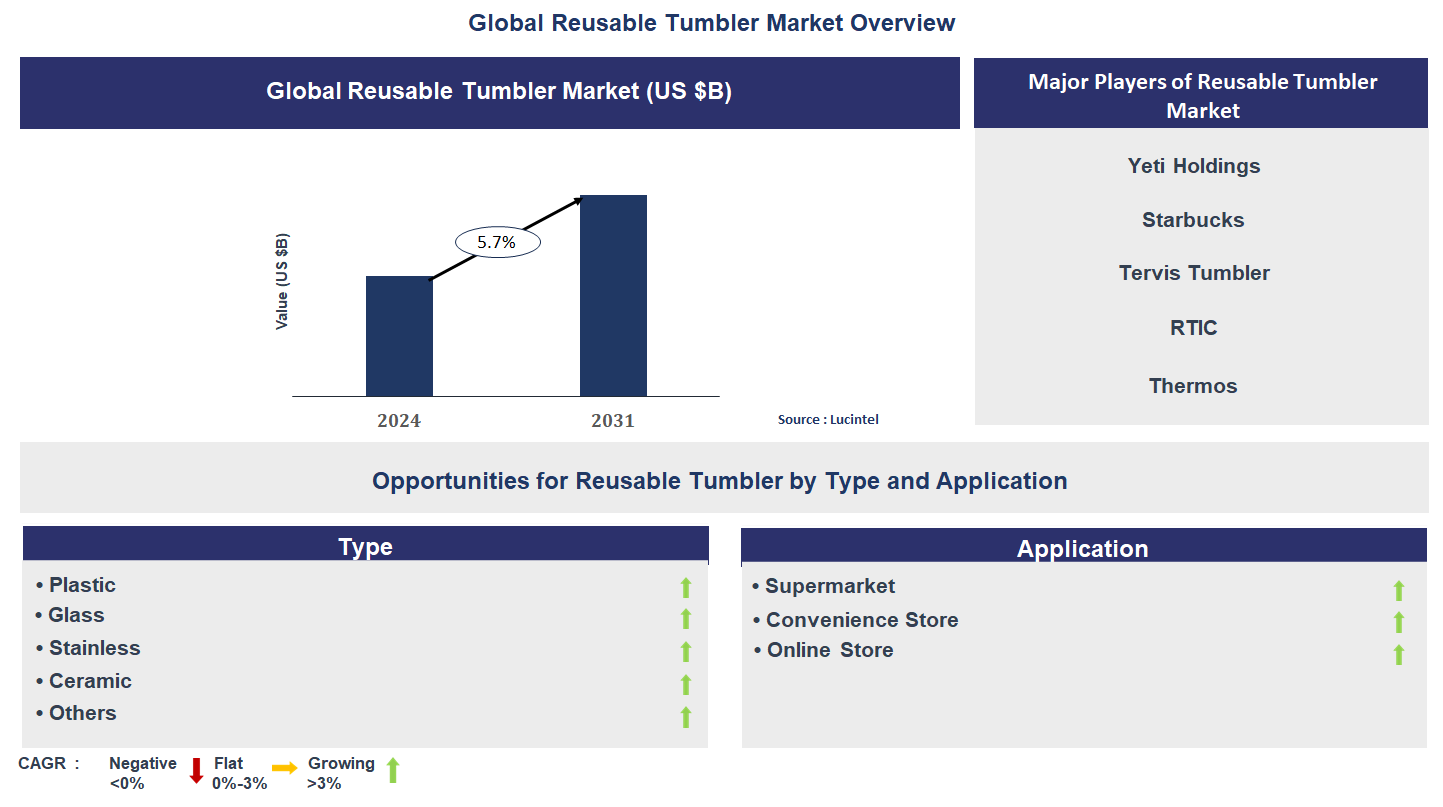
Emerging Trends in the Reusable Tumbler Market
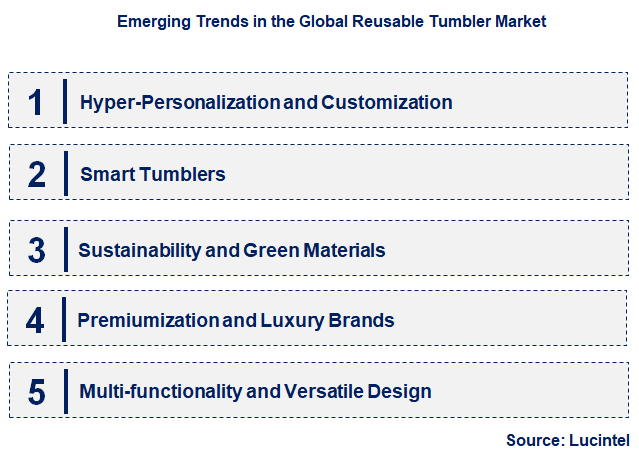
The reusable tumbler industry is at a fast-paced evolution with a number of main trends driving its future. These trends embody a core change in values among consumers to prioritize sustainability, personalization, and technology integration. The market is transforming from mere function to provide products that are not only functional but also compatible with a consumers lifestyle and identity. Increased popularity of convenience-on-the-go consumption and increased environmental sensitivity are the main drivers of such trends.• Hyper-Personalization and Customization: One of the key trends is that consumers demand goods that can be tailored according to their individual style and identity. This involves personalized engraving, immense color choice, and innovative designs. The effect is the conversion of a humble hydration tool into a fashion item or a statement piece. This trend is compelling companies to provide immense personalization options and is building a profitable niche market for custom or limited-edition tumblers, which are much in demand by consumers and shared on social media.
• Smart Tumblers: The incorporation of technology into an everyday item is a major marketplace trend. Smart tumblers include features such as temperature sensors, hydration monitoring, and even Bluetooth capabilities. The effect is a move from a simple container to a health and hydration device. The products are based on a health-focused and technologically oriented consumer base, with a heightened level of functionality and ease of use. This trend is challenging conventional design and is creating new revenue channels for manufacturers.
• Sustainability and Green Materials: The reusable tumbler industry is fueled by an inherent trend towards sustainability. Consumers are actively looking for alternatives to single-use plastics and are insisting on products produced from environmentally friendly materials like recycled plastics, stainless steel, and bamboo. The effect is a major decrease in the ecological footprint of the industry. Brands that go green are winning in terms of competitive advantage, having increased brand loyalty, and joining the rest of the world in efforts to minimize wastage.
• Premiumization and Luxury Brands: Affordability is still essential, yet increasingly consumers are looking to pay a premium for branded, durable, and quality tumblers. This is motivated by a need for a product that provides better insulation, longevity, and a form of social status. The result is a profitable premium segment in the market, in which players such as Yeti and Stanley have gained a prominent position. This trend is also altering the image of a tumbler from being an ordinary utility product to being a desirable, high-value item.
• Multi-functionality and Versatile Design: The contemporary consumer has a dynamic life and looks for items that can fulfill diverse requirements. The trend is to create tumblers that are not merely appropriate for hot and cold drinks but also for diverse activities, ranging from commutes to outdoor explorations. The effect is a more functional product that can be consumed during the day, making it more valuable to the consumer. Interchangeable lids, leak-proof closures, and ergonomic handles are becoming the norm. These tendencies are all coming together to redefine the reusable tumbler industry and make it more consumer-focused, high tech, and sustainable. The personalization and intelligent features are making the product more user-friendly, while the sustainability and high-quality focus is building a wiser and more discerning customer. In the end, these trends are transforming the market from an everyday use item to a high-tech, lifestyle-connected product that speaks to the values and dreams of a consumer.
Recent Development in the Reusable Tumbler Market
The reusable tumbler industry has seen a number of significant developments that are radically transforming its strategic and operational dynamics. These are fueled by a combination of technological advancement, a corporate strategy shift, and increased attention to safety and environmental stewardship. The market is reacting to demands for more effective production processes, alternative uses for tumblers, and greater diversity and reach of the community.• Material and Insulation Technologies: A major innovation is the ongoing development of materials and insulation technology. Brands are now relying on double-walled, vacuum-insulated stainless steel and BPA-free plastic to provide better temperature retention. This technology is affecting the market by considerably enhancing product performance and lifespan, which satisfies a central consumer need.
• Growth of Social Media and Influencer Marketing: The reusable tumbler industry is getting a big push from social media and influencer marketing. Companies are using social media platforms such as TikTok and Instagram to drive viral moments and brand loyalty, like the Stanley Quencher phenomenon. This trend is affecting the market by establishing a new and influential platform for consumer interaction and sales. It has made tumblers from a utilitarian piece of equipment into a cultural icon and a fashionable accessory, which is fueling record demand, especially among younger populations.
• Corporate and Promotional Gifting Initiatives: One of the main trends is the increasing application of imprinted reusable tumblers as corporate and promotional gifts. Tumblers with company logos are being used more often by firms as an environmentally friendly and pragmatic substitution for customary merchandise. The effect is a big new source of revenue and expanding B2B market for the industry.
• E-commerce and Retail Growth: The reusable tumbler industry has experienced a fast pace of expansion in its distribution channels. Outside of conventional retail, one significant evolution is the expansion of e-commerce websites and direct-to-consumer transactions. This evolution is affecting the market by opening up products to a worldwide market and by lowering the entry barriers for new brands.
• Emphasis on Hygiene and Safety: With consumers increasingly health-aware, one new trend is the growing emphasis on hygiene and safety in tumblers design. Companies are creating products with greater ease of cleaning, including wide-mouthed designs, gasket removal, and self-sanitizing technology. The result is an improved level of consumer confidence and less worry about bacterial accumulation. This innovation is essential in ensuring market development and is responsible for the emergence of a new generation of tumblers that focus on health and hygiene. These advances are all contributing to the reusable tumbler industry together as they create a more innovative, consumer-focused, and visionary industry. They are not only enhancing the products but also turning them into a more integral element of contemporary life. Through the adoption of these advances, the market is guaranteeing its ongoing increase and relevance in a world that appreciates technology, sustainability, and individual health.
Strategic Growth Opportunities in the Reusable Tumbler Market
The reusable tumbler industry offers various strategic growth opportunities in important applications driven by changing consumer behavior, technological developments, and the proliferation of sustainable trends. The prospects are supporting market participants to expand their portfolios, reach out to new consumer bases, and consolidate in an environment marked with intense competition. By targeting these high-growth segments, businesses are able to capitalize on the inherent appeal of tumblers as a practical, fashionable, and environmentally friendly product.• Corporate and Institutional Markets: One major growth opportunity is in the business-to-business (B2B) marketplace. The approach is to market to corporations, universities, and event planners for mass orders of custom tumblers as promotional products, employee incentives, or as part of an environmental initiative. The effect is a steady, high-margin revenue stream that is less dependent on fluctuating consumer seasonal trends. This market also offers a strong vehicle for brand exposure, as custom tumblers are a constant billboard for the corporation or organization.
• Smart Features and Technology Innovation: Integration of smart technology is a strong strategic opportunity. The strategy is to create tumblers with capabilities such as integrated scales for calorie measurement, temperature control for keeping the drinking temperature at a precise level, and app connectivity for measuring hydration. The effect is a high-end product that creates a new value proposition over basic insulation. This makes the company a leader as an innovative health and wellness brand that appeals to a tech-savvy and upscale consumer audience.
• Coffee Shop and Retail Chain Alliances: A strong growth opportunity is in building alliances with large coffee shop and retail chains. The approach is to offer co-branded or customized tumblers and to reward, in the form of discounts, customers who use their own reusable tumblers. The effect is a strong network effect that encourages the use of reusable products and fuels sales. The partnership offers a direct access to a mass consumer market and reinforces the brands environmental commitment.
• Diversification into Niche and Lifestyle Segments: The market can expand by addressing specific niche consumer segments. The approach is to create tumblers for particular lifestyle uses, e.g., for the outdoor type with tough designs, for kids with playful and safe materials, or for the working professional with clean, minimalist looks. The effect is a more diversified product line that can reach a broader market share. This strategy enables brands to become a niche player in a competitive market, serving the specific needs and values of each segment.
• Leveraging the High-Growth Asia-Pacific Market: The Asia-Pacific region, especially China and India, is a huge growth opportunity. The plan is to customize products and marketing to the local tastes and distribution channels of these markets. The effect is the potential to harness an increasingly large consumer market with increasing disposable incomes and expanding environmental awareness. The regional concentration calls for tapping into local trends, including the desire for low-cost and multi-purpose goods, in order to establish a robust presence. These strategic development opportunities collectively are affecting the reusable tumbler industry by creating a more dynamic, diversified, and consumer-focused industry. They are allowing businesses to shift beyond conventional retail and to access new, high-growth uses, including corporate gifting and intelligent technology. By targeting these opportunities, industry players are not only guaranteeing the long-term sustainability of their businesses but are also positioning themselves as leaders in a fast-changing global economy.
Reusable Tumbler Market Driver and Challenges
The reusable tumbler industry is driven by an intricate combination of drivers for its growth and challenges that can hinder its success. The major drivers are mainly based on a developing global awareness of environmental issues, an increase in on-the-go lifestyles, and ongoing product innovation. Conversely, the major challenges are often related to intense market competition, the high cost of premium materials, and the need for consistent consumer education about hygiene. The factors responsible for driving the reusable tumbler market include: 1. Rising Environmental Awareness: The major force behind the reusable tumbler market is the growing global awareness of plastic pollution and the resultant environmental damage. Consumers are actively searching for an environmentally friendly substitute for single-use plastic bottles. The effect is an intrinsic change in consumer behavior that drives a persistent and increasing demand for reusable tumblers. This force is supported by government regulations and business sustainability programs that facilitate the use of reusable products. 2. Increase in On-the-Go Lifestyle: Contemporary lifestyles are dominated by a requirement for convenience and mobility. People who commute to work, students, and outdoor lovers need a method to transport drinks that are leak-free and can keep temperature. The effect is an ever-present underlying demand for active lifestyle-designed tumblers. This trend has spurred design innovation, including ergonomic grips and spill-free lids, which are distinguishing characteristics for a moving consumer. 3. Product Innovation and Branding: The market is fueled by ongoing innovation in material, design, and functionality. Brands are distinguishing themselves through better insulation, distinctive color, and designer collaborations. The effect is a premiumization of the market, where prestige brands such as Stanley and Yeti are status symbols. This driver fosters a need for tumblers that are not only functional but also an expression of a consumers own style and identity. 4. Trends in Health and Wellness: The increasing worldwide emphasis on health and wellness is a key driver. Consumers are more conscious about staying hydrated and also wary of chemicals used in certain types of plastics. The effect is increased demand for tumblers that are safe, BPA-free materials such as stainless steel and glass. The driver also opens a window of opportunity for intelligent tumblers that assist consumers with monitoring their hydration intake and living a balanced life. 5. Digital Marketing and E-commerce: Growth in e-commerce sites and the influence of digital marketing are key drivers. They give brands an unmediated access path to consumers and allow brands to run targeted marketing campaigns. The effect is an open and competitive marketplace, where innovative small brands can reach a worldwide audience without the need for middlemen retailers. This also allows for the viral spread of trends, such as the Stanley Cup phenomenon, which can drive explosive growth. Challenges in the reusable tumbler market are: 1. High Market Competition: The reusable tumbler industry is extremely competitive with numerous international and domestic players. Such high competition can hamper the entry and market share of new brands and incumbent brands alike. This issue results in price wars, declining profit margins, and the necessity for constant innovation and differentiation to be differentiated in a congested market. 2. Perceived Low Hygiene: The major obstacle for the reusable tumbler industry is the perceived lack of hygiene among consumers. If not properly cleaned, tumblers can harbor bacteria that will discourage some consumers from using them. This issue forces manufacturers to spend money on cleanable designs and consumer education on care, driving up production and marketing expenses. 3. Price Volatility of Raw Materials: The major raw material for most premium tumblers is stainless steel, and its price can be unpredictable. Price changes in raw materials tend to affect the production cost and profit margins of a company directly. This is a challenge since it makes it hard for brands to keep a constant pricing and can compel them to either absorb the cost or transfer it to consumers, which may impact sales and competitiveness. The collective effect of these drivers and challenges is a market in dynamic transformation. The drivers, particularly environmental awareness and innovation, are driving the market towards a more mature and diversified market. Nevertheless, the challenges, mostly competition and hygiene issues, necessitate the industry to be proactive and strategic. The industry is now concentrating more on an equal strategy that aims to maximize profitability while minimizing risks and meeting the concerns of consumers regarding safety and sustainability.List of Reusable Tumbler Companies
Companies in the market compete on the basis of product quality offered. Major players in this market focus on expanding their manufacturing facilities, R&D investments, infrastructural development, and leverage integration opportunities across the value chain. With these strategies reusable tumbler companies cater increasing demand, ensure competitive effectiveness, develop innovative products & technologies, reduce production costs, and expand their customer base. Some of the reusable tumbler companies profiled in this report include-• Yeti Holdings
• Starbucks
• Tervis Tumbler
• RTIC
• Thermos
• Swell
• Vista Outdoor
Reusable Tumbler Market by Segment
The study includes a forecast for the global reusable tumbler market by type, application, and region.Reusable Tumbler Market by Type [Value from 2019 to 2031]:
• Plastic
• Glass
• Stainless
• Ceramic
• Others
Reusable Tumbler Market by Application [Value from 2019 to 2031]:
• Supermarket
• Convenience Store
• Online Store
Reusable Tumbler Market by Region [Value from 2019 to 2031]:
• North America
• Europe
• Asia Pacific
• The Rest of the World
Country Wise Outlook for the Reusable Tumbler Market
The reusable tumbler industry is, at present, in the midst of dynamic expansion owing to the convergence of environmental awareness, change in lifestyle, and innovation in products. Consumers across the globe are switching to sustainable, eco-friendly substitutes for disposable plastics, and the reusable tumbler has become a practical and stylish option. The shift is not merely a fad but an intrinsic transformation in the way consumers think, impacting product design, material selection, and brand promotion. From high-tech intelligent tumblers to visually appealing and customized designs, the market is evolving to meet a wide variety of tastes, making it a major player in the international sustainable products market.• United States: The American market for reusable tumblers is a consumption and innovation leader. The most recent trends are characterized by a strong emphasis on brand loyalty and lifestyle incorporation. The likes of Stanley and Yeti are becoming cultural icons, such that fashion limited drops send consumers into a buying frenzy. There is also a proliferation of smart tumblers with temperature sensors and hydration monitoring. The focus is on the performance-driven, ruggedized, and high-end products that are customizable, indicating a consumer behavior that is both about functionality and self-expression.
• China: Chinas market for reusable tumblers is growing very fast, fueled by urbanization and increased disposable income. The recent trends are focused on the development of e-commerce platforms and a very strong thrust towards customization. The Chinese brands are experimenting with distinctive designs, collaborations with artists, and a very diverse array of materials. Social media trends also dominate the market, where the tumbler tends to be a fashion statement.
• Germany: The reusable tumbler industry in Germany is marked by intense focus on sustainability, quality, and design minimalism. The trend is fueled by stringent environmental regulations and a long-established eco-aware consumer culture. German companies are leading the way with products that are not only long-lasting but also ethically produced and sourced. The market prefers simple functional designs with a focus on a long life and ease of cleaning. Though less fashion-led than some markets, the German consumer is prepared to pay a premium for products that bear witness to quality and sustainability.
• India: Indias market for reusable tumblers is a fast-growing one, driven by urbanization and increasing awareness of plastic pollution. Recent trends are characterized by a shift away from conventional plastic bottles towards more hygienic and long-lasting materials such as stainless steel. The market is also experiencing an upswing in low-cost and multi-use tumblers that appeal to a broad base of consumers. There is an increasing number of international brands, but local producers are also innovating to address the particular requirements of the Indian market, e.g., for hot drinks and climatic extremes.
• Japan: Japans market for reusable tumblers has a reputation for its combination of small size and sophisticated technology. New trends are aimed at producing light, highly insulated, and design-refined products that are ideal for a rapid, urban life. Japanese brands are world leaders in thermal retention technology, keeping drinks hot or cold for hours. The market also possesses a robust culture of utilizing reusable products at cafes and convenience stores due to policies and consumption patterns. The focus is on sophisticated, minimalist, and highly efficient tumblers.

Features of the Global Reusable Tumbler Market
Market Size Estimates: Reusable tumbler market size estimation in terms of value ($B). Trend and Forecast Analysis: Market trends (2019 to 2024) and forecast (2025 to 2031) by various segments and regions. Segmentation Analysis: Reusable tumbler market size by type, application, and region in terms of value ($B). Regional Analysis: Reusable tumbler market breakdown by North America, Europe, Asia Pacific, and Rest of the World. Growth Opportunities: Analysis of growth opportunities in different types, applications, and regions for the reusable tumbler market. Strategic Analysis: This includes M&A, new product development, and competitive landscape of the reusable tumbler market. Analysis of competitive intensity of the industry based on Porter’s Five Forces model.
FAQ
Q1. What is the growth forecast for reusable tumbler market? Answer: The global reusable tumbler market is expected to grow with a CAGR of 5.7% from 2025 to 2031. Q2. What are the major drivers influencing the growth of the reusable tumbler market? Answer: The major drivers for this market are the increasing environmental concerns over single-use plastics, the rising consumer demand for sustainable products, and the growing trend of personalization & customization in drinkware. Q3. What are the major segments for reusable tumbler market? Answer: The future of the reusable tumbler market looks promising with opportunities in the supermarket, convenience store, and online store markets. Q4. Who are the key reusable tumbler market companies? Answer: Some of the key reusable tumbler companies are as follows:• Yeti Holdings
• Starbucks
• Tervis Tumbler
• RTIC
• Thermos
• Swell
• Vista Outdoor Q5. Which reusable tumbler market segment will be the largest in future? Answer: Lucintel forecasts that, within the type category, stainless is expected to witness the highest growth over the forecast period. Q6. In reusable tumbler market, which region is expected to be the largest in next 5 years? Answer: In terms of region, APAC is expected to witness the highest growth over the forecast period. Q7. Do we receive customization in this report? Answer: Yes, Lucintel provides 10% customization without any additional cost.
Table of Contents
List of Figures
List of Tables
Methodology
- In-depth interviews of the major players in this market
- Detailed secondary research from competitors’ financial statements and published data
- Extensive searches of published works, market, and database information pertaining to industry news, company press releases, and customer intentions
- A compilation of the experiences, judgments, and insights of Lucintel’s professionals, who have analyzed and tracked this market over the years.


Buy Now
Choose a license that fits your team. Instant PDF delivery.
Prices exclude taxes. Instant delivery. Custom licensing available on request.
Key Questions
- • What are some of the most promising, high-growth opportunities for the reusable tumbler market by type (plastic, glass, stainless, ceramic, and others), application (supermarket, convenience store, and online store), and region (North America, Europe, Asia Pacific, and the Rest of the World)?
- • Which segments will grow at a faster pace and why?
- • Which region will grow at a faster pace and why?
- • What are the key factors affecting market dynamics? What are the key challenges and business risks in this market?
- • What are the business risks and competitive threats in this market?
- • What are the emerging trends in this market and the reasons behind them?
- • What are some of the changing demands of customers in the market?
- • What are the new developments in the market? Which companies are leading these developments?
- • Who are the major players in this market? What strategic initiatives are key players pursuing for business growth?
- • What are some of the competing products in this market and how big of a threat do they pose for loss of market share by material or product substitution?
- • What M&A activity has occurred in the last 5 years and what has its impact been on the industry? For any questions related to Reusable Tumbler Market, Reusable Tumbler Market Size, Reusable Tumbler Market Growth, Reusable Tumbler Market Analysis, Reusable Tumbler Market Report, Reusable Tumbler Market Share, Reusable Tumbler Market Trends, Reusable Tumbler Market Forecast, Reusable Tumbler Companies, write Lucintel analyst at email: helpdesk@lucintel.com. We will be glad to get back to you soon.


