
Report Feature
Remote Healthcare Market Trends and Forecast
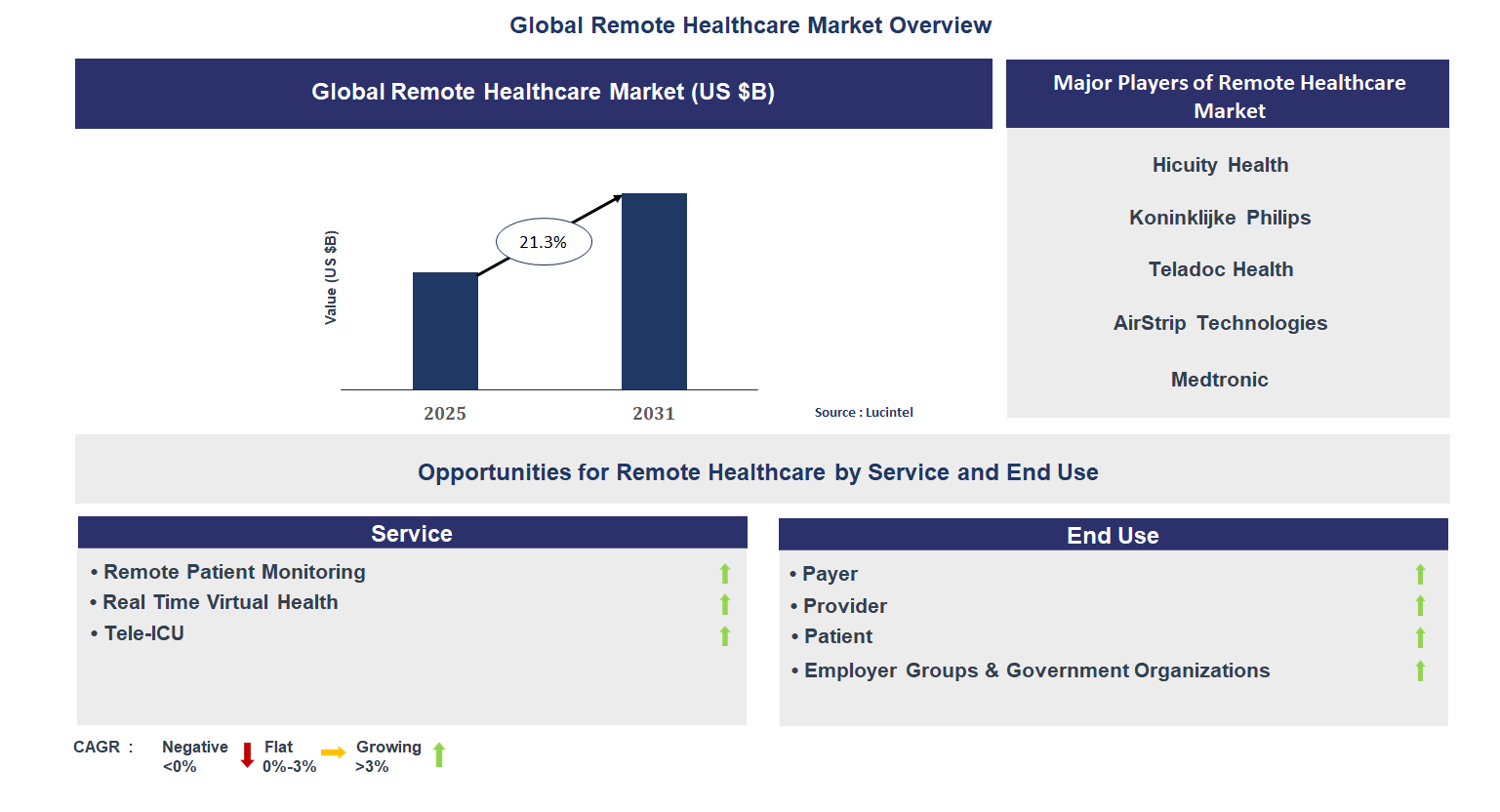
The future of the global remote healthcare market looks promising with opportunities in the payer, provider, patient, and employer group & government organization markets. The global remote healthcare market is expected to grow with a CAGR of 21.3% from 2025 to 2031. The major drivers for this market are the increasing adoption of telemedicine services, the rising prevalence of chronic diseases, and the growing penetration of digital health technologies.• Lucintel forecasts that, within the service category, real time virtual health is expected to witness the highest growth over the forecast period.
• Within the end use category, provider is expected to witness the highest growth.
• In terms of region, APAC is expected to witness the highest growth over the forecast period. Gain valuable insights for your business decisions with our comprehensive 150+ page report. Sample figures with some insights are shown below.
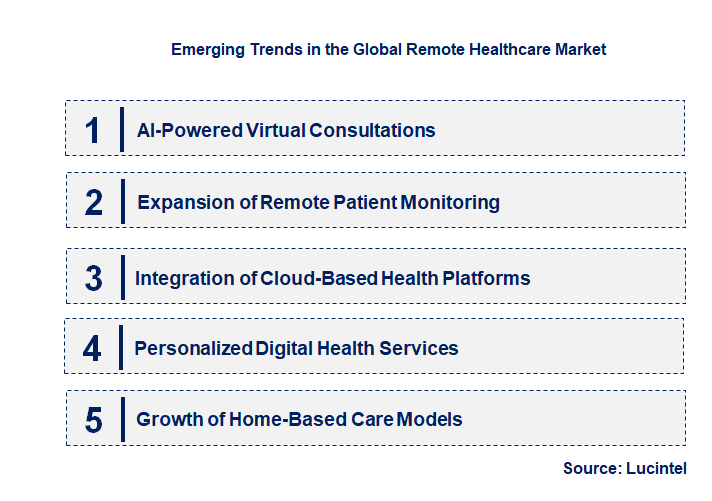
Emerging Trends in the Remote Healthcare Market
The remote healthcare market is transforming through technological innovation and patient-centric care models. Emerging trends highlight the growing importance of digital platforms, AI integration, remote diagnostics, and personalized treatment approaches. These advancements are redefining healthcare delivery by improving accessibility, reducing costs, and promoting proactive health management across global populations.• AI-Powered Virtual Consultations: Artificial intelligence is enhancing teleconsultations through automated triage, predictive analytics, and diagnostic support. AI-driven chatbots and clinical decision systems streamline patient assessment, reduce consultation time, and improve care accuracy, supporting efficient and informed medical interactions remotely.
• Expansion of Remote Patient Monitoring: Advanced wearable and IoT devices enable continuous health monitoring and early detection of abnormalities. This trend supports chronic disease management, reduces hospital readmissions, and promotes patient engagement through real-time feedback and clinician connectivity.
• Integration of Cloud-Based Health Platforms: Cloud technology is central to remote healthcare operations, allowing seamless data storage, secure sharing, and interoperability. Cloud platforms enhance collaboration between patients, healthcare providers, and diagnostic centers, enabling scalable and reliable virtual healthcare infrastructure.
• Personalized Digital Health Services: The shift toward personalized remote healthcare is driven by data analytics and precision medicine. Individual health profiles and wearable data enable customized treatment plans, improving outcomes and patient adherence to prescribed regimens.
• Growth of Home-Based Care Models: Home-based remote care is expanding with connected devices and telemonitoring systems. This trend supports elderly and chronic patients, ensuring comfort, reducing hospital visits, and delivering continuous medical supervision through remote connectivity. Emerging trends such as AI integration, personalized healthcare, and remote monitoring are transforming global healthcare delivery. These developments are fostering proactive, patient-driven care models that improve accessibility, efficiency, and overall treatment effectiveness in the remote healthcare landscape.
Recent Development in the Remote Healthcare Market
Recent developments in the remote healthcare market focus on digital transformation, patient engagement, and system interoperability. These innovations are enabling healthcare providers to deliver quality medical services remotely, enhance clinical efficiency, and reduce geographical barriers in patient access to healthcare.• Digital Telehealth Platforms: Expansion of user-friendly telehealth platforms is facilitating remote diagnosis, consultation, and treatment through virtual interfaces, improving care accessibility and patient convenience.
• Integration of Wearable Health Devices: Incorporation of wearable devices allows continuous monitoring of vital signs, supporting real-time health tracking and early intervention in chronic conditions.
• AI-Enabled Predictive Analytics: Predictive analytics tools are empowering healthcare providers to forecast health risks, personalize care, and optimize clinical decision-making for improved patient outcomes.
• Cross-Border Collaboration in Telemedicine: International collaborations between healthcare organizations are enhancing medical knowledge exchange and extending remote healthcare services across different regions.
• Enhanced Data Security Frameworks: Focus on cybersecurity and encrypted communication is strengthening patient trust and compliance with data protection standards in remote healthcare solutions. Recent developments in telehealth, AI, wearables, and security are revolutionizing the remote healthcare market. These advancements are improving efficiency, access, and care quality while promoting a more inclusive and connected healthcare environment.
Strategic Growth Opportunities in the Remote Healthcare Market
The remote healthcare market presents significant growth opportunities across various clinical applications. As healthcare systems embrace virtual technologies, remote care solutions are enhancing diagnostics, treatment continuity, and preventive care management, driving transformation across key healthcare domains.• Chronic Disease Management: Remote monitoring solutions are enabling continuous observation and management of conditions like diabetes, hypertension, and cardiac disorders, improving patient adherence and outcomes.
• Elderly and Home Care: Remote healthcare systems support aging populations with home-based monitoring, ensuring timely medical response and comfort in familiar environments.
• Mental Health Support: Digital platforms are expanding access to virtual counseling and therapy, reducing stigma, and enabling convenient mental health care delivery.
• Post-Operative Care: Remote monitoring and teleconsultation systems facilitate recovery tracking and complication prevention, reducing hospital stays and readmission rates.
• Preventive Healthcare: Continuous data collection and health analytics are promoting early diagnosis, lifestyle management, and preventive interventions, improving population health outcomes. Strategic opportunities in chronic care, elderly support, and preventive health are driving the remote healthcare market. These applications enhance accessibility, reduce healthcare burdens, and promote long-term well-being through technology-driven patient engagement.
Remote Healthcare Market Driver and Challenges
The remote healthcare market is influenced by technological, economic, and regulatory factors. Advancements in connectivity, healthcare digitalization, and patient awareness are fueling market growth, while challenges such as regulatory complexities, data privacy concerns, and digital divide hinder large-scale adoption and uniform implementation. The factors responsible for driving the remote healthcare market include: 1. Technological Advancements: Innovations in telecommunication, AI, and IoT are improving the reliability and precision of remote healthcare solutions. 2. Rising Patient Awareness: Growing public acceptance of virtual healthcare is driving widespread adoption of telehealth services and remote monitoring tools. 3. Increasing Healthcare Costs: The need to reduce operational expenses and hospital visits is promoting remote consultations and home-based care. 4. Supportive Government Policies: Policy frameworks encouraging digital health integration are boosting investment and regulatory support for remote healthcare systems. 5. Expansion of Broadband Infrastructure: Improved internet connectivity and smartphone penetration are enabling seamless delivery of remote healthcare services globally. Challenges in the remote healthcare market are: 1. Data Privacy and Security Concerns: The risk of data breaches and unauthorized access remains a critical barrier to patient trust in remote healthcare systems. 2. Regulatory Inconsistencies: Varying regional laws and approval processes complicate global implementation and interoperability of digital healthcare platforms. 3. Digital Divide and Access Barriers: Limited digital literacy and inadequate infrastructure in rural areas restrict equitable access to remote healthcare services. Technological progress and supportive policies are propelling the remote healthcare market forward. However, addressing privacy, regulatory, and accessibility challenges is vital to ensuring inclusive, secure, and sustainable growth across global healthcare systems.List of Remote Healthcare Companies
Companies in the market compete on the basis of product quality offered. Major players in this market focus on expanding their manufacturing facilities, R&D investments, infrastructural development, and leverage integration opportunities across the value chain. With these strategies remote healthcare companies cater increasing demand, ensure competitive effectiveness, develop innovative products & technologies, reduce production costs, and expand their customer base. Some of the remote healthcare companies profiled in this report include-• Hicuity Health
• Koninklijke Philips
• Teladoc Health
• AirStrip Technologies
• Medtronic
• America Well Corporation
• ClearArch
Remote Healthcare Market by Segment
The study includes a forecast for the global remote healthcare market by service, end use, and region.Remote Healthcare Market by Service [Value from 2019 to 2031]:
• Remote Patient Monitoring
• Real Time Virtual Health
• Tele-ICU
Remote Healthcare Market by End Use [Value from 2019 to 2031]:
• Payer
• Provider
• Patient
• Employer Groups & Government Organizations
Remote Healthcare Market by Region [Value from 2019 to 2031]:
• North America
• Europe
• Asia Pacific
• The Rest of the World
Country Wise Outlook for the Remote Healthcare Market
The remote healthcare market is rapidly evolving as digital connectivity, telemedicine platforms, and wearable technologies reshape global healthcare delivery. Growing emphasis on virtual consultations, remote diagnostics, and home-based care solutions is driving accessibility and efficiency. The United States, China, Germany, India, and Japan are witnessing transformative developments supporting connected and patient-centered healthcare ecosystems.• United State: The U.S. remote healthcare market is progressing with widespread adoption of telemedicine and AI-powered diagnostic platforms. Healthcare providers are expanding virtual care networks to improve patient engagement and chronic disease management. Integration with electronic health records and wearable monitoring devices enhances real-time data sharing and personalized care delivery.
• China: China’s remote healthcare sector is expanding through large-scale digital infrastructure investments and cloud-based health platforms. Local tech firms are collaborating with hospitals to provide online consultations and remote patient management. Government-backed initiatives promoting rural healthcare access are driving telemedicine adoption across community health centers.
• Germany: Germany is advancing remote healthcare through strong focus on data protection, interoperability, and healthcare digitization. Healthcare institutions are adopting certified telemedicine systems and secure digital communication tools. Enhanced integration between hospitals and home care services is improving continuity of care and patient monitoring efficiency.
• India: India’s remote healthcare market is driven by initiatives aimed at improving rural healthcare connectivity. Partnerships between government and private technology providers are enabling video consultations, digital prescriptions, and mobile health platforms. Affordable telehealth solutions are bridging the urban-rural healthcare gap and expanding reach to underserved populations.
• Japan: Japan’s market is advancing through innovation in wearable technology and home-based remote monitoring systems. Integration of IoT-enabled devices supports elderly and chronic care management. The emphasis on precision health and patient data analytics is enhancing preventive care and improving long-term health outcomes.

Features of the Global Remote Healthcare Market
Market Size Estimates: Remote healthcare market size estimation in terms of value ($B). Trend and Forecast Analysis: Market trends (2019 to 2024) and forecast (2025 to 2031) by various segments and regions. Segmentation Analysis: Remote healthcare market size by service, end use, and region in terms of value ($B). Regional Analysis: Remote healthcare market breakdown by North America, Europe, Asia Pacific, and Rest of the World. Growth Opportunities: Analysis of growth opportunities in different services, end uses, and regions for the remote healthcare market. Strategic Analysis: This includes M&A, new product development, and competitive landscape of the remote healthcare market. Analysis of competitive intensity of the industry based on Porter’s Five Forces model.
FAQ
Q1. What is the growth forecast for remote healthcare market? Answer: The global remote healthcare market is expected to grow with a CAGR of 21.3% from 2025 to 2031. Q2. What are the major drivers influencing the growth of the remote healthcare market? Answer: The major drivers for this market are the increasing adoption of telemedicine services, the rising prevalence of chronic diseases, and the growing penetration of digital health technologies. Q3. What are the major segments for remote healthcare market? Answer: The future of the remote healthcare market looks promising with opportunities in the payer, provider, patient, and employer group & government organization markets. Q4. Who are the key remote healthcare market companies? Answer: Some of the key remote healthcare companies are as follows:• Hicuity Health
• Koninklijke Philips
• Teladoc Health
• AirStrip Technologies
• Medtronic
• America Well Corporation
• ClearArch Q5. Which remote healthcare market segment will be the largest in future? Answer: Lucintel forecasts that, within the service category, real time virtual health is expected to witness the highest growth over the forecast period. Q6. In remote healthcare market, which region is expected to be the largest in next 5 years? Answer: In terms of region, APAC is expected to witness the highest growth over the forecast period. Q7. Do we receive customization in this report? Answer: Yes, Lucintel provides 10% customization without any additional cost.
Table of Contents
List of Figures
List of Tables
Methodology
- In-depth interviews of the major players in this market
- Detailed secondary research from competitors’ financial statements and published data
- Extensive searches of published works, market, and database information pertaining to industry news, company press releases, and customer intentions
- A compilation of the experiences, judgments, and insights of Lucintel’s professionals, who have analyzed and tracked this market over the years.


Buy Now
Choose a license that fits your team. Instant PDF delivery.
Prices exclude taxes. Instant delivery. Custom licensing available on request.
Key Questions
- • What are some of the most promising, high-growth opportunities for the remote healthcare market by service (remote patient monitoring, real time virtual health, and tele-ICU), end use (payer, provider, patient, and employer groups & government organizations), and region (North America, Europe, Asia Pacific, and the Rest of the World)?
- • Which segments will grow at a faster pace and why?
- • Which region will grow at a faster pace and why?
- • What are the key factors affecting market dynamics? What are the key challenges and business risks in this market?
- • What are the business risks and competitive threats in this market?
- • What are the emerging trends in this market and the reasons behind them?
- • What are some of the changing demands of customers in the market?
- • What are the new developments in the market? Which companies are leading these developments?
- • Who are the major players in this market? What strategic initiatives are key players pursuing for business growth?
- • What are some of the competing products in this market and how big of a threat do they pose for loss of market share by material or product substitution?
- • What M&A activity has occurred in the last 5 years and what has its impact been on the industry? For any questions related to Remote Healthcare Market, Remote Healthcare Market Size, Remote Healthcare Market Growth, Remote Healthcare Market Analysis, Remote Healthcare Market Report, Remote Healthcare Market Share, Remote Healthcare Market Trends, Remote Healthcare Market Forecast, Remote Healthcare Companies, write Lucintel analyst at email: helpdesk@lucintel.com. We will be glad to get back to you soon.


