
Release Liner Market Trends and Forecast
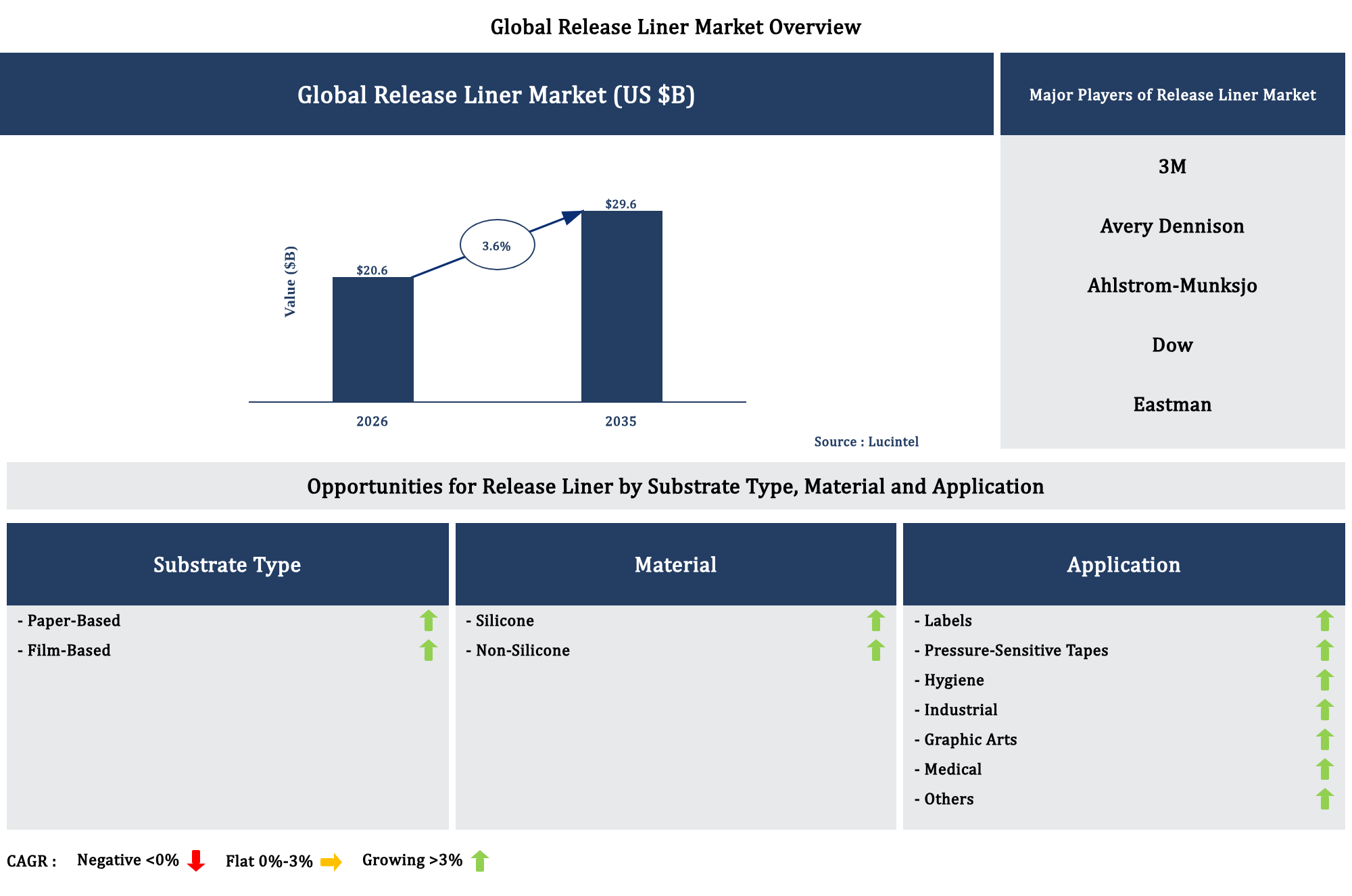
The future of the global release liner market looks promising with opportunities in the label, pressure-sensitive tape, hygiene, industrial, graphic art, and medical markets. The global release liner market is expected to reach an estimated $29,643 million by 2035 with a CAGR of 3.6% from 2026 to 2035. The major drivers for this market are the increasing demand in healthcare labeling solutions, the growing demand for automotive adhesive components, and the rising e-commerce activities boosting packaging materials.
• Lucintel forecasts that, within the substrate type category, paper-based is expected to witness higher growth over the forecast period.
• Within the application category, label is expected to witness the highest growth.
• In terms of region, APAC is expected to witness the highest growth over the forecast period.
Gain valuable insights for your business decisions with our comprehensive 150+ page report. Sample figures with some insights are shown below.
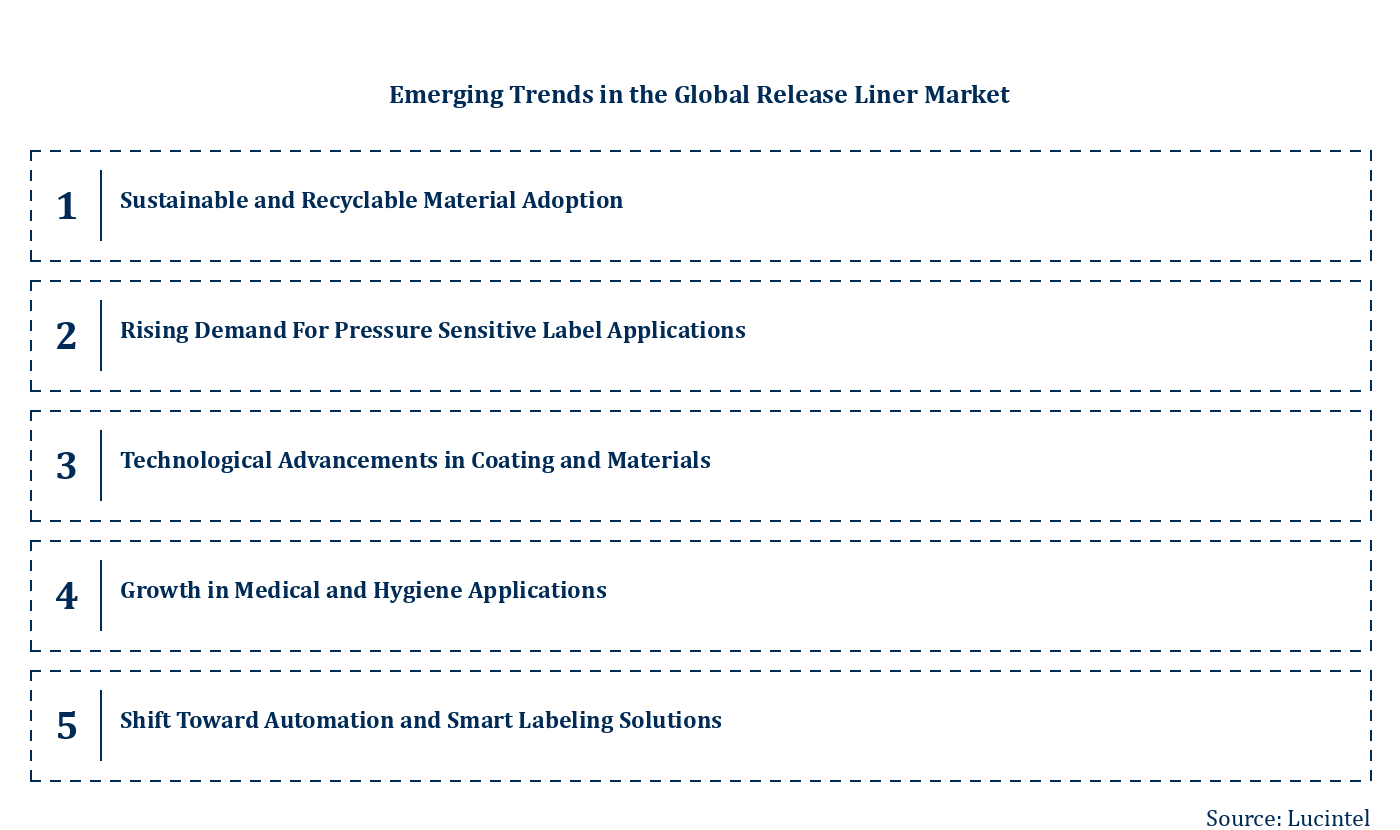
Emerging Trends in the Release Liner Market
The release liner market is undergoing rapid transformation due to evolving packaging needs, sustainability pressures, and technological innovation. Growth in e commerce, logistics, healthcare, and industrial applications is increasing demand for high performance liner materials. At the same time, regulatory requirements and environmental concerns are pushing manufacturers toward recyclable and low waste solutions. Advancements in coating technologies, material science, and automation are further enhancing product efficiency and functionality. These developments are reshaping the competitive landscape, encouraging companies to adopt innovative, cost effective, and environmentally responsible strategies to meet changing global demand patterns.
• Sustainable and Recyclable Material Adoption: Sustainability has become a central trend in the release liner market, driven by increasing environmental regulations and corporate sustainability goals. Manufacturers are developing recyclable, biodegradable, and bio based liners to reduce landfill waste and carbon footprint. Innovations include recycled fiber papers, bio polymers, and recyclable film liners that support circular economy initiatives. Companies are also investing in collection and recycling programs to recover used liners. This trend is influencing procurement decisions and product development strategies, as end users increasingly prefer eco friendly solutions, thereby reshaping material selection and driving long term market transformation toward sustainable practices.
• Rising Demand for Pressure Sensitive Label Applications: The growing use of pressure sensitive labels in packaging, logistics, food, and pharmaceuticals is significantly boosting demand for release liners. These labels offer ease of application, durability, and compatibility with automated systems, making them highly preferred across industries. The rapid expansion of e commerce and global supply chains has further accelerated label consumption, increasing the need for reliable liner materials. This trend strengthens the role of release liners as essential components in modern packaging systems and encourages manufacturers to enhance product quality, consistency, and performance to meet evolving industry requirements.
• Technological Advancements in Coating and Materials: Continuous innovation in coating technologies and material composition is improving the performance and efficiency of release liners. Developments such as non silicone coatings, UV curable silicones, and advanced film substrates are enhancing release properties, durability, and process efficiency. These innovations reduce material waste, improve production speed, and enable compatibility with high precision applications. Manufacturers are also exploring lightweight and ultra thin liners to optimize resource usage. This trend is driving competitive differentiation, as companies focus on advanced solutions that deliver higher performance while meeting sustainability and cost efficiency requirements.
• Growth in Medical and Hygiene Applications: The increasing use of release liners in medical and hygiene products is emerging as a significant trend. Applications such as wound care products, transdermal drug delivery systems, and hygiene items like diapers and sanitary products require high quality liners for adhesive protection and product integrity. Rising healthcare awareness, aging populations, and demand for advanced medical solutions are driving this growth. This trend is encouraging manufacturers to develop specialized liners with enhanced safety, sterility, and performance characteristics, thereby expanding the market scope beyond traditional packaging and labeling applications.
• Shift Toward Automation and Smart Labeling Solutions: Increasing automation in packaging and labeling processes is driving demand for high precision release liners compatible with advanced machinery. Integration of smart labeling technologies, including QR codes and tracking systems, is further boosting the need for consistent and high quality liners. Automated production lines require materials that ensure smooth dispensing and minimal downtime, prompting manufacturers to improve liner uniformity and reliability. This trend supports operational efficiency across industries and enhances supply chain visibility, positioning release liners as critical components in modern automated and digitalized production environments.
The release liner market is being reshaped by a combination of sustainability initiatives, technological innovation, and expanding application areas. The shift toward eco friendly materials is redefining production and material sourcing strategies, while growing demand from packaging, healthcare, and industrial sectors is strengthening market expansion. At the same time, advancements in coating technologies and automation are improving efficiency and product performance. Together, these trends are driving a transition toward more sustainable, high performance, and application specific solutions, positioning the market for steady long term growth and innovation across global industries.
Recent Developments in the Release Liner Market
The release liner market is experiencing dynamic changes driven by evolving industrial demand, sustainability requirements, and continuous technological innovation. Expanding applications in packaging, healthcare, and industrial sectors are encouraging manufacturers to enhance product performance and efficiency. Increasing focus on environmentally responsible materials, combined with advancements in coating and substrate technologies, is shaping new development pathways. These developments are strengthening production capabilities, improving material functionality, and expanding global market reach, thereby positioning the industry for consistent growth and competitive transformation across regions.
• Expansion of Sustainable and Recyclable Liner Solutions: Manufacturers are increasingly focusing on developing sustainable and recyclable release liner materials to address environmental concerns and regulatory pressures. Innovations include recycled paper liners, bio based films, and reusable liner systems that reduce waste generation. Companies are also investing in recycling infrastructure and liner recovery programs to support circular economy initiatives. This development is significantly influencing procurement strategies, as end users prefer environmentally responsible materials. It is also encouraging collaboration across value chains, enhancing sustainability performance while maintaining product quality and operational efficiency.
• Advancements in Silicone and Non Silicone Coating Technologies: Technological progress in coating solutions is improving the efficiency and performance of release liners. Advanced silicone coatings and emerging non silicone alternatives are enhancing release properties, durability, and compatibility with various adhesives. These innovations reduce production waste and improve processing speeds in high volume applications. Non silicone coatings are gaining attention due to their recyclability advantages and cost effectiveness. This development is enabling manufacturers to meet diverse application requirements while aligning with sustainability goals and delivering improved performance in demanding industrial environments.
• Increasing Adoption in Medical and Hygiene Applications: The growing use of release liners in medical and hygiene products is a key development supporting market expansion. Applications such as wound care, diagnostic devices, and personal hygiene products require high performance liners for protection and sterility. Rising healthcare awareness and demand for advanced medical solutions are driving this adoption. Manufacturers are developing specialized liners with enhanced safety, precision, and compatibility with sensitive materials. This development is expanding the application scope of release liners and strengthening their importance in critical healthcare and hygiene sectors globally.
• Capacity Expansion and Localization of Manufacturing Facilities: Companies are expanding production capacities and localizing manufacturing operations to meet rising regional demand and reduce supply chain risks. Investments in new production lines, advanced machinery, and regional facilities are improving supply reliability and reducing lead times. Localization strategies also help companies comply with regional regulations and cater to specific customer requirements. This development is enhancing market competitiveness by improving cost efficiency and responsiveness. It also supports growth in emerging markets where demand for packaging, labeling, and industrial applications continues to rise rapidly.
• Integration of Automation and High Precision Processing Systems: Automation and precision manufacturing technologies are transforming release liner production processes. Advanced machinery and digital control systems are enabling consistent coating quality, reduced defects, and higher production efficiency. Integration with automated labeling and packaging systems is also improving compatibility and operational performance. This development supports large scale industrial applications by ensuring reliability and uniformity in high speed environments. It is helping manufacturers optimize resource utilization, reduce operational costs, and deliver high quality products that meet the increasing demands of modern automated production ecosystems.
These developments are significantly transforming the release liner market by enhancing sustainability, performance, and operational efficiency. The shift toward eco friendly materials and advanced coating technologies is redefining product innovation, while increased adoption in healthcare and industrial sectors is expanding market opportunities. Capacity expansion and automation are improving supply chain resilience and production capabilities. Collectively, these developments are strengthening competitive positioning, driving technological progress, and supporting long term growth, ensuring that the market continues to evolve in alignment with global industry demands and environmental expectations.
Strategic Growth Opportunities in the Release Liner Market
The release liner market is expanding steadily due to increasing demand across packaging, healthcare, and industrial applications. Growth in e commerce, logistics, and consumer goods industries is driving the need for efficient labeling and adhesive solutions. At the same time, sustainability requirements and technological advancements are opening new avenues for innovation. Companies are identifying strategic growth opportunities by focusing on high demand applications, improving material efficiency, and expanding into emerging sectors, thereby strengthening their competitive positioning and long term market potential globally.
• Rising Demand for Pressure Sensitive Labels in Packaging Applications: The growing use of pressure sensitive labels in packaging is creating strong growth opportunities for release liners. Expansion of e commerce, food delivery, and retail sectors is increasing the need for reliable and high quality labeling solutions. These labels provide ease of application and compatibility with automated systems, enhancing operational efficiency. Manufacturers are focusing on developing liners that ensure smooth release and durability. This opportunity is driving higher production volumes and encouraging innovation in liner materials to meet evolving packaging requirements.
• Increasing Application in Medical and Healthcare Products Supporting Market Expansion: The healthcare sector is emerging as a key growth area for release liners due to rising demand for medical adhesives and hygiene products. Applications such as wound care, drug delivery patches, and surgical tapes require high precision liners for safety and performance. Growing healthcare awareness and aging populations are further supporting demand. Manufacturers are developing specialized liners with enhanced sterility and compatibility. This opportunity is expanding the market scope and creating demand for high value, performance oriented release liner solutions globally.
• Growth Opportunities in Industrial and Automotive Adhesive Applications: Industrial and automotive sectors are increasingly adopting adhesive technologies, creating opportunities for release liners. Applications such as bonding, insulation, and surface protection require high performance liners that ensure precision and reliability. Growth in electric vehicles and advanced manufacturing is further boosting demand. Manufacturers are focusing on durable and heat resistant liner materials to meet industrial requirements. This opportunity is supporting diversification of applications and driving innovation in liner performance, helping companies expand into high value industrial segments.
• Expanding Use in Hygiene and Personal Care Products Driving Demand: The hygiene and personal care sector is generating significant growth opportunities for release liners. Products such as diapers, sanitary napkins, and adult incontinence solutions require reliable liners for adhesive protection. Increasing consumer awareness, urbanization, and rising disposable income are driving demand for these products. Manufacturers are developing soft, flexible, and skin friendly liners to enhance product performance. This opportunity is strengthening demand in high volume applications and encouraging continuous product innovation to meet consumer expectations.
• Emerging Opportunities in Sustainable and Recyclable Packaging Solutions: Sustainability is creating new growth opportunities in the release liner market, as companies focus on eco friendly packaging solutions. Demand for recyclable and biodegradable liners is increasing due to regulatory pressures and consumer preferences. Manufacturers are investing in innovative materials and recycling technologies to reduce environmental impact. Development of reusable liner systems is also gaining traction. This opportunity is transforming material selection and production processes, enabling companies to align with sustainability goals while maintaining performance and cost efficiency.
These growth opportunities are reshaping the release liner market by expanding application areas and driving innovation. Increasing demand from packaging, healthcare, and industrial sectors is strengthening market growth, while sustainability initiatives are redefining material development. Technological advancements and diversification into high value applications are enhancing competitiveness and profitability. Collectively, these opportunities are enabling manufacturers to address evolving industry needs, improve operational efficiency, and establish a strong presence in both mature and emerging markets, ensuring long term growth and market expansion.
Release Liner Market Driver and Challenges
The release liner market is influenced by a combination of technological advancements, economic expansion, and evolving regulatory frameworks. Increasing demand from packaging, healthcare, and industrial sectors is driving innovation and production growth. At the same time, environmental regulations and sustainability goals are reshaping material selection and manufacturing processes. Companies are investing in advanced coating technologies and efficient production systems to remain competitive. However, challenges such as fluctuating raw material costs, recycling limitations, and regulatory compliance complexities continue to impact market dynamics, requiring strategic adaptation to ensure long term growth and operational stability.
The factors responsible for driving the release liner market include:-
• Rising Demand for Pressure Sensitive Labels Across Packaging and Logistics Applications: The growing use of pressure sensitive labels in packaging and logistics is a major driver for the release liner market. Expansion in e commerce, retail, and food delivery services has significantly increased the need for efficient labeling solutions. These labels offer convenience, durability, and compatibility with automated systems, making them highly preferred across industries. As global trade continues to expand, companies require reliable labeling for tracking and inventory management. This trend is encouraging manufacturers to enhance liner quality and production capacity, ensuring consistent performance and meeting the increasing demand for high speed and large scale applications.
• Technological Advancements in Coating and Material Engineering Enhancing Product Performance: Continuous innovation in coating technologies and material science is significantly driving market growth. Developments such as advanced silicone coatings, non silicone alternatives, and high performance film substrates are improving release efficiency and durability. These advancements enable better compatibility with adhesives and high precision applications. Additionally, improvements in manufacturing processes are reducing waste and increasing productivity. Companies are focusing on lightweight and high strength materials to optimize costs and performance. This driver is fostering competitive differentiation and enabling manufacturers to cater to diverse application requirements across industries with improved efficiency and reliability.
• Expanding Applications in Healthcare and Hygiene Sectors Supporting Market Growth: The increasing use of release liners in healthcare and hygiene products is contributing to market expansion. Applications such as wound care, transdermal patches, and personal hygiene products require high quality liners to ensure product safety and performance. Rising healthcare awareness, aging populations, and growing demand for advanced medical solutions are boosting adoption. Manufacturers are developing specialized liners with enhanced sterility and compatibility with sensitive materials. This driver is expanding the market scope and creating opportunities for high value products, strengthening the role of release liners in critical healthcare and hygiene applications globally.
• Growing Emphasis on Sustainable and Eco Friendly Materials Driving Innovation: Sustainability concerns and regulatory pressures are encouraging the adoption of environmentally friendly release liner materials. Companies are investing in recyclable, biodegradable, and reusable liner solutions to reduce environmental impact. Development of recycling programs and circular economy initiatives is gaining momentum. This driver is influencing product development and procurement strategies, as end users increasingly prefer sustainable solutions. It is also encouraging collaboration across the value chain to improve waste management and material recovery. As a result, sustainability is becoming a key factor shaping innovation and long term competitiveness in the release liner market.
The challenges in the release liner market are:
• Fluctuating Raw Material Prices Impacting Production Costs and Profit Margins: Variability in the prices of raw materials such as paper, plastic films, and silicone coatings poses a significant challenge for manufacturers. These fluctuations are influenced by global supply chain disruptions, economic conditions, and changes in crude oil prices. Rising material costs can reduce profit margins and create pricing pressures in competitive markets. Companies must adopt cost optimization strategies and secure stable supply chains to manage this challenge. Additionally, balancing cost efficiency with product quality remains critical, making raw material volatility a persistent concern for market participants.
• Limited Recycling Infrastructure and Environmental Concerns Restricting Adoption: Although sustainability is a major focus, limited recycling infrastructure for release liners presents a challenge. Many liners, especially those with silicone coatings, are difficult to recycle, leading to increased waste generation. Regulatory pressures are intensifying, requiring manufacturers to develop eco friendly solutions while managing costs. The lack of standardized recycling systems across regions further complicates efforts. Companies are investing in innovative materials and recycling technologies, but large scale implementation remains a challenge. This issue affects market perception and may slow adoption in environmentally conscious industries.
• Stringent Regulatory Requirements Increasing Compliance Complexity and Costs: The release liner market is subject to various environmental and safety regulations that vary across regions. Compliance with these regulations requires significant investment in research, testing, and certification processes. Companies must ensure that their products meet standards related to material safety, emissions, and waste management. Regulatory changes can also create uncertainty and require continuous adaptation. This challenge increases operational costs and may limit market entry for smaller players. However, it also encourages innovation and the development of safer and more sustainable products over time.
The release liner market is shaped by a balance between strong growth drivers and persistent challenges. Increasing demand from packaging, healthcare, and industrial sectors, along with technological advancements and sustainability initiatives, is driving market expansion. However, issues such as raw material price volatility, recycling limitations, and regulatory complexities create operational and strategic hurdles. Companies that effectively manage these challenges while leveraging innovation and sustainability trends are likely to strengthen their market position, ensuring long term growth, improved efficiency, and enhanced competitiveness in the evolving global landscape.
List of Release Liner Companies
Companies in the market compete on the basis of product quality offered. Major players in this market focus on expanding their manufacturing facilities, R&D investments, infrastructural development, and leverage integration opportunities across the value chain. With these strategies release liner companies cater increasing demand, ensure competitive effectiveness, develop innovative products & technologies, reduce production costs, and expand their customer base. Some of the release liner companies profiled in this report include-
• 3M
• Avery Dennison
• Ahlstrom-Munksjo
• Dow
• Eastman
• Felix Schoeller
• Gascogne Laminates
• Jindal Poly Films
• Loparex
• Mondi
Release Liner Market by Segment
The study includes a forecast for the global release liner market by substrate type, material, application, and region.
Release Liner Market by Substrate Type [Value from 2019 to 2035]:
• Paper-Based
• Film-Based
Release Liner Market by Material [Value from 2019 to 2035]:
• Silicone
• Non-Silicone
Release Liner Market by Application [Value from 2019 to 2035]:
• Labels
• Pressure-Sensitive Tapes
• Hygiene
• Industrial
• Graphic Arts
• Medical
• Others
Release Liner Market by Region [Value from 2019 to 2035]:
• North America
• Europe
• Asia Pacific
• The Rest of the World
Country Wise Outlook for the Release Liner Market
The release liner market is experiencing steady global transformation driven by expanding packaging, labeling, medical, and hygiene applications. Increasing demand for pressure-sensitive labels, coupled with rapid growth in e commerce and logistics, is accelerating innovation across regions. Manufacturers are focusing on sustainable materials, recyclable liners, and advanced coating technologies to meet regulatory and environmental requirements. Technological advancements, including non-silicone coatings and smart labeling solutions, are further reshaping the market landscape. Regional developments vary based on industrial maturity, regulatory frameworks, and end-use demand, with developed economies emphasizing sustainability and emerging economies focusing on capacity expansion and cost efficiency.
• United States: The United States market is witnessing steady growth driven by increasing demand for pressure-sensitive labels in e commerce, retail, and pharmaceutical sectors. The adoption of barcode and QR code labels has expanded significantly, supporting logistics and inventory tracking systems. Companies are investing in advanced silicone coatings and sustainable liner solutions to comply with environmental regulations. The presence of major players and continuous innovation in labeling technologies are strengthening the market. Additionally, the shift toward recyclable and lightweight materials is gaining momentum, supported by strong research and development capabilities and rising automation in manufacturing processes.
• China: China is emerging as a dominant production hub due to its strong manufacturing base and expanding packaging industry. Rapid industrialization, growing e commerce penetration, and increasing demand for consumer goods are driving large scale adoption of release liners. Local manufacturers are focusing on cost efficient production and scaling capacity, while also investing in eco friendly and biodegradable liner materials. Government initiatives supporting sustainable manufacturing and export oriented production are further accelerating development. Technological upgrades in coating processes and increased use in electronics and hygiene sectors are also contributing to market expansion.
• Germany: Germany is characterized by high emphasis on sustainability, innovation, and regulatory compliance. The market is driven by strong demand from automotive, industrial, and high end packaging sectors. Companies are investing in recyclable release liners and advanced coating technologies to align with stringent European environmental regulations. Research and development activities are focused on improving material efficiency and reducing waste. Additionally, integration of smart labeling technologies and precision manufacturing processes is enhancing product quality. Germany strong industrial base and focus on circular economy practices are positioning it as a leader in sustainable release liner innovations.
• India: India is experiencing rapid growth in the release liner market due to expanding packaging, healthcare, and hygiene industries. Increasing urbanization, rising disposable income, and growth in organized retail and e commerce are boosting demand for labeling solutions. Domestic manufacturers are expanding production capacities and adopting cost effective technologies to meet rising demand. There is also growing awareness of sustainable materials, although adoption is still developing compared to Western markets. Government initiatives supporting manufacturing and infrastructure development are further strengthening the market, while increasing use in pharmaceuticals and FMCG sectors continues to drive demand.
• Japan: Japan market is driven by technological sophistication and high quality standards in manufacturing. The demand for release liners is supported by advanced electronics, automotive, and healthcare industries. Companies are focusing on precision coating technologies, ultra thin materials, and high performance liners for specialized applications. Sustainability is also gaining importance, with efforts toward recyclable and environmentally friendly materials. Innovation in smart labeling and integration with electronic components is a notable trend. Japan strong emphasis on quality, efficiency, and innovation continues to support steady market development despite relatively mature industrial growth.
Features of the Global Release Liner Market
Market Size Estimates: Release liner market size estimation in terms of value ($M).
Trend and Forecast Analysis: Market trends (2019 to 2025) and forecast (2026 to 2035) by various segments and regions.
Segmentation Analysis: Release liner market size by substrate type, material, application, and region in terms of value ($M).
Regional Analysis: Release liner market breakdown by North America, Europe, Asia Pacific, and Rest of the World.
Growth Opportunities: Analysis of growth opportunities in different substrate type, material, application, and regions for the release liner market.
Strategic Analysis: This includes M&A, new product development, and competitive landscape of the release liner market.
Analysis of competitive intensity of the industry based on Porter’s Five Forces model.
FAQ
Q1. What is the release liner market size?
Answer: The global release liner market is expected to reach an estimated $29,643 million by 2035.
Q2. What is the growth forecast for release liner market?
Answer: The global release liner market is expected to grow with a CAGR of 3.6% from 2026 to 2035.
Q3. What are the major drivers influencing the growth of the release liner market?
Answer: The major drivers for this market are the increasing demand in healthcare labeling solutions, the growing demand for automotive adhesive components, and the rising e-commerce activities boosting packaging materials.
Q4. What are the major segments for release liner market?
Answer: The future of the release liner market looks promising with opportunities in the label, pressure-sensitive tape, hygiene, industrial, graphic art, and medical markets.
Q5. Who are the key release liner market companies?
Answer: Some of the key release liner companies are as follows:
• 3M
• Avery Dennison
• Ahlstrom-Munksjo
• Dow
• Eastman
• Felix Schoeller
• Gascogne Laminates
• Jindal Poly Films
• Loparex
• Mondi
Q6. Which release liner market segment will be the largest in future?
Answer: Lucintel forecasts that, within the substrate type category, paper-based is expected to witness higher growth over the forecast period.
Q7. In release liner market, which region is expected to be the largest in next 8 years?
Answer: In terms of region, APAC is expected to witness the highest growth over the forecast period.
Q8. Do we receive customization in this report?
Answer: Yes, Lucintel provides 10% customization without any additional cost.
This report answers following 11 key questions:
Q.1. What are some of the most promising, high-growth opportunities for the release liner market by substrate type (paper-based and film-based), material (silicone and non-silicone), application (labels, pressure-sensitive tapes, hygiene, industrial, graphic arts, medical, and others), and region (North America, Europe, Asia Pacific, and the Rest of the World)?
Q.2. Which segments will grow at a faster pace and why?
Q.3. Which region will grow at a faster pace and why?
Q.4. What are the key factors affecting market dynamics? What are the key challenges and business risks in this market?
Q.5. What are the business risks and competitive threats in this market?
Q.6. What are the emerging trends in this market and the reasons behind them?
Q.7. What are some of the changing demands of customers in the market?
Q.8. What are the new developments in the market? Which companies are leading these developments?
Q.9. Who are the major players in this market? What strategic initiatives are key players pursuing for business growth?
Q.10. What are some of the competing products in this market and how big of a threat do they pose for loss of market share by material or product substitution?
Q.11. What M&A activity has occurred in the last 5 years and what has its impact been on the industry?
For any questions related to Release Liner Market, Release Liner Market Size, Release Liner Market Growth, Release Liner Market Analysis, Release Liner Market Report, Release Liner Market Share, Release Liner Market Trends, Release Liner Market Forecast, Release Liner Companies, write Lucintel analyst at email: helpdesk@lucintel.com. We will be glad to get back to you soon.