
Report Feature
Recording Card Market Trends and Forecast
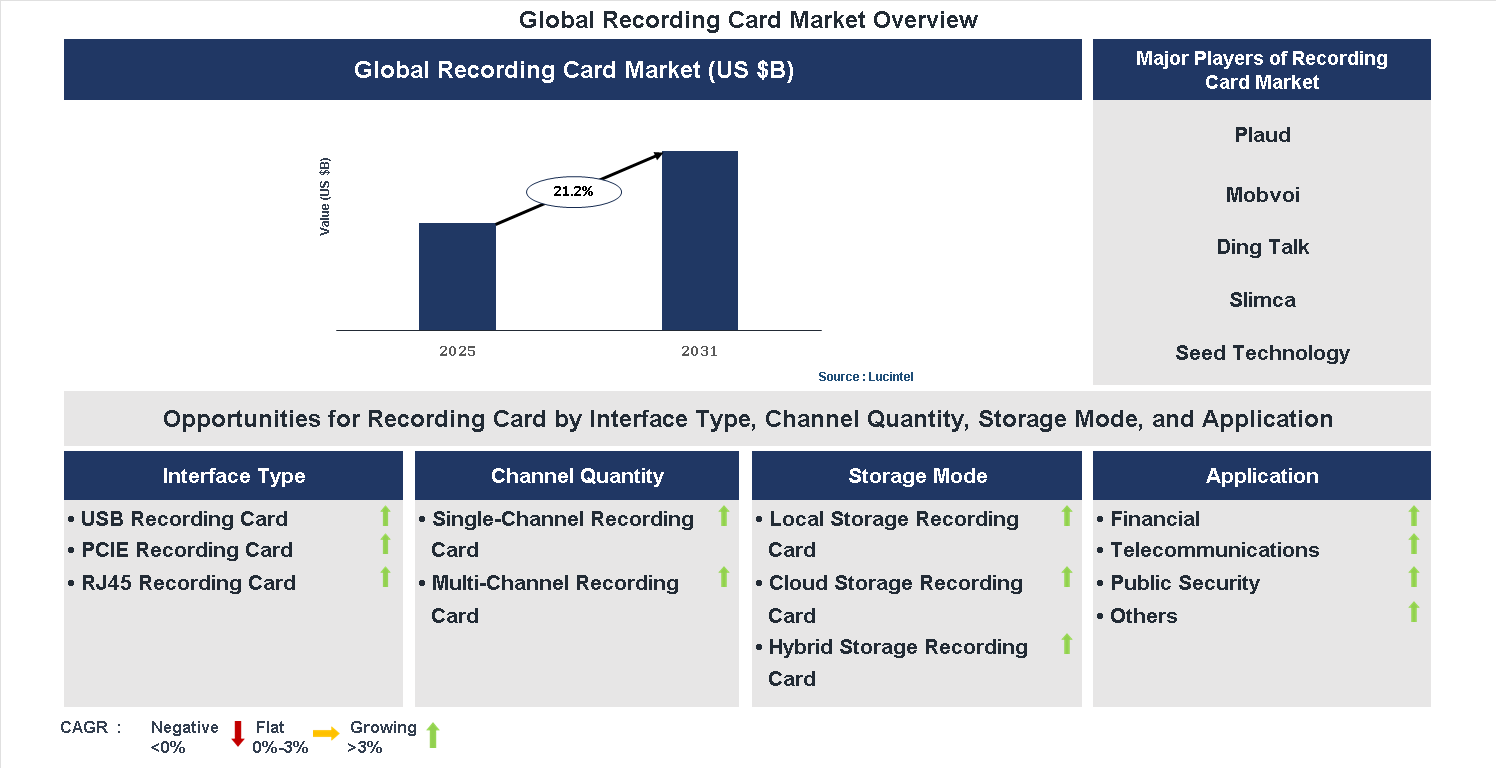
The future of the global recording card market looks promising with opportunities in the financial, telecommunication, and public security markets. The global recording card market is expected to grow with a CAGR of 21.2% from 2025 to 2031. The major drivers for this market are the increasing demand for high-quality audio recording, the rising adoption of professional recording equipment, and the growing need for advanced storage solutions.• Lucintel forecasts that, within the interface type category, USB recording card is expected to witness the highest growth over the forecast period.
• Within the application category, telecommunication is expected to witness the highest growth.
• In terms of region, APAC is expected to witness the highest growth over the forecast period. Gain valuable insights for your business decisions with our comprehensive 150+ page report. Sample figures with some insights are shown below.
Emerging Trends in the Recording Card Market
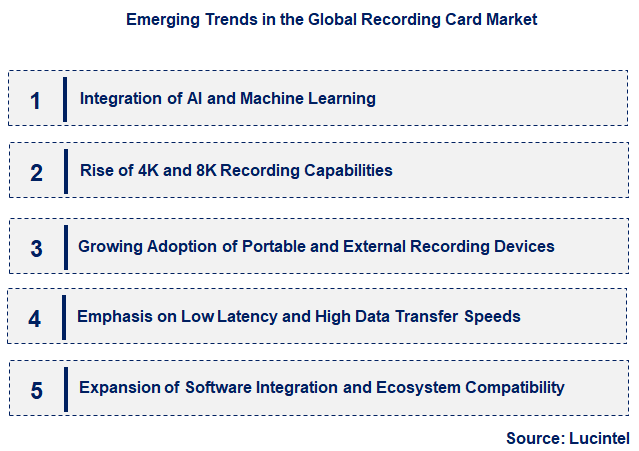
The recording card market is experiencing rapid evolution driven by technological advancements, increasing demand for high-quality audio and video recording, and the proliferation of digital content creation. As consumers and professionals seek more efficient, versatile, and high-performance recording solutions, market players are innovating to meet these needs. Emerging trends are shaping the competitive landscape, influencing product development, and expanding market opportunities. These developments are not only enhancing user experience but also driving market growth and diversification. Understanding these key trends is essential for stakeholders aiming to capitalize on the market's potential and stay ahead in this dynamic environment.• Integration of AI and Machine Learning: The incorporation of AI and machine learning into recording cards is revolutionizing the market by enabling smarter, more efficient recording solutions. These technologies facilitate real-time audio and video processing, noise reduction, and automatic adjustments, improving overall quality and user experience. AI-driven features such as voice recognition and scene detection are making recording cards more intuitive and versatile. This trend enhances productivity for content creators, broadcasters, and professionals, leading to increased adoption and opening new avenues for innovation within the market.
• Rise of 4K and 8K Recording Capabilities: The demand for ultra-high-definition recording is fueling the development of recording cards supporting 4K and 8K resolutions. These advanced capabilities cater to professional broadcasters, filmmakers, and gamers seeking superior visual quality. The adoption of higher resolution standards is pushing manufacturers to innovate with more powerful hardware and optimized data transfer technologies. This trend significantly impacts the market by enabling high-quality content creation, improving streaming experiences, and meeting the growing expectations for clarity and detail in digital media.
• Growing Adoption of Portable and External Recording Devices: As mobility and flexibility become priorities, there is a rising preference for portable and external recording devices. These devices offer ease of use, compatibility with various systems, and enhanced portability for on-the-go content creation. The trend is driven by the surge in live streaming, remote work, and field recording needs. Manufacturers are focusing on compact designs, USB-C connectivity, and rugged build quality to meet consumer demands. This shift broadens market reach, making high-quality recording accessible to a wider audience beyond traditional studio environments.
• Emphasis on Low Latency and High Data Transfer Speeds: To support real-time applications such as live streaming, gaming, and virtual events, recording cards are increasingly prioritizing low latency and high data transfer speeds. Innovations in interface technology, such as Thunderbolt and USB 3.2, are enabling faster data flow, reducing lag, and ensuring seamless recording and streaming experiences. This trend is critical for professional users who require real-time feedback and minimal delay, thereby enhancing performance and reliability. It also opens opportunities for new applications in interactive media and live broadcasting.
• Expansion of Software Integration and Ecosystem Compatibility: The market is witnessing a focus on seamless integration with various software platforms and ecosystems. Recording cards are now designed to work effortlessly with popular editing, streaming, and broadcasting software, providing users with a streamlined workflow. Compatibility with multiple operating systems and hardware configurations is also prioritized. This trend enhances user convenience, reduces setup complexity, and fosters ecosystem development. It encourages innovation through software updates and plugins, ultimately enriching the user experience and expanding the market’s versatility. In summary, these emerging trends are fundamentally reshaping the recording card market by driving technological innovation, enhancing user experience, and expanding application possibilities. They are fostering a more dynamic, versatile, and competitive landscape, enabling market players to meet evolving consumer demands and capitalize on new growth opportunities.
Recent Development in the Recording Card Market
The recording card market has experienced significant technological advancements and increasing demand across various sectors, including gaming, broadcasting, and professional audio-visual production. These developments are driven by the need for higher quality, faster data transfer, and enhanced user experience. As industries evolve, the market is poised for substantial growth, fueled by innovations in hardware and software solutions. This report highlights five key recent developments shaping the future of recording cards and their impact on the industry landscape.• Enhanced Data Transfer Speeds: The integration of PCIe 4.0 and 5.0 interfaces has significantly increased data transfer rates, enabling real-time high-resolution recording and streaming. This advancement reduces latency and improves overall performance, making recording cards more efficient for professional broadcasters and gamers. The faster data handling capacity supports 4K and 8K video recording, opening new opportunities for content creators and media companies. Consequently, market demand for high-speed recording solutions is expected to surge.
• Introduction of AI-Powered Features: Recent recording cards incorporate artificial intelligence to optimize recording quality, automate scene detection, and improve noise reduction. AI integration enhances user experience by providing intelligent editing and real-time analytics, which are crucial for live broadcasting and post-production workflows. These features reduce manual effort and increase productivity, attracting professional users seeking advanced tools. The adoption of AI-driven recording cards is expected to revolutionize content creation, expanding market applications and driving growth.
• Development of Compact, Portable Designs: Manufacturers are focusing on miniaturization, creating lightweight, portable recording cards suitable for on-the-go use. These compact devices maintain high performance while offering flexibility for field recording, live events, and mobile streaming. The portability trend caters to content creators and journalists who require mobility without sacrificing quality. As demand for portable solutions increases, the market is witnessing a shift towards versatile, user-friendly recording cards, broadening their application scope.
• Expansion of Software Compatibility and Ecosystem Integration: New recording cards now support a wider range of software platforms, including popular editing and streaming applications. Seamless integration with existing workflows enhances user efficiency and reduces setup time. Compatibility with various operating systems and hardware ecosystems ensures versatility for different user needs. This development fosters a more interconnected environment, encouraging adoption among professionals and hobbyists alike, and fueling overall market expansion.
• Adoption of 8K Recording Capabilities: The push towards 8K recording and playback has led to the development of recording cards capable of handling ultra-high-definition content. This advancement meets the rising demand for superior visual quality in broadcasting, gaming, and cinematic productions. 8K support requires robust hardware and data processing capabilities, which are now being incorporated into new products. The move towards 8K is expected to set new industry standards, attracting high-end users and expanding the market for premium recording solutions. The recent developments in the recording card market are significantly enhancing performance, usability, and application scope. These innovations are driving increased adoption across industries, fostering market growth, and setting new standards for quality and efficiency. As technology continues to evolve, the market is poised for sustained expansion, benefiting manufacturers, content creators, and end-users alike.
Strategic Growth Opportunities in the Recording Card Market
The recording card market is experiencing rapid expansion driven by increasing demand for high-quality audio and video recording solutions across various industries. Advancements in technology, rising adoption of streaming platforms, and the need for professional-grade recording equipment are fueling growth. Market players are focusing on innovation, strategic partnerships, and expanding applications to capitalize on emerging opportunities. This dynamic environment offers significant potential for growth, diversification, and increased market share for established and new entrants alike.• Expansion into Live Streaming and Content Creation Markets: Recording cards are increasingly vital for live streaming, gaming, and content creation, driven by the rise of platforms like Twitch and YouTube. High-resolution, low-latency recording solutions are in demand to meet professional and amateur content creators' needs. Companies investing in versatile, user-friendly recording cards can tap into this expanding segment, offering enhanced features such as 4K support, multi-channel recording, and seamless integration with streaming software, thereby capturing a larger share of the digital content ecosystem.
• Integration with Virtual and Augmented Reality Applications: The growth of VR and AR technologies presents new opportunities for recording card manufacturers. These applications require high-fidelity, real-time data capture for immersive experiences, demanding advanced recording solutions. Developing specialized recording cards that support VR/AR hardware can open new revenue streams. This integration enhances user experience, supports training, gaming, and simulation markets, and positions companies at the forefront of innovative immersive technology solutions.
• Development of High-Performance Recording Solutions for Professional Studios: Professional recording studios demand reliable, high-quality recording hardware capable of handling complex audio and video workflows. Investing in advanced recording cards with features like multi-channel support, low latency, and robust connectivity can meet these needs. Such solutions enable studios to improve production quality, streamline workflows, and reduce downtime. This opportunity allows manufacturers to establish themselves as essential suppliers in the professional media production industry, fostering long-term growth and brand loyalty.
• Adoption of AI and Machine Learning for Enhanced Recording Capabilities: Incorporating AI and machine learning into recording cards can revolutionize the market by enabling smarter, more efficient recording processes. Features like automatic noise reduction, real-time editing, and adaptive quality enhancement can significantly improve user experience. This technological integration attracts professional users seeking cutting-edge solutions and opens avenues for innovative product development. Companies that leverage AI can differentiate themselves, increase value propositions, and accelerate market penetration in both consumer and enterprise segments.
• Expansion into Emerging Markets with Cost-Effective Solutions: Developing affordable, entry-level recording cards tailored for emerging markets can unlock new customer bases. As digital content creation and media consumption grow globally, affordable yet reliable recording solutions are in demand. Localized marketing, strategic partnerships, and product customization can facilitate market entry. This expansion not only broadens the customer base but also fosters market diversification, reduces dependency on mature markets, and accelerates overall industry growth by tapping into the rising digitalization trend worldwide. The overall impact of these opportunities is poised to significantly accelerate growth, diversify applications, and enhance technological innovation within the recording card market. Companies that strategically capitalize on these segments can strengthen their market position, foster innovation, and meet evolving consumer and industry demands effectively. This dynamic landscape promises sustained expansion and increased competitiveness across the industry.
Recording Card Market Driver and Challenges
The recording card market is influenced by a variety of technological, economic, and regulatory factors that shape its growth and development. Advances in digital technology and increasing demand for high-quality audio and video recording solutions are primary drivers. Economic factors such as rising consumer spending on entertainment and professional recording equipment also play a significant role. Additionally, regulatory standards related to data security and intellectual property influence product development and market entry. Rapid technological innovations, evolving consumer preferences, and global market expansion further impact this industry. However, the market faces challenges including technological obsolescence, regulatory compliance costs, and intense competition, which can hinder growth prospects. Understanding these drivers and challenges is essential for stakeholders to navigate the dynamic landscape effectively. The factors responsible for driving the recording card market include:-• Technological Advancements: Rapid innovations in recording hardware and software have significantly enhanced recording quality and efficiency. The integration of AI and machine learning algorithms enables smarter, more versatile recording solutions, attracting both professional and amateur users. Cloud-based recording options and portable recording cards have expanded accessibility and convenience, fueling market growth. Continuous R&D investments ensure the development of cutting-edge products that meet evolving consumer demands, thus maintaining competitive advantage and driving industry expansion.
• Increasing Demand for High-Quality Content: The surge in digital content creation across platforms like YouTube, podcasts, and streaming services has heightened the need for superior recording equipment. Content creators and professionals seek reliable, high-fidelity recording cards to produce broadcast-quality audio and video. This demand is further amplified by the growth of the entertainment industry and corporate sectors requiring professional-grade recordings for marketing, training, and communication. As content quality standards rise, the market for advanced recording cards continues to expand, supporting industry growth.
• Growing Adoption in Gaming and E-Sports: The gaming industry and e-sports sector are experiencing exponential growth, driving demand for high-performance recording solutions. Gamers and broadcasters require recording cards capable of capturing high-resolution gameplay with minimal latency. The increasing popularity of live streaming and content monetization has made recording cards essential tools for gamers and streamers. This trend has opened new revenue streams and market segments, encouraging manufacturers to develop specialized recording cards tailored for gaming applications, thus propelling market expansion.
• Expansion of Professional and Enterprise Markets: The professional audio-visual industry, including film production, broadcasting, and corporate communications, is adopting advanced recording cards to meet high-quality standards. The need for reliable, scalable, and secure recording solutions in these sectors is boosting market growth. Additionally, the rise of remote work and virtual events has increased demand for portable and easy-to-integrate recording devices. This expansion into enterprise markets offers significant growth opportunities, encouraging innovation and investment in new product lines to cater to diverse professional needs.
• Increasing Use of Recording Cards in Medical and Scientific Fields: The healthcare and scientific research sectors are increasingly utilizing recording cards for diagnostic imaging, data acquisition, and experimental recordings. High-resolution, real-time recording capabilities are critical in these fields for accurate analysis and documentation. The integration of recording cards with advanced imaging systems enhances research outcomes and clinical diagnostics. Growing investments in medical technology and scientific research are expected to sustain demand, making this a promising growth driver for the market. The challenges facing this recording card market include:-
• Rapid Technological Obsolescence: The fast-paced nature of technological innovation leads to frequent product obsolescence, requiring continuous investment in R&D and upgrades. Companies face pressure to keep pace with evolving standards, which can increase costs and impact profitability. Consumers and enterprises may delay purchasing decisions due to concerns about future obsolescence, affecting sales cycles. This rapid evolution also results in a fragmented market with a high rate of product turnover, complicating inventory management and after-sales support.
• Regulatory and Compliance Costs: Stringent regulations related to data security, intellectual property, and industry standards impose additional compliance costs on manufacturers. Meeting diverse regional regulatory requirements can be complex and expensive, potentially delaying product launches and increasing operational expenses. Non-compliance risks include legal penalties and damage to brand reputation. As regulations evolve, companies must continually adapt their products and processes, which can divert resources from innovation and growth initiatives.
• Intense Market Competition: The recording card market is highly competitive, with numerous established players and new entrants vying for market share. Price wars, aggressive marketing, and rapid product launches create a challenging environment for differentiation. Smaller companies may struggle to compete with larger firms that have extensive R&D budgets and distribution networks. This intense competition can lead to reduced profit margins and increased pressure to innovate continuously, potentially stifling profitability and market stability. In summary, the recording card market is driven by technological innovation, rising content creation demands, and expanding applications across various sectors. However, it faces challenges such as rapid technological changes, regulatory hurdles, and fierce competition. These factors collectively influence market dynamics, requiring stakeholders to adapt swiftly to maintain growth and competitiveness. Strategic investments in R&D, compliance, and market differentiation are essential for sustained success in this evolving industry landscape.
List of Recording Card Companies
Companies in the market compete on the basis of product quality offered. Major players in this market focus on expanding their manufacturing facilities, R&D investments, infrastructural development, and leverage integration opportunities across the value chain. With these strategies recording card companies cater increasing demand, ensure competitive effectiveness, develop innovative products & technologies, reduce production costs, and expand their customer base. Some of the recording card companies profiled in this report include-• Plaud
• Mobvoi
• Ding Talk
• Slimca
• Seed Technology
Recording Card Market by Segment
The study includes a forecast for the global recording card market by interface type, channel quantity, storage mode, application, and region.Recording Card Market by Interface Type [Value from 2019 to 2031]:
• USB Recording Card
• PCIE Recording Card
• RJ45 Recording Card
Recording Card Market by Channel Quantity [Value from 2019 to 2031]:
• Single-Channel Recording Card
• Multi-Channel Recording Card
Recording Card Market by Storage Mode [Value from 2019 to 2031]:
• Local Storage Recording Card
• Cloud Storage Recording Card
• Hybrid Storage Recording Card
Recording Card Market by Application [Value from 2019 to 2031]:
• Financial
• Telecommunications
• Public Security
• Others
Recording Card Market by Region [Value from 2019 to 2031]:
• North America
• Europe
• Asia Pacific
• The Rest of the World
Country Wise Outlook for the Recording Card Market
The recording card market has experienced significant growth driven by advancements in gaming, live streaming, and professional broadcasting. As technology evolves, countries are adopting innovative solutions to enhance performance, reduce latency, and improve user experience. The United States, China, Germany, India, and Japan are leading the way with unique developments tailored to their markets. These countries are investing heavily in R&D, expanding manufacturing capabilities, and integrating new features such as 4K and 8K support, AI-driven enhancements, and improved connectivity. The competitive landscape is intensifying, with key players focusing on product quality, affordability, and compatibility with emerging technologies.• United States: The US market is characterized by rapid innovation, with major companies like Elgato and AVerMedia launching high-end recording cards supporting 4K and 8K resolutions. The rise of eSports and content creation has driven demand, prompting manufacturers to develop more user-friendly and feature-rich products. Additionally, there is a focus on integrating AI for real-time editing and streaming enhancements. The US also sees increased adoption of PCIe-based cards for professional broadcasters, emphasizing high performance and low latency.
• China: China's recording card market is expanding swiftly, fueled by a booming gaming industry and a large base of content creators. Local brands such as YUAN and Aigo are gaining prominence by offering affordable yet feature-rich products. The country is investing in R&D to develop cards with enhanced 4K and 8K support, along with better hardware encoding capabilities. E-commerce platforms facilitate rapid distribution, and collaborations with gaming and streaming platforms are boosting market growth. The Chinese market also emphasizes integration with mobile devices and cloud-based streaming solutions.
• Germany: Germany's market is driven by professional broadcasters, eSports organizations, and high-end content creators. Companies like Blackmagic Design and Magewell are prominent, offering robust, reliable recording solutions with advanced features such as multi-channel support and high frame rates. The focus is on quality, durability, and compliance with European standards. Germany also emphasizes eco-friendly manufacturing practices and energy-efficient products. The adoption of 4K and emerging 8K technologies is increasing, alongside integration with professional editing and broadcasting systems.
• India: The Indian recording card market is witnessing rapid growth due to increasing internet penetration, affordable smartphones, and a surge in gaming and streaming activities. Local startups and international brands are introducing budget-friendly options with essential features like 1080p and 4K support. The market is also seeing a rise in demand for portable and easy-to-use devices suitable for amateur streamers and small content creators. Government initiatives promoting digital content and eSports are further fueling market expansion. Additionally, there is a growing trend toward hybrid solutions combining recording and streaming functionalities.
• Japan: Japan's market is characterized by technological innovation and high-quality standards. Leading companies like Sony and Panasonic are developing advanced recording cards with superior image processing, 4K/8K support, and seamless integration with professional broadcasting equipment. The focus is on delivering high reliability, low latency, and compatibility with existing infrastructure. Japan also emphasizes the development of AI-powered features for automated editing and enhanced streaming experiences. The market is driven by a strong entertainment industry, including gaming, anime, and live events, which demand cutting-edge recording solutions.

Features of the Global Recording Card Market
Market Size Estimates: Recording card market size estimation in terms of value ($B). Trend and Forecast Analysis: Market trends (2019 to 2024) and forecast (2025 to 2031) by various segments and regions. Segmentation Analysis: Recording card market size by various segments, such as by interface type, channel quantity, storage mode, application, and region in terms of value ($B). Regional Analysis: Recording card market breakdown by North America, Europe, Asia Pacific, and Rest of the World. Growth Opportunities: Analysis of growth opportunities in different interface types, channel quantity, storage modes, applications, and regions for the recording card market. Strategic Analysis: This includes M&A, new product development, and competitive landscape of the recording card market. Analysis of competitive intensity of the industry based on Porter’s Five Forces model.
FAQ
Q1. What is the growth forecast for recording card market? Answer: The global recording card market is expected to grow with a CAGR of 21.2% from 2025 to 2031. Q2. What are the major drivers influencing the growth of the recording card market? Answer: The major drivers for this market are the increasing demand for high-quality audio recording, the rising adoption of professional recording equipment, and the growing need for advanced storage solutions. Q3. What are the major segments for recording card market? Answer: The future of the recording card market looks promising with opportunities in the financial, telecommunication, and public security markets. Q4. Who are the key recording card market companies? Answer: Some of the key recording card companies are as follows:• Plaud
• Mobvoi
• Ding Talk
• Slimca
• Seed Technology Q5. Which recording card market segment will be the largest in future? Answer: Lucintel forecasts that, within the interface type category, USB recording card is expected to witness the highest growth over the forecast period. Q6. In recording card market, which region is expected to be the largest in next 5 years? Answer: In terms of region, APAC is expected to witness the highest growth over the forecast period. Q7. Do we receive customization in this report? Answer: Yes, Lucintel provides 10% customization without any additional cost.
Table of Contents
List of Figures
List of Tables
Methodology
- In-depth interviews of the major players in this market
- Detailed secondary research from competitors’ financial statements and published data
- Extensive searches of published works, market, and database information pertaining to industry news, company press releases, and customer intentions
- A compilation of the experiences, judgments, and insights of Lucintel’s professionals, who have analyzed and tracked this market over the years.


Buy Now
Choose a license that fits your team. Instant PDF delivery.
Prices exclude taxes. Instant delivery. Custom licensing available on request.
Key Questions
- • What are some of the most promising, high-growth opportunities for the recording card market by interface type (USB recording card, PCIE recording card, and Rj45 recording card), channel quantity (single-channel recording card and multi-channel recording card), storage mode (local storage recording card, cloud storage recording card, and hybrid storage recording card), application (financial, telecommunications, public security, and others), and region (North America, Europe, Asia Pacific, and the Rest of the World)?
- • Which segments will grow at a faster pace and why?
- • Which region will grow at a faster pace and why?
- • What are the key factors affecting market dynamics? What are the key challenges and business risks in this market?
- • What are the business risks and competitive threats in this market?
- • What are the emerging trends in this market and the reasons behind them?
- • What are some of the changing demands of customers in the market?
- • What are the new developments in the market? Which companies are leading these developments?
- • Who are the major players in this market? What strategic initiatives are key players pursuing for business growth?
- • What are some of the competing products in this market and how big of a threat do they pose for loss of market share by material or product substitution?
- • What M&A activity has occurred in the last 6 years and what has its impact been on the industry? For any questions related to Recording Card Market, Recording Card Market Size, Recording Card Market Growth, Recording Card Market Analysis, Recording Card Market Report, Recording Card Market Share, Recording Card Market Trends, Recording Card Market Forecast, Recording Card Companies, write Lucintel analyst at email: helpdesk@lucintel.com. We will be glad to get back to you soon.


