
Report Feature
Recombinant Limulus and Recombinant Factor C Reagent Market Trends and Forecast
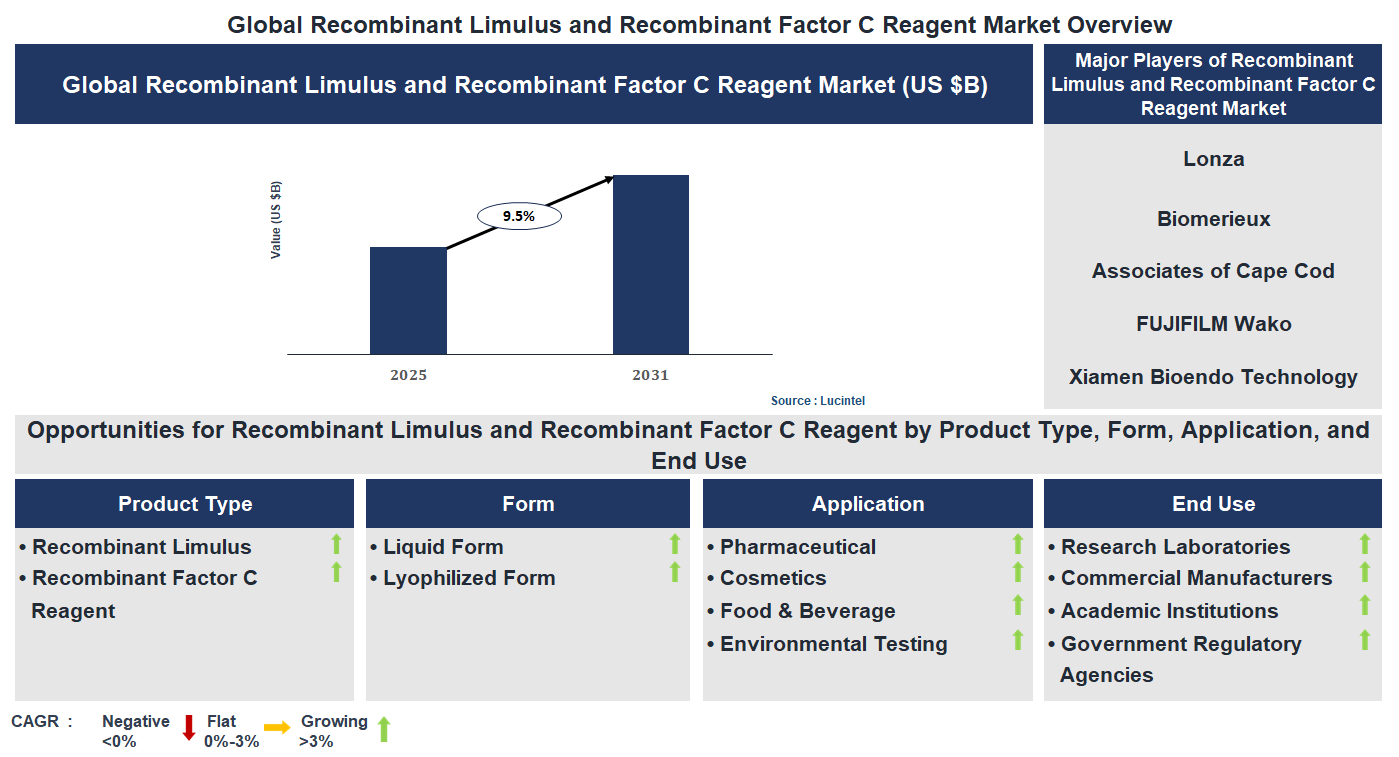
The future of the global recombinant limulus and recombinant factor C reagent market looks promising with opportunities in the research laboratory, commercial manufacturer, academic institution, and government regulatory agency markets. The global recombinant limulus and recombinant factor C reagent market is expected to grow with a CAGR of 9.5% from 2025 to 2031. The major drivers for this market are the increasing demand for endotoxin testing, the rising focus on pharmaceutical safety standards, and the growing adoption of alternative testing methods.• Lucintel forecasts that, within the product type category, recombinant factor C reagent is expected to witness higher growth over the forecast period.
• Within the end use category, research laboratory is expected to witness the highest growth.
• In terms of region, APAC is expected to witness the highest growth over the forecast period. Gain valuable insights for your business decisions with our comprehensive 150+ page report. Sample figures with some insights are shown below.
Emerging Trends in the Recombinant Limulus and Recombinant Factor C Reagent Market
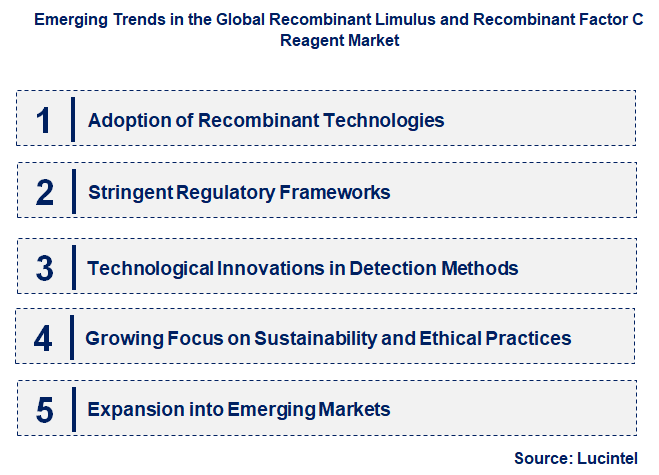
The recombinant limulus and recombinant factor C reagent market is experiencing rapid growth driven by technological advancements, regulatory changes, and increasing demand for safer, more ethical testing methods. As industries such as pharmaceuticals, cosmetics, and food safety seek reliable and humane alternatives to traditional testing, innovative solutions are emerging. These developments are transforming the landscape of endotoxin detection, emphasizing accuracy, safety, and sustainability. Understanding these key trends is essential for stakeholders aiming to capitalize on market opportunities and adapt to evolving regulatory standards. The following five trends highlight the most significant shifts shaping this market.• Adoption of Recombinant Technologies: Increasing shift from traditional Limulus Amebocyte Lysate (LAL) to recombinant-based reagents : Recombinant technologies eliminate the need for horseshoe crab blood, offering a sustainable, ethical, and consistent alternative. This trend is driven by regulatory pressures and consumer demand for cruelty-free products. Recombinant Factor C (rFC) reagents provide high sensitivity and specificity, reducing variability associated with biological sources. As a result, manufacturers are increasingly adopting recombinant methods to meet safety standards and improve test reliability, which is expected to boost market growth significantly.
• Stringent Regulatory Frameworks: Implementation of stricter endotoxin testing regulations : Governments and regulatory agencies worldwide are tightening standards for endotoxin detection in pharmaceuticals, medical devices, and cosmetics. These regulations mandate more accurate, reproducible, and humane testing methods, encouraging the adoption of recombinant reagents. Compliance with these standards is crucial for market players to avoid penalties and ensure product safety. The evolving regulatory landscape is thus a key driver, fostering innovation and increasing demand for advanced recombinant testing solutions.
• Technological Innovations in Detection Methods: Development of rapid, high-throughput testing platforms : Advances in biosensor technology, automation, and miniaturization are enabling faster and more efficient endotoxin testing. These innovations facilitate real-time monitoring and high-throughput screening, reducing turnaround times and operational costs. The integration of recombinant reagents with these platforms enhances sensitivity and reliability. Such technological progress is transforming traditional testing paradigms, making endotoxin detection more accessible and scalable across various industries, thereby expanding market opportunities.
• Growing Focus on Sustainability and Ethical Practices: Shift towards cruelty-free testing methods : The increasing awareness of animal welfare and environmental concerns is driving the demand for recombinant reagents, which do not involve animal-derived components. This trend aligns with global initiatives to eliminate animal testing and promote sustainable practices. Companies adopting recombinant methods can enhance their corporate social responsibility profiles and meet consumer expectations. The sustainability aspect is also appealing to regulatory bodies, further accelerating market adoption and fostering innovation in non-animal testing technologies.
• Expansion into Emerging Markets: Rising demand in developing regions : Emerging economies in Asia, Latin America, and Africa are witnessing rapid industrialization and increased regulatory oversight, creating new opportunities for endotoxin testing. The affordability and scalability of recombinant reagents make them suitable for these markets. Local pharmaceutical and cosmetic industries are increasingly adopting advanced testing methods to meet international standards. Market players are expanding their presence through partnerships and localized manufacturing, which is expected to drive significant growth and diversify the global market landscape. In summary, these trends are collectively reshaping the recombinant limulus and recombinant factor C reagent market by promoting sustainable, ethical, and technologically advanced solutions. They are fostering innovation, expanding market reach, and ensuring compliance with evolving regulations, ultimately leading to safer, more reliable endotoxin testing across multiple industries.
Recent Development in the Recombinant Limulus and Recombinant Factor C Reagent Market
The recombinant limulus and recombinant factor C reagent market is experiencing rapid growth driven by advancements in biotechnology and increasing demand for safer, more reliable endotoxin detection methods. Innovations in recombinant technology are replacing traditional horseshoe crab-based assays, offering sustainable and ethical alternatives. Regulatory pressures and global health standards are also fueling market expansion. This evolving landscape presents significant opportunities for manufacturers and researchers to develop more efficient, cost-effective, and environmentally friendly solutions, shaping the future of endotoxin testing across various industries.• Growing Demand for Safer Alternatives: The shift from horseshoe crab-based assays to recombinant methods is driven by ethical concerns and sustainability, leading to increased adoption of recombinant Limulus and Factor C reagents. This transition enhances safety, reduces dependency on natural resources, and aligns with regulatory standards, thereby expanding market opportunities. Companies investing in recombinant technology are gaining competitive advantages, fostering innovation, and meeting the rising global demand for ethical testing solutions.
• Technological Advancements in Recombinant Reagents: Innovations in biotechnology have improved the sensitivity, specificity, and stability of recombinant Limulus and Factor C reagents. These advancements enable more accurate endotoxin detection, reduce false positives, and streamline testing processes. As a result, industries such as pharmaceuticals and medical devices benefit from reliable, rapid, and cost-effective solutions, driving market growth and encouraging further research and development in recombinant reagent technologies.
• Increasing Regulatory and Industry Standards: Governments and regulatory agencies worldwide are tightening endotoxin testing requirements to ensure product safety. The adoption of recombinant reagents aligns with these standards, facilitating compliance and reducing regulatory hurdles. This trend encourages manufacturers to switch to recombinant methods, boosting market demand. Additionally, industry standards are promoting the development of standardized, validated testing protocols, which further support the growth and acceptance of recombinant reagents globally.
• Rising Adoption in Pharmaceutical and Medical Sectors: The pharmaceutical, biopharmaceutical, and medical device industries are increasingly adopting recombinant Limulus and Factor C reagents for endotoxin testing. The need for high-throughput, reliable, and ethical testing methods in these sectors is propelling market expansion. As these industries grow and innovate, their demand for advanced endotoxin detection solutions intensifies, fostering market competitiveness and encouraging continuous product improvements.
• Impact of Sustainability and Ethical Considerations: The shift towards recombinant reagents is driven by environmental and ethical concerns associated with harvesting horseshoe crabs. This shift reduces ecological impact and supports conservation efforts, aligning with corporate social responsibility goals. The market benefits from increased consumer and regulatory support for sustainable practices, which enhances brand reputation and market acceptance. Overall, sustainability considerations are shaping the future trajectory of the recombinant reagent market, promoting eco-friendly innovations and responsible manufacturing. The overall impact of these developments is a robust, innovative market characterized by sustainable, reliable, and regulatory-compliant endotoxin detection solutions. These advancements are expanding market reach, fostering technological innovation, and aligning industry practices with ethical standards, ultimately driving growth and ensuring safer products across healthcare and industrial sectors.
Strategic Growth Opportunities in the Recombinant Limulus and Recombinant Factor C Reagent Market
The recombinant limulus and recombinant factor C reagent market is experiencing rapid growth driven by increasing demand for sensitive, ethical, and reliable endotoxin detection methods. Advances in biotechnology and regulatory shifts towards animal-free testing are fueling innovation and adoption across pharmaceutical, medical device, and food safety sectors. Market players are focusing on product development, strategic collaborations, and expanding applications to capitalize on emerging opportunities. This evolving landscape offers significant potential for companies to enhance their market share and meet stringent safety standards globally.• Expansion into Pharmaceutical and Biopharmaceutical Industries: The increasing need for endotoxin testing in drug manufacturing and bioprocessing is a major growth driver. Recombinant Limulus and Factor C reagents offer highly sensitive, animal-free alternatives to traditional methods, ensuring compliance with regulatory standards. As biopharmaceuticals grow rapidly, demand for reliable, scalable, and ethical testing solutions is expected to surge, creating substantial opportunities for market expansion and innovation.
• Growing Adoption in Medical Device and Healthcare Sectors: The medical device industry requires rigorous endotoxin testing to ensure patient safety. Recombinant reagents provide consistent, rapid, and animal-free testing options, aligning with regulatory requirements and ethical considerations. The rising prevalence of implantable devices and sterilized medical equipment further boosts demand. Companies investing in product development tailored for these sectors can capitalize on this expanding market segment.
• Increasing Focus on Animal-Free and Ethical Testing Methods: Regulatory agencies and consumers are increasingly advocating for cruelty-free testing alternatives. Recombinant reagents eliminate the need for horseshoe crab blood, addressing ethical concerns and environmental sustainability. This shift enhances market acceptance and adoption, especially in regions with strict animal testing regulations. Companies that promote and develop animal-free endotoxin detection solutions are positioned to gain a competitive advantage and expand their global footprint.
• Technological Innovations Enhancing Sensitivity and Efficiency: Advances in recombinant protein technology and assay development are improving the sensitivity, specificity, and speed of endotoxin detection. Integration of automation and miniaturization further enhances testing efficiency. These innovations enable laboratories to perform high-throughput screening with greater accuracy, reducing costs and turnaround times. Companies investing in R&D to refine these technologies can differentiate their offerings and capture a larger share of the market.
• Strategic Collaborations and Market Expansion in Emerging Economies: Collaborations between biotech firms, regulatory bodies, and healthcare providers are facilitating market penetration in emerging economies. Increasing healthcare infrastructure, regulatory harmonization, and rising awareness about endotoxin safety are driving demand. Companies expanding their distribution networks and establishing local manufacturing facilities can tap into these growing markets, gaining a competitive advantage and fostering long-term growth. In conclusion, these growth opportunities are poised to significantly influence the recombinant limulus and recombinant factor C reagent market by fostering innovation, ethical practices, and global expansion. Embracing technological advancements and strategic collaborations will enable market players to meet rising demand, adhere to regulatory standards, and establish a strong presence across diverse application sectors. This dynamic environment promises sustained growth and increased competitiveness in the coming years.
Recombinant Limulus and Recombinant Factor C Reagent Market Driver and Challenges
The recombinant limulus and recombinant factor C reagent market is influenced by a variety of technological, economic, and regulatory factors. Advances in biotechnology and diagnostic techniques are driving innovation and demand for more accurate, rapid, and ethical testing methods. Economic factors such as increasing healthcare expenditure and the growing prevalence of infectious diseases further propel market growth. Regulatory frameworks aimed at reducing animal testing and ensuring safety standards also shape market dynamics. However, challenges such as high development costs, regulatory hurdles, and market competition pose significant obstacles. Understanding these drivers and challenges is essential for stakeholders to navigate this evolving landscape effectively. The factors responsible for driving the recombinant limulus and recombinant factor C reagent market include:• Technological Advancements: The development of recombinant technology has revolutionized endotoxin detection by replacing traditional Limulus Amebocyte Lysate (LAL) assays derived from horseshoe crabs. Recombinant Factor C (rFC) offers a more ethical, consistent, and sensitive alternative, reducing variability and improving reliability. Continuous innovations in assay sensitivity and automation are expanding applications across pharmaceuticals, medical devices, and food safety. These technological improvements are fostering increased adoption, supporting market expansion, and aligning with regulatory trends favoring animal-free testing methods.
• Rising Prevalence of Infectious Diseases: The global increase in infectious diseases, including bacterial and viral infections, has heightened the demand for rapid and accurate endotoxin detection in pharmaceuticals and medical devices. Ensuring product safety and compliance with stringent regulatory standards necessitates reliable testing methods. As healthcare infrastructure improves worldwide, especially in emerging economies, the need for advanced endotoxin testing reagents like recombinant-based assays becomes more critical, fueling market growth.
• Regulatory and Ethical Considerations: Governments and regulatory agencies are increasingly advocating for the reduction of animal testing, promoting the adoption of recombinant and alternative testing methods. Regulatory approvals and guidelines, such as those from the FDA and EMA, favor the use of recombinant reagents due to their ethical advantages and consistency. This regulatory push encourages pharmaceutical and biotech companies to transition from traditional LAL assays to recombinant-based reagents, thereby expanding market opportunities and ensuring compliance with international standards.
• Growing Pharmaceutical and Biotech Industries: The expanding pharmaceutical and biotechnology sectors worldwide are significant drivers of the recombinant reagent market. The need for stringent endotoxin testing during drug development, manufacturing, and quality control processes is escalating. Increased R&D activities, especially in biologics and biosimilars, require reliable endotoxin detection methods. This growth in industry sectors directly correlates with higher demand for recombinant Limulus and Factor C reagents, supporting market expansion and technological innovation.
• Increasing Focus on Sustainability and Ethical Practices: The shift towards sustainable and cruelty-free testing methods is influencing market dynamics. Traditional LAL assays rely on horseshoe crab blood, raising ethical and environmental concerns. Recombinant reagents, being animal-free, align with corporate social responsibility initiatives and regulatory mandates for sustainable practices. This ethical focus is driving manufacturers to develop and promote recombinant-based solutions, thereby expanding their market share and encouraging broader adoption across industries. The challenges facing this recombinant limulus and recombinant factor C reagent market include:
• High Development and Manufacturing Costs: Developing recombinant reagents involves complex biotechnological processes, requiring significant investment in research, development, and manufacturing infrastructure. These high costs can limit market entry for smaller players and result in higher prices for end-users, potentially restricting widespread adoption. Additionally, maintaining consistent quality and scalability poses ongoing challenges, impacting product availability and market competitiveness.
• Regulatory Hurdles and Approval Processes: Despite regulatory support for recombinant methods, obtaining approval for new diagnostic reagents can be lengthy and complex. Variations in regulatory standards across regions create additional barriers, delaying product launches and increasing compliance costs. Navigating these regulatory landscapes requires substantial expertise and resources, which can hinder market growth, especially for emerging companies.
• Market Competition and Patent Issues: The market is characterized by intense competition among established players and new entrants offering innovative solutions. Patent disputes and intellectual property rights can restrict access to certain technologies, limiting innovation and market expansion. Additionally, the presence of multiple similar products can lead to price wars, affecting profit margins and discouraging investment in further research and development. In summary, the recombinant limulus and recombinant factor C reagent market is driven by technological innovations, increasing disease prevalence, regulatory support, industry growth, and ethical considerations. However, high development costs, regulatory complexities, and competitive pressures pose significant challenges. These factors collectively influence market dynamics, requiring stakeholders to strategically navigate opportunities and obstacles. Overall, the market is poised for growth, provided that technological advancements continue to align with regulatory and ethical standards, and companies effectively address the associated challenges.
List of Recombinant Limulus and Recombinant Factor C Reagent Companies
Companies in the market compete on the basis of product quality offered. Major players in this market focus on expanding their manufacturing facilities, R&D investments, infrastructural development, and leverage integration opportunities across the value chain. With these strategies recombinant limulus and recombinant factor C reagent companies cater increasing demand, ensure competitive effectiveness, develop innovative products & technologies, reduce production costs, and expand their customer base. Some of the recombinant limulus and recombinant factor C reagent companies profiled in this report include-• Lonza
• Biomerieux
• Associates of Cape Cod
• FUJIFILM Wako
• Xiamen Bioendo Technology
Recombinant Limulus and Recombinant Factor C Reagent Market by Segment
The study includes a forecast for the global recombinant limulus and recombinant factor C reagent market by product type, form, application, end use, and region.Recombinant Limulus and Recombinant Factor C Reagent Market by Product Type [Value from 2019 to 2031]:
• Recombinant Limulus
• Recombinant Factor C Reagent
Recombinant Limulus and Recombinant Factor C Reagent Market by Form [Value from 2019 to 2031]:
• Liquid Form
• Lyophilized Form
Recombinant Limulus and Recombinant Factor C Reagent Market by Application [Value from 2019 to 2031]:
• Pharmaceutical
• Cosmetics
• Food & Beverage
• Environmental Testing
Recombinant Limulus and Recombinant Factor C Reagent Market by End Use [Value from 2019 to 2031]:
• Research Laboratories
• Commercial Manufacturers
• Academic Institutions
• Government Regulatory Agencies
Recombinant Limulus and Recombinant Factor C Reagent Market by Region [Value from 2019 to 2031]:
• North America
• Europe
• Asia Pacific
• The Rest of the World
Country Wise Outlook for the Recombinant Limulus and Recombinant Factor C Reagent Market
The recombinant limulus and recombinant factor C reagent market has experienced significant growth driven by advancements in biotechnology, increased demand for rapid and accurate endotoxin testing, and regulatory shifts favoring recombinant over traditional methods. Countries are investing in innovative research, expanding manufacturing capacities, and adopting stricter safety standards, which influence market dynamics globally. These developments reflect a broader trend toward more sustainable, ethical, and efficient testing solutions in the pharmaceutical, medical device, and food safety sectors. As the market evolves, key players are focusing on product innovation, strategic collaborations, and expanding their geographic presence to meet rising global demand.• United States, the market is witnessing rapid adoption of recombinant reagents due to stringent FDA regulations and a strong pharmaceutical industry, with significant investments in R&D and technological advancements.
• China is experiencing rapid market growth driven by expanding pharmaceutical manufacturing, increasing regulatory compliance, and government initiatives supporting biotech innovation.
• Germany remains a leader in Europe, emphasizing high-quality standards, with notable advancements in product development and integration into European regulatory frameworks.
• India is witnessing increased adoption of recombinant reagents owing to rising healthcare infrastructure, growing pharmaceutical exports, and government support for biotech research.
• Japan is focusing on technological innovation and quality assurance, with a rising demand for recombinant reagents in medical and food safety testing, supported by advanced healthcare infrastructure.

Features of the Global Recombinant Limulus and Recombinant Factor C Reagent Market
Market Size Estimates: Recombinant limulus and recombinant factor C reagent market size estimation in terms of value ($B). Trend and Forecast Analysis: Market trends (2019 to 2024) and forecast (2025 to 2031) by various segments and regions. Segmentation Analysis: Recombinant limulus and recombinant factor C reagent market size by various segments, such as by product type, form, application, end use, and region in terms of value ($B). Regional Analysis: Recombinant limulus and recombinant factor C reagent market breakdown by North America, Europe, Asia Pacific, and Rest of the World. Growth Opportunities: Analysis of growth opportunities in different product types, forms, applications, end uses, and regions for the recombinant limulus and recombinant factor C reagent market. Strategic Analysis: This includes M&A, new product development, and competitive landscape of the recombinant limulus and recombinant factor C reagent market. Analysis of competitive intensity of the industry based on Porter’s Five Forces model.
FAQ
Q1. What is the growth forecast for recombinant limulus and recombinant factor C reagent market? Answer: The global recombinant limulus and recombinant factor C reagent market is expected to grow with a CAGR of 9.5% from 2025 to 2031. Q2. What are the major drivers influencing the growth of the recombinant limulus and recombinant factor C reagent market? Answer: The major drivers for this market are the increasing demand for endotoxin testing, the rising focus on pharmaceutical safety standards, and the growing adoption of alternative testing methods. Q3. What are the major segments for recombinant limulus and recombinant factor C reagent market? Answer: The future of the recombinant limulus and recombinant factor C reagent market looks promising with opportunities in the research laboratory, commercial manufacturer, academic institution, and government regulatory agency markets. Q4. Who are the key recombinant limulus and recombinant factor C reagent market companies? Answer: Some of the key recombinant limulus and recombinant factor C reagent companies are as follows:• Lonza
• Biomerieux
• Associates of Cape Cod
• FUJIFILM Wako
• Xiamen Bioendo Technology Q5. Which recombinant limulus and recombinant factor C reagent market segment will be the largest in future? Answer: Lucintel forecasts that, within the product type category, recombinant factor C reagent is expected to witness higher growth over the forecast period. Q6. In recombinant limulus and recombinant factor C reagent market, which region is expected to be the largest in next 5 years? Answer: In terms of region, APAC is expected to witness the highest growth over the forecast period. Q7. Do we receive customization in this report? Answer: Yes, Lucintel provides 10% customization without any additional cost.
Table of Contents
List of Figures
List of Tables
Methodology
- In-depth interviews of the major players in this market
- Detailed secondary research from competitors’ financial statements and published data
- Extensive searches of published works, market, and database information pertaining to industry news, company press releases, and customer intentions
- A compilation of the experiences, judgments, and insights of Lucintel’s professionals, who have analyzed and tracked this market over the years.


Buy Now
Choose a license that fits your team. Instant PDF delivery.
Prices exclude taxes. Instant delivery. Custom licensing available on request.
Key Questions
- • What are some of the most promising, high-growth opportunities for the recombinant limulus and recombinant factor C reagent market by product type (recombinant limulus and recombinant factor C reagent), form (liquid form and lyophilized form), application (pharmaceutical, cosmetics, food & beverage, and environmental testing), end use (research laboratories, commercial manufacturers, academic institutions, and government regulatory agencies), and region (North America, Europe, Asia Pacific, and the Rest of the World)?
- • Which segments will grow at a faster pace and why?
- • Which region will grow at a faster pace and why?
- • What are the key factors affecting market dynamics? What are the key challenges and business risks in this market?
- • What are the business risks and competitive threats in this market?
- • What are the emerging trends in this market and the reasons behind them?
- • What are some of the changing demands of customers in the market?
- • What are the new developments in the market? Which companies are leading these developments?
- • Who are the major players in this market? What strategic initiatives are key players pursuing for business growth?
- • What are some of the competing products in this market and how big of a threat do they pose for loss of market share by material or product substitution?
- • What M&A activity has occurred in the last 6 years and what has its impact been on the industry? For any questions related to Recombinant Limulus and Recombinant Factor C Reagent Market, Recombinant Limulus and Recombinant Factor C Reagent Market Size, Recombinant Limulus and Recombinant Factor C Reagent Market Growth, Recombinant Limulus and Recombinant Factor C Reagent Market Analysis, Recombinant Limulus and Recombinant Factor C Reagent Market Report, Recombinant Limulus and Recombinant Factor C Reagent Market Share, Recombinant Limulus and Recombinant Factor C Reagent Market Trends, Recombinant Limulus and Recombinant Factor C Reagent Market Forecast, Recombinant Limulus and Recombinant Factor C Reagent Companies, write Lucintel analyst at email: helpdesk@lucintel.com. We will be glad to get back to you soon.


