Smart Card IC Market Trends and Forecast
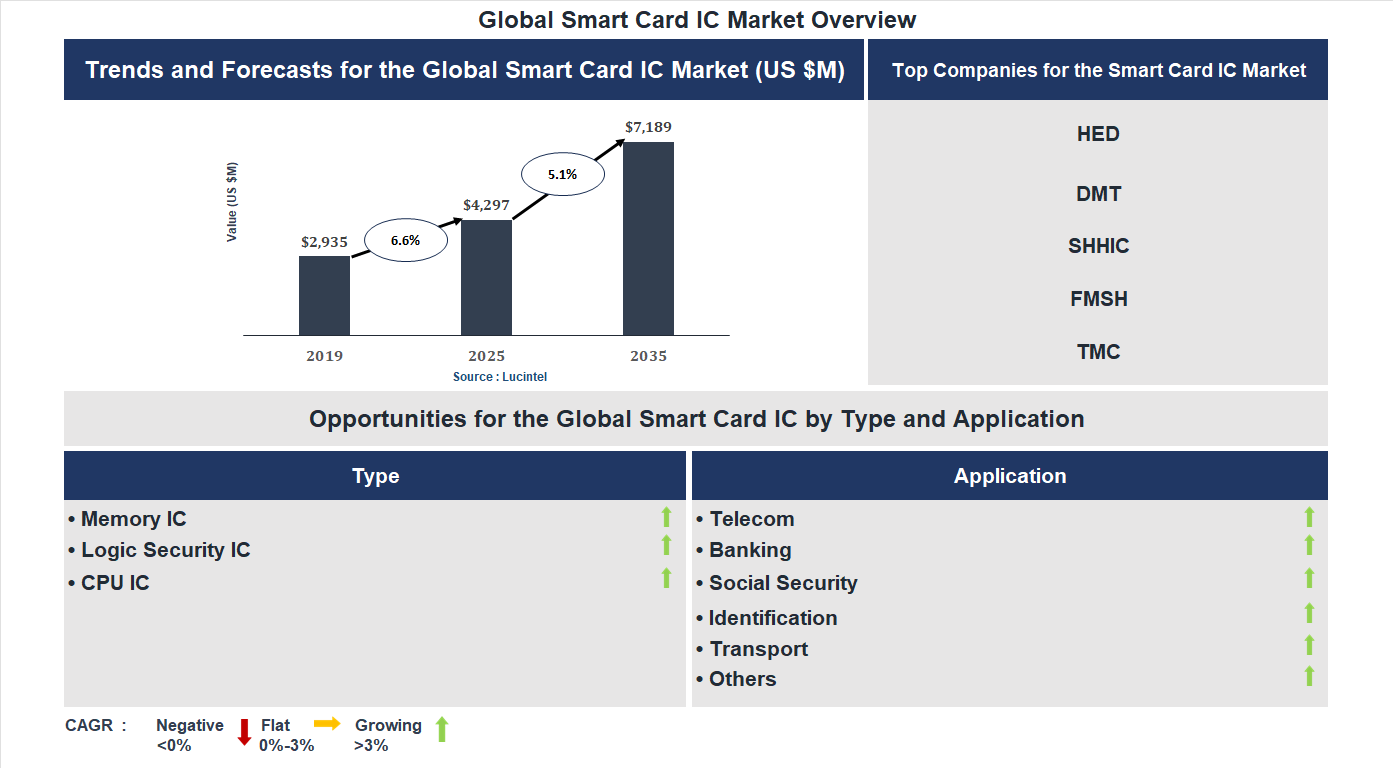
The future of the global smart card IC market looks promising with opportunities in the telecom, banking, social security, identification, and transport markets. The global smart card IC market is expected to reach an estimated $7,189 million by 2035 with a CAGR of 5.1% from 2026 to 2035. The major drivers for this market are the increasing use of smart cards in government identification programs, the growing need for data security and fraud prevention, and the rising use in healthcare for patient data management.
• Lucintel forecasts that, within the type category, CPU IC is expected to witness the highest growth over the forecast period.
• Within the application category, banking is expected to witness the highest growth.
• In terms of region, APAC is expected to witness the highest growth over the forecast period.
Gain valuable insights for your business decisions with our comprehensive 150+ page report. Sample figures with some insights are shown below.
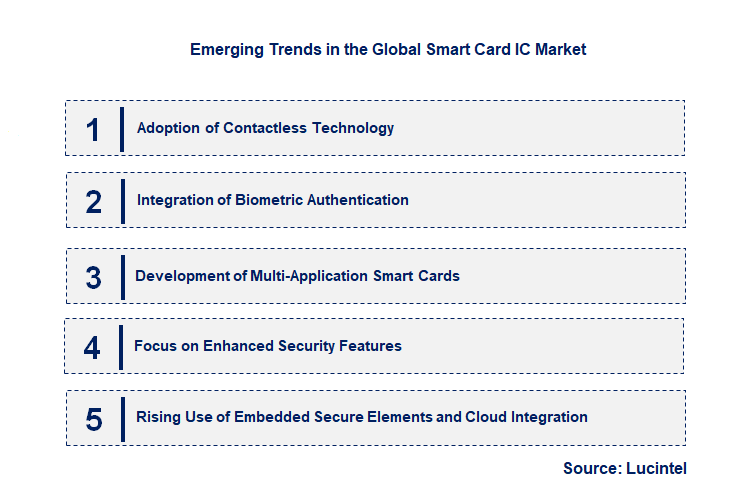
Emerging Trends in the Smart Card IC Market
The smart card IC market is experiencing rapid evolution driven by technological advancements, increasing security demands, and expanding applications across various sectors such as banking, healthcare, and government. As digital transformation accelerates, the integration of innovative features and the adoption of new standards are shaping the future landscape of this industry. Market players are focusing on enhancing security, improving interoperability, and reducing costs to meet the growing needs of consumers and organizations. These developments are not only expanding the market size but also redefining the competitive dynamics, making it crucial for stakeholders to stay abreast of emerging trends that influence growth and innovation.
• Adoption of Contactless Technology: The shift towards contactless smart card solutions is driven by the need for faster, more convenient transactions. Contactless cards use NFC or RFID technology, enabling users to make secure payments or access services without physical contact. This trend is particularly prominent in banking, transportation, and access control sectors, reducing transaction times and enhancing user experience. The COVID-19 pandemic further accelerated this adoption due to hygiene concerns. As contactless technology becomes mainstream, it is expected to boost market growth significantly, encouraging manufacturers to develop more sophisticated, secure, and versatile contactless card solutions.
• Integration of Biometric Authentication: Biometric features such as fingerprint, facial recognition, and iris scanning are increasingly integrated into smart card ICs to enhance security. This trend addresses rising concerns over card fraud and identity theft by providing multi-factor authentication. Biometric-enabled smart cards offer a seamless user experience while maintaining high security standards, making them ideal for government ID, banking, and healthcare applications. The integration of biometrics is also driving innovation in card design and chip technology, pushing the market towards more secure, user-friendly solutions. This trend is expected to significantly reduce fraud and increase consumer confidence.
• Development of Multi-Application Smart Cards: Multi-application cards are capable of supporting multiple services such as payment, identification, transportation, and access control within a single card. This trend is driven by the need for convenience, cost efficiency, and streamlined user experiences. Governments and organizations are adopting multi-application cards to replace multiple cards, reducing clutter and simplifying management. The technological challenge lies in ensuring interoperability and security across different applications. As this trend gains momentum, it is expected to expand market opportunities, foster innovation in chip design, and promote the adoption of unified digital identity solutions.
• Focus on Enhanced Security Features: With increasing cyber threats and sophisticated hacking techniques, the market is witnessing a strong emphasis on advanced security features in smart card ICs. These include encryption, secure key storage, anti-skimming, and tamper-resistant designs. Enhanced security measures are critical for protecting sensitive data in banking, government, and healthcare sectors. Manufacturers are investing in developing more resilient chips that can withstand physical and cyber attacks. This focus on security not only helps in complying with stringent regulations but also builds consumer trust, thereby driving market growth and encouraging the adoption of more secure smart card solutions.
• Rising Use of Embedded Secure Elements and Cloud Integration: The integration of embedded secure elements (SE) with cloud-based services is transforming the smart card market. This trend enables remote management, real-time updates, and enhanced security for digital identities and transactions. Cloud integration allows for flexible, scalable, and cost-effective solutions, facilitating the deployment of IoT-enabled applications and digital wallets. Embedded SEs provide a hardware root of trust, ensuring data integrity and security. This combination is particularly impactful in mobile payments, digital identity, and IoT applications, offering a seamless, secure, and efficient user experience. It is poised to significantly expand the market’s scope and capabilities.
These emerging trends are collectively reshaping the smart card IC market by fostering innovation, enhancing security, and expanding application possibilities. The shift towards contactless and biometric solutions, multi-application cards, advanced security features, and cloud integration is driving growth and competitiveness. These developments are enabling smarter, more secure, and versatile card solutions that meet the evolving needs of consumers and organizations, ultimately transforming the landscape of digital identity, payments, and access management.
Recent Developments in the Smart Card IC Market
The smart card IC market is experiencing rapid growth driven by technological advancements, increasing security needs, and expanding applications across various sectors. Innovations in chip design, rising adoption in banking, healthcare, and government sectors, and the integration of biometric features are fueling market expansion. Additionally, the shift towards contactless payment systems and digital identification solutions are creating new opportunities. These developments are transforming the landscape, making smart card ICs more secure, efficient, and versatile, thereby attracting a broader customer base and fostering global market growth.
• Growing Demand for Secure Payment Solutions: The increasing need for secure, contactless payment methods is driving the adoption of smart card ICs. Financial institutions and consumers prefer contactless cards for convenience and security, prompting manufacturers to develop advanced chips with enhanced encryption and authentication features. This trend is expanding the market, especially in emerging economies, and encouraging innovation in chip technology to meet evolving security standards.
• Expansion in Government and ID Applications: Governments worldwide are adopting smart card ICs for national ID programs, e-passports, and driver’s licenses. These applications require high-security features and durability, prompting the development of specialized chips. The integration of biometric data and multi-application capabilities is increasing the utility of smart cards in public services, thereby boosting market growth. This expansion enhances security, reduces fraud, and streamlines identity verification processes globally.
• Technological Advancements in Chip Design: Innovations such as embedded biometric sensors, multi-application capabilities, and improved power efficiency are transforming smart card ICs. These advancements enable more secure, versatile, and user-friendly cards suitable for various applications, including banking, healthcare, and access control. Enhanced chip performance and miniaturization are also facilitating integration into wearable devices and mobile platforms, broadening market scope and encouraging new product development.
• Rising Adoption of Contactless and Mobile Solutions: The shift towards contactless and mobile payment systems is accelerating the demand for smart card ICs with NFC and RFID capabilities. Consumers and businesses favor quick, hygienic, and secure transactions, prompting manufacturers to innovate with chips that support seamless integration with smartphones and wearable devices. This trend is expanding the market, especially in urban areas, and fostering the development of hybrid solutions that combine traditional and digital payment methods.
• Increasing Focus on IoT and Connected Devices: The integration of smart card ICs into IoT devices is opening new avenues for market growth. These chips enable secure data exchange and authentication in connected environments, such as access control, transportation, and healthcare. The demand for highly secure, miniaturized, and energy-efficient chips is rising as IoT applications proliferate. This development is driving innovation in chip architecture and fostering collaborations across industries to develop comprehensive connected solutions.
These developments are significantly impacting the smart card IC market by enhancing security, expanding application areas, and fostering technological innovation. The increased adoption in banking, government, and IoT sectors is driving market growth and diversification. As contactless and digital solutions become mainstream, the market is poised for continued expansion. Overall, these advancements are making smart card ICs more versatile, secure, and integral to modern digital infrastructure, ensuring sustained growth and competitive advantage.
Strategic Growth Opportunities in the Smart Card IC Market
The smart card IC market is experiencing rapid expansion driven by increasing demand for secure identification, payment solutions, and data management across various sectors. Technological advancements, rising adoption in emerging markets, and the need for enhanced security features are fueling growth. Companies are investing heavily in innovation to develop more versatile, durable, and cost-effective smart card solutions. This evolving landscape presents numerous opportunities for market players to capitalize on emerging applications and expand their global footprint.
• Growing Adoption of Contactless Payment Systems: The shift towards contactless payments is a significant growth driver for the smart card IC market. Consumers and businesses prefer quick, secure transactions, prompting financial institutions and retailers to adopt contactless card solutions. Enhanced security features, ease of use, and the proliferation of NFC-enabled devices are accelerating this trend. As digital payment methods become mainstream, demand for advanced smart card ICs capable of supporting contactless technology is expected to surge, creating substantial market opportunities.
• Expansion in Government and Identity Verification Applications: Governments worldwide are increasingly deploying smart card solutions for identity verification, e-passports, and national ID programs. These applications require highly secure, durable, and tamper-resistant ICs to prevent fraud and ensure data integrity. The rising need for reliable identification systems in public safety, border control, and healthcare sectors is driving demand. Market players are focusing on developing specialized ICs with enhanced security features to meet stringent government standards, opening new avenues for growth.
• Increasing Use in Healthcare and Access Control Systems: The healthcare industry is adopting smart card ICs for patient identification, medical records management, and access control. These cards improve data security, streamline operations, and enhance patient safety. Similarly, access control systems in corporate and residential buildings rely on smart card technology for secure entry. The growing emphasis on data privacy and security regulations is fueling demand for advanced, tamper-proof ICs, presenting significant opportunities for innovation and market expansion in these sectors.
• Rising Demand for Secure SIM and Mobile Card Solutions: The telecommunications sector is a major consumer of smart card ICs, especially for SIM cards used in mobile devices. The increasing adoption of 5G technology and IoT devices necessitates more sophisticated, secure SIM solutions. Market players are developing multi-application and eSIM-compatible ICs to cater to evolving consumer and enterprise needs. The demand for secure, flexible, and scalable mobile card solutions is expected to grow, driving innovation and competition within the market.
• Technological Advancements in Embedded Security and IoT Integration: Innovations in embedded security features, such as biometric authentication and encryption, are expanding the capabilities of smart card ICs. Integration with IoT devices enables secure data exchange and device authentication, opening new markets in smart homes, automotive, and industrial automation. As IoT adoption accelerates, the need for highly secure, interoperable ICs will increase, prompting manufacturers to invest in R&D. These advancements will significantly influence market growth and diversification across various applications.
These growth opportunities are poised to significantly influence the smart card IC market by fostering innovation, expanding application areas, and enhancing security features. As demand for secure, versatile, and efficient smart card solutions continues to rise across sectors, market players who capitalize on these opportunities will be well-positioned for sustained growth and competitive advantage.
Smart Card IC Market Driver and Challenges
The smart card IC market is influenced by a variety of technological, economic, and regulatory factors that shape its growth and development. Rapid advancements in semiconductor technology, increasing demand for secure identification solutions, and evolving regulatory standards are key drivers. Additionally, economic shifts such as rising consumer spending and government initiatives to enhance security infrastructure further propel the market. However, the market also faces challenges including high manufacturing costs, concerns over data security, and regulatory compliance complexities. These factors collectively impact the market‘s trajectory, requiring stakeholders to adapt to changing technological landscapes and regulatory environments to sustain growth and competitiveness.
The factors responsible for driving the smart card IC market include:-
• Technological Innovation: The continuous evolution of semiconductor technology enhances the performance, security, and miniaturization of smart card ICs. Innovations such as biometric integration and contactless interfaces improve user experience and security, making smart cards more versatile across banking, healthcare, and government sectors. These advancements enable manufacturers to develop more sophisticated products, expanding market applications and increasing adoption rates globally.
• Growing Security and Authentication Needs: Increasing concerns over identity theft, fraud, and data breaches drive demand for secure authentication solutions. Smart card ICs offer robust encryption and secure storage of sensitive data, making them ideal for applications like banking, access control, and e-passports. Governments and enterprises are investing heavily in secure identification systems, which significantly boosts market growth.
• Regulatory and Standardization Frameworks: Governments and industry bodies are establishing strict standards for data security and interoperability, such as EMV standards for payment cards. These regulations compel organizations to adopt compliant smart card solutions, fostering market expansion. Standardization also facilitates global acceptance and integration of smart card technologies, reducing barriers to adoption.
• Economic Growth and Digital Transformation: Rising disposable incomes and increased digitalization efforts in emerging economies create a fertile environment for smart card IC adoption. Governments are promoting cashless transactions and digital identity programs, which require secure smart card solutions. This economic momentum supports market expansion across various sectors, including banking, healthcare, and transportation.
The challenges in the smart card IC market are:-
• High Manufacturing Costs: Developing advanced smart card ICs involves significant investment in research, development, and manufacturing infrastructure. The complexity of producing secure, miniaturized chips increases costs, which can limit profitability and price competitiveness, especially in price-sensitive markets. These costs may hinder rapid adoption and limit market penetration in developing regions.
• Data Security and Privacy Concerns: Despite the inherent security features of smart card ICs, vulnerabilities such as hacking and cloning pose risks. Ensuring data privacy and preventing fraud require continuous updates and security protocols, which can be resource-intensive. These concerns may slow down adoption, especially in regions with weak cybersecurity frameworks.
• Regulatory Compliance and Standardization Challenges: Navigating diverse regulatory environments across countries can be complex and costly. Variations in standards and certification processes may delay product launches and increase compliance expenses. This fragmentation hampers global market expansion and creates barriers for manufacturers seeking to operate across multiple jurisdictions.
The smart card IC market is driven by technological innovations, security needs, regulatory standards, and economic growth, which collectively foster expansion. However, high production costs, security concerns, and regulatory complexities pose significant challenges. These factors influence market dynamics, requiring stakeholders to innovate continuously and adapt to evolving standards. Overall, the market‘s future depends on balancing these drivers and challenges to capitalize on emerging opportunities and mitigate risks, ensuring sustainable growth in a competitive landscape.
List of Smart Card IC Companies
Companies in the market compete on the basis of product quality offered. Major players in this market focus on expanding their manufacturing facilities, R&D investments, infrastructural development, and leverage integration opportunities across the value chain. With these strategies smart card IC companies cater increasing demand, ensure competitive effectiveness, develop innovative products & technologies, reduce production costs, and expand their customer base. Some of the smart card IC companies profiled in this report include-
• HED
• DMT
• SHHIC
• FMSH
• TMC
• Nationz
• Linke
Smart Card IC Market by Segment
The study includes a forecast for the global smart card IC market by type, application, and region.
Smart Card IC Market by Type [Value from 2019 to 2035]:
• Memory IC
• Logic Security IC
• CPU IC
Smart Card IC Market by Application [Value from 2019 to 2035]:
• Telecom
• Banking
• Social Security
• Identification
• Transport
• Others
Smart Card IC Market by Region [Value from 2019 to 2035]:
• North America
• Europe
• Asia Pacific
• The Rest of the World
Country Wise Outlook for the Smart Card IC Market
The smart card IC market has experienced rapid growth driven by increasing demand for secure identification, payment solutions, and digital authentication worldwide. Technological advancements, evolving security standards, and expanding applications across various sectors have significantly influenced market dynamics. Countries are adopting innovative strategies to enhance their smart card infrastructure, reflecting a global shift towards more secure and efficient digital transactions. The following summarizes recent developments in the United States, China, Germany, India, and Japan, highlighting key advancements and trends shaping the market landscape.
• United States: The US market has seen significant investments in contactless payment technologies and biometric authentication integration, driven by rising consumer demand for convenience and security. Major financial institutions are adopting advanced smart card solutions to enhance transaction security, while government agencies are deploying smart cards for secure identification and access control. The adoption of EMV chip technology continues to grow, supported by regulatory mandates and industry initiatives. Additionally, innovations in mobile wallet integration with smart card systems are expanding usage scenarios.
• China: China has experienced rapid growth in smart card adoption, especially in banking, transportation, and government sectors. The government’s push for digital identity verification and cashless transactions has accelerated the deployment of smart card-based solutions. Contactless payment systems are widely adopted, with extensive use of NFC-enabled smart cards in urban areas. The country is also investing heavily in the development of secure embedded chips to support e-government initiatives and digital currency projects, including the digital yuan.
• Germany: Germany’s market is characterized by a focus on secure identification and e-government applications. The adoption of smart cards for electronic health records, national ID, and transportation is increasing. The country emphasizes compliance with stringent security standards and data protection regulations, leading to the integration of advanced encryption and biometric features. Public-private partnerships are fostering innovation in secure payment and access control systems, with a growing emphasis on interoperability and user privacy.
• India: India has seen a surge in smart card deployment driven by government initiatives like Aadhaar, which provides biometric-based digital identity for over a billion citizens. The market is expanding into banking, transportation, and healthcare sectors, with a focus on affordable and scalable solutions. Contactless smart cards are gaining popularity, supported by the government’s push for digital payments and financial inclusion. The development of local manufacturing capabilities is also strengthening the supply chain and reducing costs.
• Japan: Japan’s market is characterized by advanced security features and integration with digital services. The adoption of smart cards for public transportation, banking, and government services is widespread. The country is investing in contactless and biometric-enabled smart cards to improve user convenience and security. Innovations in embedded chips and secure element technology are supporting the growth of mobile and wearable payment solutions. Japan’s emphasis on privacy and data security continues to shape the development of smart card applications in the region.

Features of the Global Smart Card IC Market
Market Size Estimates: Smart card IC market size estimation in terms of value ($M).
Trend and Forecast Analysis: Market trends (2019 to 2025) and forecast (2026 to 2035) by various segments and regions.
Segmentation Analysis: Smart card IC market size by type, application, and region in terms of value ($M).
Regional Analysis: Smart card IC market breakdown by North America, Europe, Asia Pacific, and Rest of the World.
Growth Opportunities: Analysis of growth opportunities in different type, application, and regions for the smart card IC market.
Strategic Analysis: This includes M&A, new product development, and competitive landscape of the smart card IC market.
Analysis of competitive intensity of the industry based on Porter’s Five Forces model.
FAQ
Q1. What is the smart card IC market size?
Answer: The global smart card IC market is expected to reach an estimated $7,189 million by 2035.
Q2. What is the growth forecast for smart card IC market?
Answer: The global smart card IC market is expected to grow with a CAGR of 5.1% from 2026 to 2035.
Q3. What are the major drivers influencing the growth of the smart card IC market?
Answer: The major drivers for this market are the increasing use of smart cards in government identification programs, the growing need for data security and fraud prevention, and the rising use in healthcare for patient data management.
Q4. What are the major segments for smart card IC market?
Answer: The future of the smart card IC market looks promising with opportunities in the telecom, banking, social security, identification, and transport markets.
Q5. Who are the key smart card IC market companies?
Answer: Some of the key smart card IC companies are as follows:
• HED
• DMT
• SHHIC
• FMSH
• TMC
• Nationz
• Linke
Q6. Which smart card IC market segment will be the largest in future?
Answer: Lucintel forecasts that, within the type category, CPU IC is expected to witness the highest growth over the forecast period.
Q7. In smart card IC market, which region is expected to be the largest in next 8 years?
Answer: In terms of region, APAC is expected to witness the highest growth over the forecast period.
Q8. Do we receive customization in this report?
Answer: Yes, Lucintel provides 10% customization without any additional cost.
This report answers following 11 key questions:
Q.1. What are some of the most promising, high-growth opportunities for the smart card IC market by type (memory IC, logic security IC, and CPU IC), application (telecom, banking, social security, identification, transport, and others), and region (North America, Europe, Asia Pacific, and the Rest of the World)?
Q.2. Which segments will grow at a faster pace and why?
Q.3. Which region will grow at a faster pace and why?
Q.4. What are the key factors affecting market dynamics? What are the key challenges and business risks in this market?
Q.5. What are the business risks and competitive threats in this market?
Q.6. What are the emerging trends in this market and the reasons behind them?
Q.7. What are some of the changing demands of customers in the market?
Q.8. What are the new developments in the market? Which companies are leading these developments?
Q.9. Who are the major players in this market? What strategic initiatives are key players pursuing for business growth?
Q.10. What are some of the competing products in this market and how big of a threat do they pose for loss of market share by material or product substitution?
Q.11. What M&A activity has occurred in the last 5 years and what has its impact been on the industry?
For any questions related to Smart Card IC Market, Smart Card IC Market Size, Smart Card IC Market Growth, Smart Card IC Market Analysis, Smart Card IC Market Report, Smart Card IC Market Share, Smart Card IC Market Trends, Smart Card IC Market Forecast, Smart Card IC Companies, write Lucintel analyst at email: helpdesk@lucintel.com. We will be glad to get back to you soon.