
Report Feature
Radar Systems Market Trends and Forecast
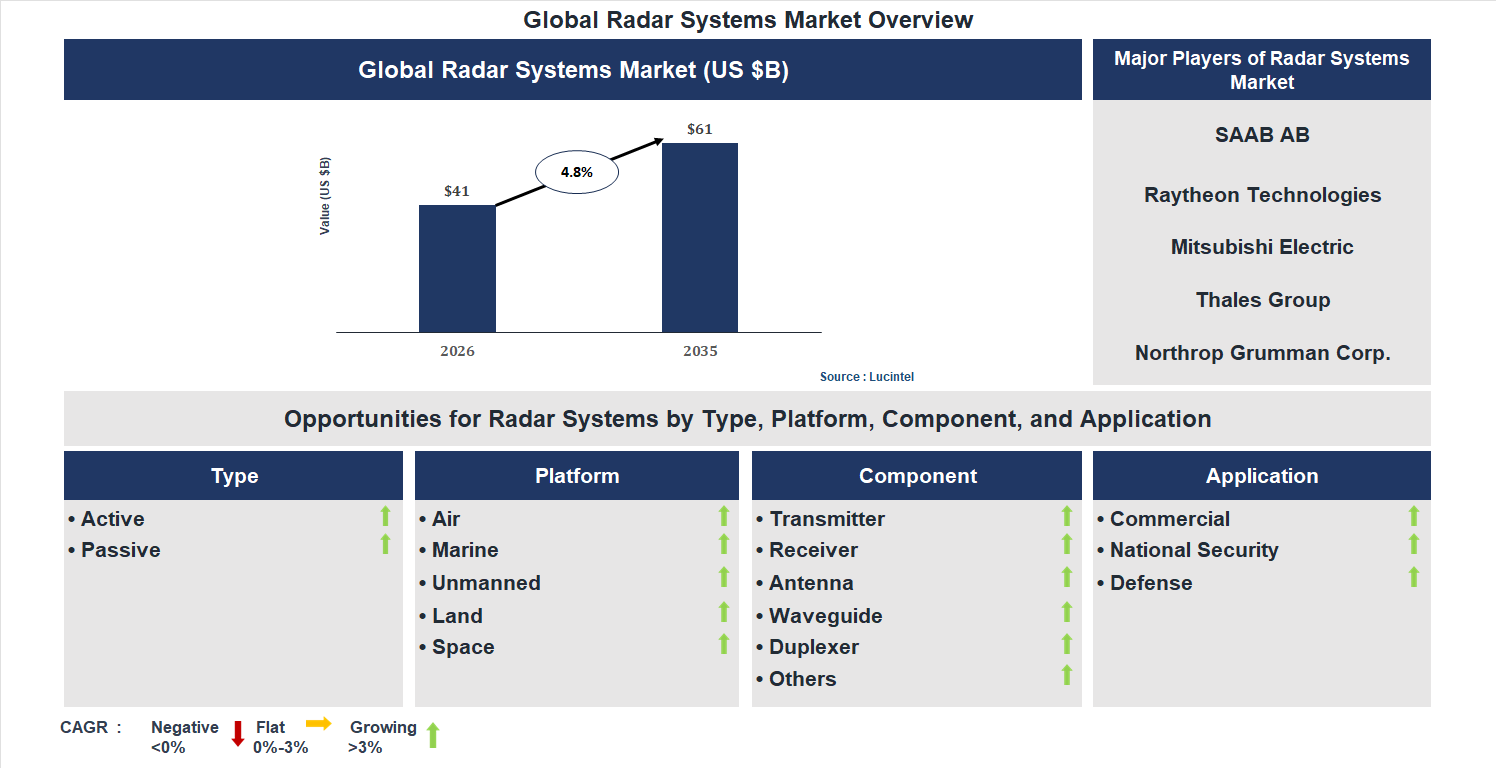
The future of the global radar systems market looks promising with opportunities in the commercial, national security, and defense markets. The global radar systems market is expected to reach an estimated $61 billion by 2035 with a CAGR of 4.8% from 2026 to 2035. The major drivers for this market are the growing need for weather monitoring & disaster management radars, the increasing use of radar in autonomous vehicles & ADAS, and the rising demand for border security & coastal monitoring.• Lucintel forecasts that, within the type category, active is expected to witness higher growth over the forecast period.
• Within the application category, defense is expected to witness the highest growth.
• In terms of region, APAC is expected to witness the highest growth over the forecast period. Gain valuable insights for your business decisions with our comprehensive 150+ page report. Sample figures with some insights are shown below.
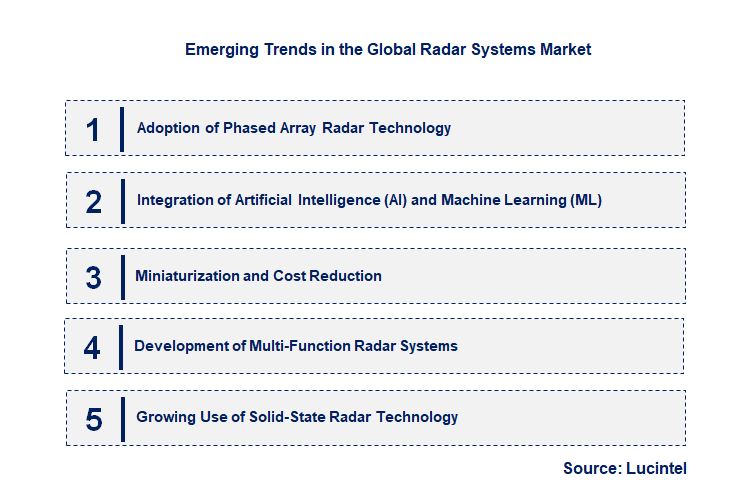
Emerging Trends in the Radar Systems Market
The radar systems market is experiencing rapid evolution driven by technological advancements, increasing defense budgets, and the growing demand for advanced surveillance and navigation solutions. As industries such as defense, aerospace, automotive, and maritime seek more efficient, accurate, and versatile radar technologies, market players are innovating to meet these needs. Emerging trends are shaping the future landscape, influencing product development, strategic partnerships, and market dynamics. These developments are not only expanding the scope of radar applications but also enhancing performance, affordability, and integration capabilities, ultimately transforming how industries utilize radar systems for safety, security, and operational efficiency.• Adoption of Phased Array Radar Technology: This trend involves the use of electronically steerable antenna arrays that enable rapid beam steering without moving parts. It offers high-resolution imaging, faster target detection, and improved tracking capabilities. Phased array radars are increasingly used in military and aerospace applications, providing real-time data and enhanced situational awareness. Their ability to operate across multiple frequencies and adapt to various scenarios makes them a critical component in modern radar systems, driving innovation and expanding application scope.
• Integration of Artificial Intelligence (AI) and Machine Learning (ML): AI and ML are being integrated into radar systems to enhance data processing, target recognition, and decision-making. These technologies enable radars to analyze vast amounts of data quickly, improve accuracy in cluttered environments, and predict target movements. AI-driven radars are particularly valuable in autonomous vehicles, defense, and maritime security, where real-time analysis is crucial. This integration is transforming radar capabilities from mere detection tools to intelligent systems capable of autonomous operation and advanced threat assessment.
• Miniaturization and Cost Reduction: Advances in materials, electronics, and manufacturing processes are leading to smaller, more affordable radar systems. Miniaturization allows for deployment in a wider range of platforms, including drones, portable devices, and small vehicles. Cost reduction makes radar technology accessible to commercial markets beyond defense, such as automotive collision avoidance and industrial automation. This trend democratizes radar technology, fostering innovation and expanding its application across various sectors, thereby increasing market competition and growth opportunities.
• Development of Multi-Function Radar Systems: Modern radars are increasingly designed to perform multiple functions simultaneously, such as surveillance, tracking, weather monitoring, and communication. Multi-function radars improve operational efficiency by reducing the need for multiple separate systems. They are especially valuable in defense and aerospace, where space and weight constraints are critical. These systems enhance situational awareness, provide comprehensive data, and streamline operations, making them a preferred choice for integrated defense solutions and complex industrial applications.
• Growing Use of Solid-State Radar Technology: Solid-state radars utilize semiconductor components instead of traditional vacuum tubes, offering higher reliability, lower maintenance, and better performance. They are more energy-efficient and capable of rapid beam steering, making them suitable for various applications, including automotive, maritime, and defense. The adoption of solid-state technology is driven by its scalability and ability to support advanced features like adaptive beamforming. This trend is significantly improving radar system durability and operational lifespan, thereby expanding their deployment in both commercial and military sectors. These emerging trends are fundamentally reshaping the radar systems market by enhancing system capabilities, reducing costs, and broadening application horizons. The integration of advanced technologies like AI, miniaturization, and multi-functionality is driving innovation, making radar systems more intelligent, versatile, and accessible. As these trends continue to evolve, they will lead to more sophisticated, reliable, and widespread radar solutions, ultimately transforming industries and defense strategies worldwide.
Recent Developments in the Radar Systems Market
The radar systems market is experiencing rapid advancements driven by technological innovations, increasing defense budgets, and expanding applications across various sectors. These developments are shaping the future landscape, offering new opportunities for growth and competition. As industries adopt more sophisticated radar solutions, market dynamics are shifting, prompting stakeholders to innovate and adapt. The following key developments highlight the current trajectory and potential of this evolving market.• Enhanced Detection Capabilities: The integration of AI and machine learning in radar systems is significantly improving detection accuracy and response times. These advancements enable better target identification, tracking, and classification, especially in complex environments. Enhanced detection capabilities are crucial for defense, aviation, and maritime sectors, providing a competitive edge. This evolution is expected to increase market demand for smarter, more reliable radar solutions, fostering innovation and expanding application scopes.
• Miniaturization of Radar Components: Advances in materials and design are leading to smaller, lightweight radar systems without compromising performance. Miniaturization allows deployment in drones, wearable devices, and compact vehicles, broadening application areas. This development reduces costs and enhances portability, making radar technology accessible to a wider range of industries. As miniaturized radars become more prevalent, market penetration is expected to grow, especially in consumer electronics and autonomous systems.
• Adoption of Solid-State Technology: The shift from traditional to solid-state radar systems offers improved reliability, lower maintenance, and enhanced performance. Solid-state radars provide better resolution and longer operational life, making them suitable for both military and civilian applications. This technology also supports phased-array systems, enabling rapid beam steering and multi-target tracking. The adoption of solid-state radars is driving market growth by offering more versatile and durable solutions, appealing to a broad customer base.
• Growing Use in Automotive and Autonomous Vehicles: Radar systems are increasingly integrated into automotive safety and autonomous driving platforms. They enable collision avoidance, adaptive cruise control, and environment mapping, essential for vehicle automation. The development of high-resolution, long-range automotive radars is expanding market opportunities. This trend is transforming transportation safety standards and encouraging automakers to adopt advanced radar solutions, thereby fueling market expansion and technological innovation.
• Expansion into Civil and Commercial Sectors: Beyond defense, radar technology is gaining traction in weather forecasting, air traffic management, and infrastructure monitoring. These civil applications require high precision and reliability, prompting innovations tailored for commercial use. The expansion into these sectors diversifies revenue streams and stimulates market growth. As demand for civil radar solutions increases, the market is poised for significant expansion, driven by government initiatives and private sector investments. The radar systems market is being reshaped by technological innovations and expanding applications, leading to increased demand and competitive dynamics. These developments are fostering a more versatile, reliable, and accessible market, promising sustained growth and new opportunities across defense, automotive, civil, and commercial sectors.
Strategic Growth Opportunities in the Radar Systems Market
Radar systems are integral to various industries, including defense, aviation, automotive, and weather forecasting. As technological advancements continue, market growth is driven by increasing demand for precision, automation, and real-time data. Emerging applications and innovations are expanding the scope of radar technology, creating significant opportunities for market players. Strategic investments and collaborations are essential to capitalize on these trends, ensuring competitive advantage and addressing evolving customer needs across diverse sectors.• Integration of Radar Systems in Autonomous Vehicles: The rise of autonomous vehicles necessitates advanced radar sensors for obstacle detection, navigation, and safety. Enhanced resolution, miniaturization, and cost reduction are key factors driving adoption. Automakers and tech companies are investing heavily in developing high-performance radar modules that can operate reliably in complex environments, ensuring safety and compliance with regulations. This integration opens new revenue streams and accelerates market growth in the automotive sector.
• Deployment of Phased-Array Radar for Defense and Aerospace: Phased-array radar offers rapid beam steering, high accuracy, and multi-target tracking capabilities, making it ideal for defense and aerospace applications. Governments and defense agencies are investing in these systems for missile defense, surveillance, and aircraft tracking. The technology’s ability to provide real-time, high-resolution data enhances situational awareness. Increasing defense budgets and technological advancements are expected to propel the adoption of phased-array radar systems globally.
• Expansion of Weather Radar Systems for Climate Monitoring: Weather radar is crucial for accurate forecasting, disaster management, and climate research. Advances in Doppler radar technology improve detection of severe weather phenomena like tornadoes and hurricanes. Governments and meteorological agencies are upgrading existing infrastructure and deploying new systems to enhance data accuracy and coverage. Growing concerns over climate change and extreme weather events are fueling investments, making weather radar a vital component in environmental monitoring and safety protocols.
• Adoption of Synthetic Aperture Radar (SAR) for Remote Sensing: SAR technology provides high-resolution imaging regardless of weather or lighting conditions, making it invaluable for earth observation, agriculture, and disaster management. Increasing demand for precise land use mapping, resource exploration, and environmental monitoring drives the adoption of SAR systems. Technological improvements in resolution and data processing are expanding applications. Governments and private entities are investing in SAR-based solutions to support sustainable development and strategic planning.
• Development of Compact, Portable Radar Systems for Security and Surveillance: Miniaturized radar systems enable portable, easy-to-deploy security solutions for border control, critical infrastructure protection, and event security. These systems offer real-time threat detection, perimeter monitoring, and crowd management capabilities. Advances in electronics and signal processing have reduced size and power consumption, making them suitable for diverse environments. Growing security concerns and the need for flexible surveillance options are expected to boost demand for portable radar solutions across multiple sectors. The market for radar systems is poised for substantial growth driven by technological innovations and expanding application areas. These opportunities will enhance operational efficiency, safety, and environmental monitoring, ultimately shaping the future landscape of radar technology and its global market presence.
Radar Systems Market Driver and Challenges
The radar systems market is influenced by a complex interplay of technological advancements, economic shifts, and regulatory frameworks. Rapid innovations in radar technology, increasing defense budgets worldwide, and evolving safety and security requirements are key drivers propelling market growth. Conversely, challenges such as high development costs, regulatory hurdles, and technological obsolescence pose significant barriers. Understanding these factors is essential for stakeholders to navigate the dynamic landscape effectively. The markets trajectory depends on how well these drivers are leveraged and challenges mitigated, shaping future opportunities and risks in the radar systems industry. The factors responsible for driving the radar systems market include:-• Technological Innovation: The continuous development of advanced radar systems, including phased-array and multi-function radars, enhances detection capabilities, accuracy, and operational efficiency. These innovations meet the increasing demand for sophisticated defense and civilian applications, fueling market growth. As technology evolves, radar systems become more compact, reliable, and versatile, opening new markets and applications. The integration of AI and machine learning further boosts performance, making radar systems more adaptive and intelligent. This ongoing innovation cycle ensures the market remains competitive and responsive to emerging needs.
• Growing Defense Budgets: Governments worldwide are increasing their defense spending to modernize military capabilities amid rising geopolitical tensions. This surge in defense budgets directly impacts the demand for advanced radar systems for surveillance, missile guidance, and aircraft detection. Countries are investing heavily in upgrading existing systems and deploying new ones to enhance national security. The expansion of military operations and the need for border security also contribute to sustained market growth. As defense budgets continue to rise, the radar systems market is poised for significant expansion, driven by strategic military requirements.
• Civil and Commercial Applications: The expanding use of radar technology in civil sectors such as air traffic control, weather forecasting, and automotive safety systems is a major growth driver. The development of autonomous vehicles relies heavily on radar sensors for obstacle detection and navigation, creating a burgeoning market segment. Additionally, weather radars are crucial for accurate forecasting and disaster management, increasing demand. The integration of radar in maritime navigation and airport security further broadens the market scope. These diverse applications ensure steady growth, driven by technological advancements and increasing safety standards across industries.
• Regulatory and Standards Development: The implementation of stringent regulations and standards for radar emissions and safety protocols influences market dynamics. Governments and international bodies are establishing guidelines to ensure electromagnetic compatibility and environmental safety, which impacts product development and deployment. Compliance with these standards can be costly but is essential for market access and acceptance. Regulatory frameworks also drive innovation by setting performance benchmarks, encouraging manufacturers to develop compliant, high-performance systems. Navigating these regulations is critical for market players aiming for global expansion and market penetration. The challenges facing the radar systems market include:-
• High Development and Production Costs: Developing advanced radar systems requires significant investment in research, technology, and manufacturing infrastructure. These costs can be prohibitive, especially for smaller players, limiting market entry and innovation. Additionally, the high costs impact pricing strategies, potentially reducing competitiveness. The lengthy development cycles and the need for continuous upgrades further escalate expenses. This financial barrier can slow down the adoption of new technologies and restrict market growth, particularly in emerging economies where budget constraints are more pronounced.
• Regulatory and Environmental Constraints: Strict regulations regarding electromagnetic emissions and environmental impact pose challenges for radar system manufacturers. Compliance requires extensive testing, certification, and sometimes redesigning products, which can delay deployment and increase costs. Variations in regulations across regions complicate international market expansion. Environmental concerns about radar emissions affecting wildlife and human health also lead to restrictions that limit operational capabilities. Navigating these complex regulatory landscapes demands significant resources and expertise, potentially hindering innovation and market agility.
• Rapid Technological Obsolescence: The fast pace of technological change in radar systems creates a risk of rapid obsolescence, forcing companies to continually innovate and upgrade. This constant evolution can lead to increased R&D costs and inventory management challenges. Companies must balance investing in current technologies while anticipating future trends, which is inherently risky. Obsolescence also impacts customer confidence and long-term planning, as outdated systems may require frequent replacements or upgrades. This dynamic environment demands agility and substantial investment, posing a significant challenge for sustained market growth. The radar systems market is driven by technological innovation, increased defense spending, expanding civil applications, and evolving regulatory standards. However, high development costs, regulatory hurdles, and rapid technological obsolescence present notable challenges. These factors collectively shape the markets growth trajectory, requiring stakeholders to strategically navigate opportunities and risks. Successful adaptation to technological and regulatory changes will be crucial for sustained growth and competitiveness in this dynamic industry.
List of Radar Systems Companies
Companies in the market compete on the basis of product quality offered. Major players in this market focus on expanding their manufacturing facilities, R&D investments, infrastructural development, and leverage integration opportunities across the value chain. With these strategies radar systems companies cater increasing demand, ensure competitive effectiveness, develop innovative products & technologies, reduce production costs, and expand their customer base. Some of the radar systems companies profiled in this report include-• SAAB AB
• Raytheon Technologies
• Mitsubishi Electric
• Thales Group
• Northrop Grumman Corp.
• Lockheed Martin
• Hensoldt AG
Radar Systems Market by Segment
The study includes a forecast for the global radar systems market by type, platform, component, application, and region.Radar Systems Market by Type [Value from 2019 to 2035]:
• Active
• Passive
Radar Systems Market by Platform [Value from 2019 to 2035]:
• Air
• Marine
• Unmanned
• Land
• Space
Radar Systems Market by Component [Value from 2019 to 2035]:
• Transmitter
• Receiver
• Antenna
• Waveguide
• Duplexer
• Others
Radar Systems Market by Application [Value from 2019 to 2035]:
• Commercial
• National Security
• Defense
Radar Systems Market by Region [Value from 2019 to 2035]:
• North America
• Europe
• Asia Pacific
• The Rest of the World
Country Wise Outlook for the Radar Systems Market
The radar systems market has experienced significant technological advancements and increased adoption across various sectors globally. Countries are investing heavily in research and development to enhance radar capabilities for defense, aviation, automotive, and weather monitoring applications. The evolving geopolitical landscape and the need for advanced surveillance systems are driving innovation and market growth. Additionally, integration of artificial intelligence and automation is transforming radar functionalities, making them more efficient and versatile. These developments reflect a strategic focus on national security, technological leadership, and commercial applications, shaping the future trajectory of the radar systems industry worldwide.• United States: The U.S. market has seen substantial investments in next-generation radar technologies, especially for defense and aerospace applications. The Department of Defense is prioritizing the development of multi-function, high-resolution radar systems to improve surveillance and missile detection. Commercial sectors are also adopting advanced automotive radar for autonomous vehicles, with significant collaborations between tech giants and defense contractors. Additionally, the U.S. is focusing on integrating AI into radar systems to enhance real-time data processing and threat detection capabilities, maintaining its leadership in radar innovation.
• China: China is rapidly advancing its radar technology, emphasizing military modernization and domestic production. The country has developed sophisticated phased-array radars for missile defense and naval applications, aiming to strengthen its strategic position. China is also investing in radar systems for civilian use, such as weather monitoring and air traffic control, to support its expanding infrastructure. The government encourages innovation through national programs, leading to increased indigenous capabilities and reduced reliance on foreign technology. These efforts are part of Chinas broader goal to become a global leader in radar and electronic warfare systems.
• Germany: Germany is focusing on integrating radar systems into its defense and automotive sectors, emphasizing precision and reliability. The country is advancing in the development of radar sensors for autonomous vehicles, aligning with its strong automotive industry. In defense, Germany is upgrading its radar infrastructure for NATO operations, emphasizing interoperability and advanced threat detection. German research institutions are also exploring innovative radar applications in civil engineering and environmental monitoring, contributing to sustainable development. The countrys emphasis on high-quality, reliable radar solutions underscores its strategic importance in European security and technological innovation.
• India: India is rapidly expanding its radar capabilities to bolster national security and border surveillance. The country has developed indigenous radar systems for missile detection, naval applications, and air defense, reducing dependency on foreign technology. India is also investing in phased-array radars for early warning and battlefield management. The government’s "Make in India" initiative promotes domestic manufacturing and innovation in radar technology. Additionally, India is exploring radar applications in weather forecasting and disaster management, enhancing its civil infrastructure. These developments reflect India’s strategic focus on self-reliance and technological sovereignty in radar systems.
• Japan: Japan is advancing its radar technology primarily for defense and maritime security. The country is developing sophisticated phased-array radars for missile defense, particularly in response to regional security concerns. Japan is also integrating radar systems into its autonomous maritime patrol vessels and aircraft to enhance surveillance capabilities. The country emphasizes high-frequency, high-resolution radars for weather monitoring and disaster prevention, leveraging its expertise in electronics. Japan’s collaborations with international partners aim to incorporate cutting-edge AI and sensor technologies, ensuring its radar systems remain at the forefront of innovation and regional security stability.

Features of the Global Radar Systems Market
Market Size Estimates: Radar systems market size estimation in terms of value ($B). Trend and Forecast Analysis: Market trends (2019 to 2025) and forecast (2026 to 2035) by various segments and regions. Segmentation Analysis: Radar systems market size by various segments, such as by type, platform, component, application, and region in terms of value ($B). Regional Analysis: Radar systems market breakdown by North America, Europe, Asia Pacific, and Rest of the World. Growth Opportunities: Analysis of growth opportunities in different types, platforms, components, applications, and regions for the radar systems market. Strategic Analysis: This includes M&A, new product development, and competitive landscape of the radar systems market. Analysis of competitive intensity of the industry based on Porter’s Five Forces model.
FAQ
Q1. What is the radar systems market size? Answer: The global radar systems market is expected to reach an estimated $61 billion by 2035. Q2. What is the growth forecast for radar systems market? Answer: The global radar systems market is expected to grow with a CAGR of 4.8% from 2026 to 2035. Q3. What are the major drivers influencing the growth of the radar systems market? Answer: The major drivers for this market are the growing need for weather monitoring & disaster management radars, the increasing use of radar in autonomous vehicles & ADAS, and the rising demand for border security & coastal monitoring. Q4. What are the major segments for radar systems market? Answer: The future of the radar systems market looks promising with opportunities in the commercial, national security, and defense markets. Q5. Who are the key radar systems market companies? Answer: Some of the key radar systems companies are as follows:• SAAB AB
• Raytheon Technologies
• Mitsubishi Electric
• Thales Group
• Northrop Grumman Corp.
• Lockheed Martin
• Hensoldt AG Q6. Which radar systems market segment will be the largest in future? Answer: Lucintel forecasts that, within the type category, active is expected to witness higher growth over the forecast period. Q7. In radar systems market, which region is expected to be the largest in next 8 years? Answer: In terms of region, APAC is expected to witness the highest growth over the forecast period. Q8. Do we receive customization in this report? Answer: Yes, Lucintel provides 10% customization without any additional cost.
Table of Contents
List of Figures
List of Tables
Methodology
- In-depth interviews of the major players in this market
- Detailed secondary research from competitors’ financial statements and published data
- Extensive searches of published works, market, and database information pertaining to industry news, company press releases, and customer intentions
- A compilation of the experiences, judgments, and insights of Lucintel’s professionals, who have analyzed and tracked this market over the years.


Buy Now
Choose a license that fits your team. Instant PDF delivery.
Prices exclude taxes. Instant delivery. Custom licensing available on request.
Key Questions
- • What are some of the most promising, high-growth opportunities for the radar systems market by type (active and passive), platform (air, marine, unmanned, land, and space), component (transmitter, receiver, antenna, waveguide, duplexer, and others), application (commercial, national security, and defense), and region (North America, Europe, Asia Pacific, and the Rest of the World)?
- • Which segments will grow at a faster pace and why?
- • Which region will grow at a faster pace and why?
- • What are the key factors affecting market dynamics? What are the key challenges and business risks in this market?
- • What are the business risks and competitive threats in this market?
- • What are the emerging trends in this market and the reasons behind them?
- • What are some of the changing demands of customers in the market?
- • What are the new developments in the market? Which companies are leading these developments?
- • Who are the major players in this market? What strategic initiatives are key players pursuing for business growth?
- • What are some of the competing products in this market and how big of a threat do they pose for loss of market share by material or product substitution?
- • What M&A activity has occurred in the last 5 years and what has its impact been on the industry? For any questions related to Radar Systems Market, Radar Systems Market Size, Radar Systems Market Growth, Radar Systems Market Analysis, Radar Systems Market Report, Radar Systems Market Share, Radar Systems Market Trends, Radar Systems Market Forecast, Radar Systems Companies, write Lucintel analyst at email: helpdesk@lucintel.com. We will be glad to get back to you soon.


