
Close Lucintel Chat
Didn't Find What You're Looking for?
Call us at +1972 636 5056 or write at helpdesk@Lucintel.com
Ask an Expert Provide Custom Requirements Download Sample Report Search Available Reports
  • helpdesk@Lucintel.com
  • |
  • Call Lucintel +1 972 636 5056
  • |
  • Login
  • |
  • Register
  • |
  • Search
  • |
'
...

The Impact of COVID-19 is included in Quinic Acid Market Report. Buy it today to get an advantage.

Request the impact of COVID-19 on your product or industry


Quinic Acid Market Trends and Forecast

The future of the global quinic acid market looks promising with opportunities in the dietary supplement, anti-flu drug, and standard markets. The global quinic acid market is expected to grow with a CAGR of 5.1% from 2025 to 2031. The major drivers for this market are the increasing demand for organic ingredients, the rising popularity of natural antioxidants, and the growing applications in pharmaceutical industry.

• Lucintel forecasts that, within the type category, natural is expected to witness higher growth over the forecast period.
• Within the application category, dietary supplement is expected to witness the highest growth.
• In terms of region, APAC is expected to witness the highest growth over the forecast period.
Gain valuable insights for your business decisions with our comprehensive 150+ page report. Sample figures with some insights are shown below.
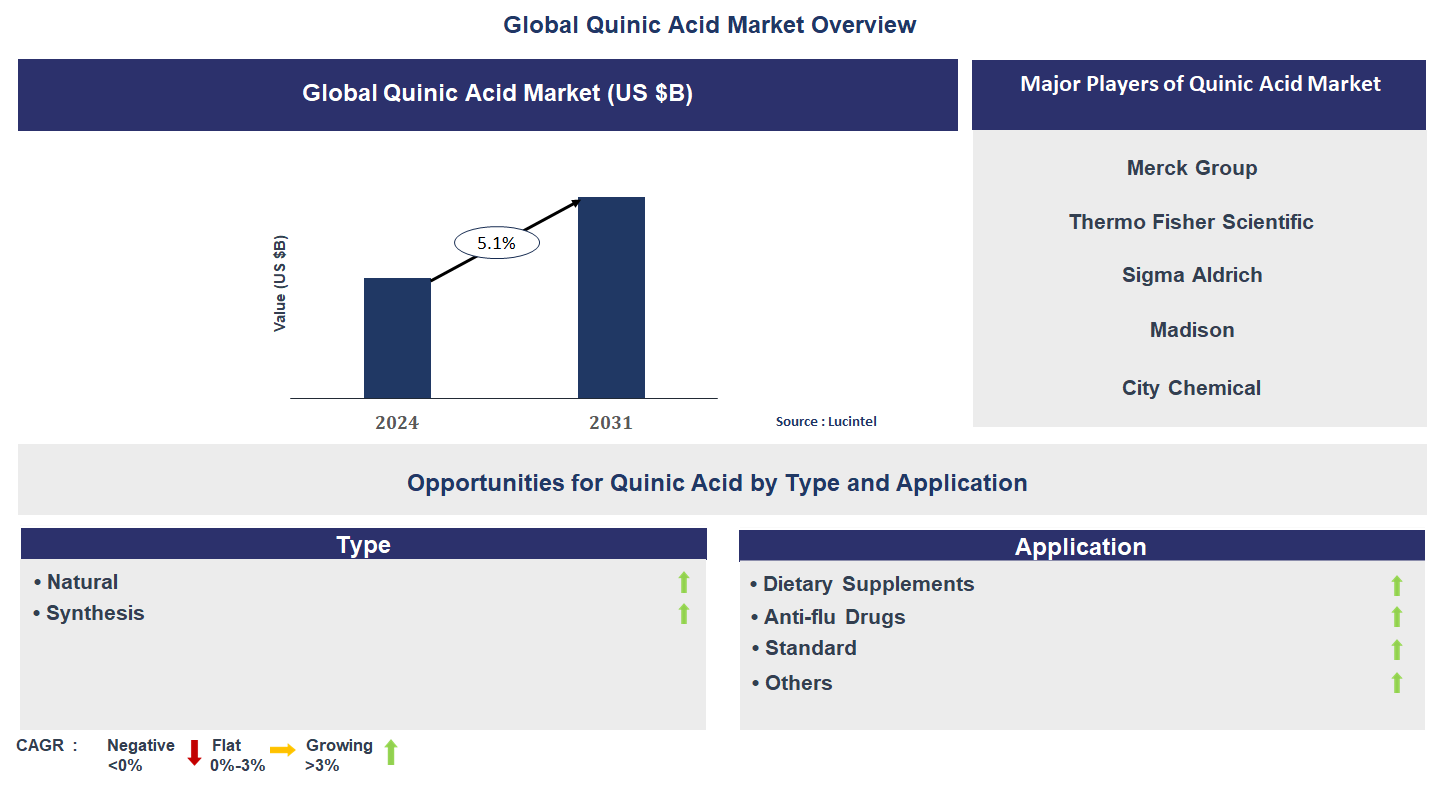
Quinic Acid Market Trends and Forecast

Emerging Trends in the Quinic Acid Market

The market for quinic acid is evolving, and there are a number of major trends that are defining its future. These trends are a reflection of global changes in consumer demand, technology, and regulatory environments. The market is shifting away from its conventional dependence on natural extraction to more sustainable and efficient modes of production. At the same time, new uses are being found, and the industry is specializing.
• Transition to Bio-based Production: There is a strong trend towards quinic acid production through biotechnology and fermentation. This approach has a more sustainable and controlled process than conventional extraction from natural material such as cinchona bark or green coffee beans, which may be variable and expensive. Bio-based manufacture offers a consistent and scalable supply, not reliant on agricultural cycles or unstable raw material prices. This transition is part of the worldwide move towards green chemistry and circular economy.
• Growth in the Cosmetics and Personal Care Industry: Quinic acid is becoming increasingly popular as a natural, active ingredient in cosmetics and personal care formulations. Its antioxidant, anti-inflammatory, and skin-protecting benefits make it an added ingredient in anti-aging creams, serums, and lotions. This is being spurred by consumer interest in "clean label" and natural beauty products. Firms are taking advantage of quinic acid to produce high-value, functional cosmetic lines that attract the health-conscious consumer.
• Emphasis on Nutraceuticals and Functional Foods: The market is witnessing growth in the application of quinic acid in nutraceuticals and functional foods. Research has indicated its probable health advantages, such as antioxidant activity and being able to modulate the gut microbiome. This is making it a constituent of dietary supplements, health beverages, and fortified foods. This is driven by mounting consumer consciousness towards preventive healthcare and wellness.
• Synthesis of Specialized Drug Precursors: Although quinic acid has been used for years as a precursor for drugs such as Tamiflu, a new trend is synthesis of specialized derivatives for broader pharmaceutical uses. Scientists are discovering new uses in synthesizing new drugs for diabetes, cancer, and neurodegenerative illnesses. It involves synthesizing quinic acid derivatives with superior therapeutic qualities.
• Advances in Technology for Extraction and Purification: Despite the shift to biobased production, there remain tremendous advances in the conventional method of extraction. Emerging technologies such as membrane separation, chromatography, and solvent-free extraction are utilized in an effort to enhance the efficiency and purity of quinic acid obtained from plant materials. These innovations minimize energy use and wastage, thereby making the natural extraction process more efficient and economical.
These new developments are literally revolutionizing the quinic acid market. The transition to bio-based production is resolving supply chain uncertainty and sustainability issues, while the move into new sectors such as cosmetics and nutraceuticals is diversifying the market and stimulating growth. The emphasis on specialized drug precursors and advances in purification technology are adding value and functionality to the product.
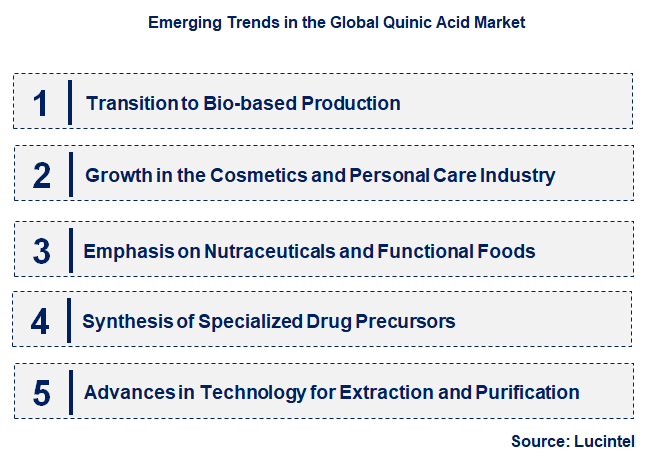
Emerging Trends in the Quinic Acid Market

Recent Development in the Quinic Acid Market

The quinic acid market is constantly evolving in a dynamic manner, as driven by a number of key developments marking its increasing relevance. These are not merely in terms of market size but also in terms of changes in production, innovation, and use. The primary developments bear witness to the flexibility of the market and the way in which it responds to worldwide trends, such as sustainability, health consciousness, and technological advancements.
• Bio-based Production Commercialization: One of the recent developments is the successful commercialization of bio-based production of quinic acid. This consists of the use of microbial fermentation for the production of quinic acid from renewable raw materials. Large-scale fermentation units have been invested in by companies beyond laboratory scale production. This innovation makes a critical difference since it makes the market less dependent on a limited number of natural plant sources, whose yields and prices might be volatile.
• More Investment in Research and Development: There has been significant R&D investment in the therapeutic applications of quinic acid. This trend is most visible within the pharmaceutical and nutraceutical industries. Research is ongoing in order to investigate its uses in treating a variety of diseases, from metabolic conditions to viral infections. This is resulting in novel applications and the creation of specialty derivatives.
• Strategic Partnerships and Collaborations: Another critical evolution is the creation of strategic partnerships and collaborations among quinic acid manufacturers, biotech companies, and end-user industries. Such partnerships are focused on co-developing novel applications and streamlining production processes. For instance, a producer of quinic acid may collaborate with a cosmetics house to launch a new line of skin care products or with a pharmaceutical company to research a new drug lead.
• Growth in the Functional Food and Beverage Segment: Quinic acid is increasingly gaining acceptance as a functional food ingredient. Recent applications involve its incorporation into emerging product lines, including antioxidant-dense beverages and health supplements. The driver here is consumer demand for items that provide health benefits above and beyond mere nutritional value. The effect is considerable, as it broadens the market away from its traditional pharma stronghold.
• Use of Advanced Purification Technologies: Another of the key developments is the use of advanced purification technologies to attain elevated purity levels of quinic acid. Technologies like simulated moving bed chromatography and advanced crystallization techniques are employed to obtain a high-purity crystalline powder. This is especially relevant for pharmaceutical and premium cosmetic applications where purity is not negotiable.
These advances are exerting a multifaceted influence on the quinic acid market. Commercialization of bio-based production is guaranteeing stable and sustainable supply, while expanded R&D is opening up new, high-value uses. Strategic alliances are driving innovation, and growing into new markets such as functional foods is broadening the market. At the same time, advanced technologies for purification are enhancing product quality and value.

Strategic Growth Opportunities in the Quinic Acid Market

The quinic acid market presents several strategic growth opportunities in key applications. The opportunities are fueled by its distinct characteristics and as a generic chemical intermediate. The growth attention is on capitalizing on market demand and innovation to increase its usage in non-traditional applications. By focusing on specific, high-growth segments, firms can optimize their payback and gain a competitive edge.
• Pharmaceutical Intermediates for Antiviral Drugs: One major opportunity for growth is the ongoing and increasing utilization of quinic acid as a crucial intermediate for antiviral drug synthesis, notably oseltamivir (Tamiflu). With the need for effective treatments against viruses ever present due to ongoing world health issues and potential pandemics, the market for such treatments continues to be high. The fact that quinic acid has a distinct chemical structure makes it the perfect precursor for such drugs.
• Functional Food and Beverage Additives: The functional food and beverage market is one of high growth for quinic acid. Its natural source and antioxidant properties combine to make it a desirable additive. There is an emerging consumer trend towards "wellness" and products offering added benefits beyond simple nutrition. Quinic acid is able to be positioned as a clean-label ingredient for antioxidant health.
• Cosmetic and Personal Care Products: The personal care and cosmetic industry presents a robust growth opportunity. Quinic acid is a potential ingredient for anti-aging, anti-inflammatory, and skin-brightening products. Its protective effects on the skin from oxidative stress and natural origin are attractive to the clean beauty market. Growth can be realized by creating specialized grades of quinic acid for use in topical applications and through clinical trials to support its effectiveness. Strategic alliances with cosmetic companies and direct-to-consumer selling will be key to targeting this market segment.
• Agrochemicals and Biopesticides: A new growth prospect for quinic acid is in the agrochemical and biopesticide industries. Quinic acid and its derivatives are suggested by research to be utilized for the synthesis of natural and biodegradable pesticides and herbicides. This fits with the worldwide move away from synthetic, petroleum-derived chemicals in agriculture. This option includes research and development to produce successful quinic acid-derived products and traversing the regulatory environment for approval.
• Specialty Polymers and Resins Precursors: Quinic acid may also be used as a precursor to specialty polymers and resins with specific properties. Its carboxyl and hydroxyl functionalities enable it to be employed as a monomer in polymerization reactions to form new materials. The resultant polymers can find uses in applications such as biodegradable plastics, superior coatings, and specialized adhesives. The strategic potential is in joint research with material science corporations to develop and commercialize these new uses.
These strategic growth opportunities are set to profoundly transform the quinic acid market. By capitalizing on its high-value applications within pharmaceuticals and its potential in high-growth, consumer-oriented markets such as functional foods and cosmetics, firms can assure themselves a sound future. The growth into new, emerging space such as agrochemicals and specialty polymers also provides a long-term growth path. The opportunity is not only about market growth but also about building the value of the product and making it a strategic ingredient for innovation in a broad array of industries.

Quinic Acid Market Driver and Challenges

Quinic acid market is driven by a mix of major drivers and challenges. The key drivers are the growing demand for natural and healthy products globally, the pharmaceuticals’ dependency on quinic acid, and production technology improvements. These drivers are driving the growth of the market and supporting an enabling environment for innovation. Nonetheless, the market also has enormous challenges, including high raw material cost and volatility, technical production complexity, and competition from substitute compounds.
The factors responsible for driving the quinic acid market include:
1. Increased Demand for Natural Ingredients: The global consumer trend for natural, clean-label, and organic products is a key driver. Consumers increasingly demand ingredients from natural origins. Quinic acid, being a natural substance occurring in plants such as green coffee beans and star anise, is well-suited to meet this demand. This is propelling its use in the food and beverage, cosmetic, and nutraceutical sectors, where it is being sought after for its genuineness and perceived health properties.
2. Strategic Importance in Pharmacy Synthesis: Quinic acid is a strategic precursor to the synthesis of various valuable drugs, particularly the antiviral drug oseltamivir (Tamiflu). Its application in the pharmacy sector is an important and recurring source of demand. The continuous risk of viral epidemics guarantees a constant demand for the compound, making it a high-value chemical intermediate for pharma companies worldwide.
3. Growth of the Nutraceutical and Functional Food Industry: With consumers taking a more active interest in their health, the nutraceutical and functional food industries are growing strongly. The antioxidant capabilities and perceived health benefits of quinic acid are propelling its use in such products. This trend opens up a new, growing application area, making quinic acid a prime ingredient for immunity-boosting, digestibility-related, and well-being-supporting products.
4. Technological Advances in Production: The emergence of more efficient and scalable production processes, including microbial fermentation, is a key impetus. Such technological breakthroughs are reducing the cost of production, enhancing product quality through purity, and providing a more stable supply chain. This is making quinic acid more economically feasible for wider applications and less dependent on the seasonality of natural plant availability.
5. New Therapeutic Uses Research: Ongoing research and development is finding new therapeutic uses for quinic acid and its derivatives. Research is investigating its use in the treatment of several conditions, which is leading to future demand. With continuous research, the market for quinic acid continues to be dynamic and ready for long-term growth since new and high-value uses are being found.
Challenges in the quinic acid market are:
1. Volatility and High Cost of Raw Materials: The conventional way of obtaining quinic acid from plant material is costly and prone to price instability and supply volatility. The yield may be unreliable based on weather, farming practices, and other external factors. The issue can affect margins and prevent manufacturers from providing stable prices, which can threaten market stability.
2. Technical Difficulty of Production: Both natural extraction and biobased fermentation are highly technical production processes involving specialized plant and machinery. The technicality can lead to high upfront capital investment and cost of operations. Purification and isolation of high-quality quinic acid from raw extracts is specifically difficult, which restricts the availability of manufacturers to make drug-grade products.
3. Alternative Compounds Competition: The market for quinic acid is competed against by alternative compounds and substitutes. In a few applications, other chemicals or acids can be utilized to get close to similar effects, which could cap market growth. For example, in the food sector, citric acid or other organic acids could be used as a cheaper alternative. Such competition requires frequent innovation to sustain the value proposition of quinic acid.
The market for quinic acid is dominated by a robust push-pull force. Key drivers, such as natural ingredients’ demand by consumers, its pivotal position in the pharmaceutical sector, and advances in technology, are driving growth. These factors lead to a rosy scenario with drivers influencing innovation, as well as new areas of application. Challenges in the market, i.e., technical complexity and the high price of raw materials, need strategic interventions.

List of Quinic Acid Companies

Companies in the market compete on the basis of product quality offered. Major players in this market focus on expanding their manufacturing facilities, R&D investments, infrastructural development, and leverage integration opportunities across the value chain. With these strategies quinic acid companies cater increasing demand, ensure competitive effectiveness, develop innovative products & technologies, reduce production costs, and expand their customer base. Some of the quinic acid companies profiled in this report include-
• Merck Group
• Thermo Fisher Scientific
• Sigma Aldrich
• Madison
• City Chemical
• Selleck Chemicals
• Kerafast
• Spectrum Chemical
• LGC Group
• Supelco

Quinic Acid Market by Segment

The study includes a forecast for the global quinic acid market by type, application, and region.

Quinic Acid Market by Type [Value from 2019 to 2031]:


• Natural
• Synthesis

Quinic Acid Market by Application [Value from 2019 to 2031]:


• Dietary Supplements
• Anti-flu Drugs
• Standard
• Others

Quinic Acid Market by Region [Value from 2019 to 2031]:


• North America
• Europe
• Asia Pacific
• The Rest of the World

Country Wise Outlook for the Quinic Acid Market

The market for quinic acid is in a phase of serious development, fueled by its multifaceted uses across the fields of pharmaceuticals, food and beverage, and cosmetics. As a naturally occurring compound and a primary precursor to drugs, quinic acid is rising in popularity. Current trends revolve around technological advancements in manufacturing, a rising emphasis on sustainable procurement, and rising demand from health-oriented consumers. These transformations are changing the dynamics of the market, causing strategic investments and consolidation in major nations.
• United States: The United States market is influenced by a strong pharmaceutical industry and a powerful consumer demand for natural ingredients. Recent trends involve further research into quinic acid’s therapeutic use, especially metabolic disease and antiviral treatments. Biotechnology investment by companies is aimed at maximizing production yields through fermentation to reduce costs and guarantee constant supply. Clean-label products also contribute to its consumption in dietary supplements and functional foods. US
• China: China is a dominant force in the quinic acid market, with advances oriented towards large-scale production and exports. The country’s extensive chemical manufacturing sector and availability of raw materials enable cost-effective production. Recent developments involve the enhancement of extraction efficiency from plant material, e.g., star anise, and the creation of novel synthetic routes to satisfy world demand. Although a major supplier of quinic acid, China is increasingly becoming a consumer, as its rapidly developing pharmaceuticals industry and growing base of consumers for health foods and natural food ingredients drive demand.
• Germany: The German market for quinic acid is mature and deeply integrated into the European chemical and pharmaceutical sectors. Advances focus on sustainable production processes and meeting tight EU regulations. German industry is driving bio-based production, with the latest fermentation technologies being applied to manufacture quinic acid at lower environmental costs.
• India: The quinic acid market in India is expanding rapidly, fueled by a booming pharmaceutical industry and rising consumer awareness of natural health products. Developments include a growing focus on domestic production to reduce reliance on imports. Studies are also being pursued for effective extraction from local plant sources. The growth in demand for traditional medicine and food supplements, for which quinic acid is a major ingredient, is fueling market growth. India is becoming an important market for both consumption and production with huge opportunities for new entrants.
• Japan: Japan’s quinic acid market is sound and technologically developed. There is emphasis on high-quality, high-purity product for niche applications. The latest applications involve the application of quinic acid in sophisticated food and drink products to refine flavor and deliver functional benefits. Both the stringent quality controls and the culture of choosing natural over unnatural add to the pressures for innovation in extraction as well as synthesis techniques. Japan also leads the pack in research into quinic acid’s actual health benefits, most notably its contribution to maintaining metabolic health and its application in anti-aging cosmeceuticals.

Lucintel Analytics Dashboard

Features of the Global Quinic Acid Market

Market Size Estimates: Quinic acid market size estimation in terms of value ($B).
Trend and Forecast Analysis: Market trends (2019 to 2024) and forecast (2025 to 2031) by various segments and regions.
Segmentation Analysis: Quinic acid market size by type, application, and region in terms of value ($B).
Regional Analysis: Quinic acid market breakdown by North America, Europe, Asia Pacific, and Rest of the World.
Growth Opportunities: Analysis of growth opportunities in different types, applications, and regions for the quinic acid market.
Strategic Analysis: This includes M&A, new product development, and competitive landscape of the quinic acid market.
Analysis of competitive intensity of the industry based on Porter’s Five Forces model.

Lucintel Consulting Services

FAQ

Q1. What is the growth forecast for quinic acid market?
Answer: The global quinic acid market is expected to grow with a CAGR of 5.1% from 2025 to 2031.
Q2. What are the major drivers influencing the growth of the quinic acid market?
Answer: The major drivers for this market are the increasing demand for organic ingredients, the rising popularity of natural antioxidants, and the growing applications in pharmaceutical industry.
Q3. What are the major segments for quinic acid market?
Answer: The future of the quinic acid market looks promising with opportunities in the dietary supplement, anti-flu drug, and standard markets.
Q4. Who are the key quinic acid market companies?
Answer: Some of the key quinic acid companies are as follows:
• Merck Group
• Thermo Fisher Scientific
• Sigma Aldrich
• Madison
• City Chemical
• Selleck Chemicals
• Kerafast
• Spectrum Chemical
• LGC Group
• Supelco
Q5. Which quinic acid market segment will be the largest in future?
Answer: Lucintel forecasts that, within the type category, natural is expected to witness higher growth over the forecast period.
Q6. In quinic acid market, which region is expected to be the largest in next 5 years?
Answer: In terms of region, APAC is expected to witness the highest growth over the forecast period.
Q7. Do we receive customization in this report?
Answer: Yes, Lucintel provides 10% customization without any additional cost.

This report answers following 11 key questions:

Q.1. What are some of the most promising, high-growth opportunities for the quinic acid market by type (natural and synthesis), application (dietary supplements, anti-flu drugs, standard, and others), and region (North America, Europe, Asia Pacific, and the Rest of the World)?
Q.2. Which segments will grow at a faster pace and why?
Q.3. Which region will grow at a faster pace and why?
Q.4. What are the key factors affecting market dynamics? What are the key challenges and business risks in this market?
Q.5. What are the business risks and competitive threats in this market?
Q.6. What are the emerging trends in this market and the reasons behind them?
Q.7. What are some of the changing demands of customers in the market?
Q.8. What are the new developments in the market? Which companies are leading these developments?
Q.9. Who are the major players in this market? What strategic initiatives are key players pursuing for business growth?
Q.10. What are some of the competing products in this market and how big of a threat do they pose for loss of market share by material or product substitution?
Q.11. What M&A activity has occurred in the last 5 years and what has its impact been on the industry?

For any questions related to Quinic Acid Market, Quinic Acid Market Size, Quinic Acid Market Growth, Quinic Acid Market Analysis, Quinic Acid Market Report, Quinic Acid Market Share, Quinic Acid Market Trends, Quinic Acid Market Forecast, Quinic Acid Companies, write Lucintel analyst at email: helpdesk@lucintel.com. We will be glad to get back to you soon.
                                           Table of Contents

            1. Executive Summary

            2. Market Overview

                        2.1 Background and Classifications
                        2.2 Supply Chain

            3. Market Trends & Forecast Analysis

                        3.1 Macroeconomic Trends and Forecasts
                        3.2 Industry Drivers and Challenges
                        3.3 PESTLE Analysis
                        3.4 Patent Analysis
                        3.5 Regulatory Environment
                        3.6 Global Quinic Acid Market Trends and Forecast

            4. Global Quinic Acid Market by Type

                        4.1 Overview
                        4.2 Attractiveness Analysis by Type
                        4.3 Natural : Trends and Forecast 2025 to 2031
                        4.4 Synthesis : Trends and Forecast 2025 to 2031

            5. Global Quinic Acid Market by Application

                        5.1 Overview
                        5.2 Attractiveness Analysis by Application
                        5.3 Dietary Supplements : Trends and Forecast 2025 to 2031
                        5.4 Anti-flu Drugs : Trends and Forecast 2025 to 2031
                        5.5 Standard : Trends and Forecast 2025 to 2031
                        5.6 Others : Trends and Forecast 2025 to 2031

            6. Regional Analysis

                        6.1 Overview
                        6.2 Global Quinic Acid Market by Region

            7. North American Quinic Acid Market

                        7.1 Overview
                        7.2 North American Quinic Acid Market by Type
                        7.3 North American Quinic Acid Market by Application
                        7.4 The United States Quinic Acid Market
                        7.5 Canadian Quinic Acid Market
                        7.6 Mexican Quinic Acid Market

            8. European Quinic Acid Market

                        8.1 Overview
                        8.2 European Quinic Acid Market by Type
                        8.3 European Quinic Acid Market by Application
                        8.4 German Quinic Acid Market
                        8.5 French Quinic Acid Market
                        8.6 Italian Quinic Acid Market
                        8.7 Spanish Quinic Acid Market
                        8.8 The United Kingdom Quinic Acid Market

            9. APAC Quinic Acid Market

                        9.1 Overview
                        9.2 APAC Quinic Acid Market by Type
                        9.3 APAC Quinic Acid Market by Application
                        9.4 Chinese Quinic Acid Market
                        9.5 Indian Quinic Acid Market
                        9.6 Japanese Quinic Acid Market
                        9.7 South Korean Quinic Acid Market
                        9.8 Indonesian Quinic Acid Market

            10. ROW Quinic Acid Market

                        10.1 Overview
                        10.2 ROW Quinic Acid Market by Type
                        10.3 ROW Quinic Acid Market by Application
                        10.4 Middle Eastern Quinic Acid Market
                        10.5 South American Quinic Acid Market
                        10.6 African Quinic Acid Market

            11. Competitor Analysis

                        11.1 Product Portfolio Analysis
                        11.2 Operational Integration
                        11.3 Porter’s Five Forces Analysis
                                    • Competitive Rivalry
                                    • Bargaining Power of Buyers
                                    • Bargaining Power of Suppliers
                                    • Threat of Substitutes
                                    • Threat of New Entrants
                        11.4 Market Share Analysis

            12. Opportunities & Strategic Analysis

                        12.1 Value Chain Analysis
                        12.2 Growth Opportunity Analysis
                                    12.2.1 Growth Opportunity by Type
                                    12.2.2 Growth Opportunity by Application
                        12.3 Emerging Trends in the Global Quinic Acid Market
                        12.4 Strategic Analysis
                                    12.4.1 New Product Development
                                    12.4.2 Certification and Licensing
                                    12.4.3 Mergers, Acquisitions, Agreements, Collaborations, and Joint Ventures

            13. Company Profiles of the Leading Players Across the Value Chain

                        13.1 Competitive Analysis
                        13.2 Merck Group
                                    • Company Overview
                                    • Quinic Acid Market Business Overview
                                    • New Product Development
                                    • Merger, Acquisition, and Collaboration
                                    • Certification and Licensing
                        13.3 Thermo Fisher Scientific
                                    • Company Overview
                                    • Quinic Acid Market Business Overview
                                    • New Product Development
                                    • Merger, Acquisition, and Collaboration
                                    • Certification and Licensing
                        13.4 Sigma Aldrich
                                    • Company Overview
                                    • Quinic Acid Market Business Overview
                                    • New Product Development
                                    • Merger, Acquisition, and Collaboration
                                    • Certification and Licensing
                        13.5 Madison
                                    • Company Overview
                                    • Quinic Acid Market Business Overview
                                    • New Product Development
                                    • Merger, Acquisition, and Collaboration
                                    • Certification and Licensing
                        13.6 City Chemical
                                    • Company Overview
                                    • Quinic Acid Market Business Overview
                                    • New Product Development
                                    • Merger, Acquisition, and Collaboration
                                    • Certification and Licensing
                        13.7 Selleck Chemicals
                                    • Company Overview
                                    • Quinic Acid Market Business Overview
                                    • New Product Development
                                    • Merger, Acquisition, and Collaboration
                                    • Certification and Licensing
                        13.8 Kerafast
                                    • Company Overview
                                    • Quinic Acid Market Business Overview
                                    • New Product Development
                                    • Merger, Acquisition, and Collaboration
                                    • Certification and Licensing
                        13.9 Spectrum Chemical
                                    • Company Overview
                                    • Quinic Acid Market Business Overview
                                    • New Product Development
                                    • Merger, Acquisition, and Collaboration
                                    • Certification and Licensing
                        13.10 LGC Group
                                    • Company Overview
                                    • Quinic Acid Market Business Overview
                                    • New Product Development
                                    • Merger, Acquisition, and Collaboration
                                    • Certification and Licensing
                        13.11 Supelco
                                    • Company Overview
                                    • Quinic Acid Market Business Overview
                                    • New Product Development
                                    • Merger, Acquisition, and Collaboration
                                    • Certification and Licensing

            14. Appendix

                        14.1 List of Figures
                        14.2 List of Tables
                        14.3 Research Methodology
                        14.4 Disclaimer
                        14.5 Copyright
                        14.6 Abbreviations and Technical Units
                        14.7 About Us
                        14.8 Contact Us

                                               List of Figures


            Chapter 1

                        Figure 1.1: Trends and Forecast for the Global Quinic Acid Market

            Chapter 2

                        Figure 2.1: Usage of Quinic Acid Market
                        Figure 2.2: Classification of the Global Quinic Acid Market
                        Figure 2.3: Supply Chain of the Global Quinic Acid Market

            Chapter 3

                        Figure 3.1: Trends of the Global GDP Growth Rate
                        Figure 3.2: Trends of the Global Population Growth Rate
                        Figure 3.3: Trends of the Global Inflation Rate
                        Figure 3.4: Trends of the Global Unemployment Rate
                        Figure 3.5: Trends of the Regional GDP Growth Rate
                        Figure 3.6: Trends of the Regional Population Growth Rate
                        Figure 3.7: Trends of the Regional Inflation Rate
                        Figure 3.8: Trends of the Regional Unemployment Rate
                        Figure 3.9: Trends of Regional Per Capita Income
                        Figure 3.10: Forecast for the Global GDP Growth Rate
                        Figure 3.11: Forecast for the Global Population Growth Rate
                        Figure 3.12: Forecast for the Global Inflation Rate
                        Figure 3.13: Forecast for the Global Unemployment Rate
                        Figure 3.14: Forecast for the Regional GDP Growth Rate
                        Figure 3.15: Forecast for the Regional Population Growth Rate
                        Figure 3.16: Forecast for the Regional Inflation Rate
                        Figure 3.17: Forecast for the Regional Unemployment Rate
                        Figure 3.18: Forecast for Regional Per Capita Income
                        Figure 3.19: Driver and Challenges of the Quinic Acid Market

            Chapter 4

                        Figure 4.1: Global Quinic Acid Market by Type in 2019, 2024, and 2031
                        Figure 4.2: Trends of the Global Quinic Acid Market ($B) by Type
                        Figure 4.3: Forecast for the Global Quinic Acid Market ($B) by Type
                        Figure 4.4: Trends and Forecast for Natural in the Global Quinic Acid Market (2019-2031)
                        Figure 4.5: Trends and Forecast for Synthesis in the Global Quinic Acid Market (2019-2031)

            Chapter 5

                        Figure 5.1: Global Quinic Acid Market by Application in 2019, 2024, and 2031
                        Figure 5.2: Trends of the Global Quinic Acid Market ($B) by Application
                        Figure 5.3: Forecast for the Global Quinic Acid Market ($B) by Application
                        Figure 5.4: Trends and Forecast for Dietary Supplements in the Global Quinic Acid Market (2019-2031)
                        Figure 5.5: Trends and Forecast for Anti-flu Drugs in the Global Quinic Acid Market (2019-2031)
                        Figure 5.6: Trends and Forecast for Standard in the Global Quinic Acid Market (2019-2031)
                        Figure 5.7: Trends and Forecast for Others in the Global Quinic Acid Market (2019-2031)

            Chapter 6

                        Figure 6.1: Trends of the Global Quinic Acid Market ($B) by Region (2019-2024)
                        Figure 6.2: Forecast for the Global Quinic Acid Market ($B) by Region (2025-2031)

            Chapter 7

                        Figure 7.1: Trends and Forecast for the North American Quinic Acid Market (2019-2031)
                        Figure 7.2: North American Quinic Acid Market by Type in 2019, 2024, and 2031
                        Figure 7.3: Trends of the North American Quinic Acid Market ($B) by Type (2019-2024)
                        Figure 7.4: Forecast for the North American Quinic Acid Market ($B) by Type (2025-2031)
                        Figure 7.5: North American Quinic Acid Market by Application in 2019, 2024, and 2031
                        Figure 7.6: Trends of the North American Quinic Acid Market ($B) by Application (2019-2024)
                        Figure 7.7: Forecast for the North American Quinic Acid Market ($B) by Application (2025-2031)
                        Figure 7.8: Trends and Forecast for the United States Quinic Acid Market ($B) (2019-2031)
                        Figure 7.9: Trends and Forecast for the Mexican Quinic Acid Market ($B) (2019-2031)
                        Figure 7.10: Trends and Forecast for the Canadian Quinic Acid Market ($B) (2019-2031)

            Chapter 8

                        Figure 8.1: Trends and Forecast for the European Quinic Acid Market (2019-2031)
                        Figure 8.2: European Quinic Acid Market by Type in 2019, 2024, and 2031
                        Figure 8.3: Trends of the European Quinic Acid Market ($B) by Type (2019-2024)
                        Figure 8.4: Forecast for the European Quinic Acid Market ($B) by Type (2025-2031)
                        Figure 8.5: European Quinic Acid Market by Application in 2019, 2024, and 2031
                        Figure 8.6: Trends of the European Quinic Acid Market ($B) by Application (2019-2024)
                        Figure 8.7: Forecast for the European Quinic Acid Market ($B) by Application (2025-2031)
                        Figure 8.8: Trends and Forecast for the German Quinic Acid Market ($B) (2019-2031)
                        Figure 8.9: Trends and Forecast for the French Quinic Acid Market ($B) (2019-2031)
                        Figure 8.10: Trends and Forecast for the Spanish Quinic Acid Market ($B) (2019-2031)
                        Figure 8.11: Trends and Forecast for the Italian Quinic Acid Market ($B) (2019-2031)
                        Figure 8.12: Trends and Forecast for the United Kingdom Quinic Acid Market ($B) (2019-2031)

            Chapter 9

                        Figure 9.1: Trends and Forecast for the APAC Quinic Acid Market (2019-2031)
                        Figure 9.2: APAC Quinic Acid Market by Type in 2019, 2024, and 2031
                        Figure 9.3: Trends of the APAC Quinic Acid Market ($B) by Type (2019-2024)
                        Figure 9.4: Forecast for the APAC Quinic Acid Market ($B) by Type (2025-2031)
                        Figure 9.5: APAC Quinic Acid Market by Application in 2019, 2024, and 2031
                        Figure 9.6: Trends of the APAC Quinic Acid Market ($B) by Application (2019-2024)
                        Figure 9.7: Forecast for the APAC Quinic Acid Market ($B) by Application (2025-2031)
                        Figure 9.8: Trends and Forecast for the Japanese Quinic Acid Market ($B) (2019-2031)
                        Figure 9.9: Trends and Forecast for the Indian Quinic Acid Market ($B) (2019-2031)
                        Figure 9.10: Trends and Forecast for the Chinese Quinic Acid Market ($B) (2019-2031)
                        Figure 9.11: Trends and Forecast for the South Korean Quinic Acid Market ($B) (2019-2031)
                        Figure 9.12: Trends and Forecast for the Indonesian Quinic Acid Market ($B) (2019-2031)

            Chapter 10

                        Figure 10.1: Trends and Forecast for the ROW Quinic Acid Market (2019-2031)
                        Figure 10.2: ROW Quinic Acid Market by Type in 2019, 2024, and 2031
                        Figure 10.3: Trends of the ROW Quinic Acid Market ($B) by Type (2019-2024)
                        Figure 10.4: Forecast for the ROW Quinic Acid Market ($B) by Type (2025-2031)
                        Figure 10.5: ROW Quinic Acid Market by Application in 2019, 2024, and 2031
                        Figure 10.6: Trends of the ROW Quinic Acid Market ($B) by Application (2019-2024)
                        Figure 10.7: Forecast for the ROW Quinic Acid Market ($B) by Application (2025-2031)
                        Figure 10.8: Trends and Forecast for the Middle Eastern Quinic Acid Market ($B) (2019-2031)
                        Figure 10.9: Trends and Forecast for the South American Quinic Acid Market ($B) (2019-2031)
                        Figure 10.10: Trends and Forecast for the African Quinic Acid Market ($B) (2019-2031)

            Chapter 11

                        Figure 11.1: Porter’s Five Forces Analysis of the Global Quinic Acid Market
                        Figure 11.2: Market Share (%) of Top Players in the Global Quinic Acid Market (2024)

            Chapter 12

                        Figure 12.1: Growth Opportunities for the Global Quinic Acid Market by Type
                        Figure 12.2: Growth Opportunities for the Global Quinic Acid Market by Application
                        Figure 12.3: Growth Opportunities for the Global Quinic Acid Market by Region
                        Figure 12.4: Emerging Trends in the Global Quinic Acid Market

                                               List of Tables


            Chapter 1

                        Table 1.1: Growth Rate (%, 2023-2024) and CAGR (%, 2025-2031) of the Quinic Acid Market by Type and Application
                        Table 1.2: Attractiveness Analysis for the Quinic Acid Market by Region
                        Table 1.3: Global Quinic Acid Market Parameters and Attributes

            Chapter 3

                        Table 3.1: Trends of the Global Quinic Acid Market (2019-2024)
                        Table 3.2: Forecast for the Global Quinic Acid Market (2025-2031)

            Chapter 4

                        Table 4.1: Attractiveness Analysis for the Global Quinic Acid Market by Type
                        Table 4.2: Market Size and CAGR of Various Type in the Global Quinic Acid Market (2019-2024)
                        Table 4.3: Market Size and CAGR of Various Type in the Global Quinic Acid Market (2025-2031)
                        Table 4.4: Trends of Natural in the Global Quinic Acid Market (2019-2024)
                        Table 4.5: Forecast for Natural in the Global Quinic Acid Market (2025-2031)
                        Table 4.6: Trends of Synthesis in the Global Quinic Acid Market (2019-2024)
                        Table 4.7: Forecast for Synthesis in the Global Quinic Acid Market (2025-2031)

            Chapter 5

                        Table 5.1: Attractiveness Analysis for the Global Quinic Acid Market by Application
                        Table 5.2: Market Size and CAGR of Various Application in the Global Quinic Acid Market (2019-2024)
                        Table 5.3: Market Size and CAGR of Various Application in the Global Quinic Acid Market (2025-2031)
                        Table 5.4: Trends of Dietary Supplements in the Global Quinic Acid Market (2019-2024)
                        Table 5.5: Forecast for Dietary Supplements in the Global Quinic Acid Market (2025-2031)
                        Table 5.6: Trends of Anti-flu Drugs in the Global Quinic Acid Market (2019-2024)
                        Table 5.7: Forecast for Anti-flu Drugs in the Global Quinic Acid Market (2025-2031)
                        Table 5.8: Trends of Standard in the Global Quinic Acid Market (2019-2024)
                        Table 5.9: Forecast for Standard in the Global Quinic Acid Market (2025-2031)
                        Table 5.10: Trends of Others in the Global Quinic Acid Market (2019-2024)
                        Table 5.11: Forecast for Others in the Global Quinic Acid Market (2025-2031)

            Chapter 6

                        Table 6.1: Market Size and CAGR of Various Regions in the Global Quinic Acid Market (2019-2024)
                        Table 6.2: Market Size and CAGR of Various Regions in the Global Quinic Acid Market (2025-2031)

            Chapter 7

                        Table 7.1: Trends of the North American Quinic Acid Market (2019-2024)
                        Table 7.2: Forecast for the North American Quinic Acid Market (2025-2031)
                        Table 7.3: Market Size and CAGR of Various Type in the North American Quinic Acid Market (2019-2024)
                        Table 7.4: Market Size and CAGR of Various Type in the North American Quinic Acid Market (2025-2031)
                        Table 7.5: Market Size and CAGR of Various Application in the North American Quinic Acid Market (2019-2024)
                        Table 7.6: Market Size and CAGR of Various Application in the North American Quinic Acid Market (2025-2031)
                        Table 7.7: Trends and Forecast for the United States Quinic Acid Market (2019-2031)
                        Table 7.8: Trends and Forecast for the Mexican Quinic Acid Market (2019-2031)
                        Table 7.9: Trends and Forecast for the Canadian Quinic Acid Market (2019-2031)

            Chapter 8

                        Table 8.1: Trends of the European Quinic Acid Market (2019-2024)
                        Table 8.2: Forecast for the European Quinic Acid Market (2025-2031)
                        Table 8.3: Market Size and CAGR of Various Type in the European Quinic Acid Market (2019-2024)
                        Table 8.4: Market Size and CAGR of Various Type in the European Quinic Acid Market (2025-2031)
                        Table 8.5: Market Size and CAGR of Various Application in the European Quinic Acid Market (2019-2024)
                        Table 8.6: Market Size and CAGR of Various Application in the European Quinic Acid Market (2025-2031)
                        Table 8.7: Trends and Forecast for the German Quinic Acid Market (2019-2031)
                        Table 8.8: Trends and Forecast for the French Quinic Acid Market (2019-2031)
                        Table 8.9: Trends and Forecast for the Spanish Quinic Acid Market (2019-2031)
                        Table 8.10: Trends and Forecast for the Italian Quinic Acid Market (2019-2031)
                        Table 8.11: Trends and Forecast for the United Kingdom Quinic Acid Market (2019-2031)

            Chapter 9

                        Table 9.1: Trends of the APAC Quinic Acid Market (2019-2024)
                        Table 9.2: Forecast for the APAC Quinic Acid Market (2025-2031)
                        Table 9.3: Market Size and CAGR of Various Type in the APAC Quinic Acid Market (2019-2024)
                        Table 9.4: Market Size and CAGR of Various Type in the APAC Quinic Acid Market (2025-2031)
                        Table 9.5: Market Size and CAGR of Various Application in the APAC Quinic Acid Market (2019-2024)
                        Table 9.6: Market Size and CAGR of Various Application in the APAC Quinic Acid Market (2025-2031)
                        Table 9.7: Trends and Forecast for the Japanese Quinic Acid Market (2019-2031)
                        Table 9.8: Trends and Forecast for the Indian Quinic Acid Market (2019-2031)
                        Table 9.9: Trends and Forecast for the Chinese Quinic Acid Market (2019-2031)
                        Table 9.10: Trends and Forecast for the South Korean Quinic Acid Market (2019-2031)
                        Table 9.11: Trends and Forecast for the Indonesian Quinic Acid Market (2019-2031)

            Chapter 10

                        Table 10.1: Trends of the ROW Quinic Acid Market (2019-2024)
                        Table 10.2: Forecast for the ROW Quinic Acid Market (2025-2031)
                        Table 10.3: Market Size and CAGR of Various Type in the ROW Quinic Acid Market (2019-2024)
                        Table 10.4: Market Size and CAGR of Various Type in the ROW Quinic Acid Market (2025-2031)
                        Table 10.5: Market Size and CAGR of Various Application in the ROW Quinic Acid Market (2019-2024)
                        Table 10.6: Market Size and CAGR of Various Application in the ROW Quinic Acid Market (2025-2031)
                        Table 10.7: Trends and Forecast for the Middle Eastern Quinic Acid Market (2019-2031)
                        Table 10.8: Trends and Forecast for the South American Quinic Acid Market (2019-2031)
                        Table 10.9: Trends and Forecast for the African Quinic Acid Market (2019-2031)

            Chapter 11

                        Table 11.1: Product Mapping of Quinic Acid Suppliers Based on Segments
                        Table 11.2: Operational Integration of Quinic Acid Manufacturers
                        Table 11.3: Rankings of Suppliers Based on Quinic Acid Revenue

            Chapter 12

                        Table 12.1: New Product Launches by Major Quinic Acid Producers (2019-2024)
                        Table 12.2: Certification Acquired by Major Competitor in the Global Quinic Acid Market

.

Buy full report or by chapter as follows

Limited Time Offer

Price by License Type:
[-] Hide Chapter Details
[Chapter Number] [Chapter Name] [Chapter Number Of Pages] [Chapter Price]
Title/Chapter Name Pages Price
Full Report: Quinic Acid Market Report: Trends, Forecast and Competitive Analysis to 2031 Full Report $ 2,990
A 150 Page Report
Lucintel has been in the business of market research and management consulting since 2000 and has published over 1000 market intelligence reports in various markets / applications and served over 1,000 clients worldwide. This study is a culmination of four months of full-time effort performed by Lucintel's analyst team. The analysts used the following sources for the creation and completion of this valuable report:
  • In-depth interviews of the major players in this market
  • Detailed secondary research from competitors’ financial statements and published data 
  • Extensive searches of published works, market, and database information pertaining to industry news, company press releases, and customer intentions
  • A compilation of the experiences, judgments, and insights of Lucintel’s professionals, who have analyzed and tracked this market over the years.
Extensive research and interviews are conducted across the supply chain of this market to estimate market share, market size, trends, drivers, challenges, and forecasts. Below is a brief summary of the primary interviews that were conducted by job function for this report.
 
Thus, Lucintel compiles vast amounts of data from numerous sources, validates the integrity of that data, and performs a comprehensive analysis. Lucintel then organizes the data, its findings, and insights into a concise report designed to support the strategic decision-making process. The figure below is a graphical representation of Lucintel’s research process. 
 

Please sign in below to get report brochure - Quinic Acid Market Report.

At Lucintel, we respect your privacy and maintain the confidentiality of information / data provided by you
(Please enter your corporate email. * These fields are mandatory )

Follow us on