
Report Feature
Quilt Market Trends and Forecast
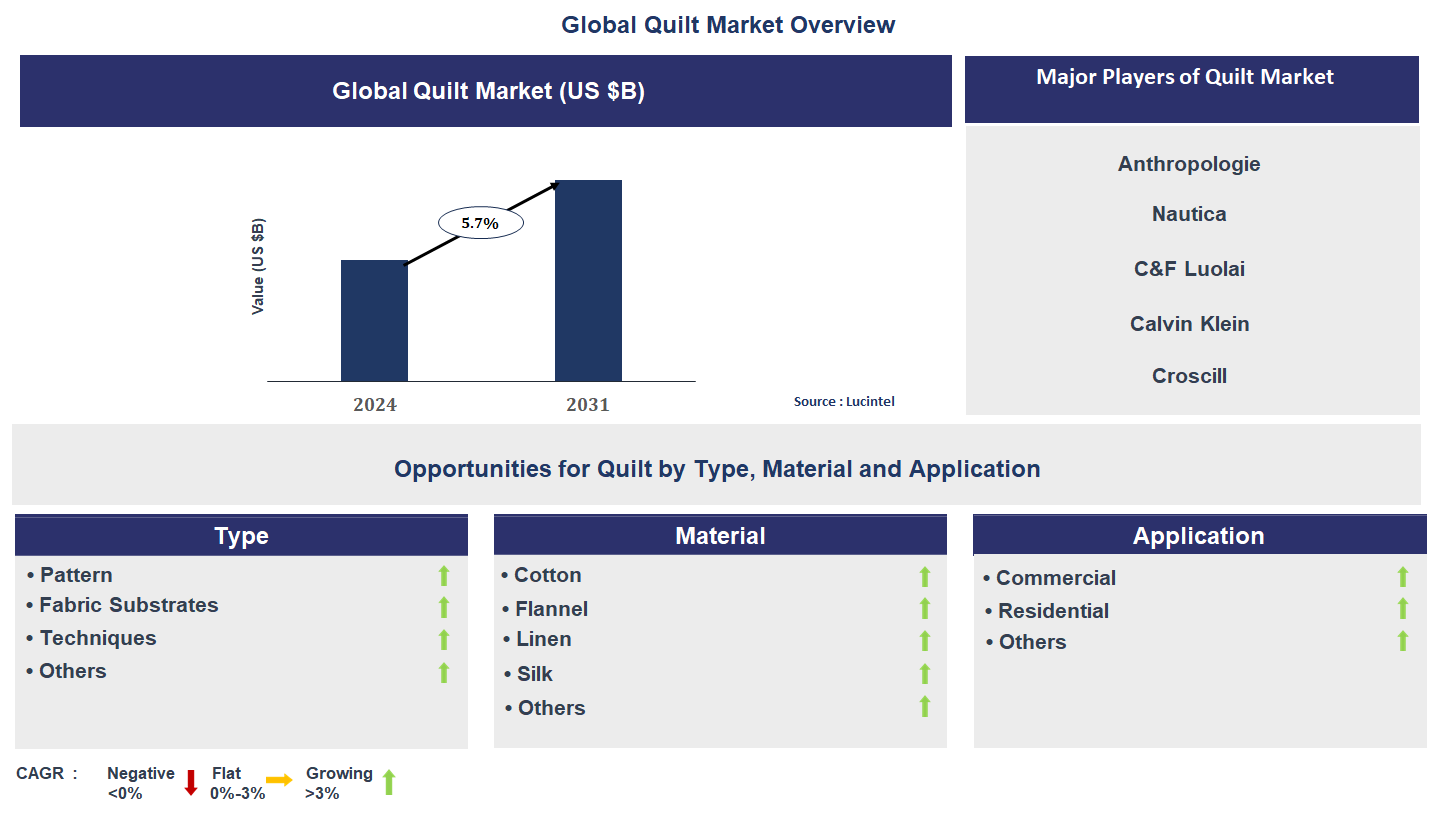
The future of the global quilt market looks promising with opportunities in the commercial and residential markets. The global quilt market is expected to grow with a CAGR of 5.7% from 2025 to 2031. The major drivers for this market are the increasing consumer interest in home decor, the rising demand for handmade products, and the growing popularity of crafting culture.• Lucintel forecasts that, within the type category, fabric substrate is expected to witness the highest growth over the forecast period.
• Within the application category, residential is expected to witness higher growth.
• In terms of region, APAC is expected to witness the highest growth over the forecast period. Gain valuable insights for your business decisions with our comprehensive 150+ page report. Sample figures with some insights are shown below.
Emerging Trends in the Quilt Market
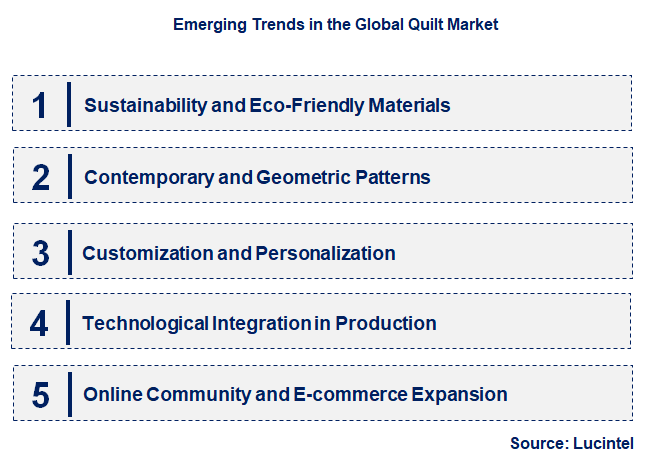
The quilt market is experiencing a period of change, with several significant trends redefining its landscape. These trends are part of a larger cultural movement towards mindful consumption, a desire for customization, and the incorporation of technology into traditional crafts. From a new emphasis on environmental stewardship to the growth of digital platforms, these trends are shaping everything from product design and material choice to marketing and distribution channels.• Sustainability and Eco-Friendly Materials: One of the biggest trends is the escalating need for quilts made from sustainable and eco-friendly textiles like organic cotton, bamboo, and recycled fibers. The reason is growing awareness among consumers about the environment implication of textile manufacturing. The effects are far-reaching: producers are making investments in ethical sourcing and cleaner production practices, while brands are promoting their products using sustainability certifications.
• Contemporary and Geometric Patterns: The older, ornate patterns of traditional quilts are being complemented by an increase in contemporary and minimalist designs. This trend caters to bold colors, plain geometric shapes, and a more modern look. The influence is a wider appeal to an urban, younger demographic with an interest in functional, artistic home decor. The trend is affecting fabric producers to create new ranges that address these contemporary tastes and is motivating design software innovation and digital printing.
• Customization and Personalization: Customers are looking for products that are more aligned with their individual style and taste. This is especially pronounced in the market for quilts, as custom quilts are well sought after as an expression of identity or a distinctive present. The effect is the creation of a robust market for individually designed and customized quilting services, frequently through online mediums.
• Technological Integration in Production: The quilt industry is adopting technology to enhance efficiency and creativity. This involves the application of computerized long-arm quilting machines for complex stitching and digital printing of fabrics for personalized designs. The effect is an immense boost in the rate of production and precision, thus making complex designs more achievable and affordable.
• Online Community and E-commerce Expansion: The quilting community has moved online, with social media, blogging, and online classes building a worldwide community of enthusiasts. This is speeding the expansion of e-commerce as the central platform for buying fabric, patterns, and supplies. The effect is the establishment of a direct-to-consumer model that circumvents conventional retailing channels. These trends cumulatively are transforming the quilt market to be more accessible, environmentally friendly, and consumer-oriented. The move into online groups and e-commerce is democratizing the art form, and the focus on sustainability and customization is attracting a new consumer generation. Bringing technology into the process is not only increasing efficiency but also allowing more artistic freedom. Eventually, these shifts are bringing the market from niche pastime to contemporary industry responsive to worldwide demands for efficiency, customization, and environmentalism.
Recent Development in the Quilt Market
The quilt market has seen a number of important developments that are transforming its landscape, from a craft to an industry. The forces behind this transformation are technological innovation, shifting consumer trends, and increasing focus on sustainability. The industry is answering the call for more efficient production, new uses for quilts, and a more diverse and welcoming community.• Smart Textiles and Materials Evolution: One of the key advancements is the integration of smart textiles in quilts. Companies are trying out materials that provide sophisticated functionalities, including temperature control, moisture management, and even built-in heating. This trend is affecting the industry by establishing a high-end, high-tech category of quilts that transcend mere bedding. It is a strategic initiative to differentiate goods and target a tech-savvy consumer with expectations for comfort and innovation in household goods.
• Expansion into Home Decor and Wall Art: Quilts are finding uses beyond mere bedding, including wall hangings, table runners, and throw decor. This growth is propelled by an increasing desire to utilize textiles as a home decorating and artistic medium. The result is the expansion of the quilt industry into the wider home furnishings market, opening up new possibilities for designers and producers. This is propelled by social media and interior design bloggers who highlight quilts as distinct and customized aspects of home decor.
• DIY and Ready-to-Sew Kits: In order to take advantage of the craft revival as a hobby, a significant trend is the emergence of DIY and ready-to-sew quilt kits. The kits include pre-cut fabric, patterns, and instructions, and this has made quilting easy and convenient for beginners and people who have little time. This innovation is affecting the market by reducing the entry barrier for new enthusiasts and creating a new revenue stream for companies.
• Combination of AI-Powered Design Tools and Computer-Aided Design: The market for quilts is going digital with the combination of AI-powered design tools and computer-aided design (CAD) systems. These appliances make it possible for quilters to sew intricate, accurate patterns and see designs prior to fabric cutting. This technology is influencing the market by simplifying the design process as well as making a level of precision impossible earlier possible. It also encourages higher creativity and allows hobbyists to try out new and complex patterns easily.
• Transformation To Direct-to-Consumer Models: More and more quilt makers and artisans are now directly selling to consumers on the web, social media, or their websites. This shift circumvents the middleman and provides closer customer access. The effect is a leaner and more profitable business model for smaller contenders, since it doesnt require a physical store and minimizes fixed expenses. These five developments collectively are impacting the quilt market in making it more innovative and pervasive. They are making the business more efficient with technical advancements and more accessible with DIY kits and internet sites. Not only is the market reacting to shifting consumer trends toward distinctive and customized products but also actively developing new uses and sources of revenue. These advances are guaranteeing the sustained vitality and expansion of the quilt market within a rapidly changing competitive environment.
Strategic Growth Opportunities in the Quilt Market
The quilt industry offers many strategic expansion opportunities throughout major applications based on a convergence of consumer behavior, technology development, and renewed appreciation for handcraft. These opportunities are allowing market participants to expand products, reach new consumer bases, and strengthen positions in an increasingly competitive marketplace. By targeting these high-growth categories, businesses can capitalize on the inherent merits of quilts as both useful products and works of art. The subsequent strategic possibilities illustrate how the industry is transitioning to accommodate the needs of contemporary consumer markets.• Expansion in the Home Decor and Interior Design Category: Quilts are no longer relegated to the bedroom; they are being used more and more as interior design statement pieces, including wall hangings and decorative throws. The strategic expansion opportunity involves promoting quilts as distinctive and customizable components of interior design. This is accomplished by partnering with interior designers and bloggers, designing collections based on todays decor trends, and providing personalization options.
• Growth in the Gift and Heirloom Marketplace: Quilts have always been valued as meaningful gifts and family heirlooms, and this use offers a solid growth opportunity. The plan is to position quilts as classic, high-quality gifts for weddings, births, and anniversaries. This can be aided by the provision of custom options, such as names or dates embroidered onto the product, and by highlighting the handmade aspect and emotional attachment of the item.
• Inroads into the Hospitality Industry: Hospitality provides a large, untapped segment for the quilt market. Hotels, resorts, and vacation rentals are now in search of distinctive and high-quality fabric to upgrade their guest experience. The strategic potential is to create custom quilts that are durable, low maintenance, and visually appealing. This involves a business-to-business solution, presenting bulk orders and custom designs that fit the brand identity of each business.
• Product Development for the Craft and Hobbyist Market: With the worldwide resurgence in crafting and DIY endeavors, there exists a huge growth potential in serving the hobbyist market. The strategy involves providing a wide range of products such as quality fabrics, patterns, tools, and pre-cut kits. This can be further promoted by establishing an online forum, providing online classes and tutorials, and offering quality customer service.
• Addressing the Sustainable and Ethical Consumer: With sustainability becoming an essential buying factor, there is a strategic opportunity for growth in addressing consumers who value eco-friendly and ethically produced merchandise. The plan is to create quilts with organic, recycled, and sustainable input materials and be open about the production process. This can be reinforced by getting certifications and joining with ethical suppliers. These growth opportunities are collectively shaping the quilt market by driving diversification and innovation. They are taking the market beyond its historic horizons into new markets, including home decor and hospitality, and are building a more consumer-driven business model. By targeting these opportunities, market participants are not only driving their top line but are also insuring the long-term sustainability and growth of the industry in an increasingly fast-changing global economy.
Quilt Market Driver and Challenges
The quilt industry is influenced by an intricate mix of drivers that drive it forward and challenges that may hinder its growth. The most important drivers are mostly based on changing consumer habits, revived enthusiasm for traditional crafts, and technological advancements. The contrary is true for the challenges, which tend to be based on economic issues, competition in the market, and the very nature of the craft. Deep understanding of such dynamics is necessary to navigate the market. The factors responsible for driving the quilt market include: 1. Revival of Handmade and DIY Culture: Consumers worldwide are looking for creative expression and being able to express themselves through handmade work. This has been a prime factor in boosting interest in quilting as a hobby. This force is driven by a need for unique, customized goods and an aversion to mass-produced items. The effect is an expansion of the consumer base for quilting supplies, patterns, and classes, which is the basis for growth in the market. 2. Increasing Consumer Interest in Home Decor: Quilts are no longer viewed as merely utilitarian bedding; they are being highly prized as decorative items that add beauty to a home. This is fueled by increasing interior design trends and social media outlets where quilts are presented as art statement pieces. The effect is the growth of the market into the home furnishing industry, giving rise to new sources of revenue and avenues for designers to develop products in line with the modern trends. 3. Focus on Ethical and Sustainable Products: The buyers are becoming increasingly aware of the social and environmental effects of their spending. This is creating a demand for sustainable quilts such as those made from organic cotton and recycled materials, and for ethically produced products. The effect is a market movement towards clear supply chains and a premium segment for environmentally responsible brands. This driver also promotes innovation in environmentally friendly materials and production processes. 4. Ease of access via E-commerce and Online Communities: The advent of e-commerce websites and online forums has never made quilting more accessible. It has brought quilters worldwide together, created a community, and offered a direct platform for artisans to market their goods to the consumers. The effect is an increased market reach and streamlined distribution channel. It also makes the craft more democratic by offering free tutorials and resources, which invite new participants. 5. Technological Manufacturing Advancements: Advances in machinery and design software, like computerized long-arm quilting machines and artificial intelligence-designed computer programs, have streamlined quilting to be more efficient and accurate. This driver enables manufacturers to create complex designs with increased speed and reproducibility. The outcome is a better-quality product and the capacity to fulfill large-scale demand. Challenges in the quilt market are: 1. Mass-Produced Competitors: The quilt industry competes vigorously with mass-produced bedding sets and comforters that are less expensive and more accessible. These substitutes attract a price-sensitive consumer market less interested in the craftsmanship and quality of a handmade quilt. This challenge compels quilt producers to concentrate on upscale, custom, and artisanal items to differentiate themselves and command a premium price. 2. High Material and Labor Cost: The manufacture of high-quality quilts may be costly because of the expense of high-grade fabrics and the labor involved in the art. This can render quilts a luxury product, reducing its affordability to a wide population strata. This challenge affects market growth by limiting demand in price-sensitive areas and compelling enterprises to strategize their supply chains and pricing carefully to remain profitable. 3. Perception as a Traditional or Niche Craft: Even with increased modern designs, there remains a perception that quilting is a traditional or niche craft of older generations. This would limit the attraction of a younger and wider consumer market. The challenge requires marketing and branding that project the modern, artistic, and practical nature of quilting to shift the public perception and open up the market appeal beyond its core tradition. The net effect of these drivers and challenges is a transitioning market. The drivers are propelling the market towards more innovation, sustainability, and expression of art, while the challenges necessitate that the industry be strategic and versatile. The market is segmenting more and more into a high-end, premium sector in which quality and workmanship are the absolute priorities and a hobbyist market based on the presence of do-it-yourself kits and Web sites.List of Quilt Companies
Companies in the market compete on the basis of product quality offered. Major players in this market focus on expanding their manufacturing facilities, R&D investments, infrastructural development, and leverage integration opportunities across the value chain. With these strategies quilt companies cater increasing demand, ensure competitive effectiveness, develop innovative products & technologies, reduce production costs, and expand their customer base. Some of the quilt companies profiled in this report include-• Anthropologie
• Nautica
• C&F Luolai
• Calvin Klein
• Croscill
• Pem America
• Shanghai Shuixing
• Laura Ashley
• Greenland Home Fashions
• Lambs & Ivy
Quilt Market by Segment
The study includes a forecast for the global quilt market by type, material, application, and region.Quilt Market by Type [Value from 2019 to 2031]:
• Pattern
• Fabric Substrates
• Techniques
• Others
Quilt Market by Material [Value from 2019 to 2031]:
• Cotton
• Flannel
• Linen
• Silk
• Others
Quilt Market by Application [Value from 2019 to 2031]:
• Commercial
• Residential
• Others
Quilt Market by Region [Value from 2019 to 2031]:
• North America
• Europe
• Asia Pacific
• The Rest of the World
Country Wise Outlook for the Quilt Market
The international quilt industry is undergoing a dramatic transformation, evolving beyond being a simple craft into a dynamic industry shaped by contemporary home furnishings trends, a resurgence of interest in handmade merchandise, and advances in technology. It is prompted by consumers who are increasingly using quilts as a method of self-expression and an extension of personal taste, and not merely as a utilitarian piece of bedding. Drivers like an increasing emphasis on sustainable and environmentally friendly materials, growth in e-commerce sites, and an overall increase in DIY and handmade trends are changing the market dynamics.• United States: The American quilt market is strong and developed, with a rich quilting heritage and a large, active community of hobbyists as well as professionals. Recent trends are marked by an increased demand for high-quality, bespoke, and contemporary-style quilts. There is also a movement towards online shopping and virtual communities with social media sites and web-based tutorials playing a significant role in generating new ideas and facilitating interaction among quilters.
• China: Chinas quilt market is a significant powerhouse, fueled by urbanization and an emerging middle class with higher disposable incomes. Some recent trends include an emerging consumer desire for high-end and quality bedding and home furnishings, resulting in demand for high-end quilts. Although historically the center for mass-produced textiles, the market is also experiencing an upturn in locally made artisanal and custom quilts. The nations robust manufacturing facilities and government policies all contribute to further cementing its role as a leading global force.
• Germany: Within Germany, the quilt industry is famous for its focus on quality, artisanal skills, and high-end designs. Developments in recent times are focused on the need for functional yet tasteful items, all with regard to materials that provide comfort as well as durability. The industry is also adopting smart textiles and new fillings, including temperature-managing fibers, to produce Mult benefits products. The urge for sustainability is one driver, with customers favoring quilts produced from organic and sustainably sourced materials.
• India: The Indian market for quilts is growing at a fast pace, driven by growing disposable incomes, changing lifestyles, and a rich cultural affinity for fabrics. Recent trends see an increasing need for both heritage, hand-stitched quilts and contemporary, machine-stitched versions. The market is becoming more diversified to incorporate goods that meet different climatic needs and target markets. Online shopping is increasingly contributing to the expansion of local manufacturers and artisans reach to a larger base and propelling the markets growth.
• Japan: Japans quilt market is a combination of heritage craftsmanship and contemporary style. Current trends indicate a continued interest in classical quilting methods such as Sachiko, which are becoming increasingly popular with an emphasis on simplicity and handmade quality. There is also increasing demand for minimalist and functional-style quilts, frequently utilizing high-quality natural materials.

Features of the Global Quilt Market
Market Size Estimates: Quilt market size estimation in terms of value ($B). Trend and Forecast Analysis: Market trends (2019 to 2024) and forecast (2025 to 2031) by various segments and regions. Segmentation Analysis: Quilt market size by type, material, application, and region in terms of value ($B). Regional Analysis: Quilt market breakdown by North America, Europe, Asia Pacific, and Rest of the World. Growth Opportunities: Analysis of growth opportunities in different types, materials, applications, and regions for the quilt market. Strategic Analysis: This includes M&A, new product development, and competitive landscape of the quilt market. Analysis of competitive intensity of the industry based on Porter’s Five Forces model.
FAQ
Q1. What is the growth forecast for quilt market? Answer: The global quilt market is expected to grow with a CAGR of 5.7% from 2025 to 2031. Q2. What are the major drivers influencing the growth of the quilt market? Answer: The major drivers for this market are the increasing consumer interest in home decor, the rising demand for handmade products, and the growing popularity of crafting culture. Q3. What are the major segments for quilt market? Answer: The future of the quilt market looks promising with opportunities in the commercial and residential markets. Q4. Who are the key quilt market companies? Answer: Some of the key quilt companies are as follows:• Anthropologie
• Nautica
• C&F Luolai
• Calvin Klein
• Croscill
• Pem America
• Shanghai Shuixing
• Laura Ashley
• Greenland Home Fashions
• Lambs & Ivy Q5. Which quilt market segment will be the largest in future? Answer: Lucintel forecasts that, within the type category, fabric substrate is expected to witness the highest growth over the forecast period. Q6. In quilt market, which region is expected to be the largest in next 5 years? Answer: In terms of region, APAC is expected to witness the highest growth over the forecast period. Q7. Do we receive customization in this report? Answer: Yes, Lucintel provides 10% customization without any additional cost.
Table of Contents
List of Figures
List of Tables
Methodology
- In-depth interviews of the major players in this market
- Detailed secondary research from competitors’ financial statements and published data
- Extensive searches of published works, market, and database information pertaining to industry news, company press releases, and customer intentions
- A compilation of the experiences, judgments, and insights of Lucintel’s professionals, who have analyzed and tracked this market over the years.


Buy Now
Choose a license that fits your team. Instant PDF delivery.
Prices exclude taxes. Instant delivery. Custom licensing available on request.
Key Questions
- • What are some of the most promising, high-growth opportunities for the quilt market by type (pattern, fabric substrates, techniques, and others), material (cotton, flannel, linen, silk, and others), application (commercial, residential, and others), and region (North America, Europe, Asia Pacific, and the Rest of the World)?
- • Which segments will grow at a faster pace and why?
- • Which region will grow at a faster pace and why?
- • What are the key factors affecting market dynamics? What are the key challenges and business risks in this market?
- • What are the business risks and competitive threats in this market?
- • What are the emerging trends in this market and the reasons behind them?
- • What are some of the changing demands of customers in the market?
- • What are the new developments in the market? Which companies are leading these developments?
- • Who are the major players in this market? What strategic initiatives are key players pursuing for business growth?
- • What are some of the competing products in this market and how big of a threat do they pose for loss of market share by material or product substitution?
- • What M&A activity has occurred in the last 5 years and what has its impact been on the industry? For any questions related to Quilt Market, Quilt Market Size, Quilt Market Growth, Quilt Market Analysis, Quilt Market Report, Quilt Market Share, Quilt Market Trends, Quilt Market Forecast, Quilt Companies, write Lucintel analyst at email: helpdesk@lucintel.com. We will be glad to get back to you soon.


