
Market Report · July 22, 2026

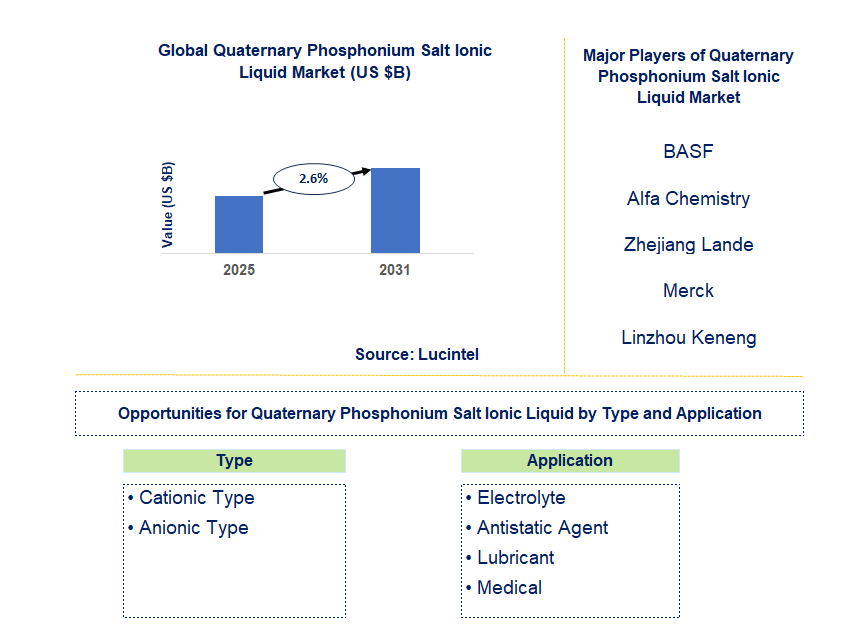
Key data points: The growth forecast = 2.6% annually for the next 7 years. Scroll below to get more insights. This market report covers Trends, opportunities and forecasts in quaternary phosphonium salt ionic liquid market to 2031 by type (cationic type and anionic type), application (electrolyte, antistatic agent, lubricant, and medical), and region (North America, Europe, Asia Pacific, and the Rest of the World)
We'll send your sample report shortly.
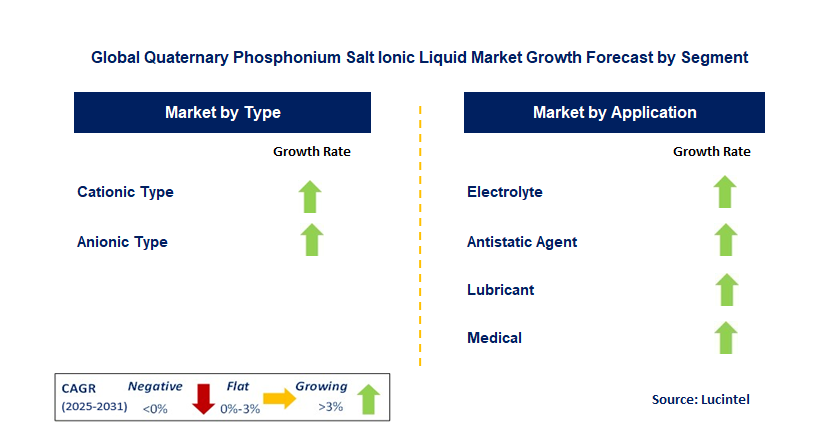
• Lucintel forecasts that, within the type category, cationic type is expected to witness higher growth over the forecast period.
• Within the application category, electrolyte is expected to witness the highest growth.
• In terms of region, APAC is expected to witness the highest growth over the forecast period.
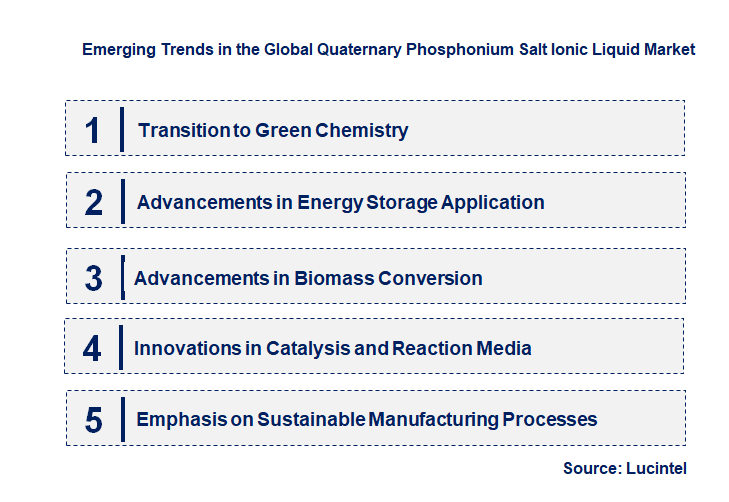
• Transition to Green Chemistry: QPSILs are becoming instrumental in the modern chemical manufacturing landscape as they facilitate the implementation of the principles of green chemistry, making them a sustainable option. The strong focus on sustainability is assisting this shift due to growing global regulations concerning the use of harmful chemicals. In addition, QPSILs inherently possess lower vapor pressure than traditional solvents due to their thermal stability, which leads to a reduction in the use of volatile organic solvents posing risks to the environment and health of employees. Their ability to be recycled in catalytic processes also contributes towards this trend. In parallel, cleaner practices are slowly being adopted by industries, positioning QPSILs as a vital part of streamlined effective chemical processes.
• Advancements in Energy Storage Application: As lithium-ion batteries, redox flow batteries, and supercapacitors evolve, QPSILs are being recognized as high-performance electrolytes. Tis increased interest is due to their high ionic conductivity, wide electrochemical window, and thermal stability which greatly improves the safety and performance of batteries. Manufacturers are working on next generation energy devices to keep up with the global push for renewables and electric mobility. This trend shows how important QPSILs will be in enabling clean energy infrastructure and surpassing the energy density, longevity, and thermal management challenges of the future.
• Advancements in Biomass Conversion: Due to their excellent solvating power, QPSILs are good candidates for biomass dissolution and processing. They can depolymerize lignocellulosic materials into fermentable sugars or platform chemicals without the harsh conditions needed by traditional methods. This is an advantage as it positions QPSILs in leading bio-refinery technology advance, aiding the development of renewables fuels and chemicals. With industries switching towards alternative feedstocks to decrease dependency on fossil fuels, the biomass value addition using QPSILs offers an affordable option that aligns with goals supporting circular economies and carbon neutrality.
• Innovations in Catalysis and Reaction Media: The chemical structure of QPSILs is unique because it allows them to function as both catalysts and solvents. This permits great flexibility in the use of these compounds in synthesis. Researchers are modifying QPSILs by adding specific functional groups to enhance reactivity, improve selectivity, and make catalyst recovery easier. Their self-actors simplify processes and increase efficiency, which is important in the synthesis of pharmaceuticals and fine chemicals. Such trends are advancing the development of cost-effective, greener production methodologies. Their growing adaptability makes them useful throughout industry. With more sophisticated catalysts, QPSILs are expected to make possible new more cleaner transformation and synthesis pathways.
• Emphasis on Sustainable Manufacturing Processes: The impact of the environment and the costs of operations have increased the need for more sustainable ways to produce QPSILs. In order to lower emissions and energy expenditures, companies are now employing greener innovative techniques, such as the use of renewable feedstocks, solvent-free routes, or microwave-assisted reactions. Economical scaling of these methods is still in the works, but they have the potential to reduce the overall carbon footprint of QPSIL production. By shifting focus on sustainability, manufacturers enhance compliance while improving marketability where demand is driven by eco-conscious sourcing and life cycle impact assessments. The dynamics of The quaternary phosphonium salt ionic liquid market are profoundly changing due to new inventions, eco-friendliness, and industrial needs. From supporting green chemical processes and augmenting battery performance to improving biomass processing and catalytic activity, QPSILs are enabling paradigm shifts across industries. These new developments are broadening the scope of applications and considering QPSILs as one of the most important materials to be used in the change towards a low-carbon, circular economy. With increasing industrial and research activity, QPSILs will undoubtedly impact the future of sustainable chemical manufacturing and energy innovations.
• Development of Antimicrobial Activity: Research on QPCs has led to the synthesis of more effective non-polymeric biocidal structures. This class of biocides is much more effective than other existing alternatives. They have meaningful effects for the health and hygiene sectors, as they provide very effective alternatives to other biocidal agents.
• Advances in Chemical and Environmental Engineering: QPs are increasingly used in chemical and environmental engineering, as their surface activity, biocidal activity, and environmental friendliness are valuable in many industrial operations. Their properties are especially useful in the development of environmentally safe solvents and the metal separation and recovery processes.
• Usage in Metal Separation and Recovery: The potential of phosphonium ionic liquids to separate the valuable metals gallium, germanium, and indium from synthetic solutions and waste materials has been demonstrated. This application is especially useful in the context of resource recovery and sustainability, providing effective strategies for the metal recycling processes.
• Development of Oxygen-Containing Quaternary Phosphonium Salts: A particular focus has been the development of oxygen-containing quaternary phosphonium salts (oxy-QPSs), with some studies pointing toward their capacity to increase hydrogen bonding interactions. Their use as solvents and in other processes involving hydrogen bonded, such as cellulose dissolution, have great potential.
• Exploration of Phytochemical-Based Quaternary Phosphonium Conjugates: The design of phytochemical derived triphenyl phosphonium conjugates with potential antimicrobial uses has been accomplished due to innovative research. This development integrates natural product research with synthetic chemistry and represents a step towards development of safer and more effective antimicrobial agents. The latest activity in the quaternary phosphonium salts ionic liquids market indicate a growing activity in the area which seems to be more and more alive. The scope of QPSILs has been broadened with advancements in antimicrobial disturbing tendencies, environmental engineering, metals novel compound synthesis. These developments increase and extend the range of effectiveness and utility of QPSILs, while simultaneously solving important problems related to the environment and health which makes them essential materials in many branches of industry and science.
• Pharmaceutical Industry: QPSILs are capable of enhancing drug delivery systems because they solubilize multiple pharmaceutical compounds and improve their bioavailability. In addition, QPSILs have antimicrobial activities which can also help in the development of new therapeutic agents. Such multiservice able ionic liquids should be further researched and developed as pharmaceutical formulations to create new medicines and advanced drug delivery systems to better serve patients and address their medical needs.
• Agrochemicals: QPSILs can be applied in the agrochemical industry as useful solvents and carriers for herbicides and pesticides, increasing their effectiveness while decreasing environmental pollution. Their biodegradability and low toxicity support the growing demand for sustainable q agriculture around the world. Such formulations based on QPSIL can aid in crop protection and food security across the globe.
• Chemical Manufacturing: QPSIL are useful as phase transfer catalysts in chemical synthesis for underlying simpler reactions. The more efficient dissolution and reaction of compounds achieved by QPSILs could result in cost savings and better processes. These QPSILs can be further developed to enhance chemical manufacturing competitiveness and drive innovation in the economy.
• Environmental Engineering: The recovery and extraction of metals is one area in environmental engineering where the use of QPSILs provides solutions to sustainable waste management. Their selectivity contributes to the circular economy by decreasing the industrial waste footprint. Their accurate separation of valuable metals enhances the waste streams’ and the economy’s oil dependency while reducing environmental impact.
• Energy Storage: Elevated thermal stability and ionic conductivity render QPSILs suitable for use as electrolytes in batteries and supercapacitors among other energy storing devices. The performance, safety, and lifespan of these technologies are also enhanced making them more effective and easing the shift towards renewable energy sources. Quaternary phosphonium salt ionic liquids have an array of strategic growth avenues across diverse sectors, with each sector leveraging on the unique characteristics and functionalities. By focusing on these applications, stakeholders can foster innovation, address specific industry problems, and also work towards achieving sustainable development goals. The QPSILs' versatility makes them key players in technology advancement and in addressing global challenges in several areas.
• BASF
• Alfa Chemistry
• Zhejiang Lande
• Merck
• Linzhou Keneng
• Leyan Reagents
• Lanzhou Greenchem
• Cationic Type
• Anionic Type
• Electrolyte
• Antistatic Agent
• Lubricant
• Medical
• North America
• Europe
• Asia Pacific
• The Rest of the World
• United States: the sustainable green chemistry initiatives by the government have driven research attention towards QPSILs in the United States, focusing on their application in green chemistry. The government has also funded eco-friendly technological initiatives, which has increased R&D expenditure in the area. Energy storage and catalysis are two areas where academic and industrial collaboration is working toward the commercialization of QPSIL-based products. Market dynamics, however, are still influenced by high production costs and regulatory compliance.
• China: The rapid expansion of ionic liquids and QPSILs in China is policy driven, with support coming from the government in the form of advanced material and green technology initiatives. Significant funding has also been made available for the development of new uses in chemicals, pharmaceuticals, and electronics. The country's strong manufacturing capabilities have positioned it as one of the leading QPSIL exporters, fulfilling the growing global demand.
• Germany: Sustainable industrial practices in Germany have greatly assisted in the advancement of QPSIL on a research and application level. The strong chemical industry in Germany is working on the integration of QPSILs towards more eco-friendly practices. Research institutions work with chemical companies to produce advanced materials based on QPSILs. The strong EU regulations are enabling innovations towards safer and sustainable chemicals.
• India: India is increasingly becoming a center for QPSIL research as firms are entering into collaborations and joint ventures. The focus on enhancing ionic liquids and the improvement of several production processes have resulted in novel QPSILs. Government efforts along with international partnerships are aiding in the skilled and technological development, making India competitive in the QPSIL market.
• Japan: In Japan, the QPSIL applications in electronics and energy storage are being highly emphasized due to the technological capabilities in the country. Businesses in Japan are funding research along with the exploration of QPSILs in next-generation batteries and electronic gadgets. Partnerships between academic institutions and business organizations are aimed at solving the problems of scalability and cost for incorporating QPSILs into commercial products.


• BASF
• Alfa Chemistry
• Zhejiang Lande
• Merck
• Linzhou Keneng
• Leyan Reagents
• Lanzhou Greenchem Q5. Which quaternary phosphonium salt ionic liquid market segment will be the largest in future? Answer: Lucintel forecasts that, within the type category, cationic type is expected to witness higher growth over the forecast period. Q6. In quaternary phosphonium salt ionic liquid market, which region is expected to be the largest in next 5 years? Answer: In terms of region, APAC is expected to witness the highest growth over the forecast period. Q7. Do we receive customization in this report? Answer: Yes, Lucintel provides 10% customization without any additional cost.


Choose a license that fits your team. Instant PDF delivery.
Prices exclude taxes. Instant delivery. Custom licensing available on request.
Market Report · July 22, 2026
Market Report · July 22, 2026
Market Report · July 22, 2026
Trusted partner for strategic intelligence and business growth


Receive a complimentary market analysis tailored to your industry. Our analysts will identify key growth opportunities and competitive dynamics specific to your business.

Market size, growth rate, and key trend analysis for your specific sector.

Top competitor positioning and market share analysis.

Strategic recommendations backed by data-driven insights.
Get curated market intelligence and competitive moves straight to your inbox.
By subscribing, you agree to receive our monthly insights. Unsubscribe anytime.
Receive a complimentary market analysis tailored to your industry. Our analysts will identify key growth opportunities and competitive dynamics specific to your business.
Market size, growth rate, and key trend analysis for your specific sector.
Top competitor positioning and market share analysis.
Strategic recommendations backed by data-driven insights.
Get curated market intelligence, emerging trends, and competitive moves straight to your inbox each month.
By subscribing, you agree to receive our monthly insights. Unsubscribe anytime.
We'll send your sample report shortly.