
Surfactant For Personal Care Product Market
The future of the global surfactant for personal care product market looks promising with opportunities in the skin care, hair care and oral care markets. The global surfactant for personal care product market is expected to reach an estimated $16.4 billion by 2035 with a CAGR of 4.8% from 2026 to 2035. The major drivers for this market are the increasing personal care product demand, the rising skincare product consumption and the growing surfactant formulation innovation.
• Lucintel forecasts that, within the type category, nonionic will remain the largest segment over the forecast period as the rising preference for multifunctional surfactant ingredients.
• Within the end use category, skin care will remain the largest segment due to the the growing innovation in anti aging skincare formulations.
• In terms of regions, APAC will remain the largest region over the forecast period due to the the growing skincare cosmetic product innovation.
Gain valuable insights for your business decisions with our comprehensive 150+ page report.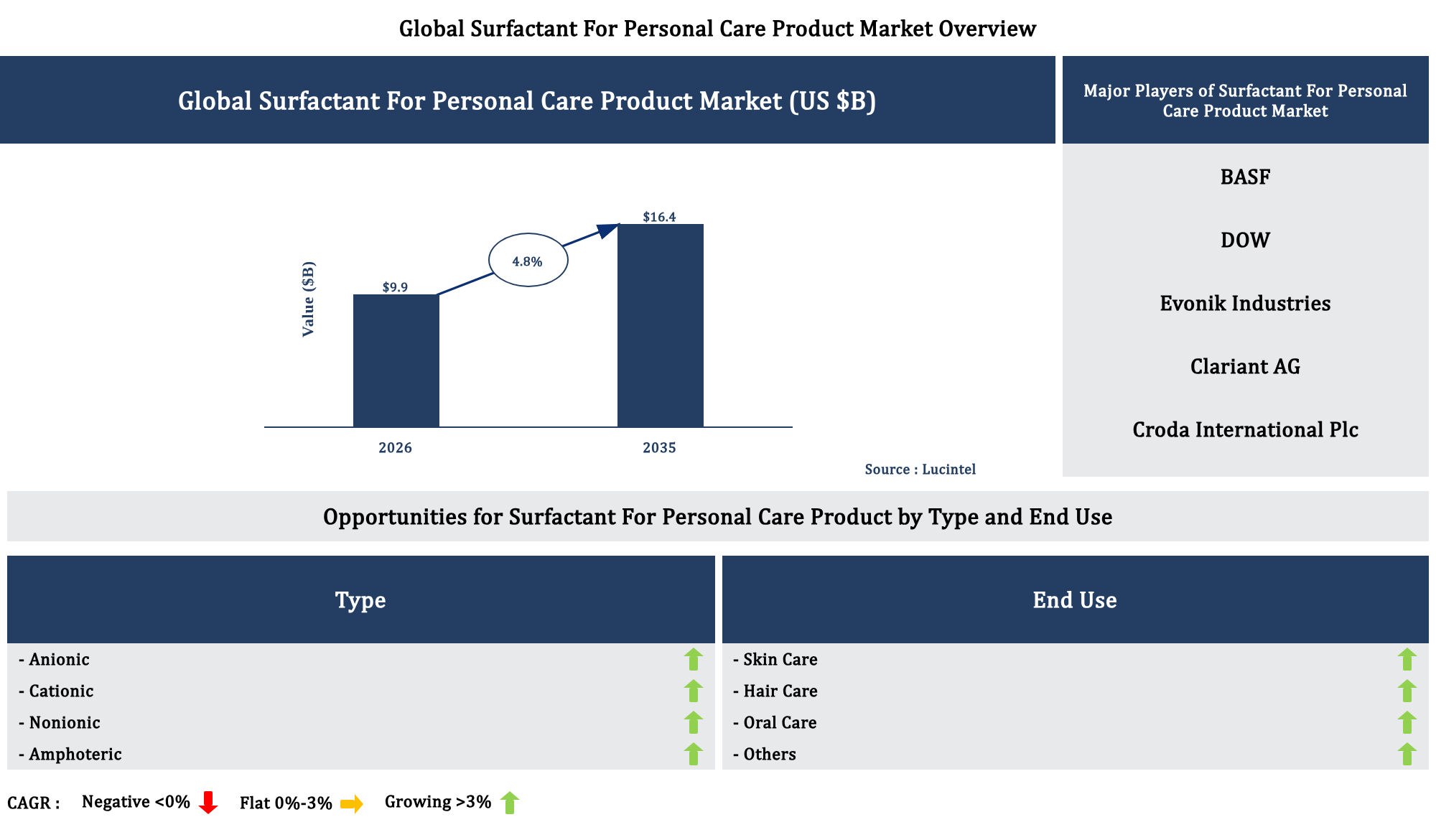
Emerging Trends in the Surfactant For Personal Care Product Market
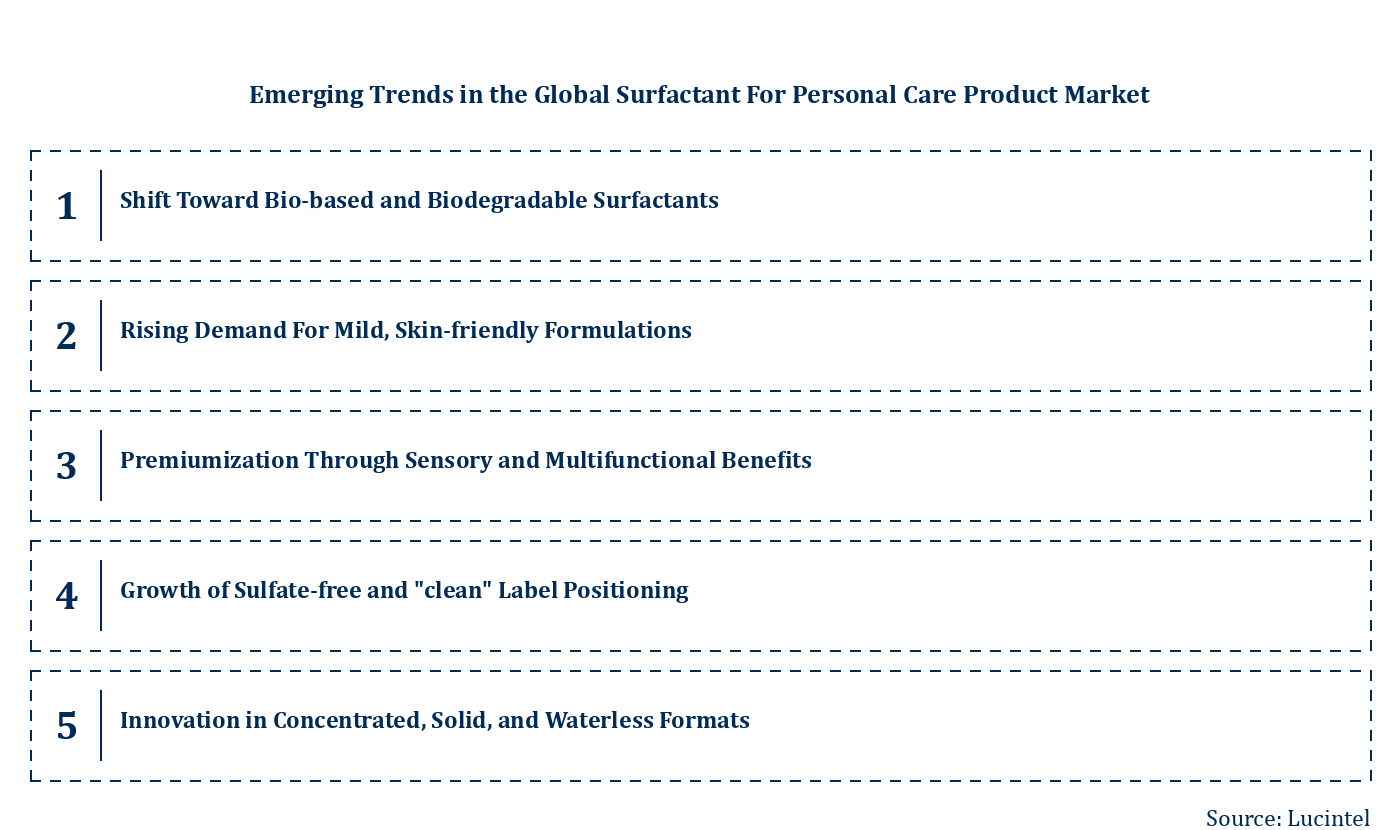
The surfactant for personal care product market is undergoing rapid change as consumers demand safer ingredients, higher performance, and more sustainable value chains. Brands are reformulating haircare, skincare, and hygiene products to balance mildness, foam quality, and environmental impact, while regulators tighten standards on toxicity and biodegradability. Digital-savvy consumers expect transparency on sourcing and claims, pushing manufacturers to innovate in bio-based chemistries and multifunctional systems. At the same time, premium and mass-market segments are converging around sensorial experiences and skin-barrier health. These emerging trends are reshaping product design, supply strategies, and competitive positioning across the global personal care ecosystem.
Recent Developments in the Surfactant For Personal Care Product Market
The surfactant for personal care product market is undergoing notable change as brands, chemical suppliers, and regulators respond to rising consumer expectations and sustainability pressures. Global demand for milder, skin-friendly formulations is accelerating innovation in bio-based and specialty surfactants that can deliver high performance with a cleaner label. At the same time, major producers are reconfiguring supply chains, scaling green manufacturing technologies, and forming strategic collaborations to secure feedstocks and reduce environmental impact. Digital formulation tools and regulatory scrutiny on safety and biodegradability are further shaping product pipelines, pricing dynamics, and competitive positioning across this market.
Strategic Growth Opportunities in the Surfactant For Personal Care Product Market
The surfactant for personal care product market is evolving as consumers demand milder, more sustainable, and higher performing formulations across daily hygiene and beauty routines. Brand owners are reformulating portfolios to align with clean beauty principles, lower environmental impact, and differentiated sensorial experiences. These shifts are opening targeted growth avenues in key application areas, from skin and hair care to oral and male grooming products. Formulators increasingly seek multifunctional, bio-based, and sulfate-free surfactant systems that can support premium positioning while meeting regulatory and retailer requirements. Companies that innovate across these applications can capture attractive, margin-accretive growth.
Surfactant For Personal Care Product Market Drivers and Challenges
The surfactant for personal care product market is shaped by a combination of technological innovation, shifting consumer preferences, economic conditions, and evolving regulatory expectations. Advancements in formulation science, growing demand for multifunctional and sustainable products, and expansion of personal care categories are among the critical forces stimulating growth. At the same time, raw material price volatility, compliance with increasingly stringent safety and environmental standards, and intense competitive pressure create structural constraints. Understanding how these drivers and challenges intersect helps manufacturers, ingredient suppliers, and brands align their R&D, sourcing, and marketing strategies to capture value in this dynamic market.
The factors responsible for driving the surfactant for personal care product market include:
The challenges facing this surfactant for personal care product market include:
Overall, the surfactant for personal care product market is propelled by rising consumer expectations for mild, high-performance, and sustainable products, alongside the expansion of premium segments and emerging markets. These drivers encourage continuous innovation in surfactant chemistry and formulation, supporting long-term growth potential. However, the landscape is complicated by volatile feedstock costs, stringent regulatory scrutiny, and heightened competitive pressure, which together constrain margins and raise operational complexity. Market participants that successfully balance innovation with regulatory compliance, supply chain resilience, and clear value differentiation will be best positioned to capture opportunities and maintain sustainable growth in this evolving sector.
List of Surfactant For Personal Care Product Market Companies
Companies in the market compete on the basis of product quality offered. Major players in this market focus on expanding their manufacturing facilities, R&D investments, infrastructural development, and leverage integration opportunities across the value chain. Through these strategies surfactant for personal care product market companies cater increasing demand, ensure competitive effectiveness, develop innovative products & technologies, reduce production costs, and expand their customer base. Some of the surfactant for personal care product market companies profiled in this report include-
Surfactant For Personal Care Product Market by Segment
The study includes a forecast for the global surfactant for personal care product market by type, end use, and region.
Country Wise Outlook for the Surfactant For Personal Care Product Market
The surfactant for personal care product market is undergoing notable shifts as brands, chemical producers, and regulators respond to changing consumer expectations and sustainability pressures. Across major economies, companies are reformulating portfolios toward milder, bio-based, and sulfate-free surfactants while enhancing performance in low-water and solid-format products. Regulatory scrutiny on ethoxylated and petroleum-derived ingredients is encouraging investment in green chemistry and biodegradable options. At the same time, growth in premium skincare, haircare, and men’s grooming is widening demand for specialized, high-purity surfactants. The following country-level developments illustrate how key markets are repositioning within this evolving landscape.
Features of the Surfactant For Personal Care Product Market
Article
Surfactant For Personal Care Product Market: Which Innovations Will Redefine Performance And Perception?
Dallas, July 17, 2026 – The surfactant for personal care product market is undergoing a rapid shift as formulators, brand owners, and raw material suppliers race to reconcile high performance with sustainability, regulatory scrutiny, and digital-era consumer expectations. From shampoos and facial cleansers to premium cosmetics and intimate hygiene, surfactants sit at the core of texture, foam, mildness, and efficacy. Yet their role is being reimagined as new technologies, bio-based feedstocks, and smart data reshape how products are designed and delivered across the beauty and personal hygiene value chain.
Strategic investors and product leaders are watching this market closely because innovations in surfactant chemistry are beginning to disrupt not only traditional mass-market bath and body categories, but also premium skincare, dermo-cosmetics, and fast-growing e-commerce beauty segments. These shifts are redefining pricing power, brand differentiation, and supply partnerships across regions and channels.
Why Are Sustainable And Bio-Based Surfactants Becoming A Strategic Imperative Rather Than A Niche Choice?
A key trend reshaping the surfactant for personal care product market is the move away from petrochemical-based ingredients toward bio-based and more readily biodegradable systems. Consumer demand for “clean beauty” and sharp increases in corporate sustainability commitments are driving brand portfolios to phase down traditional SLES, SLS, and ethoxylated nonionics in favor of plant-derived and fermentation-based alternatives.
The most significant near-term impact is visible in hair care, facial cleansers, and baby products, where mildness and eco-credentials translate directly into brand value. Over the medium term, this shift will disrupt sourcing models, increase the importance of biotechnology suppliers, and potentially compress margins for legacy petrochemical surfactant producers that do not pivot.
How Is The Push For Ultra-Mild And Skin-Barrier-Friendly Systems Redefining Market Segmentation?
Another major development is the drive toward ultra-mild surfactant systems that respect the skin barrier, microbiome, and scalp health. Consumers are increasingly aware that aggressive surfactants can strip natural lipids, trigger irritation, and worsen chronic conditions such as eczema, acne, and sensitivity.
This focus on skin-barrier protection is shifting value from commodity surfactants toward customized blends and co-developed systems, where ingredient suppliers collaborate closely with brand R&D teams. As a result, technical service capabilities and claims data are becoming as important as price per kilogram in procurement decisions.
Can Concentrated, Solid, And Waterless Formats Change The Economics Of Surfactants In Personal Care?
Disruption is also emerging from format innovation, especially concentrated liquids, bars, powders, and waterless formats that reduce plastic, shipping weight, and packaging waste. These formats rely on surfactants that can deliver stability, foam, and sensorial performance with reduced water content and often under low-preservative conditions.
These innovations are impacting markets such as premium hair care, clean beauty niche brands, and direct-to-consumer start-ups disproportionately, as they can move faster than established legacy brands. Over the coming years, major fast-moving consumer goods players may drive mainstream adoption, pressuring commodity surfactant producers to offer format-tailored solutions rather than generic ingredients.
How Are Digital Tools, Data, And Advanced Analytics Changing Surfactant Design And Application?
Technology-driven innovation is beginning to alter how surfactant systems are discovered, optimized, and positioned, creating important bridges between chemical suppliers and the wider technology ecosystem.
These developments create direct use cases in the technology industry itself. Providers of cloud infrastructure, specialized chemicals informatics, and AI-driven formulation platforms are finding new opportunities in partnering with surfactant manufacturers and major personal care brands. Enterprise software vendors and analytics providers are increasingly involved in ingredient selection and product development workflows, embedding personal care surfactant science into broader digital transformation programs.
Which Market Segments Stand To Gain Most From These Innovations And How Will Competitive Dynamics Shift?
Impact will not be uniform across the surfactant for personal care product market, with some segments likely to capture disproportionate value from innovation.
This shifting landscape will disrupt the traditional value chain where commodity surfactant suppliers sold largely on price and volume. Competitive advantage is migrating toward players that can offer tailored solutions, robust technical support, and co-marketing narratives around sustainability and health. Smaller, technology-savvy and bio-based specialists are increasingly partnering with contract manufacturers and digital-native brands, while integrated chemical majors are investing in biotechnology, acquisitions, and joint development programs to defend share.
What Key Challenges Could Slow Adoption And Where Do The Biggest Opportunities Lie?
Despite clear momentum, the surfactant for personal care product market faces substantial headwinds that could constrain or delay the full potential of these innovations.
At the same time, opportunities are substantial for players able to navigate these constraints strategically.
Which Recent Developments Signal Where The Market Is Heading Next?
Recent announcements and partnerships across the value chain highlight how quickly the surfactant for personal care product market is evolving.
These developments suggest an industry pivot from incremental tweaking to systemic redesign of cleansing and foaming systems. Over the coming years, success in the surfactant for personal care product market will depend not only on chemistry, but also on data, collaboration, and the ability to align ingredient innovation with powerful consumer narratives around health, sustainability, and convenience.
Top 5 Companies
1. BASF
BASF is a leading global chemical company headquartered in Ludwigshafen, Germany and founded in 1865. The company employs more than 110,000 people worldwide and operates production sites and research centers in Europe, North America, Asia Pacific, South America, and the Middle East. Within the surfactant for personal care product market, BASF offers a broad portfolio of anionic, nonionic, cationic, and amphoteric surfactants under its Care Chemicals division, serving applications in skin care, hair care, oral care, sun care, and mild cleansing formulations. Key product lines include sulfate and sulfate-free surfactants, mild amphoacetates, betaines, esterquats, and specialty performance surfactants tailored for premium personal care and baby care products. BASF has expanded its geographic presence in personal care surfactants through investments in Asia Pacific and North America, including capacity expansions for ethoxylates and mild surfactants to serve regional cosmetic and toiletry manufacturers. The company emphasizes sustainable and bio-based surfactants, such as those derived from plant oils and certified renewable feedstocks, to address clean beauty and eco-label demands. BASF actively collaborates with leading personal care brands to co-develop customized surfactant systems for sulfate-free shampoos, micellar cleansers, and high-foam yet gentle body washes. In the context of mergers and acquisitions related to surfactants and personal care, BASF has historically strengthened its portfolio through acquisitions and strategic asset purchases in care chemicals and oleochemical-based surfactant capacities, integrating these businesses into its global Care Chemicals network to enhance formulation expertise and regional supply security for personal care customers.
2. DOW
Dow, headquartered in Midland, Michigan, USA and established in 1897, is a major global materials science company with a comprehensive portfolio serving the personal care surfactant market. The company employs tens of thousands of people across manufacturing, innovation, and commercial sites in North America, Europe, Latin America, and Asia Pacific. Dow’s Consumer Solutions and Industrial Solutions segments supply surfactants and related ingredients for hair care, skin cleansing, bath and shower, facial care, and specialty cosmetic applications. Its surfactant offerings include nonionic and anionic surfactants, specialty polymers with surfactant-like performance, amphoteric surfactants for mild cleansing, and silicone-based surfactant systems that enhance foam, spreadability, and conditioning in shampoos and body washes. Dow has been expanding its geographic presence in high growth regions such as Asia Pacific and Latin America with application centers and production assets designed to localize supply of personal care surfactants and support regional brands with formulation expertise. The company focuses on sulfate-free, low-irritation, and biodegradable surfactant solutions that address consumer trends toward skin-friendly and environmentally responsible products. Dow has pursued portfolio streamlining and selective investments to reinforce its focus segments, and historically it has engaged in joint ventures and divestitures that reshaped its surfactant and specialty chemicals footprint. In the context of surfactants for personal care, the company continues to invest in technology platforms that combine surfactants, silicones, and polymers to deliver multifunctional benefits such as conditioning, foam enhancement, mildness, and sensory improvement tailored for global and local personal care markets.
3. Evonik Industries
Evonik Industries, headquartered in Essen, Germany and formed in 2007, is a specialty chemicals company with roots that trace back over a century through predecessor firms. Evonik employs more than 30,000 people worldwide, operating in Europe, North America, Asia, and other regions. Through its Nutrition and Care division, Evonik is a key supplier of surfactants and related specialties for the personal care industry. Its portfolio includes mild amphoteric surfactants, betaines, ether sulfates, nonionic surfactants, and innovative biosurfactants used in shampoos, shower gels, facial cleansers, baby care, and sensitive skin products. Evonik is known for high-performance and sustainable surfactant technologies, including sugar-based surfactants and rhamnolipid biosurfactants designed to combine cleansing efficiency with biodegradability and skin compatibility. The company has expanded its geographic reach in personal care ingredients through investments and capacity expansions in Europe, Asia, and the Americas, along with regional application labs that support local formulators. Evonik’s acquisitions in personal care and surfactant-related businesses have strengthened its position, including deals that broadened its portfolio of specialty surfactants, emollients, conditioning agents, and actives targeting premium cosmetic and toiletries brands. These moves allow closer integration between surfactants and other personal care ingredients to deliver optimized formulations. Evonik positions itself as a partner for both global consumer product companies and indie brands, offering technical service, regulatory support, and sustainable solution concepts that align with clean beauty, vegan formulations, and eco-label standards in the surfactant for personal care product market.
4. Clariant AG
Clariant AG, headquartered in Pratteln, Switzerland and established in 1995 following the spin-off from Sandoz, is a global specialty chemicals company with a strong presence in personal care ingredients and surfactants. Clariant employs several thousand people and operates production and technical centers in Europe, North America, Latin America, Asia Pacific, and the Middle East and Africa. Within the surfactant for personal care product market, Clariant’s Care Chemicals business offers a wide array of anionic, nonionic, amphoteric, and cationic surfactants, including sulfate and sulfate-free solutions, sugar-based surfactants, betaines, and specialty mild surfactants for skin and hair care. The company emphasizes sustainable surfactants derived from renewable raw materials, RSPO-certified feedstocks, and biodegradable chemistries, meeting demands in natural and clean beauty products. Clariant has expanded geographically by investing in production capacities and application labs in key growth regions such as Asia and Latin America, supporting local manufacturers with formulation know-how and faster supply. Its surfactant portfolio caters to shampoos, conditioners, body washes, facial cleansers, wipes, and baby care formulations, focusing on mildness, foam performance, and sensory attributes. Clariant has engaged in portfolio optimization and selective acquisitions and divestments that sharpened its focus on high-value specialty chemicals, including personal care ingredients. In the surfactant space, the company has leveraged strategic collaborations and technology partnerships to innovate next-generation mild surfactants and multifunctional ingredients that combine cleansing, conditioning, and preservation-friendly profiles tailored for modern personal care formulations worldwide.
5. Croda International Plc
Croda International Plc, headquartered in Goole, East Yorkshire, United Kingdom and founded in 1925, is a specialty chemicals company with a strong emphasis on personal care and life sciences markets. Croda employs several thousand people and has manufacturing and innovation facilities across Europe, North America, Latin America, and Asia Pacific. The company is a prominent supplier of surfactants and related ingredients to the personal care industry through its Beauty Care and Home Care segments. Its surfactant portfolio includes anionic, nonionic, amphoteric, and cationic surfactants, as well as mild and naturally derived surfactants based on fatty acids, sucrose esters, polyglyceryl esters, and amino acid derivatives. These are widely used in shampoos, conditioners, facial cleansers, micellar waters, body washes, sun care emulsions, and color cosmetics. Croda is known for its focus on bio-based and sustainable surfactants, leveraging renewable raw materials and green chemistry principles to meet eco-conscious consumer demands. The company has expanded geographically by investing in regional innovation centers and manufacturing sites in Asia and the Americas, enabling close collaboration with local and global beauty brands. Croda has been active in mergers and acquisitions to enhance its position in personal care and specialty surfactants, including transactions that added high value actives, natural surfactants, and formulation technologies to its portfolio. This strategy allows Croda to offer integrated solutions combining surfactants, emulsifiers, emollients, and actives, supporting customers in developing differentiated, mild, and sustainable personal care products across global markets.
Table of Contents
List of Figures
List of Tables
Methodology
Lucintel has been in the business of market research and management consulting since 2000 and has published over 1000 market intelligence reports in various markets / applications and served over 1,000 clients worldwide. This study is a culmination of four months of full-time effort performed by Lucintel's analyst team. The analysts used the following sources for the creation and completion of this valuable report:
- In-depth interviews of the major players in this market
- Detailed secondary research from competitors' financial statements and published data
- Extensive searches of published works, market, and database information pertaining to industry news, company press releases, and customer intentions
- A compilation of the experiences, judgments, and insights of Lucintel's professionals, who have analyzed and tracked this market over the years.
Extensive research and interviews are conducted across the supply chain of this market to estimate market share, market size, trends, drivers, challenges, and forecasts. Below is a brief summary of the primary interviews that were conducted by job function for this report.

Thus, Lucintel compiles vast amounts of data from numerous sources, validates the integrity of that data, and performs a comprehensive analysis. Lucintel then organizes the data, its findings, and insights into a concise report designed to support the strategic decision-making process. The figure below is a graphical representation of Lucintel's research process.

Buy Now
Choose a license that fits your team. Instant PDF delivery.
Prices exclude taxes. Instant delivery. Custom licensing available on request.
Frequently Asked Questions
What is the Surfactant For Personal Care Product Market size?
What is the growth forecast for Surfactant For Personal Care Product Market?
What are the major drivers influencing the growth of the Surfactant For Personal Care Product Market?
What are the major segments for Surfactant For Personal Care Product Market?
Who are the key Surfactant For Personal Care Product Market companies?
Which Surfactant For Personal Care Product Market segment will be the largest in future?
In Surfactant For Personal Care Product Market, which region is expected to be the largest in next 9 years?
Do we receive customization in this report?
Key Questions
- • What are some of the most promising, high-growth opportunities for the Surfactant For Personal Care Product Market by Type (Anionic, Cationic, Nonionic, and Amphoteric), End Use (Skin Care, Hair Care, Oral Care, and Others), and region (North America, Europe, Asia Pacific, and the Rest of the World)?
- • Which segments will grow at a faster pace and why?
- • Which region will grow at a faster pace and why?
- • What are the key factors affecting market dynamics? What are the key challenges and business risks in this market?
- • What are the business risks and competitive threats in this market?
- • What are the emerging trends in this market and the reasons behind them?
- • What are some of the changing demands of customers in the market?
- • What are the new developments in the market? Which companies are leading these developments?
- • Who are the major players in this market? What strategic initiatives are key players pursuing for business growth?
- • What are some of the competing products in this market and how big of a threat do they pose for loss of market share by material or product substitution?
- • What M&A activity has occurred in the last 9 years, and what has its impact been on the industry?


