
Market Report · July 15, 2026

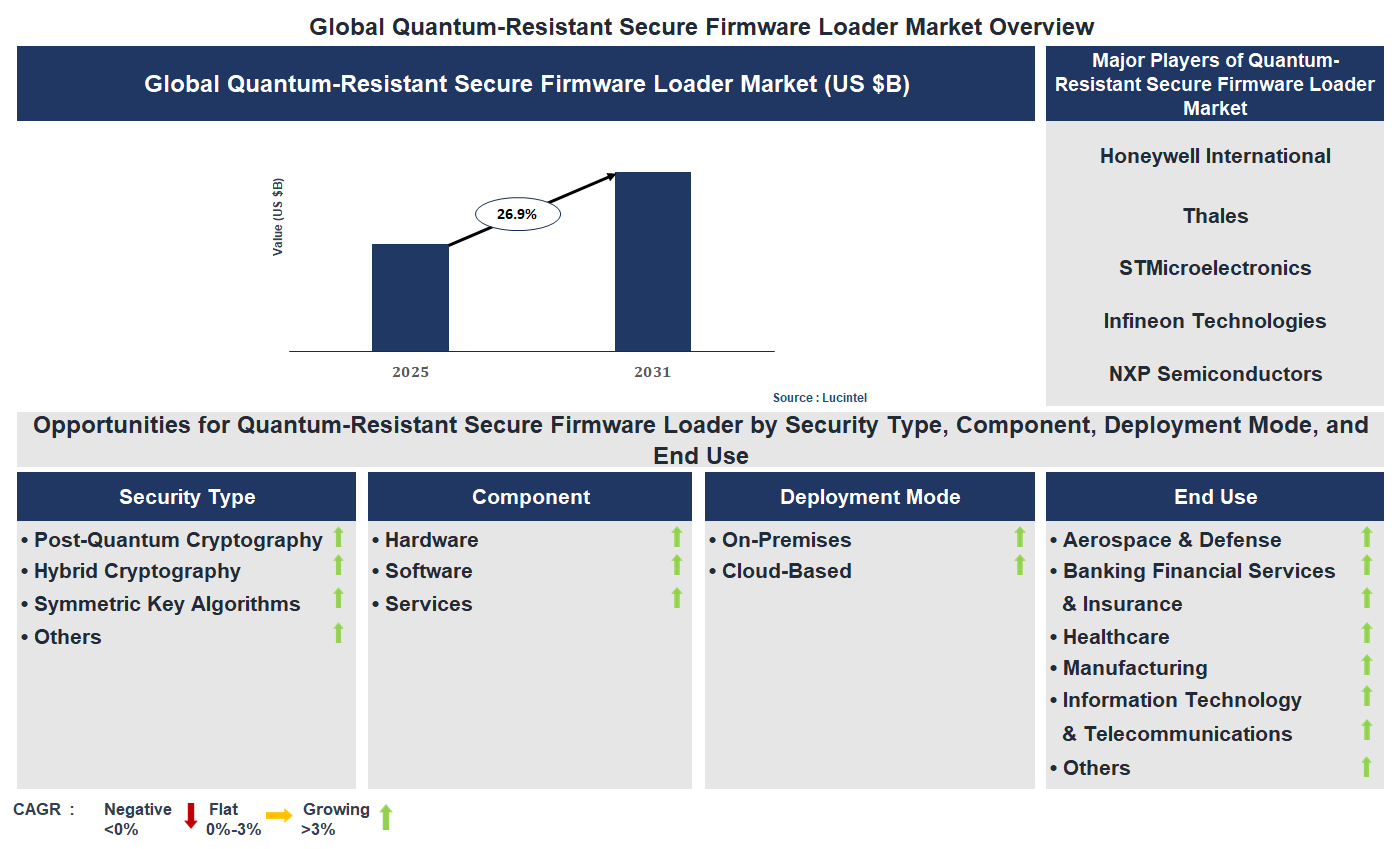
Key data points: The growth forecast = 26.9% annually for the next 7 years. Scroll below to get more insights. This market report covers trends, opportunities and forecasts in quantum-resistant secure firmware loader market to 2031 by security type (post-quantum cryptography, hybrid cryptography, symmetric key algorithms, and others), component (hardware, software, and services), deployment mode (on-premises and cloud-based), end use (aerospace & defense, banking financial services & insurance, healthcare, manufacturing, information technology & telecommunications, and others), and region (North America, Europe, Asia Pacific, and the Rest of the World)
We'll send your sample report shortly.
• Lucintel forecasts that, within the security type category, post-quantum cryptography is expected to witness the highest growth over the forecast period.
• Within the end use category, information technology & telecommunication is expected to witness the highest growth.
• In terms of region, North America is expected to witness the highest growth over the forecast period. Gain valuable insights for your business decisions with our comprehensive 150+ page report. Sample figures with some insights are shown below.
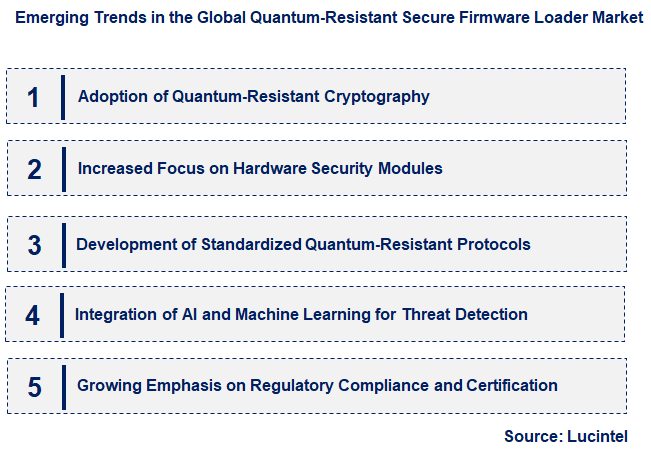
• Adoption of Quantum-Resistant Cryptography: The market is witnessing a significant shift towards integrating quantum-resistant cryptographic algorithms such as lattice-based, hash-based, and multivariate cryptography. These algorithms are designed to withstand attacks from quantum computers, which threaten traditional encryption methods. This trend enhances the security of firmware loaders by ensuring data confidentiality and integrity even in the presence of powerful quantum adversaries. As standards and regulations evolve, organizations are proactively adopting these algorithms to future-proof their firmware security infrastructure, making this a critical trend shaping the market’s future.
• Increased Focus on Hardware Security Modules: Hardware security modules are gaining prominence as a means to securely store cryptographic keys and perform sensitive operations. In the context of quantum-resistant firmware loaders, HSMs provide a tamper-proof environment that enhances overall security. They prevent unauthorized access and key extraction, which is crucial as firmware updates and authentication processes become more complex. The integration of HSMs into firmware loading processes is driven by the need for robust physical and logical security, making hardware-based solutions a key trend that bolsters trust and resilience in firmware security systems.
• Development of Standardized Quantum-Resistant Protocols: Industry and government bodies are actively working on establishing standardized protocols for quantum-resistant security. These standards aim to ensure interoperability, security, and compliance across different systems and devices. The development of such protocols influences the firmware loader market by providing clear guidelines for implementing quantum-resistant security measures. This trend promotes widespread adoption, reduces implementation risks, and accelerates the deployment of secure firmware solutions, ultimately fostering a more secure digital ecosystem resistant to future quantum threats.
• Integration of AI and Machine Learning for Threat Detection: Artificial intelligence and machine learning are increasingly being integrated into firmware security solutions to detect and respond to threats proactively. These technologies analyze patterns and anomalies in firmware operations, identifying potential security breaches or malicious activities in real-time. In the quantum-resistant firmware loader market, AI-driven threat detection enhances resilience by providing adaptive security measures that evolve with emerging threats. This trend improves the overall security posture, reduces response times, and helps organizations stay ahead of sophisticated cyberattacks targeting firmware components.
• Growing Emphasis on Regulatory Compliance and Certification: As quantum-resistant security solutions become more prevalent, regulatory bodies are establishing compliance frameworks and certification standards. These standards ensure that firmware loaders meet specific security criteria, fostering trust among users and stakeholders. The market is witnessing increased demand for certified solutions that adhere to these evolving regulations, which in turn drives innovation and quality improvements. This trend underscores the importance of compliance in market growth, encouraging vendors to develop certified, reliable, and standardized quantum-resistant firmware loading solutions to meet global security requirements. In summary, these emerging trends are collectively transforming the quantum-resistant secure firmware loader market by enhancing security, fostering standardization, and integrating advanced technologies. They are ensuring that firmware security keeps pace with the rapid evolution of quantum computing capabilities, ultimately creating a more resilient and trustworthy digital infrastructure.
• Adoption of Post-Quantum Cryptography Algorithms: The integration of quantum-resistant algorithms like lattice-based and hash-based cryptography enhances firmware security, making devices resistant to quantum attacks and increasing market confidence.
• Strategic Collaborations and Partnerships: Major tech firms and cybersecurity providers are forming alliances to develop standardized, scalable quantum-resistant firmware loaders, accelerating market adoption and innovation.
• Regulatory and Standardization Initiatives: Governments and industry bodies are establishing guidelines and standards for quantum-resistant firmware, fostering a secure ecosystem and encouraging market growth.
• Expansion into New Sectors: The market is expanding beyond traditional sectors into healthcare, automotive, and IoT, driven by the need for secure firmware updates in increasingly connected devices.
• Advancements in Firmware Management Platforms: Development of sophisticated, user-friendly firmware management solutions with embedded quantum-resistant security features is improving deployment efficiency and security assurance. These developments are significantly impacting the quantum-resistant secure firmware loader market by increasing security robustness, fostering innovation, and broadening application scope. The market is becoming more resilient to future quantum threats, ensuring long-term data integrity and device security across various industries.
• Enhanced security for 5G infrastructure : As 5G networks expand, securing firmware updates becomes vital to prevent malicious attacks, ensuring reliable communication and data integrity in telecom systems.
• Protecting critical systems : Quantum-resistant firmware loaders will safeguard avionics, satellite systems, and defense equipment from quantum-enabled cyber threats, maintaining national security and operational integrity.
• Securing medical devices : With increasing connectivity of medical devices, implementing quantum-resistant firmware loaders will prevent unauthorized access and ensure patient safety through secure firmware updates.
• Safeguarding industrial control systems : As factories adopt IoT and automation, quantum-resistant firmware loaders will protect critical infrastructure from cyberattacks, ensuring operational continuity and safety.
• Securing firmware in virtual environments : The rise of cloud computing necessitates secure firmware loading solutions to prevent breaches in virtualized environments, maintaining data integrity and trust. These growth opportunities are significantly impacting the quantum-resistant secure firmware loader market by driving innovation, increasing demand for secure firmware management, and fostering resilience against future quantum-enabled cyber threats across diverse applications.
• Growing Threat of Quantum Computing Attacks: The imminent rise of quantum computing poses significant risks to traditional cryptographic algorithms used in firmware security. As quantum capabilities develop, cybercriminals could potentially decrypt sensitive firmware data, leading to data breaches and system compromises. This threat accelerates the demand for quantum-resistant cryptographic solutions, prompting manufacturers to develop firmware loaders that can withstand quantum attacks. The urgency to safeguard critical infrastructure and IoT devices further fuels this demand, making quantum-resistant firmware loaders essential for future-proof security architectures.
• Increasing Adoption of IoT and Embedded Systems: The proliferation of IoT devices and embedded systems across industries such as healthcare, manufacturing, and automotive necessitates secure firmware updates. These devices often operate in sensitive environments and are vulnerable to cyber threats. Quantum-resistant firmware loaders enable secure, reliable firmware updates, ensuring device integrity and preventing malicious tampering. As organizations prioritize cybersecurity in their digital transformation strategies, the demand for advanced firmware loading solutions that can support secure updates in resource-constrained environments continues to grow, driving market expansion.
• Stringent Regulatory and Compliance Standards: Governments and industry bodies are implementing strict cybersecurity regulations to protect critical infrastructure and data privacy. Regulations such as GDPR, NIST guidelines, and sector-specific standards mandate robust security measures, including secure firmware management. Quantum-resistant firmware loaders help organizations comply with these standards by providing enhanced cryptographic security for firmware updates. The increasing regulatory pressure compels companies to adopt advanced security solutions, thereby propelling market growth and encouraging innovation in quantum-resistant firmware loading technologies.
• Technological Advancements in Cryptography: Innovations in post-quantum cryptography are pivotal in developing secure firmware loaders capable of resisting quantum attacks. Researchers are designing new algorithms that can replace traditional cryptographic methods vulnerable to quantum decryption. These advancements enable the development of firmware loaders that incorporate quantum-resistant algorithms, ensuring long-term security. The continuous evolution of cryptographic techniques fosters confidence among stakeholders and accelerates the deployment of secure firmware solutions, thus significantly impacting market growth positively.
• Rising Investments in Cybersecurity Infrastructure: The increasing allocation of funds by governments, private enterprises, and technology providers toward cybersecurity infrastructure underscores the importance of secure firmware management. Investments are directed toward developing and deploying quantum-resistant security solutions to safeguard digital assets. This financial backing accelerates research, development, and adoption of advanced firmware loaders capable of resisting quantum threats. As cybersecurity budgets expand, the market for quantum-resistant firmware loaders is expected to grow substantially, driven by the need to protect sensitive data and maintain operational integrity in a rapidly evolving threat landscape. The challenges in the quantum-resistant secure firmware loader market are:
• High Implementation Costs: Deploying quantum-resistant firmware loaders involves significant investment in new cryptographic algorithms, hardware, and software infrastructure. Organizations may face financial constraints, especially small and medium-sized enterprises, hindering widespread adoption. The costs associated with upgrading existing systems, training personnel, and ensuring compatibility with legacy devices can be substantial. These financial barriers slow down market penetration and delay the realization of full security benefits, posing a major challenge for vendors and users alike.
• Lack of Standardization and Interoperability: The absence of universally accepted standards for quantum-resistant cryptography complicates the development and deployment of firmware loaders. Variability in algorithms and protocols can lead to compatibility issues across different devices and platforms. This fragmentation hampers seamless integration and increases the complexity of ensuring secure firmware updates. Without standardized frameworks, organizations may hesitate to adopt new solutions, fearing vendor lock-in or operational disruptions, which impedes market growth and innovation.
• Technological Maturity and Validation: Quantum-resistant cryptographic algorithms are still in developmental stages, with ongoing research to validate their security and efficiency. The lack of mature, thoroughly tested algorithms poses risks related to potential vulnerabilities and performance bottlenecks. Implementing unproven solutions can lead to system failures or security breaches, undermining trust in quantum-resistant firmware loaders. The need for extensive testing, certification, and validation processes delays market adoption and increases uncertainty among stakeholders, presenting a significant challenge to rapid deployment. In summary, the quantum-resistant secure firmware loader market is shaped by critical drivers such as the threat of quantum computing attacks, the expansion of IoT, regulatory mandates, cryptographic innovations, and increased cybersecurity investments. However, challenges like high implementation costs, lack of standardization, and technological immaturity pose hurdles to widespread adoption. These factors collectively influence the markets evolution, requiring strategic efforts to overcome barriers and harness opportunities. The markets future growth hinges on technological advancements, regulatory support, and cost-effective solutions that can deliver resilient firmware security in a quantum-enabled world.
• Honeywell International
• Thales
• STMicroelectronics
• Infineon Technologies
• NXP Semiconductors
• Microchip Technology
• Entrust Corporation
• Kudelski
• Rambus
• Utimaco Management Services
• Post-Quantum Cryptography
• Hybrid Cryptography
• Symmetric Key Algorithms
• Others
• Hardware
• Software
• Services
• On-Premises
• Cloud-Based
• Aerospace & Defense
• Banking Financial Services & Insurance
• Healthcare
• Manufacturing
• Information Technology & Telecommunications
• Others
• North America
• Europe
• Asia Pacific
• The Rest of the World
• United States: The US has made significant investments in quantum-resistant cybersecurity, with major tech firms developing firmware solutions that incorporate post-quantum cryptography. Government agencies are also establishing standards and frameworks to ensure secure firmware updates, fostering collaboration between industry and academia to accelerate innovation.
• China: China is rapidly advancing in quantum technology, integrating quantum-resistant firmware into critical infrastructure and military systems. The government has launched national projects to develop secure communication channels and firmware loaders resistant to quantum attacks, emphasizing sovereignty and security.
• Germany: Germanys focus lies in integrating quantum-resistant firmware within its industrial and automotive sectors. The country’s research institutions are collaborating with industry leaders to develop standards and practical implementations, aiming to enhance cybersecurity resilience across European markets.
• India: India is actively investing in quantum technology research, with initiatives aimed at developing secure firmware loaders resistant to quantum threats. The government is promoting public-private partnerships to foster innovation and ensure the adoption of quantum-resistant security solutions across vital sectors.
• Japan: Japan is emphasizing the development of quantum-resistant firmware solutions for its manufacturing and financial industries. The country’s strategic focus includes establishing national standards and collaborating with international partners to ensure interoperability and security in a quantum future.


• Honeywell International
• Thales
• STMicroelectronics
• Infineon Technologies
• NXP Semiconductors
• Microchip Technology
• Entrust Corporation
• Kudelski
• Rambus
• Utimaco Management Services Q5. Which quantum-resistant secure firmware loader market segment will be the largest in future? Answer: Lucintel forecasts that, within the security type category, post-quantum cryptography is expected to witness the highest growth over the forecast period. Q6. In quantum-resistant secure firmware loader market, which region is expected to be the largest in next 5 years? Answer: In terms of region, North America is expected to witness the highest growth over the forecast period. Q7. Do we receive customization in this report? Answer: Yes, Lucintel provides 10% customization without any additional cost.


Choose a license that fits your team. Instant PDF delivery.
Prices exclude taxes. Instant delivery. Custom licensing available on request.
Market Report · July 15, 2026
Market Report · June 26, 2026
Market Report · June 24, 2026
Trusted partner for strategic intelligence and business growth


Receive a complimentary market analysis tailored to your industry. Our analysts will identify key growth opportunities and competitive dynamics specific to your business.

Market size, growth rate, and key trend analysis for your specific sector.

Top competitor positioning and market share analysis.

Strategic recommendations backed by data-driven insights.
Get curated market intelligence and competitive moves straight to your inbox.
By subscribing, you agree to receive our monthly insights. Unsubscribe anytime.
Receive a complimentary market analysis tailored to your industry. Our analysts will identify key growth opportunities and competitive dynamics specific to your business.
Market size, growth rate, and key trend analysis for your specific sector.
Top competitor positioning and market share analysis.
Strategic recommendations backed by data-driven insights.
Get curated market intelligence, emerging trends, and competitive moves straight to your inbox each month.
By subscribing, you agree to receive our monthly insights. Unsubscribe anytime.
We'll send your sample report shortly.