
Close Lucintel Chat
Didn't Find What You're Looking for?
Call us at +1972 636 5056 or write at helpdesk@Lucintel.com
Ask an Expert Provide Custom Requirements Download Sample Report Search Available Reports
  • helpdesk@Lucintel.com
  • |
  • Call Lucintel +1 972 636 5056
  • |
  • Login
  • |
  • Register
  • |
  • Search
  • |
'
...

The Impact of COVID-19 is included in Proximity Payment Market Report. Buy it today to get an advantage.

Request the impact of COVID-19 on your product or industry


Proximity Payment Market Trends and Forecast

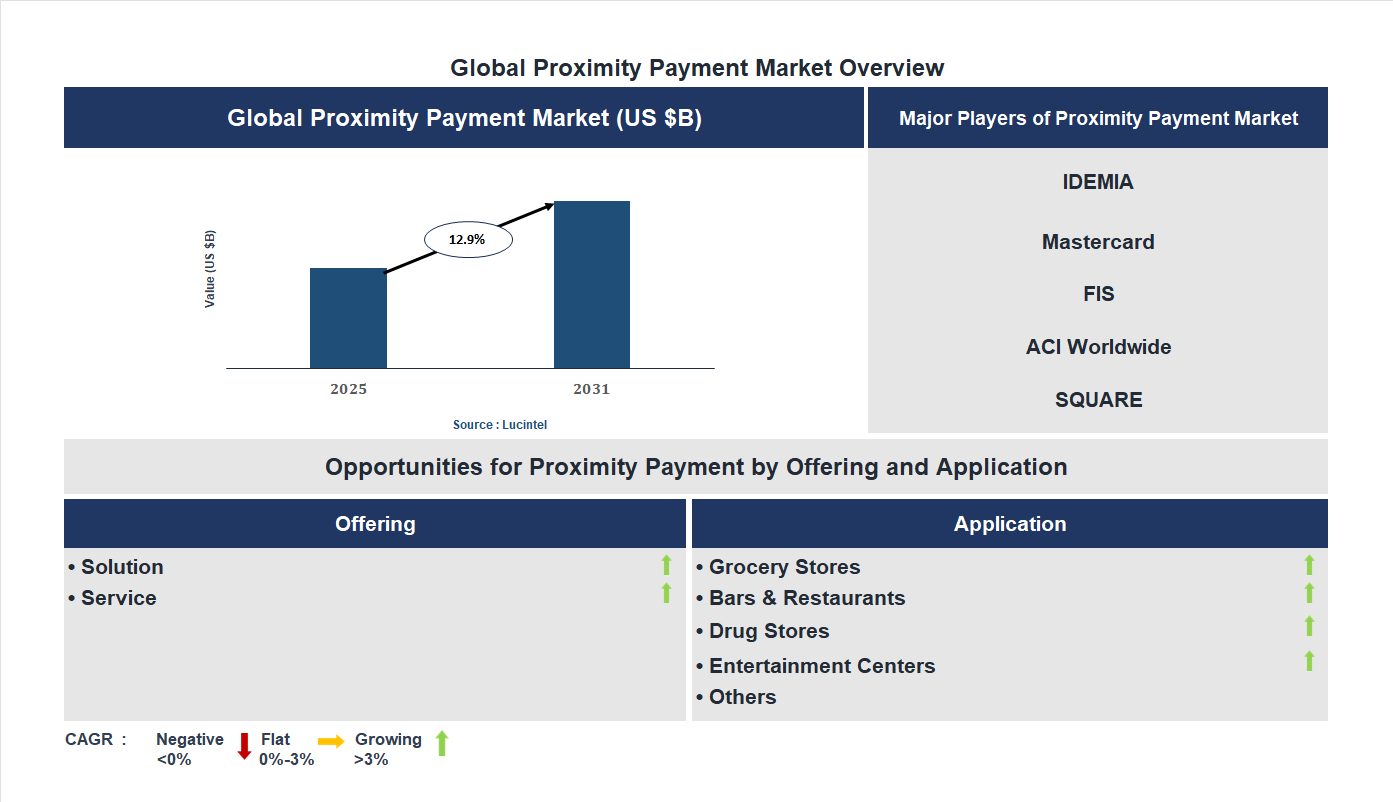
The future of the global proximity payment market looks promising with opportunities in the grocery store, bar & restaurant, drug store, and entertainment center markets. The global proximity payment market is expected to grow with a CAGR of 12.9% from 2025 to 2031. The major drivers for this market are the increasing use of smartphones for payments, the rising demand for secure digital payment solutions, and the growing adoption of contactless payment systems.

• Lucintel forecasts that, within the offering category, service is expected to witness higher growth over the forecast period.
• Within the application category, grocery store is expected to witness the highest growth.
• In terms of region, APAC is expected to witness the highest growth over the forecast period.
Gain valuable insights for your business decisions with our comprehensive 150+ page report. Sample figures with some insights are shown below.
Proximity Payment Market Trends and Forecast

Emerging Trends in the Proximity Payment Market

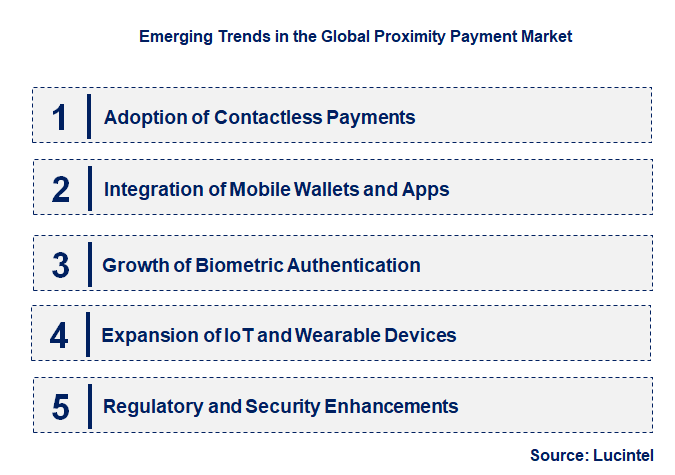
The proximity payment market is experiencing rapid evolution driven by technological advancements, changing consumer preferences, and the increasing demand for seamless, contactless transactions. As digital payment solutions become more integrated into daily life, key trends are emerging that are shaping the future landscape of this industry. These developments are not only enhancing user convenience but also influencing merchant strategies, regulatory frameworks, and technological innovations. Understanding these trends is essential for stakeholders aiming to stay competitive and capitalize on new opportunities in proximity payments. The following five key trends highlight the current and future directions of this dynamic market.

• Adoption of Contactless Payments: The rise of NFC and RFID technologies has made contactless payments more popular among consumers. This trend is driven by the need for quick, hygienic, and convenient transaction methods, especially post-pandemic. Retailers and service providers are increasingly integrating contactless options to enhance customer experience and reduce transaction times. The widespread acceptance of smartphones and wearable devices further accelerates this shift, making contactless payments a standard feature in many sectors. This trend is expected to continue expanding as technology becomes more affordable and user-friendly.
• Integration of Mobile Wallets and Apps: Mobile wallets like Apple Pay, Google Pay, and Samsung Pay are gaining traction as primary payment methods. These apps offer secure, easy-to-use platforms that store multiple payment options, loyalty cards, and coupons. Their integration with banking and financial services simplifies the checkout process and enhances security through biometric authentication. The convenience and added functionalities are driving consumer adoption, especially among younger demographics. Retailers benefit from increased transaction speed and data insights. This trend is transforming traditional payment methods into comprehensive digital ecosystems, fostering greater customer engagement and loyalty.
• Growth of Biometric Authentication: Biometric technologies such as fingerprint scanning, facial recognition, and iris scanning are increasingly used to authorize proximity payments. These methods provide enhanced security and reduce fraud risks, addressing consumer concerns about data breaches. The seamless nature of biometric authentication improves user experience by enabling quick, contactless transactions without the need for PINs or passwords. Financial institutions and merchants are investing heavily in biometric solutions to meet regulatory standards and improve security protocols. As biometric tech becomes more affordable and accurate, its adoption in proximity payments is expected to grow significantly.
• Expansion of IoT and Wearable Devices: The proliferation of Internet of Things (IoT) devices and wearables like smartwatches, fitness bands, and connected accessories is expanding the reach of proximity payments. These devices enable users to make transactions effortlessly without carrying physical cards or smartphones. The convenience of tap-and-go payments through wearables is appealing to busy consumers and enhances the overall user experience. Retailers and service providers are leveraging this trend to offer innovative payment solutions, improve customer engagement, and gather valuable data. The integration of IoT in proximity payments is set to redefine how consumers interact with digital financial services.
• Regulatory and Security Enhancements: As proximity payments grow, regulatory frameworks are evolving to address security, privacy, and interoperability concerns. Governments and industry bodies are implementing standards to ensure secure transactions, data protection, and consumer rights. Enhanced security measures such as tokenization, encryption, and multi-factor authentication are becoming standard to prevent fraud and cyber threats. These regulatory developments foster consumer trust and facilitate cross-border transactions. The focus on security and compliance is crucial for the sustainable growth of the proximity payment market, encouraging wider adoption and innovation while safeguarding user interests.

In summary, these emerging trends are collectively transforming the proximity payment market by making transactions faster, more secure, and more integrated into daily life. They are driving innovation, improving customer experiences, and expanding market reach, ultimately reshaping how consumers and businesses engage with digital financial services.
Emerging Trends in the Proximity Payment Market

Recent Development in the Proximity Payment Market

The proximity payment market has experienced significant growth driven by technological advancements, changing consumer preferences, and increasing adoption of contactless payment solutions. As digital transactions become more prevalent, key developments are shaping the future landscape of this industry. These innovations are enhancing user convenience, security, and operational efficiency, thereby expanding market reach across various sectors. The evolving regulatory environment and integration of emerging technologies like NFC and RFID are also influencing market dynamics. Understanding these recent developments is crucial for stakeholders aiming to capitalize on emerging opportunities and navigate potential challenges in this rapidly evolving market.

• Adoption of NFC Technology: The widespread integration of Near Field Communication (NFC) technology has revolutionized proximity payments by enabling quick, contactless transactions. This development has increased consumer convenience and reduced transaction times, leading to higher adoption rates across retail, transportation, and hospitality sectors. Enhanced security features associated with NFC have also boosted consumer confidence, further accelerating market growth. As more devices and payment terminals support NFC, the market is expected to see sustained expansion, especially in urban areas and developed regions.
• Rise of Mobile Wallets and Digital Payment Apps: The proliferation of mobile wallets and digital payment applications has significantly contributed to market growth. These platforms offer seamless, secure, and quick payment options, often integrating loyalty programs and offers. The convenience of using smartphones for proximity payments has attracted a broad consumer base, including younger demographics. Financial institutions and tech companies are investing heavily in developing user-friendly interfaces and security protocols, which are driving increased adoption and expanding the market footprint globally.
• Integration of Contactless Payment in Public Transportation: Public transportation systems worldwide are increasingly adopting contactless payment solutions to enhance passenger experience and operational efficiency. This development reduces cash handling, speeds up boarding processes, and minimizes physical contact, which is especially relevant during health crises like the COVID-19 pandemic. The integration of contactless payments in transit systems has expanded market opportunities, encouraging transit authorities and vendors to invest in compatible infrastructure, thereby fostering market growth and technological innovation.
• Regulatory Enhancements and Security Protocols: Governments and regulatory bodies are implementing stricter standards and protocols to ensure secure proximity payments. These measures include data encryption, tokenization, and compliance with global security standards such as PCI DSS. Enhanced regulations have increased consumer trust and reduced fraud risks, encouraging wider adoption. Simultaneously, they have prompted market players to innovate and upgrade their security systems, which has positively impacted the overall reliability and growth of the proximity payment market.
• Emergence of Contactless Payment Wearables: The introduction of wearable devices like smartwatches and fitness bands supporting contactless payments has opened new avenues for market expansion. These devices offer added convenience by enabling quick transactions without the need for smartphones or cards. The trend is particularly popular among tech-savvy consumers and in sectors like sports and fitness. The development of secure, user-friendly wearables is expected to further boost market penetration, especially in regions with high smartphone penetration and digital literacy.

In summary, these recent developments are collectively driving the growth of the proximity payment market by enhancing convenience, security, and operational efficiency. The adoption of advanced technologies and regulatory improvements are fostering consumer trust and expanding market opportunities. As these trends continue, the market is poised for sustained growth, with increased adoption across various sectors and regions.

Strategic Growth Opportunities in the Proximity Payment Market

The proximity payment market is experiencing rapid expansion driven by technological advancements, increasing consumer demand for convenience, and the proliferation of contactless payment solutions. As digital transactions become more prevalent, key applications such as retail, transportation, hospitality, healthcare, and banking are witnessing significant growth opportunities. These developments are reshaping how consumers and businesses interact, emphasizing speed, security, and seamless experiences. Companies that capitalize on these opportunities can gain competitive advantages and expand their market share. The following are five key growth opportunities across major applications in the proximity payment market, each poised to influence the industry landscape profoundly.

• Retail: Enhanced Customer Experience : Integration of proximity payments in retail settings enables faster checkouts and personalized shopping experiences, increasing customer satisfaction and loyalty. Retailers adopting contactless solutions can reduce wait times and improve operational efficiency, leading to higher sales and improved customer retention.
• Transportation: Contactless Transit Payments : Implementing proximity payment systems in public transportation facilitates quick, cashless fare transactions. This reduces congestion and wait times at stations, improves operational efficiency, and encourages more commuters to opt for public transit, thereby expanding the market.
• Hospitality: Streamlined Service Delivery : Contactless payments in hotels and restaurants enable swift billing and check-in/check-out processes. This enhances guest experiences, reduces staff workload, and promotes safety by minimizing physical contact, driving increased adoption in the hospitality sector.
• Healthcare: Secure Payment Solutions : Proximity payments in healthcare settings allow for quick, contactless billing and patient transactions. This improves operational efficiency, enhances patient safety by reducing contact points, and supports compliance with hygiene standards, fostering growth in healthcare applications.
• Banking: Digital Wallet Expansion : The integration of proximity payments with digital wallets and mobile banking apps broadens access to financial services. This promotes financial inclusion, accelerates cashless transactions, and attracts new customer segments, fueling market growth.

In summary, these growth opportunities across retail, transportation, hospitality, healthcare, and banking are significantly transforming the proximity payment market. They enhance user convenience, improve operational efficiencies, and foster innovation, ultimately driving widespread adoption and market expansion. As these applications evolve, the market is poised for sustained growth, driven by technological advancements and changing consumer preferences.

Proximity Payment Market Driver and Challenges

The proximity payment market is influenced by a variety of technological, economic, and regulatory factors that shape its growth and development. Advances in mobile technology, increasing consumer demand for convenient payment options, and supportive government policies are key drivers. However, the market also faces challenges such as security concerns, regulatory complexities, and technological integration issues. Understanding these drivers and challenges is essential for stakeholders to navigate the evolving landscape effectively and capitalize on emerging opportunities.

The factors responsible for driving the proximity payment market include:-
• Technological Advancements: The rapid evolution of mobile devices, contactless payment technologies, and near-field communication (NFC) standards have significantly enhanced the ease and speed of proximity payments. These innovations enable seamless transactions, encouraging both consumers and merchants to adopt contactless solutions. As technology continues to improve, the market benefits from increased reliability, security, and user experience, fostering widespread acceptance and growth.
• Rising Consumer Preference for Convenience: Consumers increasingly seek quick, secure, and contactless payment options to streamline their shopping experiences. The proliferation of smartphones and wearable devices has made proximity payments more accessible and appealing. This shift in consumer behavior is driven by busy lifestyles and the desire for frictionless transactions, which in turn propels merchants to adopt proximity payment solutions to meet customer expectations.
• Growing Retail and E-commerce Adoption: Retailers and e-commerce platforms are integrating proximity payment options to enhance customer engagement and loyalty. The adoption of contactless payments in retail outlets, restaurants, and entertainment venues facilitates faster checkouts and reduces queues. This trend is supported by the expansion of digital infrastructure and the need for innovative payment methods to stay competitive in a rapidly evolving market landscape.
• Supportive Regulatory Environment: Governments and regulatory bodies worldwide are implementing policies to promote digital payments and ensure secure transactions. Initiatives such as standardization of contactless payment protocols, data protection laws, and incentives for digital adoption create a favorable environment for market growth. These regulations help build consumer trust and encourage wider acceptance of proximity payment solutions.

The challenges in the proximity payment market are:
• Security and Fraud Risks: Despite technological advancements, security concerns remain a significant barrier. The risk of data breaches, card skimming, and identity theft can undermine consumer confidence. Ensuring robust encryption, authentication, and fraud detection measures is critical, but the evolving nature of cyber threats poses ongoing challenges for providers and users alike.
• Regulatory and Compliance Complexities: Navigating diverse regulatory frameworks across different regions can be complicated and costly. Variations in data privacy laws, transaction standards, and licensing requirements create hurdles for market players seeking to expand globally. Compliance demands significant resources and can delay product launches or market entry.
• Technological Integration and Interoperability Issues: Integrating proximity payment solutions with existing point-of-sale (POS) systems and ensuring interoperability across devices and platforms can be complex. Fragmented standards and lack of universal acceptance hinder seamless transactions, limiting widespread adoption. Overcoming these technical barriers requires significant investment and collaboration among stakeholders.

In summary, the proximity payment market is driven by technological innovations, consumer demand for convenience, retail adoption, and supportive regulations. However, security concerns, regulatory complexities, and technical integration challenges pose significant hurdles. These factors collectively influence the market’s trajectory, requiring stakeholders to innovate and adapt continuously. The overall impact is a dynamic landscape with substantial growth potential, provided that challenges are effectively managed to foster trust and interoperability.

List of Proximity Payment Companies

Companies in the market compete on the basis of product quality offered. Major players in this market focus on expanding their manufacturing facilities, R&D investments, infrastructural development, and leverage integration opportunities across the value chain. With these strategies proximity payment companies cater increasing demand, ensure competitive effectiveness, develop innovative products & technologies, reduce production costs, and expand their customer base. Some of the proximity payment companies profiled in this report include-
• IDEMIA
• Mastercard
• FIS
• ACI Worldwide
• SQUARE
• INGENICO
• PayPal Holdings
• APPLE
• Visa
• Alphabet

Proximity Payment Market by Segment

The study includes a forecast for the global proximity payment market by offering, application, and region.

Proximity Payment Market by Offering [Value from 2019 to 2031]:


• Solution
• Service

Proximity Payment Market by Application [Value from 2019 to 2031]:


• Grocery Stores
• Bars & Restaurants
• Drug Stores
• Entertainment Centers
• Others

Proximity Payment Market by Region [Value from 2019 to 2031]:


• North America
• Europe
• Asia Pacific
• The Rest of the World

Country Wise Outlook for the Proximity Payment Market

The proximity payment market has experienced rapid growth driven by technological advancements, increasing consumer demand for convenience, and the proliferation of contactless payment solutions. As digital transformation accelerates globally, countries are adopting innovative payment methods to enhance user experience and security. Regulatory changes, partnerships between financial institutions and tech firms, and the expansion of mobile payment infrastructure are shaping the landscape. Each country’s unique economic and technological environment influences its market development, leading to diverse strategies and adoption rates. Understanding these regional trends is crucial for stakeholders aiming to capitalize on the evolving proximity payment ecosystem.

• United States: The US market has seen significant growth in contactless and mobile payment adoption, driven by major tech companies like Apple Pay, Google Pay, and Samsung Pay. Retailers are increasingly integrating NFC-enabled payment terminals, and regulatory support has enhanced security standards. The pandemic accelerated contactless transactions, with consumers prioritizing hygiene and convenience. Fintech startups are innovating with biometric authentication and digital wallets, further expanding the market. Partnerships between banks and tech firms are fostering broader acceptance, and government initiatives are promoting digital payment infrastructure.
• China: China leads in proximity payments, with Alipay and WeChat Pay dominating the landscape. The widespread adoption of QR code-based payments has made cashless transactions ubiquitous in daily life. The government’s push for digital currency development, including the Digital Yuan, is shaping future payment trends. Retailers and small businesses widely accept mobile payments, supported by extensive merchant networks. Innovations in facial recognition and AI are enhancing payment security and user experience. The rapid digitalization, combined with a large tech-savvy population, continues to propel China’s proximity payment market forward.
• Germany: Germany’s proximity payment market is growing steadily, with a focus on contactless card payments and mobile solutions like Apple Pay and Google Pay. The country emphasizes security and privacy, leading to cautious adoption of new technologies. Banks are investing in upgrading POS terminals and digital infrastructure. Consumer awareness about data protection influences market strategies. Retailers are increasingly adopting contactless options, especially in urban areas. The government’s support for digital transformation and EU regulations on data privacy are shaping the development of secure and compliant proximity payment solutions.
• India: India’s proximity payment market is expanding rapidly, driven by government initiatives like Digital India and the Unified Payments Interface (UPI). Mobile wallets such as Paytm, PhonePe, and Google Pay are widely used, especially in rural and semi-urban areas. The adoption of QR code-based payments is high due to affordability and ease of use. Financial inclusion efforts are boosting digital transaction volumes. Fintech startups are innovating with biometric authentication and micro-ATM solutions. The market’s growth is supported by increasing smartphone penetration and supportive regulatory policies, making India a key player in proximity payments.
• Japan: Japan’s proximity payment market is experiencing gradual growth, with a focus on contactless card and mobile payments. Major banks and credit card companies are expanding NFC-enabled services. The adoption of mobile payment apps like Line Pay and Rakuten Pay is increasing, especially among younger consumers. The country’s emphasis on security and privacy influences technology choices. Retailers are upgrading POS systems to support contactless transactions. Government initiatives promoting cashless payments, along with collaborations between financial institutions and tech firms, are fostering market expansion. The aging population’s preferences for convenience are also influencing market trends.

Lucintel Analytics Dashboard

Features of the Global Proximity Payment Market

Market Size Estimates: Proximity payment market size estimation in terms of value ($B).
Trend and Forecast Analysis: Market trends (2019 to 2024) and forecast (2025 to 2031) by various segments and regions.
Segmentation Analysis: Proximity payment market size by offering, application, and region in terms of value ($B).
Regional Analysis: Proximity payment market breakdown by North America, Europe, Asia Pacific, and Rest of the World.
Growth Opportunities: Analysis of growth opportunities in different offerings, applications, and regions for the proximity payment market.
Strategic Analysis: This includes M&A, new product development, and competitive landscape of the proximity payment market.
Analysis of competitive intensity of the industry based on Porter’s Five Forces model.

Lucintel Consulting Services

FAQ

Q1. What is the growth forecast for proximity payment market?
Answer: The global proximity payment market is expected to grow with a CAGR of 12.9% from 2025 to 2031.
Q2. What are the major drivers influencing the growth of the proximity payment market?
Answer: The major drivers for this market are the increasing use of smartphones for payments, the rising demand for secure digital payment solutions, and the growing adoption of contactless payment systems.
Q3. What are the major segments for proximity payment market?
Answer: The future of the proximity payment market looks promising with opportunities in the grocery store, bar & restaurant, drug store, and entertainment center markets.
Q4. Who are the key proximity payment market companies?
Answer: Some of the key proximity payment companies are as follows:
• IDEMIA
• Mastercard
• FIS
• ACI Worldwide
• SQUARE
• INGENICO
• PayPal Holdings
• APPLE
• Visa
• Alphabet
Q5. Which proximity payment market segment will be the largest in future?
Answer: Lucintel forecasts that, within the offering category, service is expected to witness higher growth over the forecast period.
Q6. In proximity payment market, which region is expected to be the largest in next 5 years?
Answer: In terms of region, APAC is expected to witness the highest growth over the forecast period.
Q7. Do we receive customization in this report?
Answer: Yes, Lucintel provides 10% customization without any additional cost.

This report answers following 11 key questions:

Q.1. What are some of the most promising, high-growth opportunities for the proximity payment market by offering (solution and service), application (grocery stores, bars & restaurants, drug stores, entertainment centers, and others), and region (North America, Europe, Asia Pacific, and the Rest of the World)?
Q.2. Which segments will grow at a faster pace and why?
Q.3. Which region will grow at a faster pace and why?
Q.4. What are the key factors affecting market dynamics? What are the key challenges and business risks in this market?
Q.5. What are the business risks and competitive threats in this market?
Q.6. What are the emerging trends in this market and the reasons behind them?
Q.7. What are some of the changing demands of customers in the market?
Q.8. What are the new developments in the market? Which companies are leading these developments?
Q.9. Who are the major players in this market? What strategic initiatives are key players pursuing for business growth?
Q.10. What are some of the competing products in this market and how big of a threat do they pose for loss of market share by material or product substitution?
Q.11. What M&A activity has occurred in the last 5 years and what has its impact been on the industry?

For any questions related to Proximity Payment Market, Proximity Payment Market Size, Proximity Payment Market Growth, Proximity Payment Market Analysis, Proximity Payment Market Report, Proximity Payment Market Share, Proximity Payment Market Trends, Proximity Payment Market Forecast, Proximity Payment Companies, write Lucintel analyst at email: helpdesk@lucintel.com. We will be glad to get back to you soon.
                                           Table of Contents

            1. Executive Summary

            2. Market Overview

                        2.1 Background and Classifications
                        2.2 Supply Chain

            3. Market Trends & Forecast Analysis

                        3.1 Macroeconomic Trends and Forecasts
                        3.2 Industry Drivers and Challenges
                        3.3 PESTLE Analysis
                        3.4 Patent Analysis
                        3.5 Regulatory Environment
                        3.6 Global Proximity Payment Market Trends and Forecast

            4. Global Proximity Payment Market by Offering

                        4.1 Overview
                        4.2 Attractiveness Analysis by Offering
                        4.3 Solution : Trends and Forecast 2025 to 2031
                        4.4 Service : Trends and Forecast 2025 to 2031

            5. Global Proximity Payment Market by Application

                        5.1 Overview
                        5.2 Attractiveness Analysis by Application
                        5.3 Grocery Stores : Trends and Forecast 2025 to 2031
                        5.4 Bars & Restaurants : Trends and Forecast 2025 to 2031
                        5.5 Drug Stores : Trends and Forecast 2025 to 2031
                        5.6 Entertainment Centers : Trends and Forecast 2025 to 2031
                        5.7 Others : Trends and Forecast 2025 to 2031

            6. Regional Analysis

                        6.1 Overview
                        6.2 Global Proximity Payment Market by Region

            7. North American Proximity Payment Market

                        7.1 Overview
                        7.2 North American Proximity Payment Market by Offering
                        7.3 North American Proximity Payment Market by Application
                        7.4 The United States Proximity Payment Market
                        7.5 Canadian Proximity Payment Market
                        7.6 Mexican Proximity Payment Market

            8. European Proximity Payment Market

                        8.1 Overview
                        8.2 European Proximity Payment Market by Offering
                        8.3 European Proximity Payment Market by Application
                        8.4 German Proximity Payment Market
                        8.5 French Proximity Payment Market
                        8.6 Italian Proximity Payment Market
                        8.7 Spanish Proximity Payment Market
                        8.8 The United Kingdom Proximity Payment Market

            9. APAC Proximity Payment Market

                        9.1 Overview
                        9.2 APAC Proximity Payment Market by Offering
                        9.3 APAC Proximity Payment Market by Application
                        9.4 Chinese Proximity Payment Market
                        9.5 Indian Proximity Payment Market
                        9.6 Japanese Proximity Payment Market
                        9.7 South Korean Proximity Payment Market
                        9.8 Indonesian Proximity Payment Market

            10. ROW Proximity Payment Market

                        10.1 Overview
                        10.2 ROW Proximity Payment Market by Offering
                        10.3 ROW Proximity Payment Market by Application
                        10.4 Middle Eastern Proximity Payment Market
                        10.5 South American Proximity Payment Market
                        10.6 African Proximity Payment Market

            11. Competitor Analysis

                        11.1 Product Portfolio Analysis
                        11.2 Operational Integration
                        11.3 Porter’s Five Forces Analysis
                                    • Competitive Rivalry
                                    • Bargaining Power of Buyers
                                    • Bargaining Power of Suppliers
                                    • Threat of Substitutes
                                    • Threat of New Entrants
                        11.4 Market Share Analysis

            12. Opportunities & Strategic Analysis

                        12.1 Value Chain Analysis
                        12.2 Growth Opportunity Analysis
                                    12.2.1 Growth Opportunity by Offering
                                    12.2.2 Growth Opportunity by Application
                        12.3 Emerging Trends in the Global Proximity Payment Market
                        12.4 Strategic Analysis
                                    12.4.1 New Product Development
                                    12.4.2 Certification and Licensing
                                    12.4.3 Mergers, Acquisitions, Agreements, Collaborations, and Joint Ventures

            13. Company Profiles of the Leading Players Across the Value Chain

                        13.1 Competitive Analysis Overview
                        13.2 IDEMIA
                                    • Company Overview
                                    • Proximity Payment Market Business Overview
                                    • New Product Development
                                    • Merger, Acquisition, and Collaboration
                                    • Certification and Licensing
                        13.3 Mastercard
                                    • Company Overview
                                    • Proximity Payment Market Business Overview
                                    • New Product Development
                                    • Merger, Acquisition, and Collaboration
                                    • Certification and Licensing
                        13.4 FIS
                                    • Company Overview
                                    • Proximity Payment Market Business Overview
                                    • New Product Development
                                    • Merger, Acquisition, and Collaboration
                                    • Certification and Licensing
                        13.5 ACI Worldwide
                                    • Company Overview
                                    • Proximity Payment Market Business Overview
                                    • New Product Development
                                    • Merger, Acquisition, and Collaboration
                                    • Certification and Licensing
                        13.6 SQUARE
                                    • Company Overview
                                    • Proximity Payment Market Business Overview
                                    • New Product Development
                                    • Merger, Acquisition, and Collaboration
                                    • Certification and Licensing
                        13.7 INGENICO
                                    • Company Overview
                                    • Proximity Payment Market Business Overview
                                    • New Product Development
                                    • Merger, Acquisition, and Collaboration
                                    • Certification and Licensing
                        13.8 PayPal Holdings
                                    • Company Overview
                                    • Proximity Payment Market Business Overview
                                    • New Product Development
                                    • Merger, Acquisition, and Collaboration
                                    • Certification and Licensing
                        13.9 APPLE
                                    • Company Overview
                                    • Proximity Payment Market Business Overview
                                    • New Product Development
                                    • Merger, Acquisition, and Collaboration
                                    • Certification and Licensing
                        13.10 Visa
                                    • Company Overview
                                    • Proximity Payment Market Business Overview
                                    • New Product Development
                                    • Merger, Acquisition, and Collaboration
                                    • Certification and Licensing
                        13.11 Alphabet
                                    • Company Overview
                                    • Proximity Payment Market Business Overview
                                    • New Product Development
                                    • Merger, Acquisition, and Collaboration
                                    • Certification and Licensing

            14. Appendix

                        14.1 List of Figures
                        14.2 List of Tables
                        14.3 Research Methodology
                        14.4 Disclaimer
                        14.5 Copyright
                        14.6 Abbreviations and Technical Units
                        14.7 About Us
                        14.8 Contact Us

                                               List of Figures


            Chapter 1

                        Figure 1.1: Trends and Forecast for the Global Proximity Payment Market

            Chapter 2

                        Figure 2.1: Usage of Proximity Payment Market
                        Figure 2.2: Classification of the Global Proximity Payment Market
                        Figure 2.3: Supply Chain of the Global Proximity Payment Market

            Chapter 3

                        Figure 3.1: Trends of the Global GDP Growth Rate
                        Figure 3.2: Trends of the Global Population Growth Rate
                        Figure 3.3: Trends of the Global Inflation Rate
                        Figure 3.4: Trends of the Global Unemployment Rate
                        Figure 3.5: Trends of the Regional GDP Growth Rate
                        Figure 3.6: Trends of the Regional Population Growth Rate
                        Figure 3.7: Trends of the Regional Inflation Rate
                        Figure 3.8: Trends of the Regional Unemployment Rate
                        Figure 3.9: Trends of Regional Per Capita Income
                        Figure 3.10: Forecast for the Global GDP Growth Rate
                        Figure 3.11: Forecast for the Global Population Growth Rate
                        Figure 3.12: Forecast for the Global Inflation Rate
                        Figure 3.13: Forecast for the Global Unemployment Rate
                        Figure 3.14: Forecast for the Regional GDP Growth Rate
                        Figure 3.15: Forecast for the Regional Population Growth Rate
                        Figure 3.16: Forecast for the Regional Inflation Rate
                        Figure 3.17: Forecast for the Regional Unemployment Rate
                        Figure 3.18: Forecast for Regional Per Capita Income
                        Figure 3.19: Driver and Challenges of the Proximity Payment Market

            Chapter 4

                        Figure 4.1: Global Proximity Payment Market by Offering in 2019, 2024, and 2031
                        Figure 4.2: Trends of the Global Proximity Payment Market ($B) by Offering
                        Figure 4.3: Forecast for the Global Proximity Payment Market ($B) by Offering
                        Figure 4.4: Trends and Forecast for Solution in the Global Proximity Payment Market (2019-2031)
                        Figure 4.5: Trends and Forecast for Service in the Global Proximity Payment Market (2019-2031)

            Chapter 5

                        Figure 5.1: Global Proximity Payment Market by Application in 2019, 2024, and 2031
                        Figure 5.2: Trends of the Global Proximity Payment Market ($B) by Application
                        Figure 5.3: Forecast for the Global Proximity Payment Market ($B) by Application
                        Figure 5.4: Trends and Forecast for Grocery Stores in the Global Proximity Payment Market (2019-2031)
                        Figure 5.5: Trends and Forecast for Bars & Restaurants in the Global Proximity Payment Market (2019-2031)
                        Figure 5.6: Trends and Forecast for Drug Stores in the Global Proximity Payment Market (2019-2031)
                        Figure 5.7: Trends and Forecast for Entertainment Centers in the Global Proximity Payment Market (2019-2031)
                        Figure 5.8: Trends and Forecast for Others in the Global Proximity Payment Market (2019-2031)

            Chapter 6

                        Figure 6.1: Trends of the Global Proximity Payment Market ($B) by Region (2019-2024)
                        Figure 6.2: Forecast for the Global Proximity Payment Market ($B) by Region (2025-2031)

            Chapter 7

                        Figure 7.1: Trends and Forecast for the North American Proximity Payment Market (2019-2031)
                        Figure 7.2: North American Proximity Payment Market by Offering in 2019, 2024, and 2031
                        Figure 7.3: Trends of the North American Proximity Payment Market ($B) by Offering (2019-2024)
                        Figure 7.4: Forecast for the North American Proximity Payment Market ($B) by Offering (2025-2031)
                        Figure 7.5: North American Proximity Payment Market by Application in 2019, 2024, and 2031
                        Figure 7.6: Trends of the North American Proximity Payment Market ($B) by Application (2019-2024)
                        Figure 7.7: Forecast for the North American Proximity Payment Market ($B) by Application (2025-2031)
                        Figure 7.8: Trends and Forecast for the United States Proximity Payment Market ($B) (2019-2031)
                        Figure 7.9: Trends and Forecast for the Mexican Proximity Payment Market ($B) (2019-2031)
                        Figure 7.10: Trends and Forecast for the Canadian Proximity Payment Market ($B) (2019-2031)

            Chapter 8

                        Figure 8.1: Trends and Forecast for the European Proximity Payment Market (2019-2031)
                        Figure 8.2: European Proximity Payment Market by Offering in 2019, 2024, and 2031
                        Figure 8.3: Trends of the European Proximity Payment Market ($B) by Offering (2019-2024)
                        Figure 8.4: Forecast for the European Proximity Payment Market ($B) by Offering (2025-2031)
                        Figure 8.5: European Proximity Payment Market by Application in 2019, 2024, and 2031
                        Figure 8.6: Trends of the European Proximity Payment Market ($B) by Application (2019-2024)
                        Figure 8.7: Forecast for the European Proximity Payment Market ($B) by Application (2025-2031)
                        Figure 8.8: Trends and Forecast for the German Proximity Payment Market ($B) (2019-2031)
                        Figure 8.9: Trends and Forecast for the French Proximity Payment Market ($B) (2019-2031)
                        Figure 8.10: Trends and Forecast for the Spanish Proximity Payment Market ($B) (2019-2031)
                        Figure 8.11: Trends and Forecast for the Italian Proximity Payment Market ($B) (2019-2031)
                        Figure 8.12: Trends and Forecast for the United Kingdom Proximity Payment Market ($B) (2019-2031)

            Chapter 9

                        Figure 9.1: Trends and Forecast for the APAC Proximity Payment Market (2019-2031)
                        Figure 9.2: APAC Proximity Payment Market by Offering in 2019, 2024, and 2031
                        Figure 9.3: Trends of the APAC Proximity Payment Market ($B) by Offering (2019-2024)
                        Figure 9.4: Forecast for the APAC Proximity Payment Market ($B) by Offering (2025-2031)
                        Figure 9.5: APAC Proximity Payment Market by Application in 2019, 2024, and 2031
                        Figure 9.6: Trends of the APAC Proximity Payment Market ($B) by Application (2019-2024)
                        Figure 9.7: Forecast for the APAC Proximity Payment Market ($B) by Application (2025-2031)
                        Figure 9.8: Trends and Forecast for the Japanese Proximity Payment Market ($B) (2019-2031)
                        Figure 9.9: Trends and Forecast for the Indian Proximity Payment Market ($B) (2019-2031)
                        Figure 9.10: Trends and Forecast for the Chinese Proximity Payment Market ($B) (2019-2031)
                        Figure 9.11: Trends and Forecast for the South Korean Proximity Payment Market ($B) (2019-2031)
                        Figure 9.12: Trends and Forecast for the Indonesian Proximity Payment Market ($B) (2019-2031)

            Chapter 10

                        Figure 10.1: Trends and Forecast for the ROW Proximity Payment Market (2019-2031)
                        Figure 10.2: ROW Proximity Payment Market by Offering in 2019, 2024, and 2031
                        Figure 10.3: Trends of the ROW Proximity Payment Market ($B) by Offering (2019-2024)
                        Figure 10.4: Forecast for the ROW Proximity Payment Market ($B) by Offering (2025-2031)
                        Figure 10.5: ROW Proximity Payment Market by Application in 2019, 2024, and 2031
                        Figure 10.6: Trends of the ROW Proximity Payment Market ($B) by Application (2019-2024)
                        Figure 10.7: Forecast for the ROW Proximity Payment Market ($B) by Application (2025-2031)
                        Figure 10.8: Trends and Forecast for the Middle Eastern Proximity Payment Market ($B) (2019-2031)
                        Figure 10.9: Trends and Forecast for the South American Proximity Payment Market ($B) (2019-2031)
                        Figure 10.10: Trends and Forecast for the African Proximity Payment Market ($B) (2019-2031)

            Chapter 11

                        Figure 11.1: Porter’s Five Forces Analysis of the Global Proximity Payment Market
                        Figure 11.2: Market Share (%) of Top Players in the Global Proximity Payment Market (2024)

            Chapter 12

                        Figure 12.1: Growth Opportunities for the Global Proximity Payment Market by Offering
                        Figure 12.2: Growth Opportunities for the Global Proximity Payment Market by Application
                        Figure 12.3: Growth Opportunities for the Global Proximity Payment Market by Region
                        Figure 12.4: Emerging Trends in the Global Proximity Payment Market

                                               List of Tables


            Chapter 1

                        Table 1.1: Growth Rate (%, 2023-2024) and CAGR (%, 2025-2031) of the Proximity Payment Market by Offering and Application
                        Table 1.2: Attractiveness Analysis for the Proximity Payment Market by Region
                        Table 1.3: Global Proximity Payment Market Parameters and Attributes

            Chapter 3

                        Table 3.1: Trends of the Global Proximity Payment Market (2019-2024)
                        Table 3.2: Forecast for the Global Proximity Payment Market (2025-2031)

            Chapter 4

                        Table 4.1: Attractiveness Analysis for the Global Proximity Payment Market by Offering
                        Table 4.2: Market Size and CAGR of Various Offering in the Global Proximity Payment Market (2019-2024)
                        Table 4.3: Market Size and CAGR of Various Offering in the Global Proximity Payment Market (2025-2031)
                        Table 4.4: Trends of Solution in the Global Proximity Payment Market (2019-2024)
                        Table 4.5: Forecast for Solution in the Global Proximity Payment Market (2025-2031)
                        Table 4.6: Trends of Service in the Global Proximity Payment Market (2019-2024)
                        Table 4.7: Forecast for Service in the Global Proximity Payment Market (2025-2031)

            Chapter 5

                        Table 5.1: Attractiveness Analysis for the Global Proximity Payment Market by Application
                        Table 5.2: Market Size and CAGR of Various Application in the Global Proximity Payment Market (2019-2024)
                        Table 5.3: Market Size and CAGR of Various Application in the Global Proximity Payment Market (2025-2031)
                        Table 5.4: Trends of Grocery Stores in the Global Proximity Payment Market (2019-2024)
                        Table 5.5: Forecast for Grocery Stores in the Global Proximity Payment Market (2025-2031)
                        Table 5.6: Trends of Bars & Restaurants in the Global Proximity Payment Market (2019-2024)
                        Table 5.7: Forecast for Bars & Restaurants in the Global Proximity Payment Market (2025-2031)
                        Table 5.8: Trends of Drug Stores in the Global Proximity Payment Market (2019-2024)
                        Table 5.9: Forecast for Drug Stores in the Global Proximity Payment Market (2025-2031)
                        Table 5.10: Trends of Entertainment Centers in the Global Proximity Payment Market (2019-2024)
                        Table 5.11: Forecast for Entertainment Centers in the Global Proximity Payment Market (2025-2031)
                        Table 5.12: Trends of Others in the Global Proximity Payment Market (2019-2024)
                        Table 5.13: Forecast for Others in the Global Proximity Payment Market (2025-2031)

            Chapter 6

                        Table 6.1: Market Size and CAGR of Various Regions in the Global Proximity Payment Market (2019-2024)
                        Table 6.2: Market Size and CAGR of Various Regions in the Global Proximity Payment Market (2025-2031)

            Chapter 7

                        Table 7.1: Trends of the North American Proximity Payment Market (2019-2024)
                        Table 7.2: Forecast for the North American Proximity Payment Market (2025-2031)
                        Table 7.3: Market Size and CAGR of Various Offering in the North American Proximity Payment Market (2019-2024)
                        Table 7.4: Market Size and CAGR of Various Offering in the North American Proximity Payment Market (2025-2031)
                        Table 7.5: Market Size and CAGR of Various Application in the North American Proximity Payment Market (2019-2024)
                        Table 7.6: Market Size and CAGR of Various Application in the North American Proximity Payment Market (2025-2031)
                        Table 7.7: Trends and Forecast for the United States Proximity Payment Market (2019-2031)
                        Table 7.8: Trends and Forecast for the Mexican Proximity Payment Market (2019-2031)
                        Table 7.9: Trends and Forecast for the Canadian Proximity Payment Market (2019-2031)

            Chapter 8

                        Table 8.1: Trends of the European Proximity Payment Market (2019-2024)
                        Table 8.2: Forecast for the European Proximity Payment Market (2025-2031)
                        Table 8.3: Market Size and CAGR of Various Offering in the European Proximity Payment Market (2019-2024)
                        Table 8.4: Market Size and CAGR of Various Offering in the European Proximity Payment Market (2025-2031)
                        Table 8.5: Market Size and CAGR of Various Application in the European Proximity Payment Market (2019-2024)
                        Table 8.6: Market Size and CAGR of Various Application in the European Proximity Payment Market (2025-2031)
                        Table 8.7: Trends and Forecast for the German Proximity Payment Market (2019-2031)
                        Table 8.8: Trends and Forecast for the French Proximity Payment Market (2019-2031)
                        Table 8.9: Trends and Forecast for the Spanish Proximity Payment Market (2019-2031)
                        Table 8.10: Trends and Forecast for the Italian Proximity Payment Market (2019-2031)
                        Table 8.11: Trends and Forecast for the United Kingdom Proximity Payment Market (2019-2031)

            Chapter 9

                        Table 9.1: Trends of the APAC Proximity Payment Market (2019-2024)
                        Table 9.2: Forecast for the APAC Proximity Payment Market (2025-2031)
                        Table 9.3: Market Size and CAGR of Various Offering in the APAC Proximity Payment Market (2019-2024)
                        Table 9.4: Market Size and CAGR of Various Offering in the APAC Proximity Payment Market (2025-2031)
                        Table 9.5: Market Size and CAGR of Various Application in the APAC Proximity Payment Market (2019-2024)
                        Table 9.6: Market Size and CAGR of Various Application in the APAC Proximity Payment Market (2025-2031)
                        Table 9.7: Trends and Forecast for the Japanese Proximity Payment Market (2019-2031)
                        Table 9.8: Trends and Forecast for the Indian Proximity Payment Market (2019-2031)
                        Table 9.9: Trends and Forecast for the Chinese Proximity Payment Market (2019-2031)
                        Table 9.10: Trends and Forecast for the South Korean Proximity Payment Market (2019-2031)
                        Table 9.11: Trends and Forecast for the Indonesian Proximity Payment Market (2019-2031)

            Chapter 10

                        Table 10.1: Trends of the ROW Proximity Payment Market (2019-2024)
                        Table 10.2: Forecast for the ROW Proximity Payment Market (2025-2031)
                        Table 10.3: Market Size and CAGR of Various Offering in the ROW Proximity Payment Market (2019-2024)
                        Table 10.4: Market Size and CAGR of Various Offering in the ROW Proximity Payment Market (2025-2031)
                        Table 10.5: Market Size and CAGR of Various Application in the ROW Proximity Payment Market (2019-2024)
                        Table 10.6: Market Size and CAGR of Various Application in the ROW Proximity Payment Market (2025-2031)
                        Table 10.7: Trends and Forecast for the Middle Eastern Proximity Payment Market (2019-2031)
                        Table 10.8: Trends and Forecast for the South American Proximity Payment Market (2019-2031)
                        Table 10.9: Trends and Forecast for the African Proximity Payment Market (2019-2031)

            Chapter 11

                        Table 11.1: Product Mapping of Proximity Payment Suppliers Based on Segments
                        Table 11.2: Operational Integration of Proximity Payment Manufacturers
                        Table 11.3: Rankings of Suppliers Based on Proximity Payment Revenue

            Chapter 12

                        Table 12.1: New Product Launches by Major Proximity Payment Producers (2019-2024)
                        Table 12.2: Certification Acquired by Major Competitor in the Global Proximity Payment Market

.

Buy full report or by chapter as follows

Limited Time Offer

Price by License Type:
[-] Hide Chapter Details
[Chapter Number] [Chapter Name] [Chapter Number Of Pages] [Chapter Price]
Title/Chapter Name Pages Price
Full Report: Proximity Payment Market Report: Trends, Forecast and Competitive Analysis to 2031 Full Report $ 2,990
A 150 Page Report
Lucintel has been in the business of market research and management consulting since 2000 and has published over 1000 market intelligence reports in various markets / applications and served over 1,000 clients worldwide. This study is a culmination of four months of full-time effort performed by Lucintel's analyst team. The analysts used the following sources for the creation and completion of this valuable report:
  • In-depth interviews of the major players in this market
  • Detailed secondary research from competitors’ financial statements and published data 
  • Extensive searches of published works, market, and database information pertaining to industry news, company press releases, and customer intentions
  • A compilation of the experiences, judgments, and insights of Lucintel’s professionals, who have analyzed and tracked this market over the years.
Extensive research and interviews are conducted across the supply chain of this market to estimate market share, market size, trends, drivers, challenges, and forecasts. Below is a brief summary of the primary interviews that were conducted by job function for this report.
 
Thus, Lucintel compiles vast amounts of data from numerous sources, validates the integrity of that data, and performs a comprehensive analysis. Lucintel then organizes the data, its findings, and insights into a concise report designed to support the strategic decision-making process. The figure below is a graphical representation of Lucintel’s research process. 
 

Please sign in below to get report brochure - Proximity Payment Market Report.

At Lucintel, we respect your privacy and maintain the confidentiality of information / data provided by you
(Please enter your corporate email. * These fields are mandatory )

Follow us on