
Market Report · July 31, 2026

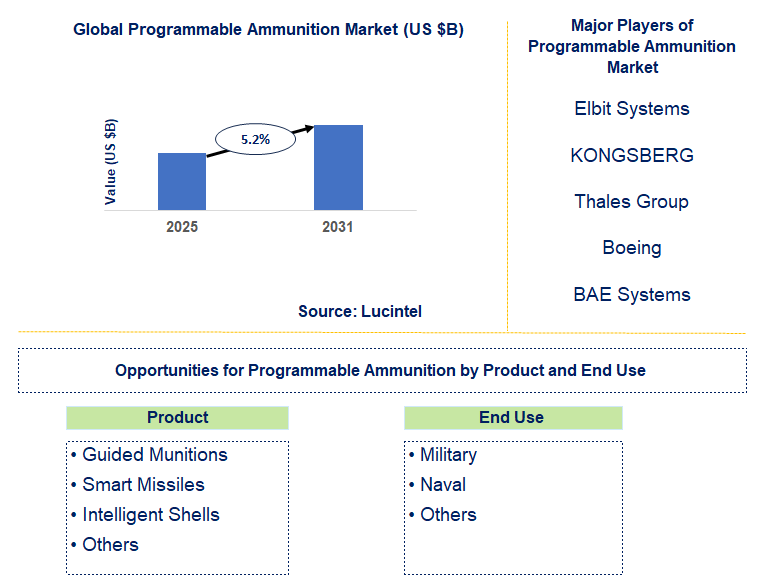
Key data points: The growth forecast = 5.2% annually for the next 7 years. Scroll below to get more insights. This market report covers trends, opportunities and forecasts in programmable ammunition market to 2031 by product (guided munitions, smart missiles, intelligent shells, and others), end use (military, naval, and others), and region (North America, Europe, Asia Pacific, and the Rest of the World)
We'll send your sample report shortly.
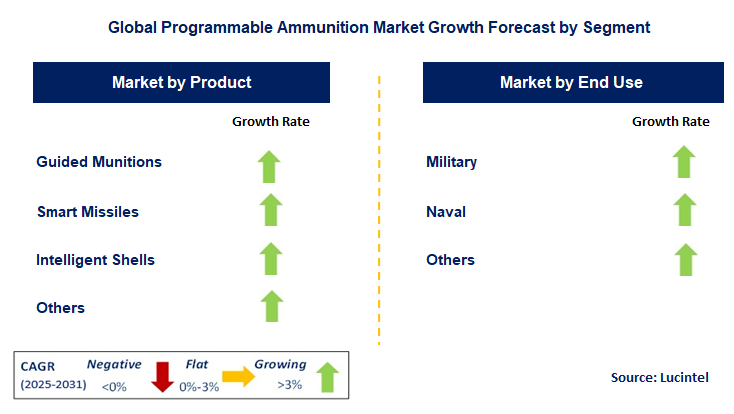
• Lucintel forecasts that, within the product category, smart missile is expected to witness the highest growth over the forecast period.
• Within the end use category, naval is expected to witness higher growth.
• In terms of region, APAC is expected to witness the highest growth over the forecast period. Gain valuable insights for your business decisions with our comprehensive 150+ page report. Sample figures with some insights are shown below.
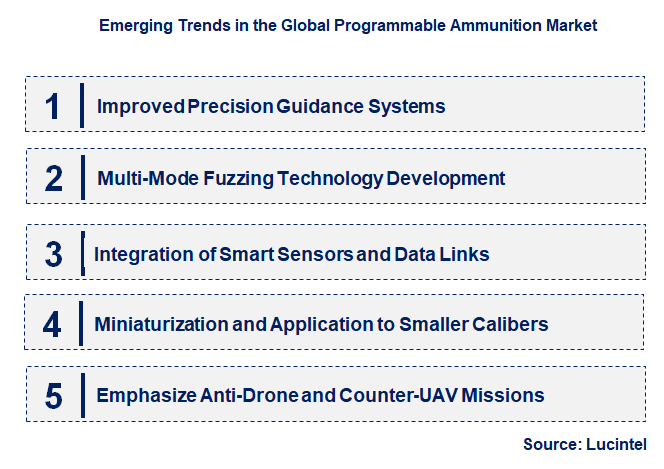
• Improved Precision Guidance Systems: One of the largest trends is the ongoing refinement of precision guidance systems built into programmable ammunition. These involve GPS, inertial measurement units (IMUs), and laser guidance for higher accuracy and lower chances of missing targets or destroying collateral damage. Sophisticated algorithms and real-time data processing are facilitating more accurate in-flight adjustments, making such munitions extremely effective against moving targets and in challenging terrain.
• Multi-Mode Fuzzing Technology Development: Programmable rounds are increasingly adopting multi-mode fuzzing technology that can detonate on impact, delayed, or at a given height above the target (air-burst). This offers flexibility to engage a broader array of targets, such as targets behind cover or in bunkered positions. The capacity to remotely or in-system program the fuse setting prior to firing substantially improves tactical adaptability and efficiency.
• Integration of Smart Sensors and Data Links: New programmable ammunition may feature advanced onboard sensors, like infrared, acoustic, or electromagnetic sensors, to enhance target acquisition and discrimination. In addition, integration with data links enables communication with the firing platform or other networked assets, allowing for real-time feedback and enabling in-flight updates or adjustments in response to changing battlefield conditions.
• Miniaturization and Application to Smaller Calibers: While initial programmable ammunition emphasized larger artillery and mortar rounds, miniaturizing such technologies for application in smaller caliber direct-fire weapons, like grenade launchers and even rifle rounds, is becoming increasingly desirable. This would give infantry units improved precision and the capability to strike targets behind cover, greatly enhancing their tactical capabilities at the individual soldier level.
• Emphasize Anti-Drone and Counter-UAV Missions: The use of unmanned aerial vehicles (UAVs) or drones has made it imperative to have good counter-measures. Programmable ammunition with air-burst and possibly sensor-fitted capabilities to locate and attack drones is becoming a new trend. The possibility of accurately detonating projectiles close to a drone provides a better and possibly less expensive solution than standard air defense weapons in some situations. These trends are transforming the programmable ammunition market by compelling the creation of more accurate, adaptable, and networked rounds that can counter a broader set of threats and operational needs, ultimately increasing the lethality and accuracy of contemporary military forces.
• Electronic Fuzzing Advances for Artillery: Electronic fuses for artillery rounds have undergone notable improvement towards more advanced systems. These fuses enable accurate time-delay detonation and air-burst functionality, which can be programmed shortly before firing. Recent innovation centers on enhanced reliability under different environmental factors and the capacity to communicate with digital fire control systems to transfer data easily and program the fuses.
• Guided Mortar Rounds: Guided mortar rounds with onboard GPS or inertial guidance systems are becoming more common. These rounds provide much greater accuracy than conventional unguided mortar fire, enabling precise targeting of the target with less risk of collateral damage. Advances include increased range and the capacity to correct the trajectory in flight to account for wind or other conditions.
• Introduction of Programmable Air-Burst Munitions for Infantry: Programmable air-burst grenades and rifle ammunition are being fielded and developed in order to give the infantry greater capacity to attack targets at and behind cover. Programmable air-burst grenades and rounds can be programmed to detonate at a particular distance or over a target, giving a fragmentation effect over areas that might be hard to access otherwise. Recent developments concentrate on making these devices lighter and easier to use for dismounted troops.
• Integration of Advanced Sensor Payloads: Certain programmable ammunition is increasingly being developed with sensor payloads integrated into them, including small cameras or acoustic sensors. These sensors can offer near-real-time data regarding the target zone ahead of or at detonation, improving situational awareness and enabling more accurate targeting in future engagements. Advances in miniaturization are central to this trend.
• Advances in Anti-Drone Ammunition: The increasing menace of small drones has triggered the advancement of programmable ammunition tailored for counter-UAV use. These involve projectiles with specialized fuses that can explode close to a drone, and rounds featuring onboard guidance systems designed for engaging air targets. Research is also aimed at non-kinetic techniques that can be delivered via programmable projectiles. These innovations are playing a major role in the market for programmable ammunition by offering more accurate, flexible, and powerful solutions for an ever broadening array of battlefield situations, ultimately increasing the capabilities of contemporary militaries while working to mitigate collateral damage.
• Urban Combat and Close-Quarters Battle: Programmable ammunition, such as air-burst and guided rounds for grenade launchers and small arms, provides a critical advantage in urban combat by enabling engagement of targets behind cover and reducing collateral damage to nearby buildings and non-combatants. This generates increasing demand for such ammunition in military and law enforcement forces that patrol densely populated environments.
• Counter-Unmanned Aerial Vehicle (C-UAV) Operations: The proliferation of drones as threats requires proper countermeasures. Programmable ammunition with air-burst effect or dedicated guidance systems to intercept and destroy UAVs is a major growth area for both military and security forces. Cost-effective and deployable C-UAV ammunition development is essential.
• Targeting of Soft and Lightly Armored Targets with Precision: Programmable fuzzing and guidance provide precision targeting of soft targets, soldiers, and lightly armored vehicles with optimized effects to minimize the requirements for larger, less discriminate ordnance. This is highly applicable in situations of asymmetric warfare and for special operations forces necessitating customized firepower.
• Improved Indirect Fire Support: For mortars and artillery, programmable ammunition provides greater accuracy and the capability to produce effects such as air-burst over troops in trenches or behind cover. This improves the effectiveness of indirect fire support, giving ground forces more tactical flexibility and less dependence on close air support in some cases.
• Special Operations Law Enforcement: For high-stress and highly-controlled scenarios, including clearing doors and dealing with threats pinned down behind them without delivering lethal collateral damage, programmable ammo for law enforcement use presents an asset capability. Development of non-lethal programming opportunities as a growth field likewise is possible with crowd management and de-escalation. These growth prospects are affecting the programmable ammunition market by stimulating innovation to particular operational requirements, resulting in the creation of custom solutions that maximize the efficacy and accuracy of military and law enforcement operations across a variety of challenging environments.
• Elbit Systems
• KONGSBERG
• Thales Group
• Boeing
• BAE Systems
• Textron
• Aerojet Rocketdyne
• Raytheon Technologies
• Northrop Grumman
• Leonardo
• Guided Munitions
• Smart Missiles
• Intelligent Shells
• Others
• Military
• Naval
• Others
• North America
• Europe
• Asia Pacific
• The Rest of the World
• United States: The United States is the leader in the development of programmable ammunition with large investments going into programs such as the Army's XM1156 Precision Guidance Kit (PGK) for artillery and air-burst rounds for infantry. Current advancements are aimed at enhancing the accuracy and dependability of such systems as well as their integration with sophisticated fire control systems. There is also a focus on creating programmable ammunition for major caliber weapons as well as on investigating technologies for increased range and target engagement in various operational environments.
• China: China is quickly expanding its programmable ammunition capabilities in line with its overall military modernization. Recent reports include the fielding of digitally controlled artillery rounds and guided mortar rounds. There is also probably continued research and development in air-burst rounds and precision-guided rounds for multiple weapons systems. Specific information is frequently not made public, but the trend suggests a high priority for improving the precision strike capabilities of the People's Liberation Army.
• Germany: Germany's programmable ammunition development is motivated by an emphasis on high-accuracy and reducing collateral damage, as part of its defense strategies. Recent developments have seen the production and deployment of programmable fuses for artillery and mortar shells, enabling air-burst functionality. Integration with advanced targeting and fire control systems employed by the German military and for export purposes is also a focus. Cooperation with other European countries in ammunition technology is also important.
• India: India is slowly stepping up its efforts to modernize its ammunition capabilities, such as the indigenous development and procurement of programmable munitions. Recent initiatives include indigenous development projects for precision-guided artillery shells and looking into collaborations with foreign partners for technology transfer. The focus is on improving the accuracy and killing power of its current artillery and mortar systems, as well as arming its infantry with more efficient ammunition types for asymmetric warfare environments.
• Japan: Japan's strategy for programmable ammunition development focuses on technological advancement and defensive powers. Some of the recent trends are likely to involve researching next-generation fuse technologies for artillery and mortar rounds, as well as investigating precision guidance for some types of projectiles. With Japan's focus on technological advancement, there is probably work in progress to incorporate sophisticated sensors and control systems into its ammunition, though specifics tend to be well-protected.


• Elbit Systems
• KONGSBERG
• Thales Group
• Boeing
• BAE Systems
• Textron
• Aerojet Rocketdyne
• Raytheon Technologies
• Northrop Grumman
• Leonardo Q5. Which programmable ammunition market segment will be the largest in future? Answer: Lucintel forecasts that, within the product category, smart missile is expected to witness the highest growth over the forecast period. Q6. In programmable ammunition market, which region is expected to be the largest in next 5 years? Answer: In terms of region, APAC is expected to witness the highest growth over the forecast period. Q7. Do we receive customization in this report? Answer: Yes, Lucintel provides 10% customization without any additional cost.


Choose a license that fits your team. Instant PDF delivery.
Prices exclude taxes. Instant delivery. Custom licensing available on request.
Market Report · July 31, 2026
Market Report · July 31, 2026
Market Report · July 31, 2026
Trusted partner for strategic intelligence and business growth


Receive a complimentary market analysis tailored to your industry. Our analysts will identify key growth opportunities and competitive dynamics specific to your business.

Market size, growth rate, and key trend analysis for your specific sector.

Top competitor positioning and market share analysis.

Strategic recommendations backed by data-driven insights.
Get curated market intelligence and competitive moves straight to your inbox.
By subscribing, you agree to receive our monthly insights. Unsubscribe anytime.
Receive a complimentary market analysis tailored to your industry. Our analysts will identify key growth opportunities and competitive dynamics specific to your business.
Market size, growth rate, and key trend analysis for your specific sector.
Top competitor positioning and market share analysis.
Strategic recommendations backed by data-driven insights.
Get curated market intelligence, emerging trends, and competitive moves straight to your inbox each month.
By subscribing, you agree to receive our monthly insights. Unsubscribe anytime.
We'll send your sample report shortly.