
Report Feature
Programmable AI Accelerator Market Trends and Forecast
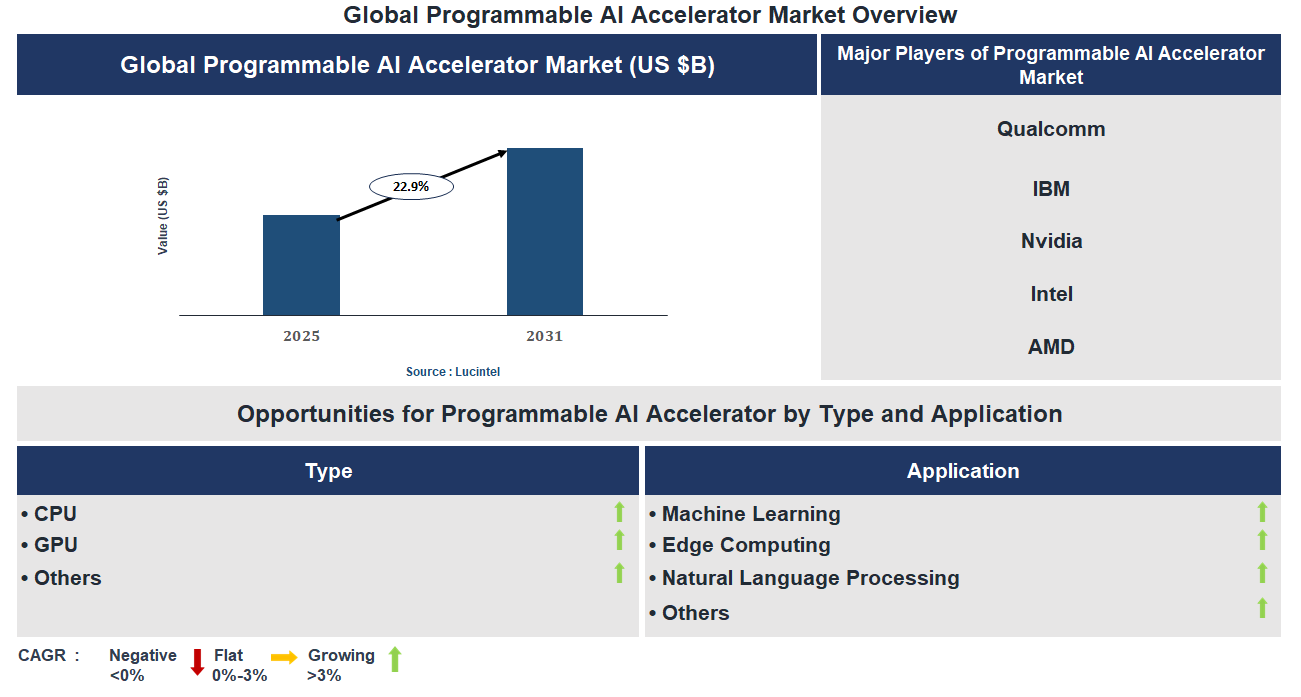
The future of the global programmable AI accelerator market looks promising with opportunities in the machine learning, edge computing, and natural language processing markets. The global programmable AI accelerator market is expected to grow with a CAGR of 22.9% from 2025 to 2031. The major drivers for this market are the increasing demand for AI applications, the rising need for faster processing speeds, and the growing adoption of cloud-based solutions.• Lucintel forecasts that, within the type category, GPU is expected to witness higher growth over the forecast period.
• Within the application category, edge computing is expected to witness the highest growth.
• In terms of region, APAC is expected to witness the highest growth over the forecast period. Gain valuable insights for your business decisions with our comprehensive 150+ page report. Sample figures with some insights are shown below.
Emerging Trends in the Programmable AI Accelerator Market
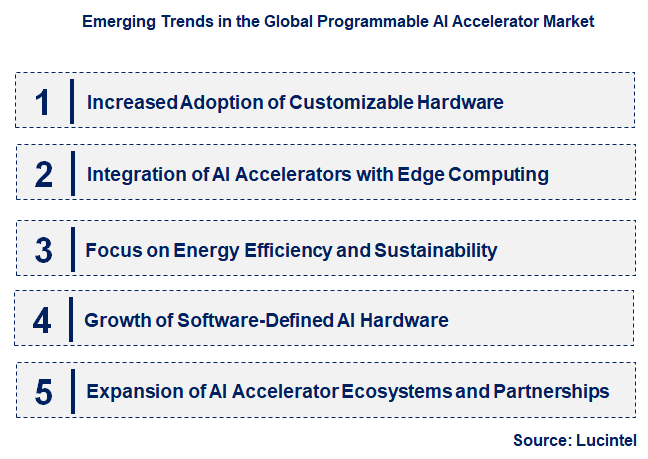
The programmable AI accelerator market is experiencing rapid growth driven by advancements in artificial intelligence, increasing demand for high-performance computing, and the need for customizable hardware solutions. As AI applications become more complex and widespread across industries such as healthcare, automotive, and finance, the market is evolving to meet these demands with innovative hardware accelerators. Emerging trends are shaping the future landscape, emphasizing flexibility, efficiency, and integration. These developments are not only enhancing AI capabilities but also transforming how businesses deploy and scale AI solutions, leading to more personalized, faster, and cost-effective applications.• Increased Adoption of Customizable Hardware: This trend reflects a shift towards programmable AI accelerators that can be tailored to specific workloads. Companies seek flexible solutions that adapt to evolving AI models, enabling optimized performance and energy efficiency. Customizable hardware reduces time-to-market and allows for rapid updates, making AI deployment more agile. As AI models grow more complex, the ability to modify hardware configurations on the fly becomes crucial, driving innovation in hardware design and increasing market competitiveness.
• Integration of AI Accelerators with Edge Computing: The proliferation of IoT devices and the need for real-time data processing are fueling the integration of AI accelerators at the edge. This trend enables faster decision-making, reduces latency, and minimizes data transmission costs. Edge AI accelerators are designed to operate in resource-constrained environments while maintaining high performance. This shift is expanding AI applications into new domains such as autonomous vehicles, smart cities, and industrial automation, significantly impacting the market by broadening its scope and accessibility.
• Focus on Energy Efficiency and Sustainability: As AI workloads become more demanding, energy consumption is a critical concern. The market is witnessing a push towards designing energy-efficient accelerators that deliver high performance without excessive power use. Innovations include low-power architectures, improved cooling techniques, and the use of sustainable materials. This trend aligns with global sustainability goals and helps reduce operational costs for enterprises. Energy-efficient AI accelerators are becoming a key differentiator, influencing purchasing decisions and encouraging industry-wide adoption of greener technologies.
• Growth of Software-Defined AI Hardware: The emergence of software-defined hardware allows users to reprogram and optimize accelerators through software updates, enhancing flexibility and longevity. This approach simplifies integration with existing systems and accelerates deployment cycles. It also enables rapid adaptation to new AI models and algorithms without hardware changes. The trend is fostering a more dynamic market where hardware can evolve alongside software innovations, reducing the total cost of ownership and expanding the potential user base across various industries.
• Expansion of AI Accelerator Ecosystems and Partnerships: Collaboration between hardware manufacturers, software developers, and cloud providers is creating comprehensive AI ecosystems. These partnerships facilitate seamless integration, better support, and shared innovation. Ecosystem expansion accelerates market adoption by providing end-to-end solutions, reducing complexity, and offering scalable options. This trend is also encouraging open standards and interoperability, which are vital for widespread deployment. As ecosystems grow, they are driving competitive differentiation and enabling more sophisticated AI applications across diverse sectors. In summary, these emerging trends are fundamentally reshaping the programmable AI accelerator market by enhancing flexibility, efficiency, and integration. They are enabling faster deployment, broader application, and more sustainable solutions, ultimately driving innovation and growth across multiple industries. The market is becoming more dynamic, with a focus on customization, edge deployment, energy efficiency, software adaptability, and collaborative ecosystems, positioning it for continued expansion and technological advancement.
Recent Development in the Programmable AI Accelerator Market
The programmable AI accelerator market is experiencing rapid growth driven by advancements in artificial intelligence and increasing demand for high-performance computing solutions. As industries adopt AI technologies, the need for specialized hardware accelerators has surged, creating new opportunities for innovation and market expansion. Key developments include technological innovations, strategic partnerships, and expanding applications across sectors, which are shaping the future landscape of AI hardware. These developments are fostering competitive advantages and enabling more efficient AI deployment worldwide.• Technological Innovations in Accelerator Design: Enhanced architectures and chip designs are improving processing speeds and energy efficiency, enabling faster AI model training and inference. These innovations reduce costs and power consumption, making AI accelerators more accessible for diverse applications. As a result, companies can deploy more complex models in real-time environments, boosting productivity and innovation across sectors such as healthcare, automotive, and finance. This evolution is setting new standards for AI hardware performance.
• Strategic Partnerships and Collaborations: Major tech firms and startups are forming alliances to co-develop advanced AI accelerators, sharing expertise and resources. These collaborations accelerate product development cycles and expand market reach, fostering innovation ecosystems. Such partnerships also facilitate standardization and interoperability, which are crucial for widespread adoption. The synergy between industry leaders is driving rapid technological progress and opening new revenue streams, strengthening the overall market position.
• Expansion into New Industry Verticals: AI accelerators are increasingly being adopted in sectors like healthcare, automotive, and manufacturing, where real-time data processing is critical. This diversification broadens market scope and creates tailored solutions for specific industry needs. The integration of AI accelerators enhances automation, predictive analytics, and decision-making processes, leading to improved operational efficiency and competitive advantage. As industries recognize the benefits, demand for specialized accelerators is expected to grow significantly.
• Advances in Software and Ecosystem Development: The growth of supportive software frameworks and development tools is simplifying AI accelerator integration and programming. These advancements lower barriers for developers and enable faster deployment of AI models. Robust ecosystems foster innovation and facilitate customization, which accelerates market adoption. Enhanced software support also ensures better hardware utilization, maximizing performance and return on investment for users across various applications.
• Growing Investment and Funding in AI Hardware Startups: Increased venture capital and corporate investments are fueling innovation in AI accelerator technologies. Funding supports research, development, and commercialization of cutting-edge solutions, leading to a more competitive market landscape. This influx of capital encourages startups to push technological boundaries and develop niche products, expanding the market’s diversity. The investment trend indicates strong confidence in the market’s growth potential and will likely accelerate the pace of technological breakthroughs. The overall impact of these developments is a dynamic, competitive market characterized by rapid innovation, broader application scope, and increased accessibility. These advancements are driving faster AI deployment, reducing costs, and enabling smarter solutions across industries. As a result, the programmable AI accelerator market is poised for sustained growth, transforming how organizations leverage AI for strategic advantage and operational excellence.
Strategic Growth Opportunities in the Programmable AI Accelerator Market
The programmable AI accelerator market is experiencing rapid expansion driven by increasing demand for high-performance computing solutions across various industries. Advancements in AI workloads, edge computing, and cloud integration are fueling innovation and adoption. Market players are focusing on developing flexible, scalable, and energy-efficient accelerators to meet diverse application needs. Strategic investments and collaborations are further accelerating growth, creating significant opportunities for market expansion and technological breakthroughs in the coming years.• Expansion into Edge Computing for Real-Time AI Processing: The growth of IoT devices and the need for real-time data analysis are driving programmable AI accelerators toward edge computing. These accelerators enable faster processing at the data source, reducing latency and bandwidth costs. As industries like healthcare, manufacturing, and autonomous vehicles demand on-site AI capabilities, the market is poised for significant growth in edge deployment, fostering innovation in low-power, compact, and adaptable accelerator solutions.
• Increasing Adoption in Data Centers for Enhanced AI Performance: Data centers are increasingly integrating programmable AI accelerators to handle complex AI workloads efficiently. These accelerators offer customizable architectures that optimize performance for specific applications such as deep learning, natural language processing, and computer vision. The demand for scalable, energy-efficient solutions is prompting data center operators to adopt these accelerators, leading to improved throughput, reduced operational costs, and enabling large-scale AI deployment across industries.
• Development of Customizable and Flexible Accelerator Architectures: The market is witnessing a shift toward programmable accelerators that can be tailored to specific AI tasks and workloads. This flexibility allows developers to optimize performance, power consumption, and cost-effectiveness. Companies are investing in FPGA-based and other reconfigurable architectures that support rapid updates and diverse application requirements, fostering innovation and enabling a broader range of AI solutions across sectors such as automotive, healthcare, and finance.
• Integration with Cloud Platforms for Scalable AI Solutions: Cloud service providers are increasingly incorporating programmable AI accelerators into their infrastructure to offer scalable, on-demand AI processing capabilities. This integration allows organizations to access high-performance accelerators without significant capital expenditure, facilitating rapid deployment and experimentation. The cloud-based approach supports diverse workloads, accelerates AI development cycles, and broadens access to advanced AI hardware, fueling market growth and democratizing AI technology.
• Focus on Energy Efficiency and Power Optimization for Sustainable Growth: As AI workloads grow, energy consumption becomes a critical concern. The market is emphasizing the development of energy-efficient programmable accelerators that deliver high performance with lower power usage. Innovations in low-power architectures, dynamic voltage scaling, and thermal management are enabling sustainable AI acceleration solutions. This focus supports environmentally conscious growth, reduces operational costs, and aligns with global efforts toward sustainable technology development. The overall market landscape is shaped by these opportunities, promising accelerated innovation, broader adoption, and enhanced performance of programmable AI accelerators. These growth avenues will drive technological advancements, expand application horizons, and foster competitive differentiation, ultimately transforming the AI hardware ecosystem and enabling smarter, faster, and more sustainable AI solutions worldwide.
Programmable AI Accelerator Market Driver and Challenges
The programmable AI accelerator market is influenced by a complex interplay of technological advancements, economic shifts, and regulatory developments. As AI applications become more sophisticated and widespread, the demand for specialized hardware accelerators that can efficiently process AI workloads is increasing. Simultaneously, rapid innovations in chip design and integration are shaping market dynamics. Economic factors such as rising investments in AI startups and enterprise adoption are fueling growth, while regulatory concerns around data privacy and security pose challenges. Navigating these drivers and challenges is crucial for stakeholders aiming to capitalize on the markets potential and address emerging risks effectively. The factors responsible for driving the programmable AI accelerator market include:-• Technological Innovation: Rapid advancements in chip design and architecture are enabling the development of more powerful, flexible, and energy-efficient AI accelerators. Programmable hardware allows customization for specific AI workloads, improving performance and reducing latency. This innovation attracts industries like healthcare, automotive, and finance, seeking tailored solutions. As AI models grow in complexity, the need for adaptable hardware becomes critical, fostering continuous R&D investments and market expansion.
• Increasing AI Adoption Across Industries: Businesses across sectors are integrating AI to enhance operational efficiency, customer experience, and decision-making. The proliferation of AI-driven applications in autonomous vehicles, robotics, and predictive analytics drives demand for high-performance accelerators. As organizations seek faster processing and real-time insights, programmable AI accelerators become essential for handling diverse and demanding workloads, fueling market growth.
• Rising Investments and Funding: Venture capitalists and corporate investors are channeling significant funds into AI hardware startups and established players. This influx of capital accelerates product development, innovation, and market penetration. Governments and private entities are also investing in AI research initiatives, fostering a conducive environment for market expansion. Increased funding supports the development of next-generation programmable accelerators, ensuring the market remains competitive and innovative.
• Growing Data Volumes and Complexity: The exponential increase in data generated by IoT devices, sensors, and digital platforms necessitates advanced processing capabilities. Programmable AI accelerators are designed to handle large-scale, complex datasets efficiently. Their flexibility allows adaptation to evolving AI models and algorithms, ensuring scalability and longevity. This trend underscores the importance of customizable hardware solutions in managing big data challenges, thereby driving market demand.
• Strategic Collaborations and Partnerships: Major technology firms are forming alliances with hardware manufacturers, software developers, and research institutions to co-develop advanced AI accelerators. These collaborations facilitate knowledge sharing, resource pooling, and faster commercialization of innovative solutions. Such strategic partnerships enhance product offerings, expand market reach, and accelerate adoption across various sectors, reinforcing the markets growth trajectory. The challenges facing this programmable AI accelerator market include:-
• Regulatory and Ethical Concerns: Increasing scrutiny over data privacy, security, and ethical AI use poses significant hurdles. Regulatory frameworks are evolving, often lagging behind technological advancements, creating uncertainty for market players. Compliance costs and potential restrictions can delay product launches and limit deployment, especially in sensitive sectors like healthcare and finance. Navigating these regulatory landscapes requires substantial effort and resources, impacting market agility and growth prospects.
• High Development and Manufacturing Costs: Developing programmable AI accelerators involves substantial R&D investments, advanced manufacturing processes, and specialized materials. These costs can be prohibitive for smaller players, leading to market consolidation. Additionally, supply chain disruptions and geopolitical tensions can escalate manufacturing expenses, affecting pricing strategies and profit margins. The high entry barrier may slow innovation and limit competition, impacting overall market dynamism.
• Rapid Technological Obsolescence: The fast-paced nature of AI hardware development means products can become outdated quickly. Continuous innovation demands frequent upgrades and new product launches, increasing R&D costs and operational complexity. Companies must balance investment in current technologies with future-proofing, which can strain resources. This rapid obsolescence risk discourages long-term planning and can lead to market fragmentation if standards are not unified. In summary, the programmable AI accelerator market is shaped by significant technological progress, increasing industry adoption, and substantial investments, all driving growth. However, regulatory challenges, high development costs, and rapid technological changes pose considerable risks. These drivers and challenges collectively influence market dynamics, requiring stakeholders to innovate strategically while navigating complex regulatory and economic landscapes. Success in this market hinges on balancing innovation with compliance, cost management, and adaptability to evolving AI needs, ultimately determining the pace and sustainability of market expansion.
List of Programmable AI Accelerator Companies
Companies in the market compete on the basis of product quality offered. Major players in this market focus on expanding their manufacturing facilities, R&D investments, infrastructural development, and leverage integration opportunities across the value chain. With these strategies programmable AI accelerator companies cater increasing demand, ensure competitive effectiveness, develop innovative products & technologies, reduce production costs, and expand their customer base. Some of the programmable AI accelerator companies profiled in this report include-• Qualcomm
• IBM
• Nvidia
• Intel
• AMD
Programmable AI Accelerator Market by Segment
The study includes a forecast for the global programmable AI accelerator market by type, application, and region.Programmable AI Accelerator Market by Type [Value from 2019 to 2031]:
• CPU
• GPU
• Others
Programmable AI Accelerator Market by Application [Value from 2019 to 2031]:
• Machine Learning
• Edge Computing
• Natural Language Processing
• Others
Programmable AI Accelerator Market by Region [Value from 2019 to 2031]:
• North America
• Europe
• Asia Pacific
• The Rest of the World
Country Wise Outlook for the Programmable AI Accelerator Market
The programmable AI accelerator market is experiencing rapid growth driven by increasing demand for high-performance computing in artificial intelligence applications. As industries adopt more sophisticated AI models, the need for specialized hardware accelerators has surged globally. Countries are investing heavily in research, development, and deployment of these accelerators to maintain technological leadership and support emerging AI-driven sectors. The markets evolution reflects advancements in chip design, energy efficiency, and integration capabilities, shaping the future of AI infrastructure worldwide. This dynamic landscape varies across regions, influenced by technological innovation, government policies, and industry adoption rates.• United States: The US leads in programmable AI accelerators, with major tech giants like NVIDIA, AMD, and Intel pioneering new architectures. Recent developments include the launch of next-generation GPUs optimized for AI workloads and the expansion of AI-specific hardware in data centers. Government initiatives such as the CHIPS Act aim to boost domestic semiconductor manufacturing, fostering innovation. Startups and research institutions are also contributing to advancements in custom AI chips, emphasizing energy efficiency and scalability. The US market remains highly competitive, with a focus on integrating accelerators into cloud services and enterprise solutions.
• China: China has made significant strides in developing indigenous AI accelerators to reduce reliance on foreign technology. Companies like Huawei and Alibaba are investing heavily in custom chip design, with recent launches of AI chips tailored for cloud computing and edge devices. Government policies support domestic innovation through funding and strategic initiatives like the "Made in China 2025" plan. The focus is on creating cost-effective, energy-efficient accelerators to serve both consumer and industrial AI applications. Collaborations between academia and industry are fostering rapid technological progress, positioning China as a key player in the global AI hardware landscape.
• Germany: Germany emphasizes industrial applications of programmable AI accelerators, particularly in manufacturing and automotive sectors. Recent developments include the deployment of AI chips in autonomous vehicles and smart factories. Research institutions like Fraunhofer are advancing chip design for energy efficiency and real-time processing. The German government supports AI hardware innovation through funding programs and partnerships with industry leaders. Companies are also exploring the integration of AI accelerators with existing industrial automation systems to enhance productivity and safety. The focus remains on creating robust, reliable solutions tailored to Europes stringent standards.
• India: India is rapidly expanding its AI hardware ecosystem, with startups and research labs developing custom accelerators for local needs. Recent advancements include the launch of AI chips optimized for mobile devices and edge computing, driven by the growing demand for affordable AI solutions. Government initiatives like the Digital India campaign promote indigenous chip development to foster self-reliance. Collaborations between academia and industry are accelerating innovation, with a focus on energy-efficient, low-cost accelerators suitable for diverse applications, from healthcare to agriculture. The market is poised for significant growth as AI adoption accelerates across sectors.
• Japan: Japan continues to innovate in AI hardware, emphasizing robotics and industrial automation. Recent developments include the creation of specialized accelerators for robotics applications, enhancing real-time processing and energy efficiency. Companies like Sony and Toshiba are investing in AI chip research to improve performance in consumer electronics and manufacturing. The Japanese government supports AI hardware research through funding and strategic initiatives aimed at maintaining technological leadership. Collaborations with global firms are fostering the development of advanced, reliable accelerators. The focus remains on integrating AI hardware into existing industrial ecosystems to boost productivity and innovation.

Features of the Global Programmable AI Accelerator Market
Market Size Estimates: Programmable ai accelerator market size estimation in terms of value ($B). Trend and Forecast Analysis: Market trends (2019 to 2024) and forecast (2025 to 2031) by various segments and regions. Segmentation Analysis: Programmable ai accelerator market size by type, application, and region in terms of value ($B). Regional Analysis: Programmable ai accelerator market breakdown by North America, Europe, Asia Pacific, and Rest of the World. Growth Opportunities: Analysis of growth opportunities in different types, applications, and regions for the programmable AI accelerator market. Strategic Analysis: This includes M&A, new product development, and competitive landscape of the programmable AI accelerator market. Analysis of competitive intensity of the industry based on Porter’s Five Forces model.
FAQ
Q1. What is the growth forecast for programmable AI accelerator market? Answer: The global programmable AI accelerator market is expected to grow with a CAGR of 22.9% from 2025 to 2031. Q2. What are the major drivers influencing the growth of the programmable AI accelerator market? Answer: The major drivers for this market are the increasing demand for AI applications, the rising need for faster processing speeds, and the growing adoption of cloud-based solutions. Q3. What are the major segments for programmable AI accelerator market? Answer: The future of the programmable AI accelerator market looks promising with opportunities in the machine learning, edge computing, and natural language processing markets. Q4. Who are the key programmable AI accelerator market companies? Answer: Some of the key programmable AI accelerator companies are as follows:• Qualcomm
• IBM
• Nvidia
• Intel
• AMD Q5. Which programmable AI accelerator market segment will be the largest in future? Answer: Lucintel forecasts that, within the type category, GPU is expected to witness higher growth over the forecast period. Q6. In programmable AI accelerator market, which region is expected to be the largest in next 5 years? Answer: In terms of region, APAC is expected to witness the highest growth over the forecast period. Q7. Do we receive customization in this report? Answer: Yes, Lucintel provides 10% customization without any additional cost.
Table of Contents
List of Figures
List of Tables
Methodology
- In-depth interviews of the major players in this market
- Detailed secondary research from competitors’ financial statements and published data
- Extensive searches of published works, market, and database information pertaining to industry news, company press releases, and customer intentions
- A compilation of the experiences, judgments, and insights of Lucintel’s professionals, who have analyzed and tracked this market over the years.


Buy Now
Choose a license that fits your team. Instant PDF delivery.
Prices exclude taxes. Instant delivery. Custom licensing available on request.
Key Questions
- • What are some of the most promising, high-growth opportunities for the programmable AI accelerator market by type (CPU, GPU, and others), application (machine learning, edge computing, natural language processing, and others), and region (North America, Europe, Asia Pacific, and the Rest of the World)?
- • Which segments will grow at a faster pace and why?
- • Which region will grow at a faster pace and why?
- • What are the key factors affecting market dynamics? What are the key challenges and business risks in this market?
- • What are the business risks and competitive threats in this market?
- • What are the emerging trends in this market and the reasons behind them?
- • What are some of the changing demands of customers in the market?
- • What are the new developments in the market? Which companies are leading these developments?
- • Who are the major players in this market? What strategic initiatives are key players pursuing for business growth?
- • What are some of the competing products in this market and how big of a threat do they pose for loss of market share by material or product substitution?
- • What M&A activity has occurred in the last 6 years and what has its impact been on the industry? For any questions related to Programmable AI Accelerator Market, Programmable AI Accelerator Market Size, Programmable AI Accelerator Market Growth, Programmable AI Accelerator Market Analysis, Programmable AI Accelerator Market Report, Programmable AI Accelerator Market Share, Programmable AI Accelerator Market Trends, Programmable AI Accelerator Market Forecast, Programmable AI Accelerator Companies, write Lucintel analyst at email: helpdesk@lucintel.com. We will be glad to get back to you soon.


